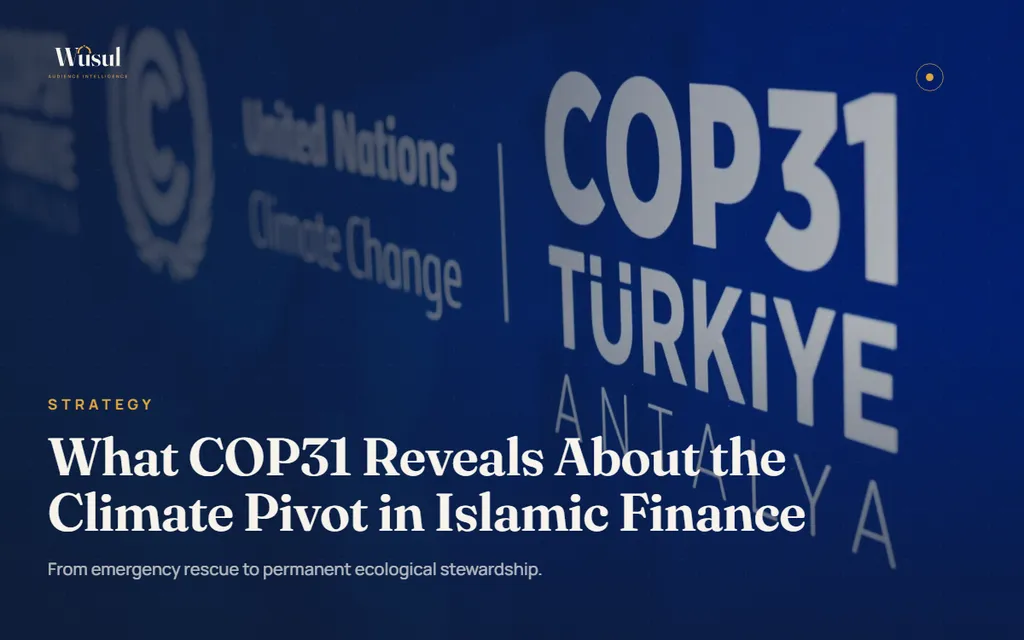
On November 12, on the sidelines of COP31 in Antalya, the Islamic Development Bank formally joined the Türkiye Industrial Decarbonization Investment Platform as a strategic partner. Alongside the World Bank, the European Investment Bank, and the EBRD, the IsDB signed onto a coalition aiming to mobilize over €5 billion ($5.5 billion) by 2030 to decarbonize heavy industries; an effort projected to cut more than 20 million tons of carbon dioxide equivalent annually. On the same day, the bank committed an additional $250 million to finance sustainable organized industrial zones and joined a coalition of multilateral development banks pledging to accelerate climate-smart implementation.
On paper, this looks like standard multilateral diplomacy. In the broader arc of Muslim economic life, however, it underscores a widening structural divide.
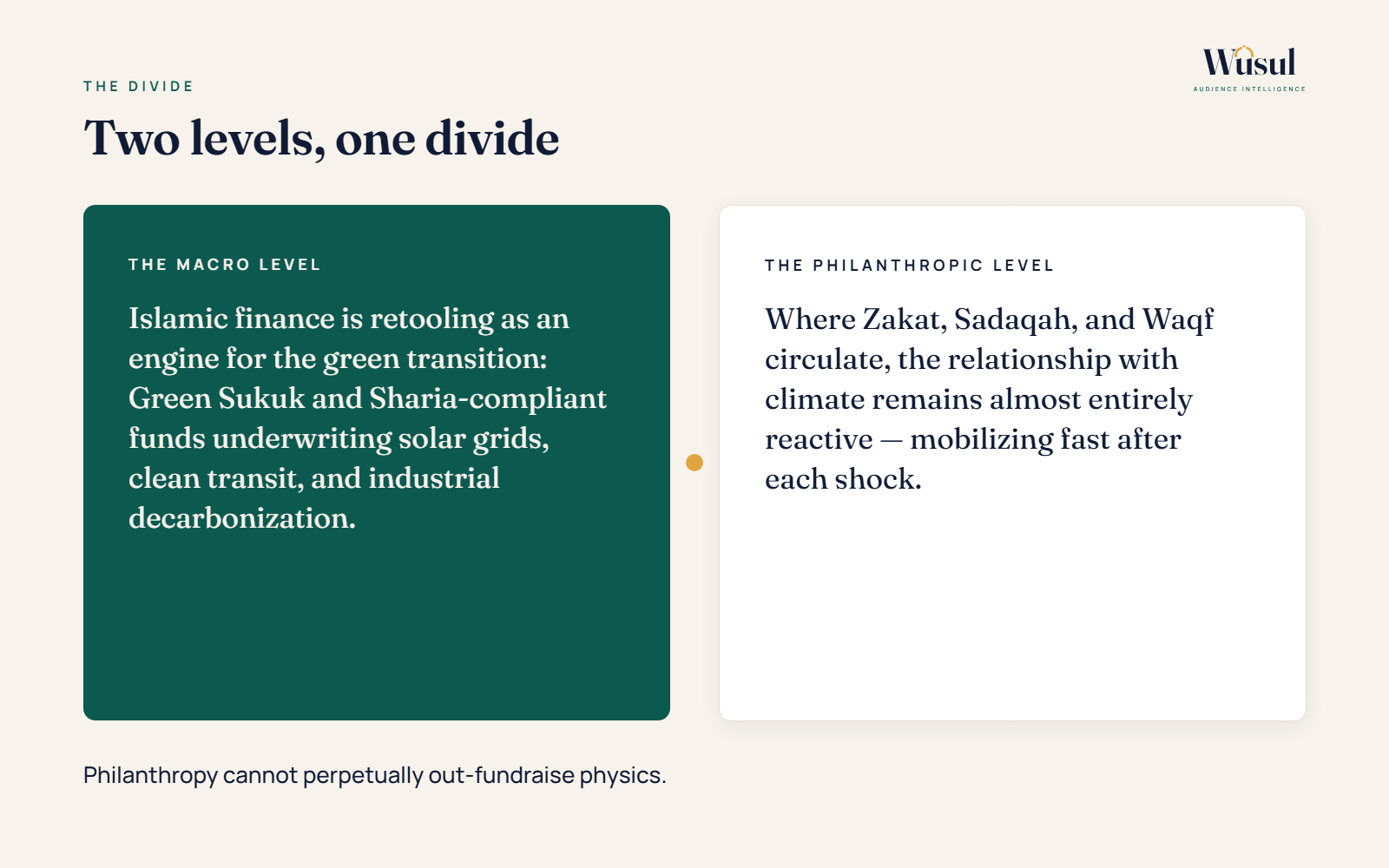
At the macroeconomic level, Islamic finance is rapidly retooling itself as an engine for the green transition. Green Sukuk and Sharia-compliant infrastructure funds are increasingly underwriting solar grids, clean transit, and industrial decarbonization across emerging markets. Yet down at the level of Islamic philanthropy; where hundreds of billions of dollars in Zakat, Sadaqah, and Waqf circulate annually; the relationship with climate change remains almost entirely reactive.
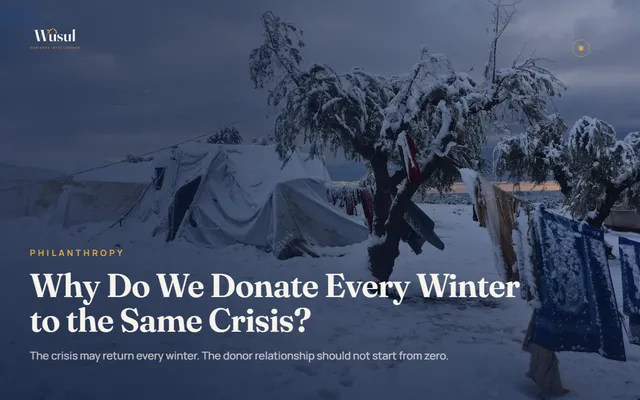
When catastrophic floods submerge Sindh in Pakistan, when prolonged drought triggers famine in the Horn of Africa, or when winter storms tear through displacement camps in Gaza and Syria, Muslim charities mobilize with remarkable speed and generosity. Millions are raised within days for emergency food parcels, temporary shelters, and clean water tankers.
That responsiveness is one of the great strengths of faith-based humanitarianism. It is also its strategic limitation.
As climate disasters shift from once-in-a-generation anomalies to annual certainties across much of the Muslim world, treating climate change solely as a recurring humanitarian emergency is a losing proposition. Philanthropy cannot perpetually out-fundraise physics. The central challenge facing modern Muslim giving is no longer just how to deliver relief after a climate shock, but how to finance adaptation and resilience before the waters rise.
The case for perpetual ecological capital
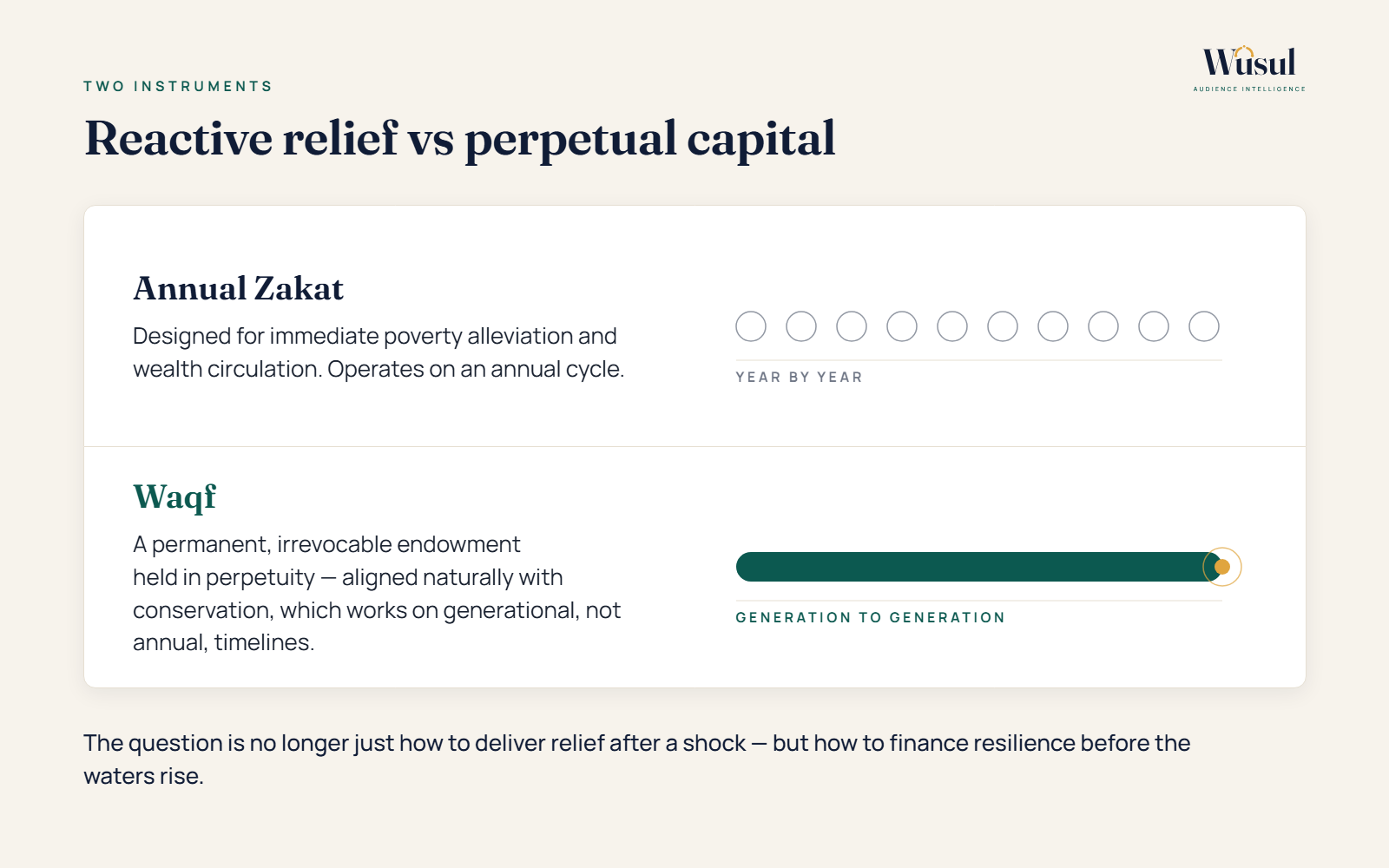
In Islamic tradition, the institutional mechanism best suited for long-term climate adaptation is not annual Zakat (which is primarily designed for immediate poverty alleviation and wealth circulation) but Waqf: the permanent endowment of an asset for public benefit.
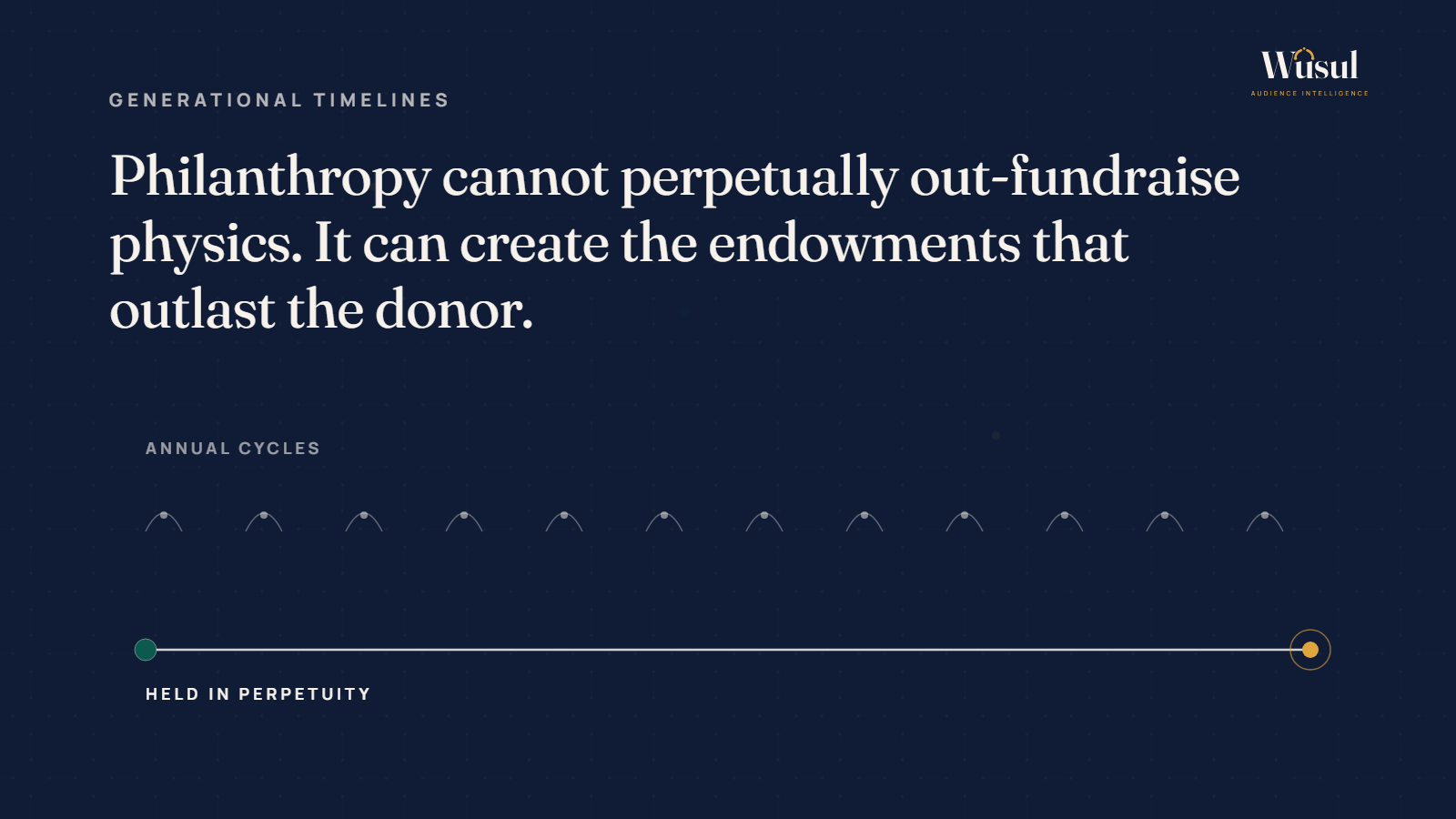
Historically, Waqf financed the civic backbone of Muslim societies: hospitals, universities, public water fountains, and even sanctuaries for injured birds. Because a Waqf asset is irrevocable and held in perpetuity, its structure aligns naturally with environmental conservation, which operates on generational timelines rather than annual grant cycles.
Over the past few years, practitioners and researchers have begun translating this classical concept into Green Waqf; endowments specifically structured to fund ecological preservation and climate resilience. The theological grounding is explicit. With over 750 Quranic verses addressing ecology and the natural world, concepts like Khilafah (human stewardship over creation) and the prohibition of Al-Israf (wastefulness) place environmental balance at the centre of ethical responsibility.
In practice: Indonesia's green waqf blueprint
To see how this works outside of academic theory, look to Indonesia, the world's largest laboratory for modern Waqf innovation.
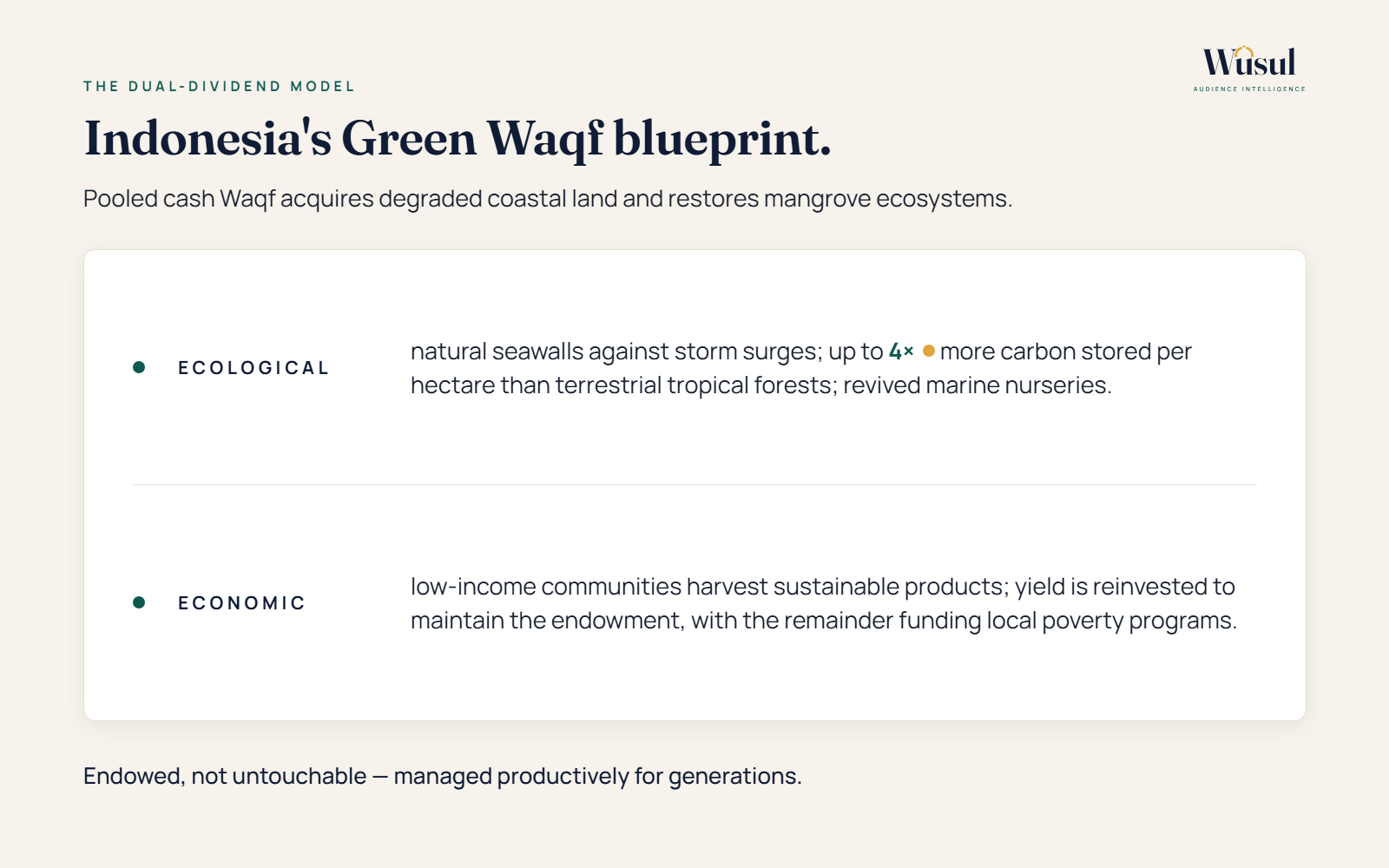
Through the national Green Waqf Movement; a partnership involving the Indonesian Waqf Board (Badan Wakaf Indonesia), the Ministry of Religious Affairs, and civil society organizations like Dompet Dhuafa practitioners have begun pooling cash Waqf donations to acquire degraded coastal land and reforest critical mangrove ecosystems.
The model works through a dual-dividend structure. Restored mangroves act as natural seawalls against storm surges, sequester up to four times more carbon per hectare than terrestrial tropical forests, and revive coastal marine nurseries. Rather than sitting as an untouchable nature reserve, the endowed mangrove zones are managed productively. Local low-income communities harvest sustainable non-timber products, such as mangrove honey, natural batik dyes, and eco-tourism revenues. A portion of the financial yield is reinvested to maintain the endowment, while the remainder funds local poverty alleviation programs.
In parallel, grassroots initiatives backed by coalitions like Ummah for Earth have applied similar endowment logic to community infrastructure, using pooled Sadaqah Jariyah and cash Waqf to install solar microgrids on rural mosques and schools; slashing utility costs and freeing up permanent operating budgets for local social services.
Why scale remains elusive
If the theology is clear and pilots like Indonesia's prove the financial logic, why are Green Waqf initiatives still operating on the margins of global Muslim philanthropy?
Recent empirical scholarship points to an institutional governance gap. In an August 2026 study published in Challenges in Sustainability examining Islamic social finance as a transition institution, researcher Fouad Ahmed Atallah notes that while Zakat and Waqf possess strong institutional compatibility with sustainable development, their environmental impact is currently bottlenecked by fragmented regulatory frameworks, a lack of standardized environmental reporting metrics, and poor coordination between religious authorities and climate policymakers.
A separate evidence synthesis published in late 2026 in the Journal of Islamic Monetary Economics and Finance emphasizes that unlocking community climate resilience requires moving away from siloed charity management toward integrated ZISWAF models, blending Zakat for immediate household stabilization, Sadaqah, and Waqf for long-term productive infrastructure under coherent digital governance.
The donor psychology problem: why we struggle to fund the future
There is also a cultural hurdle on the donor side, and it is arguably the most significant barrier to scaling Green Waqf.
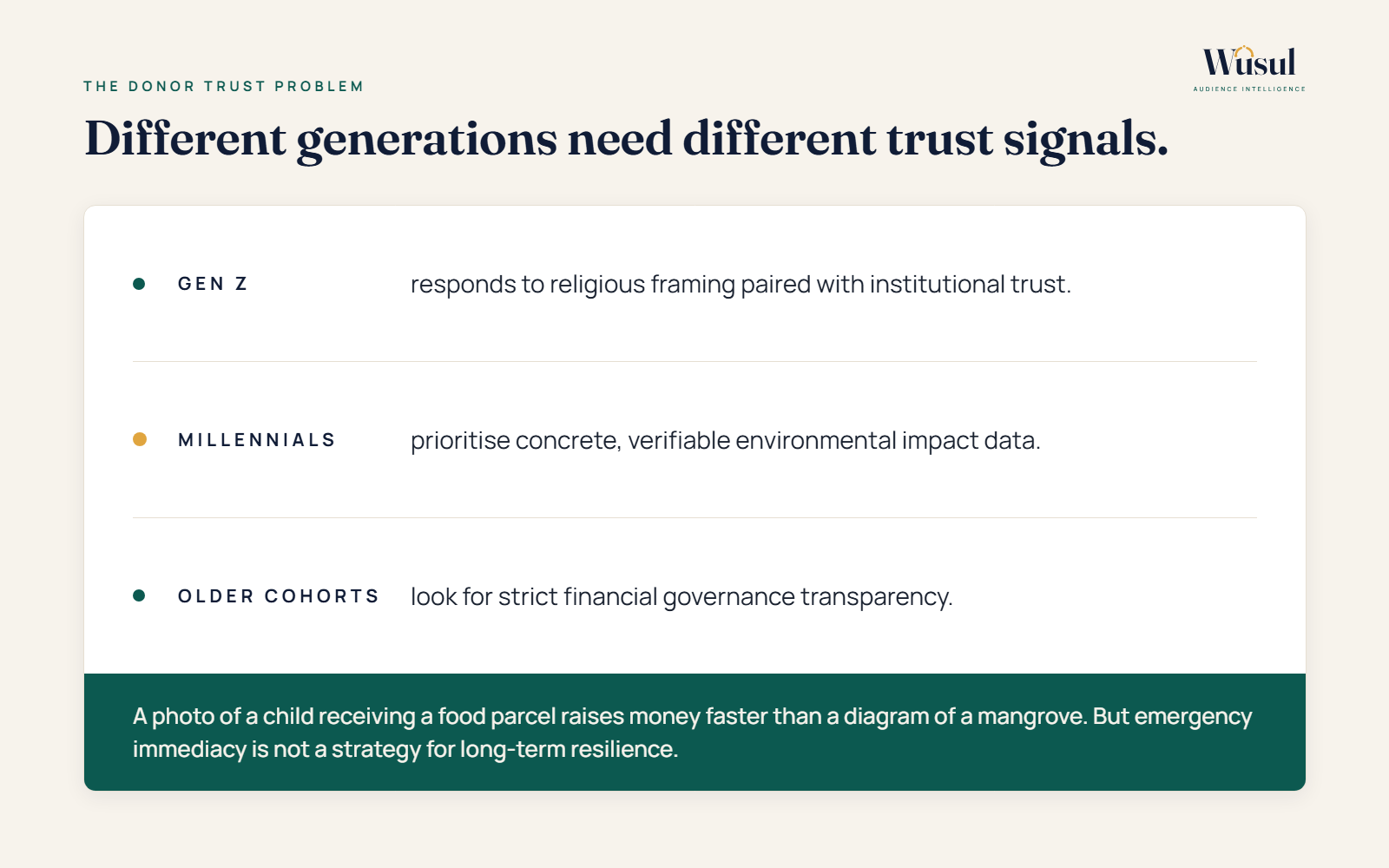
Recent behavioral research on intergenerational giving in Indonesia found that different generations require distinct trust signals to support environmental endowments. Gen Z donors respond strongly to religious framing paired with institutional trust. Millennials prioritise concrete, verifiable environmental impact data. Older cohorts look for strict financial governance transparency.
Most legacy charities still pitch donors with a single emotional register built around immediate human suffering. They struggle to market the slower, less photogenic work of watershed management or solar infrastructure. A photograph of a child receiving a food parcel will always raise more money, more quickly, than a diagram of a mangrove restoration project. The emotional immediacy of emergency relief is a powerful fundraising tool. But it is not a strategy for long-term resilience.
The work of watershed management, solar infrastructure, and mangrove restoration is not photogenic. It does not produce the tear-jerking images of emergency relief. It does not offer the immediate gratification of knowing a family was fed today. It requires donors to trust that their giving will produce results they may never see; and to believe that the institution managing their Waqf will still be there decades from now.
This is a profound psychological shift. It requires a different kind of stewardship, a different kind of reporting, and a different kind of relationship between donor and institution. It requires charities to move from asking "Will you help us feed this family today?" to asking "Will you help us build a future where this family no longer needs our help?"
A story from Sumatra
Consider the case of a coastal village in Aceh that was devastated by the 2004 tsunami. In the years since, a Green Waqf initiative has restored the mangrove forests that once protected the shoreline. The mangroves are not just a carbon sink. They are a nursery for fish, a buffer against storm surges, and a source of livelihood for women who harvest mangrove honey and natural dyes.
The donors who funded this Waqf will never meet the women whose lives were changed. They will never see the mangroves at sunrise or hear the birds that have returned to the estuary. But their giving created a legacy that will outlast them. The mangroves will continue to protect the village long after the donors are gone. The honey will continue to be harvested. The fish will continue to breed. The legacy is not a receipt. It is a living ecosystem.
This is what strategic stewardship looks like. It is not a transaction. It is an investment in the future. And it requires a different kind of trust, a trust that the institution managing the Waqf will honor the donor's intention, that the community will steward the resource wisely, and that the impact will endure.
What This Means for Wusul's Clients
The shift from reactive charity to strategic stewardship is not just a financial or theological question. It is a cultural intelligence question. It requires understanding why donors give, what they trust, and how to communicate the value of slow, systemic work in a way that resonates with different generations.
For Wusul's; the implications are clear.
Understand your donors' trust signals. A Gen Z donor and an older donor may both care about the environment. But they need different evidence. Gen Z wants religious framing. Millennials want data. Older donors want governance transparency. A single message will not work for all of them.
Make the invisible visible. The work of mangrove restoration, solar microgrids, and watershed management is hard to photograph. But it can be made tangible through storytelling, data visualization, and community voices. Charities that can communicate the value of slow, systemic work will be the ones that attract long-term support.
Build institutions that can be trusted for decades. A Waqf is a promise that outlasts the donor. Charities that manage Waqf funds must demonstrate the governance, transparency, and accountability that justify that trust. This is not just a compliance requirement. It is a condition of survival.
Speak both languages. The language of emergency relief (urgent, emotional, immediate) will always be necessary. But it must be complemented by the language of strategic stewardship, patient, evidence-based, long-term. Organizations that can speak both languages will be best positioned to thrive.
Start with the problem, not the product. Donors do not wake up wanting to fund a Waqf. They wake up wanting to make a difference. The most effective engagement will start with the problem (the flooding, the drought, the displacement) and then show how a Waqf is a solution. The product follows the problem.
The bigger question
The IsDB's partnership in Antalya this week proves that Sharia-compliant capital can operate at the frontier of industrial decarbonization. Multilateral banks, however, only finance projects large enough to absorb hundreds of millions of dollars. They cannot rebuild a smallholder farmer's topsoil in Bangladesh, solarize a rural clinic in Mali, or restore a mangrove buffer in Sumatra.
That middle layer belongs to philanthropy.
The bigger question coming out of COP31 isn't whether Islamic finance has a seat at the climate table, it clearly does. The question is whether Muslim charities and everyday donors are willing to evolve their definition of generosity: from an act of emergency rescue to an investment in permanent ecological stewardship.
The answer will determine not just the future of Islamic philanthropy, but the future of the communities it serves. Philanthropy cannot perpetually out-fundraise physics. But it can invest in the systems that make the next disaster less devastating. It can build the mangroves that hold back the storm. It can fund the solar microgrids that keep the clinic running. It can create the endowments that outlast the donor.
That is the pivot. And it is long overdue.
At Wusul, we believe that cultural intelligence means designing engagement that honors the values, trust signals, and aspirations of the communities we serve. The climate pivot in Islamic finance is not just a financial shift. It is a cultural one. And the organizations that can navigate it; that can help donors see their giving as an investment in permanent ecological stewardship, will be the ones that lead the next era of Islamic philanthropy.
Frequently asked questions
What is Green Waqf?
Green Waqf refers to endowments structured specifically to fund ecological preservation and climate resilience. It translates the classical Islamic concept of permanent asset endowment into modern environmental practice. These initiatives, such as reforesting mangrove ecosystems or installing solar microgrids, use the perpetual nature of Waqf to support generational environmental conservation and sustainable community development.
What is the difference between Zakat and Waqf?
Zakat is primarily designed for immediate poverty alleviation and wealth circulation, functioning as an annual obligation. In contrast, Waqf is the permanent endowment of an asset for public benefit. While Zakat addresses urgent household stabilization, Waqf provides a structure for long-term, perpetual investment in civic and environmental infrastructure, operating on generational timelines rather than annual grant cycles.