On 31 December, Muslim charities in London, New York, Toronto, Paris and Doha may all be asking for one last gift. The date is the same. What it means for the donor is not. The opening article of Wusul's series on year-end giving, tax relief and Zakat sets out the question the next nineteen articles will try to answer.
Year-end campaigns across eight websites
Human Appeal, one of the largest British Muslim charities, runs national websites for the United Kingdom, the United States, Canada, France, Belgium, Ireland and Spain, and an Arabic site for the Middle East. This winter, its American and Canadian sites offer the same winter kits with the same contents, priced almost exactly at the exchange rate apart: a Syria winter kit is USD 165 in America and CAD 230 in Canada.
The kit is the same. The donor's tax position is not. An American who gives before 31 December may be able to deduct the gift from that year's income. A Canadian earns a federal and provincial tax credit for the same calendar year. A French donor may cut their income tax by 66% of the gift. A British donor's gift can be topped up by 25% through Gift Aid, but nothing changes at midnight on 31 December, because the British tax year ends in April. And a donor in Doha or Dubai has no personal income-tax incentive to give before New Year at all.
One charity, one appeal, one date, and at least five different reasons, or none, for giving before it passes. Yet year-end fundraising tends to sound the same everywhere: final days, last chance, help us reach our target, make your gift count before the year ends.
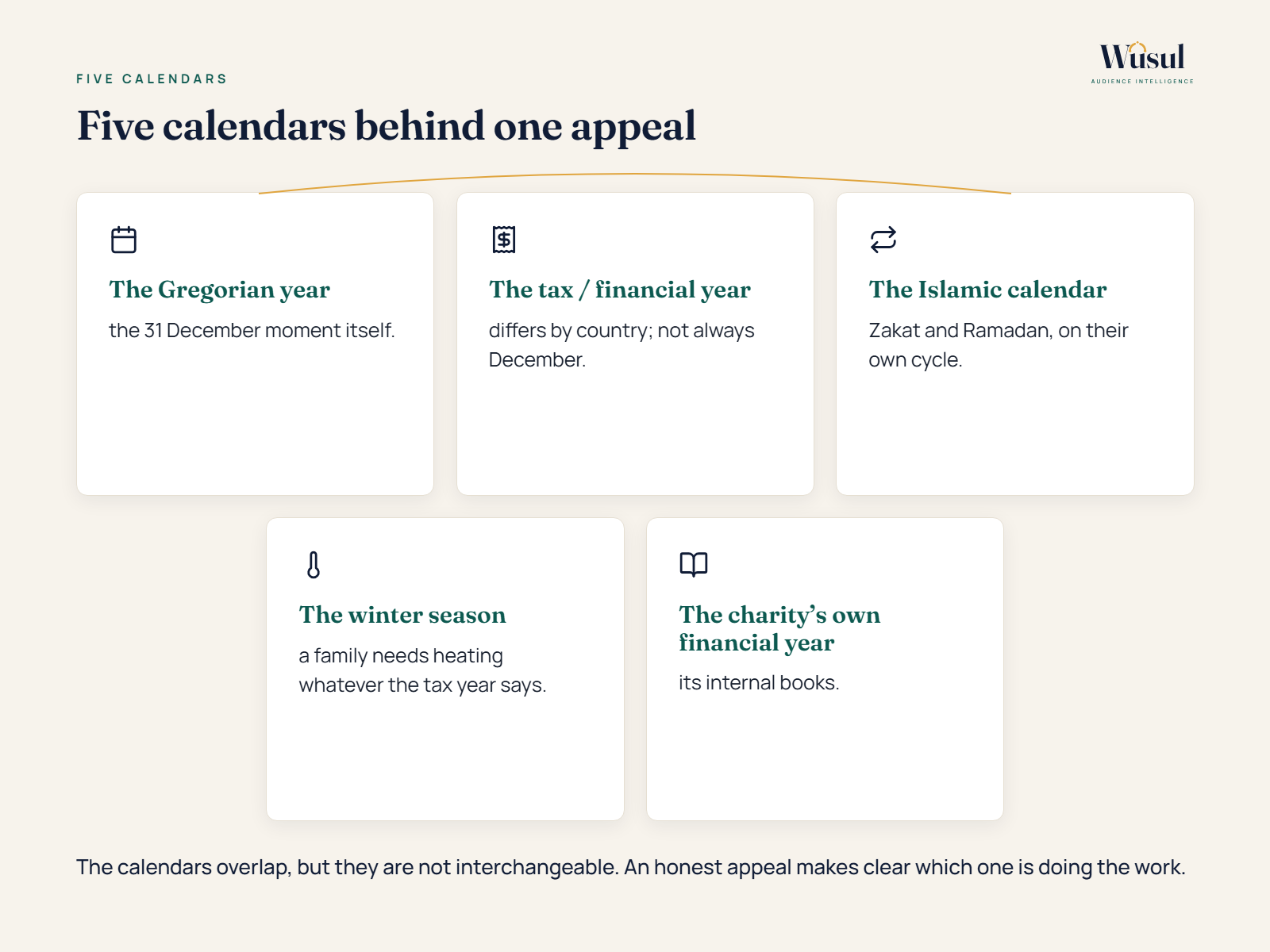
For Muslim charities the picture is more layered still. The Gregorian year-end sits alongside the Islamic calendar, Zakat, Ramadan, winter emergencies and each charity's own financial year. A donor may be responding to a tax incentive, a religious obligation, a humanitarian crisis, or simply to a moment when giving is everywhere.
This series, The Last Gift of the Year, follows those motives across Britain, the United States, Canada, continental Europe and the Gulf. Its central question is simple.
What counts as a year-end campaign
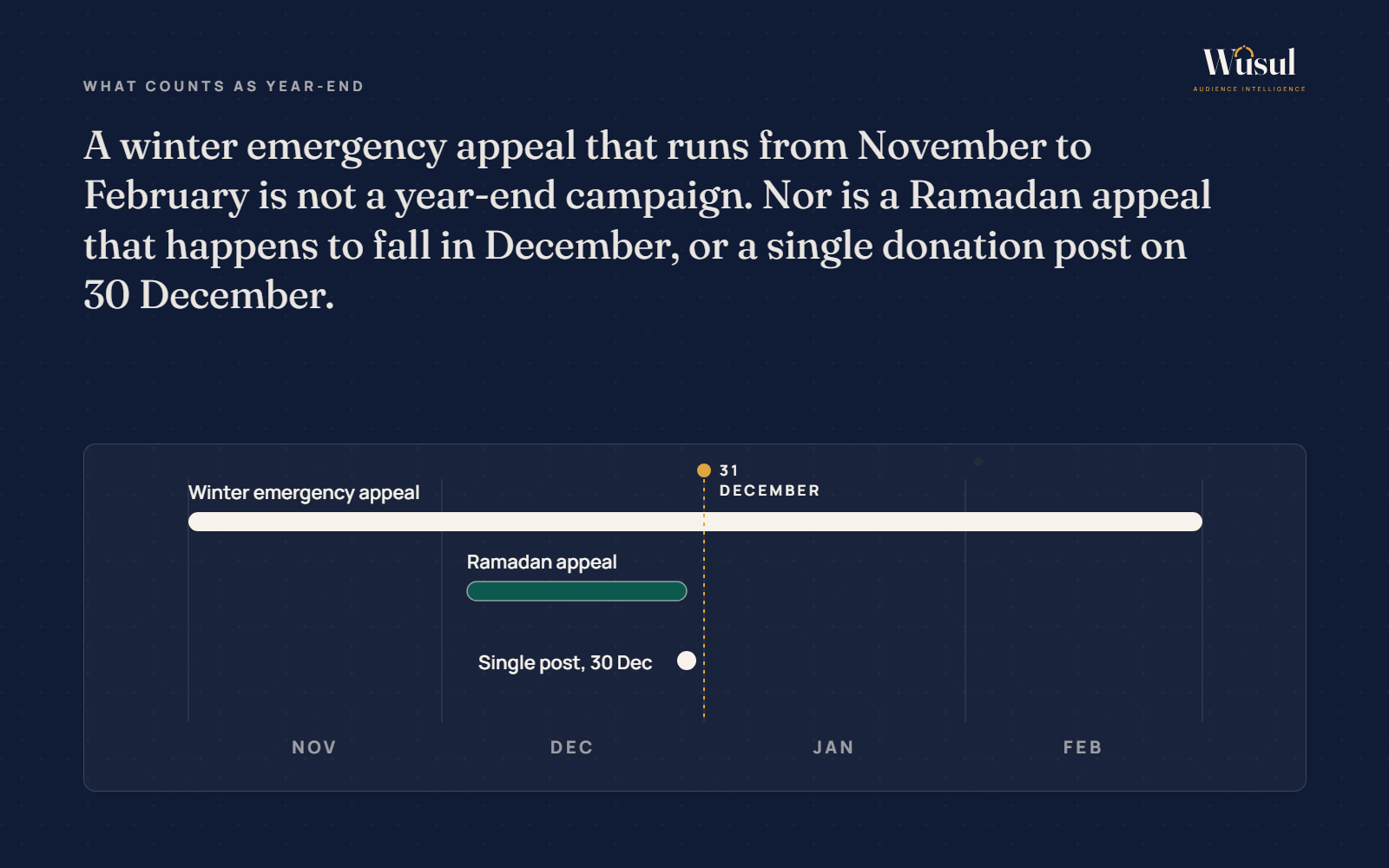
A year-end campaign is not simply any appeal that runs in December. What defines it is that the approaching end of a period, calendar, tax or financial, becomes part of the reason donors are asked to give now: a target to reach by 31 December, a tax benefit to claim before the year closes, a matching offer that expires, an annual commitment to complete.
A winter emergency appeal that runs from November to February is not a year-end campaign. Nor is a Ramadan appeal that happens to fall in December, or a single donation post on 30 December. To avoid counting every December appeal as evidence of year-end fundraising, this series sorts campaigns into three groups:
| Category | What it means |
|---|---|
| Year-end campaign | Explicitly ties the request to the end of a calendar, tax or financial year |
| Seasonal campaign active at year-end | Runs in November or December but is framed around something else, such as winter or an emergency |
| Unclear | Appears in the period, but the evidence does not show whether the year-end was central |
The distinction matters because a campaign's timing shows when it ran, while its message shows why donors were asked to give. They are not the same thing.
Five calendars behind a Muslim charity appeal
Every Muslim charity appeal in this series sits inside five calendars at once. The series will refer back to them throughout.
| Calendar | What it shapes | Why it matters |
|---|---|---|
| Gregorian year | Christmas, GivingTuesday, year-end appeals | Creates a widely recognised moment to give |
| Personal tax year | When a gift earns tax relief | Ends on 31 December in some countries, not in others |
| Charity's financial year | Budgets, targets, annual accounts | May or may not end in December |
| Islamic lunar year | Ramadan, Eid and many donors' Zakat dates | Moves about eleven days earlier every year |
| Humanitarian calendar | Winter need, emergencies, programme deadlines | Can create real urgency that has nothing to do with any year-end |
The calendars overlap, but they are not interchangeable. A charity's financial year ending in December does not make December its donors' tax deadline. A donor who pays Zakat in Ramadan does not make Ramadan the charity's peak for unrestricted income. And a family that needs heating before February needs it whatever the tax year says. An honest year-end appeal makes clear which calendar is doing the work.
Different countries with different tax systems
The clearest reason to compare countries is that their charitable tax rules differ in kind, not just in degree.
| Market | How tax relief works | Does 31 December matter? |
|---|---|---|
| United States | A deduction from taxable income, generally only for donors who itemise in 2023–25; new rules from 2026 | Yes: it ends the individual tax year |
| Canada | Federal and provincial tax credits, with unused amounts carried forward for up to five years | Yes: it ends the individual tax year |
| France | A reduction of income tax, generally 66% of the gift and 75% for some organisations, within limits | Yes: it ends the tax year |
| Britain | Gift Aid: the charity reclaims basic-rate tax; higher-rate donors claim extra relief themselves | No: the tax year ends on 5 April, and the key filing date is 31 January |
| Gulf states | No comparable personal income-tax incentive; corporate rules differ by country | Not for individuals' income tax |
Germany, the Netherlands and Belgium add three more systems, each with its own rules on eligible organisations, documentation and limits. The series treats each separately rather than assuming a gift that qualifies in one country qualifies in another.
Two principles follow. A tax benefit is a legal arrangement, not a slogan: its existence and value for a particular donor have to be established before anyone can ask whether it changed their giving. And rules change. American and French rules both shifted around 2025 and 2026, so a campaign from 2023 must be judged by the rules of 2023.
December 2025: when a tax change moved the deadline
The period this series studies, 2023 to 2025, ends with a natural experiment. In July 2025, the United States passed tax legislation, known as the One Big Beautiful Bill Act, that rewrote the charitable deduction from 2026. Itemisers can now deduct gifts only above 0.5% of their adjusted gross income; donors in the top bracket can deduct at a maximum of 35%; and, for the first time since 2021, people who do not itemise can deduct up to $1,000 of cash gifts, or $2,000 for married couples.
For some donors, that made 2025 the last year of the old, more generous rules. Advisers said so plainly. One philanthropy executive's advice to corporations and individual itemisers was to bring giving planned for 2026 and 2027 forward into 2025: "move now". One large donor-advised fund provider reported that a record 74% of its 2025 contributions came as non-cash assets, a trend it linked partly to donors acting ahead of the changes.
It has happened before. The 2017 Tax Cuts and Jobs Act sharply raised the standard deduction, and afterwards fewer than 10% of households itemised, down from around 30%. Donors who expected to lose the deduction had an incentive to give more in December 2017 and less afterwards.
For this series, December 2025 is a test. Did American Muslim charities tell donors to give before the rules changed? Did they distinguish donors who itemise from those who do not? And if their December 2025 totals rose, how much was new generosity, and how much was giving pulled forward from 2026? A strong December can mean donors gave more. It can also mean they gave sooner.
The Gulf as the control case
At first sight, the Gulf looks out of place in a series about tax and year-end giving. Qatar, Saudi Arabia, Kuwait and the United Arab Emirates offer individuals no broad personal income-tax deduction that would make 31 December a deadline. That is exactly why they matter.
In an experiment, a control group is the one without the treatment. The Gulf is, roughly, the year-end without the personal tax incentive. If Gulf charities run year-end appeals as intensely as their Western counterparts, then tax may matter less to the December season than charities assume. If they do not, tax may be doing more of the work elsewhere than donors realise. Either finding would be informative, and the absence of distinct December campaigns would itself be a result.
The comparison is not perfectly clean, because the Gulf is not tax-free. Since the UAE introduced corporate tax in 2023, companies can deduct donations made to a Qualifying Public Benefit Entity listed in a Cabinet Decision, while donations to unlisted bodies, including many mosques and community causes, are generally not deductible. In Saudi Arabia, businesses pay Zakat to the state as a form of corporate levy. Many companies close their books on 31 December. So the Gulf may have a year-end deadline after all, for companies rather than individuals.
The Gulf articles will test those possibilities rather than assume them: whether year-end appeals exist; whether they target companies, individuals or both; and whether their timing follows corporate budgets, humanitarian need or the Islamic calendar. As Wusul's winter series found, Gulf charities publish fundraising totals most readily in emergencies, through televised national campaigns. Whether December plays any similar role is an open question.
Zakat is not a tax strategy
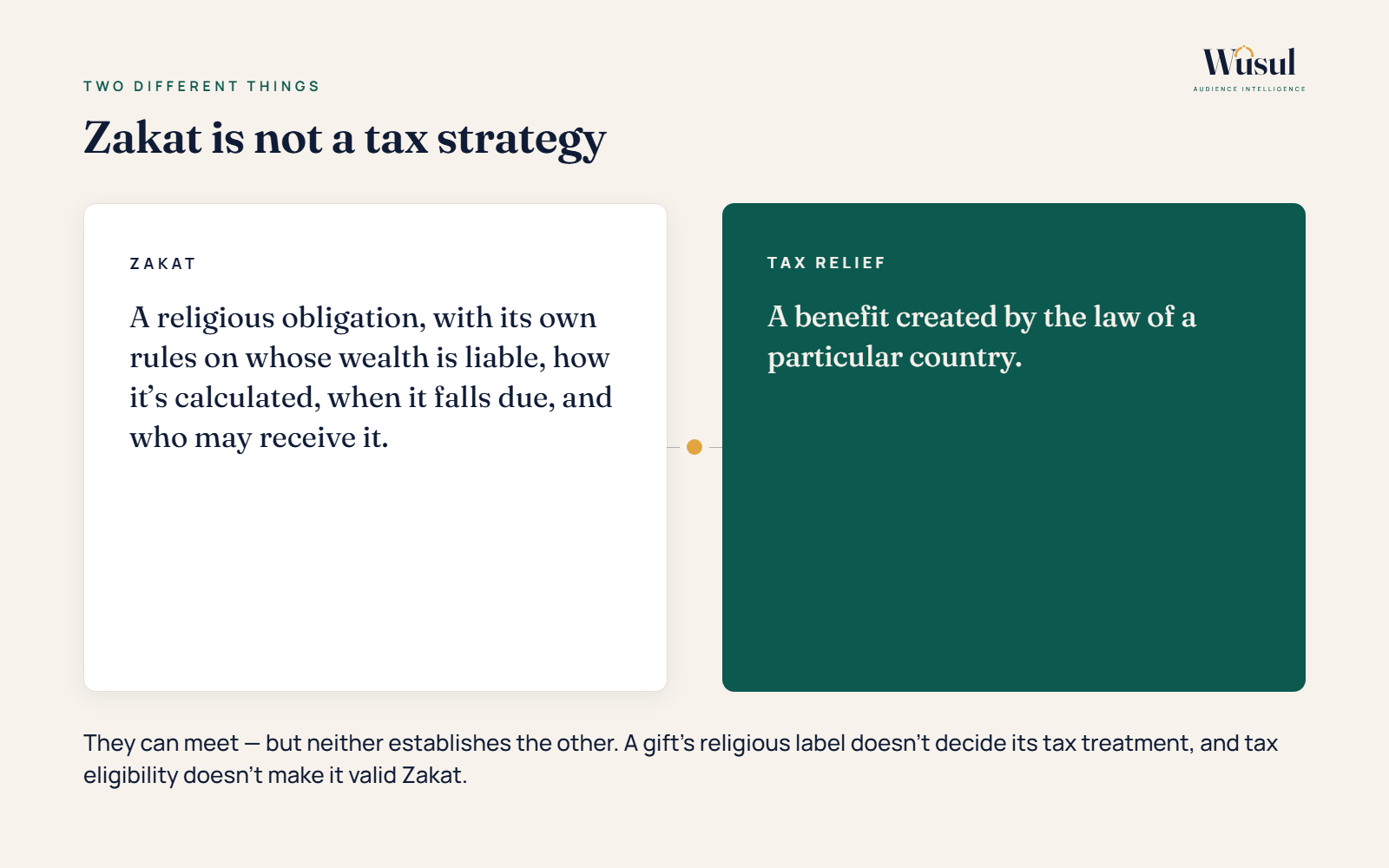
It is tempting to treat Zakat and tax relief as two versions of the same financial decision. They are not. Zakat is a religious obligation with its own rules on whose wealth is liable, how it is calculated, when it falls due and who may receive it. Tax relief is a benefit created by the law of a particular country.
The two can coincide: a donor can pay Zakat to a registered charity and receive tax relief where local law allows. But neither establishes the other. A gift's religious label does not decide its tax treatment, and its tax eligibility does not make it valid Zakat. Nor does the Gregorian year-end make Zakat due: many donors pay in Ramadan or on their own Islamic-calendar anniversary.
Where the two meet, a governance question follows. When a Zakat gift generates extra money for a charity, such as Britain's 25% Gift Aid top-up, where does that money go? Charities answer differently, and article 4 of this series examines how. Across all markets, the series will ask the same thing: what the donor intended, what the charity promised, and what it later reported.
Raising more, or raising earlier?
Suppose a charity raises $2 million in December, against $1.5 million the December before. The extra $500,000 could mean many things: more donors, larger gifts, better fundraising, a major one-off gift, an emergency that drew attention, more spent on advertising, or simply money that would have arrived in January coming in December instead.
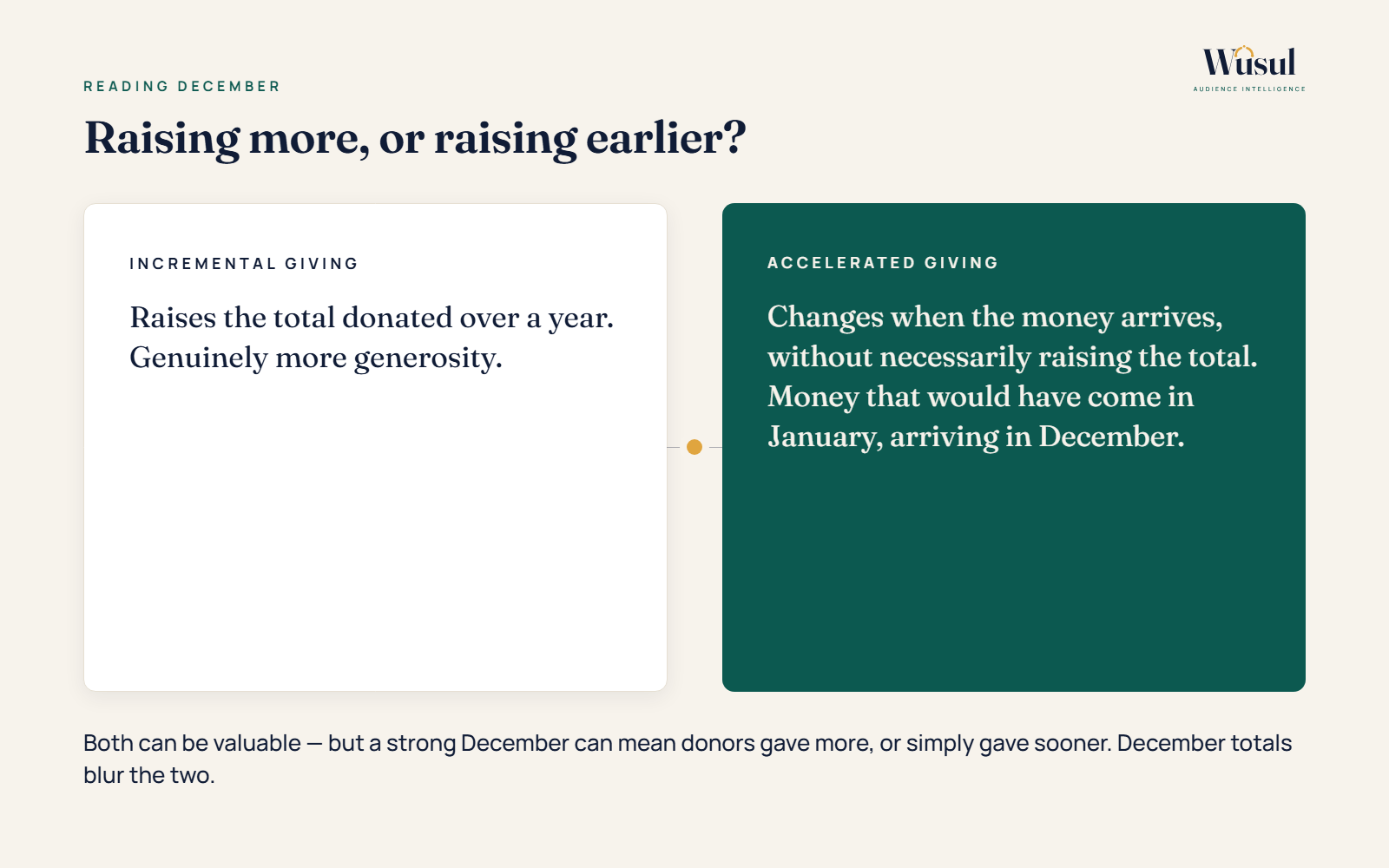
This series separates two outcomes that December totals blur together:
- Incremental giving raises the total donated over a year.
- Accelerated giving changes when the money arrives, without necessarily raising the total.
Both can be valuable. Money that arrives earlier can fund winter aid sooner. But earlier cash and greater generosity are different achievements, and December 2025 in America, when donors were advised to bring giving forward, is a reminder of how easily one can be mistaken for the other.
Telling them apart needs monthly giving data, donor histories, campaign costs and comparable annual totals. Charities' public reports rarely provide all of these, and that limits what any outside study can conclude. The series will say so where it applies, rather than turning annual income into an estimated December figure the evidence cannot support.
When Ramadan meets December
During the period studied, Ramadan fell in March and April, well apart from the December season. That will not last. Because the Islamic year is about eleven days shorter than the Gregorian year, Ramadan moves steadily earlier. On current astronomical estimates it will begin around 26 December 2030, and in mid-December and early December in the two years after. The last time Ramadan spanned the New Year was in the late 1990s.
When it happens, the collision will look different in each market. In the United States, Canada and France, the month of Ramadan, and the Zakat many donors pay in it, will coincide with the end of the tax year. In Britain, it will coincide with Christmas and winter appeals, but not with a tax deadline. In the Gulf, it will coincide with the Gregorian year-end and, perhaps, with companies' financial year-ends.
Will giving grow, concentrate or simply move between appeals? Will the same gift be counted as Ramadan, Zakat, winter and year-end income at once? No one yet knows. Understanding how the calendars interact now, while they are still apart, is part of what this series is for, and a later article returns to the question in full.
How the series will work
The series has twenty articles in six parts. Its main research window is 2023 to 2025; later rules and future calendars are discussed without being applied to earlier campaigns.
| Part | Articles | Central question |
|---|---|---|
| Introduction | 1 | Why does the year-end matter, and to whom? |
| United Kingdom | 2–5 | Why year-end appeals thrive where the tax year ends in April, and where Gift Aid on Zakat goes |
| United States | 6–9 | How charities sell a real 31 December deadline, and what changed in 2025 |
| Canada | 10–13 | How tax credits are presented, and whether they change giving |
| Continental Europe | 14–16 | How France, Germany, the Netherlands and Belgium treat a gift, and what happens when Ramadan meets December |
| The Gulf | 17–19 | What drives year-end giving without a personal tax incentive |
| Accountability | 20 | What did tax relief actually help fund? |
Each market will be examined against the same questions; was there a distinct year-end appeal; what deadline or occasion justified it; was a tax benefit mentioned, and accurately; was Zakat linked to it; was the campaign's own result published; is there evidence of new giving rather than changed timing; and what was delivered.
Three simple measures will summarise what charities say, across markets:
- Tax message visibility: the share of verified year-end campaigns that mention a tax benefit.
- Zakat, tax integration: the share that explicitly connect Zakat with tax relief.
- Campaign result disclosure: the share for which the campaign's own result is public.
They describe communication and disclosure, not effectiveness. A campaign that mentions tax relief does not prove tax relief caused a gift, and a charity that publishes no campaign figure is not, for that reason alone, unaccountable. Evidence will be marked as verified, partial or not found, because the absence of an archived page does not prove a campaign never existed.
Conclusion: the year ends; the reasons for giving do not
31 December is shared by much of the world. Its meaning for a donor is not. In the United States, Canada and France it closes the tax year. In Britain it closes a giving season but not the tax year. In the Gulf it may matter to companies but not to individuals' income tax. And for Muslim donors everywhere, it sits beside Zakat, Ramadan and humanitarian need, none of which follow the Gregorian calendar.
There may be no single global explanation for year-end giving. Some campaigns will prove effective, some poorly explained, some admirably transparent; in some markets the year-end may matter far less than the religious calendar. All of those findings belong in the evidence. The aim is not to prove that December is the most important month for Muslim giving, or that tax drives it, but to understand how one date acquires different meanings, and how charities turn those meanings into requests.
Frequently asked questions
What is a year-end giving campaign?
An appeal that uses the end of a calendar, tax or financial year as a reason to give now. Not every appeal running in December qualifies.
Are year-end campaigns always about tax?
No. They may reflect a giving season, a charity's targets, humanitarian need or a matching offer. How much tax matters varies by country and donor.
In which countries does 31 December end the personal tax year?
Among the markets in this series: the United States, Canada and France. Britain's tax year ends on 5 April, and Gulf states have no comparable personal income-tax incentive.
Can Zakat qualify for tax relief?
It can, depending on the country, the recipient and the donor. Calling a gift Zakat does not by itself decide its tax treatment, and tax relief does not make a gift valid Zakat.
Why include the Gulf?
Because it shows what year-end giving looks like without a personal tax incentive, making it a useful comparison for the other markets.
Does a bigger December prove a year-end campaign worked?
Not on its own. It may reflect gifts brought forward from the next year, an emergency, more advertising or a single large donation.
Wusul Insight: Year-end giving is not one global behaviour but many different decisions gathered around one date. Tax may drive it in one market, faith in another, and humanitarian need in all of them. For Muslim charities, the challenge is to know which reason applies to which donor, and to say so accurately.
Methodology note*: this opening article is a comparative framework, not a completed study. Tax descriptions are simplified from official guidance and do not apply to every donor. Future Ramadan dates are approximate astronomical estimates. Claims about each market, including the Gulf, will be tested in later articles rather than assumed. This article is general information, not tax or religious advice.