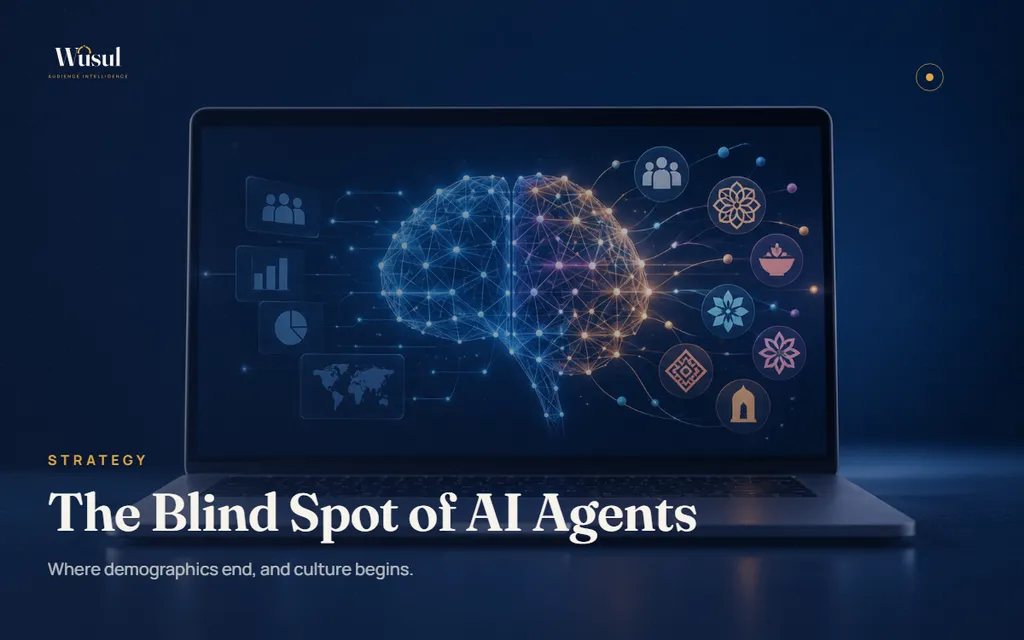
Artificial intelligence agents are increasingly being deployed to understand, segment, and engage audiences at scale. They analyze vast datasets, generate personalized content, and identify patterns faster than any human team. Yet they share a fundamental limitation that threatens to undermine their effectiveness: they are only as culturally intelligent as the data they are trained on.
The challenge is not hypothetical. Research consistently shows that AI systems, when left to their own devices, default to demographic categories and reinforce stereotypes rather than capturing the cultural nuance that drives human behavior. For organizations seeking to engage Muslim audiences (or any culturally distinct community) this represents a significant blind spot.
The demographic default
AI marketing platforms are primarily built on demographic data: age, income, location, ethnicity. These are countable, measurable, and easy to collect. They are also insufficient for genuine cultural understanding.
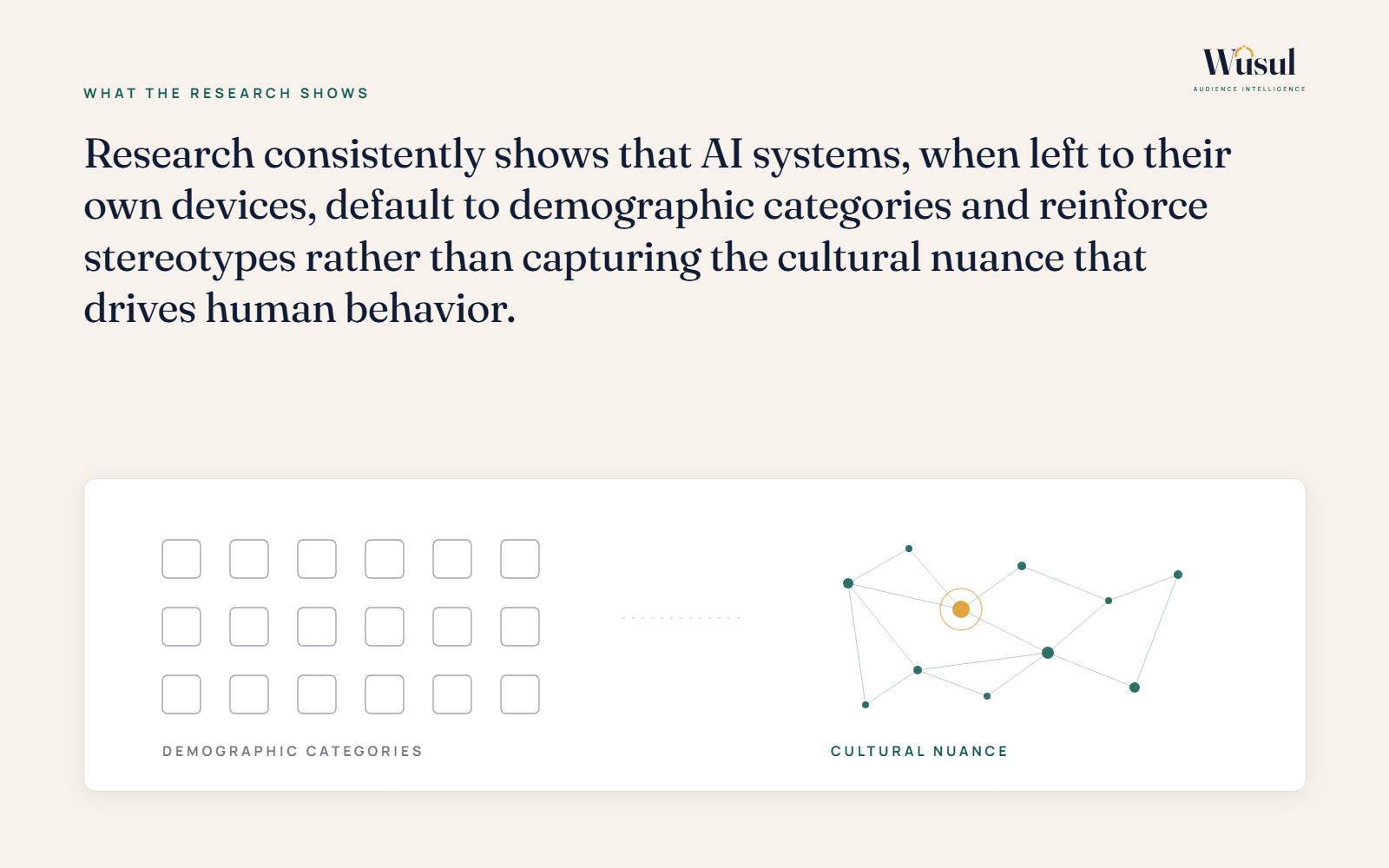
As research from Lux Research argues, "knowing someone is a 40-year-old woman tells you little about her values, beliefs, or aspirations." Demographics "provide the skeleton but not the soul" . Relying on demographic segmentation risks stereotyping, ignores cultural and emotional context, and limits innovation by anchoring too tightly to surface-level categories.
The same is true of AI agents. If an AI system is trained on demographic data alone, it will produce outputs that are technically accurate but culturally hollow. It will know that a person is Muslim, but it will not understand how they experience their faith, what motivates their giving, or how they make decisions.
The Research: AI Agents Exaggerate Stereotypes
A 2026 study from Penn State University, published at the AAAI Conference on Artificial Intelligence, audited synthetic personas generated by three large language models (GPT-4o, Gemini 1.5 Pro, and Deepseek v2.5) and compared them to human-authored responses.
The findings were striking. LLMs "disproportionately foreground racial markers, overproduce culturally coded language, and construct personas that are syntactically elaborate yet narratively reductive." The researchers identified four types of representational harm:
- Stereotyping: relying on generalizations and conventional tropes regarding specific racial or cultural groups
- Exoticism: positioning minoritized identities as foreign or exotic
- Erasure: flattening or omitting complex histories and individualities
- Benevolent bias: using language that bypasses bias filters by being polite or positive
They formalized this phenomenon as "algorithmic othering;" where minoritized identities are "rendered hypervisible but less authentic."
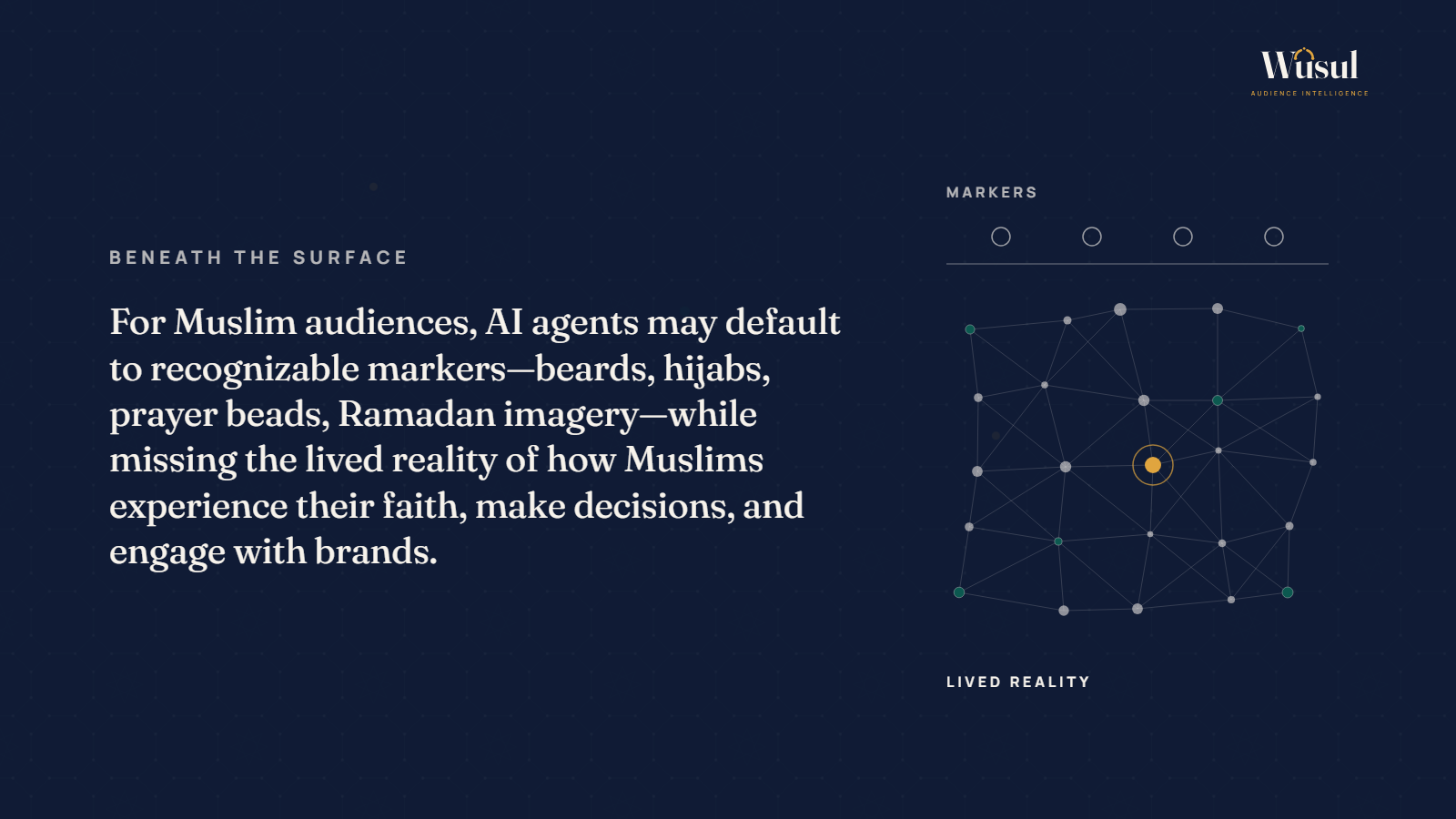
For Muslim audiences, this means AI agents may default to recognizable marker; beards, hijabs, prayer beads, Ramadan imagery, while missing the lived reality of how Muslims experience their faith, make decisions, and engage with brands.
The cultural value alignment problem
A related body of research examines whether AI systems can accurately reflect diverse cultural values. A 2026 paper presented at ICML introduced OG-MAR, a framework that uses the World Values Survey to construct a global cultural ontology and improve cultural alignment in LLMs.
The researchers noted that LLMs "often exhibit misalignment due to skewed pretraining data and the absence of structured value representations." Their solution (creating demographically grounded persona agents that reason through cultural values) improved alignment across benchmarks. But the fact that such a framework is necessary at all reveals the underlying problem: AI systems do not naturally understand culture. They must be explicitly designed to do so.
Another 2026 ICML paper introduced DOVE, a framework for evaluating cultural alignment in open-ended writing rather than fixed-choice surveys. The researchers argued that most evaluations "rely on rigid surveys" that "miss how people usually interact with AI: through open-ended writing, where values emerge indirectly" . This matters because cultural intelligence is not about ticking boxes, it is about understanding how values shape expression, decision-making, and behavior in context.
The WEIRD bias
A 2025 paper from the AAAI/ACM Conference on AI, Ethics, and Society raised a related concern: LLMs are often trained on data that reflect WEIRD values; Western, Educated, Industrialized, Rich, and Democratic. This creates a systematic bias toward certain cultural perspectives while marginalizing others.
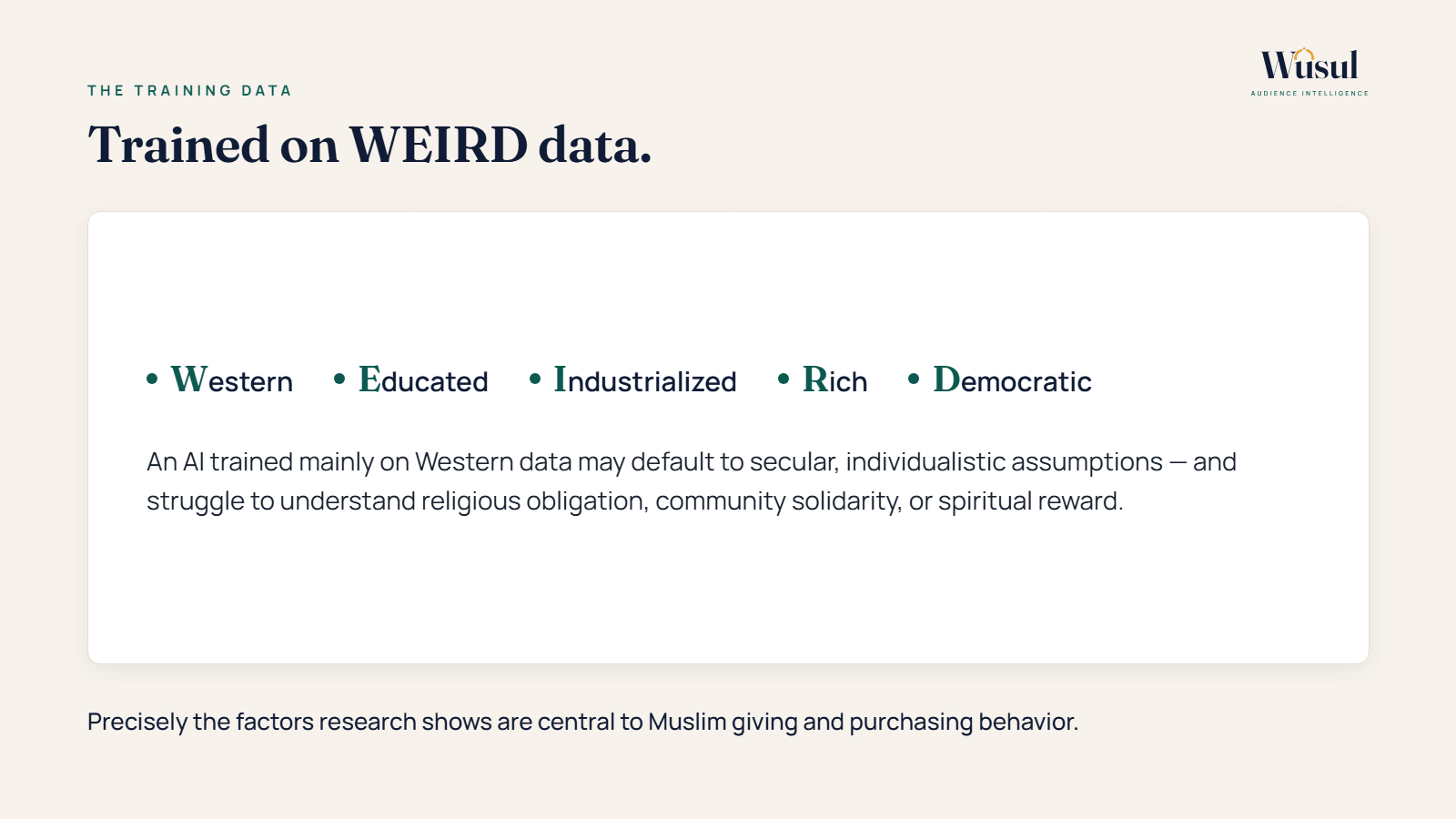
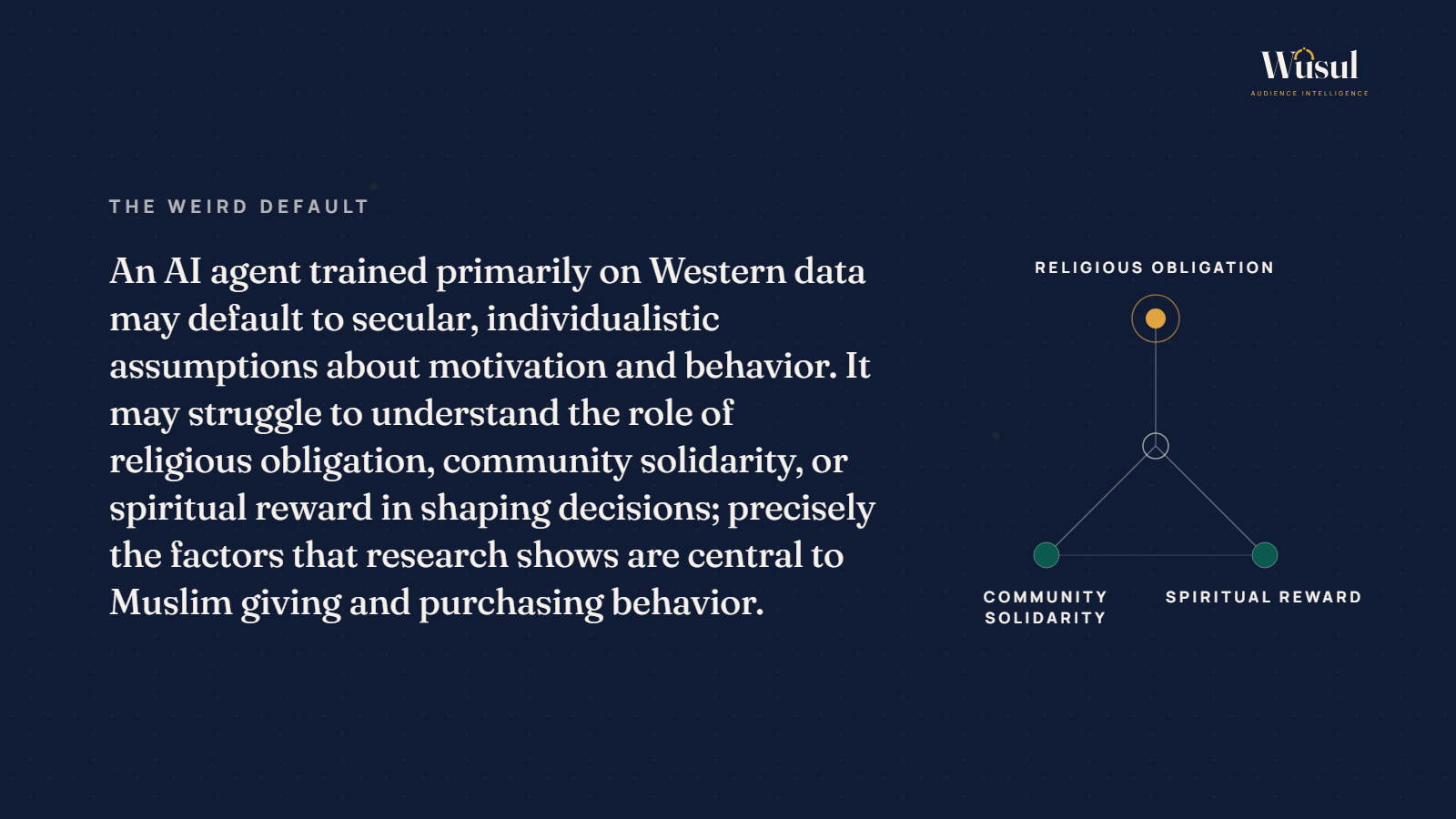
For organizations engaging Muslim audiences in the US, UK, and Europe, this bias manifests in subtle but consequential ways. An AI agent trained primarily on Western data may default to secular, individualistic assumptions about motivation and behavior. It may struggle to understand the role of religious obligation, community solidarity, or spiritual reward in shaping decisions; precisely the factors that research shows are central to Muslim giving and purchasing behavior.
The cultural intelligence opportunity
The good news is that this blind spot is increasingly recognized, and addressed. WPP and Google Cloud have developed a Cultural Intelligence Engine, described as "a multimodal, geospatial predictive AI system that extracts early social signals from public content, clusters them into distinct cultural codes, and forecasts their diffusion across 50 cities and 50 categories" . The system translates predictive cultural insights into actionable opportunities, enabling brands to act ahead of emerging cultural shifts.
This represents a different approach to AI and culture: not simply training on more data but building systems that are designed to detect and interpret cultural signals in real time.
For organizations serving Muslim communities, the lesson is clear. AI agents are powerful tools, but they are not culturally intelligent by default. They require intentional design, culturally grounded training data, and ongoing human oversight to ensure that they reflect the complexity of the communities they are meant to serve.
What this means for engagement
1. Do not assume AI understands culture. Demographic data is a starting point, not an endpoint. AI systems trained on demographics alone will reproduce the same stereotypes that plague human-led marketing.
2. Invest in culturally grounded data. The quality of an AI agent's output depends on the quality of its training data. Organizations seeking to engage Muslim audiences should ensure their AI systems are trained on data that reflects the diversity, complexity, and lived experience of those communities.
3. Maintain human oversight. AI agents can process data at scale, but they cannot understand nuance, context, or the meaning behind behavior. Human cultural intelligence (insider knowledge, community engagement, scholarly oversight) remains essential.
4. Measure cultural alignment, not just performance. Metrics like conversion rates and engagement tell you whether an AI agent is working. They do not tell you whether it is representing your audience authentically. Organizations should develop frameworks for evaluating cultural alignment alongside commercial outcomes.
We need to know where demographics end
The blind spot of AI agents is not a technical failure. It is a reflection of the data they are trained on and the assumptions built into their design. Demographics tell you who someone is on paper. Culture tells you why they behave the way they do. AI systems that stop at demographics will miss the most important part.
For Wusul's audience; organizations seeking to engage Muslim communities authentically, this is both a warning and an opportunity. The warning is that AI agents, deployed without cultural intelligence, will reproduce the same blind spots that have undermined marketing to Muslim audiences for decades. The opportunity is that organizations which invest in culturally intelligent AI; grounded in insider knowledge, designed for nuance, and overseen by human judgment, will build relationships that last.
At Wusul, we believe that cultural intelligence is not a feature that can be added to an AI system after the fact. It is a foundation that must be built from the beginning; with data that reflects lived experience, design that honors complexity, and oversight that ensures accountability. AI agents are powerful tools. But they are only as culturally intelligent as the people who build them.
Frequently asked questions
What is algorithmic othering?
Algorithmic othering is a phenomenon where AI systems render minoritized identities hypervisible but less authentic. It involves disproportionately foregrounding racial markers and overproducing culturally coded language. This process constructs personas that are syntactically elaborate yet narratively reductive, often relying on generalizations, exoticism, erasure, or benevolent bias rather than capturing the lived reality of individuals.
Why do AI models reinforce stereotypes?
AI models reinforce stereotypes because they are trained on data that lacks cultural nuance and often rely on demographic categories like age, income, or ethnicity. When left to their own devices, these systems default to conventional tropes and generalizations. They lack an inherent understanding of culture, leading them to produce outputs that are technically accurate but culturally hollow.
What is the WEIRD bias in AI?
The WEIRD bias refers to AI models being trained on data reflecting Western, Educated, Industrialized, Rich, and Democratic values. This creates a systematic bias toward specific cultural perspectives while marginalizing others. Consequently, AI agents may default to secular, individualistic assumptions, struggling to understand the role of community solidarity, religious obligation, or spiritual reward in shaping human behavior.