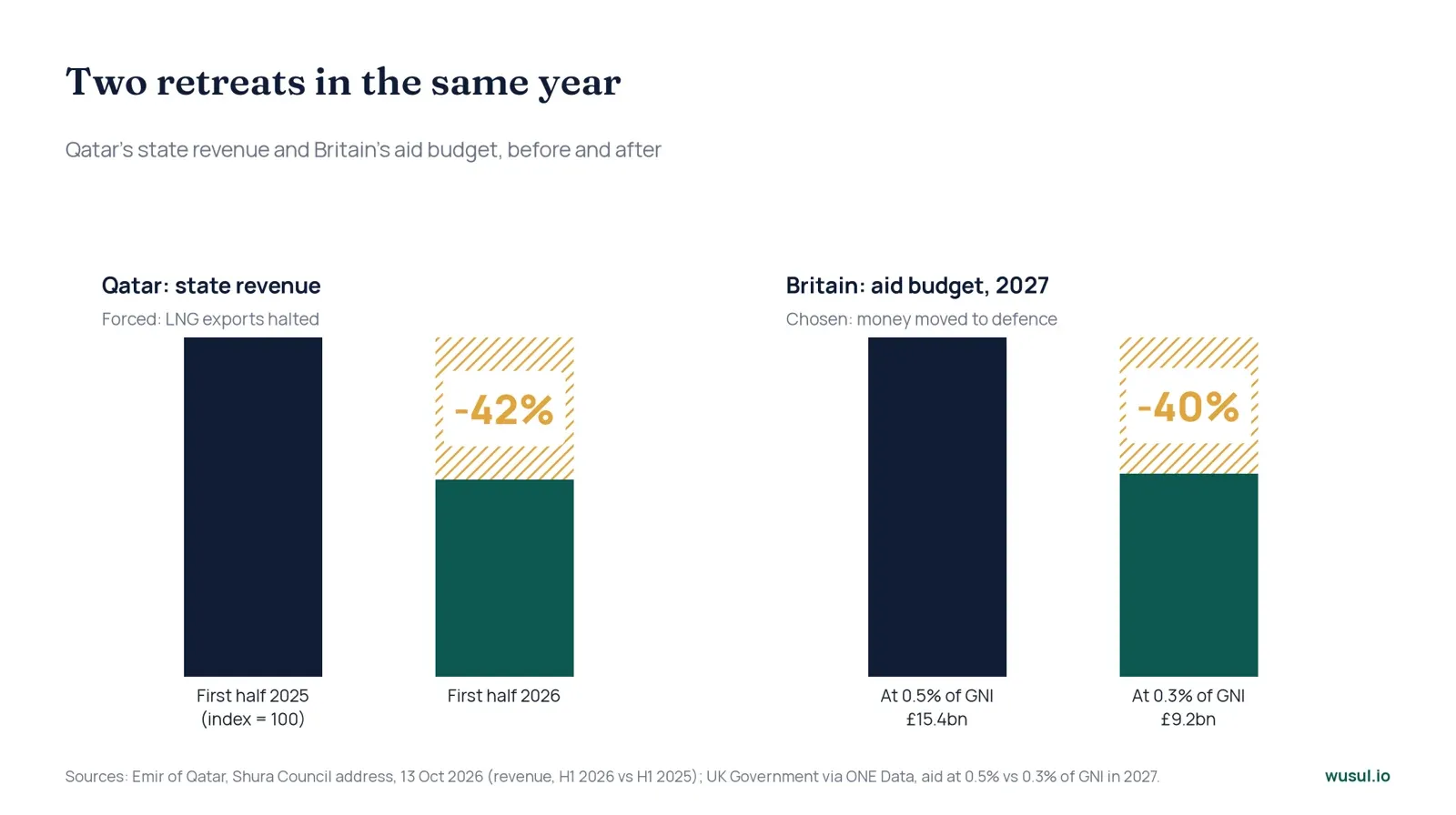
In 2026 two of the most important funders of Muslim-majority crises stepped back at the same time, for completely different reasons. Qatar's state revenue fell 42% in the first half of the year after the war shut most of its gas exports.1 Britain chose to cut its aid budget to pay for defence.2 Both matter most in the same kind of place: Muslim-majority crises, from Gaza and Sudan to Yemen, Somalia and Syria. But they are not pulling back in the same way, and that difference is the point of this article.
Put side by side, the two countries show two different ways of organising Islamic giving. One is large and concentrated around a few institutions and a state that sits next to them. The other is fragmented and built on millions of individual gifts. 2026 is a stress test of both, and the result is not the one most people would guess.
This analysis uses Qatar Charity's own Strategic Plan 2026-2030,3 public statements from Doha and London, and Wusul's Islamic Charity Index of 3,919 registered Muslim charities in England and Wales.4
Key numbers
- -42%: Qatar's state revenue in the first half of 2026
- -40%: Britain's aid budget in 2027, £9.2bn instead of £15.4bn
- $120.5m to about $26m: Qatar Red Crescent relief allocations, 2025 against 2026 so far
- 25 to 30%: Britain's 2026-27 cut to Yemen, Somalia, Afghanistan and three other long-running crises, while Gaza and Sudan are protected
- about £364m: Qatar Charity's average yearly income, 2021-2024, or 22% of all 3,919 UK Muslim charities combined
- 15% against 1%: yearly growth of Qatar Charity's online donations against its total income
- 21: UK Muslim charities above £10m a year, holding half of the sector's income
Is Qatar cutting foreign aid? What is actually known
The facts are narrower than the headlines.
- The shock is real. QatarEnergy declared force majeure on LNG exports in March 2026,5 and partners reported it was extended into November.6 On 13 October the Emir told the Shura Council that state revenue fell 42% in the first half of 2026 and spending fell 14%.1 The IMF expects the economy to shrink 8.6% this year.7
- The aid cut figure is disputed. In August the Financial Times reported cuts of up to 30% to some government budgets and about 85% to foreign aid funding.8 The Foreign Ministry spokesperson called the report "inaccurate" and out of context, and said the 30% applied to operating costs only and that the measures are temporary.9 The ministry did not publish its own aid figure, so the true size of the aid cut is not known.
- Qatari charities have not left the field. Qatar Charity reports work in 44 countries in the first seven months of 2026,10 and opened its 35th international office, in Cairo, in October 2026. Talk of Qatar "stopping its projects abroad" is not supported by anything published.
The more useful question is not whether Qatari giving stopped. It is which parts of it are bending.
Relief is bending, development is holding
Qatar Charity reports its spending in two lines: humanitarian relief and development. Using its figures for 2025 and for January to July 2026:10
| Qatar Charity spending | 2025 (full year) | 2026 (Jan to Jul) | 2026 at the same pace |
|---|---|---|---|
| Humanitarian relief | QR645m | QR236m | about QR405m (37% lower) |
| Development | QR925m | QR573m | about QR982m (6% higher) |
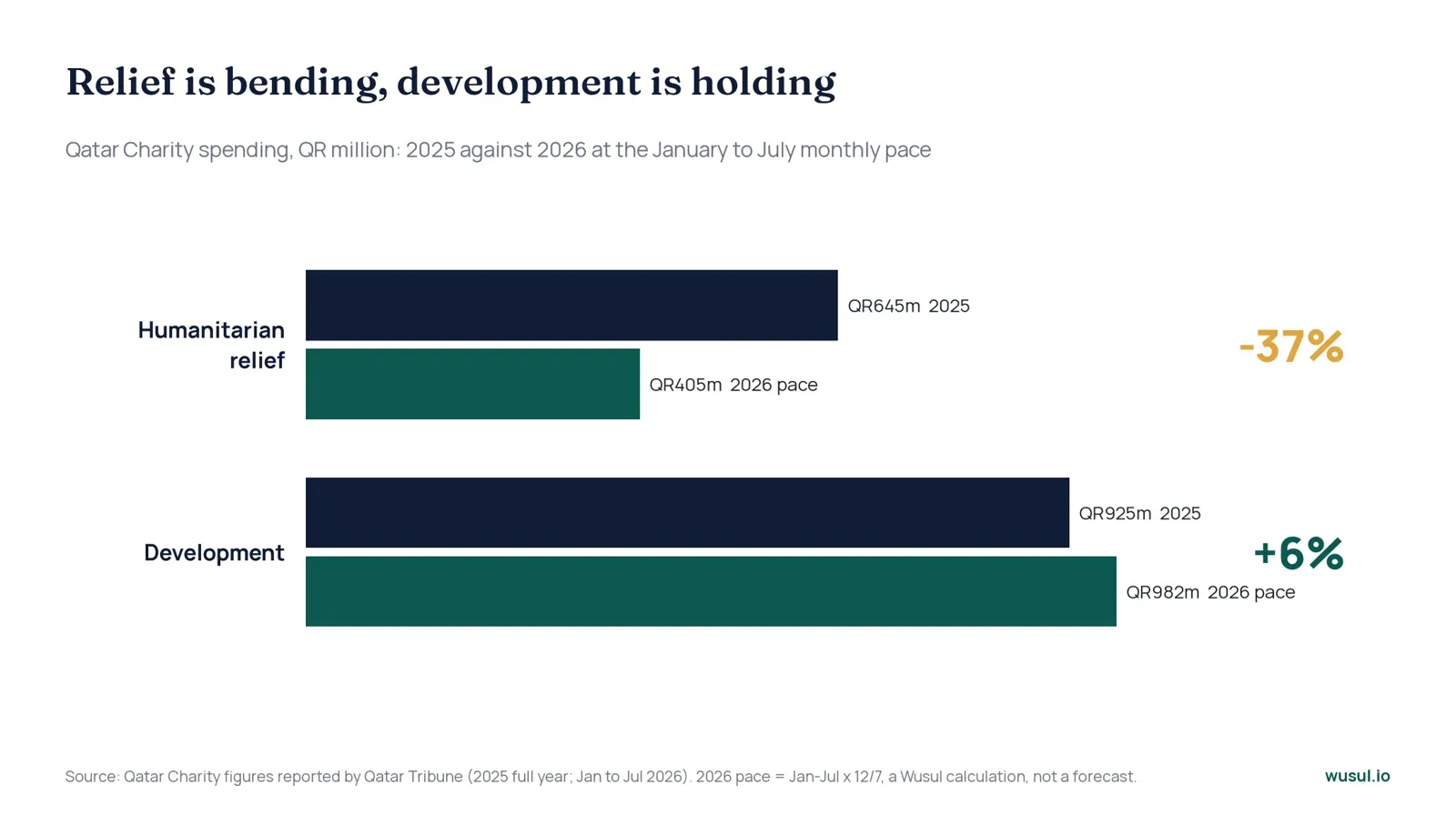
Read the 37% as a direction, not a result. It is seven months of spending stretched to twelve, and two caveats matter. Spending is not spread evenly across a year, so the full-year figure may land differently. And the 2025 relief figure was swollen by Gaza. But the pattern matches what the same report shows for the Qatar Red Crescent, whose relief allocations went from about $120.5m in 2025 to about $26m so far in 2026. In 2025, Gaza alone took $51m, or 45.5%, of the Red Crescent's annual spending.10
When budgets tighten, emergency money is where the pressure shows first. That is exactly the money Gaza, Sudan and Syria depend on.
Development is the slow, planned work of schools, water and livelihoods, with commitments made years ahead. Emergency relief is money that has to be found quickly, when a crisis breaks.
The scale gap between Qatar and Britain
To understand why a Qatari slowdown matters, look at the size of one Qatari charity against the whole British Muslim sector.
Qatar Charity's strategy reports total donations and revenues of QR6.89bn over 2021 to 2024.3 That is an average of about QR1.72bn a year, roughly $473m, or around £364m. Its published project spending for 2024, QR1.57bn, is in the same range.11
| Latest yearly income | |
|---|---|
| Qatar Charity (yearly average, 2021-2024) | about £364m |
| Islamic Relief Worldwide, the largest UK Muslim charity | £239.0m |
| Human Appeal, the second largest | £90.2m |
| All 3,919 Muslim charities in England and Wales | £1.66bn |
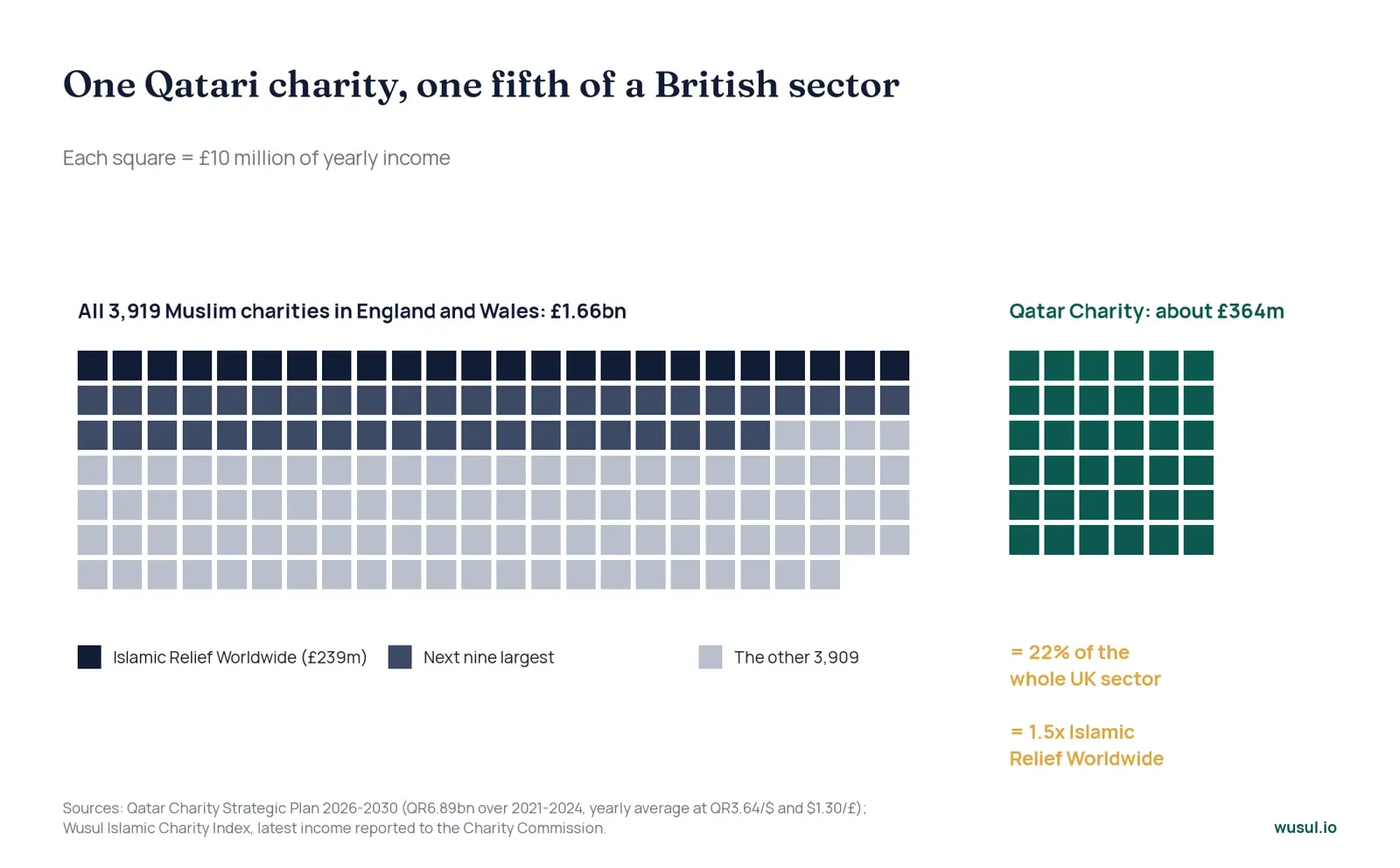
One Qatari charity takes in roughly one and a half times the income of Britain's largest Muslim charity, and about a fifth of the reported income of the entire Muslim charity sector in England and Wales. These are not perfectly like-for-like: both sides include grants as well as public donations, and UK totals are a floor, because many mosques and small charities do not report income.4
Scale like that is a strength in a normal year. It means fast, large responses, deep field presence and a seat at the table with the UN. But it also means a great deal of the region's Islamic giving runs through very few hands.
Two models, one stress test
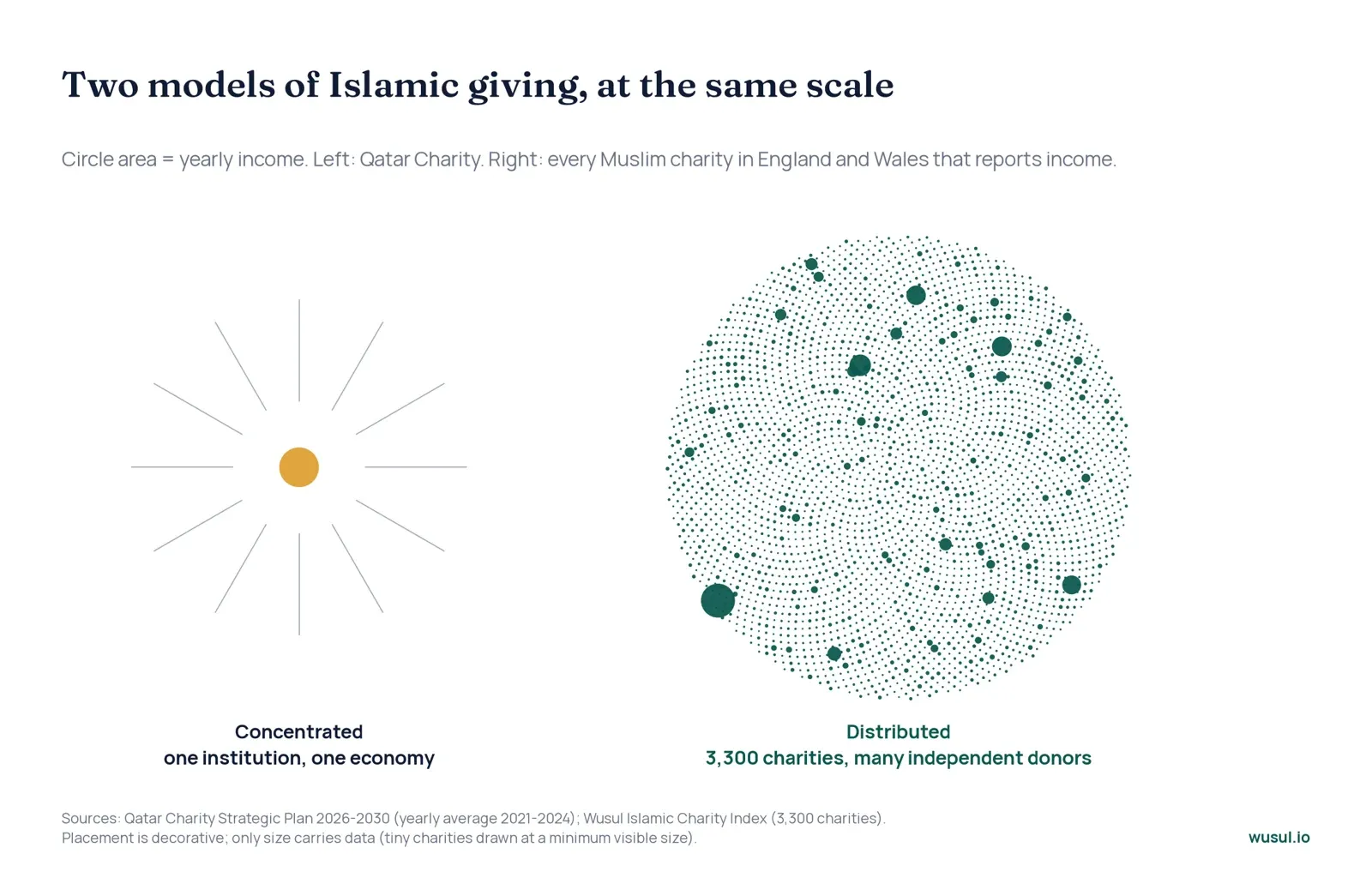
The Gulf model concentrates giving in a few large institutions. They work closely with the state, align with national strategy (Qatar Charity's plan is explicitly tied to Qatar National Vision 2030), and draw on donors whose wealth comes from the same economy. When that economy is hit, the state, the major donors and the corporate givers are all hit at once. Their giving moves together.
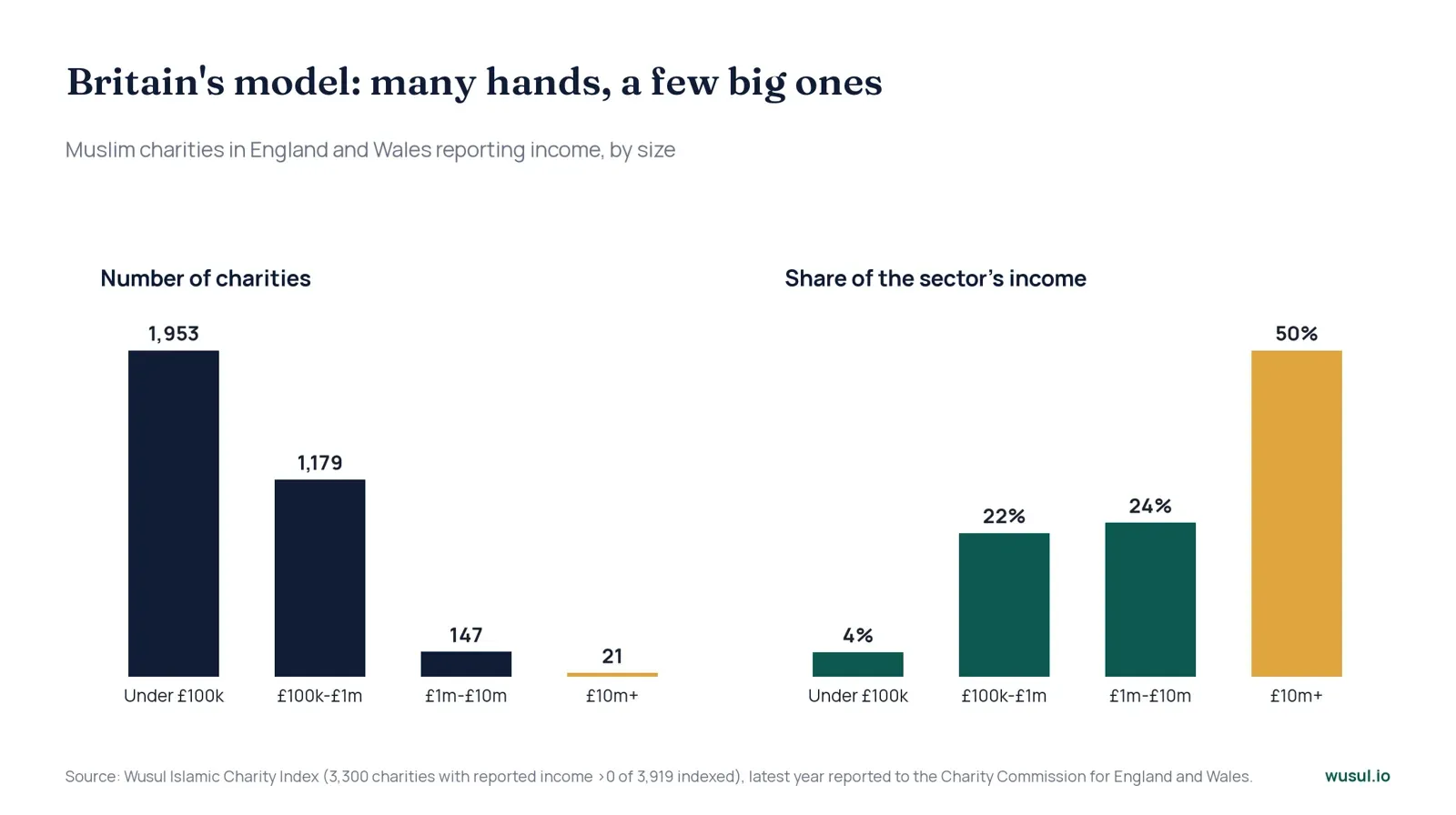
The British model is more spread out. Of the 3,300 Muslim charities in England and Wales that report income, 1,953 take in less than £100,000 a year. Just 21 are above £10m, and together they hold half of the sector's income.4 The sector is built on public appeals: zakat, sadaqah, Ramadan, Qurbani, emergencies.
Fragmented does not mean evenly spread. Half of the money sits in 21 organisations, so British Muslim giving is concentrated too, in its own way. The real difference from the Gulf is not how many charities there are. It is who pays. The large British charities raise a large part of their income from public appeals to many individual donors, alongside institutional grants. A long list of organisations is not, by itself, proof of resilience. A broad base of independent donors is.
It is less efficient. Charities compete for the same donors, spend heavily on acquisition, and lose many first-time givers. But no single shock hits all of its donors at once. A British nurse's zakat does not depend on gas prices or on the Foreign Office's aid budget.
This year, both states cut. London's cut is planned and permanent: aid falls from 0.5% to 0.3% of national income by 2027, about £9.2bn instead of £15.4bn.2 The Independent Commission for Aid Impact projects a 42% fall between 2023 and 2027-28.12 Britain's cut is a choice. Qatar's is forced, and Doha says it is temporary.9
But the two cuts do not fall in the same places. London has said that funding for Ukraine, Palestine, Sudan and Lebanon is fully protected, and has committed £1.4bn a year to the worst humanitarian crises.17 The reductions fall elsewhere. The aid watchdog reports cuts of 25 to 30% in 2026-27 for Afghanistan, DR Congo, Myanmar, Somalia, South Sudan and Yemen,18 and Plan International UK puts the fall in bilateral aid at 49% for Somalia and 46% for South Sudan.19 Syria is not on the protected list.
So the pressure arrives differently. Qatari relief is thinning in the headline emergencies. British aid is holding there, on paper, and thinning in the long-running crises that get less attention.
In Qatar, private giving sits on the same economic foundation as the state. In Britain, most Muslim giving sits on a foundation the state's decision barely touches.
Qatar Charity's own numbers pointed here
Qatar Charity launched its strategy on 17 May 2026, two months after the gas shock began.20 The most interesting thing in it is not a target. It is a set of numbers from 2021 to 2024, before the war.3
| 2021-2024 | Total | Average yearly growth | New yearly target |
|---|---|---|---|
| Total donations and revenues | QR6.89bn | 1% | +10% |
| Donations through the internet | QR2.09bn | 15% | +15% |
| Number of donors (2024) | 235,920 | 9% | +10% |
| Own revenues (investment, endowment) | QR319m | 2% | +20% |
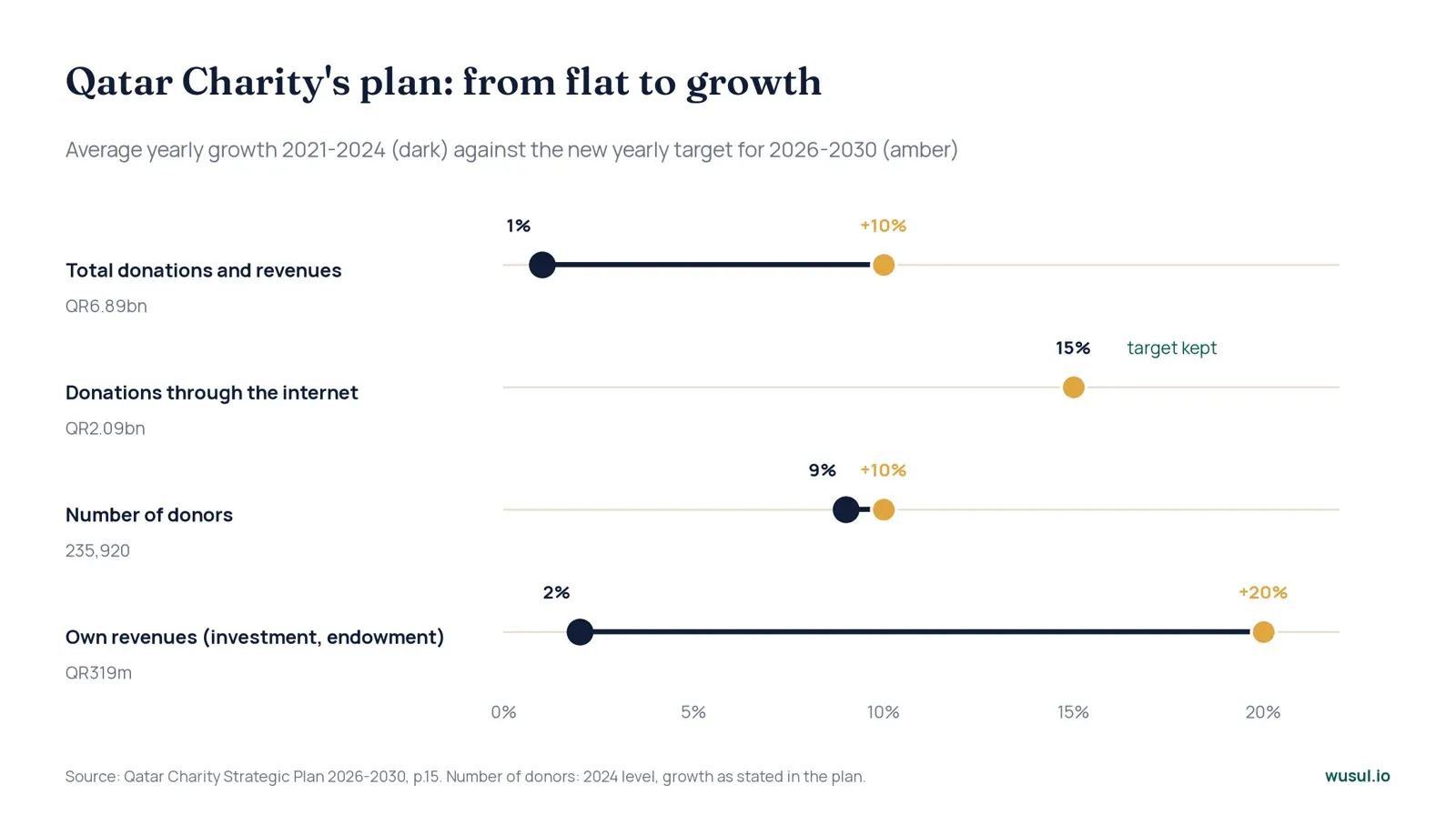
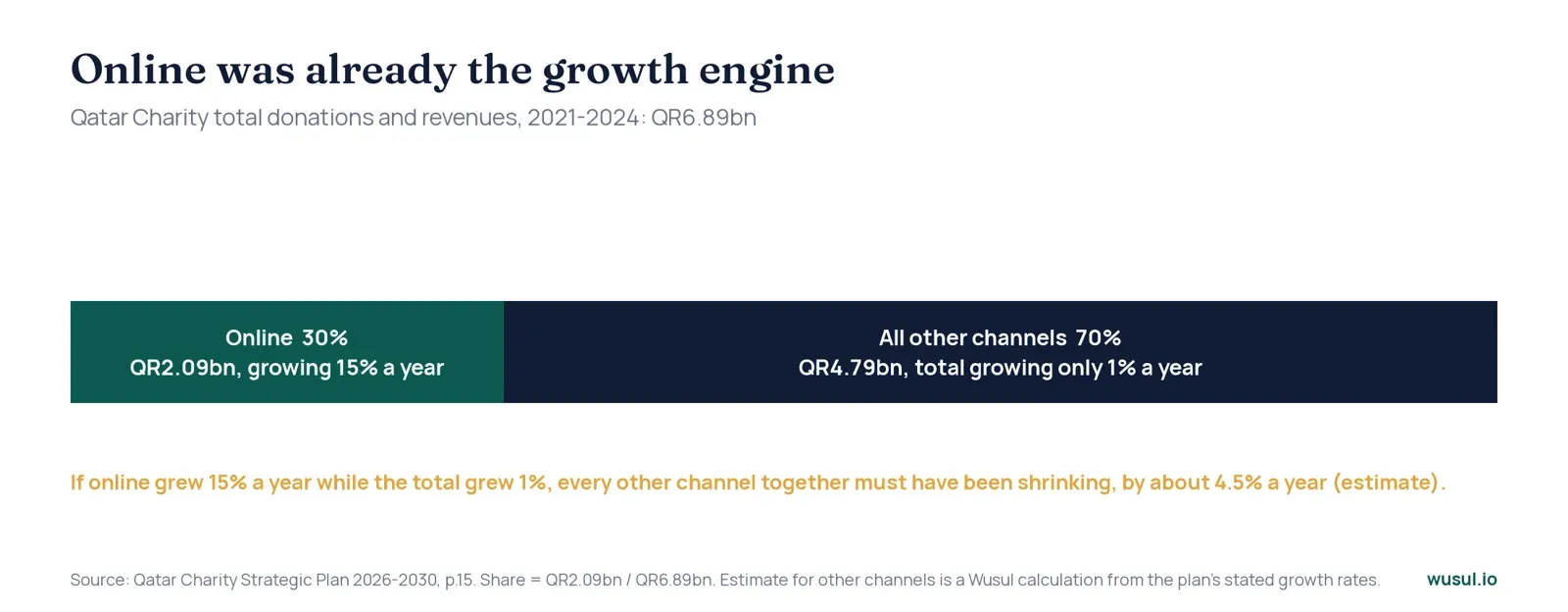
Online giving was already about 30% of the total and growing at 15% a year, while total income barely moved. Do the arithmetic and every other channel together must have been shrinking, by about 4.5% a year on our estimate. More donors were giving, but the money was flat.
Read against that, the strategy's priorities make sense: a better digital donor experience, retention and loyalty programmes, "data analytics and artificial intelligence to understand donor behavior", new tools for Islamic funding such as zakat and waqf, and a 20% yearly growth target for its own investment and endowment income.3
In other words, the plan of the largest charity in Qatar is built on trends that were visible before the crisis, and it points to a more diversified funding model: less dependence on a few large sources, more on many individual donors and on its own endowment. We do not know how much of it was drafted before March. Either way, it moves towards a broader donor base while keeping its scale. 2026 has made that plan more urgent, not less.
What this means for Gaza, Sudan, Syria and the crises behind them
The gap was already wide before 2026. Global humanitarian funding fell for a third year running in 2025.13 The UN's 2026 appeal was cut to $23bn of an estimated $33bn need; the Palestinian territories are the largest single appeal at $4bn, followed by Sudan and Syria.14 The United States stopped funding UNRWA in 2025.15
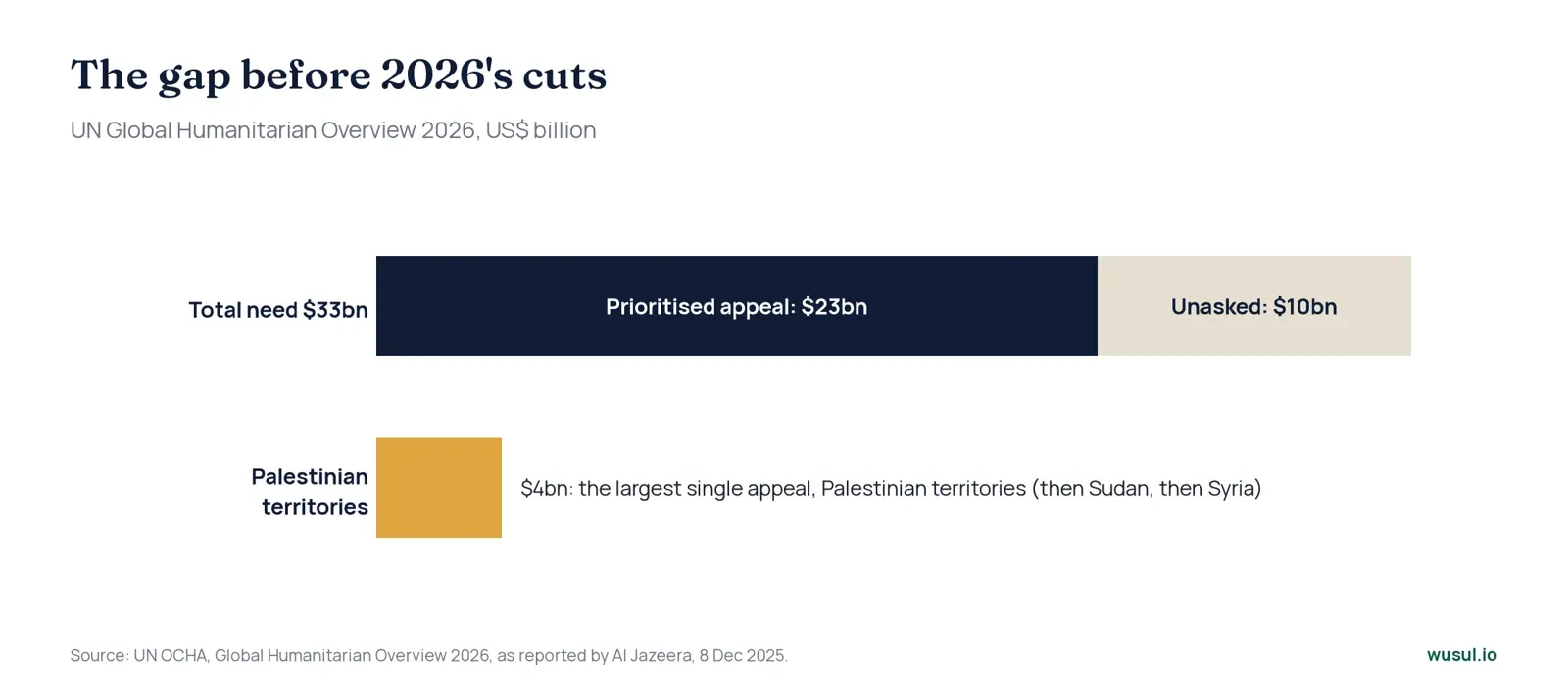
Add a forced slowdown in Gulf relief and a British cut that protects the headline crises but not the others, and three things are likely to follow.
- Individual Muslim donors become a larger share of what reaches these places. Not because they give more, but because others give less. Wherever institutional money thins, the zakat of a family in Birmingham or Bolton carries more weight than it did in 2023.
- Emergency money becomes scarcer than development money. Planned programmes have multi-year budgets. Sudden needs, such as a new displacement in Sudan or a winter in Gaza, depend on donors who can be reached and moved quickly.
- The less visible crises are the most exposed. Yemen, Somalia and Afghanistan are losing British aid now and have no protected status. They are places where Muslim charities already work, and where public attention is lower than it is for Gaza.
A caution on cause and effect. We can show that these budgets are falling. We cannot yet show how much less reaches each crisis, because neither Doha nor London publishes that breakdown in full.
What charities should do
For Gulf charities
- Treat the donor base as a portfolio. Count how much income depends on a handful of institutional or major donors, and set a target for individual and recurring giving.
- Build the endowment side now, while the case for it is obvious to every board member.
- Invest in retention before acquisition. Qatar Charity's own numbers show more donors and flat income; keeping and upgrading donors is where that gap closes.
For UK and Western Muslim charities
- Plan for heavier emergency demand. If Gulf relief thins in Gaza and Sudan while British aid falls in Yemen, Somalia and Afghanistan, public appeals will carry more of the load in both. Prepare the creative, the payment routes and the reporting before the next crisis, not during it.
- Do not assume co-funding from Gulf partners or government grants for 2027. Budget as if it will not come.
- Keep the fragmented model's real advantage, independence, and fix its real weakness, retention. Most of the cost of the British model is in replacing donors who give once and leave. See our data on donor retention.
The lesson of 2026
Islamic giving is often described by its size: the billions given in zakat, the scale of Gulf institutions. 2026 suggests a better measure is how many independent hands hold it. Concentrated giving is powerful and fast, but it moves with one economy. Distributed giving is slower and more expensive to raise, but it is far less likely to stop when one state's budget does.
The strongest charities in the next five years will combine the two: the scale and field presence of the Gulf, with the broad, independent donor base of the diaspora. Qatar Charity's strategy is one bet on that combination. British Muslim charities already have much of the other half, though not every one of them: a charity that leans on a few grants is as exposed as any Gulf institution.
What we do not know yet
- The size of Qatar's aid cut. The 85% figure was reported and then disputed, and Doha has not published its own number.
- The full year. Qatar Charity and Qatar Red Crescent figures for 2026 cover part of the year. The final totals could look different.
- Country by country. Britain's protection for Palestine and Sudan is a commitment. What is actually spent there will only show in later accounts.
- Syria. We found no published 2026 figure for Qatari or British aid to Syria, so we make no claim about it.
What to watch in 2027
- Qatar's 2027 budget, and whether Doha publishes an aid figure of its own.
- Britain's actual spending in the protected countries, against the commitment.
- Ramadan 2027. If individual giving is carrying more of the load, it will show first in the Ramadan appeals of Muslim charities, and later in the accounts we track in the Islamic Charity Index.
- Qatar Charity's first year against its plan: 10% more income, 10% more donors, 20% more from its own revenues.
Where does your charity sit?
The question this article asks of two countries can be asked of one organisation: how much of your income rests on a few sources, and how many of your donors come back? You can look up any of the 3,919 charities in the Islamic Charity Index and compare your organisation with its peers. If you want a closer reading of your own donor base, its concentration and its retention, book a call with Wusul. You can also take Itqan, our free assessment of how mature your fundraising and data are.
Frequently asked questions
Is Qatar cutting foreign aid?
Qatar's state revenue fell 42% in the first half of 2026 and the government has cut spending. A reported 85% cut to foreign aid funding was called inaccurate by the Foreign Ministry, which has not published its own figure. Qatari charities are still working abroad, but their relief spending in 2026 is running below 2025.
How much is the UK cutting its aid budget?
UK aid falls from 0.5% to 0.3% of national income by 2027, about £9.2bn instead of £15.4bn. The aid watchdog projects a fall of about 42% between 2023 and 2027-28.
Are Gaza and Sudan affected by the UK aid cuts?
The UK government says funding for Palestine and Sudan is fully protected, along with Ukraine and Lebanon. The cuts fall on other crises, including Yemen, Somalia, South Sudan and Afghanistan, which lose 25 to 30% or more in 2026-27.
How big is Qatar Charity compared with UK Muslim charities?
Qatar Charity's income averaged about £364m a year over 2021 to 2024. That is about one and a half times Islamic Relief Worldwide, the largest UK Muslim charity, and about a fifth of the reported income of all 3,919 Muslim charities in England and Wales.
How we calculated
- Exchange rates: QR3.64 to the US dollar (the official peg) and about $1.30 to the pound.
- Qatar Charity yearly average: QR6,885.7m over four years = QR1,721m = $473m = about £364m. We read the plan's QR6.89bn as a four-year total because it is labelled 2021-2024 and matches Qatar Charity's separately published yearly figures (QR1.57bn of projects in 2024; more than QR1.2bn of aid in 2023).16
- 2026 pace: January to July figures x 12 / 7. It is not a forecast. Relief is compared with relief and development with development; Qatar Charity's 2026 figures exclude its sponsorship programme.
- Other channels: assuming steady growth of 15% online and 1% overall, with online at 30.4% of the four-year total, all other channels fell from 75.3 to 65.5 (2021 total = 100) by 2024, about 4.5% a year.
- UK sector: 3,300 of the 3,919 indexed charities report income above zero in their latest accounts with the Charity Commission.
Disclosure: members of the Wusul team worked on Qatar Charity's Ramadan 2019 digital campaign in a previous role. This analysis uses only published figures.
Sources
- Annahar, 13 October 2026: the Emir's address to the Shura Council (revenue -42%, spending -14%, first half of 2026).
- ONE Data, UK aid cuts: aid at 0.3% of GNI in 2027 is about £9.2bn, against about £15.4bn at 0.5%.
- Qatar Charity, Strategic Plan 2026-2030, figures from p.15 of the PDF.
- Wusul, Islamic Charity Index: 3,919 Muslim charities in England and Wales, latest income reported to the Charity Commission (data of 8 November 2026).
- The National, 4 March 2026: QatarEnergy declares force majeure after attacks halt supply.
- gasworld: Edison confirms Qatar force majeure extended to November.
- CNBC Arabia, 22 August 2026: IMF expects Qatar's economy to contract 8.6% in 2026.
- Businessmen Middle East, reporting the Financial Times (August 2026): budgets cut by up to 30%, foreign aid by about 85%.
- Al Jazeera Net, 25 August 2026: Foreign Ministry spokesperson Majed Al Ansari on the Financial Times report.
- Qatar Tribune: Qatar shifts charity focus towards sustainable humanitarian impact (Qatar Charity and Qatar Red Crescent figures for 2025 and 2026).
- Gulf Times: Qatar Charity implements projects worth QR1.57bn in 2024.
- Charity Times: UK aid budget set to fall 42% by 2027-28 (ICAI projection).
- ALNAP / Development Initiatives: Global Humanitarian Assistance Report 2026, summary.
- Al Jazeera, 8 December 2025: UN cuts 2026 aid appeal despite great need.
- Arab Center Washington DC: The human cost of US aid cuts across the Arab world.
- Qatar News Agency, 3 June 2024: Qatar Charity provides over QR1.2bn in aid during 2023.
- UK Foreign Secretary, statement to Parliament, 19 March 2026: statement on international development (£1.4bn a year for humanitarian crises; Ukraine, Palestine, Sudan and Lebanon protected).
- Independent Commission for Aid Impact, 16 July 2026: UK aid spending set to fall by around 42% (priority countries protected; 25 to 30% reductions for six long-running crises).
- Plan International UK, 16 July 2026: FCDO Africa budgets (bilateral aid to Somalia down 49%, South Sudan down 46%).
- Qatar News Agency, 17 May 2026: Qatar Charity launches its 2026-2030 strategy.
Sources note: This article is based solely on publicly available annual reports, financial statements, regulatory records and web pages published by the organisations named. None of the organisations discussed was involved in its preparation.