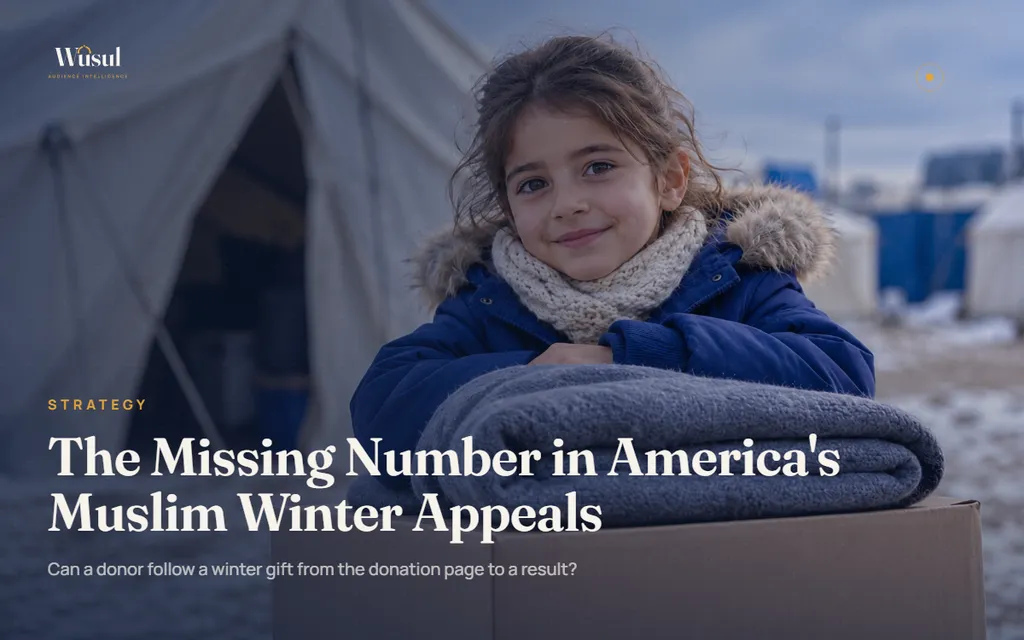
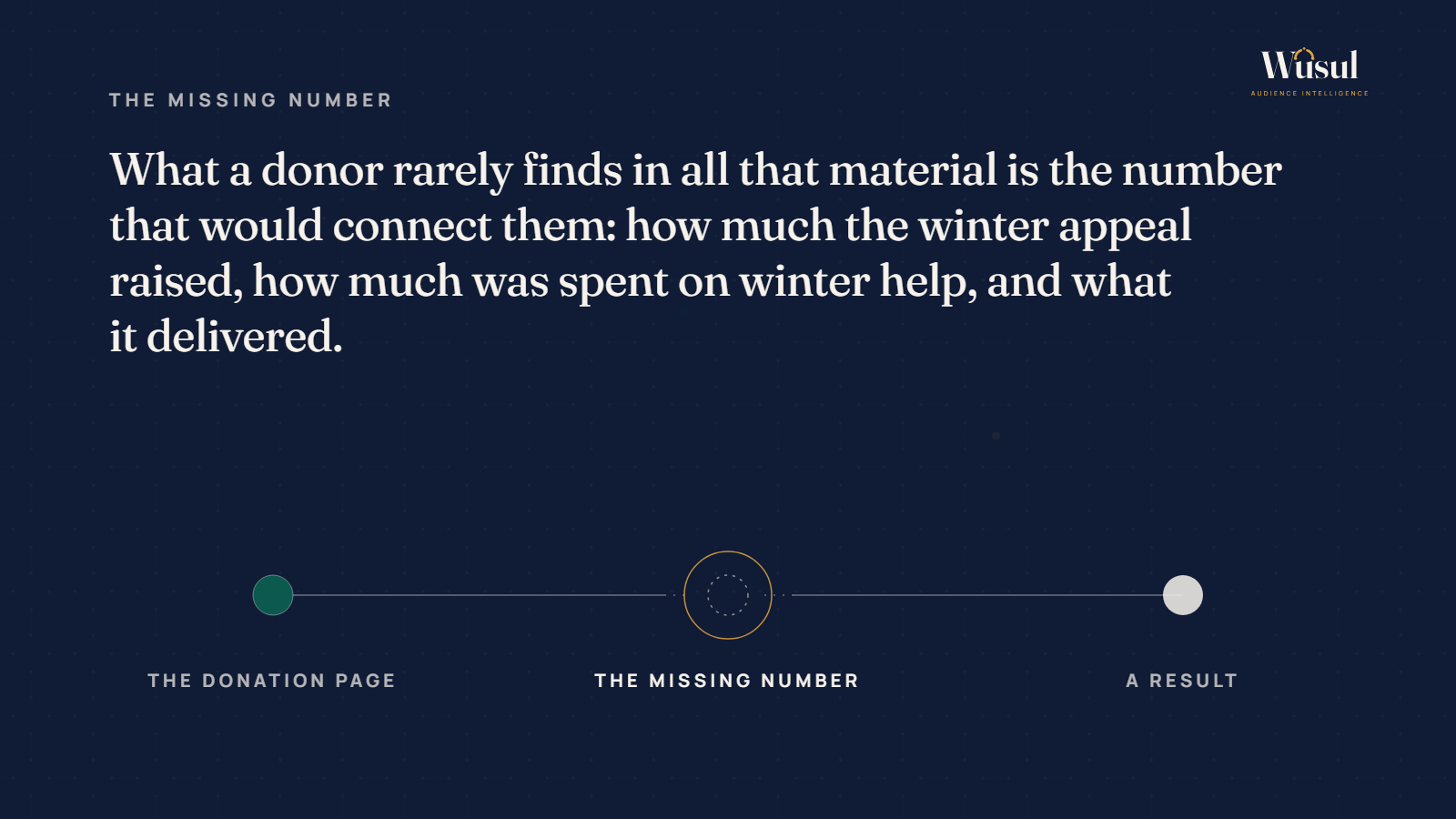
Every autumn, US Muslim charities ask donors to fund blankets, heating fuel, clothing and winter kits. Every year they publish tax filings, audited accounts and impact reports. What a donor rarely finds in all that material is the number that would connect them: how much the winter appeal raised, how much was spent on winter help, and what it delivered.
This article, the third in Wusul's winter series, looks at eight US charities and asks whether a donor can follow a winter gift from the donation page to a result.
Ahmed Sheikh's Ehsan, a newsletter on American Muslim nonprofits, has used IRS filings to compare the overheads of US Muslim relief charities. In one analysis it noted that it could not break down Zakat programmes, because US Muslim charities do not account separately for Zakat.
In March 2026, Islamic Relief USA, the largest of them, published a response to the newsletter's 2026 Zakat issue. It rejected the newsletter's conclusions, arguing that using an organisation's full financial statements to draw conclusions about Zakat is misleading, because those statements largely reflect non-Zakat activity. It also acknowledged that the absence of a standalone Zakat financial report can make that distinction less visible.
Wusul takes no side in that exchange. Both parties agree on one point: an American charity's annual accounts do not show what happened to one particular stream of money. That is true of Zakat. It is equally true of winter.
Four different numbers
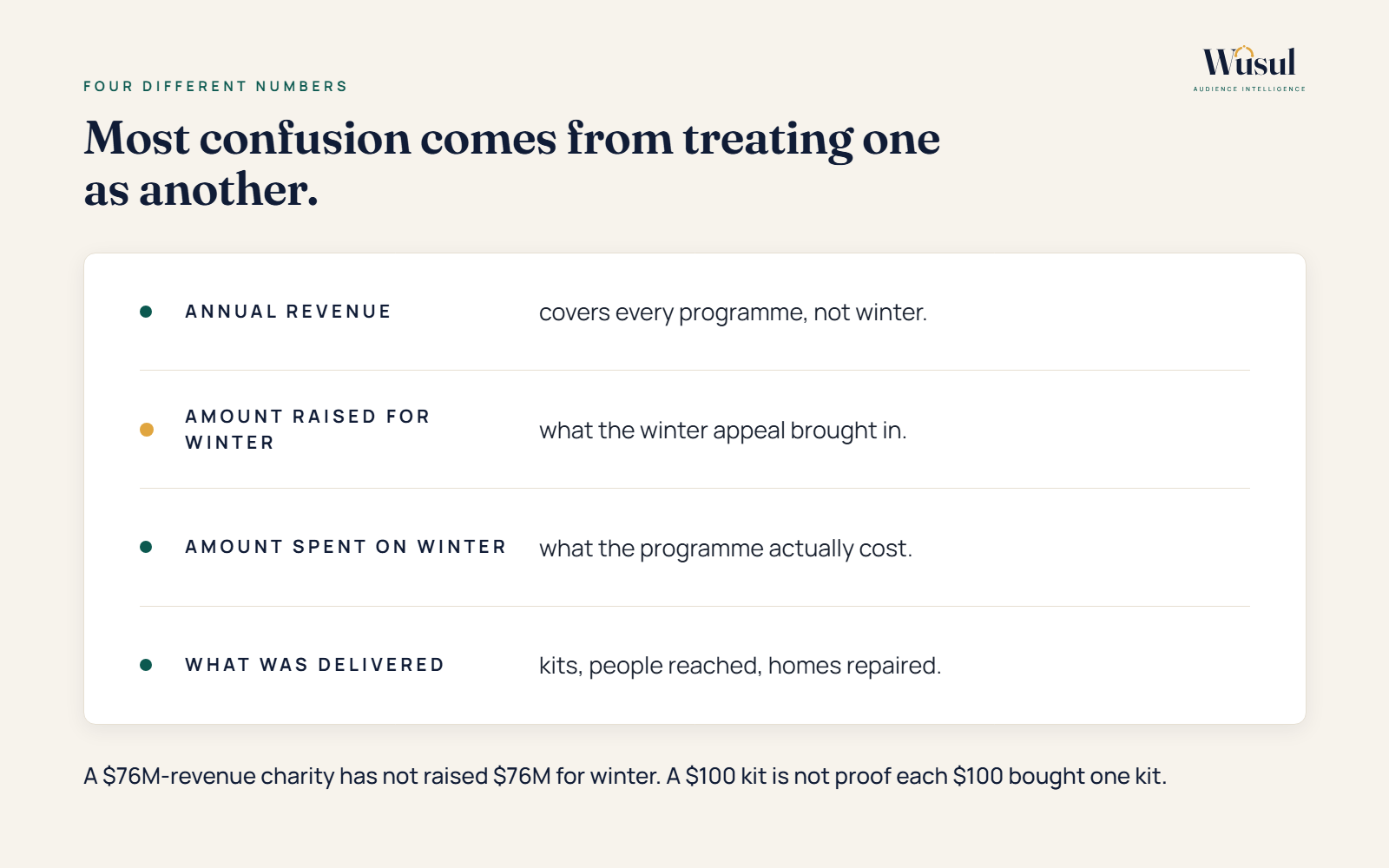
Any account of a winter appeal involves four different figures, and most confusion comes from treating one as another.
| Figure | What it measures | Where it usually appears |
|---|---|---|
| Annual revenue | Everything the organisation received in a financial year, for all programmes | IRS Form 990, audited accounts |
| Winter campaign income | What donors gave in response to the winter appeal | Rarely published |
| Winter programme spending | What was spent on winter help, possibly from several years' donations | Rarely separated |
| Winter outputs and outcomes | What was delivered, to whom, and what changed | Press releases, appeal pages, impact reports |
A charity with $76 million in annual revenue has not raised $76 million for winter. A charity that distributed 10,000 winter kits has not said what they cost or what was raised to pay for them. And a $100 kit on a donation page is not proof that each $100 bought one kit.
The question this article asks is simple: for each charity, how many of the middle two figures can a member of the public find?
Looking inside the audited accounts
IRS Form 990 does not ask charities to report income by campaign. Audited financial statements go further: US nonprofit accounting requires them to show money that donors restricted to particular purposes, and many break those restrictions down in a note. That is the closest public place a winter figure could appear.
Islamic Relief USA's 2024 audited accounts are a useful test, because they are detailed. Of $148.7 million in contributions, $80.6 million came with donor restrictions, and Note 5 shows where those restrictions sat.
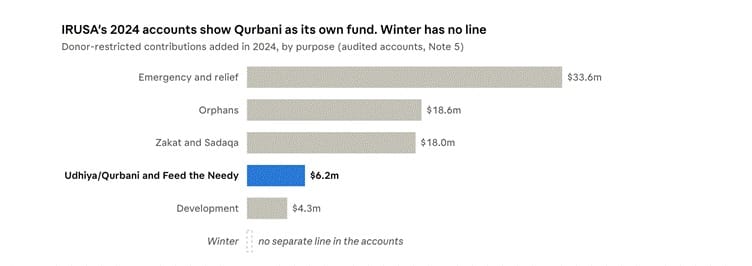
Two seasonal programmes are visible. Qurbani has its own fund: $6.2 million restricted to Udhiya/Qurbani and Feed the Needy in 2024, all of it released and spent within the year. Ramadan food distribution is described as a programme in the notes. Winter does not appear at all. Gifts to a winter appeal are presumably recorded within a broader category, most likely emergency and relief, or Zakat and Sadaqa, with nothing to show how much of either was for winter.
That is not a failure of the audit, which follows accounting standards and is not designed to report campaigns. It shows that, even in one of the most detailed sets of accounts in the sector, winter is invisible as a stream of money.
It does not have to be. UNHCR, which runs its own annual winter appeal to individuals and companies, publishes the result: it raised $34 million in its winter campaign in 2024-25, and about $47 million in 2025-26.
A look at different charities' models
The eight charities below were chosen as each runs a winter appeal aimed at US donors and publishes at least some winter information. They include the largest US Muslim relief charities and smaller organisations with distinctive models. This is not a ranking, and the absence of a figure in public material does not mean it does not exist internally.
1- Islamic Relief USA
One of the largest US Muslim relief charities, IRUSA reported $148.7 million in contributions in 2024. Its winter work is visible at project level: a donor report updated in April 2024 describes a $150,000 Palestine winterisation project that gave winter clothing to 4,250 displaced people in Khan Younis between November 2023 and March 2024. That connects a budget, an activity and a reach. As the previous section shows, the accounts do not show winter as a separate stream, so there is no season-wide figure for what was raised.
2- Zakat Foundation of America
Zakat Foundation makes its winter products unusually concrete: its 2024-25 initiative offered a coat or blanket for $10, 100 kg of firewood or coal for $20, a family heater for $50 and a full winter package for $120. Its 2023 annual report lists a winter-aid figure of 10,250 within its Gaza response. Notably, its Qurbani impact page publishes kilograms and beneficiaries country by country, as discussed in Wusul's Qurbani series; no equivalent winter page was found.
3- Baitulmaal
Baitulmaal publishes some of the clearest winter delivery reports. In January 2025 it reported winter kits for about 1,700 families, or 9,650 people, in Türkiye and Syrian camps, listing coal, blankets, mattresses and shelter materials. In December 2025 it reported winter aid for 1,020 orphan families in Istanbul and Kilis. Its 2024 Form 990 shows about $76 million in revenue; neither source shows what winter appeals raised.
4- ICNA Relief USA
ICNA Relief's winter drive is domestic: coats, blankets, heating help, food and shelter for vulnerable families and people experiencing homelessness in the United States. Its annual impact reporting counts more than a million people across food, housing, refugee and disaster programmes, but winter help runs through those year-round programmes and is not reported separately.
5- Human Appeal USA
Human Appeal USA's winter page reports that in 2025 it reached five countries, delivered 10,502 winter kits in Syria and provided essential winter kits to more than 23,000 people. It lists country-specific kits from $52 (a child's kit in Morocco) to $185 (Yemen), plus a Gaza fund for clothing vouchers. The page also illustrates a boundary that matters for any comparison: it describes more than 35 years of winter work, which belongs to the international Human Appeal network, while the US charity is a separate legal entity, Human Appeal Inc., with its own tax registration and accounts.
6- Penny Appeal USA
Penny Appeal USA reported that its winter programme reached over 25,000 individuals across five countries in 2022 with winter kits and food packs, and has since run winter appeals for up to nine countries. It is one of the few US charities to publish a winter-specific reach figure for a full season, though not alongside the amount raised.
7- Life for Relief and Development
LIFE, based in Michigan, reported distributing winter kits to thousands of families across eight countries in 2025, including Afghanistan, Egypt, Gaza, Iraq and Jordan. Its public material describes the programme and its countries, but gives neither precise counts nor the sums raised.
8- Mercy-USA
Mercy-USA shows a different, local model. Its 2023 annual report describes seven packaging events in Michigan that produced 300 winter warmth packages, each with a $50 gift card for a coat, alongside hygiene packages distributed through shelters. Volunteer time and donated goods make this kind of programme hard to express as a single dollar figure at all.
One further charity illustrates the limits of tax filings. Helping Hand for Relief and Development reported about $89 million in revenue in 2024, but its filing, like everyone's, says nothing about winter specifically.
Where winter money is visible: crowdfunding
There is one place where the amount raised for a winter appeal is routinely public: crowdfunding platforms. On LaunchGood, the largest Muslim crowdfunding platform, each campaign page shows the total raised, the number of supporters and the deadline. One Gaza winter campaign, for example, showed $20,082 raised from 605 supporters, with funds collected by the end of February 2025. GlobalGiving goes further, requiring dated progress reports from each project after the money is raised.
These campaigns are usually small, and many are run by organisations outside the United States. But they show that publishing a running total for a winter appeal, and reporting back on what it bought, is technically easy and familiar to Muslim donors. The larger charities' own appeal pages show tiers and impact, but not the total.
What the small print says
If the accounts cannot say what happened to a winter gift, the donation terms often can. Human Appeal USA's winter page is a clear example. It commits to providing aid in the country or programme the donor selects, but adds that if the programme is completed, raises more than it needs, or loses access to a country for reasons beyond the charity's control, Human Appeal reserves the right to reallocate the donation to another programme where it is needed most.
That clause answers a question no impact report does. Suppose a winter appeal raises $500,000 and the winter programme spends $420,000. The remaining 80,000 might be carried into next winter, committed to distributions still under way, or undetermined season report," X carried forward, $Y reallocated to Z", would close the gap.
The same page states that winter projects are Zakat-eligible. That links winter directly to the dispute over Zakat reporting described at the start of this article. If part of what a winter appeal raises is Zakat, then the absence of a standalone Zakat report and the absence of a standalone winter report are the same problem seen from two sides. And with Ramadan, when much Zakat is paid, now falling in the winter months for several years, the overlap is growing.
What each charity publishes
The table summarises what the public material reviewed for this article shows. One column is left out deliberately: for none of the eight did we find the amount raised by the winter appeal, so it would read "not found" in every row.
| Charity | Winter products and prices | Winter outputs published | Season-wide winter figure |
|---|---|---|---|
| Islamic Relief USA | Yes | Project level (Gaza, 4,250 people) | Not found; winter not separate in audited accounts |
| Zakat Foundation of America | Yes, $10 to $120 | Within Gaza emergency reporting | Not found |
| Baitulmaal | Yes | Distribution reports (1,700 families; 1,020 families) | Not found |
| ICNA Relief USA | Yes, domestic | Within year-round programmes | Not found |
| Human Appeal USA | Yes, $52 to $185 by country | 10,502 Syria kits | 23,000+ people, 5 countries (2025) |
| Penny Appeal USA | Yes | Winter kits and food packs | 25,000+ people, 5 countries (2022) |
| Life for Relief and Development | Yes | Eight countries, "thousands of families" | Not found |
| Mercy-USA | Domestic packages | 300 winter warmth packages (2023) | Not found |
"Not found" means not located in the public sources reviewed. It does not mean the figure is zero, or that the charity does not hold it.
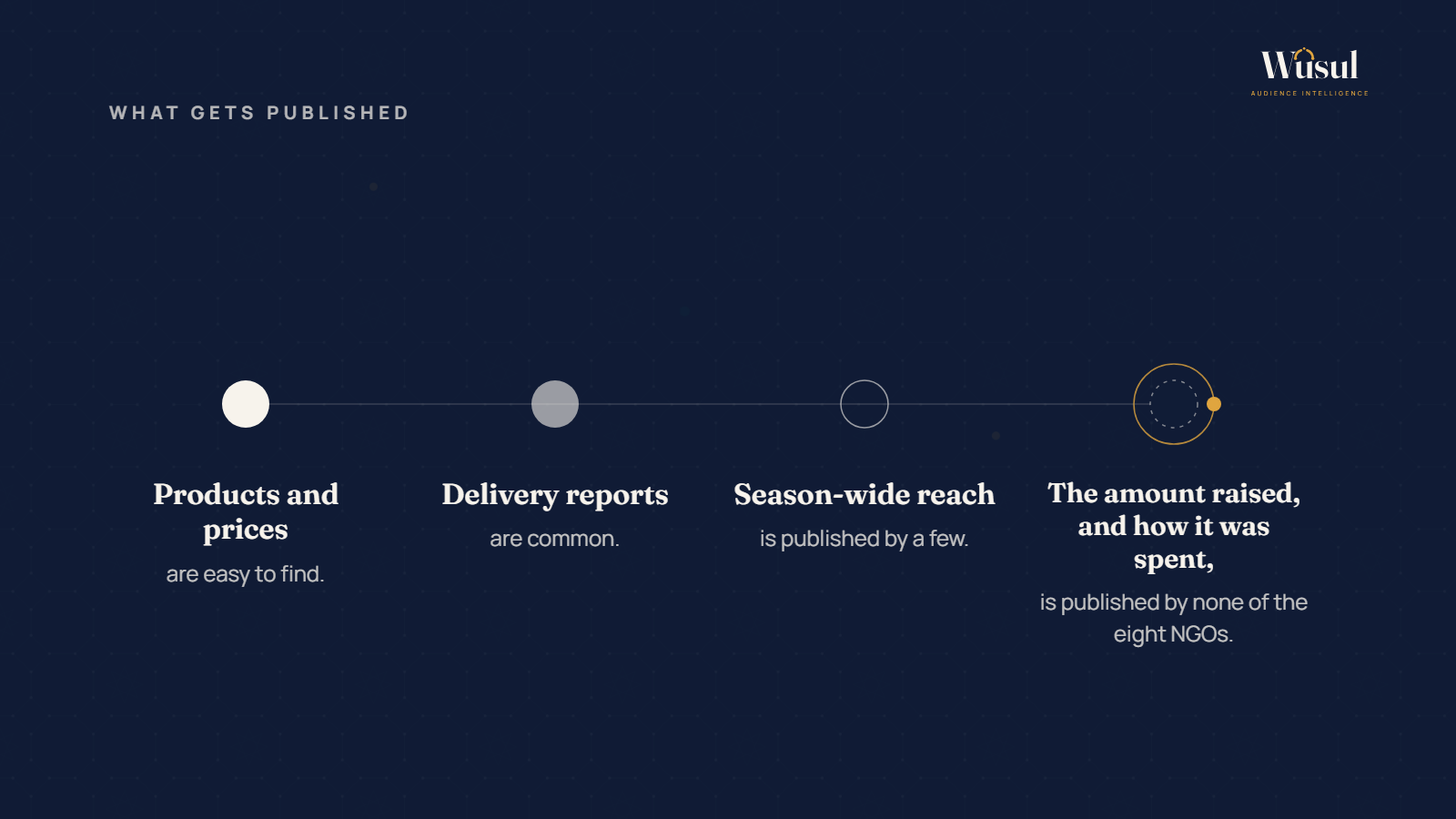
The pattern is consistent. Products and prices are easy to find. Delivery reports are common. Season-wide reach is published by a few. But the amount raised, and how it was spent, is published by none of the eight NGOs.
Why annual revenue cannot be divided by winter beneficiaries
When campaign figures are missing, it is tempting to improvise with the numbers that are available. Suppose a charity reports $80 million in annual revenue and 10,000 people helped in winter. Dividing one by the other gives $8,000 per person, a figure that is arithmetically correct and means nothing: the $80 million paid for food, water, health, orphan care and much else.
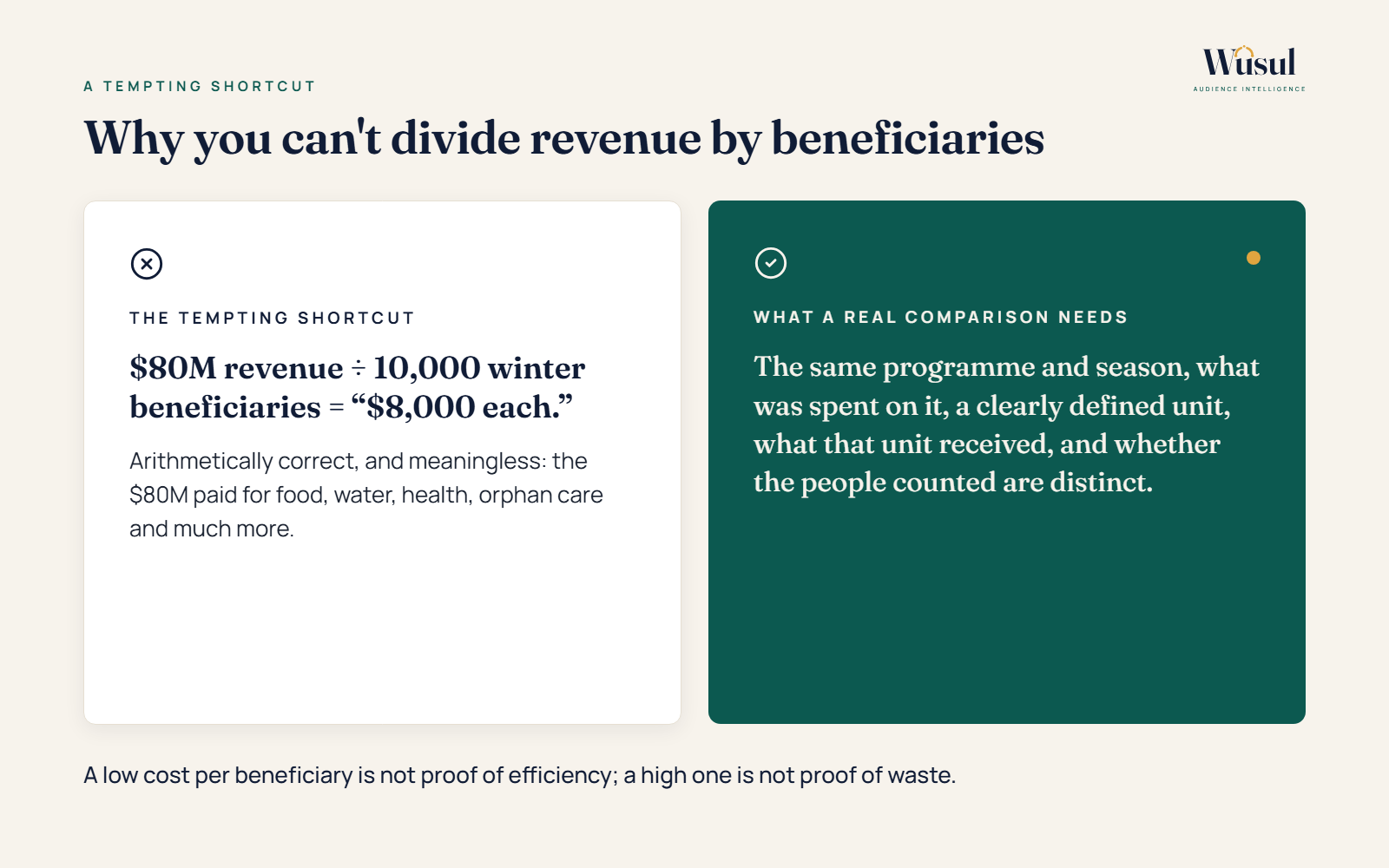
Even a genuine winter spending figure divided by winter beneficiaries needs care. Repairing a damaged home costs far more per family than a blanket. Three months of heating support is not comparable with one coat. Some charities count unique people, others count kits or distributions. A low cost per beneficiary is not proof of efficiency, and a high one is not proof of waste.
A meaningful winter cost comparison would need, for the same programme and season: what was spent on it, a clearly defined unit (person, household or kit), what that unit received, and whether the people counted are distinct. Without that, the figures most easily calculated from tax filings are the least informative, whoever is calculating them.
A winter campaign reconciliation
None of this requires new regulation. US charities already keep the underlying records: restricted gifts, programme budgets, distribution lists. What is missing is a short public statement each spring that puts them side by side. Wusul proposes a one-page winter campaign reconciliation:
| Item | What to disclose |
|---|---|
| Campaign period | When the winter appeal opened and closed |
| Raised | Donations given in response to the winter appeal, and how much was Zakat |
| Spent | What was spent on winter help this season, including funds from earlier years |
| Balance | What was carried forward, committed or reallocated, and to what |
| Planned reach | Households or people the programme aimed to reach |
| Actual reach | Distinct households or people reached, counted or estimated, by country |
| What they received | Kits, fuel, cash, clothing or shelter work, with quantities |
| Timing | Whether help arrived before the coldest weeks |
| Evidence of effect | What is known about warmth, shelter and heating afterwards |
The logic is the same as the reporting standard proposed in Wusul's Qurbani series: connect what was promised, what was raised, what was spent and what arrived, and label every estimate. A domestic coat drive and an overseas heating programme would fill the table differently, but in the same way.
The most useful line may be the balance. It is where a donor's reasonable question, "what happened to the rest?", gets an answer before anyone needs to ask.
Conclusion: America can count the money, but not yet the winter appeal
The eight charities in this review show the range of American Muslim winter giving: overseas heating fuel and clothing, kits in Syrian camps, coats and utility help for families in the United States. Most publish their products clearly. Several publish real delivery figures. A few publish season-wide reach. Their tax filings and audited accounts are among the most detailed in the sector.
Yet in all that material, the winter appeal itself barely exists as a number. Even one of the most detailed sets of accounts shows Qurbani as its own fund and gives winter no line at all. The public debate over Zakat reporting has exposed the same gap from another direction, and both sides of that debate agree it exists.
The remedy is not more impressive totals. It is a short, honest account each spring of what the winter appeal raised, what it spent, what was carried forward, and what reached families, published as plainly as the prices on the donation page.
The United States has a strong tradition of nonprofit financial disclosure. Winter appeals deserve the same: a clear account of what they raised, what they delivered and what changed for families.
Frequently asked questions
Which US Muslim charities run winter appeals?
Among others, Islamic Relief USA, Zakat Foundation of America, Baitulmaal, ICNA Relief USA, Human Appeal USA, Penny Appeal USA, Life for Relief and Development, Mercy-USA and Helping Hand for Relief and Development. Some work overseas, some in the United States, and some in both.
How much do US Muslim charities raise for winter?
There is no public total. None of the eight charities reviewed here publishes the amount raised by its winter appeal, and annual revenue figures cover all programmes, not winter alone.
Can a Form 990 show how much a charity raised for winter?
No. Form 990 reports organisation-wide finances. Audited accounts sometimes break restricted gifts down by purpose; Islamic Relief USA's 2024 accounts, for example, show a separate Qurbani fund, but no winter line.
Can my winter donation be used for something else?
Sometimes. Some charities' terms allow them to move a gift to another programme if the original one is fully funded or cannot be delivered. Human Appeal USA's winter page, for example, reserves that right. Check the terms before you give.
Is winter giving Zakat-eligible?
Many charities say so. Human Appeal USA, for example, states that its winter projects are Zakat-eligible. Ask how the charity records and reports Zakat separately.
Which charities publish winter results?
Several publish delivery figures. Human Appeal USA reports more than 23,000 people reached across five countries in 2025, Penny Appeal USA reported more than 25,000 in 2022, and Baitulmaal publishes reports of individual distributions.
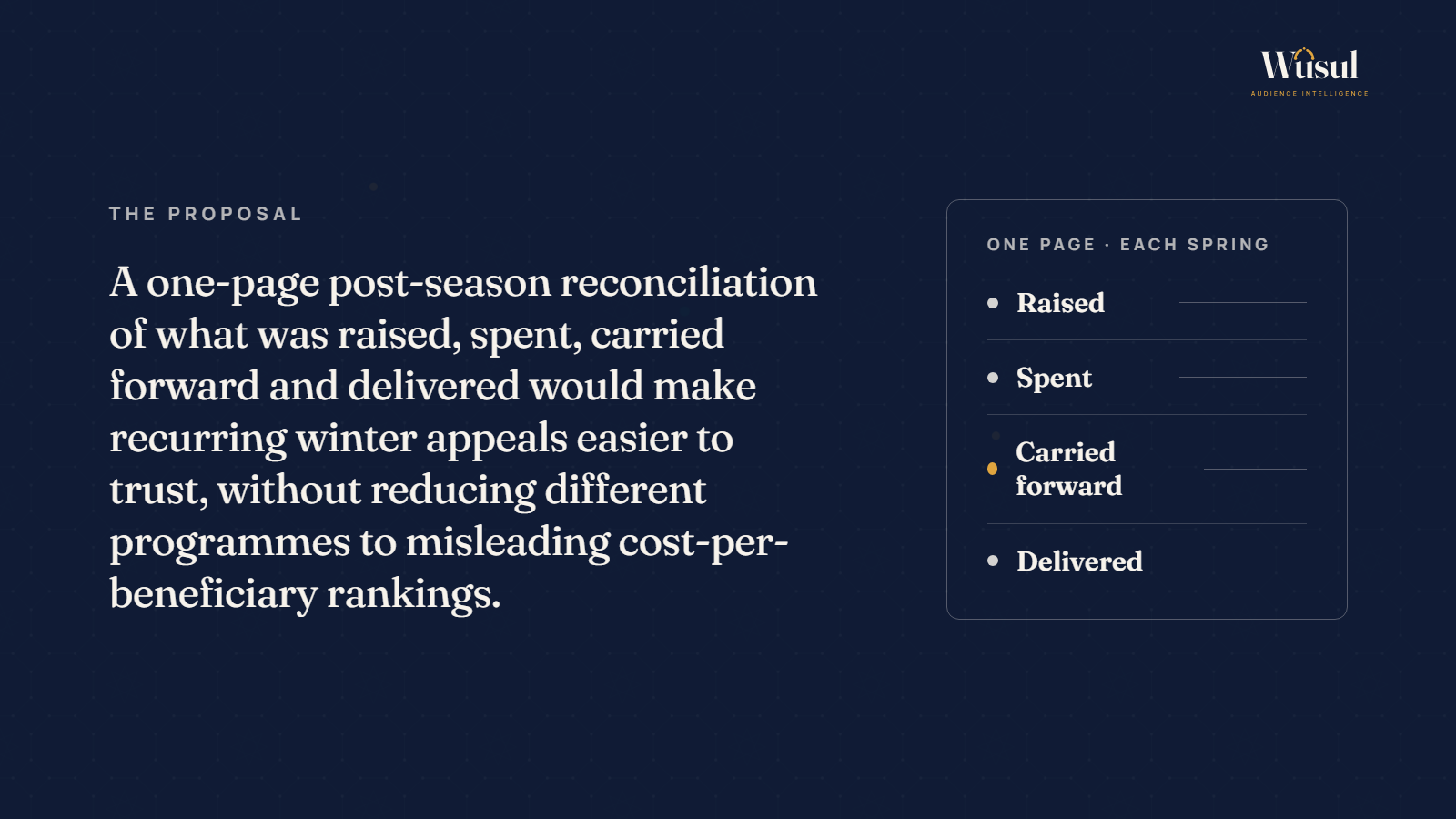
Wusul Insight: American Muslim charities are transparent about their organisations and increasingly concrete about their winter products, but the winter appeal itself rarely appears as a number. A one-page post-season reconciliation of what was raised, spent, carried forward and delivered would make recurring winter appeals easier to trust, without reducing different programmes to misleading cost-per-beneficiary rankings.
Methodology note: this is a review of public annual reports, tax filings, audited accounts, appeal pages and distribution announcements for eight US-facing charities, chosen because each runs a winter appeal and publishes some winter information. It is not an audit or a ranking. "Not found" means not located in the sources reviewed. Figures refer to different years, legal entities and scopes. Wusul takes no position in the debate over Zakat reporting; it is cited because it concerns the same reporting gap. The proposed reconciliation is an editorial framework, not a regulatory standard.
Sources note: This article is based solely on publicly available annual reports, financial statements, regulatory records and web pages published by the organisations named. None of the organisations discussed was involved in its preparation.