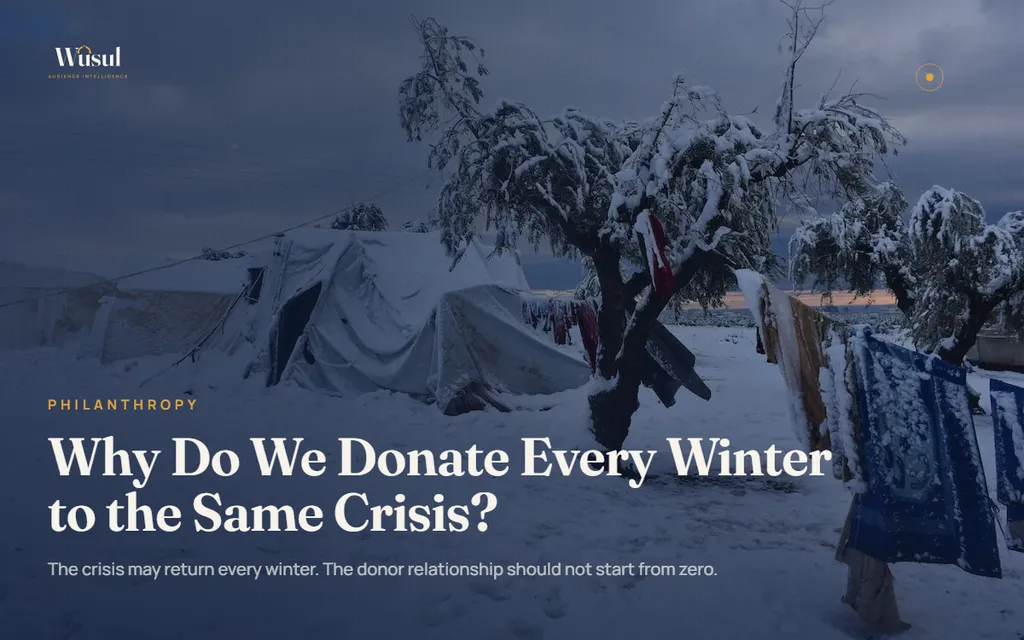
Imagine a donor who first gave to a Syrian winter appeal in 2013.
The message was urgent. Families had fled their homes and were living in tents and unfinished buildings. Winter was coming, and the charity needed money for blankets, heating fuel and shelter. The donor gave $100.
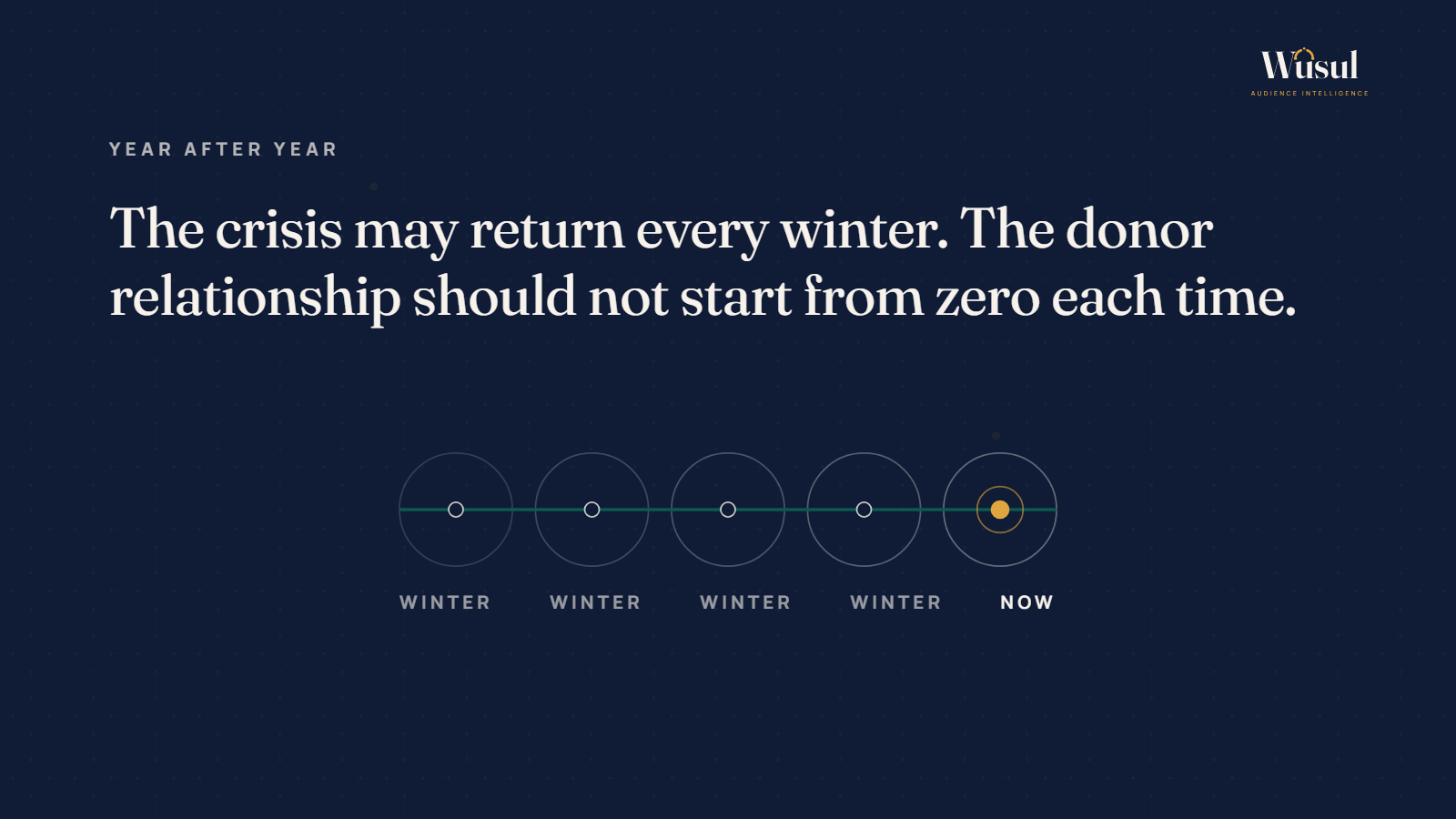
A year later, another appeal arrived. The families were still displaced. Winter had returned. The donor gave again. In 2018, another message. In 2021, another. In 2025, another. The photographs changed; the appeal did not: families facing freezing nights, children without warm clothes, a request to help before the cold turned dangerous.
Thirteen winters on, the donor might reasonably ask two questions. Why do these families still need help? And why does the charity still describe it as an emergency?
Neither question is indifference. The first is about how long humanitarian need lasts. The second is about the language charities use to describe it. For the charity, winter is a recurring operational challenge. For the family, it is another season of exposure. For the donor, it may be another email asking for money. Those three experiences do not produce the same understanding of what is happening.
The first article in this series raised this question: if the same family needs winter help again next year, how should a charity explain why last year's help was not enough? This article tries to answer it, from the donor's side. A crisis can remain genuinely urgent while the appeal describing it becomes familiar. That tension sits at the centre of winter fundraising.
When an emergency becomes a season
An emergency suggests something sudden. Winter is not sudden. Agencies know when temperatures will fall, which settlements are most exposed and when supplies must be bought. Yet winter appeals are almost always written in the language of emergency.
There is a good reason: predictable cold can still threaten lives when people lack shelter, heating or clothing. But there is also a cost. If the same emergency message returns every year, donors struggle to tell an acute deterioration from a continuing structural problem.
A family living in a tent for ten years may genuinely need winter help every year. The repetition does not make the help unnecessary. It does raise questions the appeal rarely answers. What happened after last winter's help? Did the family move somewhere safer? Can it now meet any of its winter costs itself? Was the help only seasonal relief, or part of something longer?
A campaign can describe urgent winter need truthfully without implying that every winter is a brand-new crisis. The difference is between communicating an emergency, and communicating an emergency as though it has no history. For donors who have given before, that history is the point.
Loyalty, not fatigue
The usual assumption is that people who are asked to give to the same crisis year after year will eventually tire of it. The data on donor retention points the other way.
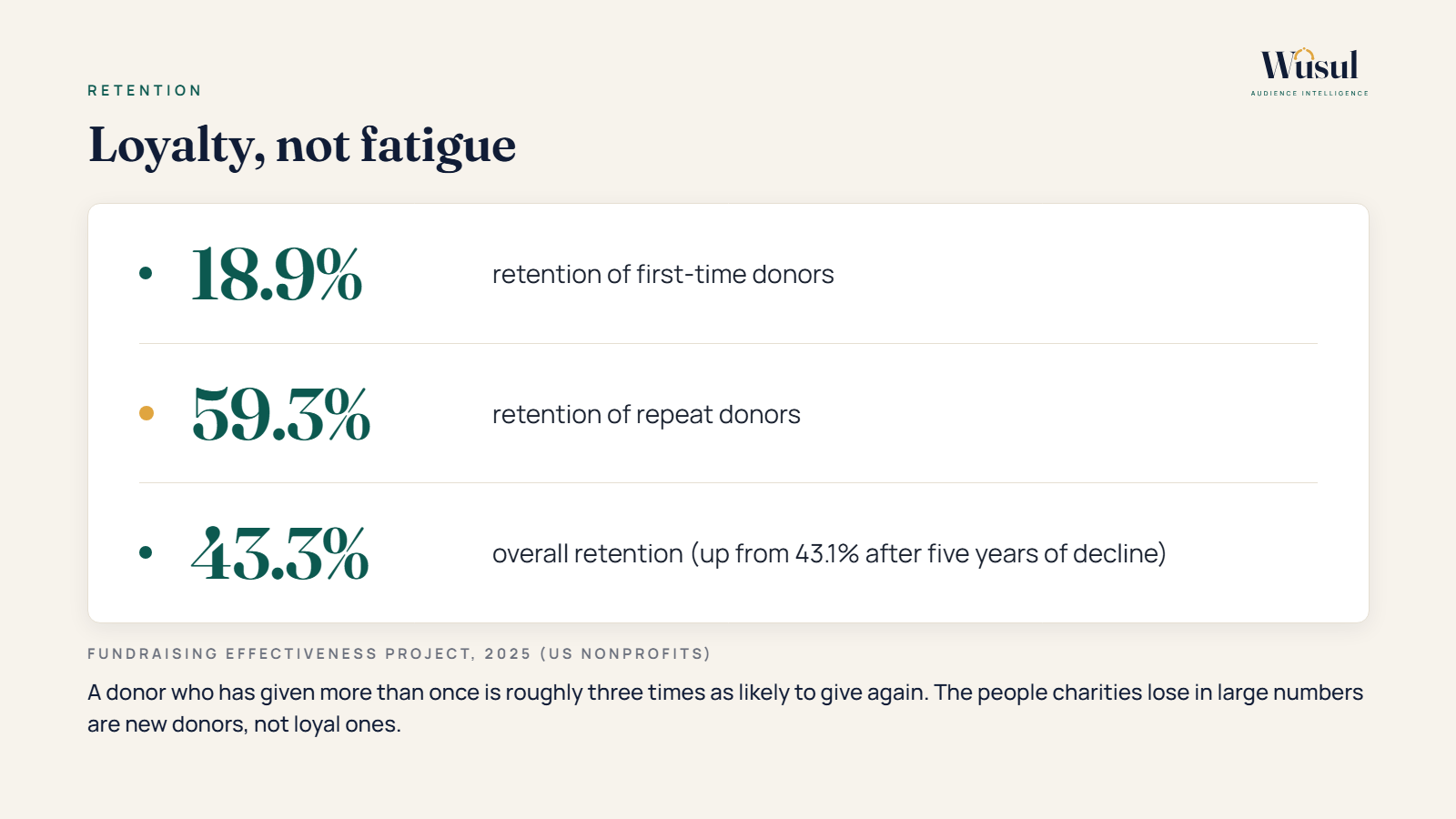
The Fundraising Effectiveness Project tracks giving across thousands of US nonprofits. Its figures for 2025 put retention of first-time donors at 18.9%, retention of repeat donors at 59.3%, and overall retention at 43.3%, edging up from 43.1% after five years of decline. In other words, a donor who has already given more than once is roughly three times as likely to give again as someone giving for the first time. The people charities lose in large numbers are new donors, not loyal ones.
Wusul's own research points the same way. In an analysis of 22 months of a partner charity's donations, the number of new donors to Gaza appeals rose and fell with news attention. Existing donors were far less sensitive: they kept giving whether or not Gaza was in the headlines. Their giving was anchored in the cause, not the news cycle.
That does not mean every repeat gift reflects deep engagement. A donor may still be giving because a direct debit was never cancelled, or because the same email arrives every December and they respond out of habit. Those gifts are valuable, but they say little about whether the donor understands the crisis or trusts the charity's account of it. A payment schedule is not the same thing as trust. The task is to turn habit into understanding, before habit runs out.
Five things called donor fatigue
"Donor fatigue" is used to explain almost any fall in giving. In practice it covers at least four different problems, and for Muslim charities a fifth:
- Too many requests. A donor who unsubscribes after a fourth email in a week is tired of the asking, not the cause.
- Tighter budgets. A donor whose bills have risen may care just as much and give less. In Britain, CAF found the share of people giving falling, from 65% in 2019 to 58% in 2023, while those who still give are giving more.
- Lost confidence. A donor who doubts the charity's effectiveness may still care deeply about the crisis, and give elsewhere.
- Emotional overload. A donor who turns away from yet another image of a freezing child may be protecting themselves, not losing compassion.
- A calendar illusion. Much Muslim giving follows the Islamic calendar, which moves about eleven days earlier each year. When retention is measured by Gregorian season or by a named campaign, a donor whose giving follows Ramadan can look as if they have joined, then left, a winter appeal, when they have simply kept giving on the same religious date. With Ramadan in the winter months from 2024 to about 2030, many Ramadan gifts will be counted as winter giving; as Ramadan moves into autumn, those donors will appear to "lapse" from winter appeals without changing their behaviour at all. Wusul examined this problem in Generosity Was Designed to Return: a loyal annual Ramadan donor flagged as lapsed by a Gregorian system.
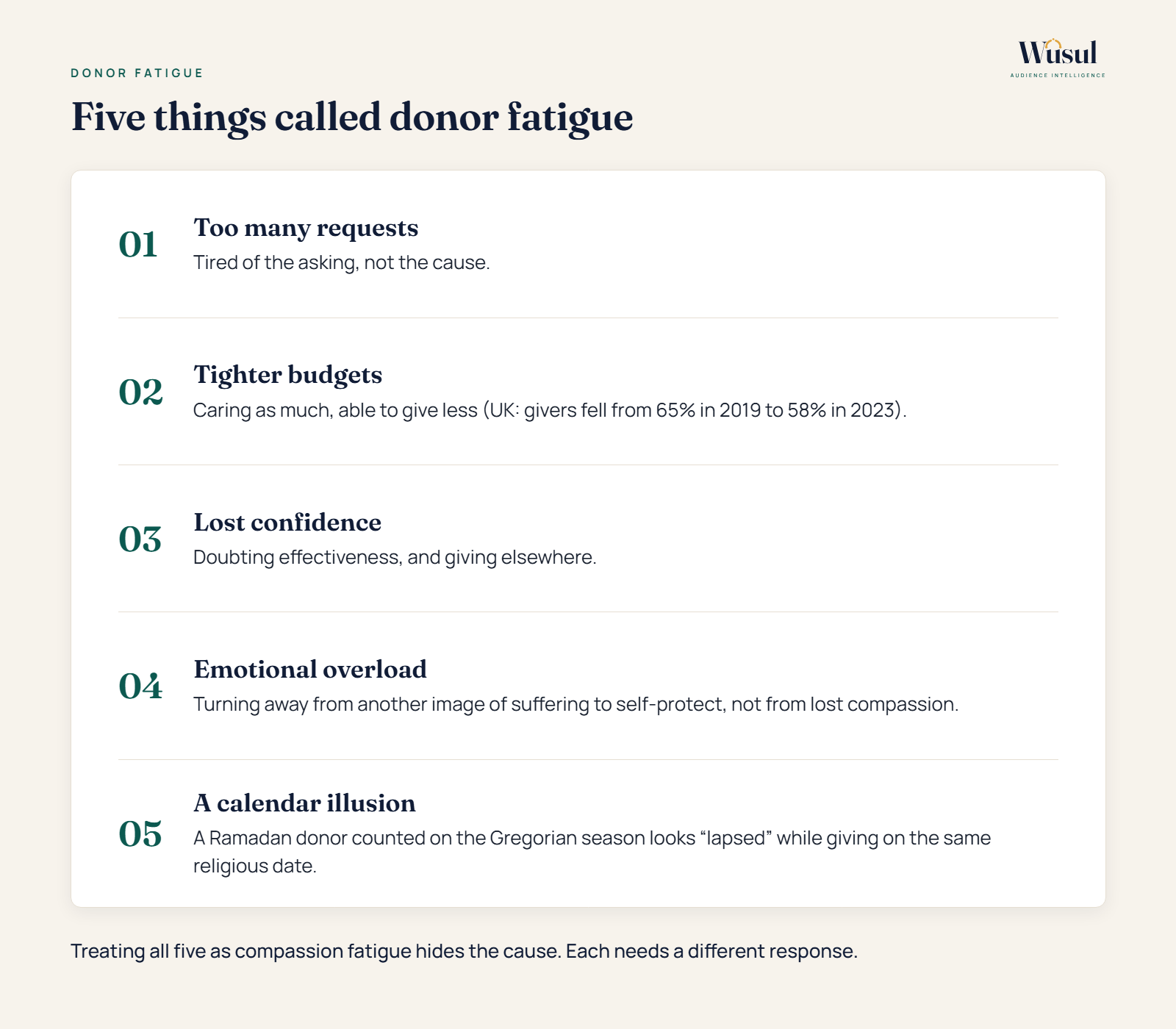
Treating all five as compassion fatigue hides the cause, and each needs a different response: fewer and better-timed asks, flexible giving, better reporting, more dignified storytelling, or retention measured on the Hijri calendar. Before diagnosing fatigue, a charity needs to know which of these it is looking at.
One child, one story, one winter
Winter appeals rely heavily on single stories: one child, one family, one freezing night. There is evidence behind this. In a 2014 study, Västfjäll, Slovic, Mayorga and Peters described compassion fade: emotional responses and willingness to help can weaken as the number of people in need grows, in some experiments already when going from one person to two. Presenting several people as a single, unified group could counteract the effect. A donor may feel more for one named child than for statistics about hundreds of thousands.
But the evidence is not a formula. A 2018 study in PLOS ONE, The Elusive Power of the Individual Victim, tested appeals focused on one victim against appeals focused on many and found no difference in their effectiveness in its settings. And compassion fade is about how people respond to numbers in a single decision. It does not show that donors exposed to the same crisis for ten winters inevitably care less. That is a different question, and it should not be answered by borrowing a term from a different experiment.
There is also an ethical cost to emotional repetition. When a crisis is presented every year through images of suffering children, families become recipients of blankets rather than people with histories, skills, relationships and plans. Their lives seem to begin when the fundraising camera arrives and end when the donation is complete. A charity should be able to show urgent need without reducing a whole population to the same image of helplessness, and to tell stories of adaptation and recovery alongside the hardship. Otherwise the campaign creates an endless visual emergency in which nothing ever seems to change, which may be exactly what wears donors down.
Asking again: what research on repeated requests shows
If fatigue is not the main problem, the way charities ask may be. Field experiments on charitable requests point to a consistent pattern: asking works, but people also work to avoid being asked.
In a field experiment with the Danish charity DanChurchAid, Damgaard and Gravert sent about 17,000 previous donors a fundraising email; half also received a reminder a week later. The reminder raised giving, but it also substantially increased unsubscriptions from the mailing list. Once the lost future donations from those who unsubscribed were counted, the reminder cut the long-term gain from the campaign by about a third. In a second test, promising donors fewer solicitations reduced unsubscriptions.
Other experiments find the same avoidance. When households were warned that fundraisers would call, fewer opened the door (DellaVigna, List and Malmendier, 2012). Shoppers took a different entrance to avoid a bell-ringer collecting for charity when they expected to be asked (Andreoni, Rao and Trachtman, 2017). Part of giving, these studies suggest, comes from social pressure, and pressure creates avoidance.
There is also hopeful evidence. In a 2023 laboratory study in Oxford Economic Papers, Späth found that giving people an unconditional option to opt out of future requests did not reduce giving; gratitude and reciprocity appeared to offset the lower pressure.
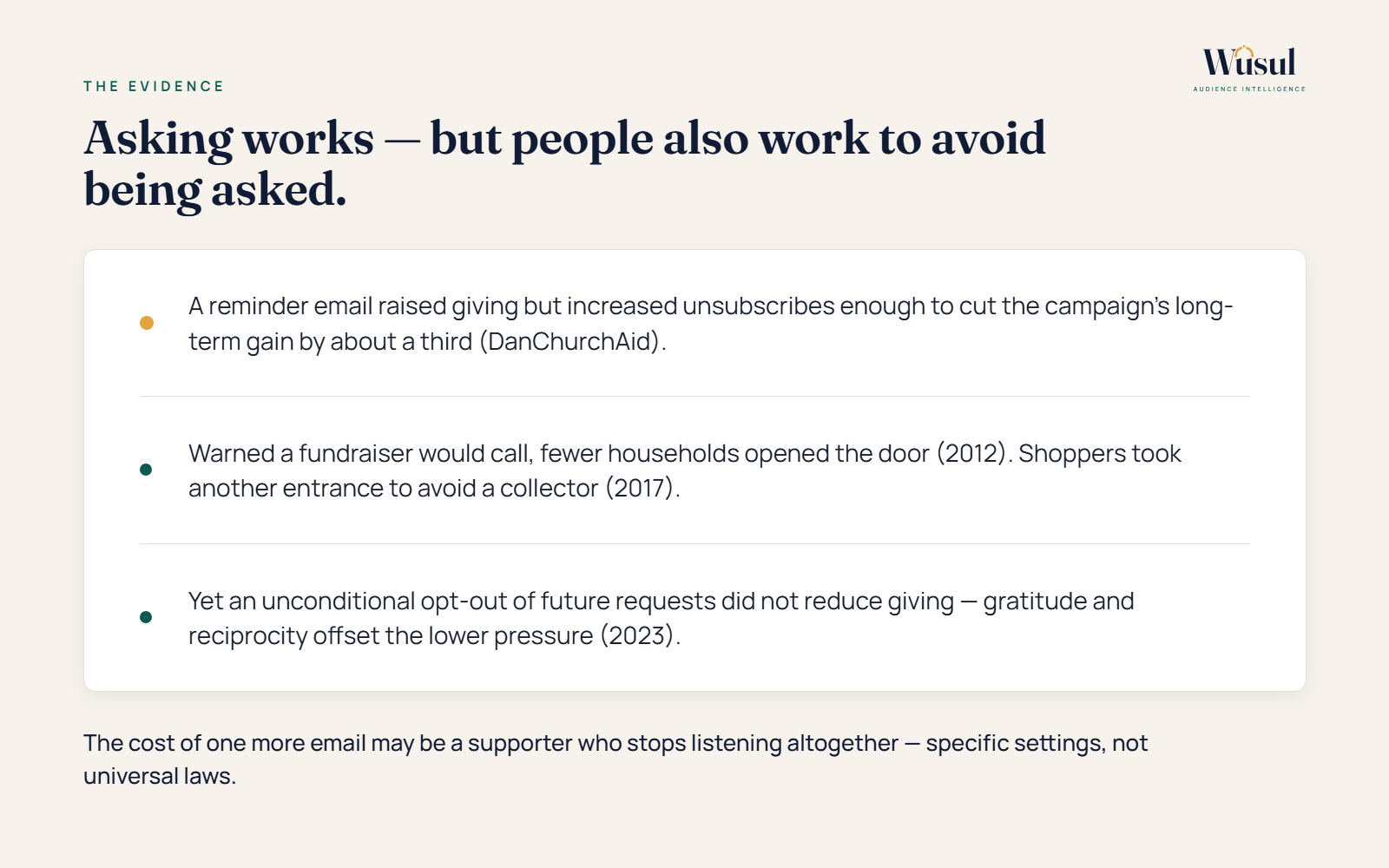
For winter appeals, the lesson is that the cost of another email is not only the chance that it is ignored. It may be a supporter who stops listening altogether. The problem may not be that donors have stopped caring about the crisis. They may simply want a different relationship with the organisation communicating it.
Why the same crisis may still deserve the same donation
None of this means repetition is the problem. A displaced family does not stop needing winter protection because donors have heard about it before. A tent does not become adequate because the crisis has fallen out of the news.
Some help is recurrent by nature. Heating fuel is burned. Children outgrow their clothes. Blankets wear out. Temporary shelters need repair every winter. A family may be displaced again or lose the little income it had. In these circumstances, repeated winter assistance is entirely appropriate, and the donor who funds it every year is doing exactly what the situation requires.
For many Muslim donors, the commitment has another dimension. Zakat is an obligation, due every year on eligible wealth; Sadaqah is voluntary. A donor who gives every winter, or every Ramadan, may be fulfilling a religious practice as much as responding to a particular appeal. Repetition is built into the giving itself.
The question is not whether charities may ask the same donors to help the same people again. It is whether they explain honestly why the need persists, distinguish emergency relief from recovery, and show whether repeated help is keeping people safe, preventing things getting worse, or helping them towards stability. The problem arises when charities ask again without explaining what the last gift achieved.
The missing message: what happened after last winter?
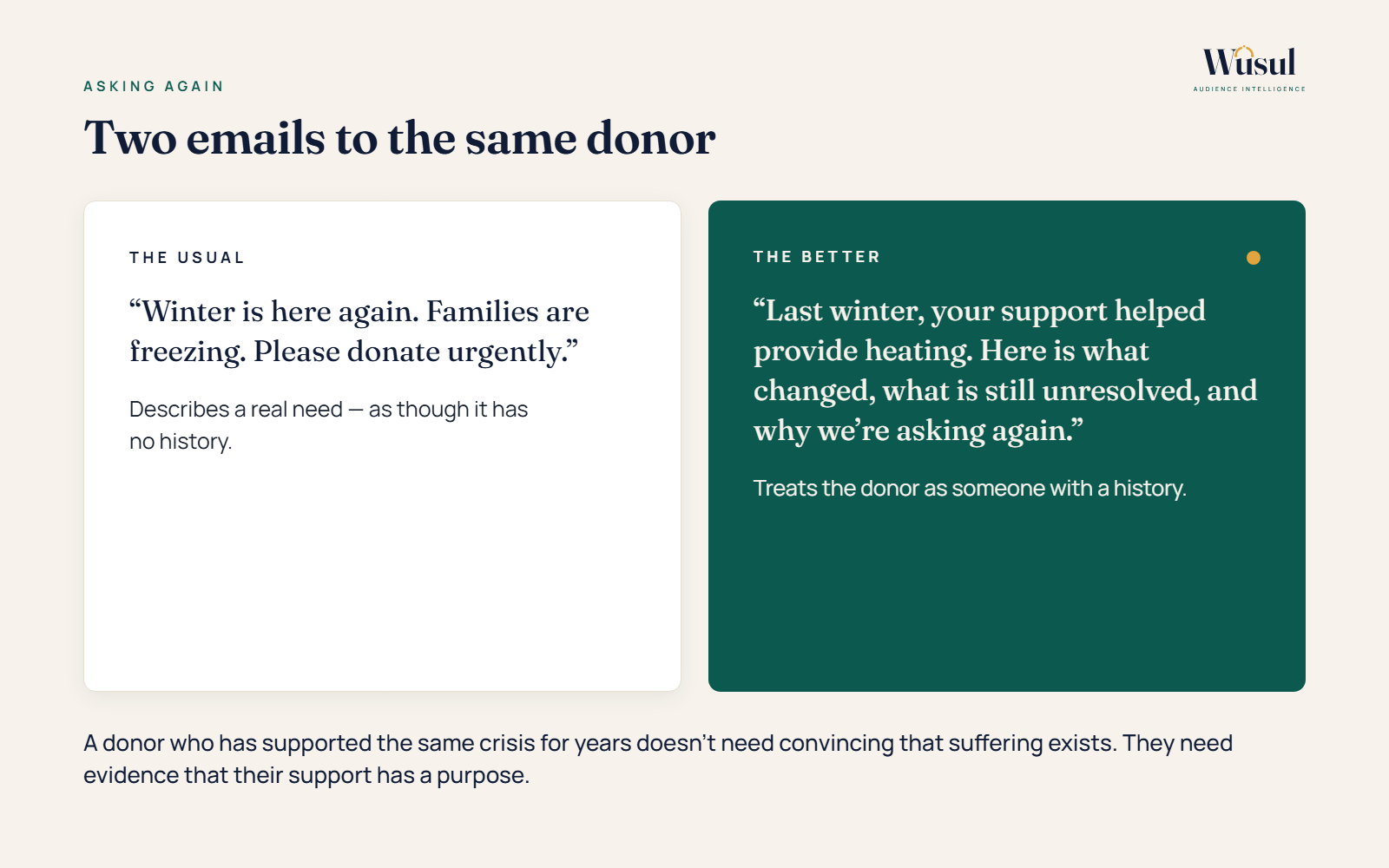
Consider two emails sent to someone who gave to a Syrian winter appeal last year.
The first: "Winter is here again. Families are freezing. Please donate urgently."
The second: "Last winter, your support helped us provide heating help to displaced families in north-west Syria. This year, many of those households still lack reliable income and safe shelter. Here is what changed, what is still unresolved, and why we are asking again."
Both describe a real need. Only the second acknowledges that the donor has a history with the cause and treats last year's gift as something that deserves an account of what happened next. Over time, that difference may matter more than finding a more powerful photograph. A donor who has supported the same crisis for years does not need to be convinced that suffering exists. They need evidence that their support has a purpose.
Winter fundraising usually runs as a cycle of urgency, gift and receipt, followed months later by the next urgent appeal. What is missing is the period in between. Did the supplies arrive? How many households were helped? Were distributions delayed? What needs were left unmet? Did any families move somewhere safer?
Not every answer will be simple, and some will be uncomfortable. But charities can report delays and limitations without losing donors' trust; for returning donors especially, candour may strengthen it. Reported this way, the annual appeal becomes part of a continuing relationship rather than a recurring request that seems disconnected from everything that came before.
How to test whether winter donors are tiring
Falling revenue alone cannot diagnose fatigue. A charity with several years of records can follow the donors who gave to a winter appeal in one year and see what they did next.
| Question | What to measure |
|---|---|
| Do winter donors come back? | Share giving again in the next winter appeal, and in any appeal |
| Is giving declining? | Inflation-adjusted giving per donor, per year |
| Are donors responding less often? | Gifts relative to the number of appeals actually received |
| Are they moving, not leaving? | Giving to other appeals within the same charity, such as Gaza instead of Syria |
| Is the calendar distorting the picture? | Retention measured on Hijri as well as Gregorian dates for donors who give at Ramadan |
| Is asking costing supporters? | Unsubscribes and complaints by frequency and type of message |
| Does reporting help? | Later giving among donors who received a report on last year's help |
Two cautions apply. First, campaign retention and organisational retention are different. A donor who stops giving to Syria but starts giving to Gaza, or gives less in winter and more in Zakat, has not been lost. Second, long-standing donors are already unusually committed, so comparing them with newcomers will flatter loyalty. Analyses should account for how donors were recruited, their past giving and how many messages they received.
The cleanest test is an experiment. Returning winter donors could be assigned at random to receive either a conventional emergency appeal or one that begins with an honest account of last year's help, with the same current need and the same way to give. Comparing gifts, average amounts, unsubscribes and next-year retention would show whether the second email works better. It would test one communication strategy, not a universal law, but it is the kind of evidence the sector rarely collects.
What charities should do differently
Stop treating every returning donor as a first-time witness. Someone who has supported a crisis for years should not always receive the same introduction. Acknowledge the relationship, without assuming what they remember.
Separate emergency need from structural need. Explain which winter risks demand immediate action and which come from years of displacement, poverty or broken infrastructure.
Report continuity, not just activity. Distribution totals matter, but returning donors also need to know what changed since last winter, and why help is still needed.
Count the asks. Track how many requests each supporter receives across all appeals, not only winter. The DanChurchAid experiment suggests the cost of one more email can be a supporter lost for good.
Offer real choices. Let supporters choose updates, appeals or fewer messages. A preference for less contact is not a lack of concern.
Measure loyalty on the right calendar. For donors who give at Ramadan, assess retention on the Hijri calendar before declaring anyone lapsed.
Tell fuller stories. Test stories of verified outcomes, continuing need and the dignity of the families involved alongside the single image of suffering.
Measure loyalty across causes. A supporter moving from one appeal to another is not a lost donor.
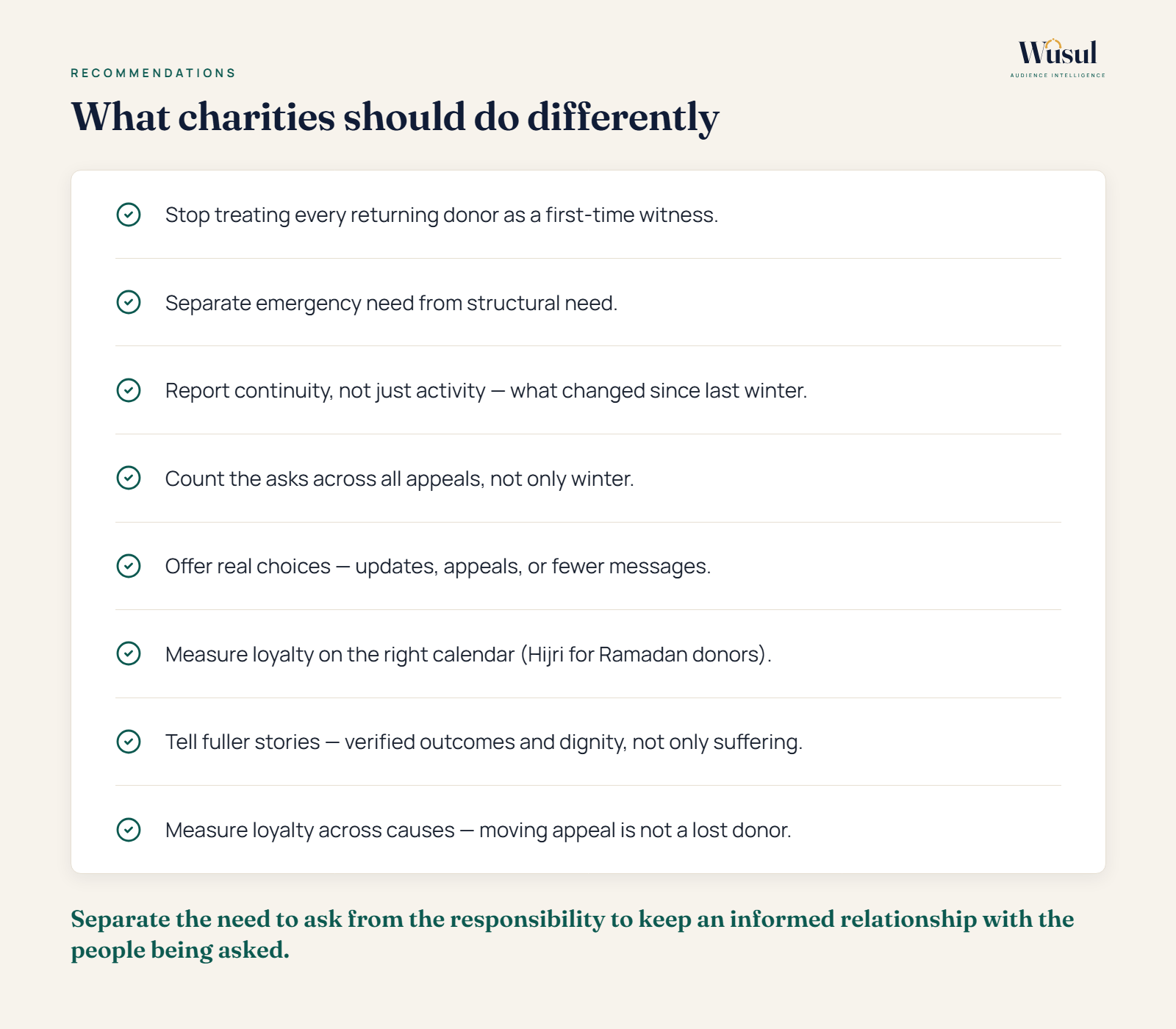
None of these guarantees more money. Their value is that they separate the need to ask from the responsibility to keep an informed relationship with the people being asked.
The deeper question: why is the crisis still here?
There is one more possibility fundraisers should take seriously. When a donor asks why the same crisis needs help every winter, they may not be tired at all. They may be asking a fair question about the humanitarian system.
Why has temporary shelter become permanent accommodation? Why can families still not afford heating? Why is seasonal help still needed after years of international funding? Why are recovery and lasting solutions so hard to reach?
A winter appeal cannot answer all of that. Much of it depends on conflict, politics, economics and access far beyond any one charity's control. But charities should not avoid the questions because the answers are complicated. Repeated appeals create an obligation to explain repeated need.
That explanation may mean admitting that humanitarian aid has prevented harm without resolving the crisis; showing that some households have recovered while others remain vulnerable; and separating what a charity can credibly claim from changes it cannot control. For the donor, that is not a less compelling story. It is a more credible one.
Conclusion: the crisis repeats. Must the appeal?
Why do we give every winter to the same crisis? Because the need genuinely returns. Because many donors make lasting commitments, and for Muslim donors those commitments are often part of their faith. Because giving becomes a habit. Because a single story can make distant suffering real. And because charities have built annual campaigns around a predictable season.
Why do some donors stop? The answer is less certain, and rarely just fatigue. They may face tighter budgets, receive too many requests, lose confidence, turn away from repeated images of suffering, or, in the case of Ramadan donors, simply be counted on the wrong calendar. The evidence suggests that the donors who have already returned are the ones most likely to stay.
The challenge for charities is not to stop asking. While winter needs remain unresolved, that is impossible. It is to make repeated giving meaningful: to tell a returning donor what last year's gift achieved and why another is needed, to show the families helped as more than another seasonal photograph, and to explain, year after year, what has changed and what has not.
Frequently asked questions
What is donor fatigue?
A loose term for falling responsiveness to appeals. In practice it can mean too many requests, tighter household budgets, lost confidence in a charity, or emotional overload from repeated images of suffering. Each has a different cause and a different remedy.
Do donors get tired of giving to the same crisis?
The evidence suggests the opposite for many. Across US nonprofits in 2025, donors who had given more than once were about three times as likely to give again as first-time donors. Wusul's own research found that existing donors to Gaza appeals were far less affected by falling news attention than new donors.
Is compassion fade the same as donor fatigue?
No. Compassion fade describes weaker emotional responses as the number of people in need increases within a single decision. It does not show that long exposure to a crisis makes donors care less.
Do more reminders raise more money?
In the short term they can, but at a cost. In one field experiment, a reminder email increased donations but also increased unsubscriptions enough to cut the campaign's long-term gain by about a third.
Why might a loyal Muslim donor appear to have lapsed?
Because much Muslim giving follows the Islamic calendar, which moves about eleven days earlier each year. A donor who gives every Ramadan can appear to join or leave a winter appeal as Ramadan moves through the seasons, without changing their behaviour.
What should charities tell returning winter donors?
What last year's gift achieved, what has and has not changed, and why help is needed again, rather than repeating the same emergency message.
Wusul Insight: Returning to the same crisis every winter is usually commitment, not fatigue: repeat donors are far more likely to stay than new ones. What erodes that commitment is too many asks, too little explanation, and, for Muslim charities, measuring loyalty on the wrong calendar. Charities that tell returning donors what their last gift achieved turn an annual appeal into a relationship.
Research note: this article combines published research on charitable behaviour, US and UK giving data, and Wusul's own analysis. It does not present original longitudinal data on winter donors. Fundraising Effectiveness Project figures describe participating US nonprofits and are not specific to winter appeals or Muslim charities. Experimental findings describe particular settings and should not be read as universal laws.