For global brands, timing is often as important as the message itself. And for Muslim audiences, timing means the Islamic calendar: its months, its Muslim holidays, and the giving seasons around them.
Companies spend millions understanding Christmas shopping habits, Chinese New Year spending, or Black Friday purchasing behavior. Yet many overlook one of the world's most influential cultural calendars: the Islamic (Hijri) calendar.
With nearly two billion Muslims worldwide spread across every continent, the Muslim calendar shapes not only religious life but also consumer behavior, family routines, media consumption, travel patterns, charitable giving, and purchasing decisions. Brands that understand these rhythms communicate more effectively, avoid cultural missteps, and build stronger relationships with Muslim audiences.
Understanding the Muslim calendar isn't simply about knowing when Ramadan begins. It is about recognizing how time itself is experienced differently within Muslim communities and how marketing should adapt accordingly.
What is the Islamic (Hijri) calendar?
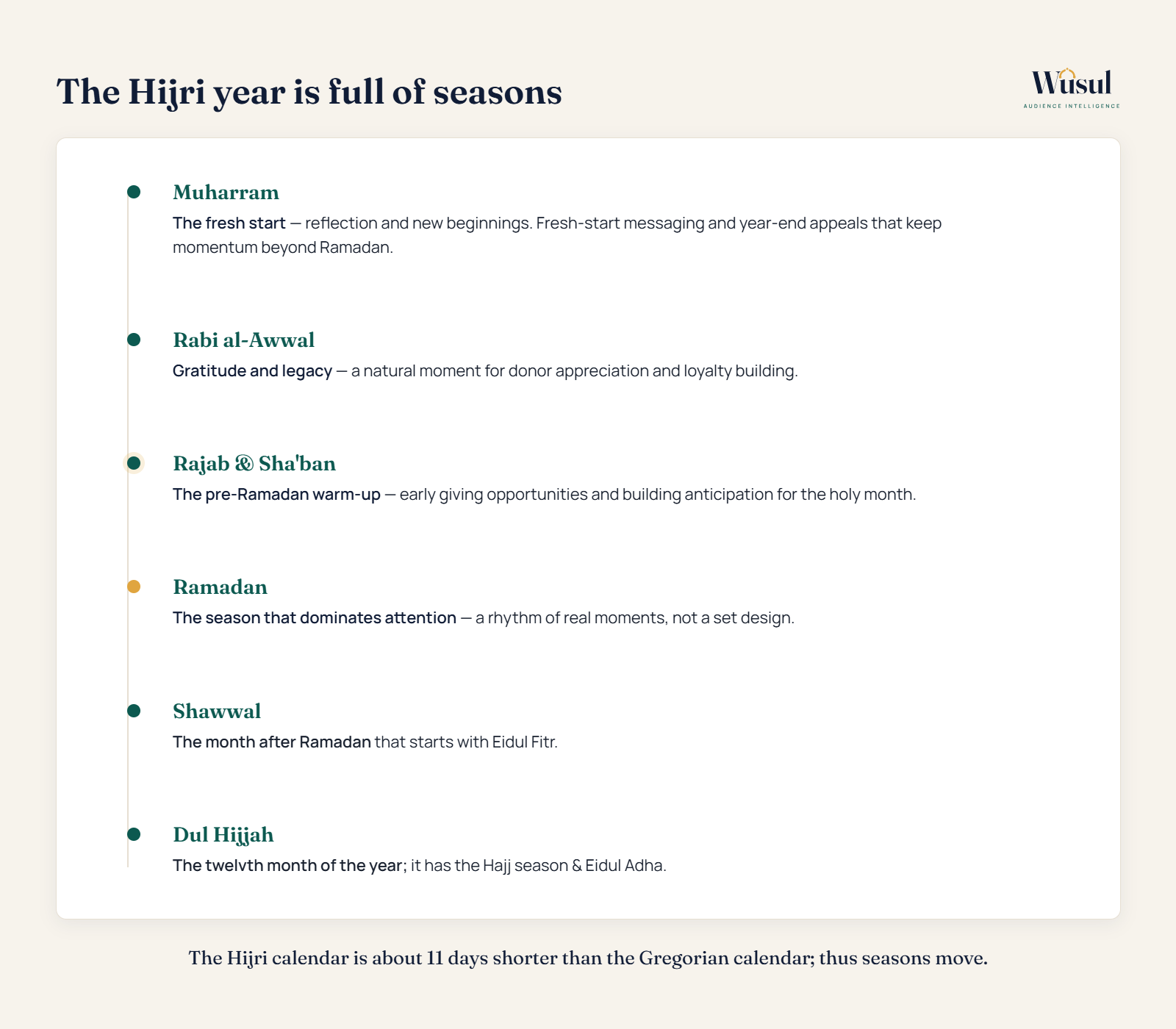
Unlike the Gregorian calendar, the Hijri calendar doesn’t track the sun; it follows the moon. That's why it’s about 11 days shorter than the standard solar year, making the Islamic seasons move every year as it constantly cycles through the seasons.
The calendar marks the beginning of the Hijrah (which in Arabic means migration), the Prophet Muhammad’s (PBUH) journey from Makkah to Medina in 622 CE. This wasn't just a trip; it was the birth of the first Muslim community. When we use the Hijri calendar, we aren't just counting days, we are marking time from the very moment that community began.
Why understanding the muslim calendar matters
Tired of guessing when holidays start? The Hijri calendar is the heartbeat of Muslim life. Mastering its lunar cycle helps you track sacred months, plan trips, and sync with the global community. Stop wondering why dates shift and start owning your schedule. Let’s decode the moon’s math and turn your calendar into a tool for intentional, meaningful living.
Beyond Ramadan: Muslim holidays across the Islamic calendar months
While Ramadan dominates attention, the Islamic calendar offers multiple moments for meaningful engagement throughout the year.
Muharram: the fresh start opportunity
Muharram, the first month of the Islamic calendar, represents a time of reflection and new beginnings. Muslim charities and brands that understand this can craft fresh start messaging and year-end appeals that resonate with donors and consumers alike, maintaining momentum beyond the Ramadan season.
Rabi al-Awwal: gratitude and legacy
This month marks the birth of the Prophet Muhammad and is often associated with gratitude, reflection, and community connection. Organizations can leverage this theme for donor appreciation campaigns, thanking supporters for their contributions, and building lasting loyalty.
Rajab and Sha'ban: The Pre-Ramadan Warm-Up
These months serve as spiritual preparation for Ramadan. Smart marketers recognize this as a time for pre-Ramadan engagement; offering early giving opportunities, promoting spiritual reflection, and building anticipation for the holy month.
The Eids: the biggest Islamic holidays
Both Eid al-Fitr (in Shawwal) and Eid al-Adha (Dhul-Hijjah) create strong emotional moments comparable to major holiday seasons in many parts of the world.
Muslim consumers purchase new clothing, gifts, children's products, home décor, travel experiences, and luxury items
Marketing messages emphasizing celebration, togetherness, appreciation, and generosity often resonate more strongly during these periods than purely promotional messaging.
Sunni and Shia: One Calendar, Two Lenses
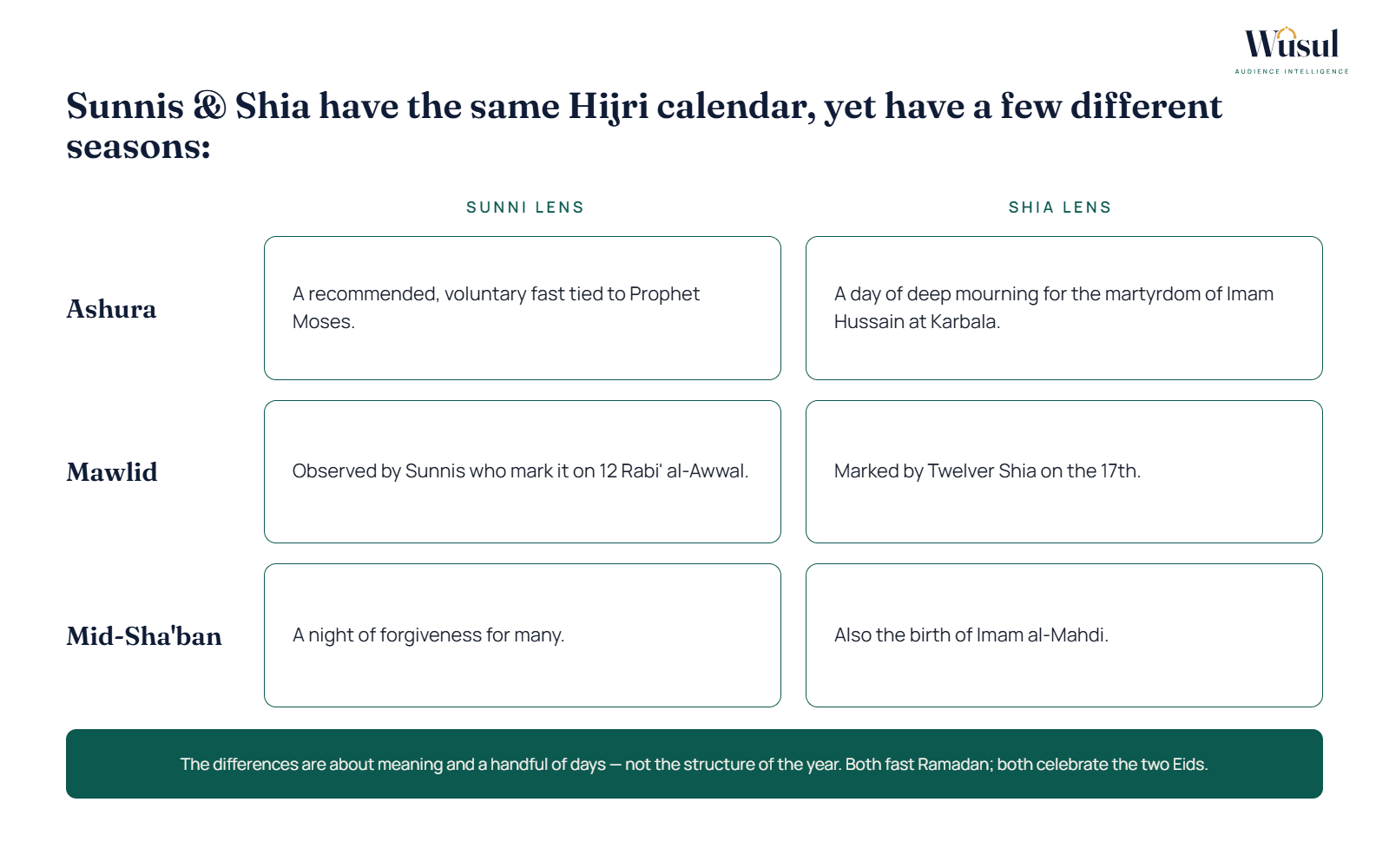
A common myth is that Sunnis and Shia use different calendars. They do not. Both follow the same 12-month Hijri lunar calendar, both fast Ramadan, and both celebrate the two Eids; Eid al-Fitr and Eid al-Adha. The differences are about meaning and about a handful of extra days, not about the structure of the year.
Where they read the same day differently
Ashura: Sunnis celebrate it as a recommended, voluntary act tied to Prophet Moses. Shia observe it as deep mourning for the martyrdom of Imam Hussain at Karbala.
Mawlid: Sunnis who observe it mark 12 Rabi' al-Awwal; Twelver Shia mark the 17th.
Mid-Sha'ban: A night of forgiveness for many; for Shia, also the birth of Imam al-Mahdi.
Why cultural intelligence matters
Younger, digital-first audiences are increasingly skeptical of copy-paste campaigns that rely on generic imagery; lanterns, dates, crescents, along with vague "togetherness" messages. As one strategist notes, "Ramadan is a month of many layers. Too often, ads reduce it to the same familiar symbols... But Ramadan is not a set design. It is a rhythm of real moments, emotions, and details that tell a deeper story."
Generic Ramadan imagery no longer works
Brands that tap into real, local moments tend to connect more deeply, with better sentiment, stronger engagement, and higher recall. In the UK, IKEA's 2026 "Iftar at Ours" campaign that created pop‑up “home away from home” living rooms in central commuter locations (Southbank, London and Exchange Square, Manchester) where fasting Muslims could pause their journeys, pray, and share a free three‑course iftar meal. This stands in contrast to the hollow, generic "brand Islam" that floods marketing during Ramadan; the stereotypical lanterns and crescents without genuine cultural understanding.
Common cultural missteps to avoid
Many global campaigns unintentionally create discomfort because they rely on assumptions rather than understanding.
Common mistakes include:
- Treating Ramadan as simply a food marketing opportunity.
- Scheduling daytime food promotions in Muslim-majority markets without context.
- Using inappropriate imagery around sacred occasions.
- Confusing Eid al-Fitr with Eid al-Adha.
- Assuming all Muslims celebrate the same way regardless of geography or culture.
Successful campaigns don't just overlay crescent moons on existing assets; they align with the calendar, the values of the community, and the emotional experiences of Muslim consumers. Because in a world where 2 billion people are guided by the Islamic calendar, understanding that calendar is the foundation of authentic engagement.
At Wusul, we believe that cultural intelligence begins with understanding the rhythms of Muslim life. The Islamic calendar is more than a schedule of holidays; it is a framework for connection. For organizations seeking to engage Muslim audiences authentically, investing in this understanding is not optional. It is essential.