Every Islamic charity knows the donor who built the sector: the parent or grandparent who gives faithfully every Ramadan, responds to the emergency appeal, trusts the institution, and writes the cheque, sometimes literally.
That donor is still here, still generous, still essential. But behind them is a generation entering its earning and giving years with the same tradition of generosity and almost nothing else in common with how the sector reaches donors today.
Muslim communities in both the UK and US skew dramatically young, among the youngest faith populations in both countries. That means the Gen Z cohort isn't a future consideration for Islamic charities. It is the present pipeline. And most fundraising operations were not built for it.
What carries over for Muslim Gen Z, and what doesn't
Start with the good news, because it's genuinely good: the obligation and the instinct to give are intact. Zakat doesn't expire between generations. Sadaqah, Ramadan generosity, Qurbani: the framework that makes Muslim communities among the most reliably generous in the West is inherited. Gen Z Muslims are not less giving than their parents.
What changes is everything around the gift:
Who they trust. The older generation trusted institutions: the established charity name, the mosque endorsement, the community elder. Gen Z extends trust differently: to people over logos, to creators and peers over institutions, and to evidence over reputation. A charity's name opens fewer doors on its own; what the charity can show matters more.
What they expect to see. This is the generation of the receipt. They expect to know where the money went, what it did, and to see it, quickly, visually, and without having to ask. "Trust us, we've been doing this for thirty years" worked on their parents. "Here's the well, here's the village, here's the update" works on them. Transparency isn't a nice-to-have in their giving journey; it is the giving journey.
Where they live. Not on the email list, mostly. Not at the fundraising dinner, usually. They're on the platforms where their attention already is, discovering causes through short video, peer shares, and creators they follow, then giving in two taps or not at all. A donation flow with friction designed for desktop banking will quietly lose them at the exact moment of intent.
How they give. Smaller amounts, more often, more impulsively at first (a fiver at midnight in Ramadan because something moved them) with the capacity to become committed regular givers if the relationship is built. The first gift is a beginning, not a conversion. Charities that treat a £5 first-time donor as a £5 donor, rather than as a future monthly giver at the start of a forty-year relationship, are reading the moment exactly backwards.
What moves them. Justice framing alongside charity framing. Dignity in how beneficiaries are portrayed: this generation is acutely sensitive to poverty-porn and will penalise it. Causes connected to identity and global community. And authenticity as a threshold condition: they can detect manufactured sentiment at a glance, because they grew up inside the internet that produces it.
Gen Z giving: the retention problem nobody is measuring
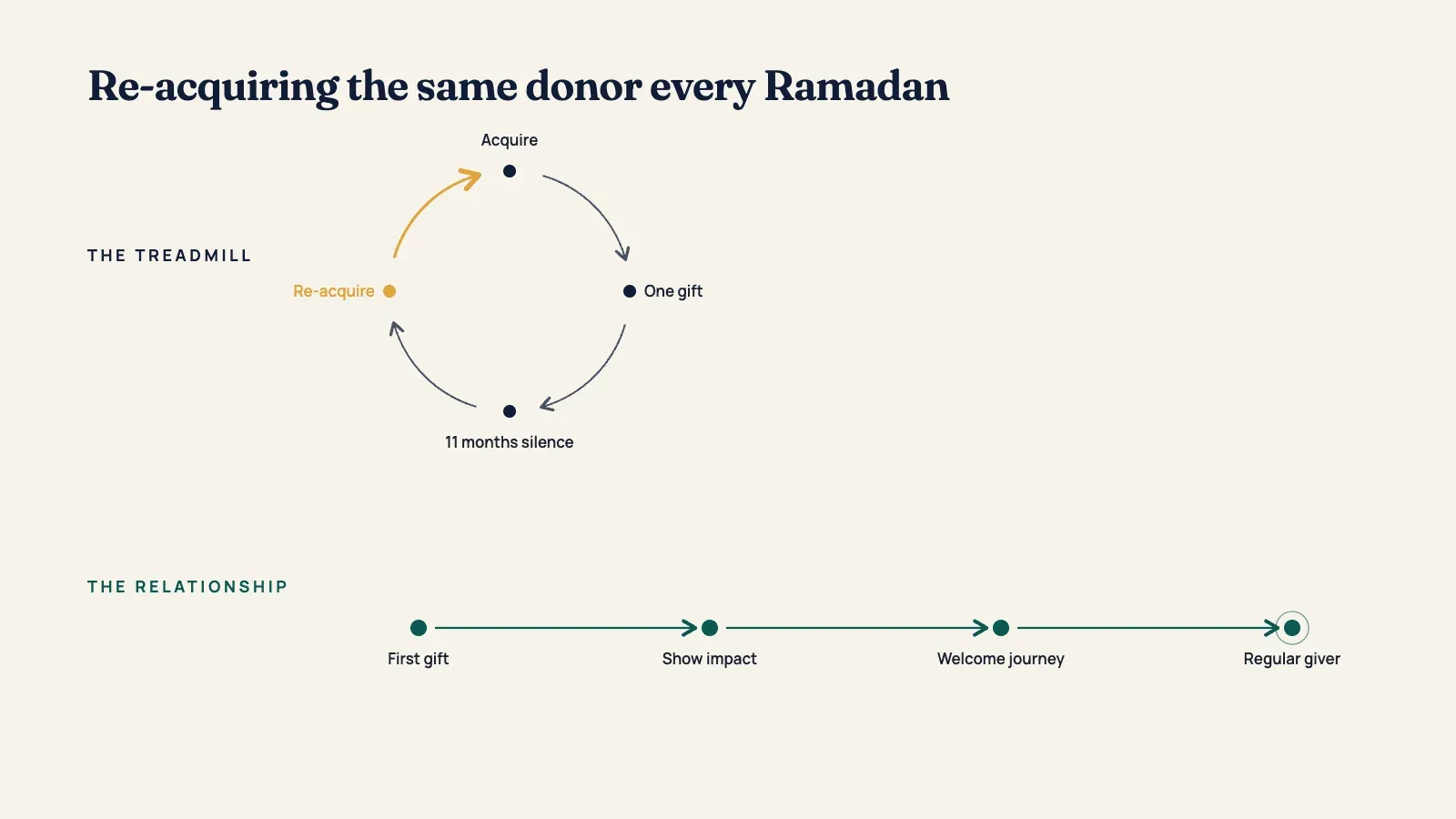
Here's the uncomfortable part. Many charities are acquiring young Muslim donors, Ramadan campaigns on social platforms see to that. The silent failure is what happens next: nothing. The young donor gives once, receives a generic receipt email written for their parents, hears nothing relevant for eleven months, and is "re-acquired" from scratch (at full media cost) the following Ramadan.
That isn't a retention strategy; it's an annual acquisition treadmill. And it's invisible in most reporting, because the sector's dashboards measure campaign totals, not cohort relationships. The single highest-leverage question a charity can ask about young donors is not "how do we reach them?", it's "what happened to the ones who already gave?"
What to change, practically
None of this requires abandoning the donors who built the institution. It requires running a second playbook alongside the first:
- Build the journey for the first-time small gift. A young-donor welcome path: immediate, visual impact confirmation; a follow-up that shows outcomes, not asks; an invitation to regular giving framed around Sadaqah Jariyah, ongoing reward for ongoing giving, a concept this audience already owns.
- Show the work, permanently. Make impact evidence a content stream, not an annual report. Where the money went, shown the way this generation consumes everything: short, visual, frequent, honest.
- Borrow trusted voices honestly. Partner with creators and community figures who already hold this audience's trust, for genuine collaboration, not logo placement. One authentic advocate outperforms a media budget of polished anonymity.
- Remove every step you can from giving. Mobile-first, wallet payments, two taps. Audit your own donation flow on a phone, at night, on mobile data. That's where your next decade of donors is deciding.
- Respect the calendar, all of it. Ramadan remains the peak, but this cohort responds year-round to moments of meaning: Dhul Hijjah, crises, awareness moments, GivingTuesday. Eleven months of silence is eleven months of someone else building the relationship.
- Measure cohorts, not campaigns. Track second-gift rate, young-donor retention, and lifetime value by generation. What gets measured gets funded, and right now, the most important number in the sector's future mostly isn't on its dashboards.
The decade that's being decided now
Giving habits formed in a donor's twenties tend to compound for life. The charities that build genuine relationships with Gen Z Muslim donors now (on their channels, in their language of evidence and dignity) won't just survive the generational transition. They'll inherit it.
The generosity is not in question. It never was. The only question is which organisations will deserve it.
Wusul helps Islamic charities understand, reach, and retain Muslim donors across generations, with donor intelligence, calendar-native strategy, and honest measurement. If your young-donor retention is a number you've never seen, book a call.