A donor browsing a winter appeal can choose between £50, £100 or £350 in seconds. The decision feels straightforward: one amount buys food, another blankets, another a complete winter package. But behind those neat donation buttons lies a far more complicated humanitarian reality.
A "winter kit" is not a standard product. Its contents vary from one organisation to another, from one country to the next, and sometimes from one year to another. The price on the page is not necessarily what the charity pays, what the programme costs, or even what a family ultimately receives.
This article, the second in Wusul's winter series, examines what those familiar donation amounts actually represent, how they compare with the costs published by humanitarian agencies, and whether today's winter fundraising pages give donors enough information to understand what their gift really buys.
A look at Islamic Relief’s kits
Islamic Relief UK's winter appeal page offers a donor five ways to help: a £50 food pack, a £100 winter essentials kit, a £160 fuel and winter essentials kit, a £210 basic winter pack and a £350 complete winter pack. Elsewhere the charity describes the £100 kit as blankets, quilts, shawls, sweaters and mattresses.
The tiers are clear. Each step up seems to buy another layer of protection. But they leave the questions a careful donor might ask unanswered. How many people is the kit for? How many blankets does it contain? How long will the fuel in the £160 pack last? Would the same £100 do more in northern Syria, Afghanistan or Lebanon? And is £100 what the kit costs the charity, or a suggested amount that feeds a wider programme?
None of this makes the appeal misleading. Every winter appeal faces the same task: turning a programme of cash transfers, supplier contracts, fuel, repairs and monitoring into a handful of prices a donor can understand. The first article in this series traced how winter became a fixed humanitarian season. This one looks at the products sold within it: what a winter price on a donation page represents, how it compares with what the sector actually pays, and what families do with the help.
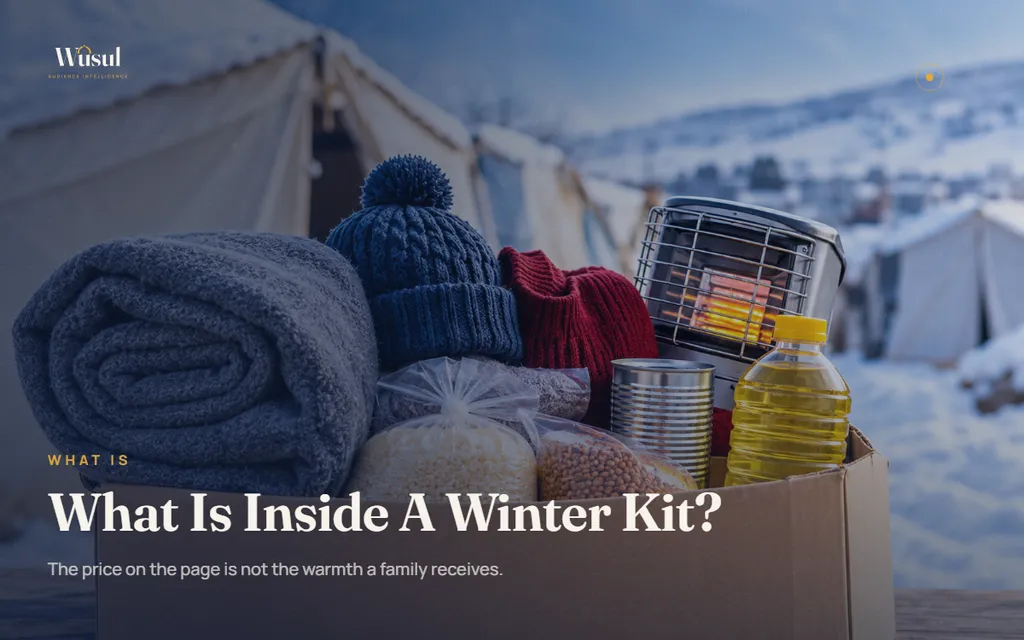
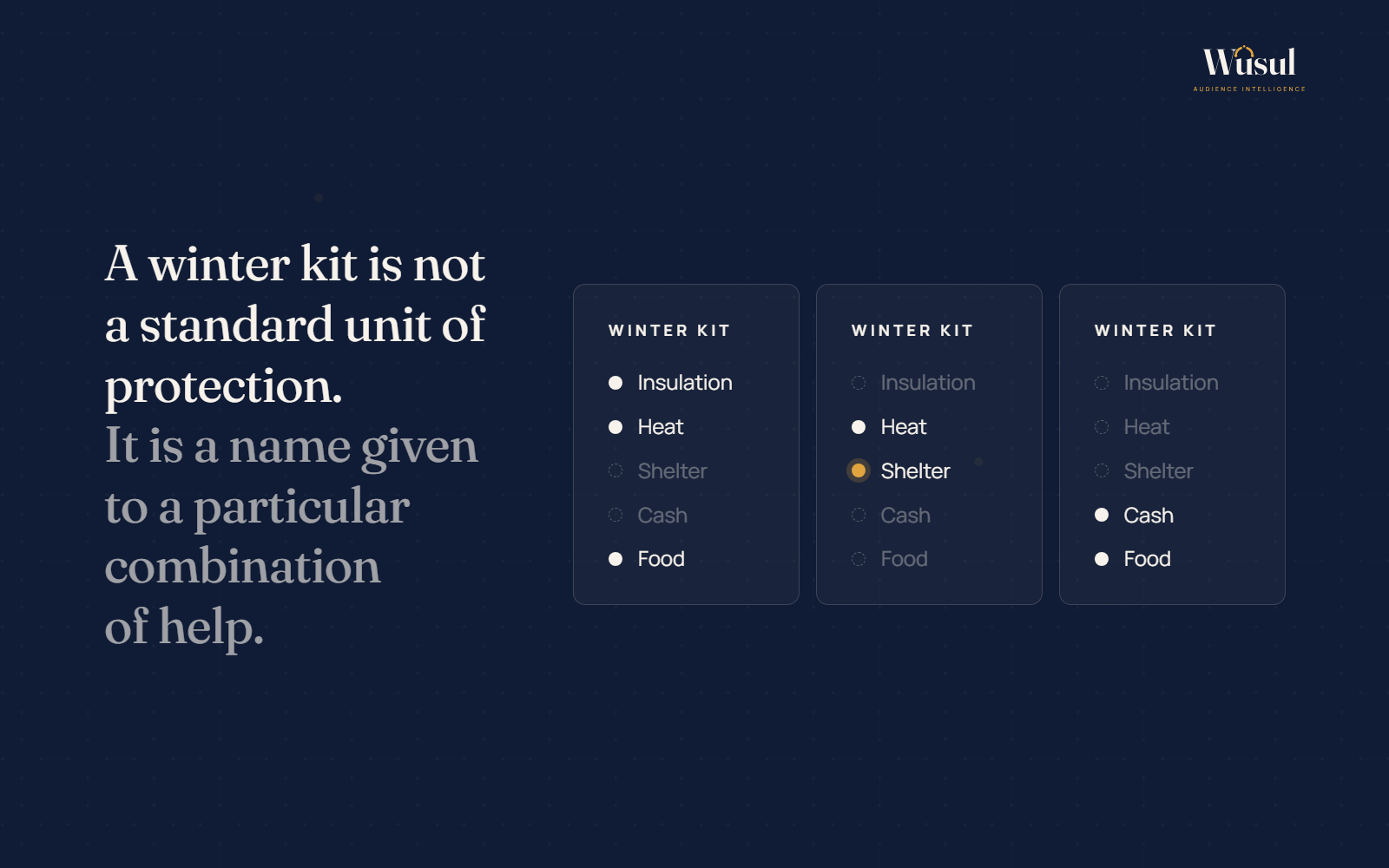
A winter kit is not a standard unit of protection. It is a name given to a particular combination of help.
One label, many products
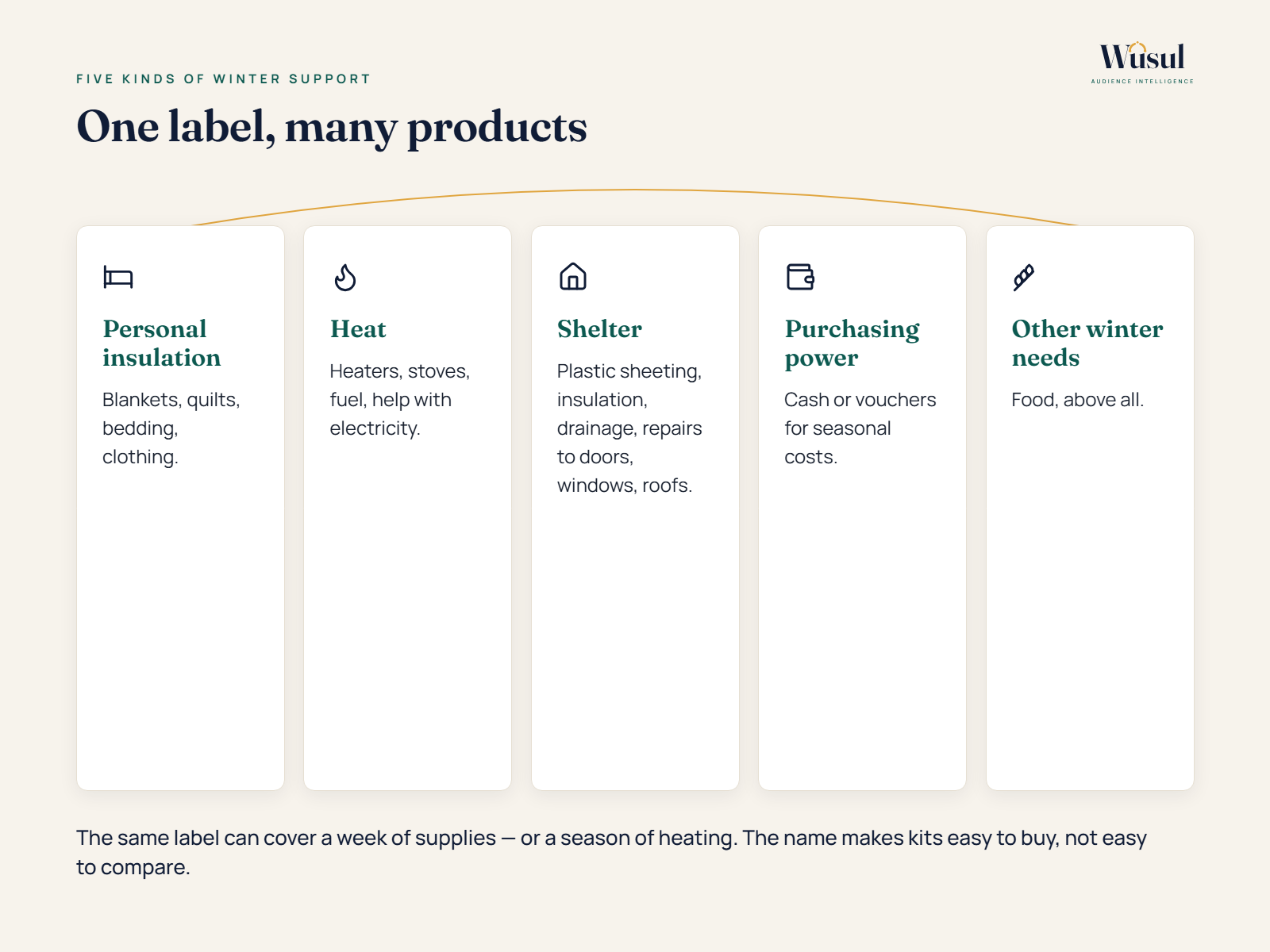
Winter kit, winter essentials, survival kit, family package, heating package: the names suggest standard products. In practice, the same label can cover very different help. Winter assistance draws on five kinds of support, and a package can combine any of them:
- Personal insulation: blankets, quilts, bedding and clothing.
- Heat: heaters, stoves, fuel or help with electricity.
- Shelter: plastic sheeting, insulation, drainage, repairs to doors, windows and roofs.
- Purchasing power: cash or vouchers for seasonal costs.
- Other needs made worse by winter: food, above all.
Nor is the idea of a multi-part kit new. As early as 2014-15, UNHCR targeted Syrian refugee families at Iraq's Al-Obeidy camp with five thermal blankets, a plastic sheet, two jerry cans, a stove and 100 litres of kerosene a month for four months, plus shelter insulation.
That package is worth reading closely, because it states four things most donation pages do not: who it is for (a family), what it contains and in what quantity, how long the consumable part lasts (four months of fuel), and where it goes. Two charities can both sell a "winter kit for a family" and mean, in one case, a week of supplies and, in the other, a season of heating. The name makes them easy to buy. It does not make them easy to compare.
Four prices for one kit
A winter product has at least four different values, and a donation page shows only one of them.
| Price | What it is | Who sees it |
|---|---|---|
| Procurement cost | What the charity or its partner pays for the goods | The charity's finance team |
| Delivered cost | Procurement plus transport, storage, distribution and staff | Programme budgets |
| Fundraising amount | The amount shown to a donor | The donor |
| Value to the household | What the help is worth to the family, given local prices and needs | The family |
These values are related, but they are rarely equal. A charity may buy blankets at wholesale prices; a partner may cover transport; a donation may feed a pooled programme rather than buy one traceable kit; and in a remote settlement, delivery may cost more than the goods.
Islamic Relief UK's tiers show how fundraising amounts are built. The £210 basic winter pack is exactly the £50 food pack plus the £160 fuel and essentials kit, and the £160 kit is the £100 essentials kit plus £60. That makes the options easy to understand. It does not mean fuel costs the charity exactly £60. These are donation amounts, not a published cost model, and the clearest appeals say so.
What the sector actually pays
Charities rarely publish what a winter kit costs them. UN agencies, however, often publish unit costs in their plans, and they give a useful sense of scale.
| Plan | What is provided | Unit cost |
|---|---|---|
| UNHCR regional plan, 2013–14 | One high-thermal blanket (budget ÷ planned quantity) | About $11 |
| UNHCR Lebanon, 2017–18 | Winter top-up for families already on monthly cash | $225 per family ($75 × 3 months) |
| UNHCR Lebanon, 2017–18 | Winter cash for families not on monthly cash | $375 per family over five months |
| UNHCR Lebanon, 2019–20 | Winter cash top-up | $75 per family per month, November to March |
| UNHCR Iraq, 2019–20 | One-off winter cash for fuel, electricity, blankets and clothing | $82 per person |
| UNICEF Lebanon, 2024–25 | Winter clothing kit for children | $40 per kit |
| UNICEF Lebanon, 2024–25 | Winter cash | $150 per household ($50 × 3 months) |
The blanket figure comes from dividing a planned budget line by a planned quantity, so it is an implied allocation, not an invoice. The others are planned transfer values or unit costs, not audited spending.
These figures are not directly comparable with a £100 kit, which is roughly $130. Contents, household size, country and year all differ. But they show the scale. In UN programmes, a season of winter cash for a family in Lebanon is planned at a few hundred dollars, and a child's winter clothing kit at around $40. A donor choosing between a £100 kit and a £160 kit is choosing within that range, without being told where in it their gift sits.
The basket that already exists
If you wanted to track the real cost of keeping a family warm, you would need a standard basket: a defined set of items and fuel for a defined household, priced each season. The humanitarian sector already has one.
In Lebanon, agencies use a Winter Expenditure Basket. UNICEF's 2024 plan describes it as ranging from $200 to $400 and covering the extra needs winter brings, such as blankets, winter clothing, heaters and fuel. It sits alongside the minimum and survival expenditure baskets agencies use to decide who is poor enough to need help. UNHCR's household visits found that a refugee family's spending rises by $70 to $150 a month in winter, and cash transfer values are set with that gap in mind.
This is the yardstick donor-facing appeals rarely draw on. A charity that says "£160 provides fuel and winter essentials" could also say what share of a family's winter gap that covers, and for how long.
That suggests a simple translation for donors, which this series calls household winter coverage: for each package, state the household it is meant for and how long each consumable part is meant to last. Fuel for so many weeks of expected heating; food for so many days; durable items and shelter repairs listed as such, not converted into days. These should be stated separately rather than added up, because heat, food and shelter are different kinds of help. It is not a new measure. It is the Winter Expenditure Basket, put in words a donor can use.
What families did with winter cash
In the winter of 2013-14, aid agencies in Lebanon gave Syrian refugee families winter cash through a shared ATM card. The amount was designed to cover a stove and five months of heating fuel. An inter-agency evaluation led by the International Rescue Committee then looked at how families actually spent it.
The answer, as summarised by Save the Children's adviser who co-chaired Lebanon's Cash Working Group: most of the extra cash went on food, rent and water, and on average only about 10% was spent on heating fuel and clothing.
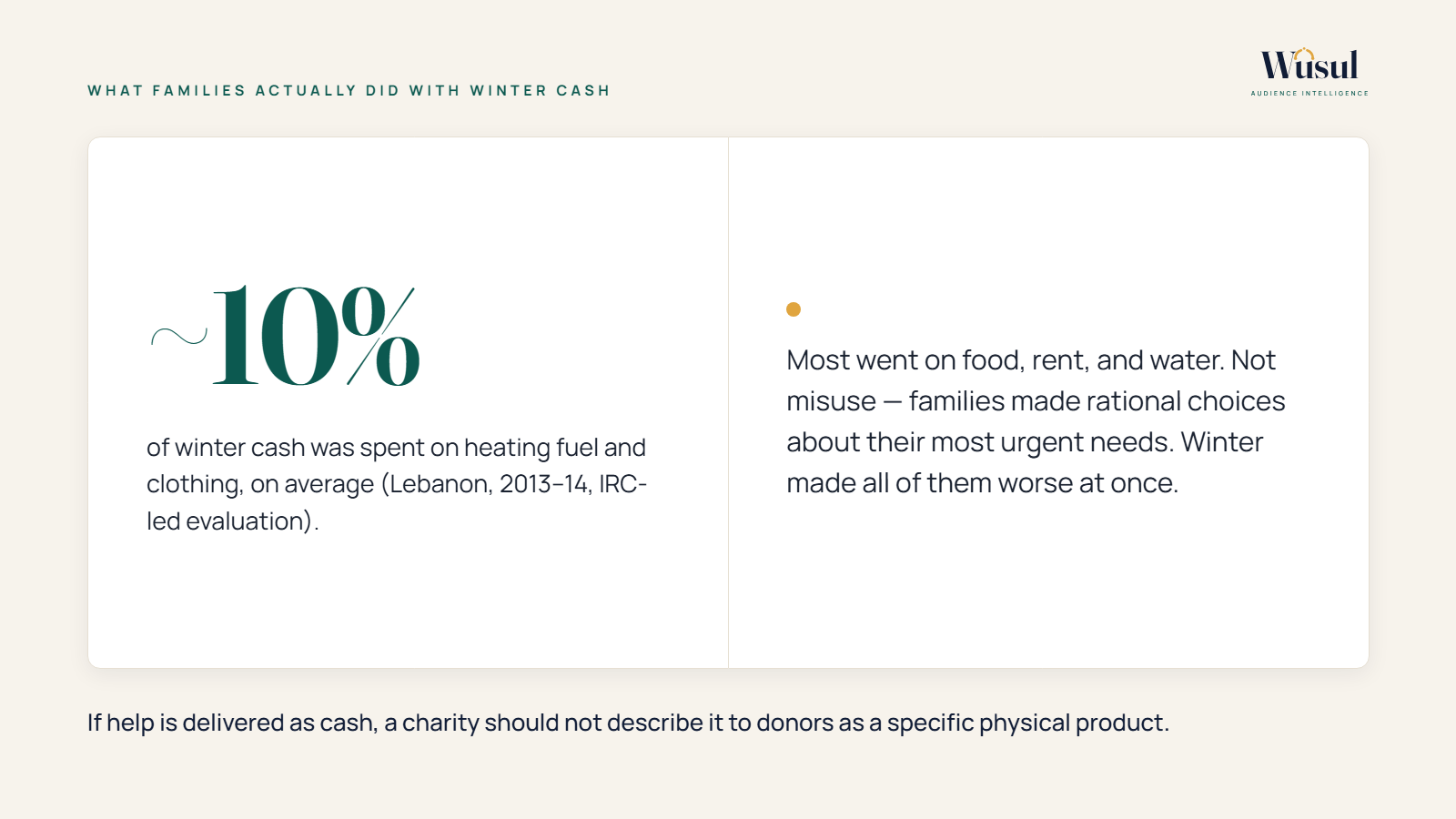
That is not a story of misuse. Families facing hunger, eviction and debt made rational choices about their most urgent needs; winter made all of them worse at once. Later UNHCR monitoring found the same pattern: alongside heating, winter cash is usually spent on food, winter clothing, shelter repairs, debt repayment and health. Reviewing the programme, the Cash Working Group's co-chair drew a design lesson: the transfer had been sized on the cost of fuel and a stove, rather than on an understanding of each household's overall income gap.
For winter fundraising, the lesson is sharp. A donation page that says "£60 provides fuel for a family" describes what the money was intended for. If the help is delivered as cash, it may well have bought rent or food instead, and arguably done more good. Cash can be the right choice. But a charity that delivers cash should not describe it to donors as a specific physical product.
Prices that do not move
There is a detail on Islamic Relief UK's appeal page worth noticing. When we accessed it in November 2026, the page was headed "Winter Appeal 2022", and its impact figure, winter help for over 451,354 people in 15 countries "last year", reads like a 2021 result. The five tiers, £50 to £350, sat beneath it.
This may simply be a page that has kept an old heading. But if those tiers have not changed since 2022, they have held steady through a period when food and energy prices rose sharply in many of the countries where winter aid is delivered, and when the cost of fuel was at the centre of the crisis. A £160 fuel and essentials kit priced in 2022 would buy noticeably less fuel and fewer essentials four winters later.
Wusul found the same pattern in Zakat al-Fitr: published amounts that stay fixed while the cost of what they are meant to buy rises. A fixed price is not wrong in itself. Familiar amounts are easy for donors, and a charity may top up programmes from other funds. But it means the price no longer tells the donor what their gift buys. The simplest fix is to date each tier and review it each season against the cost of the items, or the Winter Expenditure Basket, in the countries concerned.
Repeating relief, or repairing the shelter
Some winter products are consumed and some last. Fuel and food are used up. Blankets and heaters may last several winters. A repaired roof or a replaced window can protect a family for years. Yet appeals usually present all of them as "winter help", as if they were the same kind of thing.
The difference matters because the same families often need help every year. UNHCR has noted that many refugees in Lebanon live in informal settlements where shelters need to be weatherproofed and insulated every winter. Every year, the same plastic sheeting; every year, the same donation.
That invites a question annual appeals rarely ask. Consider an illustrative family that receives about $120 of shelter-related supplies each winter for five years, $600 in all, when a $450 repair would keep it drier and warmer for several seasons. On those numbers, the repair looks better. But the comparison is only a starting point. The family may not own the building, may be moved on, or may live somewhere permanent repairs are not allowed; the repair may need maintenance; and the $120 may include fuel and food that a repair cannot replace.
The point is not that repairs always beat relief. It is that the convenience of an annual appeal should not stop charities from asking, each year, whether some of the need could be met once rather than again.
What a better donation page would show
None of this requires a charity to publish its supplier invoices or bury donors in detail. A short, expandable description under each tier could answer seven questions:
- Where: the country or programme area.
- Who: the household the package is designed for, and its size.
- What: the main contents and quantities, or that it is delivered as cash.
- How long: the expected coverage of fuel, food or cash, in weeks or months.
- How it is funded: whether the gift buys a complete package or contributes to a pooled programme.
- When it was priced: the season the amount was last reviewed.
- What may change: what happens if local prices or needs require a different package.
An illustrative example of the difference:
Before: "£160 provides fuel and winter essentials."
After: "£160 is our 2026 estimate for a family of six in north-west Syria: blankets and winter clothing, plus about six weeks of heating fuel. Gifts are pooled across our winter programme; if fuel prices rise, we adjust the quantity and report it."
The second version is no less moving. It is simply something a donor can believe, and check.
Conclusion
Winter appeals have done something genuinely useful: they have turned a complicated humanitarian response into choices a donor can make in seconds. But the simplification has costs. The same label covers very different help. The price on the page is not the cost of the kit and may not have changed in years. And when help is given as cash, families may spend most of it on food and rent, sensibly, rather than the fuel the page described.
The sector already has the tools to describe winter help precisely: published unit costs, a Winter Expenditure Basket, transfer values tied to measured winter spending. What is missing is their use on the page where donors decide.
A donor should be able to see what a package contains, who it is for, how long it lasts, when it was priced and whether their gift buys it or contributes to it. And charities should keep two things apart: what they delivered, and what that delivery achieved.
Frequently asked questions
What is in a winter kit?
There is no standard contents list. Depending on the charity and country, a kit may include blankets, bedding, winter clothing, plastic sheeting, a heater or stove, fuel or food. Some programmes give cash or vouchers instead.
How much does a winter kit cost?
Appeal prices vary. Islamic Relief UK, for example, lists tiers from £50 to £350. UN agencies' published unit costs give a sense of scale: UNICEF planned $40 for a child's winter clothing kit in Lebanon in 2024, and UNHCR planned $75 a month in winter cash per refugee family in Lebanon in 2019-20.
Is the price on a donation page what the kit costs?
Not necessarily. It is a fundraising amount. The charity's purchase cost, delivery cost and the value to the family can all be different, and a gift may contribute to a pooled programme.
Is cash better than winter kits?
It depends. Where markets work, cash lets families meet their most urgent needs. In Lebanon in 2013-14, families spent most winter cash on food, rent and water, and only about 10% on fuel and clothing. Kits make more sense where goods are scarce or prices unstable.
What is a Winter Expenditure Basket?
A tool used by aid agencies in Lebanon to price the extra costs winter brings for a household, such as blankets, clothing, heaters and fuel. UNICEF's 2024 plan puts it at $200 to $400.
How long does a winter kit last?
It depends on the contents. Blankets and heaters can last years; fuel and food are used up. Charities should state how long the consumable parts are meant to last.
Wusul Insight: Winter appeals sell products; families need warmth. The humanitarian sector already prices that need carefully, through unit costs and the Winter Expenditure Basket. Charities that bring the same precision to their donation pages, stating contents, household, duration and when a price was set, give donors something they can trust and check.
Methodology note*: donation tiers are fundraising amounts, not procurement or delivery costs. UN unit costs are planned transfer values or budget allocations, not audited spending, and are not directly comparable with charity tiers because contents, household size, country and year differ. The blanket cost is an implied allocation from a planned budget line. The observation about the appeal page's date reflects the page as accessed and may not reflect current pricing decisions. Household winter coverage is a donor-facing translation of existing practice, not a new or validated indicatorز