Values-driven marketing (often called value-based marketing) is a customer-centric strategy that leads with what matters to the customer: their needs, motivations, beliefs, and desired outcomes. Rather than simply promoting a product's features or price, it builds the brand around the values that shape why people buy, give, and engage.
For organizations serving Muslim communities (Islamic charities, halal brands, and Muslim-focused media) values-driven marketing is not a trend. It is the foundation of authentic engagement. Because for Muslim audiences, purchasing and giving decisions often reflect identity, ethics, community, and religious principles as much as price or convenience.
Values-driven marketing core idea
Instead of saying, "Our product has X features," a values-driven brand says, "Here is the problem you face, the outcome you want, and how we help you achieve it in a way consistent with what you believe."
This shifts marketing from product-centric selling to long-term relationship building. As one analysis puts it, values-driven marketing is "the marketing that entails customers forming relationships out of their own will" and "enhances the life of the people itself."
One famous example: Dove's "Real Beauty" campaign did not sell soap by listing ingredients. It sold self-esteem, representation, and the rejection of unrealistic beauty standards: values that resonated with women who felt unseen by traditional advertising. The product followed the values, not the other way around.
A Muslim example: A modest-fashion brand would not only advertise fabric quality. It would communicate dignity, faith-conscious design, inclusivity, and practical coverage: values that resonate with its audience.
The four types of customer value
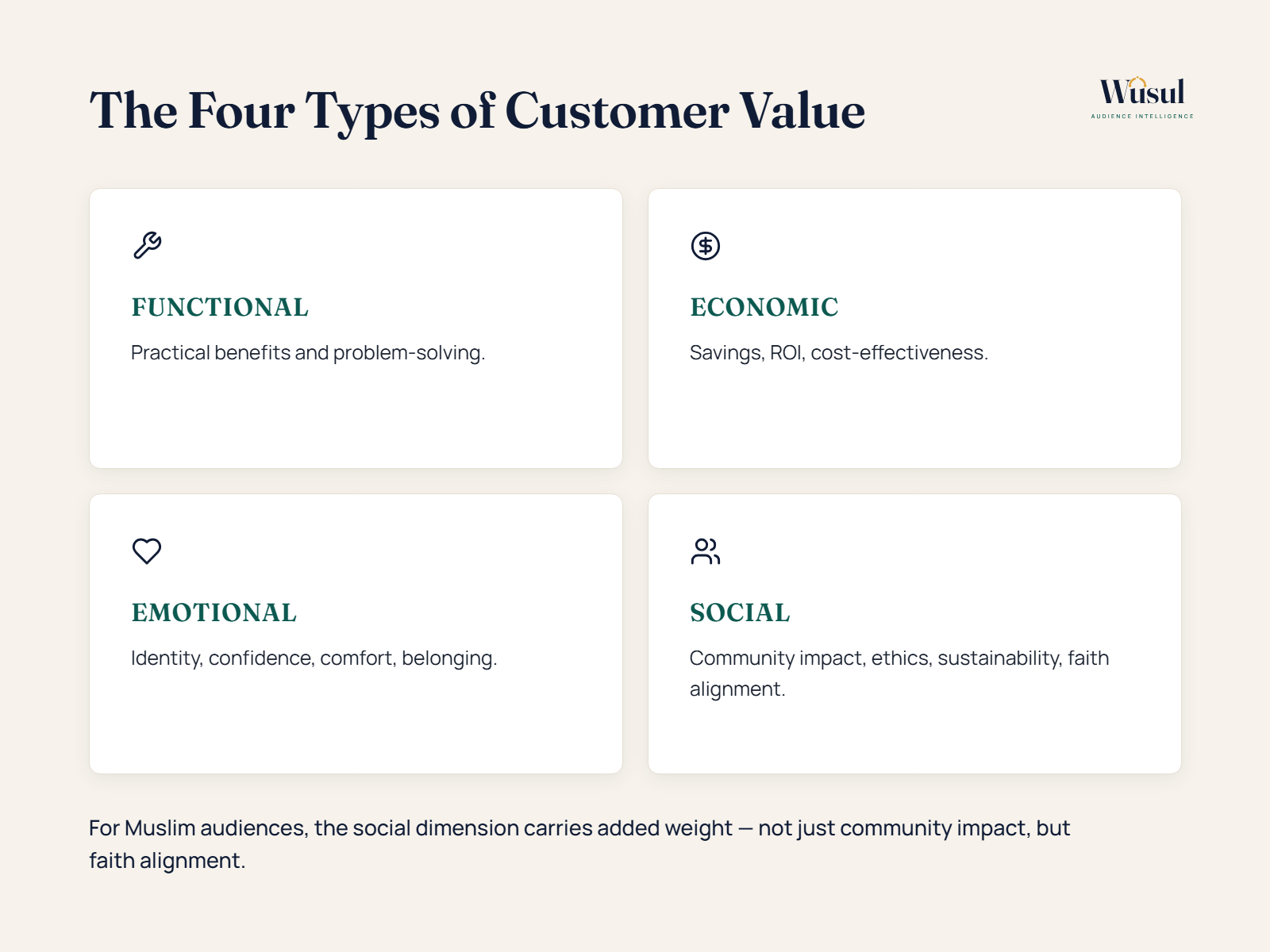
Values-driven marketing recognizes that customers seek multiple types of value. The four dimensions commonly used to frame a brand's value proposition are:
A. Functional: Practical benefits and problem-solving. A skincare product that visibly reduces dryness.
B. Economic: Savings, ROI, or cost-effectiveness. A subscription that lowers long-term cost.
C. Emotional: Identity, confidence, comfort, belonging. A campaign that makes customers feel represented.
D. Social: Community impact, ethics, sustainability, faith alignment. A brand supporting ethical sourcing or local communities.
For Muslim audiences, the social dimension often carries additional weight, not just community impact but faith alignment. A product or organization that respects Islamic values, supports the Ummah, and operates ethically is not just preferred. It is trusted.
How it differs from traditional marketing
Traditional marketing typically emphasizes product features, promotions, and short-term conversion. Values-driven marketing emphasizes customer insight, shared beliefs, trust, and lifetime relationships. It aims to make the brand relevant beyond the transaction.
But values-driven marketing is not the same as "purpose-washing." Research on authentic brand activism identifies four factors whose alignment determines whether values-based messaging is perceived as genuine: the message, pro-social corporate practices, the brand's purpose, and the brand's values. When these are misaligned (when a brand claims to stand for something but does not act on it) audiences perceive the messaging as inauthentic.
For Muslim audiences, this distinction is especially critical. When a brand claims to respect Islamic values but does not act on them, when a halal certification is questionable, when a charity's Zakat distribution is opaque, when a campaign uses generic Ramadan imagery without genuine cultural understanding, the gap between message and reality is noticed. And trust, once broken, is difficult to rebuild.
How to implement values-driven marketing for Muslim audiences
1. Research motivations, not just demographics
Move beyond age, income, and location to understand why customers buy or give. Research on Muslim consumers in Malaysia and Pakistan found that the strength of an individual's religious identity is a strong predictor of halal choice behavior and perceived self-expressive benefits. Consumers' halal choice behavior directly predicts consumer-based halal brand equity.
A study on Muslim consumers and green cosmetics found that both altruistic and hedonic values positively influence personal norms, which in turn positively impact green purchase behavior. Personal norms mediate the relationship between values and purchase behavior.
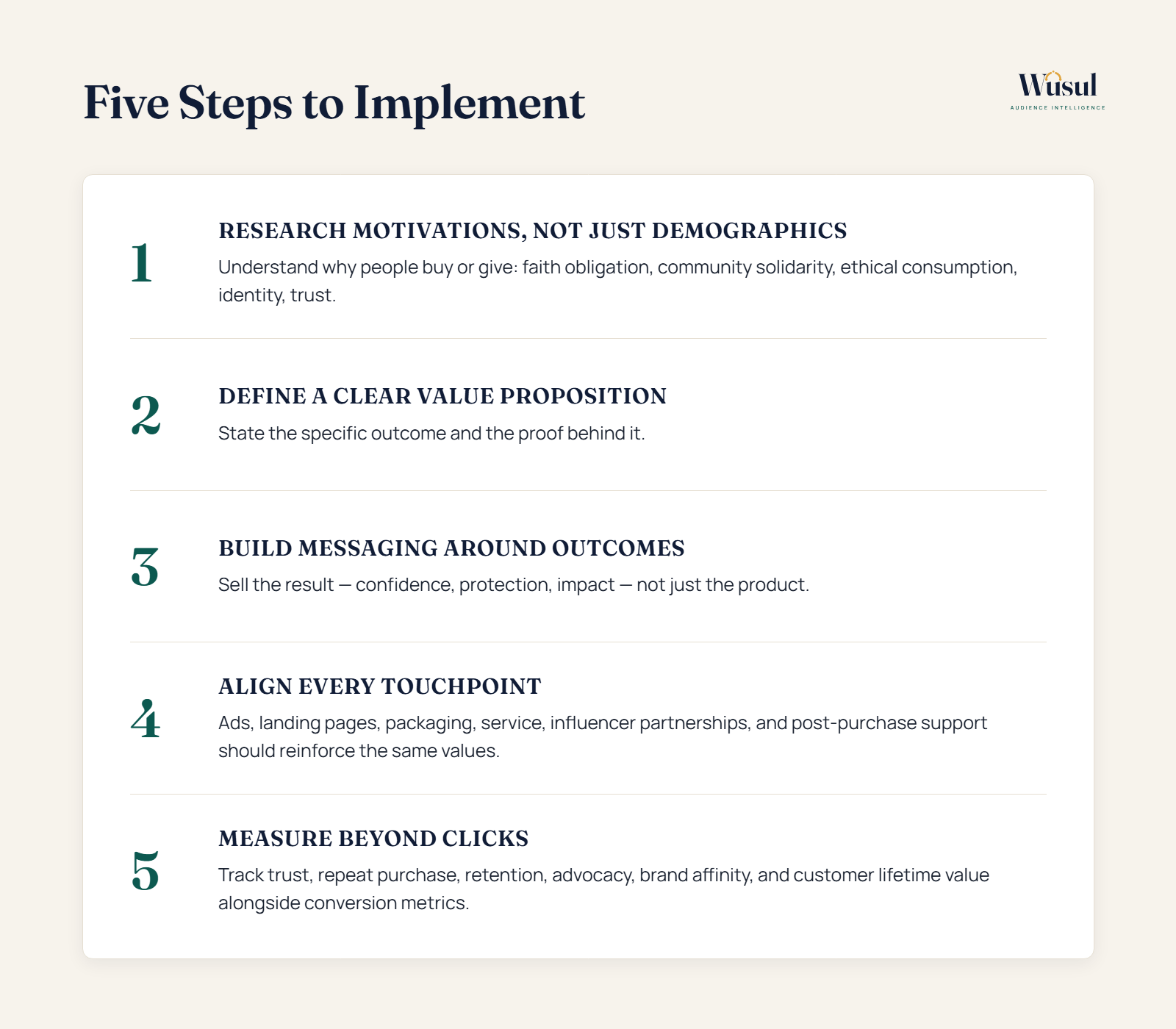
For Muslim audiences, motivations may include:
- Faith obligation: Zakat, Sadaqah, and religious duty
- Community solidarity: Supporting the Ummah, both locally and globally
- Ethical consumption: Halal, Tayyib, and responsible sourcing
- Identity affirmation: Expressing Muslim identity through purchasing choices
- Trust in institutions: Confidence that funds or products align with Shariah principles
2. Define a clear value proposition
State the specific outcome and the proof behind it. For Muslim audiences, this means being concrete:
- For a charity: "Your Zakat provides a family with food for a month. 100% of Zakat donations go directly to eligible recipients, verified by our Zakat Advisory Board."
- For a halal brand: "Certified halal, ethically sourced, and transparently produced. Every ingredient is traceable; every process is verified."
- For a media organization: "Stories that reflect Muslim life authentically. No stereotypes. No clichés. Just real narratives."
3. Build messaging around outcomes
Sell the result (confidence, convenience, protection, impact), not just the product.
Research on sustainable modest fashion found that altruism and egoism values affect attitudes, and attitudes affect purchase intention. Entrepreneurs can incorporate the values of altruism and egoism in their marketing communications, emphasizing environmental and social protection aspects alongside product aesthetics and quality.
For a charity, the outcome is not "we run programs." The outcome is "your Zakat feeds a family, educates a child, heals a patient." For a halal brand, the outcome is not "we are certified." The outcome is "you can trust what you consume."
4. Align every touchpoint
Ads, landing pages, packaging, service, influencer partnerships, and post-purchase support should reinforce the same values.
A study on halal fashion brands found that brand experience and self-congruence positively influence brand trust, and brand trust and brand image predict brand love. Marketers should create brand experiences aligned with Islamic values, ensure transparency in sourcing and halal certification, and embrace cultural diversity in campaigns.
For Muslim audiences, this means:
- Consistent messaging across Ramadan campaigns, year-round communications, and donor stewardship
- Cultural intelligence in creative: no generic crescent moons, no performative representation
- Transparency in operations: clear financial reporting, verified certifications, visible accountability
- Respect in tone: warm, dignified, and never condescending.
5. Measure beyond clicks
Track trust, repeat purchase, retention, advocacy, brand affinity, and customer lifetime value alongside conversion metrics.
For charities, this means measuring donor retention, repeat giving, average gift size, and trust, not just the number of donations in Ramadan. Research on humanitarian giving in Aceh, Indonesia (the world's most generous nation for seven consecutive years) found that altruistic, social, and emotional values, together with organizational reputation, significantly influenced giving, while socioeconomic status showed no effect. Religiosity amplified these relationships, acting as a moral compass that transformed personal values into durable commitments to donate.
The study concluded that humanitarian organizations can improve fundraising effectiveness by segmenting donors according to religiosity and value orientation, using faith-consistent messaging, and providing transparent, real-time reporting of fund utilization.
Why values-driven marketing works
Value alignment can improve differentiation, loyalty, satisfaction, and willingness to buy. Research on authentic brand activism shows that when the message, pro-social practices, purpose, and values are aligned, audiences perceive the brand as genuine, and trust follows.
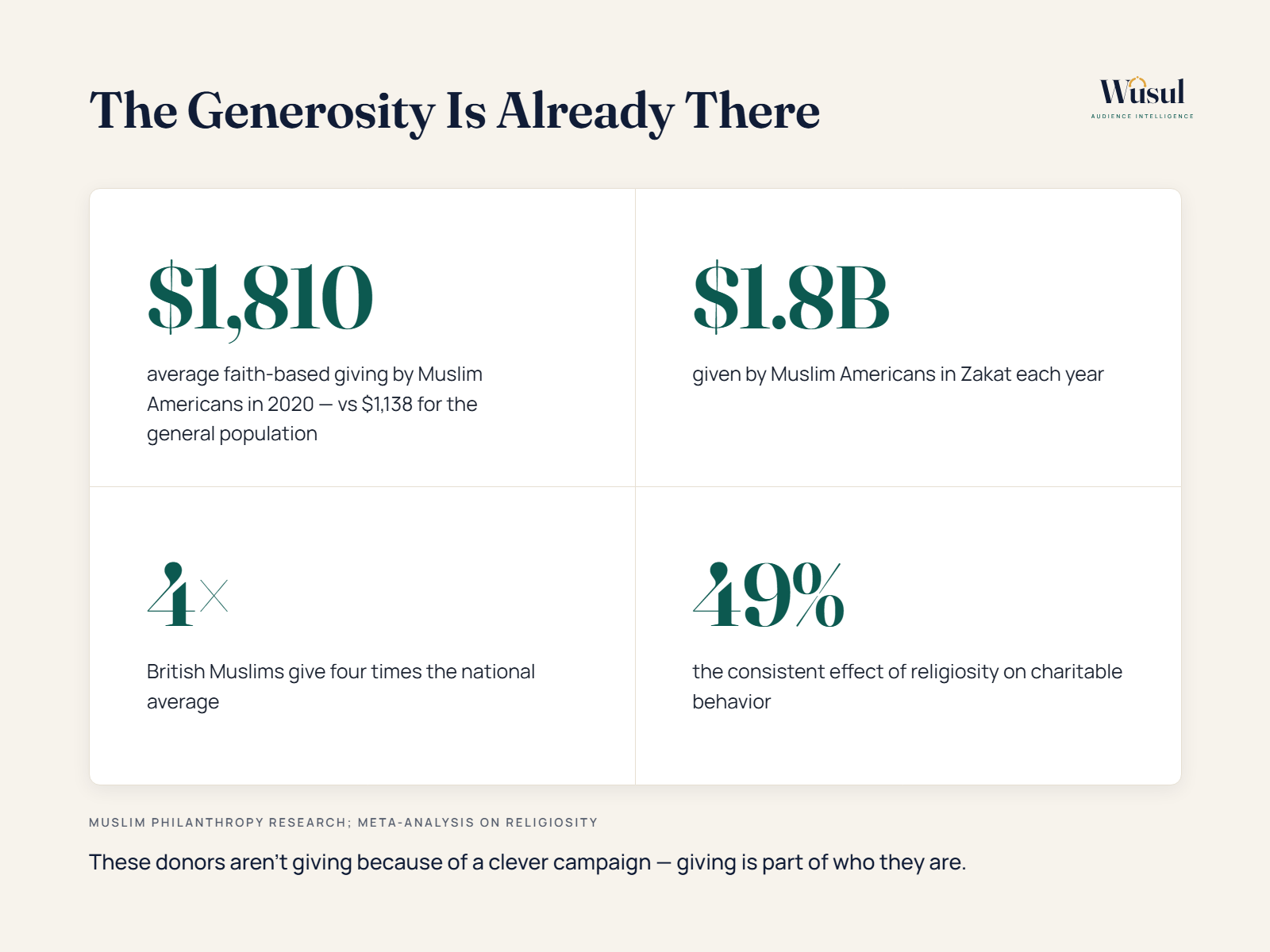
A meta-analysis on religiosity and charitable behavior found that the effect of religiosity on charitable behaviors was consistently 49%. The study identified three categories of variables influencing Islamic charitable behavior: religious, individual, and demographic factors.
For culturally nuanced markets (such as Muslim consumers, diaspora communities, or faith-based philanthropy audiences) values-driven marketing is especially powerful because purchase decisions often reflect identity, ethics, community, and religious principles as much as price or convenience.
Consider what this means for Islamic charities:
- Muslim Americans are the most generous religious group in the US when measured by reported faith-based giving: an average of $1,810 in 2020, against $1,138 for the general population.
- Muslim Americans give $1.8 billion in zakat each year, with nearly 70% given during Ramadan.
- British Muslims give four times more than the national average, with much of the £2 billion raised annually coming during Ramadan.
These donors are not giving because of a clever campaign. They are giving because giving is part of who they are. Values-driven marketing does not create that motivation; it aligns with it.
The difference between values-driven marketing and purpose-washing
Purpose-washing is when a brand claims to stand for something but does not act on it. Research identifies four factors whose alignment determines authenticity: the message, pro-social corporate practices, the brand's purpose, and the brand's values. When these are misaligned, audiences perceive the messaging as inauthentic.
For Muslim audiences, purpose-washing looks like:
- A Ramadan campaign that uses crescent moons and lanterns but has no substance
- A halal label that is not backed by credible certification
- A charity that claims to distribute Zakat but cannot demonstrate compliance
- A brand that claims to support Muslim communities but does not invest in them
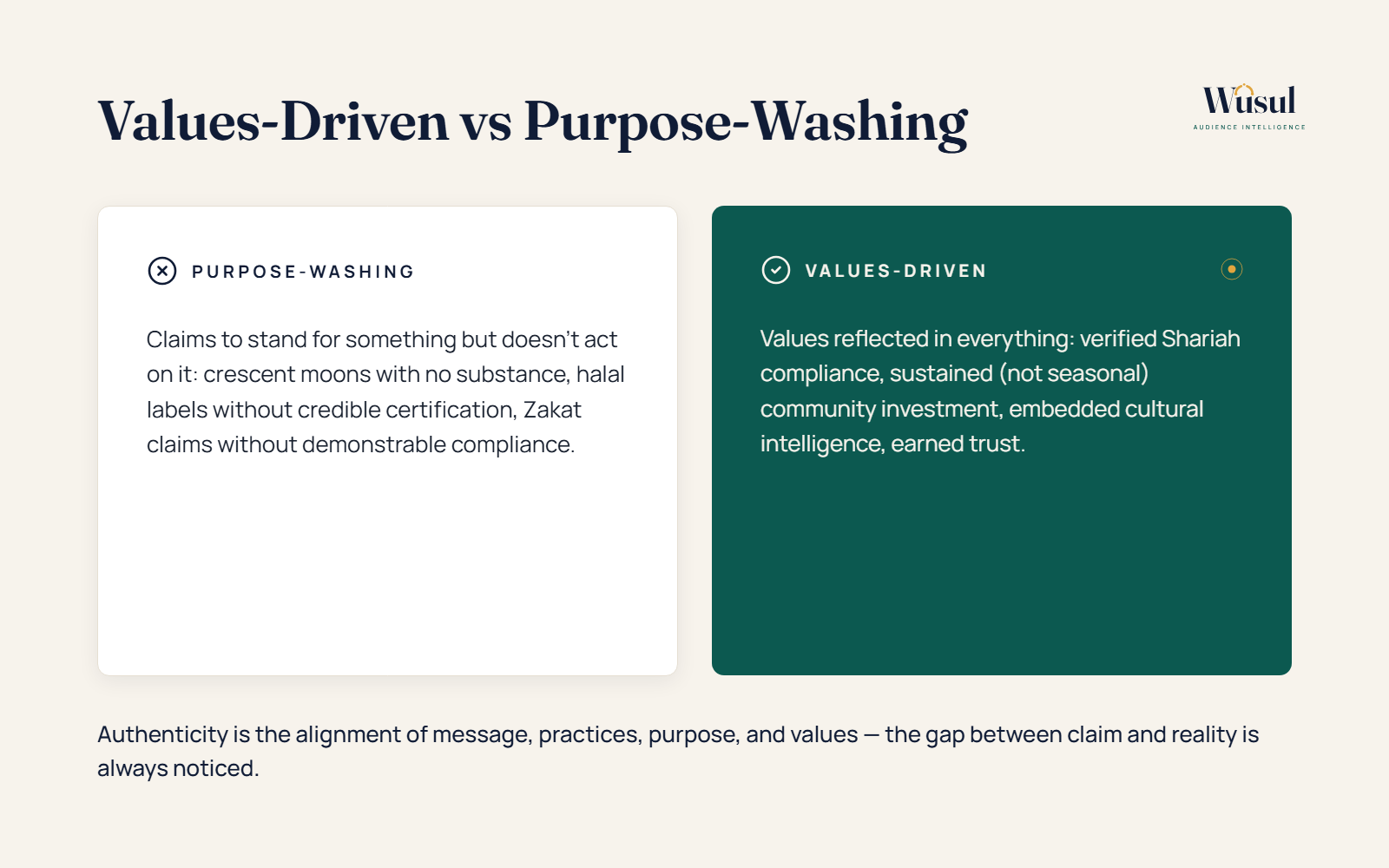
Values-driven marketing, by contrast, is when the brand's values are reflected in everything it does, from sourcing to service to communications. For Muslim audiences, this means:
- Shariah compliance that is verified, not just claimed
- Community investment that is sustained, not seasonal
- Cultural intelligence that is embedded, not outsourced
- Trust that is earned, not bought
Conclusion: values as the foundation of trust
Values-driven marketing is not a tactic. It is a philosophy. It recognizes that customers and donors are not just transactions, they are people with beliefs, motivations, and identities that shape their decisions.
For organizations serving Muslim communities, values-driven marketing is especially powerful because the values that drive purchasing and giving are deeply held. Faith, community, ethics, and trust are not marketing messages. They are the foundation of identity.
The brands and charities that succeed will be those that align with those values, not just in their campaigns, but in their operations. They will demonstrate Shariah compliance. They will invest in the community. They will communicate with cultural intelligence. And they will build trust that lasts beyond a single transaction.
Because in the end, values-driven marketing is not about selling. It is about belonging.
At Wusul, we believe that cultural intelligence means understanding not just what an audience does, but why they do it, and designing engagement that honors the values that shape their decisions. Values-driven marketing is not a strategy. It is a commitment.
Frequently asked questions
What is value-based marketing?
Value-based marketing, also called values-driven marketing, is a customer-centric strategy that leads with what matters to the customer: their needs, motivations, beliefs and desired outcomes. Rather than promoting a product’s features or price, it builds the brand around the values that shape why people buy, give and engage, and aims for long-term relationships rather than one-off transactions.
Why do Muslim consumers respond to values-driven marketing?
For many Muslim consumers and donors, buying and giving decisions reflect identity, ethics, community and religious principles as much as price or convenience. A brand or charity that respects Islamic values, operates ethically and supports the community earns trust. When the message and the practice do not match, such as a questionable halal certification or opaque Zakat distribution, the gap is noticed and trust is hard to rebuild.