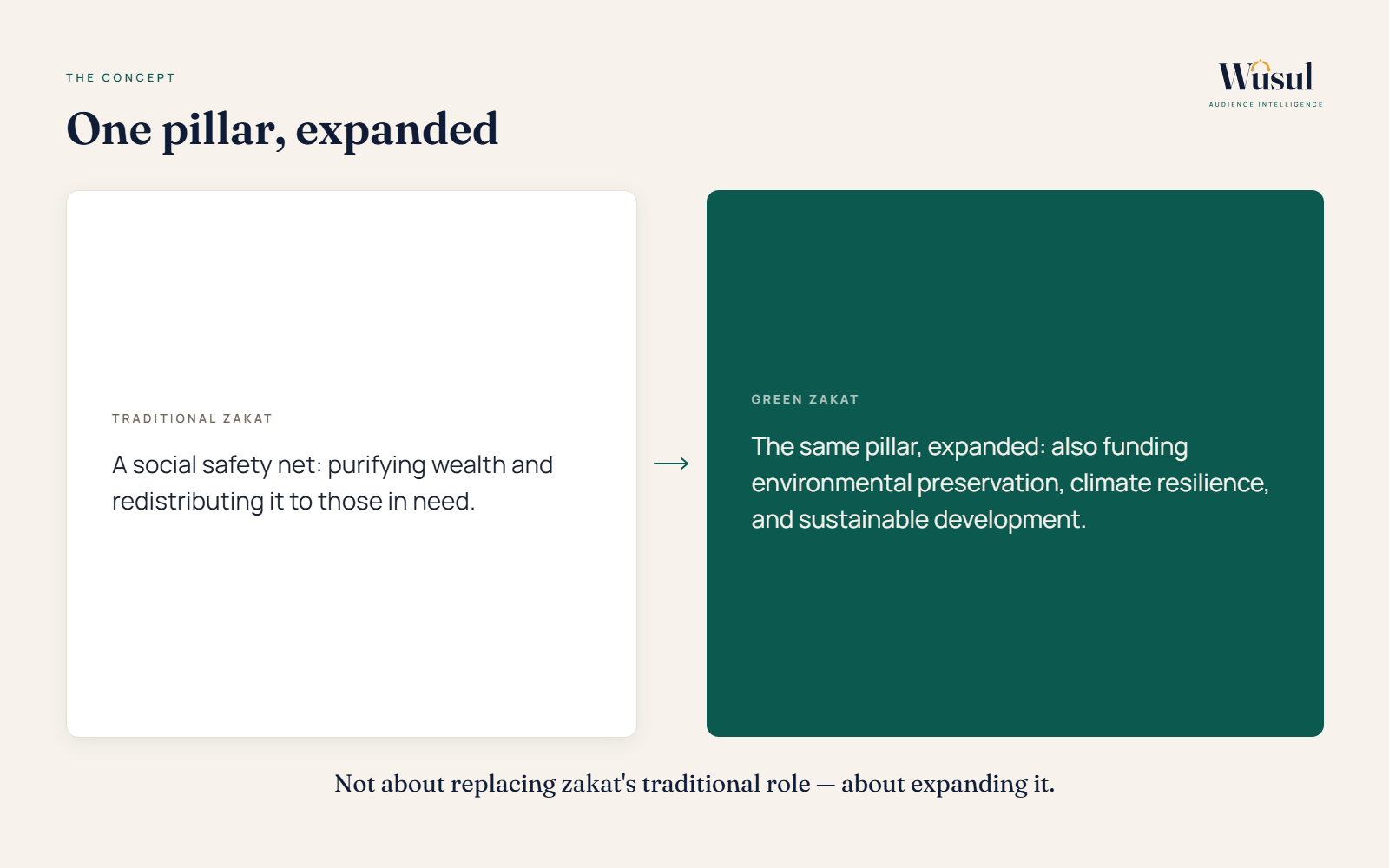
Zakat is one of the five pillars of Islam; a mandatory act of charity that purifies wealth and redistributes it to those in need. But what if fulfilling this pillar could do more than alleviate poverty? What if it could also heal the planet?
This is the premise of Green Zakat, an emerging framework that channels obligatory charitable giving toward environmental sustainability and climate action. It represents a significant evolution in Islamic philanthropy: moving zakat beyond its traditional role as a social safety net to become a strategic instrument for addressing climate change, protecting ecosystems, and building resilient communities.
The core concept of green Zakat
Green Zakat integrates the principles of Zakat with a commitment to environmental protection. It ensures that Zakat funds support not only poverty alleviation but also programs that contribute to environmental preservation and sustainable development.
This concept is grounded in the Islamic principle of stewardship (khalifah) and the prohibition of waste (israf). The framework emphasizes that zakat should not only be halal (permissible) but also tayyib (pure and wholesome); ensuring that the sources of income are ethical and that the programs funded do not harm the environment.
The concept of hifzul bi'ah (protecting the environment) holds a position in Islamic jurisprudence equivalent to hifz al-nafs (protecting life) and hifz al-mal (protecting wealth), as articulated by contemporary scholars including Yusuf al-Qaradhawi. This theological foundation gives Green Zakat its moral weight. As BAZNAS leadership has stated: "Green Zakat is not just a trend, but a real response to the global environmental crisis that aligns with Islamic values".
A Pioneering Initiative with Global Ambition
In August 2025, the National Board of Zakat (BAZNAS) of Indonesia, in collaboration with Bank Syariah Indonesia (BSI) and the United Nations Development Programme (UNDP) Indonesia, officially launched the Green Zakat Framework. This framework is a strategic reference for integrating zakat management with environmental protection and climate resilience. It was formally handed over to Indonesia's Ministry of Religious Affairs as a strategic reference for the government.
The initiative addresses a critical funding gap. Indonesia requires approximately USD 281-285 billion to meet its climate targets under its Enhanced Nationally Determined Contribution (ENDC), within an overall SDG financing gap of around USD 1.7 trillion. National zakat collection has reached approximately USD 2.53 billion, alongside Islamic endowments (waqf) of around USD 216 million; a significant pool of resources that can be mobilized for green initiatives.
Crucially, the initiative has been presented as a contribution from Indonesia to the world. Bank Syariah Indonesia's ESG Group Head noted that the Green Zakat Framework "is not just a contribution to Indonesia, but to the world". Indonesia's Minister of Religious Affairs emphasized: "Through the Green Zakat Framework, zakat is expected to become an economic force for the ummah while also supporting environmental sustainability".
Green Zakat as a broader Islamic social finance model
The Green Zakat concept is increasingly being discussed as a broader Islamic social finance model, not limited to Indonesia. UNDP has explicitly stated that the framework is envisioned as "a foundational tool for integrating sustainability into zakat management, not just within Indonesia but as a model with global applicability".
This has significant implications for countries with large Muslim populations and active Zakat institutions. The framework demonstrates how zakat can be leveraged for climate action in contexts ranging from renewable energy projects in rural communities to ecosystem restoration and sustainable agriculture. The Green Zakat Framework provides guidance for Zakat institutions in integrating environmental aspects into all operational processes (from green fund allocation and collection governance to distribution management) while promoting accountability and measurable social and environmental impact.
What does green Zakat fund?
Green Zakat funds can support a wide range of environmentally focused programs.
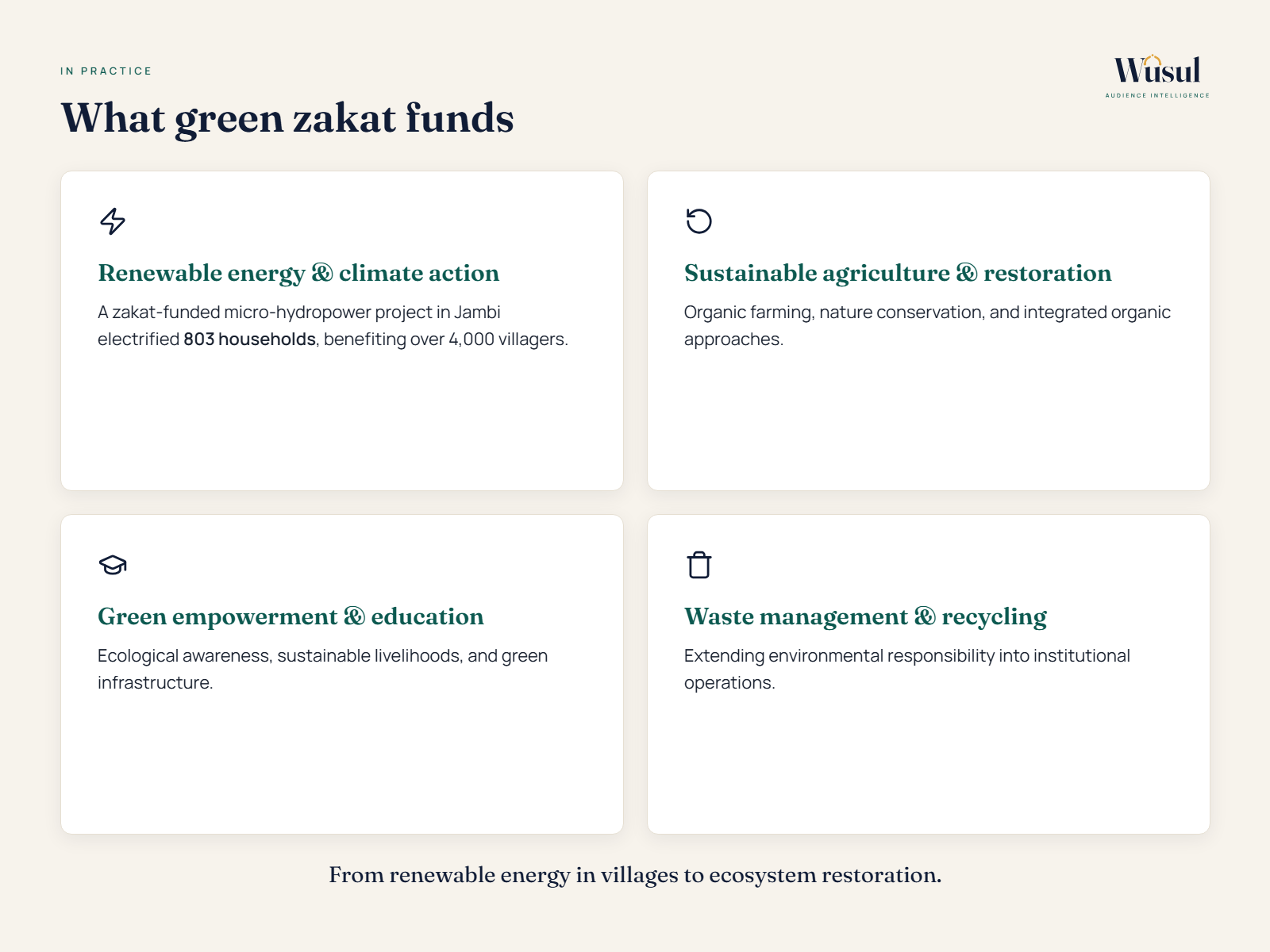
A. Renewable Energy and Climate Action have been a priority focus. A zakat-funded micro-hydropower project in Jambi, Indonesia, electrified 803 households, benefiting over 4,000 villagers, including vulnerable communities, a powerful example of how faith and innovation can unite for sustainable impact.
B. Sustainable Agriculture and Ecosystem Restoration projects include organic farming, nature conservation, and integrated farming with organic approaches. BAZNAS has implemented programs such as organic food barns and green infrastructure.
C. Green Empowerment and Education supports communities to become active agents of change, with programs focused on ecological awareness, sustainable livelihoods, and green infrastructure.
D. Waste Management and Recycling is also part of the operational framework, with BAZNAS implementing archive recycling as part of its Green Zakat program; demonstrating that environmental responsibility extends to institutional operations.
The green Zakat index
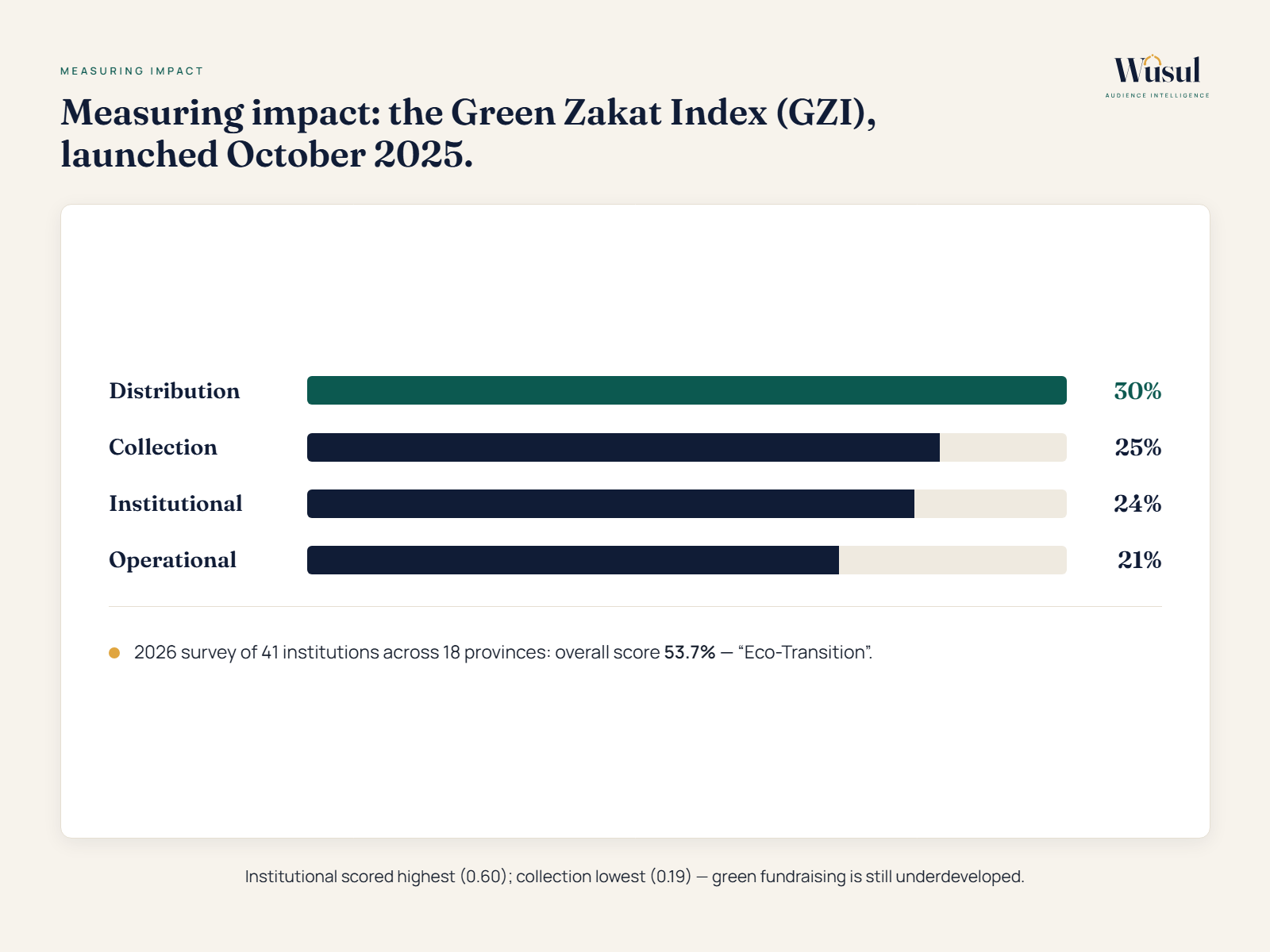
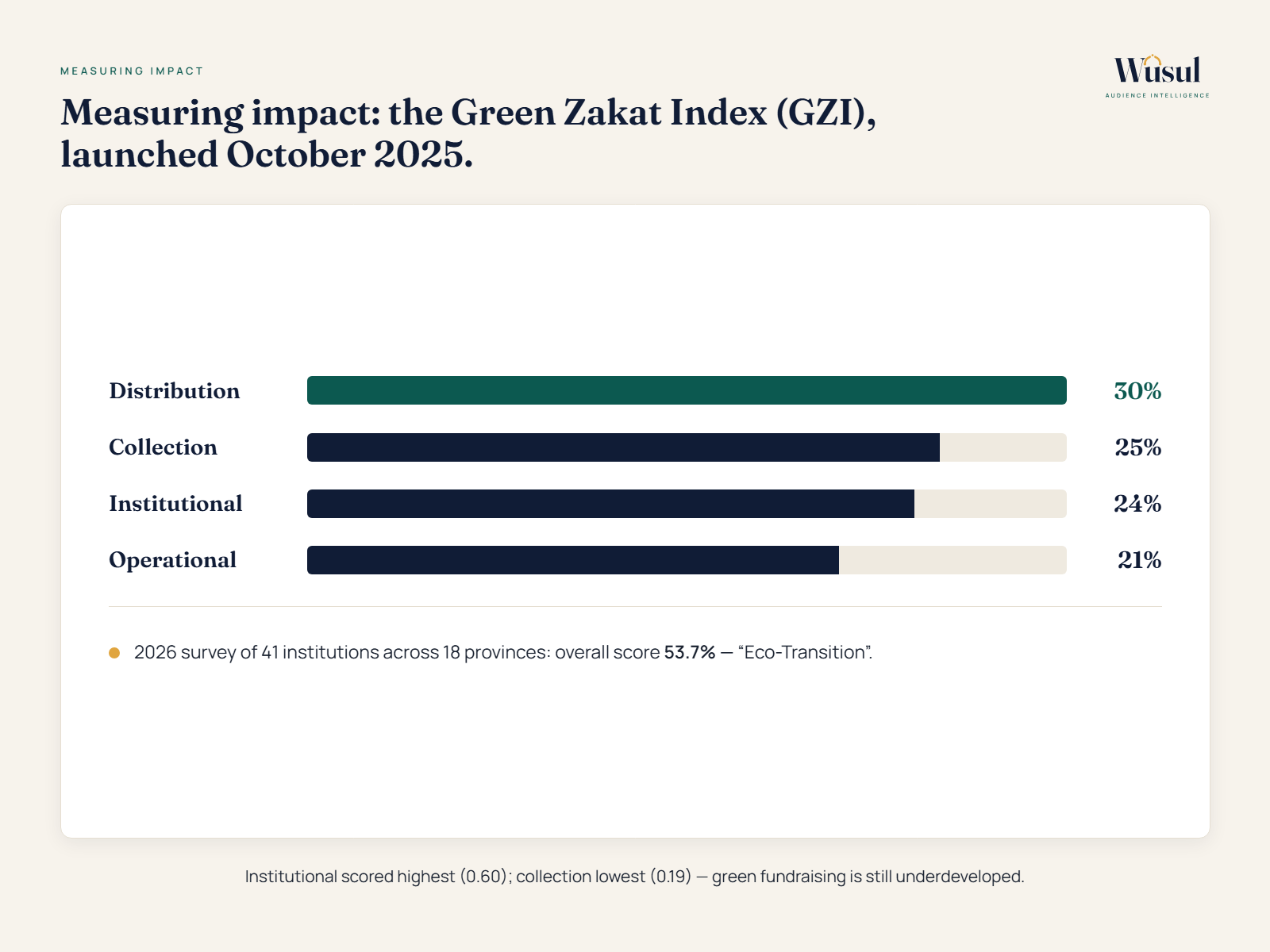
To ensure accountability and measurable impact, BAZNAS launched the Green Zakat Index (GZI) in October 2025. The GZI is a comprehensive measurement tool consisting of 4 main dimensions: Institutional (24%), Collection (25%), Operational (21%), and Distribution (30%), with 29 variables and 9 indicators, including Green Office, Sustainable Livelihood, Green Infrastructure, and Digital Fundraising.
Early results from the 2026 GZI survey of 41 zakat institutions across 18 provinces showed an overall score of 53.7% (Eco-Transition). This indicates that the national zakat sector is still in a transition stage and has not yet fully reached maturity in environmental aspects. The institutional dimension scored highest (0.60), while the collection dimension scored lowest (0.19); highlighting that green-based fundraising strategies such as digital fundraising and green loyalty programs are still underdeveloped.
As one BAZNAS researcher noted: "The Green Zakat Index helps us move from concept to measurement. It provides an evidence-based approach to ensure that zakat contributes not only to social and economic welfare but also to environmental sustainability".
Why green Zakat matters now
The world is facing a financing gap to achieve the Sustainable Development Goals (SDGs), including climate targets. Green Zakat offers a way to mobilize community-based religious resources to address this gap.
This initiative demonstrates that zakat is not only for basic needs assistance, but can also strengthen community resilience through green initiatives. As UNDP Indonesia's Deputy Resident Representative Sujala Pant explained: "Zakat can now be utilized more strategically, not only for basic needs assistance but also to strengthen community resilience through green initiatives such as renewable energy in villages, sustainable farming, and women-led enterprises".
The framework aligns with Maqashid Shariah, the higher objectives of Islamic law; which include the preservation of life (hifz an-nafs), wealth (hifz al-mal), and the environment (hifz al-bi'ah).
A 2026 academic study concluded that Green Zakat "can serve as a strategic bridge between Islamic philanthropy and environmental justice if supported by adaptive policies, cross-sector collaboration, and enhanced ecological zakat literacy".
Conclusion
Green Zakat is not about replacing zakat's traditional role. It is about expanding it. By integrating environmental sustainability into zakat management, the framework ensures that Islamic charity serves both people and the planet.
At Wusul, we believe that cultural intelligence means understanding the evolution of Islamic traditions in response to contemporary challenges. Green Zakat is a powerful example of how faith-based giving can adapt to serve both spiritual and global needs, offering organizations a framework for authentic, values-driven engagement with Muslim communities.
Frequently asked questions
What is Green Zakat?
Green Zakat is an emerging framework that channels obligatory Islamic charitable giving toward environmental sustainability and climate action. It evolves the traditional role of zakat from a social safety net into a strategic instrument for protecting ecosystems, addressing climate change, and building resilient communities while maintaining its core purpose of poverty alleviation.
How does Zakat help the environment?
Green Zakat supports various environmentally focused programs, including renewable energy projects like micro-hydropower, sustainable agriculture, and ecosystem restoration. It also funds green empowerment and education to foster sustainable livelihoods, while promoting institutional responsibility through waste management and recycling initiatives, ensuring that zakat funds contribute to both social welfare and environmental preservation.
Can zakat be spent on environmental projects?
Scholars differ on how far zakat can fund environmental work. Zakat must reach the eight categories of recipients named in the Quran (9:60), so Green Zakat programmes generally fund environmental projects that directly benefit eligible people, such as clean water or solar power for poor families. Donors should check a programme's zakat policy with a qualified scholar.