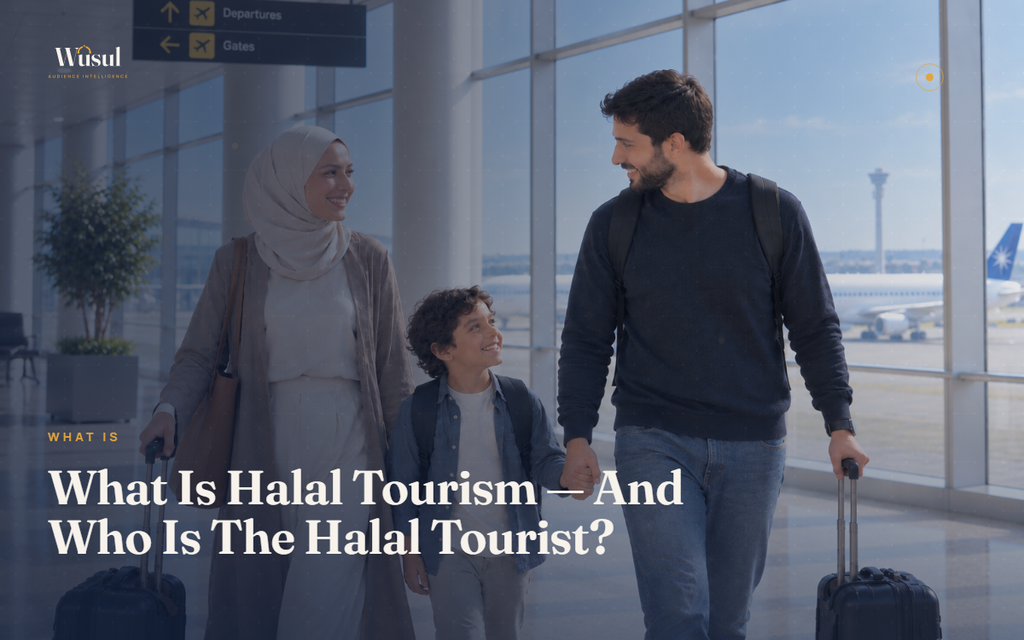
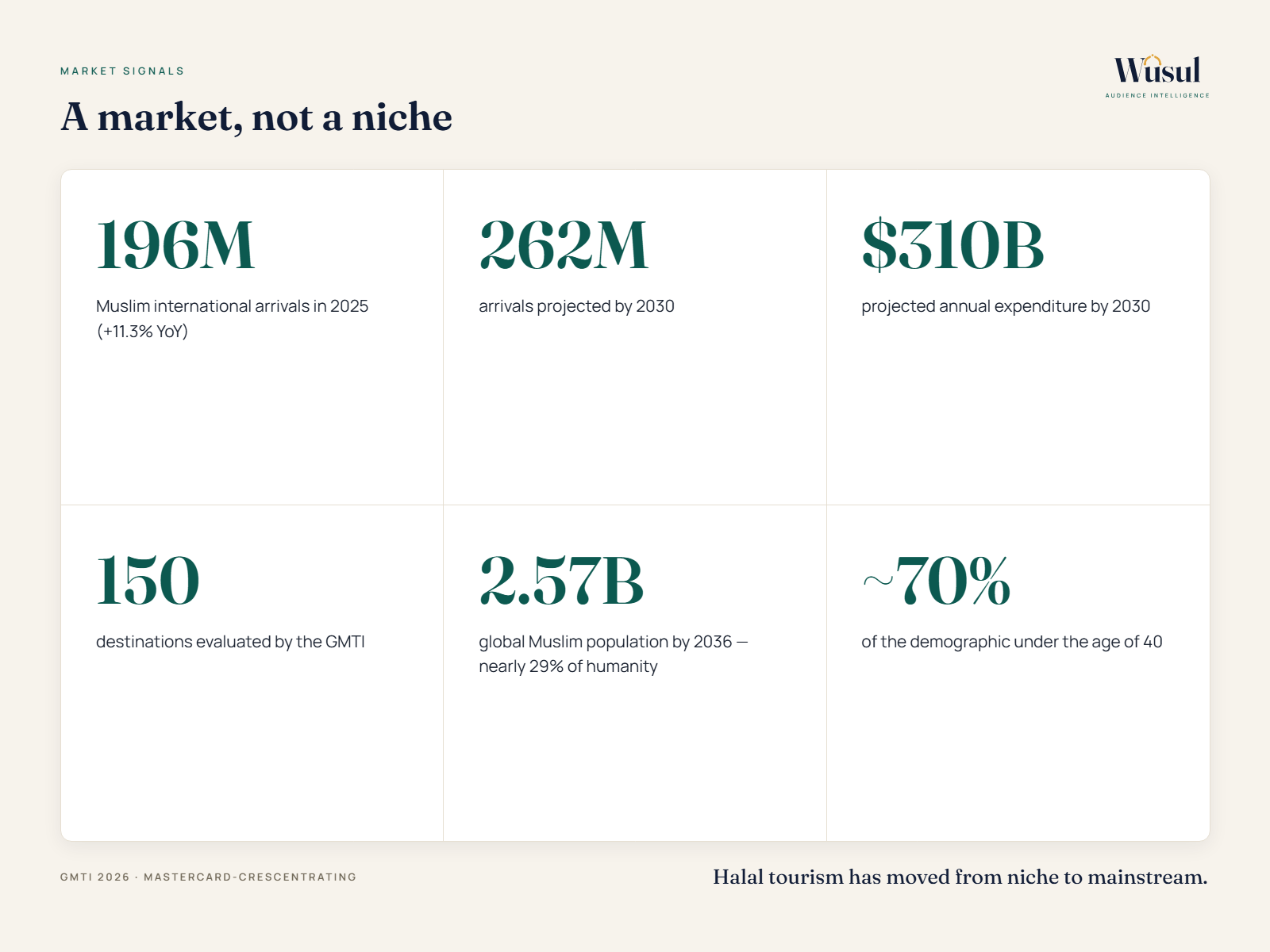
Halal tourism, often called Muslim-friendly travel, has moved from niche to mainstream. In 2025, 196 million Muslim travelers crossed international borders; an 11.3% surge from the year before, and a figure that exceeded earlier forecasts by 10 million. By 2030, that number is projected to reach 262 million, driving an estimated $310 billion in annual expenditure.
This is not a niche market. It is one of the fastest-growing segments of the global travel industry, and it is reshaping how destinations, hotels, airlines, and tourism boards think about service design. Yet the term "halal tourism" itself is becoming inadequate. The market has outgrown the label, and understanding why requires looking beyond the name to the people, the values, and the trust dynamics that define it.
Halal tourism in a nutshell
Halal tourism is travel designed so Muslims can enjoy leisure, family, and cultural trips without compromising core Islamic requirements. It covers destinations, hotels, tour packages, airlines, and entire travel ecosystems that align with Sharia principles, especially around food, prayer, modesty, and gender-sensitive facilities.
Rather than a narrow "religious tourism" category, halal tourism is better understood as Muslim-friendly travel: an environment where faith-based needs are met as a standard part of the hospitality experience, whether the trip is for vacation, visiting friends and relatives, business, or pilgrimage.
The Global Muslim Travel Index (GMTI), published annually by Mastercard and CrescentRating, evaluates 150 destinations representing more than 98% of global Muslim visitor arrivals across its Access, Communications, Environment and Services (ACES) framework. The 2026 edition introduces a stronger focus on AI readiness, digital visibility, smart destination infrastructure, traveler confidence, and resilience planning.
Halal tourism in practice
The term "halal" means "permissible" in Arabic. In tourism, this translates into services and environments that respect Islamic values. Academic and industry definitions highlight several common elements:
Halal food and drink. No pork or alcohol in Muslim-focused offerings; clear labelling and preferably halal-certified kitchens and supply chains. A global survey found that 67% of Muslim tourists rank halal food as a key factor in their travel decisions.
Prayer infrastructure. Easy access to mosques or prayer rooms, Qibla direction in rooms, prayer mats on request, and consideration of prayer times in scheduling.
Modesty and gender sensitivity. Dress-code expectations communicated clearly; options such as women-only pool or spa hours, family-only areas, and privacy-conscious room layouts.
Family-friendly and safe environments. Spaces where families feel comfortable, with activities and facilities that align with conservative norms where relevant.
Islamic finance options. In some markets, Sharia-compliant payment or financing options for travel packages and bookings.
Crucially, halal tourism does not require destinations to be Muslim majority. Non-Muslim countries can (and increasingly do) offer halal-friendly hotels, tours, and city experiences that cater to Muslim travelers' needs while remaining open to all guests.
Halal tourism market size
Halal tourism has moved from niche to mainstream. The macroeconomic trajectory is unmistakable.
Sustained Scale Trajectory: International Muslim arrivals reached 196 million in 2025 (an 11.3% year-on-year surge) and are on track to hit 208 million in 2026. The 2030 projection of 262 million arrivals represents a significant upward revision from earlier forecasts of 245 million, driven by broader demand from emerging and diaspora communities.
Annual Muslim travel spending is expected to reach roughly USD 230-310 billion by 2030. The global halal tourism market was valued at approximately $232.91 billion in 2025 and is forecast to reach $336.99 billion by 2031.
The Demographic Engine: This growth is underpinned by a continuous, massive population expansion. The global Muslim population is scaling from 2.22 billion to 2.57 billion by 2036, encompassing nearly 29% of humanity. With a youth median age of 25-27 years, approximately 70% of this demographic is under the age of 40, forming an unyielding consumer core of digital natives.
Demand is broadening beyond traditional markets. In 2019, nearly 90% of Muslim outbound travelers originated from just 30 source markets. By 2026, that figure had fallen to 77%, as demand expanded from emerging and diaspora communities across Europe, North America, and East Asia. As Fazal Bahardeen, founder and CEO of CrescentRating, noted: "The destinations that win Muslim travel over the next decade will not be the ones with the most flights or the most hotels or even the most halal restaurants. They will be the ones that travelers can trust before they arrive."
Who is the "halal tourist"?
There is no single "typical" halal tourist. The segment spans many nationalities, ages, income levels, and travel styles. However, data and industry analysis reveal clear patterns in demographics, motivations, and preferences.
The rise of Muslim women travelers
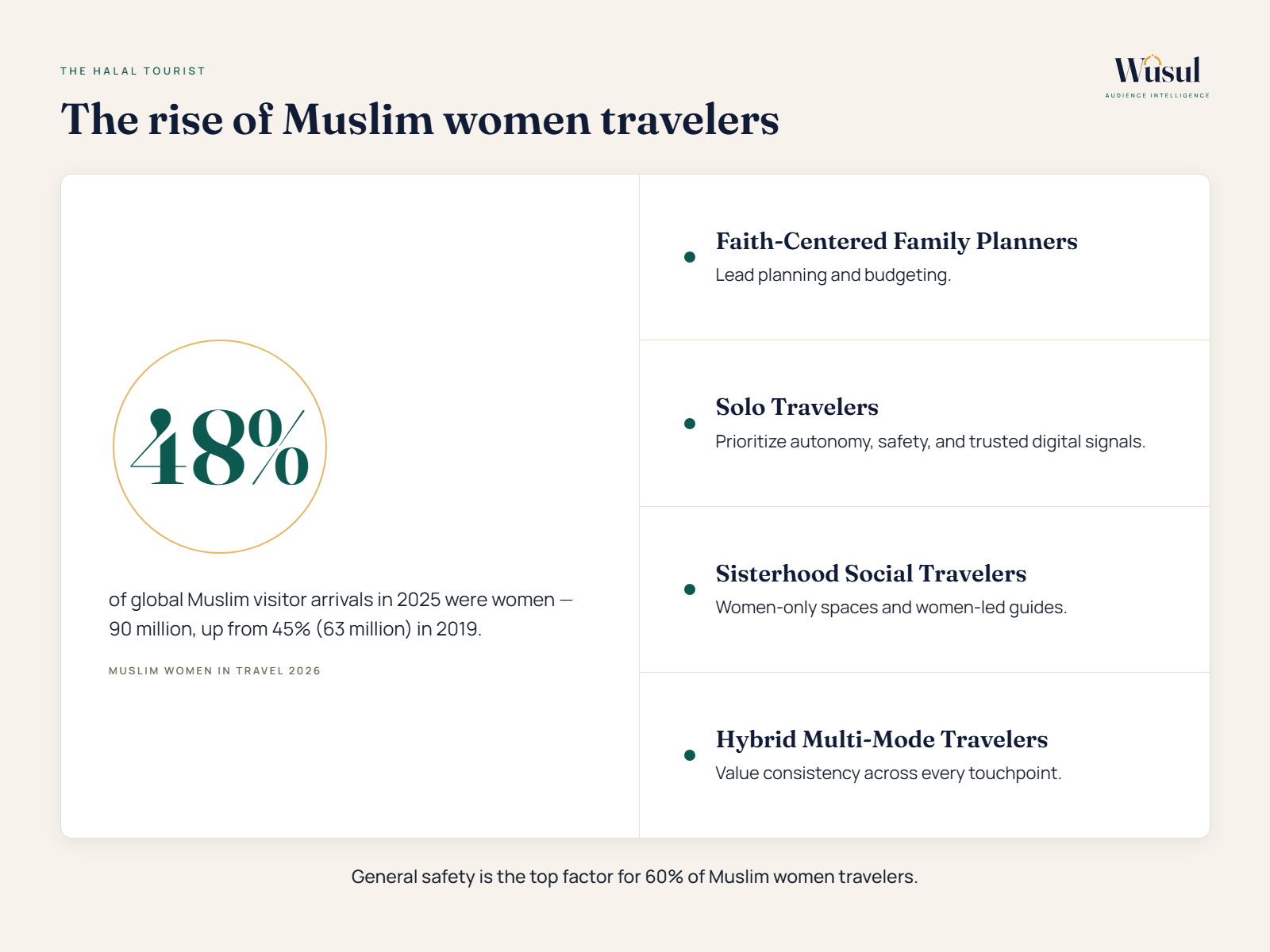
One of the most significant shifts in the market is the growing role of Muslim women. According to the Mastercard-CrescentRating Muslim Women in Travel 2026 report, Muslim women accounted for 90 million international arrivals in 2025, representing 48% of global Muslim visitor arrivals, up from 63 million (45%) in 2019.
The report, built on responses from more than 1,700 Muslim women across 20+ source markets, identifies four distinct personas:
Faith-Centered Family Planners. Within a family trip, women take the lead on planning and budgeting, even more so for religious travel. They prioritize clean, female-friendly prayer and wudu facilities, family-oriented accommodation, child-friendly amenities, and halal-verified dining within walking distance.
Solo Travelers. Solo travel among Muslim women is one of the fastest-growing sub-segments. These travelers prioritize autonomy and safety, leaning on digital tools and trusted signals to navigate unfamiliar destinations. They seek AI-driven safety briefings, trusted reviews from fellow Muslim women travelers, and clear Muslim-friendly signals.
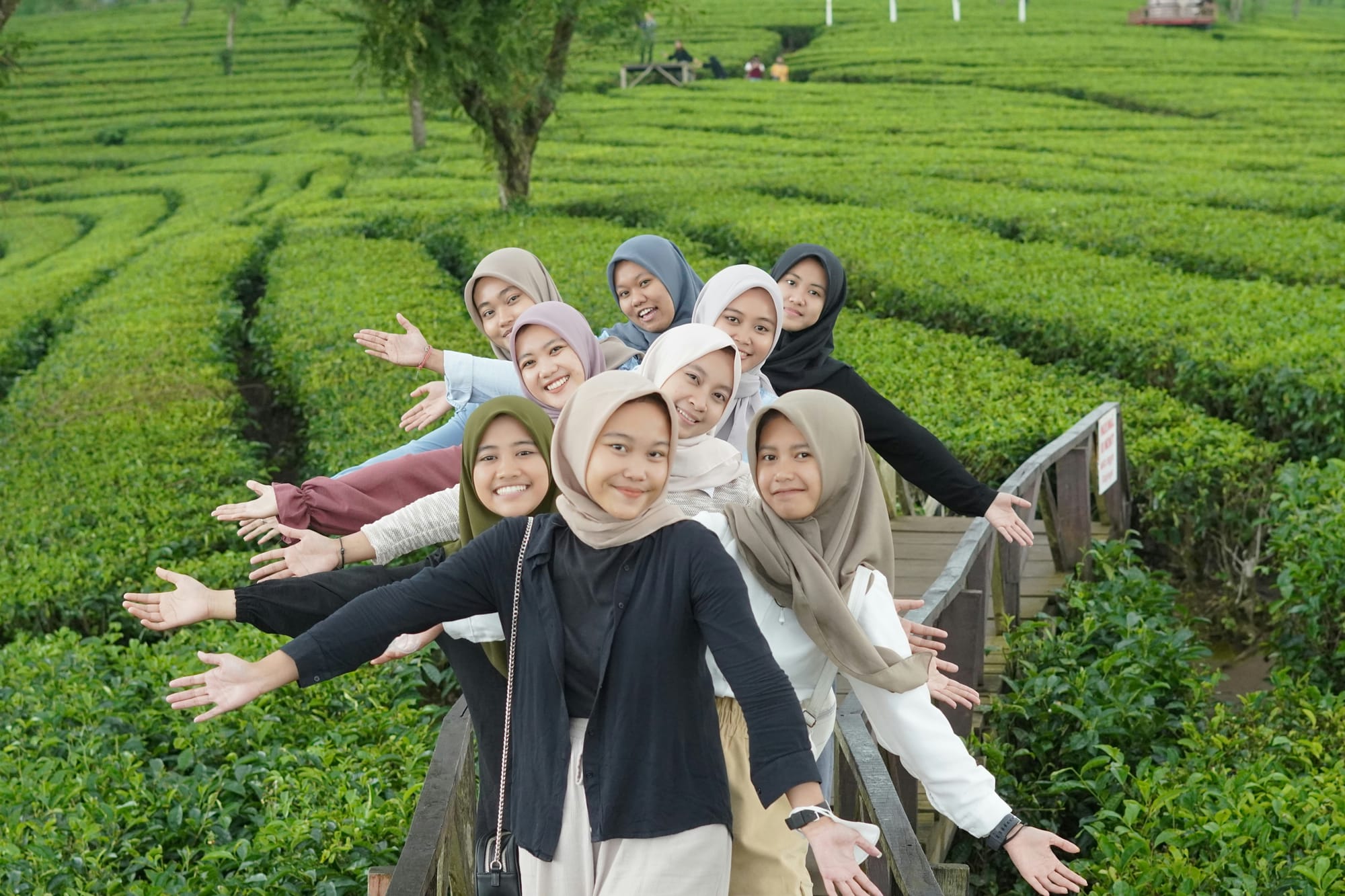
Sisterhood Social Travelers. Female-only group travelers shape the experience around shared comfort, social connection, and women-friendly spaces. They demand women-only floors, spas, beaches, and prayer spaces, alongside women-led tour operators and guides.
Hybrid Multi-Mode Travelers. These travelers adapt their roles across solo, group, and family trips. Consistency across touchpoints matters more than any single feature, digital booking, e-wallets, seamless mobility, and loyalty programs that recognize multiple travel modes.
Safety and trust are key priorities. General safety and comfort are the most important destination factors for 60% of Muslim women travelers, followed by Muslim-friendliness at 30%. Travelers want to feel confident accessing halal food, finding prayer spaces, dressing modestly, moving through destinations safely, and practicing their faith without discrimination or judgment.
Digital discovery is defining the segment. 68% of respondents said social media influenced their travel decisions, with Instagram as the most used platform, followed by YouTube and TikTok. AI tools are also emerging as a new layer of travel assurance, helping travelers research destinations, compare options, plan itineraries, identify halal dining, locate prayer spaces, and assess safety considerations.
Other key traveler segments
Beyond the women's segment, industry analysts describe Muslim travelers through additional personas:
Faith-Centered Family Planners (broader segment). This is often the largest volume segment. These are multi-generational families planning holidays where everyone's needs are met. For this group, "halal" is a baseline expectation, not a niche add-on. They are willing to pay a premium for destinations and hotels that remove uncertainty around religious compliance.
Hybrid Travelers (Work + Leisure / Education + Travel). This segment includes professionals on business trips, conference attendees, and students studying abroad who extend their stays for leisure. Their needs are pragmatic: halal dining options near business districts and universities, prayer-friendly workplaces or campuses, and flexible itineraries that accommodate prayer times.
Independent Solo Travelers (Gen Z and Millennials). Young, digitally savvy Muslims are increasingly traveling solo or in small friend groups. They seek authentic cultural experiences, social hostels or boutique hotels with halal-friendly options, and clear online information about prayer spaces, halal food, and local norms.
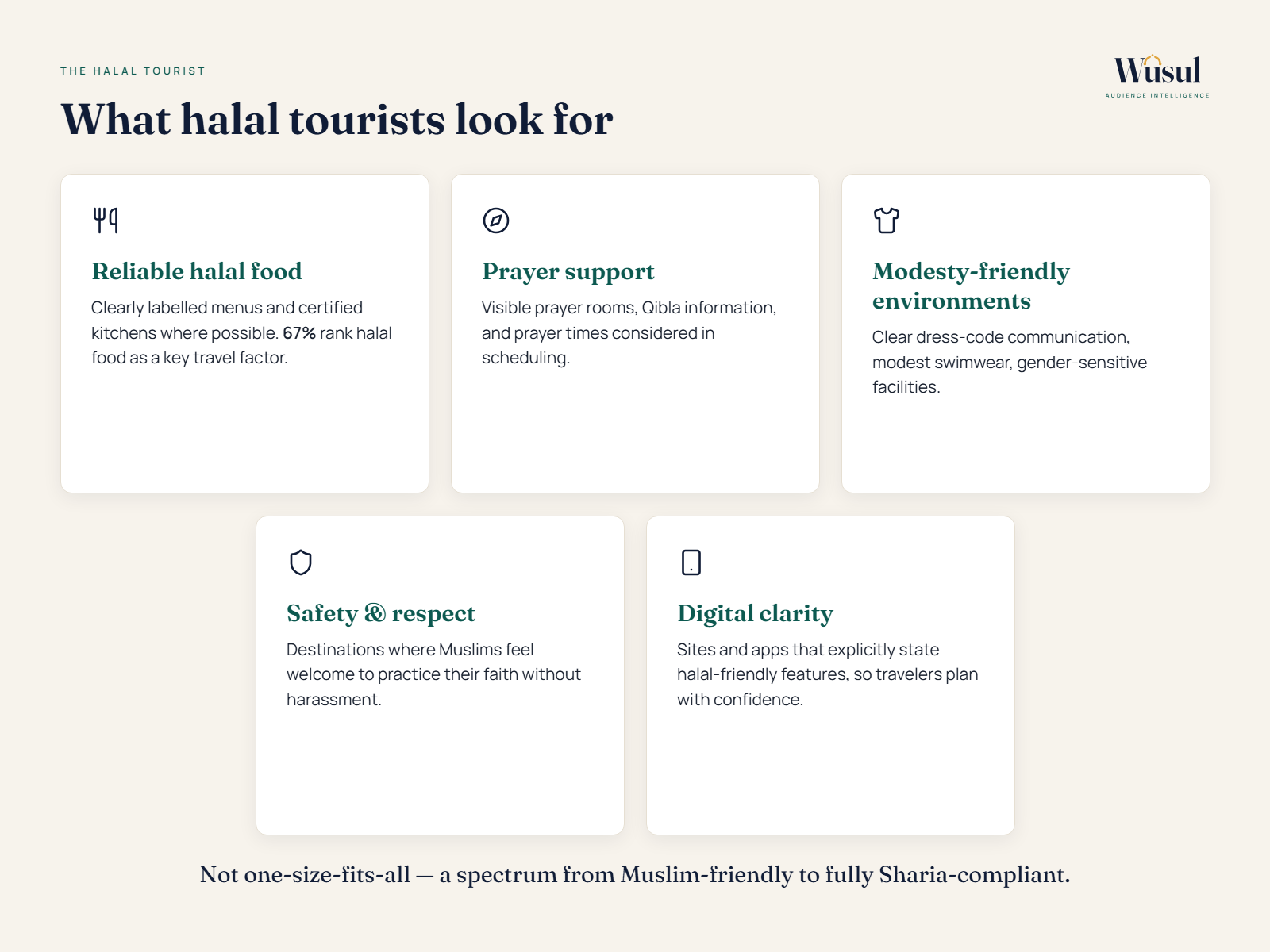
What halal tourists typically look for
Despite this diversity, certain "must-haves" recur across segments:
Reliable halal food. Clearly labelled menus, halal-certified kitchens where possible, and alternatives to pork and alcohol.
Prayer support. Visible prayer rooms, Qibla information, and consideration of prayer times in tour schedules.
Modesty-friendly environments. Clear communication on dress codes, availability of modest swimwear or private beach/pool options, and gender-sensitive facilities.
Safety and respect. Destinations where Muslims feel welcome and safe to practice their faith without harassment.
Digital clarity. Websites and apps that explicitly state halal-friendly features, so travelers can plan with confidence.
Importantly, not all Muslim travelers require the same level of "halal intensity." Some are comfortable in mixed environments if basic needs are met; others prefer fully Islamic ecosystems. The most successful halal tourism strategies recognize this spectrum and offer tiered options (from Muslim-friendly to fully Sharia-compliant) rather than a one-size-fits-all model.
Halal travel at non-Muslim destinations
A striking trend in recent years is the rise of non-OIC destinations (countries that are not part of the Organization of Islamic Cooperation) as formidable players in the halal tourism market.
Hong Kong was ranked second among non-OIC destinations in the GMTI 2026, with Ocean Park named Muslim-friendly Attraction of the Year. The city has invested in halal-certified dining (now over 220 certified restaurants), prayer facilities with Qibla indicators and Qurans in multiple languages, and Muslim-friendly washrooms with ablution facilities.
However, Hong Kong's data reveals a communication gap: while the city scored 85/100 in destination marketing and over 90/100 in infrastructure, it scored only 26/100 in communication proficiency. This gap between promotion and grassroots service delivery (particularly in accessible, community-level halal dining) suggests that Muslim-friendly infrastructure must extend beyond flagship attractions.
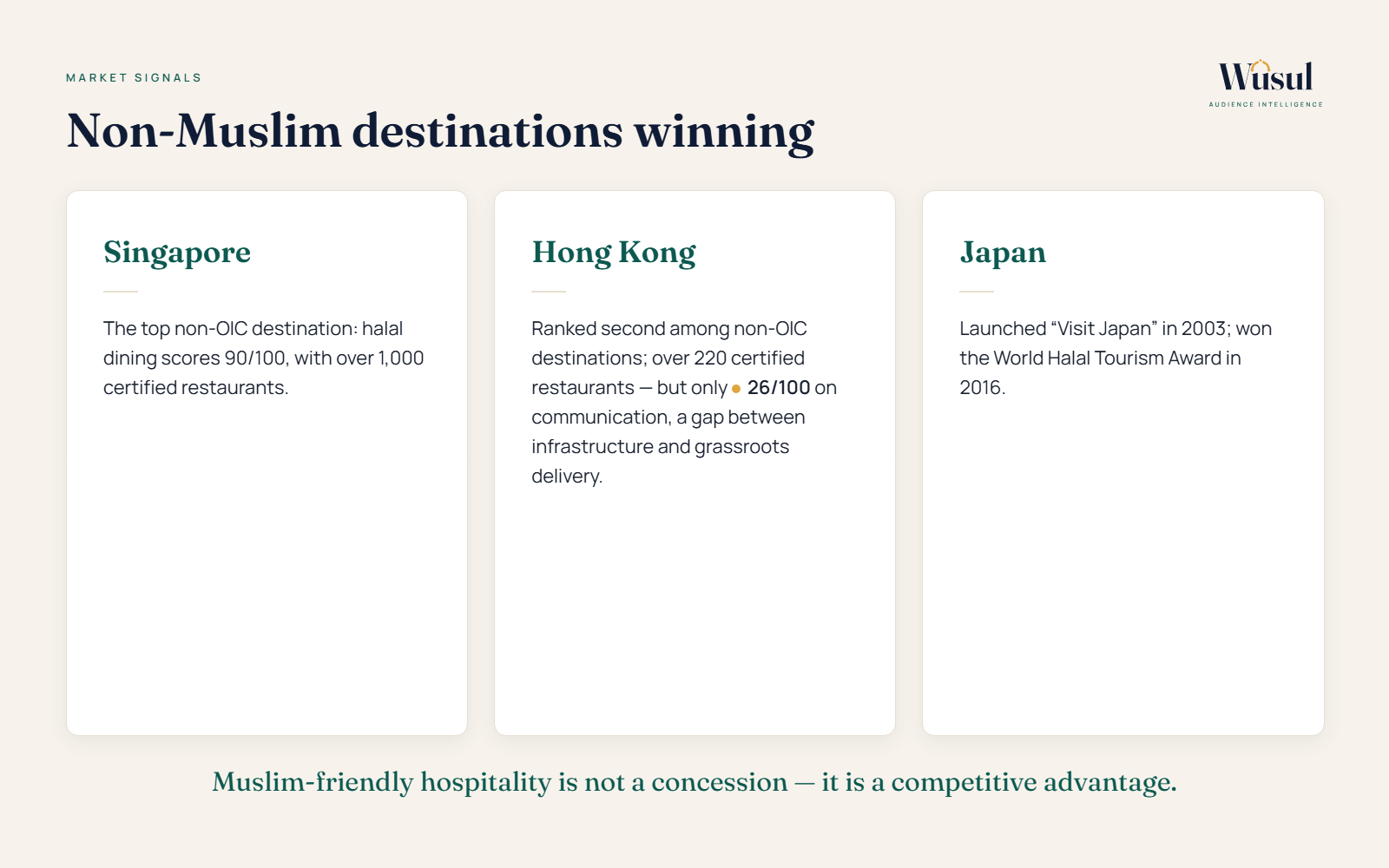
Singapore has long been the top non-OIC destination, with halal dining scoring 90/100 and over 1,000 certified restaurants spanning from hawker centres to fine dining.
Japan launched its "Visit Japan" campaign in 2003 to grow international tourism overall. Over the following decade it steadily added Muslim-friendly facilities and hospitality guidance, and in 2016 it was named World's Best Non-OIC Emerging Halal Destination at the World Halal Tourism Awards.
These destinations have recognized something important: Muslim-friendly hospitality is not a concession. It is a competitive advantage.
The digital transformation of Muslim travel
80% of travelers worldwide now use AI tools for travel purposes, according to GMTI 2026. This represents a fundamental shift from search-based discovery to AI-assisted recommendations.
AI readiness is now a competitive requirement. The GMTI 2026 notes that destinations which fail to digitize their Muslim-friendly offerings risk being excluded from AI-driven recommendation systems, regardless of the quality of their physical infrastructure.
Social media shapes travel decisions. 68% of Muslim women travelers said social media influenced their travel decisions, with Instagram as the most used platform, followed by YouTube and TikTok. AI tools are emerging as a new layer of travel assurance, helping travelers research destinations, compare options, plan itineraries, identify halal dining, locate prayer spaces, and assess safety considerations.
The lesson is respect
As the market moves toward an estimated 262 million Muslim arrivals and over $310 billion in annual spend by 2030, halal tourism will continue to shape global travel; pushing the industry toward greater inclusivity, cultural intelligence, and faith-aware service design.
The lesson is not about travel. It is about respect. When an industry takes Muslim values seriously (designing for prayer, modesty, halal food, and family needs) it doesn't just serve Muslim travelers. It raises the standard for everyone.
At Wusul, we believe that cultural intelligence means understanding not just what an audience does, but why they do it, and designing for the values that shape their decisions. Halal tourism is a case study in what happens when an industry takes those values seriously.
Frequently asked questions
What is halal tourism?
Halal tourism is travel designed to allow Muslims to enjoy leisure, family, and cultural trips without compromising core Islamic requirements. It involves travel ecosystems, such as destinations, hotels, and airlines, that align with Sharia principles regarding food, prayer, modesty, and gender-sensitive facilities. It is often described as Muslim-friendly travel where faith-based needs are met.
Why is halal tourism growing?
The growth of halal tourism is driven by a massive expansion of the global Muslim population, which is projected to reach 2.57 billion by 2036. This demographic is young, with a median age of 25-27 years, and includes many digital natives. Additionally, demand is broadening beyond traditional markets to include emerging and diaspora communities across Europe, North America, and East Asia.
How can destinations cater to Muslim travelers?
To cater to Muslim travelers, providers should offer halal food and drink without pork or alcohol, preferably with clear labelling or certification. Prayer infrastructure, such as prayer rooms and Qibla direction, is essential. Providers should also ensure modesty and gender sensitivity through options like women-only pool hours or family-only areas, while maintaining safe, family-friendly environments.