When a Muslim charity tells an American donor to give before December 31, what is the donor actually being promised? Wusul compared the tax language of four verified year-end appeals, the rules that applied in 2025, and one Muslim organisation that explained the difference.
The deadline is real. The benefit is conditional.
In December 2024 and 2025, three American Muslim charities used something British charities do not have: a genuine reason to tell donors to give before New Year. For individuals whose tax year follows the calendar, a charitable gift must generally be completed by 31 December to count for that year. Zakat Foundation of America, Human Appeal USA and, a year earlier, Baitulmaal all built appeals around that date, as the previous article found.
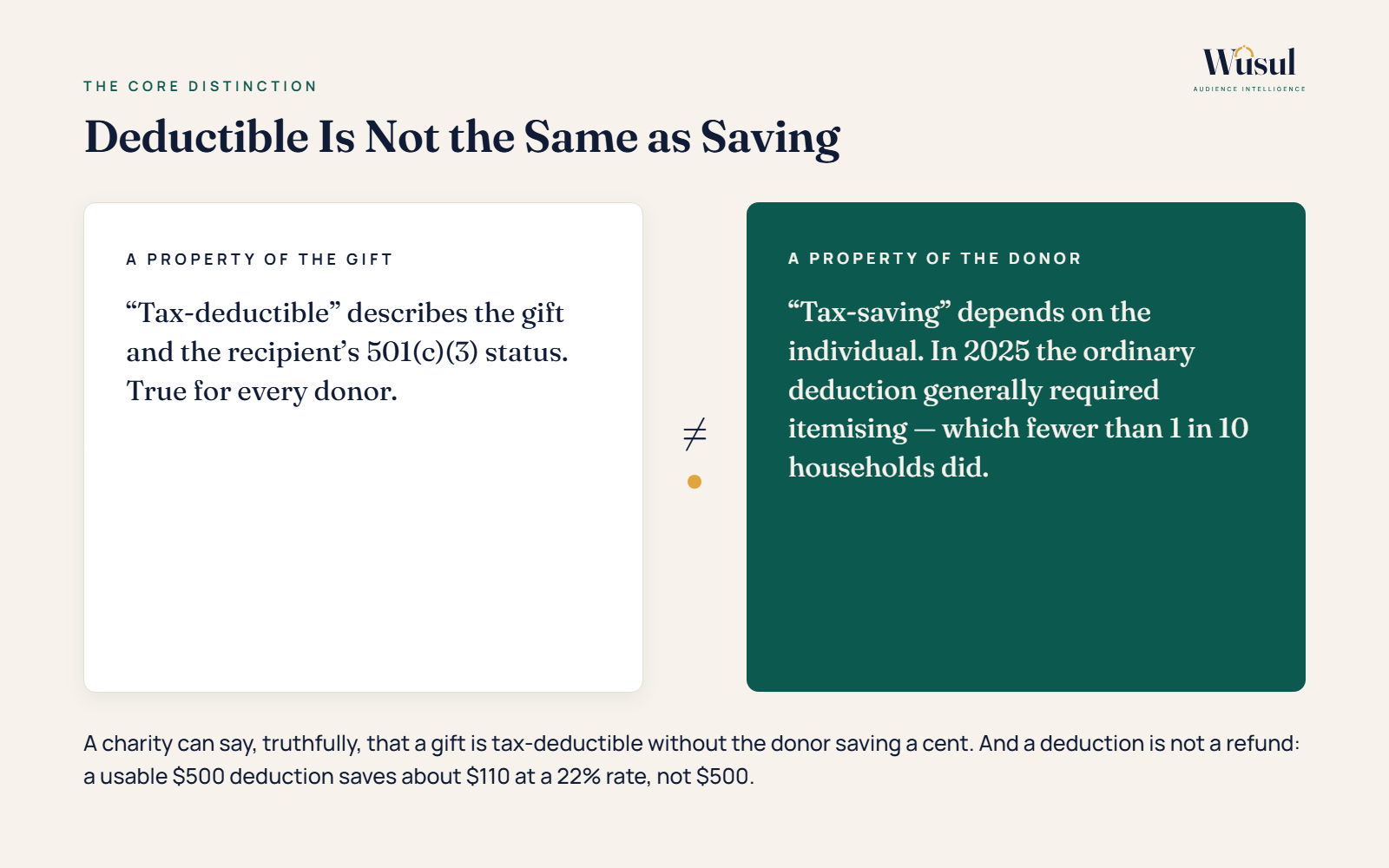
But a deadline for a deduction is not a deduction for everyone. In 2025, the ordinary federal charitable deduction generally benefited only donors who itemised their deductions. A donor taking the standard deduction, which after the 2017 tax reform meant more than nine in ten households, usually received no additional federal tax benefit from a December gift. Muslim charity donors may differ from the national average, but it is likely that most of the people reading these appeals could not have used the deduction they were offered.
The legal deadline was the same for everyone. The financial benefit was not. A charity can say, truthfully, that a gift is tax-deductible without the donor saving a cent. This article looks at how the four verified American year-end appeals described that benefit, what the rules allowed, and what a clearer message would look like.
Four appeals, four ways of promising a tax benefit
The previous article classified thirty American charity-years and found four with an explicit year-end appeal. All four used tax language. They did not use it in the same way.
| Appeal | What it said about tax | How the benefit was framed |
|---|---|---|
| Zakat Foundation of America, 2024 | Give before year-end and make a tax-deductible gift for 2024 | A deadline attached to orphan sponsorship |
| Baitulmaal, 2024 | A tax-deductible donation can support our efforts | Deductibility as a feature of the gift |
| Zakat Foundation of America, 2025 | A contribution can reduce your 2025 taxable income | A conditional possibility, plus employer matching |
| Human Appeal USA, 2025 | One gift fulfils Zakat, builds Sadaqah Jariyah and earns a tax deduction | A combined religious and financial reward |
Zakat Foundation, 2024, led with the child, not the tax code: sponsor an orphan for $50 a month or $600 a year, with the tax deadline as the reason to decide now. The humanitarian case stands on its own; the deduction adds urgency.
Baitulmaal, 2024, ran more than one year-end page. End of Year 2024 offered $250, $500 or $1,000 and described every gift as tax-deductible, giving the charity's 501(c)(3) status and tax number. A second page, Orphan Support End of Year 2024, offered a year's sponsorship for $768 or $64 a month under the same frame. Giving the charity's tax status is useful: it shows the recipient can receive deductible gifts. It says nothing about whether the donor can use the deduction. Both pages belong to the same Baitulmaal 2024 case, not to two separate campaigns.
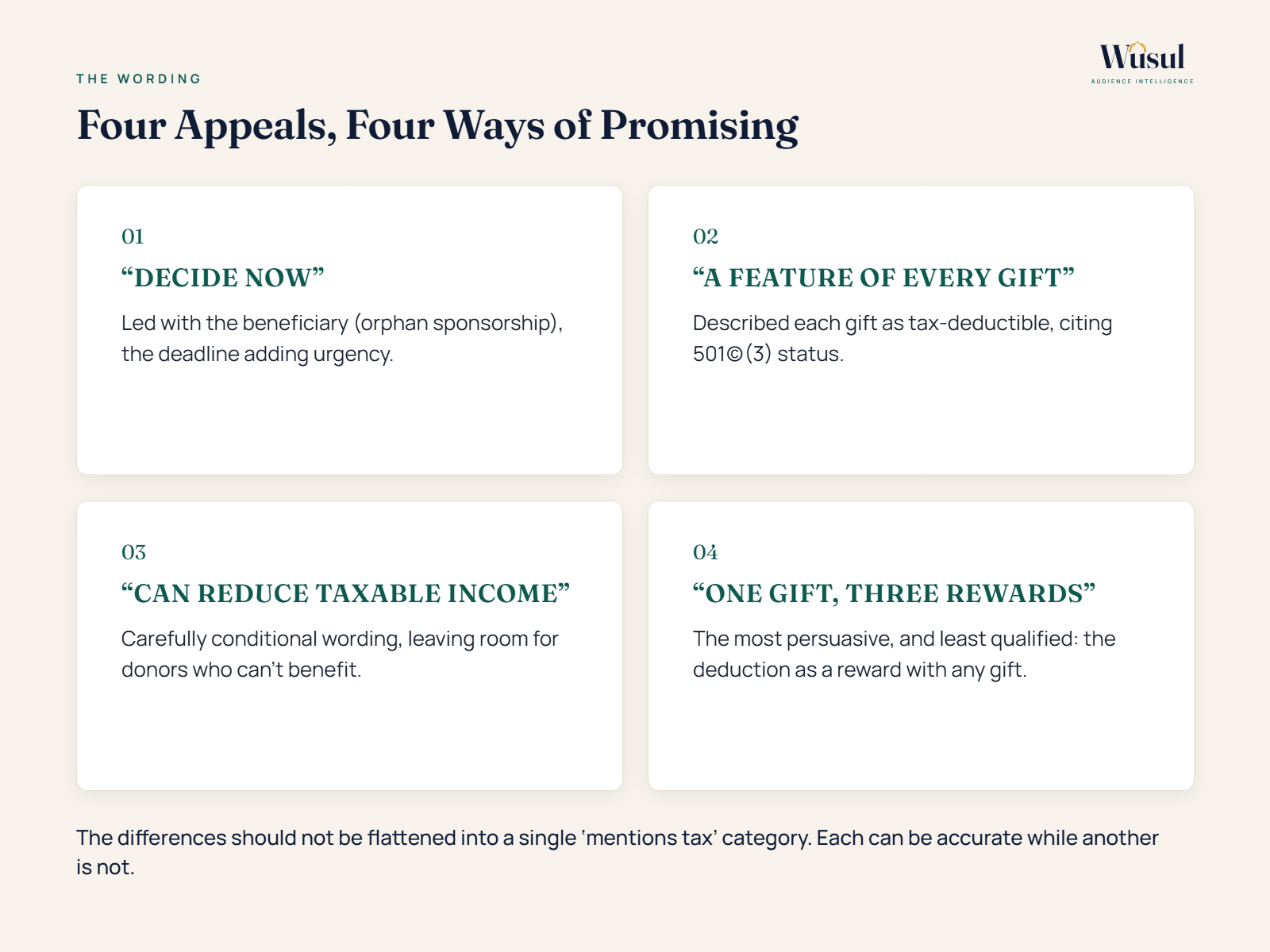
Zakat Foundation, 2025, chose its words carefully: a gift can reduce taxable income. That leaves room for donors who cannot benefit, without telling them who they are.
Human Appeal USA, 2025, went furthest. "One Gift. Three Rewards." presents the tax benefit as one of three rewards that come with any gift before 31 December. It is the most persuasive framing of the four, and the least qualified. For an itemiser it was accurate; for most donors, the third reward probably did not exist in 2025.
Deductible is not the same as saving
For the 2025 tax year, an individual generally had to itemise deductions on Schedule A to claim the ordinary charitable deduction. Donors taking the standard deduction generally could not. Two donors giving the same gift show the difference:
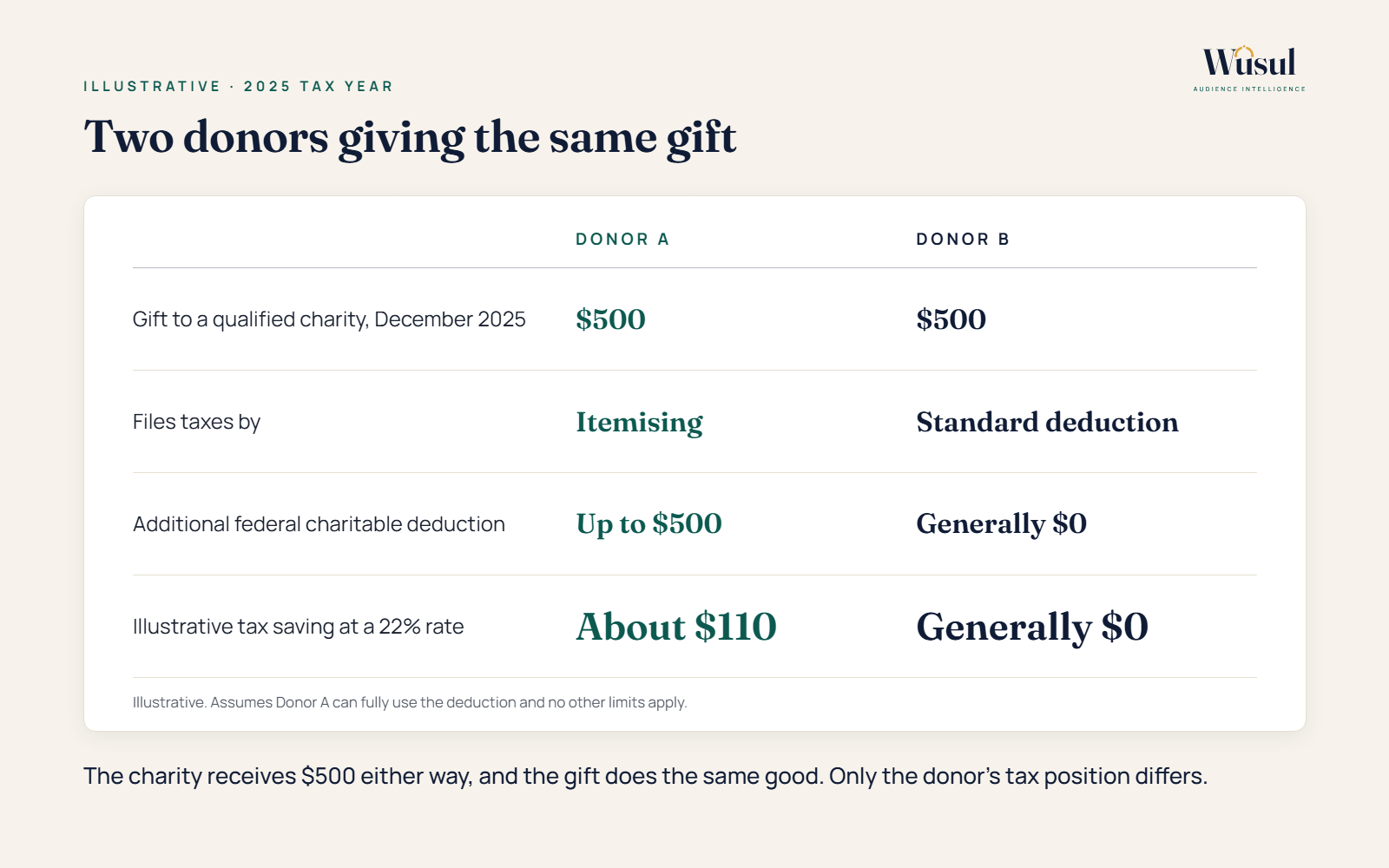
Illustrative. Assumes Donor A can fully use the deduction and no other limits apply.
The charity receives $500 either way, and the gift does the same good. Only the donor's tax position differs. Even for Donor A, a deduction is not a refund: a $500 deduction reduces taxable income by $500, which at a 22% rate saves about $110, not $500.
So "your donation is tax-deductible" describes the gift and the recipient. It does not describe what a particular donor will save. Which gifts qualify, what records are needed, and how gifts for overseas causes or for named families are treated are covered in the next article.
December 2025: the deadline changed meaning
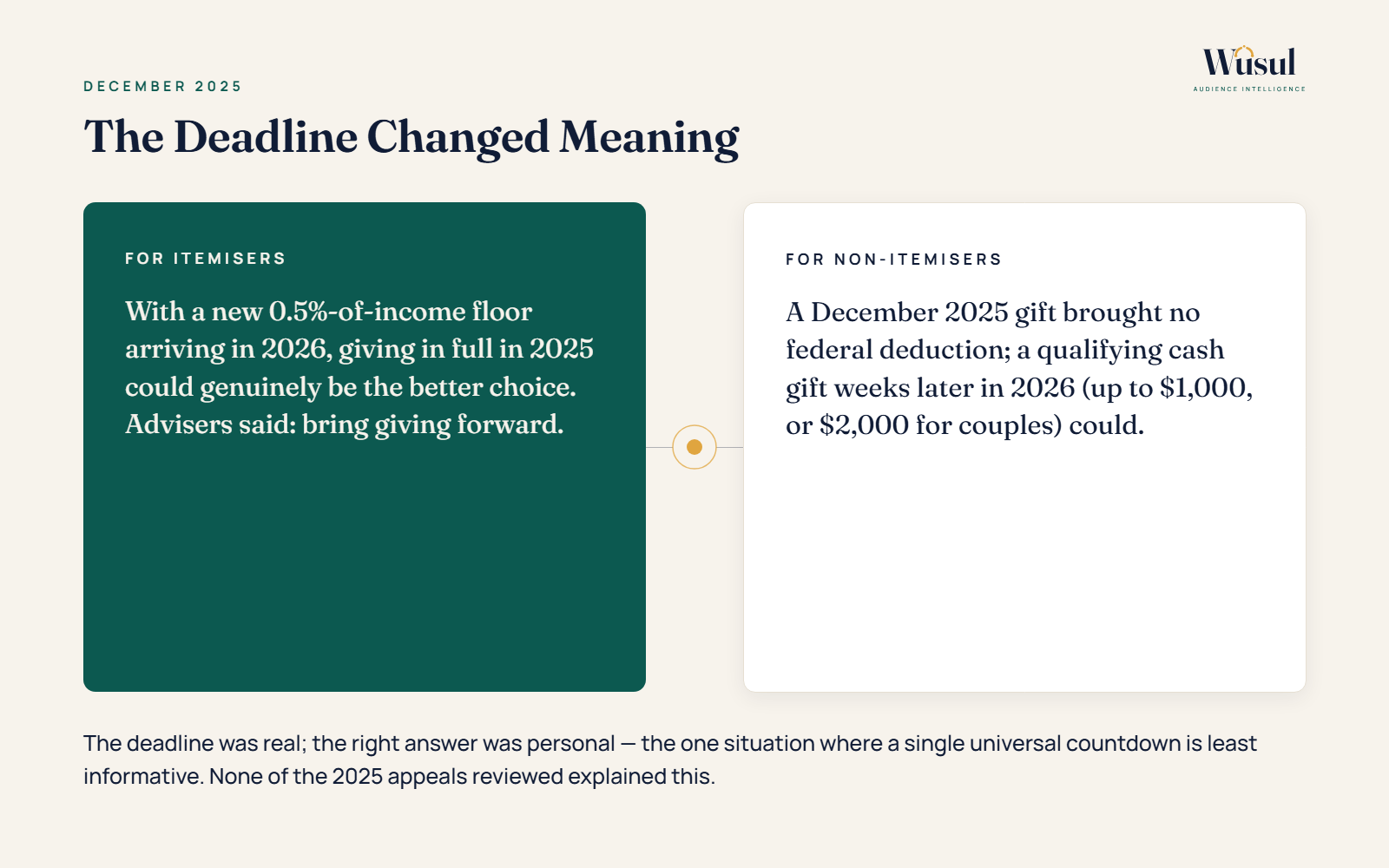
Tax legislation enacted on 4 July 2025 rewrote the charitable deduction from 2026. That made December 2025 unusual: the date was the same, but what giving before it meant now depended on which kind of donor you were.
| Donor | Rule from 2026 | Giving before 31 December 2025 versus January 2026 |
|---|---|---|
| Itemiser | Only gifts above 0.5% of adjusted gross income count; top-bracket deductions capped at 35% | Often better to give in 2025, under the old rules |
| Non-itemiser | New deduction for cash gifts up to $1,000, or $2,000 for married couples; gifts to donor-advised funds excluded | A cash gift in 2026 may earn a deduction a 2025 gift could not |
| Others | Depends on income, deductions and gift type | No general answer |
A worked example shows the itemiser's position. With adjusted gross income of $100,000, the 2026 floor is $500. A donor giving $1,000 in 2026 would ordinarily count only the $500 above the floor; the same gift in 2025 would count in full. Advisers duly told itemisers to bring planned giving forward into 2025.
For non-itemisers, the incentive ran the other way. A December 2025 gift brought no federal deduction; a qualifying cash gift a few weeks later, in 2026, could.
So was "give before 31 December" good tax advice in 2025? For some donors, yes. For others, waiting might have been better. For many, it made no difference. The deadline was real; the right answer was personal. That is exactly the situation in which a single universal countdown is least informative.
What the 2025 pages left out
Against that background, the two verified 2025 appeals are revealing for what they did not say. Neither Zakat Foundation's December article nor Human Appeal USA's Give Beyond 2025, as reviewed, explained that the ordinary 2025 deduction generally depended on itemising. Neither mentioned the rules due to take effect in 2026.
That needs to be stated precisely. It is a finding about the pages reviewed, not proof that the charities gave no tax guidance by email, through donor services or elsewhere. Neither appeal invented a deadline: 31 December was real for itemisers. And Zakat Foundation's wording, a gift can reduce taxable income, was carefully conditional. Human Appeal's was more assertive, presenting the deduction as one of three rewards that came with the gift.
The fair criticism is narrower than "misleading", and more useful. Both appeals simplified a benefit whose value depended on the donor, in the one year when the details changed most. A donor reading them could reasonably have concluded that giving in December would lower their tax. For most donors in 2025, it probably would not have.
A Muslim organisation that explained the difference
Greater precision was available from within American Muslim philanthropy in the same season. The American Muslim Community Foundation, which is outside the ten-charity sample, published year-end guidance in 2025 titled Year-End Giving at Every Level. It explained that donors taking the standard deduction in 2025 generally received no extra federal benefit from ordinary gifts; set out when itemising, appreciated securities, qualified charitable distributions from retirement accounts or donor-advised funds might help; and described the rules due in 2026 and why different donors might choose differently.
A companion piece on donor-advised funds made a further point that standard appeals miss: a donor can make a contribution to a fund before 31 December, take the deduction for that year, and recommend the actual grants to charities later. The tax deadline and the moment the money reaches a cause are not necessarily the same.
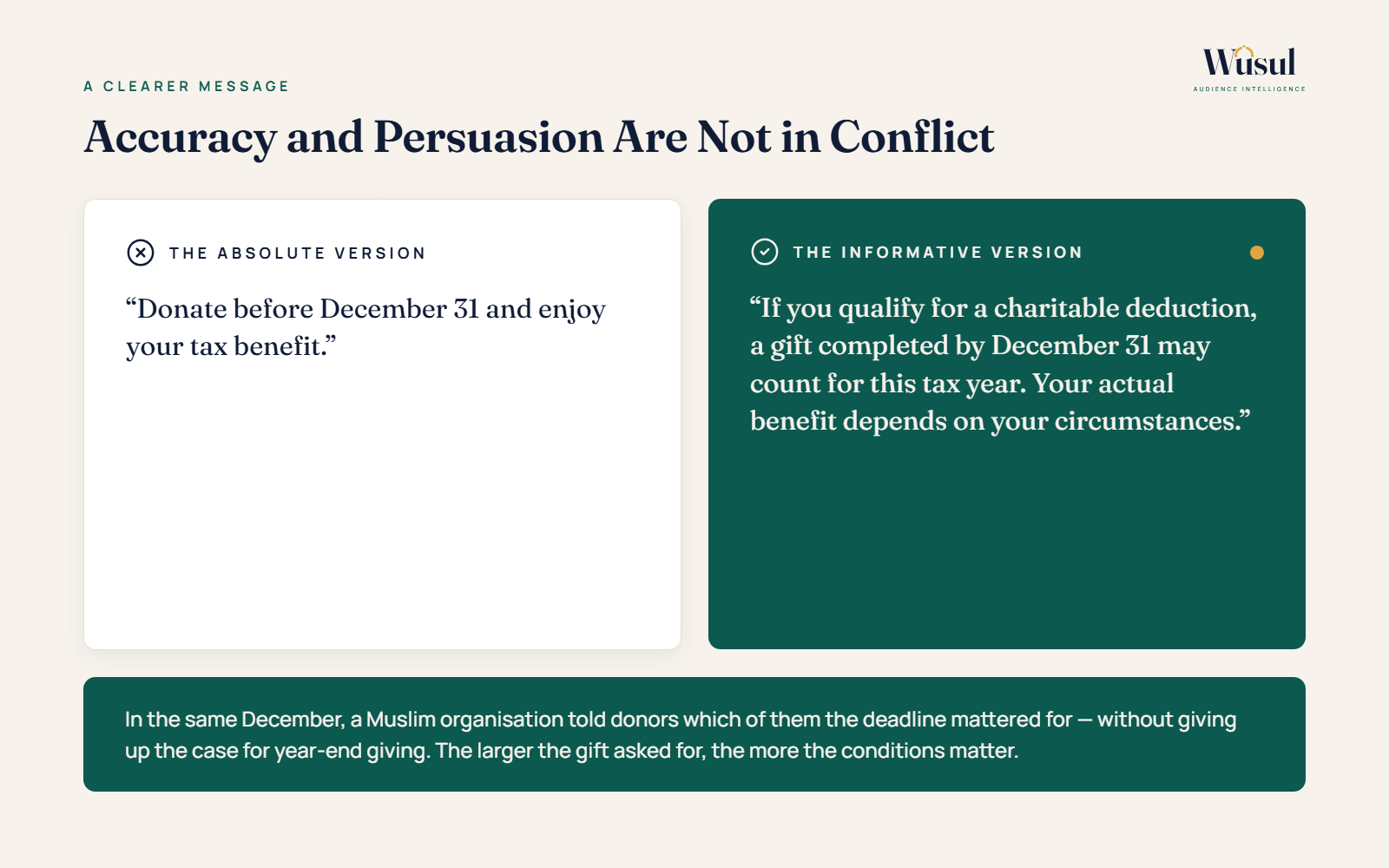
AMCF still encouraged year-end giving. It still treated 31 December as an important decision date and still made the case for supporting Muslim communities and humanitarian causes. It simply told donors which of them the deadline mattered for, and why.
The public record cannot show whether that more careful approach raised more or less money than the shorter appeals, and no such claim is made here. What it shows is that accuracy and persuasion were not in conflict: in the same December, a Muslim organisation managed both.
Employer matching: a second, different promise
Zakat Foundation's 2025 appeal added another reason to give: an employer match that can "double" a gift. That is a real opportunity, and a different mechanism from tax relief.
A match depends on the employer's own rules: eligibility, caps, the matching ratio and an application, often after the gift is made. If a donor gives $500 and a participating employer matches it one-to-one, the charity may receive $1,000. But the employer's $500 is the employer's gift, not the employee's, and it does not add to the employee's deduction. Nor is a match automatic simply because an employer has a scheme.
The distinction matters for reporting as well as for donors. A campaign total that includes matching funds tells you what the charity received, not what its donors gave. Tax relief changes the donor's position; matching changes the charity's receipts. Both can be good reasons to give, but they are not the same reason.
Tax-deductible without the deadline: the other charities
Seven charities in the sample had no verified year-end appeal. Most still describe their gifts as tax-deductible, but as a fact about the gift rather than a reason to give by a date.
| Charity | Tax language found | Linked to 31 December? |
|---|---|---|
| Helping Hand (HHRD) | Morocco earthquake appeal: donations Zakat-eligible and tax-deductible, with 501(c)(3) status and tax number | No: an emergency appeal |
| Penny Appeal USA | Palestine emergency appeal: tax-deductible and Zakat-eligible | No: an emergency appeal |
| Muslim Aid USA | Checkout states 501(c)(3) status and that gifts are tax-deductible | No: standard donor information |
| Islamic Relief USA | A 2015 article on giving tips to lower taxes, covering records and personal circumstances | Background only, outside the study period |
| Life for Relief and Development | A donor guide to charitable tax deductions, since updated for 2026 | Current guidance, not dated campaign wording |
| Mercy-USA | Tax number given in donation documentation | No |
| ICNA Relief USA | No tax-deadline language found in the material reviewed | No |
The distinction matters. Telling donors that Zakat is tax-deductible describes a possible legal attribute of the gift. Telling them to pay Zakat before 31 December uses the tax calendar to set the timing of a religious obligation. Helping Hand and Penny Appeal USA do the first. Human Appeal USA's 2025 appeal does the second. They should not be counted as the same message.
What a transparent tax appeal would say
A good appeal does not need to reproduce IRS guidance. It needs to keep the charity's status apart from the donor's benefit. A short note, or a link to a short FAQ, could cover:
| Element | What the donor should understand |
|---|---|
| Tax status | Gifts to this organisation may be deductible under the applicable rules |
| Who benefits | The actual saving depends on how the donor files, the tax year, the type of gift and their circumstances |
| The deadline | A gift generally must be completed by 31 December to count for this tax year; some gift types take longer to complete |
| Matching | An employer's match depends on its own scheme and approval |
| Zakat | Whether a gift is valid Zakat is a separate question from its tax treatment |
| Records | A receipt or acknowledgment may be needed to claim a deduction |
The difference in wording is small:
Instead of: "Donate before December 31 and enjoy your tax benefit."
Say: "If you qualify for a charitable deduction, a gift completed by December 31 may count for this tax year. Your actual benefit depends on your circumstances."
The second is less absolute and more informative. And the larger the gift a campaign asks for, the more it matters: a $50 donor is mostly giving for charitable reasons, while a donor weighing $50,000 may be making a tax decision. The stronger the financial promise, the clearer its conditions should be.
What the four campaigns can and cannot prove
The evidence supports three conclusions. American Muslim charities do use the tax deadline as a fundraising argument. Their wording varies, from a property of the gift, to a conditional possibility, to a promised reward, and those differences should not be flattened into a single "mentions tax" category. And none of the pages reviewed explained who could actually benefit.
What the evidence cannot show is the effect of the message. We do not know how many of these charities' donors itemise, how many gave because of the deadline rather than the cause or the religious obligation, or how much the tax message added. None of the four appeals published what it raised.
For future comparisons, across this series' remaining markets and later years, four questions can be asked of any dated tax-led appeal:
- Deadline visibility: does it ask donors to give before 31 December for tax reasons?
- Eligibility clarity: does it say the benefit depends on the donor's circumstances?
- Religious, tax integration: does it explicitly link Zakat or Sadaqah to the tax benefit?
- Result disclosure: does the charity publish what the appeal raised?
On the four American appeals: four of four, zero of four, one of four, and zero of four.
Conclusion: a powerful message, not a universal reward
The American tax calendar gives Muslim charities a real deadline, and they use it. Zakat Foundation of America ties it to orphan sponsorship. Baitulmaal presents the deduction as a feature of every gift. Human Appeal USA packages Zakat, Sadaqah Jariyah and tax relief into one proposition.
The deadline was the same for every donor. The benefit was not. In 2025 the ordinary deduction generally helped only itemisers, and as new rules approached, whether to give before or after 31 December depended on the donor. None of the appeals reviewed said so. An American Muslim organisation outside the sample did, in the same month, without giving up the case for year-end giving.
The marketing strength of a year-end tax appeal comes from making the deadline feel universal. Its accuracy depends on explaining why the benefit is not.
Next: Zakat, Sadaqah and the IRS: What Muslim Donors Can Actually Deduct.
Frequently asked questions
Is December 31 a real tax deadline for American donors?
Generally, yes. For individuals on the calendar year, a gift usually has to be completed by 31 December to count for that year.
Could every donor deduct a gift in 2025?
No. The ordinary federal deduction generally required itemising, which fewer than one in ten households did after 2017.
Does tax-deductible mean I get my donation back?
No. A deduction reduces taxable income. At a 22% rate, a fully usable $500 deduction saves about $110.
What changed in 2026?
Non-itemisers can deduct up to $1,000 of cash gifts, or $2,000 for married couples; itemisers can deduct only gifts above 0.5% of adjusted gross income, and top-bracket deductions are capped at 35%.
Were the 2025 appeals wrong to mention the deduction?
Not for mentioning it: the deadline and the deduction were real for itemisers. The question is whether they made clear that the benefit depended on the donor. None of the pages reviewed did.
Does paying Zakat before December 31 give an automatic deduction?
No. Zakat follows religious rules; tax treatment follows US law. One does not establish the other.
Can an employer match double my gift?
It can, if your employer runs a matching scheme and approves the match. The employer's contribution is its own gift, not part of your deduction.
Wusul Insight: A tax deadline is a fact; a tax saving is an individual outcome. American Muslim charities use the 31 December deadline well as a reason to act, but none of the year-end appeals reviewed told donors that, in 2025, most of them could not use the deduction. Telling donors who the deadline matters for, as one Muslim organisation did, would make the appeal more accurate without making it less persuasive.
Methodology note: this article examines the tax language of the four year-end appeals verified in article 6, from the ten American charities in Wusul's dataset. Findings are limited to the pages reviewed; a missing explanation on a page does not show that a charity gave no guidance elsewhere. Current pages and guides updated in 2026 are not treated as historical campaign wording. The American Muslim Community Foundation is an outside comparison. Tax examples are illustrative and general, not tax advice; religious points are discussed only to distinguish the claims appeals make.
Sources note: This article is based solely on publicly available annual reports, financial statements, regulatory records and web pages published by the organisations named. None of the organisations discussed was involved in its preparation.