On 29 October 2026, two leading British charity research organisations issued a warning. The Office for Budget Responsibility had just raised its inflation forecast for 2027 from 2% to 3.4%, largely because of higher energy costs linked to conflict in the Middle East. Pro Bono Economics and the Charities Aid Foundation calculated that this alone would cut the real value of regular gifts to UK charities by a cumulative £125 million over three years.
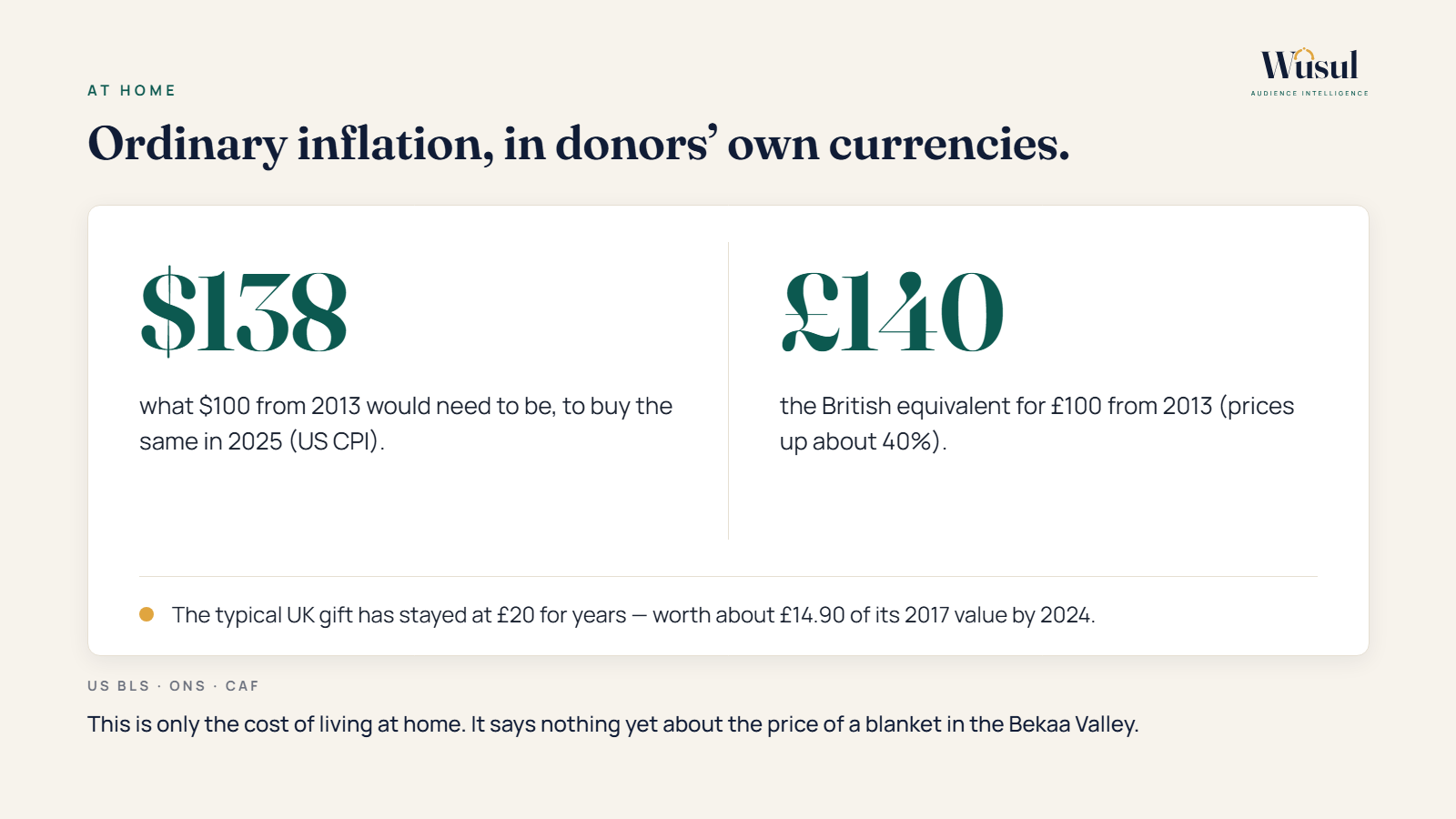
The idea is not new. In 2022 the same organisations showed that the average £20 monthly donation of 2017 would be worth just £14.90 by 2024. CAF's UK Giving research has since noted that the typical gift has stayed at £20 for years, while £20 in 2017 would need to become more than £25 to buy the same in 2024.
Winter appeals have a version of the same problem, with two twists. First, donation tiers are often tied to promises: £100 "provides" a winter kit. When the price does not move, the promise quietly shrinks. As the second article in this series found, Islamic Relief UK's winter tiers appeared unchanged on a page still headed "Winter Appeal 2022". Second, winter help is bought not in Britain but in Lebanon, Syria, Gaza or Afghanistan, where prices, currencies and fuel follow paths of their own.
This article asks the question in its title literally: what has a winter donation actually been worth, in donors' currencies and to a family receiving help, across more than a decade? For one country, Lebanon, the published record lets us answer.
What happened to $100 and £100?
Start with the donor's own currency. Using the US Bureau of Labor Statistics' annual-average consumer price index (CPI-U), the general purchasing power of $100 changed as follows:
| Year | US CPI-U, annual average | $100 then, in 2025 dollars | What $100 in 2025 was worth in that year's terms |
|---|---|---|---|
| 2013 | 232.957 | $138 | 72% |
| 2019 | 255.657 | $126 | 79% |
| 2025 | 321.943 | $100 | 100% |
British donors saw a similar erosion. On the ONS consumer price index, prices rose by roughly 40% between 2013 and 2025, so £100 given in 2013 would need to be about £140 today to buy the same in Britain. Gulf currencies are pegged to the dollar, so the US figures give a reasonable guide for Gulf donors too.
These figures describe the cost of living in donor countries. They say nothing directly about what a blanket costs in the Bekaa Valley or heating oil in Idlib. For that, we need prices where the help is bought, and the clearest long record is in Lebanon.
What one winter of help was worth to a family in Lebanon
Since 2013, aid agencies in Lebanon have given Syrian refugee families winter help in cash, loaded onto ATM cards, and they have published how much. That makes it possible to follow the value of a season's winter help to one family over more than a decade.
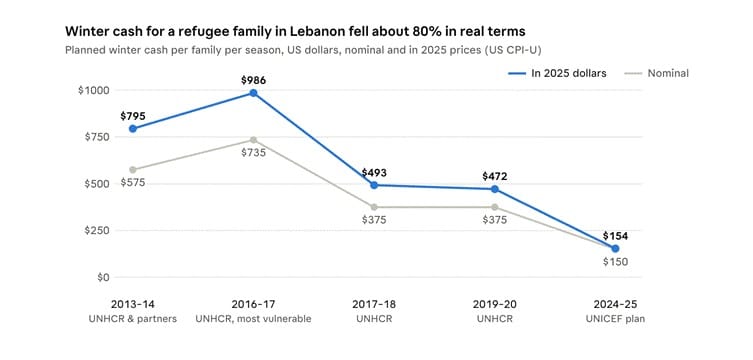
The record runs like this. In 2013-14, the first large winter cash programme gave each family about $575 over the season: $147 in November and $107 a month from December to March. In 2016-17, UNHCR gave the most vulnerable households $147 a month for five months, $735 in all, while families already on monthly cash got a $75 top-up. By 2017-18, families not on monthly cash received $375 over five months, and in 2019-20 the winter top-up was $75 a month for five months. UNICEF's 2024 winter plan set $150 per household: $50 a month for three months.
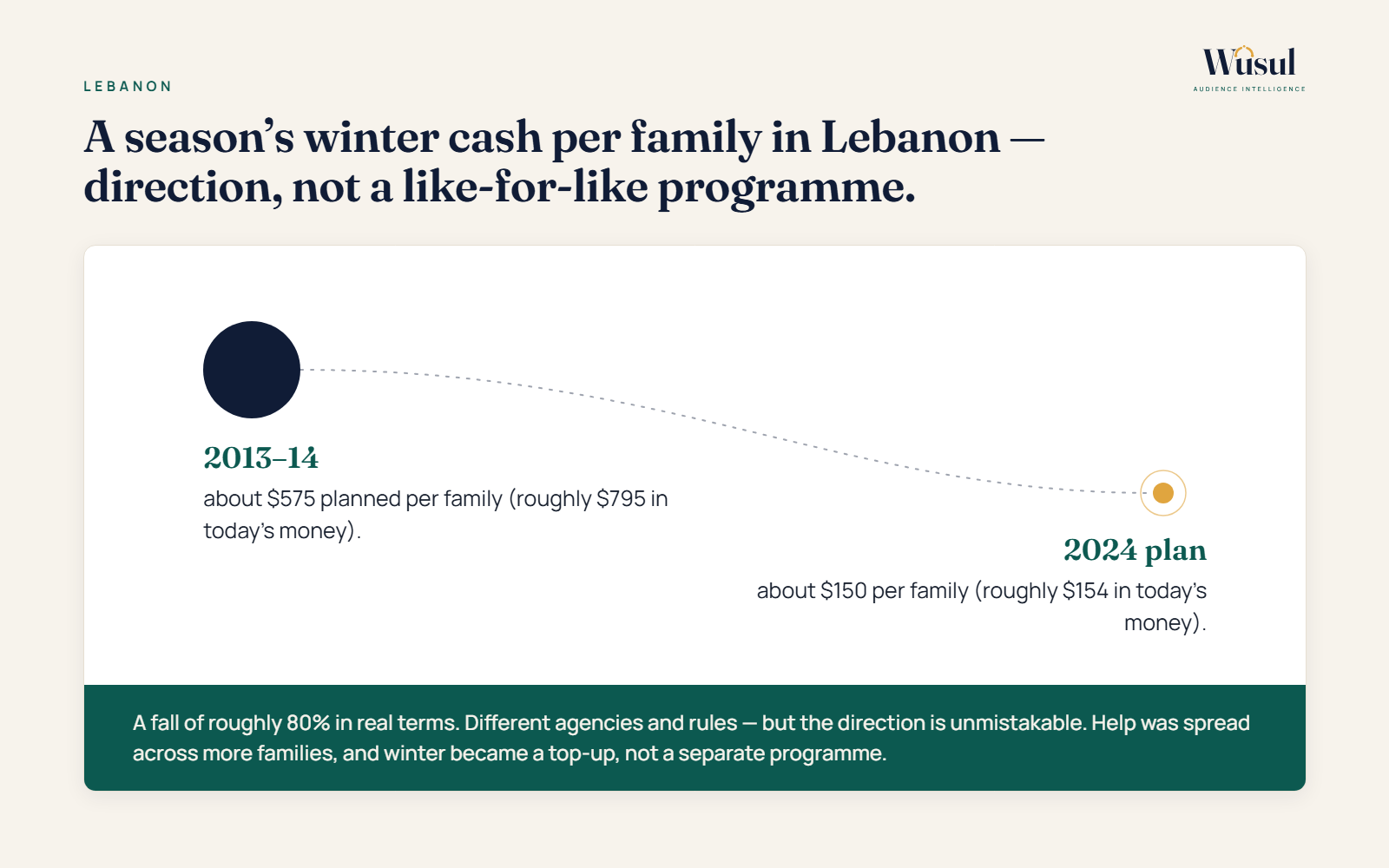
In real terms, the season's help for a family fell from about $795 in 2013-14, in today's money, to about $154 in UNICEF's 2024 plan: a drop of roughly 80%. Even the nominal figure fell by almost three-quarters.
These are not one programme measured consistently. The agencies, targeting rules and the role of other monthly assistance all changed, and the 2024 figure is UNICEF's, not UNHCR's. But the direction is unmistakable, and it is the answer to this article's title. A season of winter help for a refugee family in Lebanon was worth far less in 2025 than in 2013, in dollars and in what those dollars could buy.
Why the figure fell
The decline is not a story of agencies becoming less generous. It reflects choices made under pressure.
Help was spread across more families. The 2013-14 programme reached about 87,700 families. By 2016-17, UNHCR was giving seasonal cash to over 173,000 households. As the number of people in need grew and the crisis lengthened, agencies chose broader coverage at lower amounts.
Winter became a top-up, not a separate programme. From the mid-2010s, many families received monthly multipurpose cash all year, with winter treated as an extra on top. A $75 monthly winter top-up for a family already receiving support is a different thing from $147 a month as the main winter lifeline.
Funding did not keep pace. As the first article in this series showed, UNHCR's 2017-18 regional winter plan was only 26% funded at launch. Smaller transfers are one way agencies stretch short budgets.
The same pattern appears elsewhere in this series. Qatar Charity's winter aid per person reached fell from about QAR 47 in 2019-20 to about QAR 25 in 2023-24, partly because of how a large Syrian programme was counted. In both cases, the winter response grew wider and thinner at once.
For donors, the implication is direct. A charity that still says "$100 keeps a family warm this winter" may be describing a level of help that the humanitarian system itself stopped providing years ago.
The fuel paradox
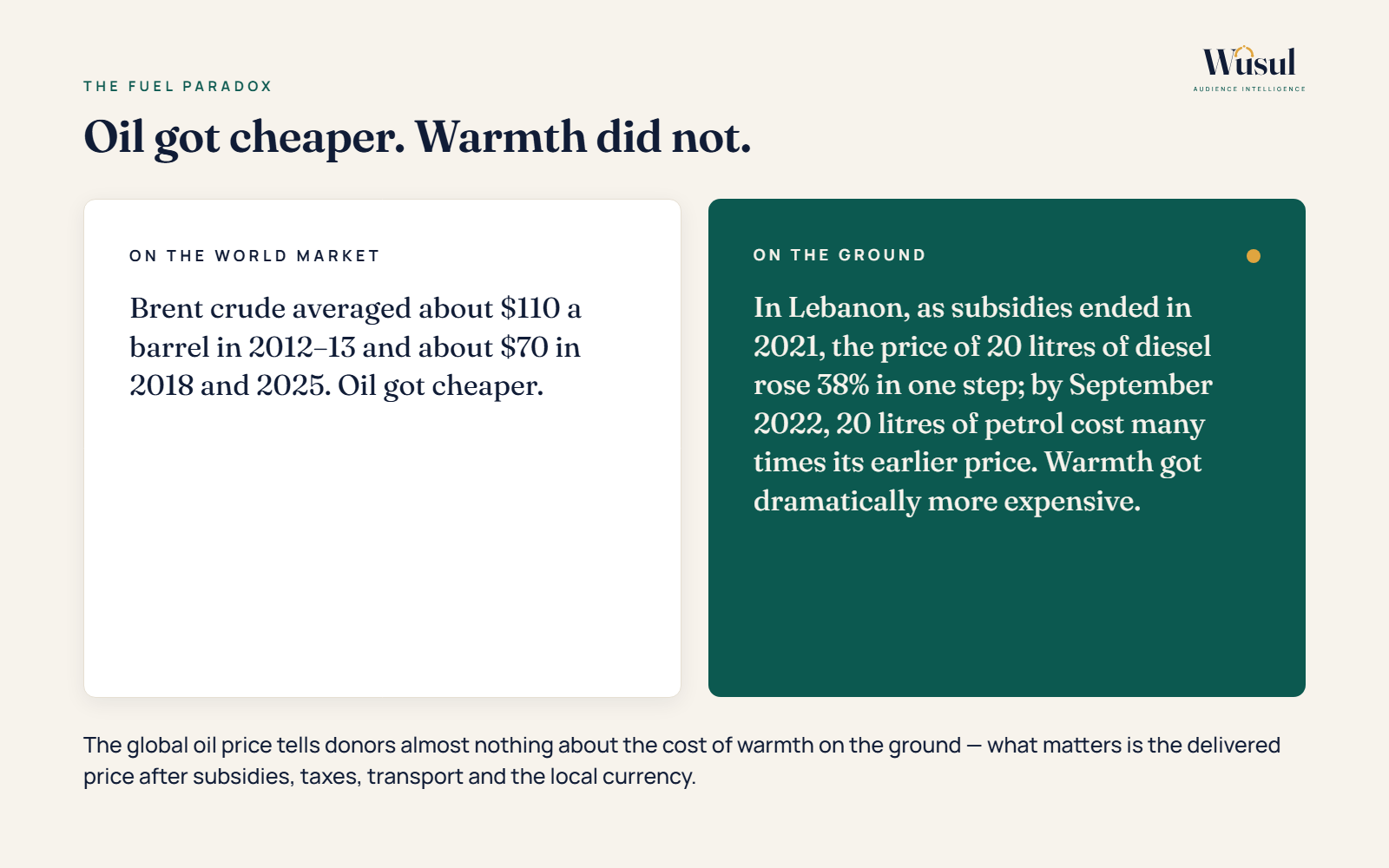
It would be natural to assume that heating became more expensive everywhere. On the world market, it did not. Brent crude averaged around $110 a barrel in 2012 and 2013, and about $70 in 2018 and 2025. A barrel of oil was cheaper in 2025 than when Syria's winter appeals began.
Yet for the families those appeals serve, heating became dramatically more expensive. Lebanon shows how. In June 2021, as the central bank began withdrawing fuel subsidies, the government raised the price of 20 litres of diesel by 38% to 46,100 Lebanese pounds. By October 2021, a further rise marked a complete lifting of petroleum subsidies, with diesel and cooking gas raised alongside petrol; 20 litres of petrol now cost 312,700 pounds, almost half the monthly minimum wage, with a chilly winter ahead. By September 2022, the same 20 litres cost 638,000 pounds.
The paradox is that global oil prices tell donors almost nothing about the cost of warmth on the ground. What matters is the delivered price of the fuel a family actually burns, after subsidies, taxes, transport, shortages and the local currency have done their work. In Lebanon, those forces pushed heating costs up just as the winter cash meant to pay for them was shrinking.
When a dollar buys more lira but less warmth
A collapsing local currency can look like good news for a donor giving in dollars or pounds. Each dollar buys more local money. In Lebanon, the pound lost more than 95% of its value against its official rate of 1,507.5 between late 2019 and late 2022, when it traded around 35,000 to the dollar on the parallel market.
But more lira did not mean more warmth. Lebanon imports almost all its fuel, much of its clothing and the materials for blankets. When the currency collapsed, importers priced in dollars, subsidies were withdrawn because the central bank could no longer afford them, and local prices rose to match. A dollar converted into pounds did not necessarily buy more than before, once shortages and black-market premiums were added.
The lesson for international charities is that exchange rates belong in programme design, not just in the accounts. The question is not how many pounds a donation converts into, but how many days of heating, blankets or months of rent support those pounds buy in the market where the family lives. That depends on local prices, which can move faster than any exchange rate.
Campaign totals in real terms
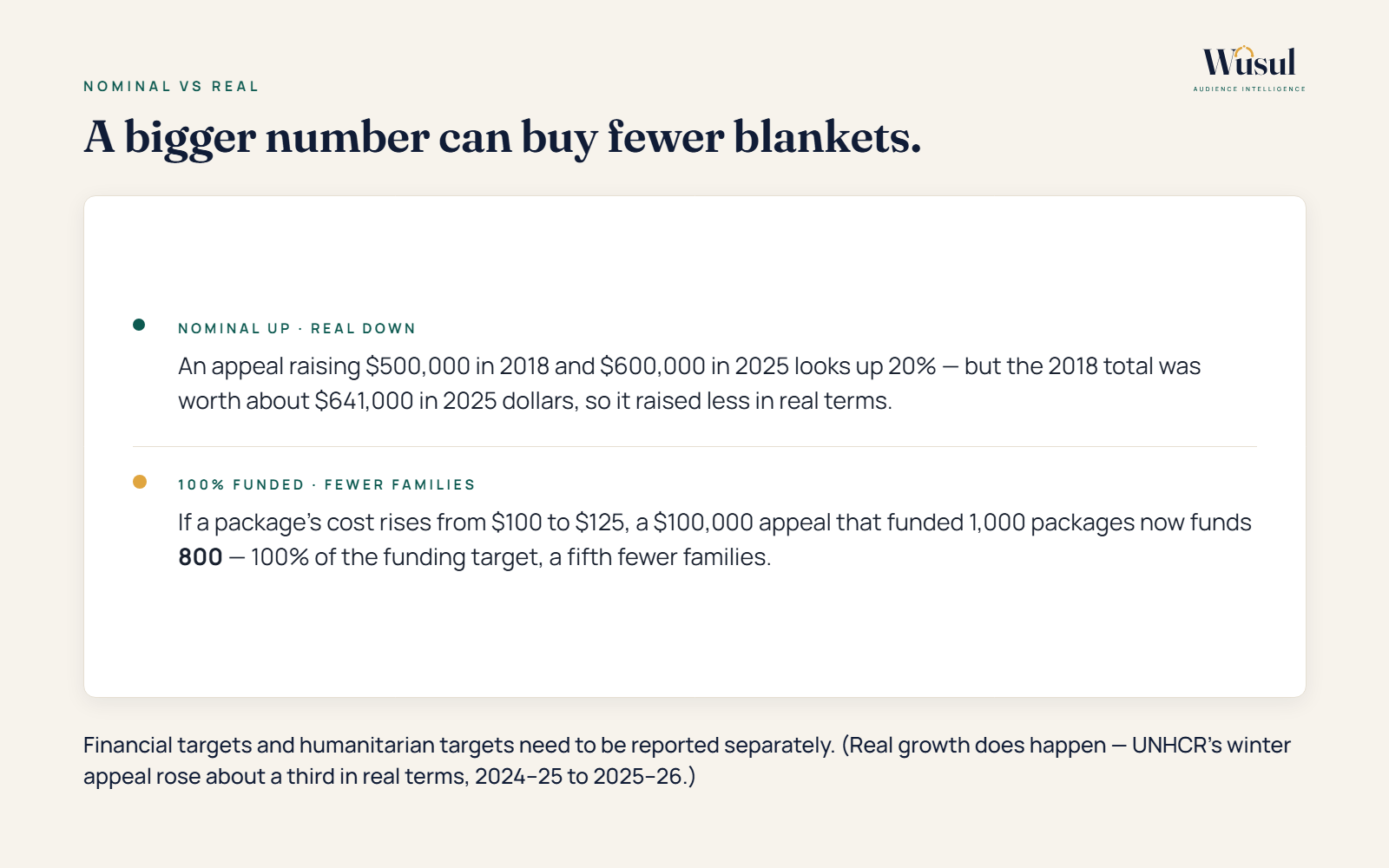
The same arithmetic applies to the figures charities celebrate. A winter appeal that raised $500,000 in 2018 and $600,000 in 2025 grew by 20% on paper. In 2025 dollars, though, the 2018 total was worth about $641,000, so the later campaign raised less in real terms.
Sometimes growth survives the adjustment. UNHCR's annual winter appeal to individuals and companies raised $34 million for 2024-25 and about $47 million for 2025-26. With US prices rising by under 3% in between, that is real growth of roughly a third.
But even real growth in money raised is not the same as growth in help delivered. If the cost of a defined winter package rises from $100 to $125, a $100,000 appeal that once funded 1,000 packages now funds 800. The charity can hit 100% of its fundraising target and still help a fifth fewer families. Financial targets and humanitarian targets need to be reported separately.
What charities should change
Reprice impact claims every winter. Where a tier promises a specific outcome, check it each season against the current delivered cost in the country concerned, and show the date it was last priced. The second article in this series sets out what a clearer donation page would show.
Price where the help is bought. Use local price data, such as Lebanon's Winter Expenditure Basket, rather than donor-country inflation, to judge whether a package still does what it says.
Watch the delivered cost of fuel, not the oil price. Track the price of the fuel families use, in local currency and in dollars, through the season.
Report real, not just nominal, growth. When announcing that a winter appeal raised more than last year, say how much more in real terms, and how many more families that bought.
Be honest when help has been spread thinner. If a winter package now covers fewer weeks, or a transfer has fallen, say so, and explain why. Donors are more likely to respond to a candid explanation than to discover the gap themselves.
Conclusion: the price of a donation is not the value of its help
In donors' own currencies, a $100 or £100 winter gift has lost more than a quarter of its purchasing power since 2013. That much is ordinary inflation, and Britain's charity analysts have been warning about it for years.
On the ground, the loss has been far greater. A season of winter cash for a refugee family in Lebanon was planned at about $575 in 2013-14 and $150 in UNICEF's 2024 plan, roughly an 80% fall in real terms, while the price of heating fuel in local currency multiplied after subsidies ended. Oil on world markets got cheaper; warmth for those families did not.
The donation amount is what the donor gives. The protection it buys depends on prices, currencies and choices far from the donation page. Charities that keep asking for the same amount should be able to show that it still buys what they say.
So, generosity has not fallen. What it can buy has.
Frequently asked questions
How much is $100 from 2013 worth today?
About $138 in 2025 prices, on the US consumer price index. In Britain, £100 from 2013 would need to be roughly £140.
Has winter aid for refugees become less generous?
In Lebanon, the published winter cash per family fell from about $575 a season in 2013-14 to $150 in UNICEF's 2024 plan, around 80% less in real terms. The programmes differ, and agencies have spread help across more families, but the direction is clear.
If oil got cheaper, why did heating get more expensive?
Families pay local prices, not world prices. In Lebanon, fuel subsidies ended in 2021 and the currency collapsed, so the local price of fuel multiplied even though Brent crude was cheaper in 2025 than in 2013.
Does a weaker local currency make my donation go further?
Not necessarily. Where fuel, clothing and materials are imported, local prices rise as the currency falls, so a donation may buy no more than before.
Should charities raise their winter donation amounts?
Where an amount promises a specific package, charities should check it against current delivered costs each year and either adjust it, change what it promises, or explain the gap.
Has anyone else studied inflation and charity donations?
Yes. Pro Bono Economics and the Charities Aid Foundation have published several analyses of how inflation erodes the value of UK donations, most recently in October 2026.
Wusul Insight: A familiar donation amount is a fundraising convenience, not a fixed unit of help. Over a decade, inflation in donor countries took more than a quarter off its value, and on the ground winter help per family in Lebanon fell by around four-fifths while fuel costs soared. Charities that price their promises where help is bought, and report real rather than nominal growth, will keep their appeals honest.
Methodology note: real values use US CPI-U annual averages for the first year of each winter season, expressed in 2025 dollars. The Lebanon series combines planned per-family winter cash values from different programmes and agencies, with different targeting rules and alongside other assistance; it shows the direction and scale of change, not one programme measured consistently. Brent crude figures are approximate annual averages. Lebanese fuel prices are official prices at the dates cited, mostly for petrol, as a guide to the movement of heating fuel and gas prices announced alongside them.