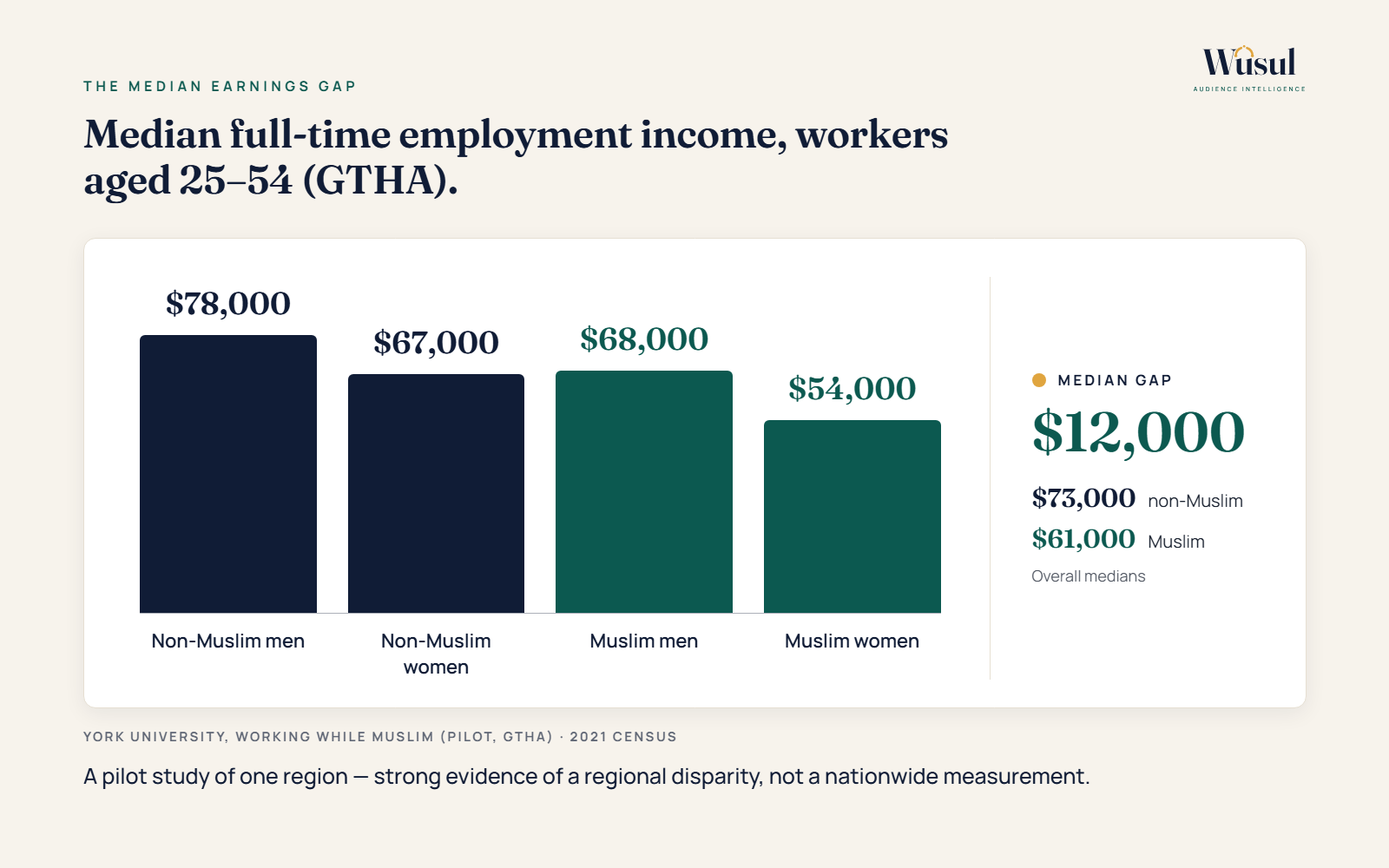
Muslim workers in the Greater Toronto and Hamilton Area earn a median $12,000 less per year** than comparable non-Muslim workers, according to a new pilot study from York University. The research, titled Working While Muslim, found that full-time, full-year workers aged 25 to 54 earned a median of $61,000 if they were Muslim, compared with $73,000 for their non-Muslim peers.
The gap is not explained by immigration status, credentials, or work experience. Even after controlling for visible-minority status, gender, and immigrant generation, the researchers found that being Muslim is associated with a measurable earnings penalty. They estimate that this religious affiliation alone costs Muslim workers in the region approximately $1.2 billion annually in aggregate.
The numbers behind the gap
The study combined 2021 Canadian Census data with an online survey of 423 Muslim workers in the Greater Toronto and Hamilton Area. It is explicitly a pilot study, limited to that region rather than all of Canada. The researchers caution that its estimates should be read as strong evidence of a regional disparity, not a nationwide final measurement.
The headline figures are stark:
| Group | Median Employment Income |
| Muslim men | $68,000 |
| Muslim women | $54,000 |
| Non-Muslim men | $78,000 |
| Non-Muslim women | $67,000 |
Muslim women earned about 69% as much as Muslim men, while non-Muslim women earned about 86% as much as non-Muslim men. The religious earnings penalty, in other words, is larger for women than for men.
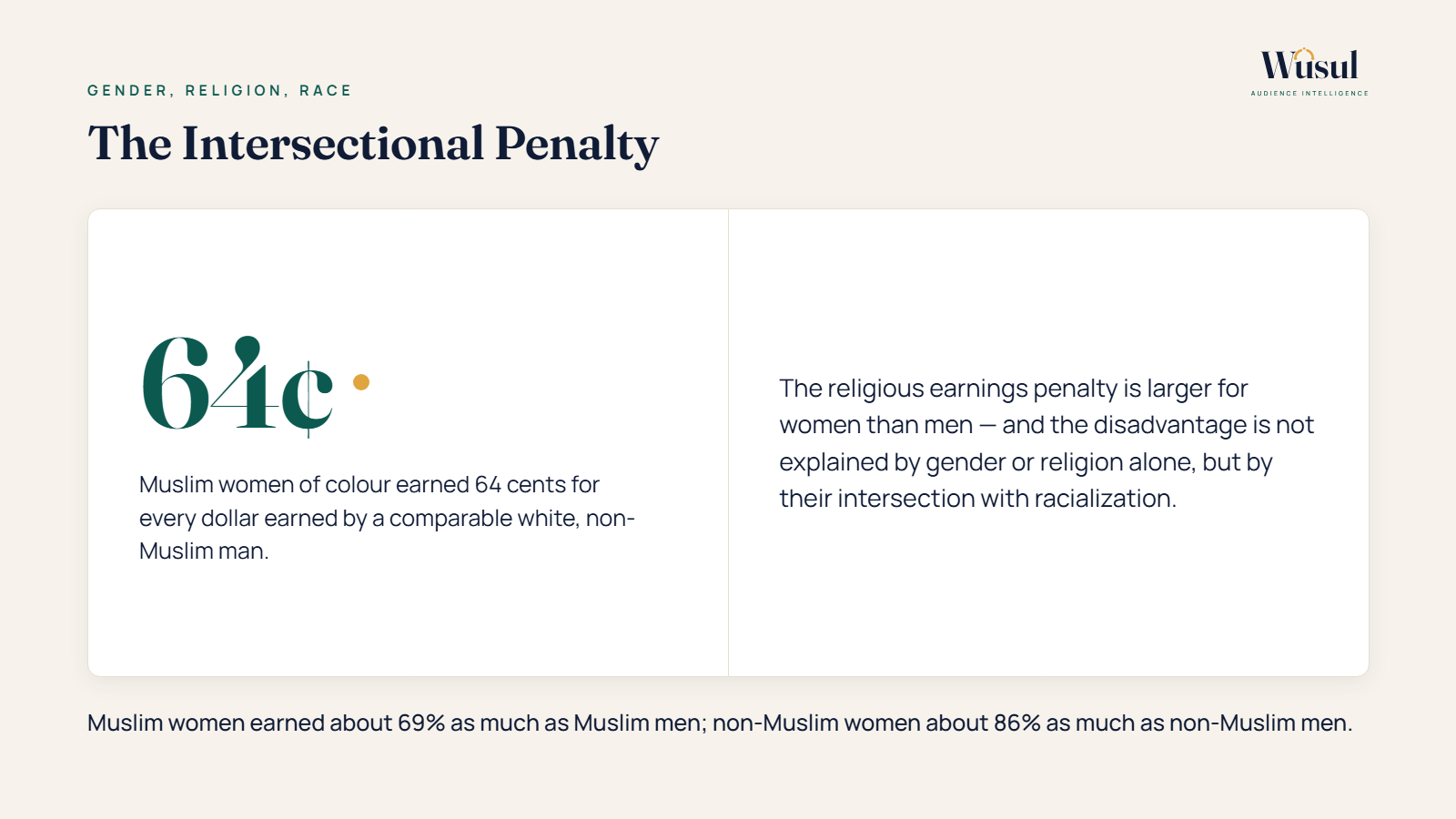
The intersectional effect is even more pronounced. Muslim women of color had a median full-time employment income of $54,000; equivalent to 64 cents for every dollar earned by a comparable white, non-Muslim man. The disadvantage is not explained by gender or religion alone. It is an intersection of Muslim identity, racialization, and gender.
The gender gap also appears before pay. Muslim men's labor-force participation rate was 22.8 percent higher than Muslim women's, compared with a 6.8 percentage-point difference between non-Muslim men and women. Muslim women were much less likely to be in the labor force than Muslim men; and even those working full time earned less than their male counterparts.
The unemployment and poverty picture
The wage gap is only one dimension of the economic disparity the study documents. The research also found that Muslims in the Greater Toronto and Hamilton Area had higher unemployment than non-Muslims and were almost twice as likely to be classified as low-income.
This is not a marginal finding. It means that the earnings gap is compounded by a higher likelihood of being out of work altogether. A Muslim worker in the region is not only likely to earn less than a non-Muslim peer in the same role, they are also more likely to be unemployed, and more likely to live in poverty even when employed.
The unemployment disparity also helps explain the wage gap. When a community faces higher barriers to employment, its members may be more likely to accept lower-paying jobs, work in sectors with less stability, and have less bargaining power when negotiating salaries. The researchers found that Muslims were overrepresented in transportation and warehousing, and accommodation and food services; sectors that can contribute to lower pay and less stable employment.
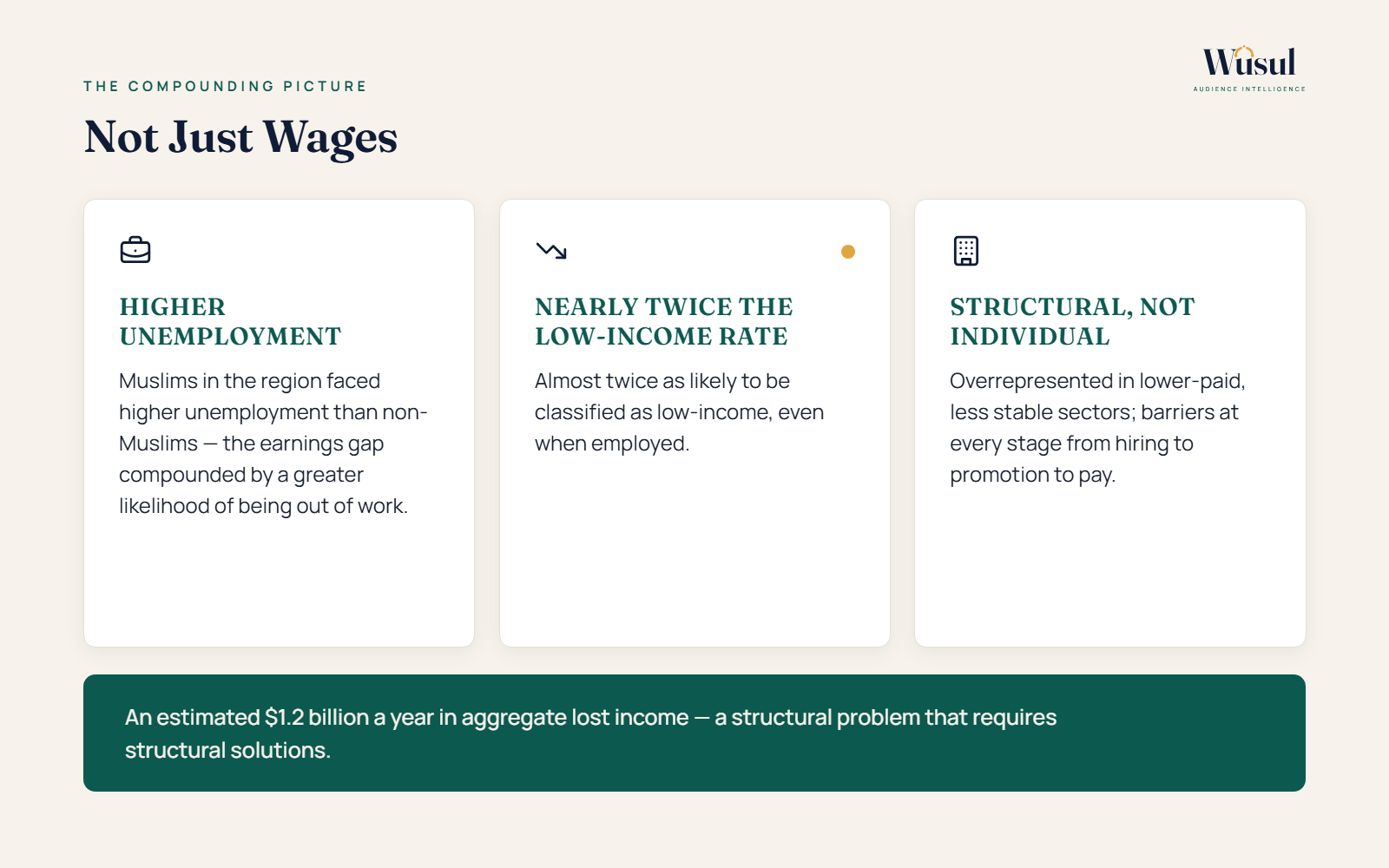
This is a structural problem, not an individual one. The unemployment gap is not explained by a lack of qualifications or a lack of willingness to work. It reflects systemic barriers that affect Muslim workers at every stage of the employment journey; from hiring to promotion to pay.
For Muslim charities and organizations serving these communities, the unemployment finding has direct implications. A community that faces higher unemployment has less disposable income for charitable giving. It also has greater need for the services that charities provide; from food assistance to housing support to mental health services. The wage gap and the unemployment gap are two sides of the same coin: a community that is being held back economically, and a charitable sector that must respond to the consequences.
Why immigration is not the explanation
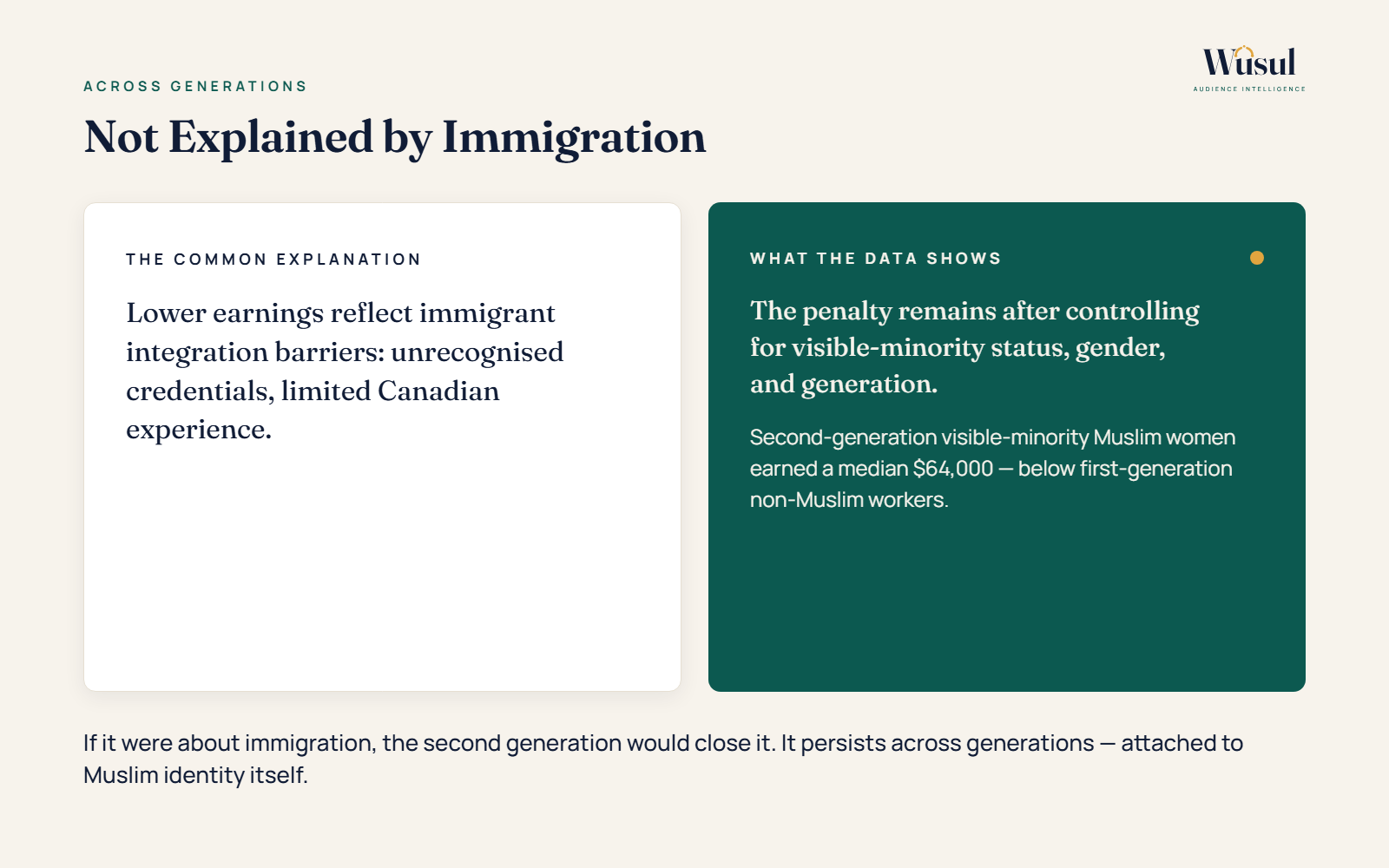
The study specifically tested the common explanation that lower earnings reflect immigrant integration barriers, such as unrecognized credentials or limited Canadian work experience.
The findings challenge that narrative. While first-generation workers earned less than second-generation workers overall, the Muslim earnings penalty remained after accounting for visible-minority status, gender, and religion. Second-generation visible-minority Muslim women, for example, had a median income of $64,000; lower than first-generation non-Muslim workers.
The unemployment finding reinforces this. If the gap were simply a matter of immigration status, second-generation Muslims would be expected to close it. But the data suggests that the penalty persists across generations, that it is attached to Muslim identity itself, not to the immigrant experience.
The broader context: Islamophobia in the workplace
The study is part of a growing body of research on the economic impact of Islamophobia. York University's Islamophobia research hub, which produced the Working While Muslim study, has documented how discrimination in hiring, promotion, and pay affects Muslim communities across Canada [16, 25].
The $1.2 billion annual cost is not just an abstract figure. It represents lost income for families, reduced spending in local economies, and a drain on public resources. It is a structural problem that affects not only Muslim workers but the communities in which they live and work.
This gap that should concern everyone
The $12,000 gap between Muslim and non-Muslim workers in the Greater Toronto and Hamilton Area is not just a Muslim problem. It is an economic problem, a social problem, and a moral problem.
It reflects a society that has not yet fully dismantled the barriers that prevent Muslim workers from earning what they deserve. It is a gap that costs the economy $1.2 billion annually. And it is a gap that will not close on its own.
The study's authors are careful to note that it is a pilot, limited to one region and one point in time. But the findings are consistent with other research on the economic impact of Islamophobia. They point to a structural issue that requires structural solutions; in hiring, in promotion, in pay, and in the broader culture of workplaces across Canada.
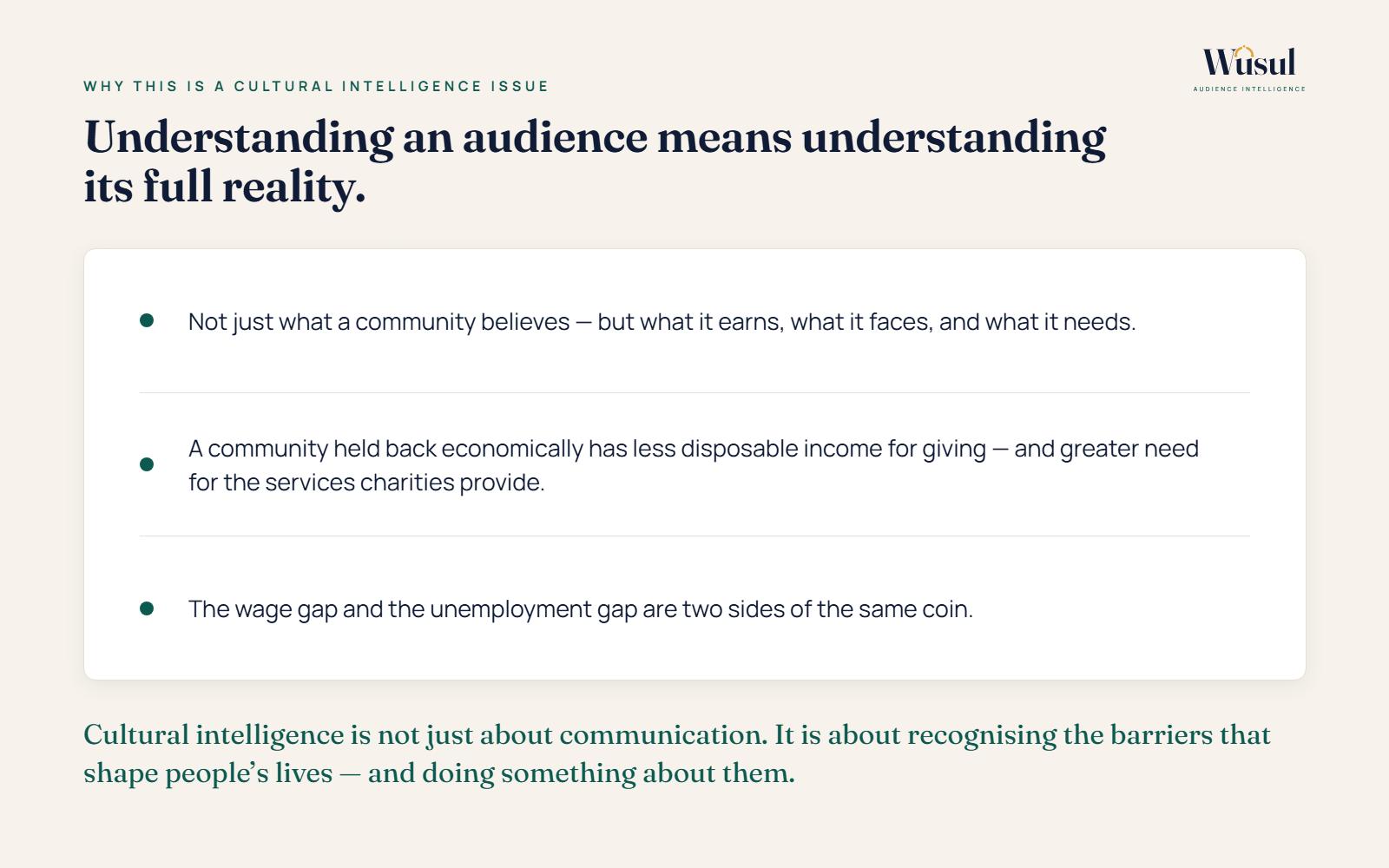
The lesson is clear. Understanding Muslim audiences means understanding their full reality; not just what they believe, but what they earn, what they face, and what they need. Cultural intelligence is not just about communication. It is about recognizing the barriers that shape people's lives; and doing something about them.
At Wusul, we believe that cultural intelligence means understanding not just what a community believes, but what it faces. The Working While Muslim study is a reminder that economic inequality is a cultural intelligence issue; and that organizations seeking to serve Muslim communities must engage with the full complexity of their lives.
Frequently asked questions
Why do Muslim workers earn less than their non-Muslim peers?
Research indicates that Muslim workers in the Greater Toronto and Hamilton Area face systemic barriers throughout their employment journey, from hiring to promotion and pay. These disparities are not explained by immigration status, credentials, or work experience. Instead, the gap is linked to structural issues and the intersection of Muslim identity, racialization, and gender.
What is the Muslim earnings penalty?
The Muslim earnings penalty refers to a measurable income gap where Muslim workers earn a median of $12,000 less per year than comparable non-Muslim workers in the Greater Toronto and Hamilton Area. This religious affiliation alone is estimated to cost Muslim workers in the region approximately $1.2 billion annually in aggregate lost income.