You must have read convert stories. But have you read one written by a German diplomat who used to advise NATO, held a doctorate in law, and approached Islam like a forensic scientist approaching a crime scene?
The average "how I found Islam" memoir usually follows a predictable arc: youthful rebellion, existential emptiness, a chance encounter with a translated Quraan, tears, shahada, and a happily-ever-after. These stories are sincere but rarely offer the intellectual rigor that many Western Muslims navigating secular societies crave.
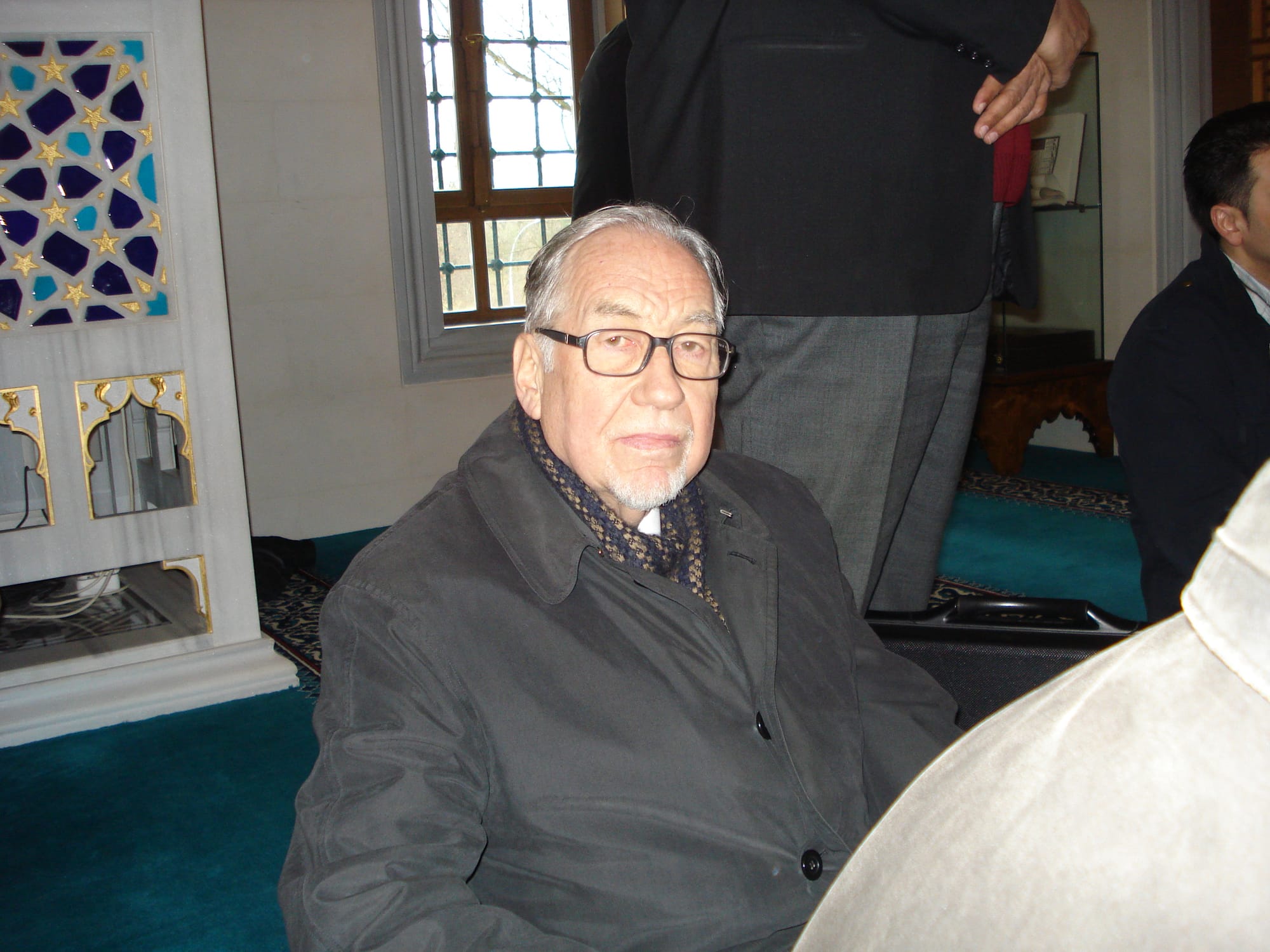
But here is a different book. Journey to Makkah by Murad (formerly Dr. Wilfried) Hofmann is not a sentimental diary; it is a philosophical battering ram disguised as a pilgrimage journal. First published in German in 1996, it chronicles Hofmann's conversion to Islam in 1980 and his first Hajj journey later that same decade. What makes it extraordinary is the author himself: a Harvard-educated lawyer, a high-ranking German diplomat, and a man who initially viewed religion as a pre-modern relic.
Who is Murad Hofmann? (and why his voice matters)
Hofmann served as a German ambassador to Algeria and Morocco, and earlier in his career, he worked in NATO defense planning. He was a Cold War strategist, a rationalist, and a cultural skeptic. When he first encountered Islam, he dismissed it as "oriental exoticism." But then he read the Qur'an; not for spiritual reasons, but to critique a Muslim colleague. That reading changed everything.
His conversion in 1980 was met with significant controversy due to his high profile in the German government. The public reaction was so intense that it threatened his diplomatic career. As an academic review of his earlier work noted, Hofmann was a rare figure in interfaith dialogue: a convert who could present Islamic arguments "in a few and absolutely to-the-point replies" in German, a language in which many Muslims were unable to articulate their faith coherently.
A "reverse orientalism" that validates the hybrid Identity
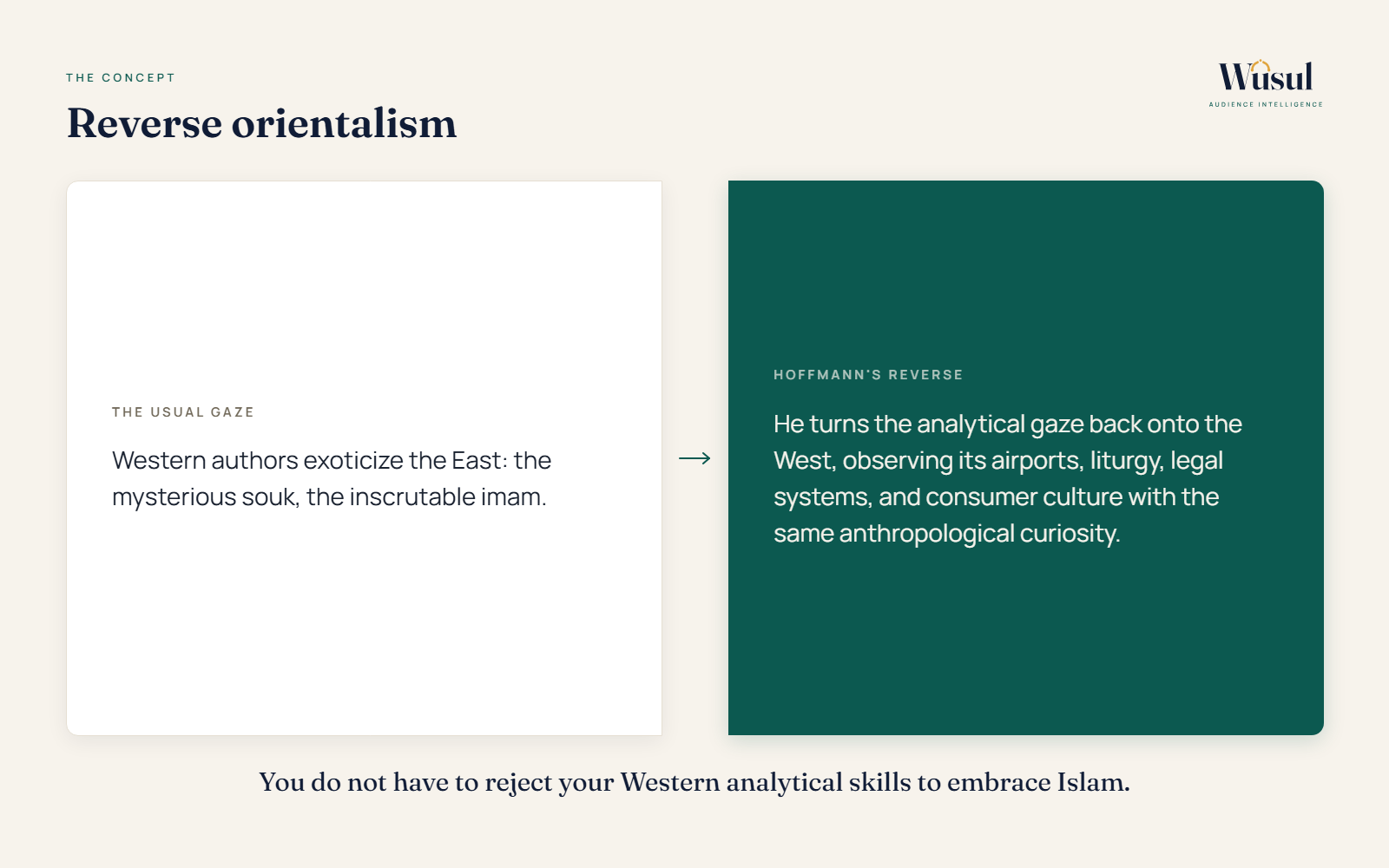
The most intellectually thrilling aspect of Journey to Makkah is what can be called Hofmann's "reverse orientalism."
We are used to Western authors exoticizing the East: the mysterious souk, the inscrutable imam, the chaotic beauty of Cairo. Hofmann does the exact opposite. He turns his analytical gaze back onto the West. He observes German airports, Christian liturgy, European legal systems, and American consumer culture with the same anthropological curiosity that Western scholars usually reserve for Muslims.
In one striking passage, he compares Frankfurt Airport during Christmas rush to Makkah during Hajj. The airport, he argues, is technically "orderly" but spiritually barren; people rushing past each other without eye contact, driven by consumption and deadlines. The Hajj, by contrast, appears chaotic to the untrained eye, but Hofmann reveals its divine grammar: millions moving not as isolated individuals but as a single body, synchronized by prayer times and ritual unity.
In another passage, he writes that "the West is the sunset of a morning that dawned in the East." For Western Muslims who feel torn between two worlds, this analysis is deeply validating. Hofmann proves that you do not have to reject your Western analytical skills to embrace Islam. Rather, you can use those skills to see the West more clearly; including its spiritual poverty masked by material wealth.
The brutal honesty of discomfort
The author writes bluntly about the physical exhaustion: the heat radiating off the marble floor, the crush of bodies near the Black Stone, the frustration of lost luggage, the bureaucracy of Saudi visas. He describes how, during the journey to Mina, "a few pilgrims were trying to take the direct route on foot, across the dark volcanic mountains, their forms contrasting off of the black rocks like lost and lonely white ghosts." He admits that during some rituals, he felt nothing but fatigue and irritation.
This honesty is a gift to the reader. Hofmann gives us permission to be human. He shows that the barakah (blessing) of Hajj is not constant euphoria but a slow, sometimes painful peeling away of ego. The spiritual breakthrough comes after the exhaustion, not during it.

One of the most moving passages describes Hofmann lying on his bed in a Mina tent, unable to move from fatigue, when suddenly the meaning of talbiyah (Labbayk Allahumma labbayk; "Here I am, O Allah, here I am") strikes him with full force. He realizes that he has spent his entire diplomatic career saying "Here I am" to ambassadors, ministers, and power brokers. But never once had he said it to his creator with such vulnerability.
A loving critique of Muslims
Another reason this book resonates with Western Muslims is Hofmann's willingness to critique Muslim societies without Islamophobia.
He is deeply critical of sectarianism, calling it "a scandal that would make the Prophet weep." He laments the abandonment of scientific inquiry in some Muslim-majority countries, arguing that Islam's golden age was built on curiosity, not rote memorization. He chides wealthy Gulf nations for importing Western luxury without importing Western discipline or innovation.
But here's the crucial difference: Hofmann critiques from inside the faith. He loves Islam too much to let Muslims distort it. This is a model for Western Muslims who often find themselves caught between two equally unhelpful positions: defending every action of "Muslim countries" out of tribal loyalty, or internalizing Western critiques as proof that Islam is backward. Hofmann offers a third way: radical love for the faith, combined with clear-eyed honesty about Muslim failures.
Why this book matters right now
Published in the 1990s, Journey to Makkah feels almost prophetic in today's political climate. Western Muslims are constantly asked: "Can you really be modern and Muslim?" Hofmann's life answers: "I was a NATO diplomat, and Islam made me more rational, not less."
He also addresses the elephant in the room; violence and extremism, without defensiveness. He argued that the Qur'an's permission for defensive fighting has been grotesquely distorted by modern militants, and he traced this distortion to the very Western ideologies (fascism, radical Marxism) that those militants claim to despise. It is a sophisticated argument that gives Western Muslims a language to discuss difficult topics without falling into either apologetics or self-flagellation.
At Wusul, we believe that cultural intelligence requires understanding the intellectual and spiritual journeys that shape Muslim identity. This book is a testament to the power of reason, faith, and the courage to seek truth across cultures. For organizations seeking to engage Muslim communities authentically, this book offers a window into the rational, reflective, and deeply human dimensions of Islamic faith.
Frequently asked questions
What is reverse orientalism?
Reverse orientalism is a perspective where a Western author turns an analytical gaze back onto Western society. Instead of exoticizing the East, the author observes Western institutions, such as airports and legal systems, with the same anthropological curiosity that Western scholars typically reserve for Muslim cultures, highlighting spiritual poverty within material wealth.
Who is Murad Hofmann?
Murad Hofmann was a Harvard-educated lawyer and a high-ranking German diplomat who served as an ambassador to Algeria and Morocco. Earlier in his career, he worked in NATO defense planning. He was a rationalist and cultural skeptic who converted to Islam in 1980 and authored a pilgrimage journal titled Journey to Makkah.