If you are a Muslim living in the West, you most probably have been asked these questions. Maybe dozens of times. And every time, you feel the same exhaustion: the burden of representing the whole Ummah, the frustration of having your faith reduced to a headline, the quiet anger of being asked to apologize for something you have nothing to do with.
What if you could stop defending and start presenting data? What if you could say, “Actually, let me show you what 90% of the world’s Muslims really think, based on the largest study ever conducted”?
That is exactly what Who Speaks for Islam? What a Billion Muslims Really Think by Dalia Mogahed and John L. Esposito delivers. This book is not a feelgood
sermon. It is a data-driven bomb dropped on the post-9/11 media landscape. Based on the Gallup World Poll, which interviewed representative samples of Muslims in over 35 countries, covering more than 90% of the global Muslim population back then, this book destroys myths with surgical precision
Who are the authors and why should you trust them?
Dalia Mogahed is a name many Western Muslims already know. A hijabi woman who served as the executive director of the Gallup Center for Muslim Studies. She is a former advisor to President Obama on faith-based partnerships. In other words, she is exactly the person the media claims doesn’t exist: a visibly Muslim woman in a position of power, analyzing data, shaping policy, and refusing to be anyone’s victim.
John Esposito is a Georgetown professor and one of the world’s most respected academic voices on Islam and the West. A Catholic scholar who has spent decades defending the study of Islam in American universities, Esposito has been called “the dean of Muslim-Western studies.” His presence ensures the book meets rigorous academic standards.
Together, they formed a dream team: a Muslim woman speaking from lived experience, and a non-Muslim ally speaking from scholarly authority. The result is a book that cannot be dismissed as “biased” by Islamophobes nor as “too academic” by community readers.
The book came to debunk the most common myths about Muslims, here’s a quick review of them:
Myth #1: Muslims Hate the West
The claim you hear: “They want to destroy our way of life.”
The data: When asked what they admire about the West, Muslims consistently cite two things: technology and democracy (as a political process). When asked what they criticize about the West, the overwhelming answer is not “Christianity” or “freedom” but foreign policy; specifically, the perception that Western governments support dictators, occupy Muslim lands, and ignore Palestinian suffering.
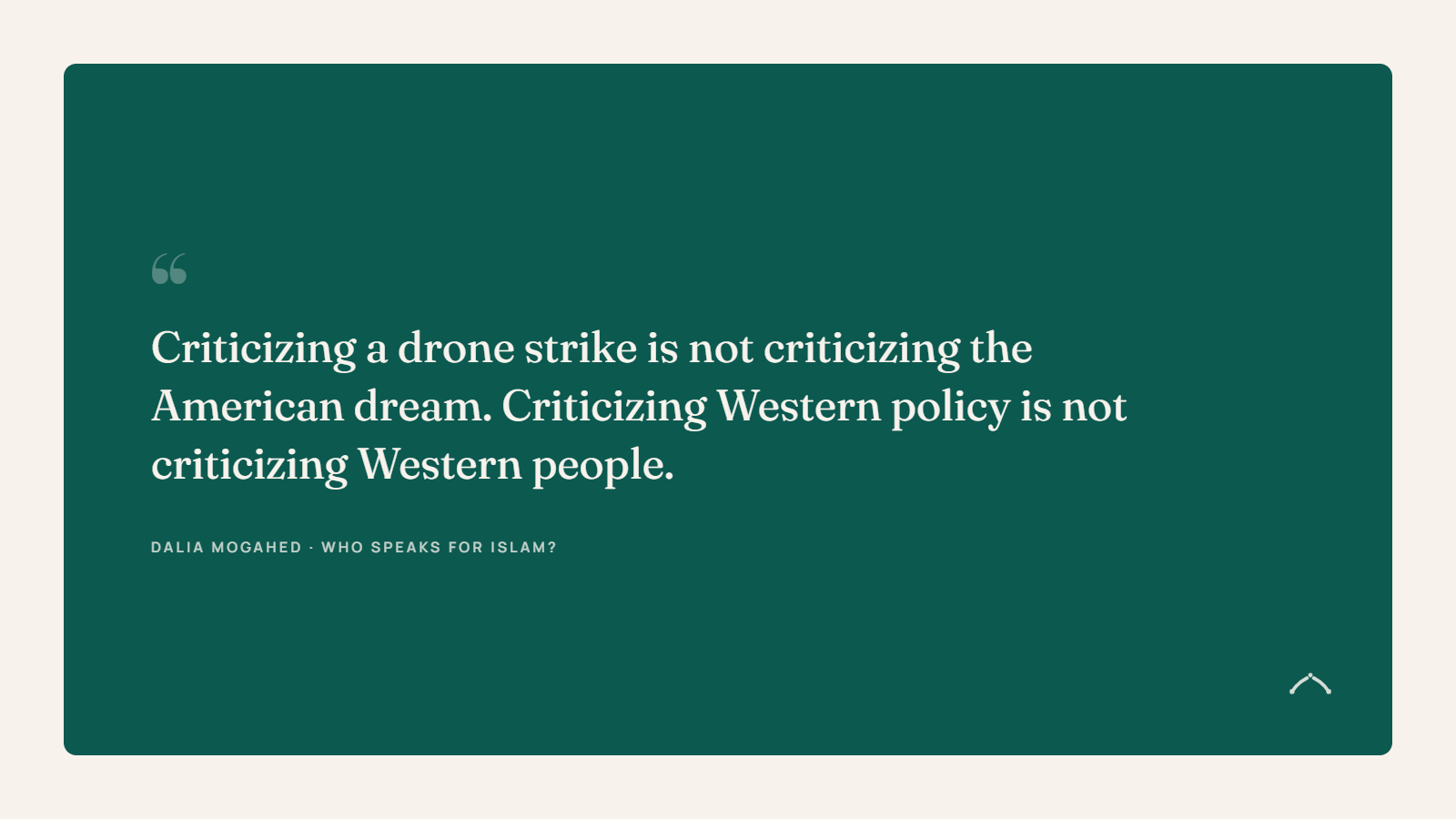
Mogahed makes a crucial distinction that every Western Muslim should memorize: “Criticizing a drone strike is not criticizing the American dream.
Criticizing Western policy is not criticizing Western people.”
This distinction is liberating for Western Muslims. It means you can love your country, genuinely love it, while protesting its actions. It means you don’t have to choose between patriotism and faith. The data shows that Muslims admire the West’s potential (science, justice, opportunity) but reject its hypocrisy (promising democracy to some while bombing it into others).
Myth #2: Muslim Women Are Oppressed Victims
The claim you hear: “Islam chains women.”
The data: This chapter is worth the price of the book alone. The Gallup poll asked Muslim women about their aspirations, their daily realities, and their views on gender justice. The findings shattered the media narrative.
• Muslim women in countries like Egypt, Saudi Arabia, and Indonesia reported higher levels of gender justice (as they defined it: equal education, equal legal recourse, equal opportunity) than Western media typically portrays.
• The single greatest barrier to Muslim women’s progress is not Islam but local cultural patriarchy; the same kind of patriarchy that existed in the West a century ago.
• When asked what they would improve in their societies, Muslim women’s top answer was not “leave Islam” but “better education and economic opportunity.”
Mogahed shares personal anecdotes about leading the Gallup Center while visibly pregnant, traveling to Muslim countries, and being treated with respect by conservative scholars. She also shares painful moments: being asked by a Western journalist, “Aren’t you afraid of your husband?” The absurdity of the question, she writes, reveals more about the journalist’s biases than about any Muslim reality.
For Western Muslim women who wear hijab and face daily microaggressions, this chapter is a shield. It provides data to counter the pity; the assumption that you are a victim waiting to be saved.
Myth #3: Most Muslims Support Terrorism
The claim you hear: “Why aren’t they condemning it?”
The data: The numbers are overwhelming and unambiguous. Across every country surveyed, the vast majority of Muslims condemned the 9/11 attacks and later condemned ISIS. In fact, when asked what they criticize about their own societies, Muslims’ top answers are: lack of religious unity, corruption, poverty, and extremism itself.
The book introduces a crucial concept: the difference between “political grievances” and “theological endorsement.” A Muslim might oppose Western foreign policy (political) without ever supporting violence against civilians (theological). The two are not the same, but media coverage constantly conflates them.
Perhaps most surprisingly, the data shows that “extremist” views (defined as supporting violence against civilians) are not correlated with religiosity. A Muslim who prays five times a day is less likely to support terrorism than a nominal Muslim. The real drivers of extremism are political disenfranchisement, lack of economic opportunity, and feelings of humiliation; not the Qur’an.
The “Western Muslim” Takeaway: A Toolkit for Daily Life Reading Who Speaks for Islam? is not just an intellectual exercise. It is practical, even urgent, for Western Muslims navigating hostile environments.
For Muslim youth in public schools: When a teacher asks, “Doesn’t Islam oppress women?” you no longer have to stumble. You can say, “Actually, the largest study of Muslim women shows the opposite. Would you like the citation?”
For Muslim activists: The book provides empirical ammunition to fight Islamophobia in local politics. When a city council member claims “Muslims want sharia to replace the Constitution,” you can counter with data showing Muslims’ overwhelming support for democratic processes.
For interfaith dialogue: This book is the perfect gift for a concerned neighbor or a curious coworker. It is non-defensive, academic, and yet deeply respectful of Muslim identity.
For your own self-doubt: Let’s be honest. Living as a Muslim in the West today is exhausting. News cycles of violence, political rhetoric, and social media pile-ons can make you feel isolated. This book reminds you that you are not alone; and that the silent majority of Muslims worldwide share your values: family, faith, justice, and peace.
The book’s only weakness
We must offer one critique. Who Speaks for Islam? was published in 2008. The Arab Spring (2011), the rise of ISIS (2014), the refugee crisis (2015), and the social media era have changed so many dynamics. While the book’s core findings about moderation, aspiration, and rejection of extremism remain valid, we desperately need a 2026 update with new data.
Additionally, the book focuses heavily on Muslim-majority countries and says less about Western Muslims themselves; a demographic growing rapidly and facing unique challenges. A sequel exploring how Western Muslims differ from (or resemble) Muslims in Cairo or Jakarta would be invaluable.
This is not a book you read once and shelve. It is a reference work, a toolkit, and a source of validation. Keep it on your desk. Highlight it. Lend it out and never expect it back.
Who should read this book?
- Every Western Muslim who has ever been asked, “Why don’t you condemn terrorism?”
- Non-Muslim allies who genuinely want to understand what Muslims think, not what pundits tell them Muslims think.
- High school and college students writing papers on Islam and the West: this is your primary source.
- Imams and community leaders who want data-driven talking points for Friday sermons.
At Wusul, we offer Cultural Intelligence grounded in a simple but powerful belief: no community is a monolith, and the Muslim world is no exception. We recognize that Muslims encompass a vast spectrum of cultures, traditions, interpretations, and lived realities shaped by geography, history, language, and personal experience. To reduce this rich diversity to a single narrative is not only inaccurate but also unjust. That is why our approach is built on nuance, curiosity, and respect equipping organizations with the tools to engage meaningfully with Muslim communities, on their own terms, and with the depth they deserve.