Here is a sentence that has quietly cost organisations enormous amounts of money: "We should target the Muslim audience."
It sounds reasonable. It's how briefs get written, budgets get approved, and segments get bought from data vendors. And it contains a false assumption so large that everything built on it tilts: that "the Muslim audience" is one audience.
It isn't. It never was.
Muslim demographics: one label, dozens of audiences
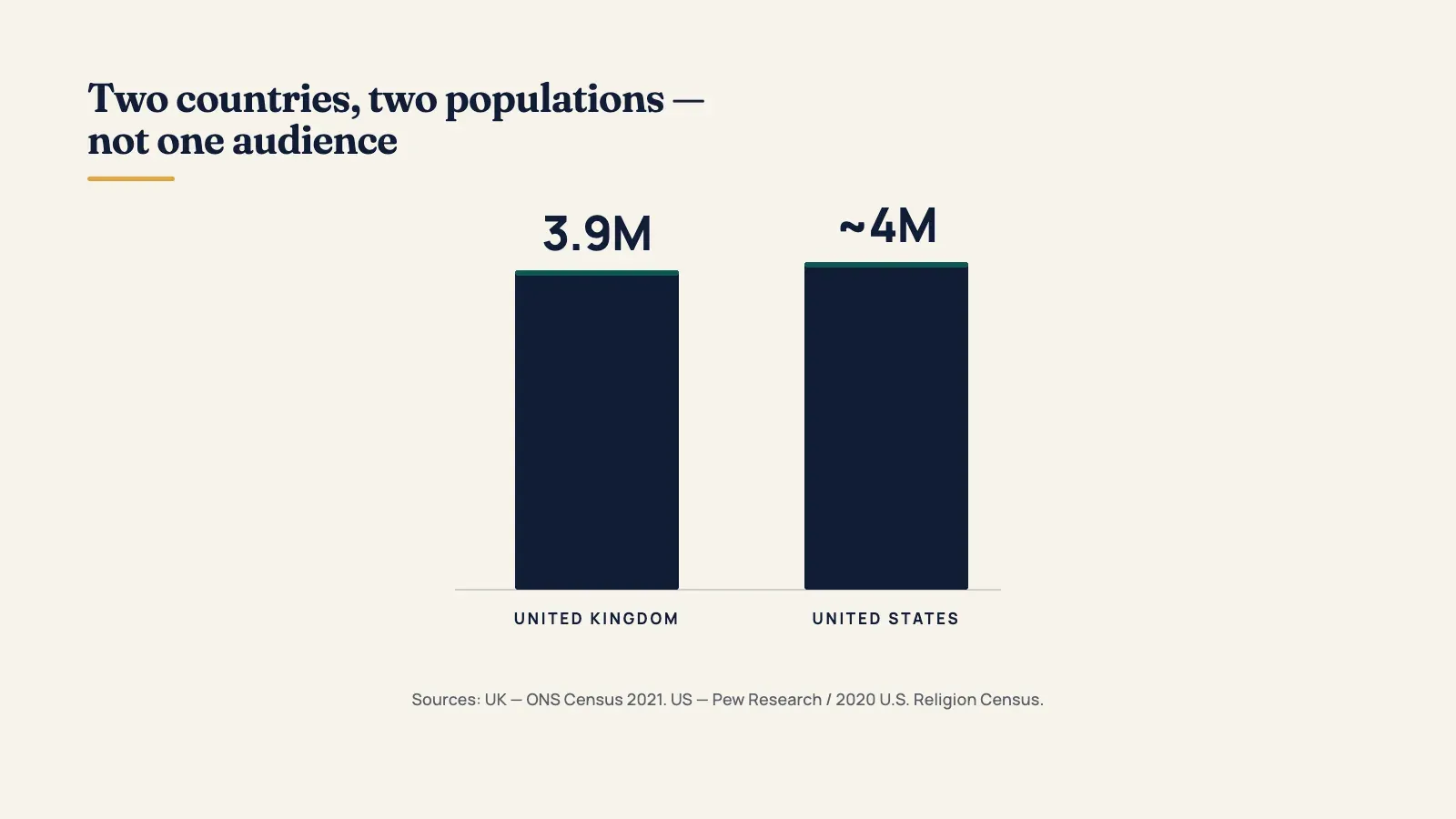
No marketer would build a campaign for "the Christian audience" and expect one message to work equally on a Catholic grandmother in Warsaw, a Pentecostal teenager in Lagos, and a lapsed Anglican in London. The label is real; the audience is not singular.
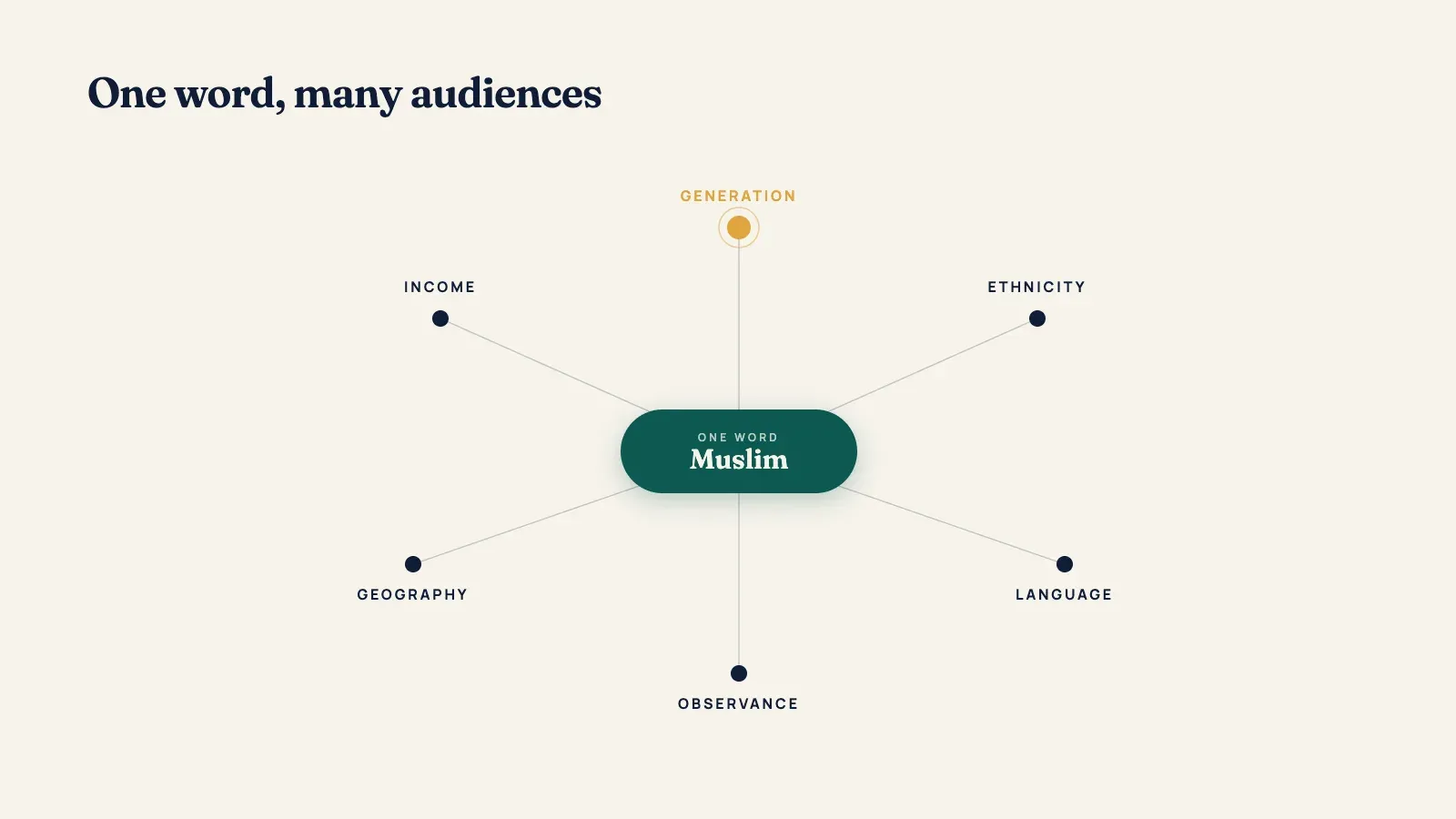
The same is true (at least as strongly) for Muslim communities in Western markets. Consider what a single tag flattens:
Ethnicity and heritage. British Muslims alone trace heritage to Pakistan, Bangladesh, India, Somalia, Nigeria, Turkey, the Arab world, and beyond, alongside a growing population of converts. American Muslim communities add large African-American, South Asian, Arab, Iranian, and Bosnian populations, each with distinct histories and institutions. These communities don't just differ from each other; they consume different media, trust different messengers, and respond to different causes.
Generation. A first-generation parent and their British- or American-born children may share a household and a faith and almost nothing about how they receive marketing. One was reached through community newspapers and the mosque noticeboard; the other lives on platforms where institutional voices carry less weight than creators they trust. Generational difference inside Muslim communities is at least as wide as in the general population, arguably wider, because it often spans languages too.
Language. English, Urdu, Arabic, Bengali, Somali, Turkish, Farsi, and crucially, which contexts each language belongs to. Many second-generation Muslims live in English but give, pray, and grieve partly in a heritage language. Knowing which moments belong to which language is segmentation gold that no off-the-shelf dataset contains.
Practice and identity. Levels and styles of religious practice vary enormously, and faith can be central to one person's consumer identity and quietly personal to another's. Both may give generously in Ramadan. They will not respond to the same creative.
Life stage and economics. Students, young professionals, growing families, business owners, retirees, with the added fact that Muslim populations in both the UK and US skew significantly younger than the national average. A community this young is a community whose loyalties are still being formed. That is an opportunity with a time limit.
Why the monolith myth survives
If the diversity is this obvious, why does one-size targeting persist?
Partly because the data encourages it. Third-party segments labelled "Muslim consumers" are cheap to buy and easy to brief. Building real segmentation requires first-party data, community research, and cultural fluency, slower, harder, and not on a rate card.
Partly because the feedback is silent. When a monolithic campaign misses, it doesn't fail loudly; it just underperforms. Nobody in the wash-up meeting says "we treated nine audiences as one." They say "the channel mix was off."
And partly because, for many organisations, nobody in the room can see the differences. You cannot segment along lines you don't know exist.
What real segmentation looks like
Organisations that take Muslim audiences seriously segment them like any sophisticated market, with dimensions that actually predict behaviour:
- Generation × language: who receives what, where, in which tongue.
- Cause affinity, emergency relief, orphan sponsorship, education, local community building, and faith-based obligations like Zakat each have distinct donor profiles. A Zakat-focused donor and a GivingTuesday-responsive donor may be different people in the same family.
- Giving and buying rhythm, Ramadan-concentrated versus year-round; obligation-driven (Zakat, Qurbani) versus voluntary (Sadaqah); planned versus responsive.
- Trust pathways: who moves each segment: scholars, community institutions, creators, peers, or evidence.
None of this is theoretical. It changes which channels you buy, which messages you write, when you send them, and what you measure. That is the entire point of segmentation, and Muslim audiences have been denied it for decades while every other market got it by default.
The opportunity in being early
Here is the upside hiding inside this failure: because most organisations still market to the monolith, the ones that segment properly stand out almost immediately. The community notices who speaks to it precisely, because precision is rare. Being understood is so uncommon an experience for these audiences that it functions as differentiation by itself.
That advantage won't last forever. It belongs to whoever moves first.
Wusul helps Islamic charities, media, and values-driven brands segment, reach, and retain Muslim audiences across the US, UK, and the Gulf, with cultural intelligence and evidence, not assumptions. Book a call to talk about what your audience actually looks like.