Cultural intelligence, commonly abbreviated as CQ (or the “cultural quotient”), is a person's or organization's capability to function effectively in culturally diverse situations; to understand, interpret, and adapt to people whose cultural background differs from their own. It was first formally defined by researchers Christopher Earley and Soon Ang in their 2003 book, Cultural Intelligence: Individual Interactions Across Cultures.
What is CQ? The definition of cultural intelligence
"A person's adaptation to new cultural settings and capability to deal effectively with other people with whom the person does not share a common cultural background and understanding.", Earley & Ang, 2003
This matters directly for the Cultural Intelligence Gap, because CQ gives a name and a structure to the exact skill most organizations assume they already have, but don't. Hiring people who "get" an audience, running a successful campaign once, or having a diverse team are not the same as having genuine, measurable cultural intelligence. CQ is specific, learnable, and (unlike a personality trait) something an organization can deliberately build.
How is CQ different from IQ and EQ?
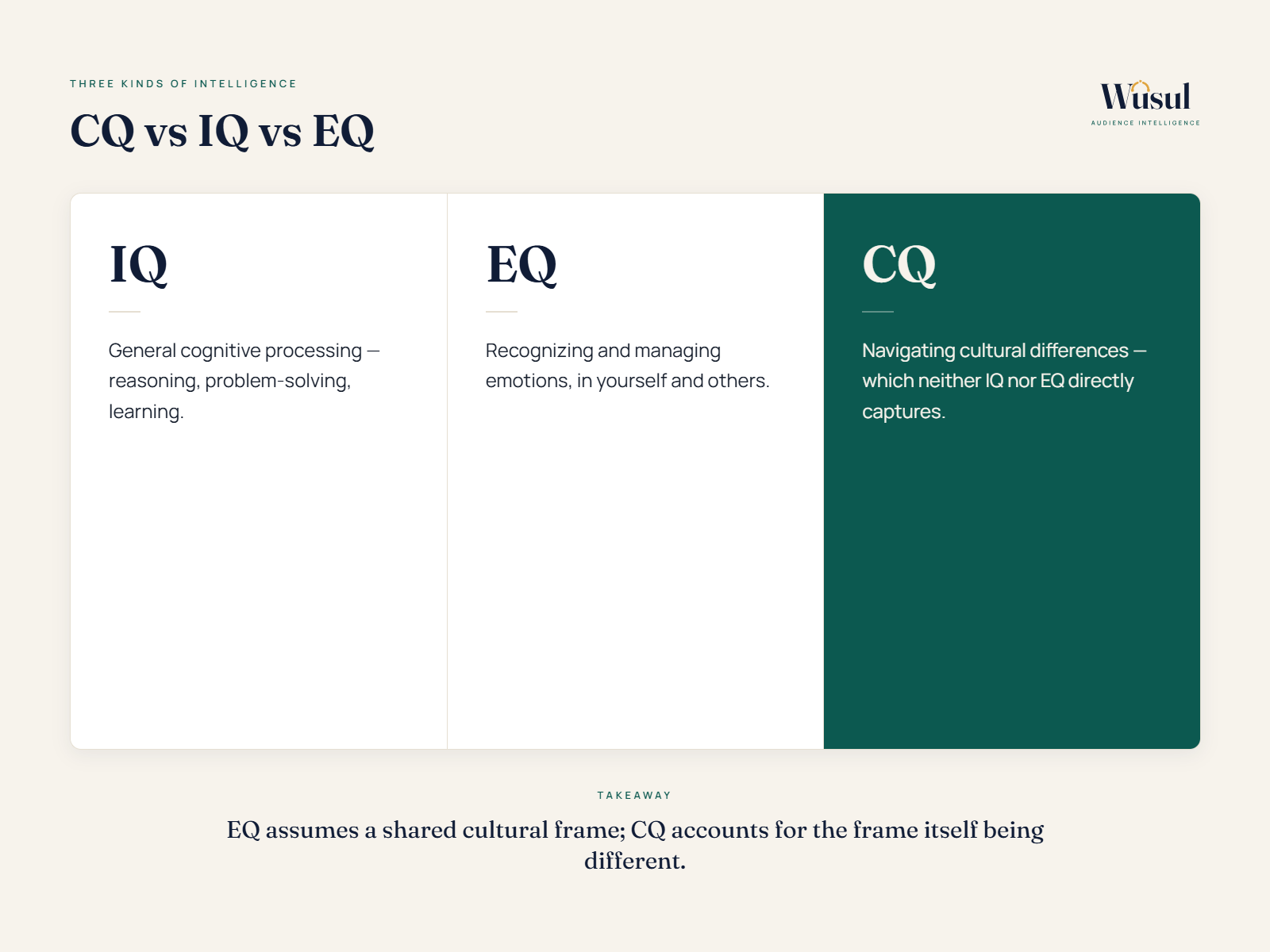
It helps to place CQ next to two concepts most people already know. IQ measures general cognitive processing; how well you reason, solve problems, and learn. EQ (emotional intelligence) measures how well you recognize and manage emotions, in yourself and others. CQ is distinct from both: it specifically addresses how well someone navigates cultural differences, which neither IQ nor EQ directly captures, since emotional cues themselves are shaped by cultural context.
A useful way to think about it: a highly emotionally intelligent person can still misread a cultural situation badly, because EQ assumes a shared cultural frame for interpreting emotional signals. CQ is the capability that specifically accounts for the fact that the frame itself can be different.
The four dimensions of cultural intelligence (CQ)
Earley and Ang's research breaks cultural intelligence down into four distinct dimensions. An organization (or an individual) can be strong in some and weaker in others, which is part of why CQ is useful as a diagnostic, not just a concept.

1- Metacognitive CQ: awareness of your own assumptions
The ability to notice your own cultural assumptions and adjust your thinking when you're in an unfamiliar cultural context. This is the "thinking about your thinking" dimension; catching yourself before you project your own cultural defaults onto someone else's situation.
Example: pausing before assuming a Muslim donor's giving motivation mirrors a Western secular donor's and actively questioning that assumption.
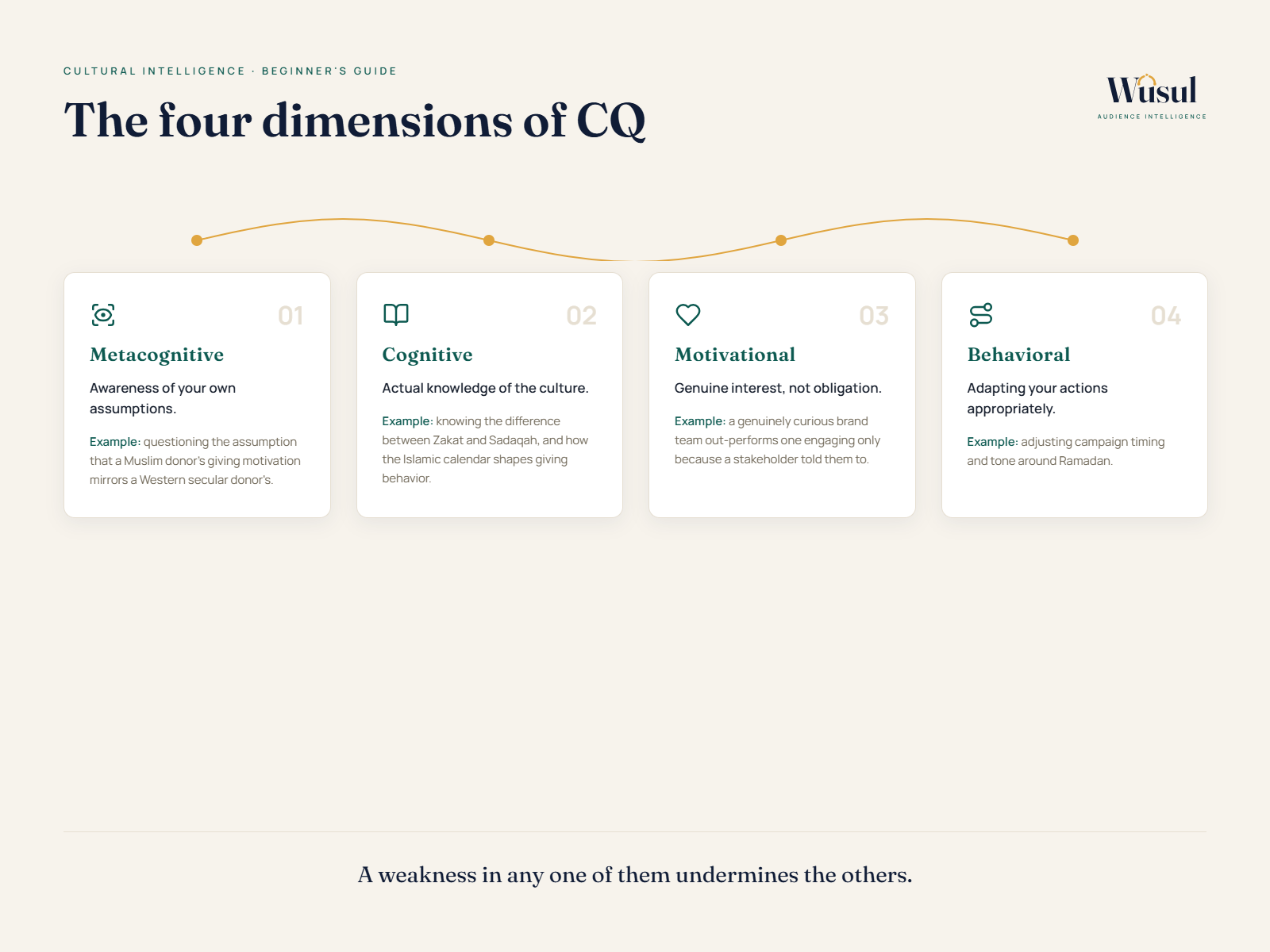
2- Cognitive CQ: actual knowledge of the culture
Real, substantive knowledge of a culture's values, customs, norms, and practices; both broad patterns and specific context. This is the "knowing things" dimension, and it's the one most often confusing for the whole of cultural intelligence, when it's only one part of it.
Example: understanding the difference between Zakat and Sadaqah, and how the Islamic calendar shapes giving behavior throughout the year.
3- Motivational CQ: genuine interest, not obligation
The drive and confidence to engage across cultural differences, rather than treating it as a box to tick. Research on motivation suggests this dimension determines whether someone invests real energy into understanding a different culture, or does the minimum required.
Example: a brand team that's genuinely curious about Muslim consumer behavior will out-perform one that's only engaging because a stakeholder told them to.
4- Behavioral CQ: adapting your actions appropriately
The ability to change your verbal and non-verbal behavior once you understand a cultural context; not just knowing what's appropriate but doing it. This is where understanding turns into action.
Example: adjusting campaign timing and tone around Ramadan rather than running the exact messaging used the rest of the year.
Why do all dimensions matter together?
The four dimensions aren't ranked; they're complementary, and a weakness in any one of them undermines the others. An organization can have excellent cognitive CQ (it knows the facts about Ramadan, Zakat, and the Islamic calendar) but weak behavioral CQ (it still runs the same generic campaign timing anyway). Or it can have strong motivational CQ (genuine curiosity and good intentions) but weak cognitive CQ (it simply doesn't know enough yet to act well).
This is, in miniature, exactly the pattern behind most failed attempts to reach Muslim audiences: good intentions (motivational CQ) without the underlying knowledge (cognitive CQ), or accurate knowledge that never translates into adapted behavior (behavioral CQ). Genuine cultural intelligence requires all four working together, which is also why it's difficult to fake or shortcut.
Is CQ fixed, or can it be built?
Unlike personality traits, which tend to be relatively stable, CQ is described in the research as state-like and malleable, meaning it can be developed over time through deliberate exposure, learning, and practice (Ang et al., 2015, as cited in subsequent CQ literature). This is genuinely good news for any organization that doesn't currently have strong cultural intelligence about Muslim audiences: the capability can be built, not just inherited or hired for once and left alone.
Can cultural intelligence be improved, or is it fixed?
It can be developed. Unlike a fixed personality trait, CQ is described in the research as malleable; it can improve through deliberate learning, exposure, and practice over time.
Does having a diverse team automatically mean high cultural intelligence?
Not automatically. Team diversity can support cognitive CQ (access to cultural knowledge), but an organization still needs motivational drive and behavioural follow-through to translate that knowledge into effective action; diversity alone doesn't guarantee all four dimensions are present.
Why does cultural intelligence matter for reaching Muslim audiences specifically?
Because Muslim communities in Western markets are frequently treated as demographically uniform when they are culturally diverse; differing by generation, observance level, geography, and more. CQ is the specific capability required to navigate that internal diversity accurately, rather than defaulting to assumption.
What does this mean for your organization?
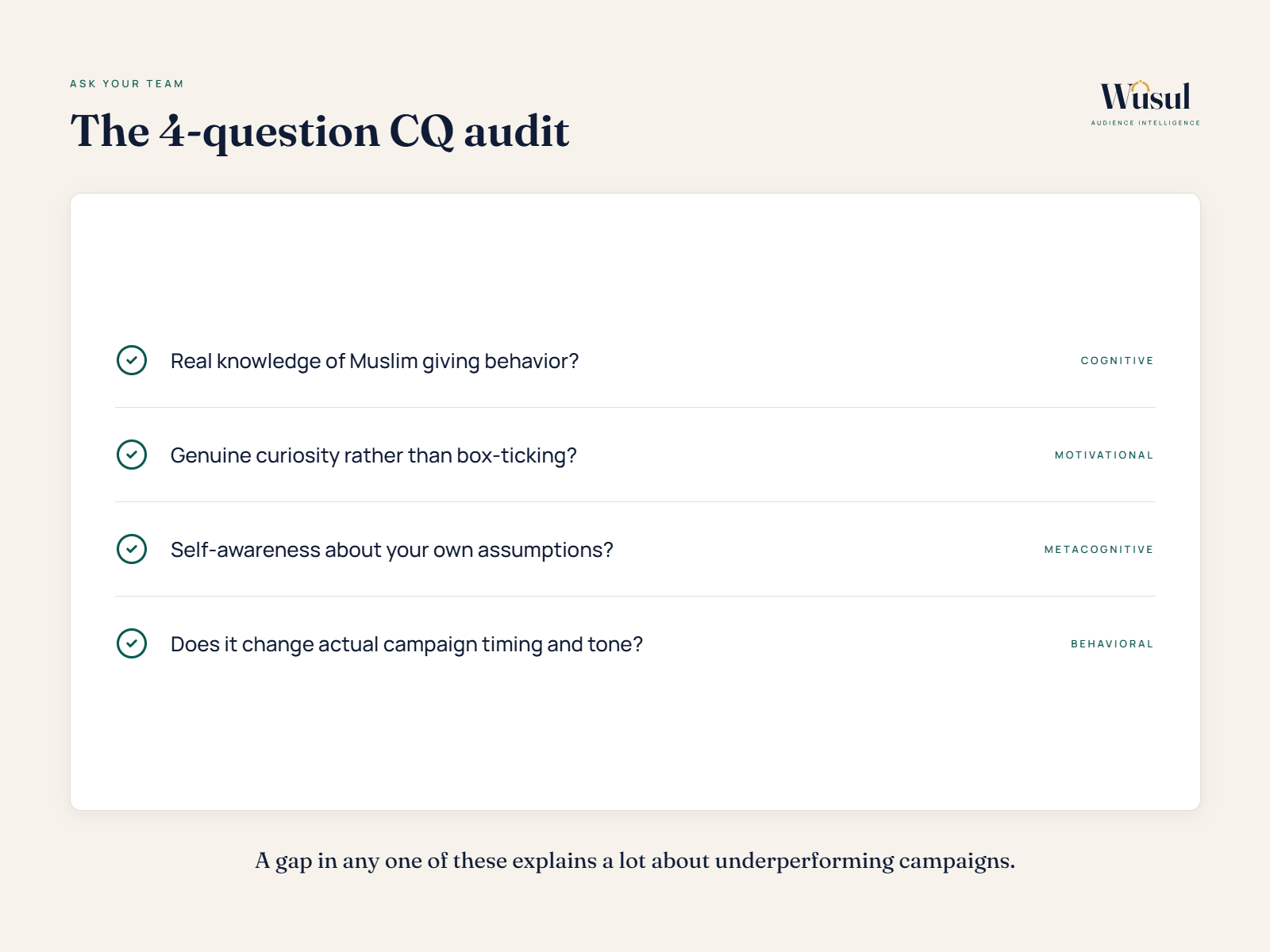
For charities: use the four dimensions as a quick internal audit. Does your team have real knowledge of Muslim giving behavior (cognitive), genuine curiosity rather than box-ticking (motivational), self-awareness about its own assumptions (metacognitive), and does that translate into actual changes in campaign timing and tone (behavioral)? A gap in any one of these explains a lot about underperforming campaigns.
For brands: hiring one person with cultural knowledge solves only the cognitive dimension. Lasting cultural intelligence requires building motivational and behavioral capability across the whole team responsible for a campaign, not concentrating it in a single role.
For media and content teams: if a piece of content "knows the facts" but still doesn't land with an audience, the gap is likely behavioral, not cognitive: the team understood the culture but didn't adapt the actual creative output to reflect that understanding.
For researchers: when designing studies on cultural understanding, consider measuring more than knowledge alone. A respondent can score well on cultural facts and still have low motivational or behavioral CQ; knowledge and action are genuinely separable.
At Wusul, we believe that organizations targeting Muslim communities must invest in cultural intelligence; not just as a compliance exercise, but as a genuine commitment to appreciating the rich heritage of the communities they serve.