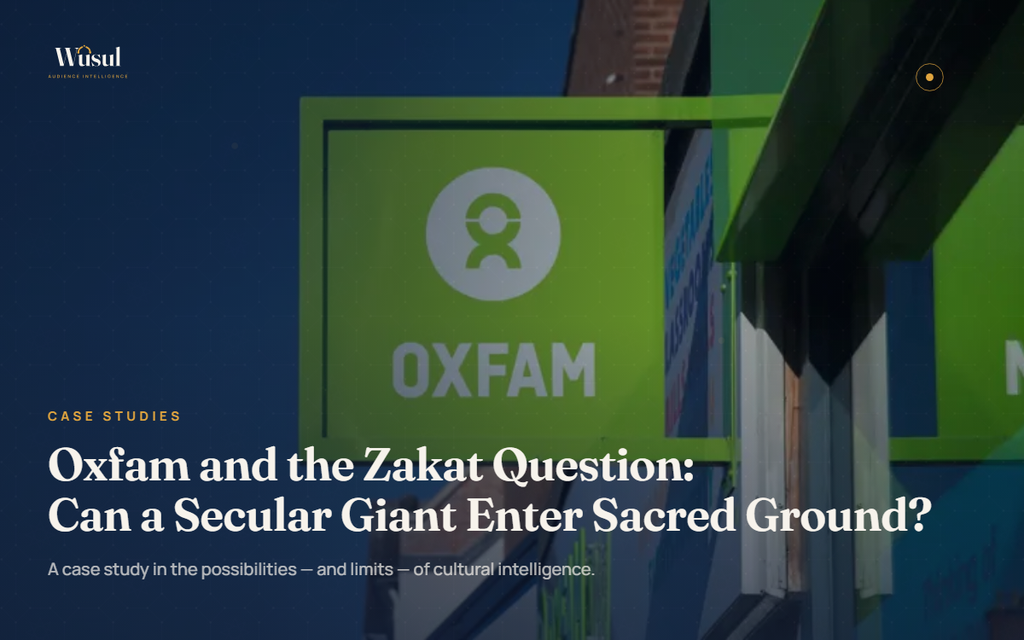
When Oxfam GB launched its formal Zakat policy and procedures, it did something few secular humanitarian organizations had attempted before. It entered a space historically occupied by Muslim-led charities, scholarly institutions, and community networks, and it did so with a restricted fund, an interest-free bank account, and a panel of Islamic scholars.
The move was not born of sudden religious conviction. It was driven by a clear-eyed recognition of a funding reality: many of the countries where Oxfam works, and many of the communities it serves, are Muslim-majority. And Muslims, as the organization itself acknowledged, are among the most generous donors in the world.
But entering the Zakat space is not like entering any other fundraising market. Zakat is not a mere charity. It is a pillar of Islam: a divinely ordained obligation with strict rules about who can receive it, how it must be handled, and who is qualified to distribute it. For a secular organization to enter this space, it would need to demonstrate not only good intentions, but theological legitimacy.
This is the story of what Oxfam built, what it got right, where friction remains, and what its experience teaches about the limits and possibilities of cultural intelligence in Islamic philanthropy.
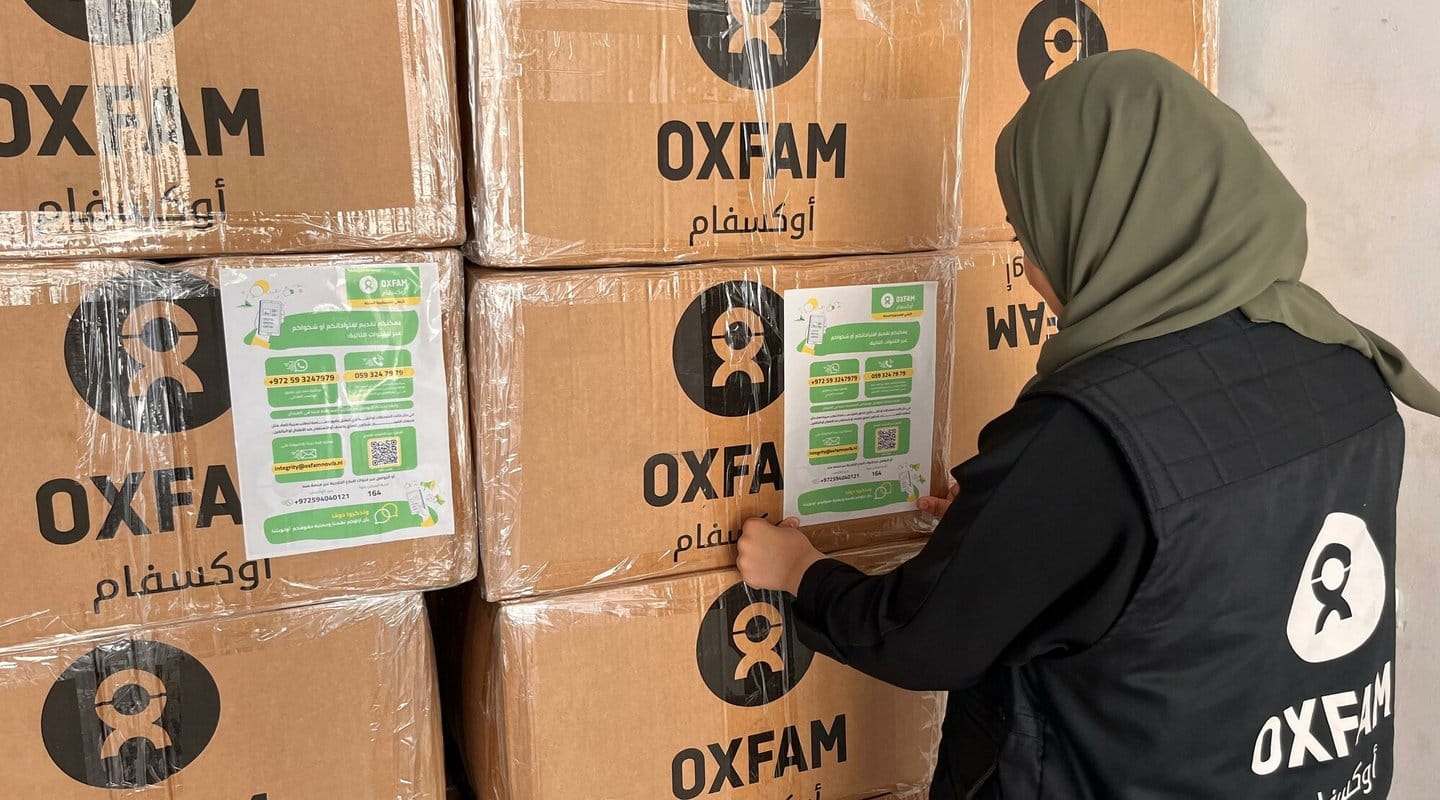
The strategy: building a Zakat policy from scratch
Oxfam's approach was methodical. The organization did not simply add a "Zakat" button to its donation page. It embarked on a comprehensive process of research, consultation, and policy development.
The first step was understanding the Zakat landscape. Oxfam's policy document outlines the eight categories of eligible Zakat recipients as defined in the Qur'an, including the destitute, the poor, Zakat collectors, those in debt, and wayfarers. It explicitly acknowledges that Zakat may not be paid to the rich, those capable of work but unwilling to undertake it, relatives of the giver, or those belonging to the lineage of the Prophet (PBUH).
The consultation process was extensive. Oxfam conducted 13 one-to-one interviews with scholars, leading experts, and Muslim philanthropists, alongside public market research involving 485 interviews and 10 focus groups with Muslims from Bangladeshi, Pakistani, Indian, and Arab communities. This was not a token gesture; it was an attempt to build the policy on genuine insider knowledge.
The resulting policy restricted Zakat payments to two areas: responding to emergency situations in Muslim-majority communities and supporting development projects in those communities. Oxfam also committed that 100% of Zakat donations would be spent directly in the country, area, or project specified. The organization partnered with the National Zakat Foundation to offer a Zakat calculator service, acknowledging that it was not positioned to offer this itself.
The governance: a Zakat advisory panel
Perhaps the most significant element of Oxfam's approach was the creation of a Zakat Advisory Panel: a group of voluntary Islamic advisors to support and validate the organization's Zakat policy.
The panel included figures with significant religious and community standing: Imam Qari Asim MBE, Senior Imam at Makkah Mosque, Leeds, and a government advisor on Islamophobia; Dr Shuruq Naguib, Lecturer in Islamic Studies at Lancaster University; Imam Sayed Ali Abbas Razawi, Theologian and Director General of the Scottish Ahlul Bayt Society; Shaykha Safia Shahid, Scholar and Principal of Women's Muslim College; Dr Sariya Cheruvallil-Contractor, researcher and lecturer; and Dr Wakkas Khan MBE, a humanitarian and philanthropist who served as a Trustee of Oxfam GB and convenes the panel.
The composition was carefully considered. It included Sunni and Shia representation, male and female scholars, and both academic and community-based voices. This was an attempt to demonstrate that Oxfam's Zakat policy was not simply a marketing exercise but had genuine theological oversight.
Oxfam’s Zakat implementation: from policy to practice
Oxfam's Zakat work moved from policy into practice in several key areas.
Cox's Bazar, Bangladesh became a flagship example. Oxfam's Zakat Fund supported Rohingya refugees and host communities in the world's largest refugee camp, where food rations had been cut by 33% since 2023. The organization supported vertical gardens and homestead garden kits, enabling families to grow their own food. Tahera, a Rohingya woman who fled Myanmar in 2017, received a vertical garden kit and now grows enough vegetables for her family of seven, sharing surplus with neighbors.
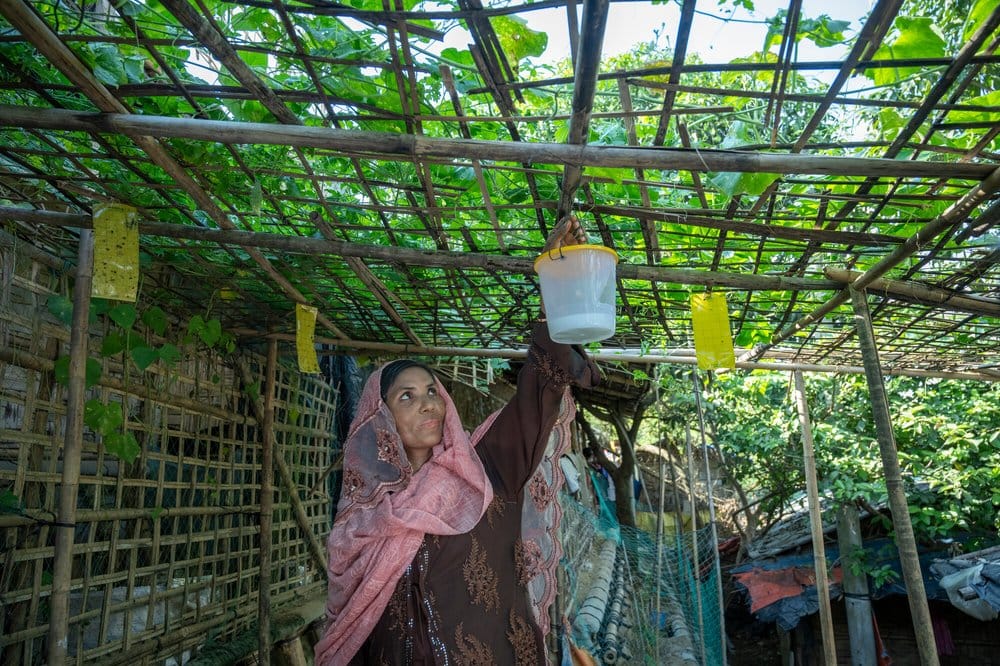
The framing was explicitly Islamic. "Your Zakat is an Amanah," Oxfam wrote, using the Islamic concept of trust to describe its responsibility.
The critique: when critics question the fundamentals
Despite Oxfam's careful approach, its entry into the Zakat space attracted significant criticism, and some of it went to the heart of whether a secular organization should be handling Zakat at all.
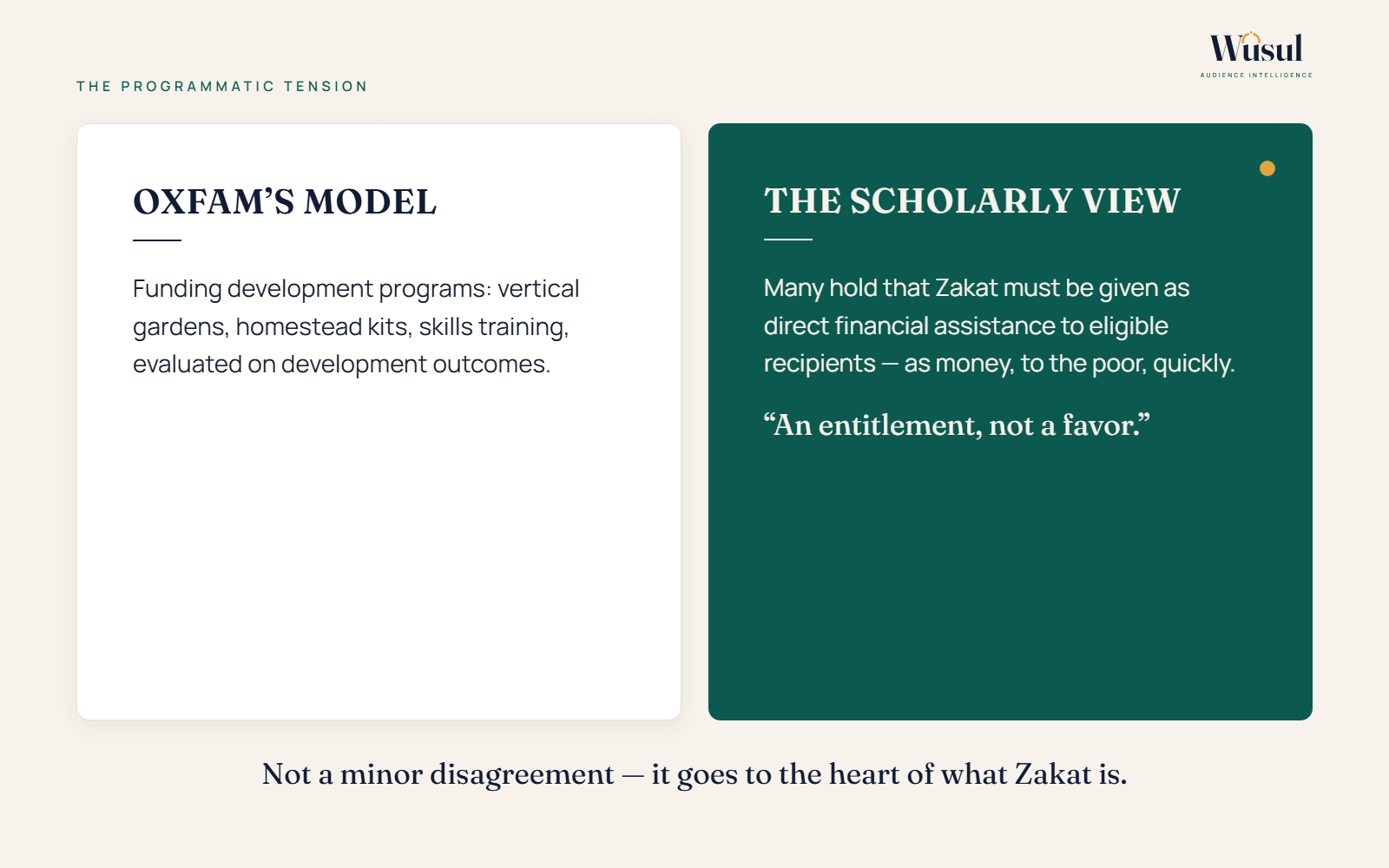
One of the most pointed critiques came from a Muslim commentator who argued that Oxfam fundamentally misunderstood what Zakat is. The central issue, they argued, is that Zakat must be given as money, not as programs or services. Oxfam's approach (funding vertical gardens, skills training, and development projects) was seen by some as violating the requirement that Zakat be disbursed as direct financial assistance to eligible recipients.
"The Qur'anic framing makes clear that zakat belongs to the poor," the critic wrote. "It is an entitlement, not a favor." The argument was that by treating Zakat as just another funding stream for its programs, Oxfam was effectively taking money that belongs to the poor and using it for its own organizational priorities.
The critic also raised a governance concern: Zakat must be disbursed as quickly as possible, not hoarded. The suggestion was that organizations like Oxfam may hold Zakat funds in reserves, mixing them with other donations without separate accounting practice that, if true, would be deeply problematic.
This critique reflects a broader tension in the sector. The Zakat space has historically been dominated by Muslim-led charities that are deeply embedded in the community and understood as legitimate by donors. A secular organization entering this space must prove not just that it can distribute funds effectively, but that it understands and respects the theological framework that governs Zakat.
The broader context: Muslim charities under scrutiny
Oxfam's entry into the Zakat space must be understood against a backdrop of disproportionate scrutiny of Muslim-led charities.
As Samantha May, Senior Lecturer in Politics at the University of Aberdeen, has documented, the "Financial War on Terror" that emerged after 9/11 resulted in disproportionate scrutiny and surveillance of Muslim-led charities, humanitarian organizations, and non-profits. In the UK, the Charity Commission's powers were extended to include removing trustees, freezing funds, and closing charities. The publication of the Claystone report revealed a disproportionate number of investigations on specifically Muslim-led charities.
The consequences have been severe. According to a 2025 report by the Muslim Charities Forum, 68% of Muslim charities have had account requests rejected, and 42% have experienced complete account closures, compared with 12% of charities generally. Organizations have had to wait up to three years to open a bank account; many have had accounts suddenly closed without explanation or appeal, or have faced rigorous questioning about aid payments, particularly going to Palestine, Syria, or Pakistan.
As May notes, this can be considered a form of "slow violence" and "an attritional violence that is typically not viewed as violence at all."
Against this backdrop, Oxfam's entry into the Zakat space raises uncomfortable questions. Was this a genuine attempt to expand the funding pool for Muslim-majority communities? Or was it a secular organization leveraging its size and reputation to enter a market that Muslim-led charities had built, despite facing disproportionate barriers?
What Oxfam got right
Despite the critiques, Oxfam's approach demonstrated several elements of genuine cultural intelligence.
Extensive consultation. The organization did not assume it understood Zakat. It conducted 13 in-depth interviews with scholars and experts, and spoke with 485 Muslims through interviews and focus groups. This is a level of consultation that many organizations skip entirely.
Theological governance. The creation of a Zakat Advisory Panel with respected scholars demonstrated a commitment to theological legitimacy, not just marketing.
Transparency. Oxfam published its full Zakat policy and procedures document, making it available for public scrutiny. This level of transparency is rare in the sector.
100% distribution commitment. By committing that 100% of Zakat donations would be spent directly in the specified country or project, Oxfam addressed a key donor concern about administrative overhead.
Partnership with Zakat specialists. Rather than trying to offer Zakat calculation services itself, Oxfam partnered with the National Zakat Foundation, acknowledging the limits of its own expertise.
What Oxfam got wrong (or couldn't overcome)
The programmatic approach to Zakat. Oxfam's model of funding development programs (vertical gardens, skills training) conflicts with the view held by many scholars and donors that Zakat must be given as direct financial assistance to eligible recipients. This is not a minor disagreement; it goes to the heart of what Zakat is.
The perception problem. No matter how careful Oxfam's policy, the organization will always be seen by some as an outsider to the Muslim community. This is not something that can be fixed with a policy document or an advisory panel. It requires sustained relationship-building over years.
The competitive tension. Oxfam's entry into the Zakat space comes at a time when Muslim-led charities are facing disproportionate regulatory scrutiny and barriers to banking. A secular organization with Oxfam's size and reputation entering the same space raises questions about equity and whether Muslim donors should support institutions that are led by and for their community.
The measurement challenge. Oxfam's impact is measured through evaluations of its programs. But Zakat donors may not want their Zakat used for a program that is evaluated on development outcomes. They may want to know that their Zakat went directly to a poor family, as money, quickly.
Conclusion: a bold attempt with an unresolved question
Oxfam's attempt to enter the Zakat space is a case study in both the possibilities and the limits of cultural intelligence. The organization did many things right: it consulted extensively, created theological governance, published its policy transparently, and committed to 100% distribution. It approached Zakat with seriousness and respect.
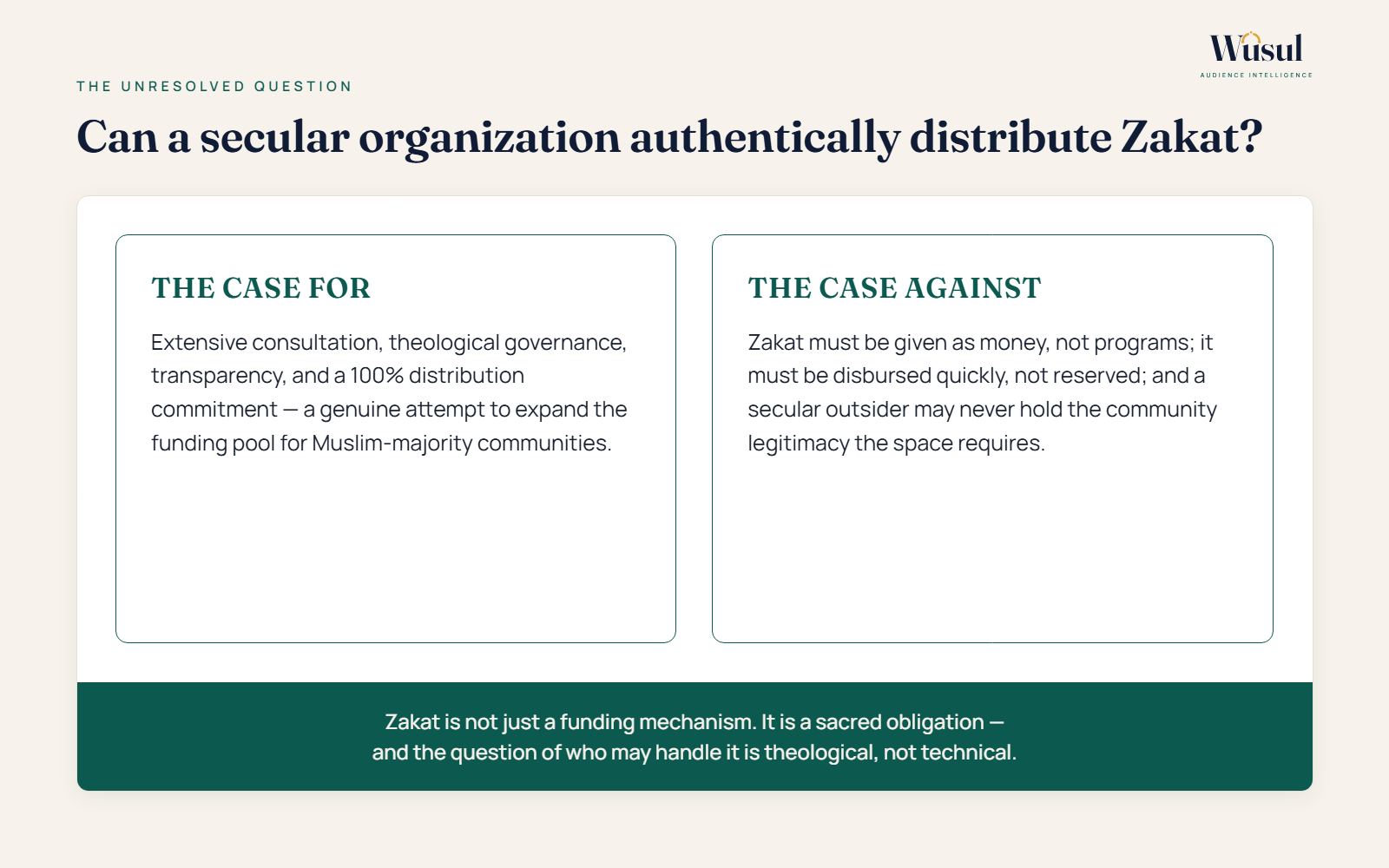
But it also encountered a fundamental challenge: Zakat is not just a funding mechanism. It is a sacred obligation, and the question of who is qualified to handle it is not merely technical; it is theological.
The larger question remains unresolved. Can a secular organization authentically serve as a Zakat distributor? Or does the very nature of Zakat require that it be handled by Muslim-led institutions, embedded in the community, and accountable to the scholars and donors who understand it as an act of worship?
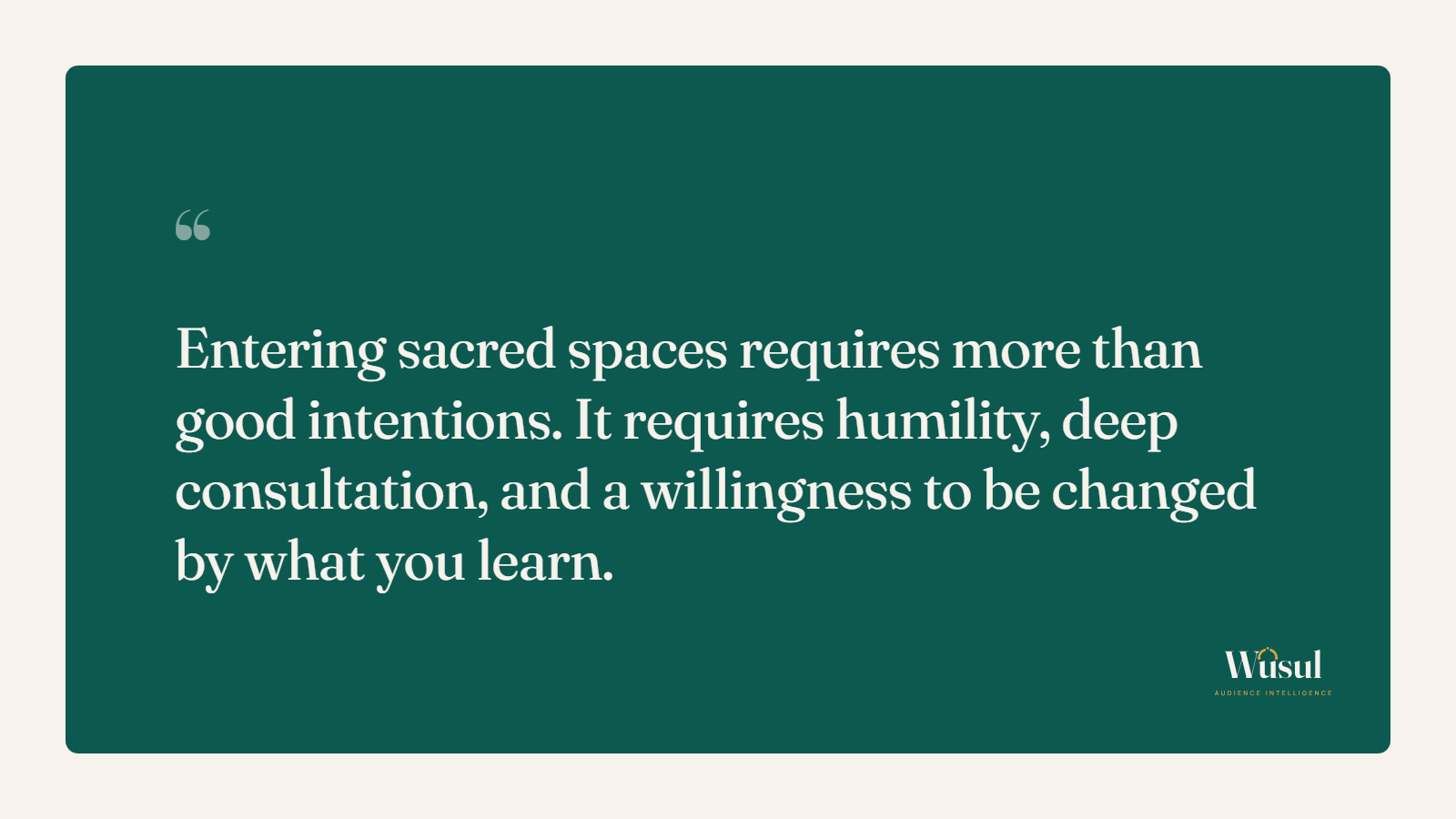
At Wusul, we believe that cultural intelligence means understanding not just what a community does, but why it does it, and respecting the boundaries it sets. Oxfam's Zakat journey demonstrates that entering sacred spaces requires more than good intentions. It requires humility, deep consultation, and a willingness to be changed by what you learn.
Frequently asked questions
Does Oxfam accept Zakat?
Yes. Oxfam GB has a formal Zakat policy. Zakat goes into a restricted fund held in an interest-free bank account, it is used for emergency response and development projects in Muslim-majority communities, and Oxfam commits that 100% is spent directly in the country, area or project specified.
Who oversees Oxfam’s Zakat policy?
A Zakat Advisory Panel of voluntary Islamic advisers supports and validates the policy. It includes Sunni and Shia representation, male and female scholars, and academic and community voices, and it is convened by Dr Wakkas Khan MBE, who has served as an Oxfam GB trustee.