A three-decade-old brand is gone. Here's what happened, why it matters, and what every Muslim nonprofit should learn from the most expensive rebranding experiment in American Muslim philanthropy.
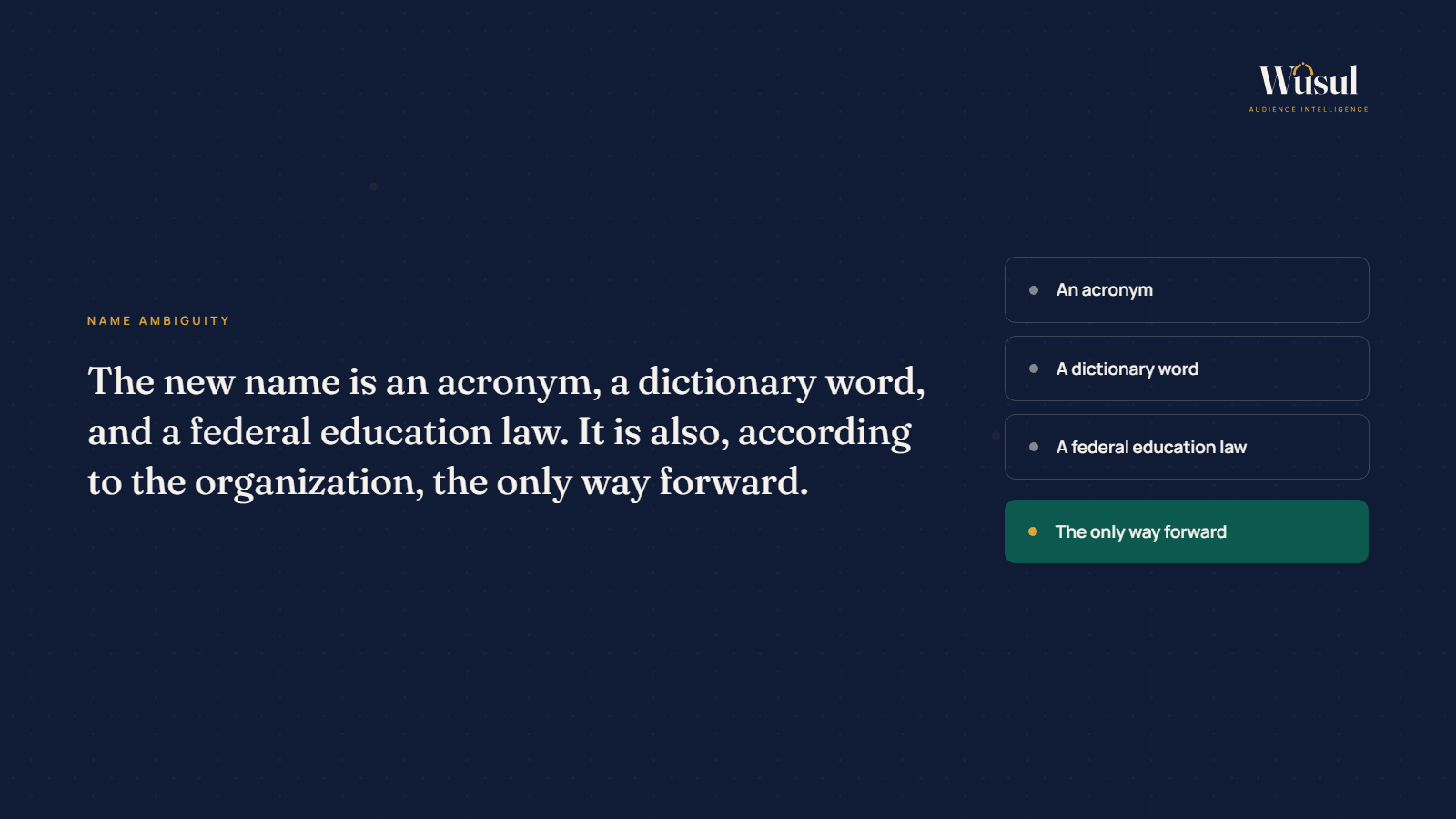
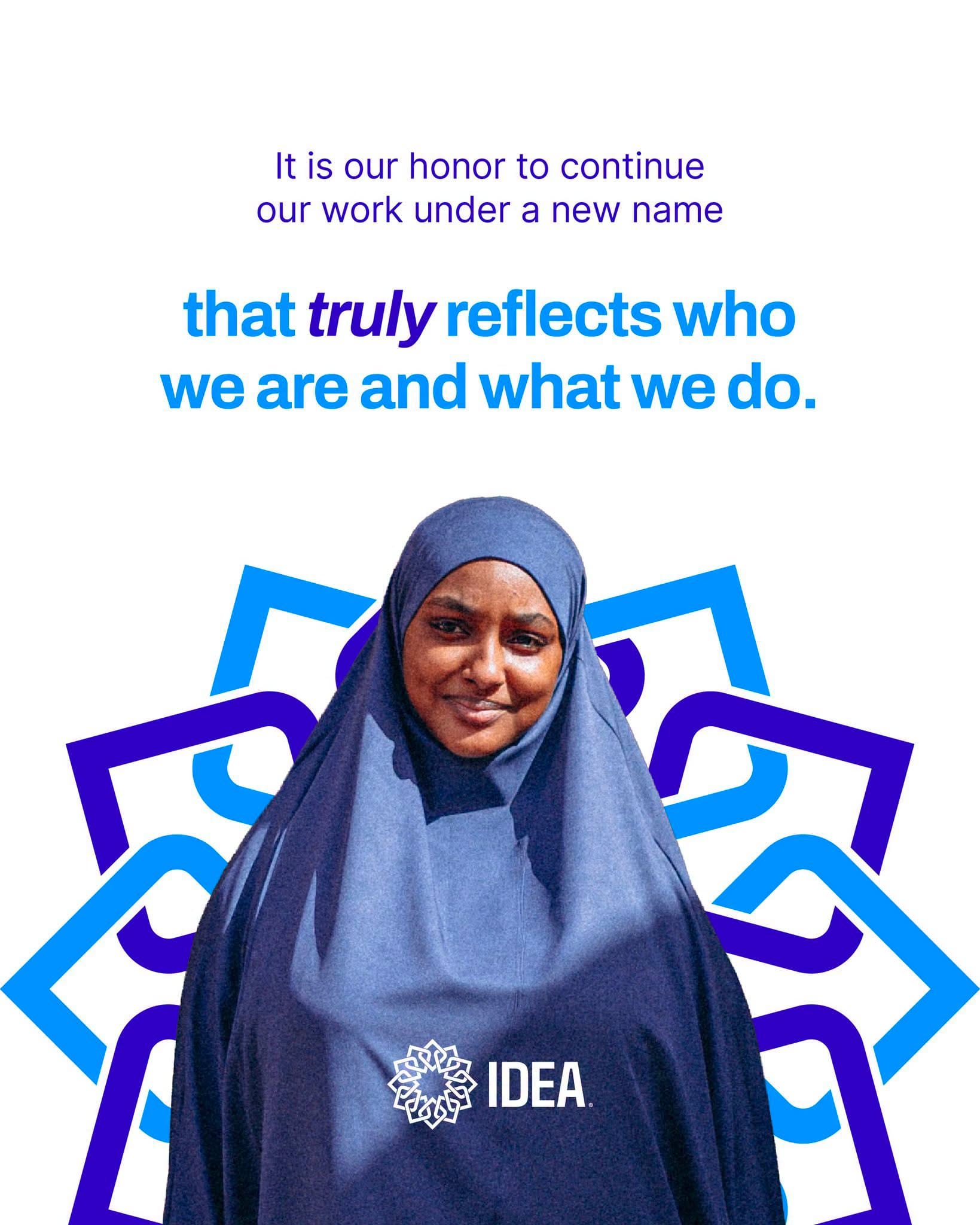
On September 15, 2026, Islamic Relief USA announced it had become IDEA: Islamic Development & Empowerment in America. The name that American Muslims had typed into search bars, written on checks, and heard from minbars for more than thirty years was retired. The new name is an acronym, a dictionary word, and a federal education law. It is also, according to the organization, the only way forward.
Three days earlier, on September 12, the International General Assembly of Islamic Relief Worldwide voted unanimously to remove Islamic Relief USA from its federation. The American charity no longer had permission to use the Islamic Relief name. What followed was not a marketing refresh. It was a forced migration.
This is the story of how one of the largest Muslim charities in America changed its name, and what that change actually costs.
I. IRUSA to IDEA: how it happened?
The trouble did not begin with a dispute between charities. It began in the Congress!
In September 2024, House Ways and Means Committee Chairman Jason Smith sent letters to the IRS referring multiple organizations for investigation, including Islamic Relief USA, citing its affiliation with Islamic Relief Worldwide and alleged ties to terrorist groups. The committee's concerns centered on IRW's alleged connections to Hamas, antisemitic statements by former leaders, and foreign government designations.
Islamic Relief Worldwide has consistently rejected these allegations, pointing to independent audits and its partnerships with the United Nations and Western governments. But the political pressure was real, and it was aimed at the American affiliate.
By October 2025, IRUSA's board had determined that continued participation in the relationship "presents an immediate threat to the reputation, integrity or operation" of the organization. The board's letter explicitly cited the Ways and Means Committee's referral to the IRS, noting that the committee's accusations were grounded solely in IRUSA's financial relationship with IRW.
On December 24, 2025, IRUSA sent IRW a formal Letter of Intent to terminate their contractual relationship. The letter was blunt about the stakes:
"Although IRUSA, a 501(c)(3) non-profit organization headquartered in the United States, and IRW, a United Kingdom based charity... are legally separate and independent entities, it is nevertheless necessary to sever any existing contractual obligations or relationship to maintain continuity of independent operations and protect the interests of beneficiaries. This measure is undertaken not for commercial reasons or out of any personal animus; rather it is absolutely necessary for IRUSA to continue to exist and operate as an American 501(c)(3) entity."
The letter proposed that IRW transfer all rights to the "Islamic Relief USA" and "IRUSA" name and logo to the American organization, in exchange for financial compensation. IRW did not agree.
The lawsuit
In March 2026, Islamic Relief USA filed a federal lawsuit in the Southern District of New York seeking to formally sever the relationship. The complaint accused IRW of a pattern of conduct that jeopardized IRUSA's legal standing and donor relationships.
Among the allegations:
- Unauthorized fundraising: IRW allegedly solicited donations from American donors without proper registration, violating brand licensing agreements. According to the complaint, between November 2025 and February 2026, approximately 25 percent of IRW's internet traffic originated from U.S.-based addresses, with IRW actively purchasing advertisements targeting American donors.
- False claims about orphan sponsorships: IRUSA alleged that IRW "fraudulently fabricated records" to create the impression that IRUSA had canceled hundreds of orphan sponsorships.
- Audit obstruction: IRUSA requested audits of four Afghanistan grants covering food insecurity, health education, women's entrepreneurship, and earthquake recovery. IRW declined to engage.
- Sanctions concerns: IRUSA raised concerns about an overseas project involving the export of sewing machines from Iran to Afghanistan. IRW maintained that the machines were manufactured in China and that the confusion stemmed from an erroneous statement by a staff member. IRW offered a refund of $28,443, the full cost of the machines in question.
IRUSA sought more than $6.4 million in damages and a court order voiding certain agreements.
Islamic Relief Worldwide characterized the lawsuit as a "publicity stunt" and a "years-long smear campaign," arguing that the dispute should be resolved through private arbitration as stipulated in the Members' Agreement.
The expulsion
While the court-ordered dispute resolution process was underway, Islamic Relief Worldwide's International General Assembly proceeded with a vote. On September 12, 2026, the IGA (the federation's highest governing body) voted unanimously to remove Islamic Relief USA from the federation.
IRW chair Haroun Atallah said the decision was necessary because the U.S. organization's actions had "damaged the work of the entire federation".
Islamic Relief USA characterized the expulsion as a "bad faith and ineffective attempt" to avoid accountability.
Three days later, the American organization announced its new name.
II. IRUSA to IDEA: What the Name Change Actually Means
IDEA offers two explanations for the rebrand.
First, the organization says it has "outgrown" the word "relief." Its work has expanded from emergency responses into long-term development; education, health, food security, and economic empowerment. "Development" and "Empowerment" in the new name reflect this programmatic evolution.
Second, CEO Ahmed Shehata said the new identity would reduce confusion among government regulators, institutional partners, and donors who had sometimes conflated the American charity with the U.K.-based federation.
Both explanations are plausible. But the timeline makes clear that the rebrand was not primarily a strategic choice. It was a legal necessity. The word "forced" appears nowhere in IDEA's public messaging, but the sequence of events—congressional referral, IRS threat, lawsuit, arbitration, expulsion—tells a different story.
What stays the same
According to IDEA, the essentials have not changed.
- Same 501(c)(3): The organization retains its tax-exempt status under the same EIN (95-4453134).
- Same leadership and teams: The staff and governance structures remain in place.
- Same zakat policy: IDEA says its zakat policy, scholars, and eligibility criteria are unchanged.
- Same programs: Domestic initiatives like Day of Dignity and the Disaster Management Team continue, as do international projects.
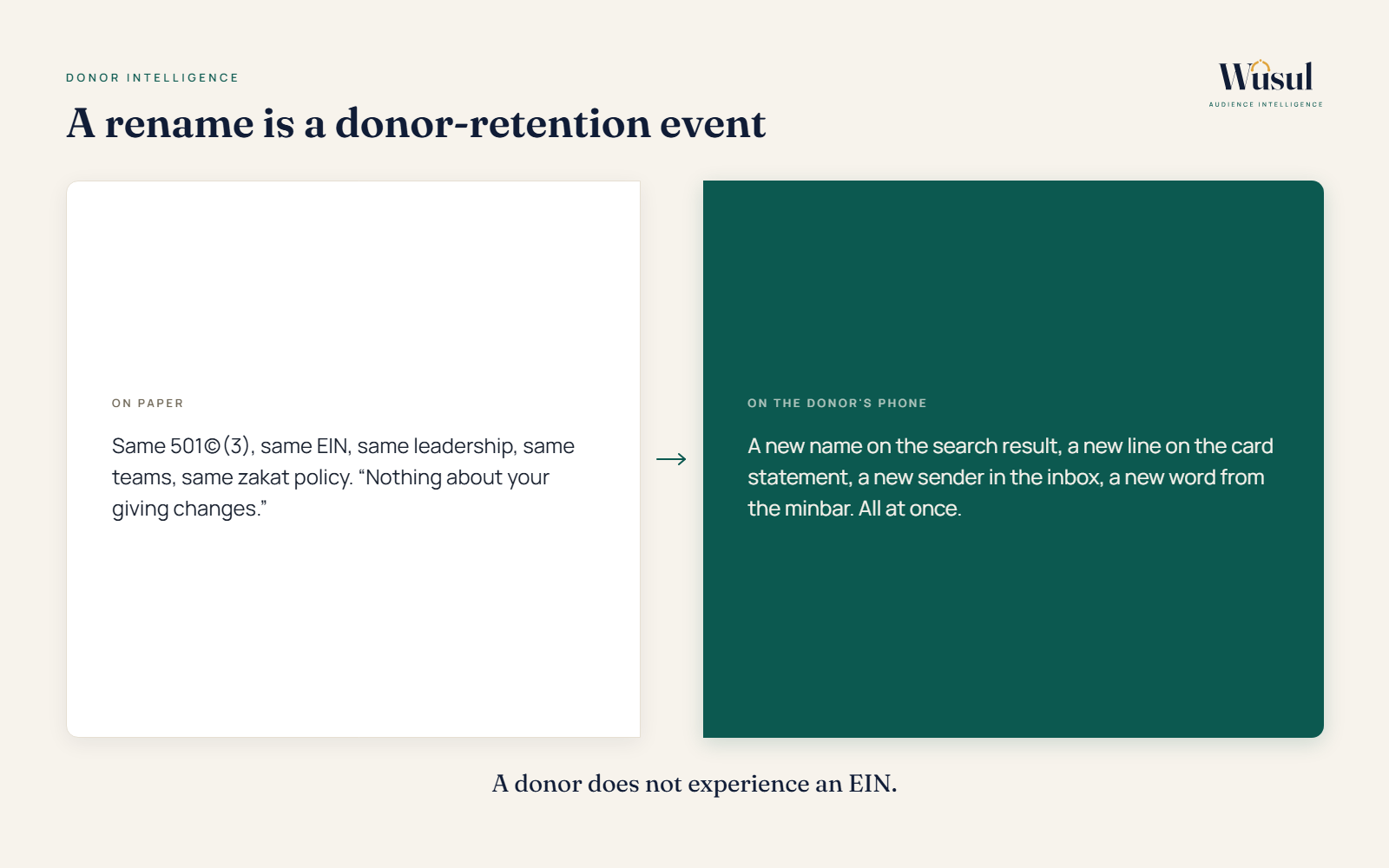
IDEA's FAQ states simply: "Nothing about your giving changes."
From an accountant's perspective, that is true. From a donor's perspective, it is not.
What changes for donors
A donor does not experience an EIN. They experience a name they recognize on a search result, a line on a card statement, a sender in an inbox, and a word they hear from the minbar.
All of those changed at once.
Search behavior: Donors search by memory. "Islamic Relief" will continue to be typed for years by people who want to give zakat, sponsor an orphan, or find last year's receipt. The organization can now use that name only as "formerly." Any competitor with an ad account can bid on it tomorrow.
Recurring donations: The line on the donor's card statement changes. Some donors will not recognize it. An unrecognized charge becomes a dispute or a cancellation. The first sixty to ninety days after a rename are when monthly givers quietly disappear.
Email deliverability: Messages now arrive from a new domain with no sending reputation. The email explaining the change is the message most likely to land in spam.
The "Islamic" question: The long form of the name keeps the word. The short brand—IDEA—hides it. For a meaningful share of donors, and for zakat donors above all, the old name was a shortcut for "my zakat is safe here." The new name asks them to verify that again from scratch. The Zakat Policy, the scholars, and the eligibility statement now have to do the work the name used to do.
The timing challenge
The rebrand was announced roughly ten weeks before year-end giving and about five months before the first Ramadan under the new brand.
Ramadan is where Muslim charities earn the largest share of their annual revenue. A name launched in September will be examined in February, by donors who may not have encountered it before. The organization will need to communicate the change repeatedly—not just once—to ensure that Ramadan giving does not suffer.
III. IRUSA to IDEA: The Financial Stakes
The financial relationship between IRUSA and IRW was substantial.
According to the Civil Society, Islamic Relief Worldwide received £36.8 million from Islamic Relief USA in 2025, representing 13 percent of IRW's total income. In earlier years, the American affiliate was even more dominant: in 2022, IRUSA contributed £67 million to IRW, accounting for 29 percent of the global organization's income. In 2021, the figure was £54.3 million, or approximately 44 percent of IRW's income.
The separation affects not only branding and governance, but also the flow of funds through the international federation. IRW's 2025 accounts noted that income had fallen by £36.7 million compared to the previous year, partly due to "exceptionally large emergency appeals" in 2024 not repeating. The loss of the American affiliate's contributions will compound that decline.
The intellectual property question
IRUSA's December 2025 letter proposed that IRW transfer the "Islamic Relief USA" and "IRUSA" name and logo to the American organization in exchange for financial compensation. That transfer never occurred. IRW's subsequent actions—including the expulsion vote—made clear that it intended to retain control of the brand.
IDEA now operates without any rights to the Islamic Relief name. Its former domain, irusa.org, redirects to the new site at development.org. The organization cannot use "Islamic Relief" in its marketing, its fundraising, or its branding—except as a historical reference.
IV. Lessons for Muslim Nonprofits
There are two kinds of nonprofit rebrands.
The chosen kind: Leadership believes the mission has outgrown the old name. The organization has time, resources, and political capital to invest in a thoughtful transition.
The forced kind: Governance, regulation, or litigation has made the name a liability. The organization has no choice but to change, often under time pressure and with incomplete preparation.
Islamic Relief USA's rebrand was the second kind, described in the language of the first.
For any nonprofit board watching this unfold, the lesson is not that rebranding is bad. It is that name equity is fragile, and it can be destroyed by forces outside the organization's control. The name donors have typed for thirty years can become unavailable overnight.

What to do if you're considering a rebrand?
- Treat it as an eighteen-month migration, not a launch day. Run "New Name, formerly Old Name" on everything for as long as you are legally able. Keep the old domain redirecting for years, not months.
- Pick a name you can be found by. Search the candidate name before you fall in love with it. Existing meanings, laws, brands, and acronyms are all competition. "IDEA" is a dictionary word and a federal education law. "development.org" is a category, not a name.
- Sequence your audiences. Recurring donors first, before the press release. Then Zakat donors, then lapsed donors, then partners and grantees, then the public. Message them thirty days before, on the day, and at thirty, sixty, and ninety days after.
- Fix payments before the announcement. Agree the statement descriptor with your processors. Show donors exactly what their statement will say. Set up retry logic for failed charges. Give the "what is this charge?" call a person to reach.
- Warm up the new email domain months ahead. Run both domains in parallel with authentication aligned. Send the first "we have changed our name" email from the old domain, where the reputation lives.
- Defend the old name in search. Keep bidding on it. Watch your auction reports weekly for competitors appearing on your former brand. Build the new brand campaign with sitelinks that explain the change in the ad itself.
- Don't launch inside ninety days of Ramadan or year-end. If circumstances force it, a Muslim nonprofit should double the donor communication and cut any acquisition spend that depended on the old name.
- Measure the things that break. Brand search volume, monthly donor churn, inbox placement, failed recurring charges. Baseline them before the announcement and alert them after it.
V. What's Next?
For IDEA
The organization's immediate task is to establish that its new identity represents both independence and continuity. It must preserve the loyalty of longtime supporters while reaching donors who may be unfamiliar with the new name.
That will require more than a new logo or website. It will require sustained communication about governance, financial stewardship, program outcomes, and the organization's relationship with overseas partners. The case for the change must be made repeatedly, not once.
IDEA also faces practical challenges in restructuring its international work. Without the Islamic Relief federation, the organization will need new agreements with field offices, local organizations, and humanitarian suppliers. A separate U.S. identity could provide greater control over partnerships and compliance, but it may also require building infrastructure that previously came through the federation.
For Islamic Relief Worldwide
IRW must manage the financial and operational consequences of losing its largest affiliate. The £36.8 million annual contribution from IRUSA represented 13 percent of IRW's income. Replacing that revenue will not be easy.
The organization also faces ongoing scrutiny from U.S. authorities. The expulsion vote may have resolved the immediate governance question, but it does not address the underlying allegations that prompted congressional attention in the first place.
For Muslim donors
The most immediate question for donors is simpler: Is the organization I have trusted still the organization I trusted?
IDEA says yes. Same EIN, same teams, same zakat policy, same programs. The name is new, but the institution is not.
Donors will decide whether that answer is sufficient. Some will follow the new name. Some will drift away, either because they do not recognize the charge on their statement or because they interpret the name change as a retreat from the organization's Islamic identity. Others will wait and see.
The next twelve months will show, in public, what a name was worth.