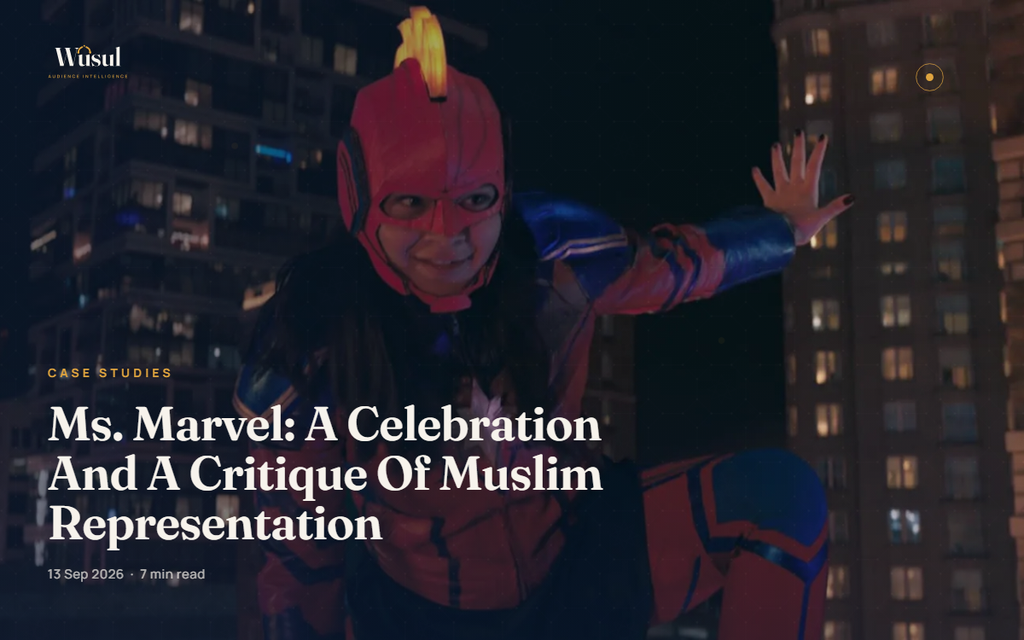
When Ms. Marvel mini-series premiered on Disney+ in June 2022, it was hailed as a watershed moment for Muslim representation. For the first time, a major Hollywood franchise placed a Muslim, Pakistani-American teenage girl at the center of a superhero narrative . Kamala Khan, played with infectious charm by Iman Vellani, was not a sidekick or a victim; she was the hero. The show was praised for its vibrant depiction of South Asian culture, its embrace of Islamic traditions, and its celebration of a community long marginalized on screen .
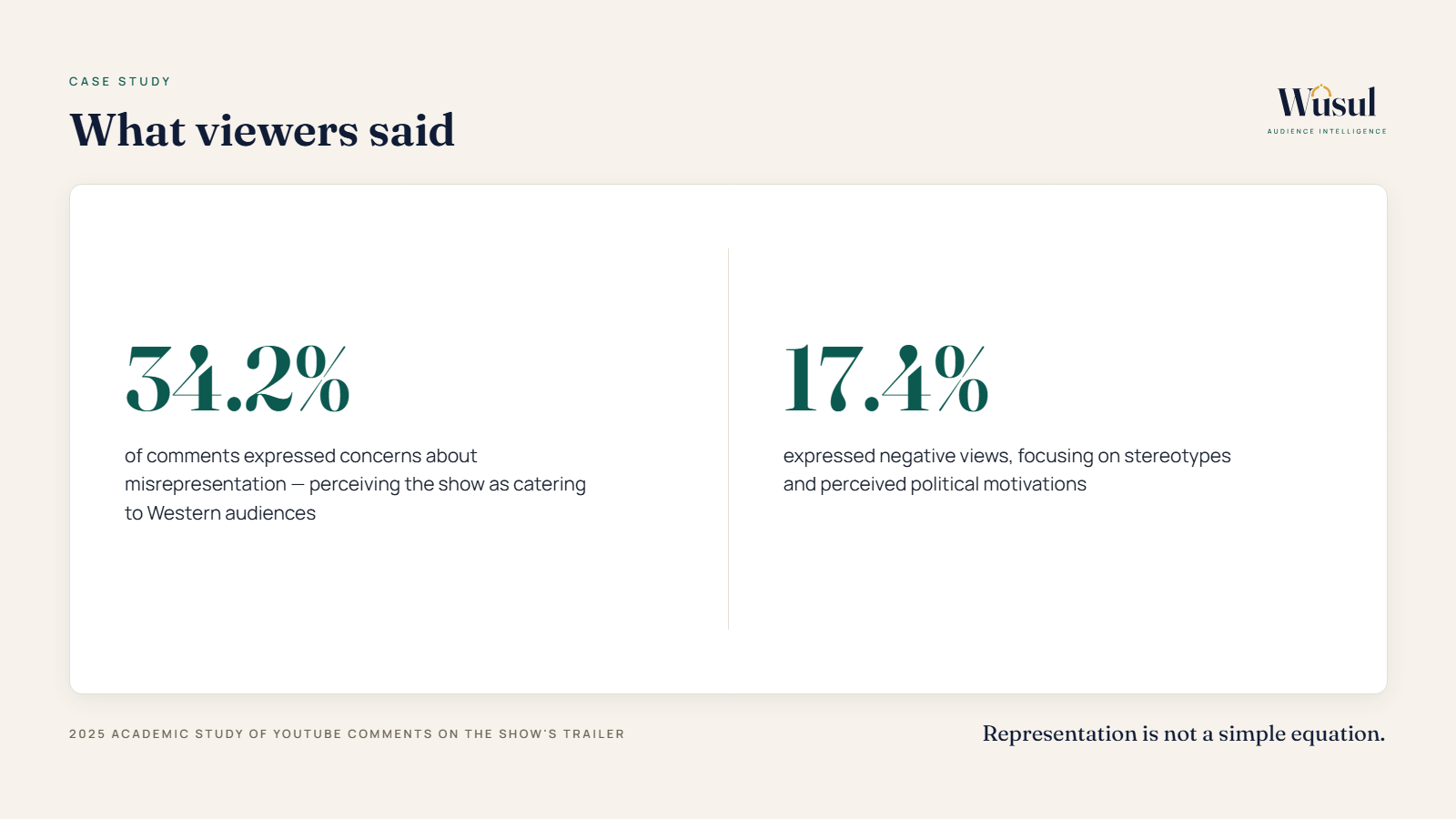
But representation is not a simple equation. Nearly three years after its release, critical voices have complicated the celebration. A 2025 academic study analyzing YouTube comments on the show's trailer found that while some viewers appreciated the respectful cultural depiction, 34.2% of comments expressed concerns about misrepresentation, criticizing the show for catering more to Western audiences than authentically portraying Muslim youth. A further 17.4% expressed negative views, focusing on stereotypes and what they perceived as Marvel's political motivations.
Ms. Marvel review: what the show gets right, visibility and normalization
One of the show's most significant achievements is its normalization of everyday Muslim life. As one Muslim viewer from Anaheim, California, told the press: "Kamala Khan is me... She is just like me" . This sentiment was echoed by many in the South Asian diaspora who saw their families and traditions reflected on screen.
The show explicitly reclaims Islamic language that has been weaponized in Western media. In one scene, Kamala's family joyously chants "Allahu Akbar" ("God is great") at her brother's wedding; a phrase usually associated with terrorism in Hollywood narratives.
Arij Mikati, managing director of culture change for the Pillars Fund, noted: "When you hear the call to prayer, that's usually a sign that you're somewhere unsafe on television... And all of these things are being reclaimed in this show."
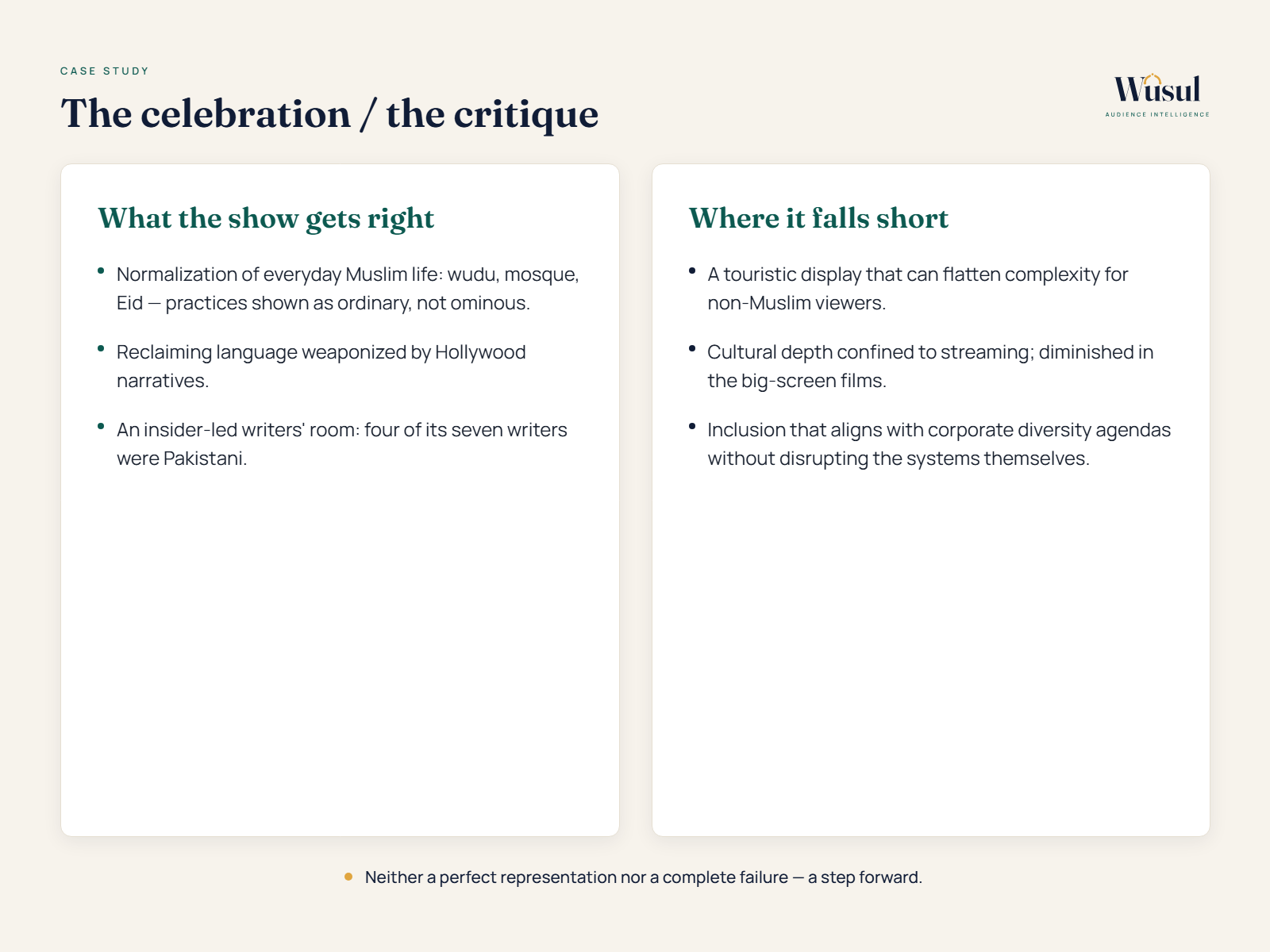
The show also features authentic Islamic practices: Kamala performs wudu (ablution) before praying, attends mosque, and references Urdu-language cultural codes. The friend Nakia, a hijabi character, has a storyline exploring her identity as a young Muslim woman in the mosque ecosystem; a narrative that, as Public Books noted, television "truly should be praised as a vehicle for authentic representation" .
Insiders Behind the Camera
The show's authenticity was driven by an insider-led creative team. Head writer Bisha K. Ali, who is British Pakistani, described the writers' room, four of its seven members were Pakistani; as "incredibly emotional," as they shared memories of their mosques and contacted relatives on WhatsApp for details. Sana Amanat, an executive producer and co-creator of Kamala Khan in the comics, ensured that the character was not "put on a pedestal" but was instead "awkward, funny, a sweet person who ultimately wants to do better".
This insider perspective is essential for cultural intelligence. As the creators of the comic originally understood, Kamala Khan was designed to "feel like someone you know," a character who embodies the "plurality of Islam: its contradictions and coherence."
The critique: where the show falls short
The Western gaze and performative representation
Despite its strengths, Ms. Marvel has faced criticism for catering to Western audiences. The 2025 academic study finds that 34.2% of YouTube commenters perceived misrepresentation as significant. Critics argue that the show's celebration of Pakistani culture feels, at times, like a touristic display: a "look how cool this culture is" approach that flattens complexity for the consumption of non-Muslim viewers.
One IMDb reviewer captured this tension: "They put a little too much effort into showing how cool this culture is... I get it, it's important to give a good light to a not-so-well-known culture, but it does feel a little fake sometimes" . This reflects a broader concern that Hollywood's version of diversity is often a market-driven strategy; a "global market strategy to bring Muslims to the surface" that, as one academic study noted, serves corporate diversity agendas rather than meaningful change.
The small screen success, big screen erasure
A striking critique of Ms. Marvel is that its impact is confined to the small screen. When Kamala Khan appears in Marvel films, such as The Marvels, the depth of her culture, religion, and race is significantly diminished. As one analysis in Public Books observed: "All the depth of Ms. Marvel's culture, religion, and race (the sort that we know Disney can achieve when it sets its mind to it on the small screen) is erased. Instead, the big-budget films simply settle for the box-office win: a superhero who is both brown and female".
The author argued that Hollywood executives refuse to invest in hijabi-focused narratives out of "fear of financial repercussions," believing that a white-majority audience "won't resonate with or enjoy a prominent spotlighting of the hijab" . This suggests that Ms. Marvel was permitted to be culturally specific on streaming, where lower budgets and smaller viewerships create "a safer space for risk taking" . On the big screen, representation becomes a box to tick rather than a story to tell.
The Tokenism Problem
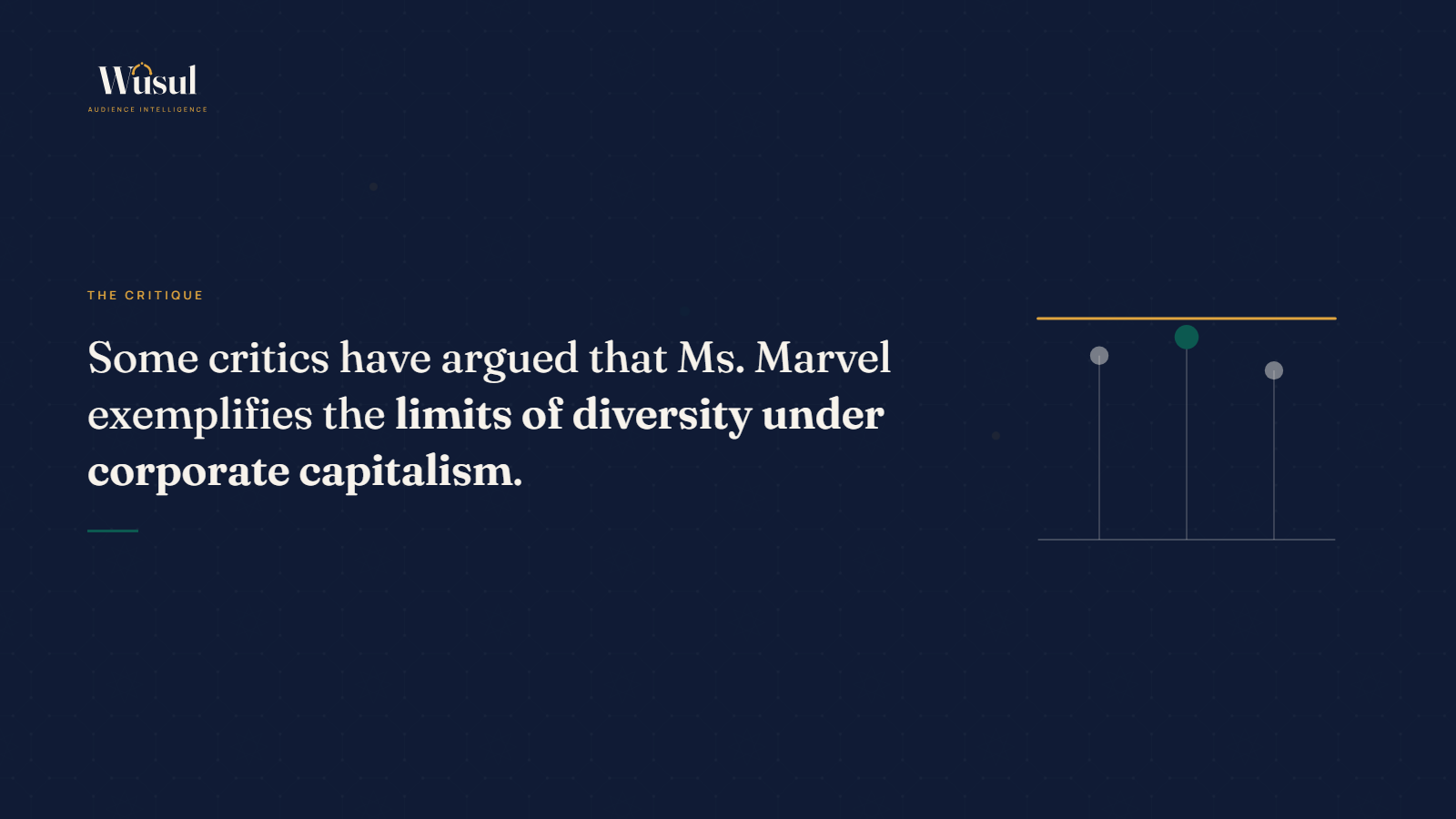
Some critics have argued that Ms. Marvel exemplifies the limits of diversity under corporate capitalism. An academic analysis framed the show as part of a broader media industry pattern: the "continual and savvy recognition by the state and the media industries of social and cultural difference" that does not necessarily lead to social change. The show aligns "neatly with corporate diversity agendas," raising the question of whether inclusion is "not a secondary consideration but rather, part of a recalibration of nationalist imaginations" .
In other words, Ms. Marvel does not disrupt the systems that marginalize Muslims in Western society; it simply makes Muslims visible within them. This is progress, but it is not liberation. As Riz Ahmed noted in his landmark 2017 speech, representation should not be "something you can live without;" it should be transformative.
The Academic Response: A New Narrative?
Despite the critiques, scholars have also defended Ms. Marvel as a significant breakthrough. A 2025 academic study examining the show through a feminist lens found that it presents a "new narrative of Muslim women as heroes, which have never been portrayed in Western films" . It argued that Ms. Marvel offers a "new aesthetic" that embraces Muslim audiences across the world, portraying Islamic identity "powerfully through symbols of the daily lives of devout Muslims, hijab, prayer, mosques, and Eid al-Fitr" .
Francesco Piraino, a researcher at Harvard's Center for the Study of World Religions, observed that Ms. Marvel "epitomizes the plurality of Islam: its contradictions and coherence," engaging with Islamic tradition "by embracing it, living it, negotiating with it, and questioning it". He noted that the show rejects "persistent stereotypes and associations of Islam with terrorism and extremism" and has become "a symbol of resistance against fundamentalism and racism".
In 2015, activists in San Francisco covered Islamophobic advertisements on buses with images of Ms. Marvel, "reclaiming public space and transforming a message of hate into images of empowerment and resistance" . This, Piraino argues, is the power of representation: it creates cultural touchstones that communities can rally around.
Lessons for Cultural Intelligence Practitioners
1. Insider-led Creativity is Essential, But Not Sufficient
Ms. Marvel demonstrates that having insiders in the writers' room is essential, but it is not enough. The show's creators were authentically Muslim and Pakistani, yet critics still perceived it as catering to Western audiences. This suggests that commercial constraints (the need to appeal to a global audience, the genre conventions of superhero storytelling, and corporate diversity mandates) can limit even well-intentioned representation.
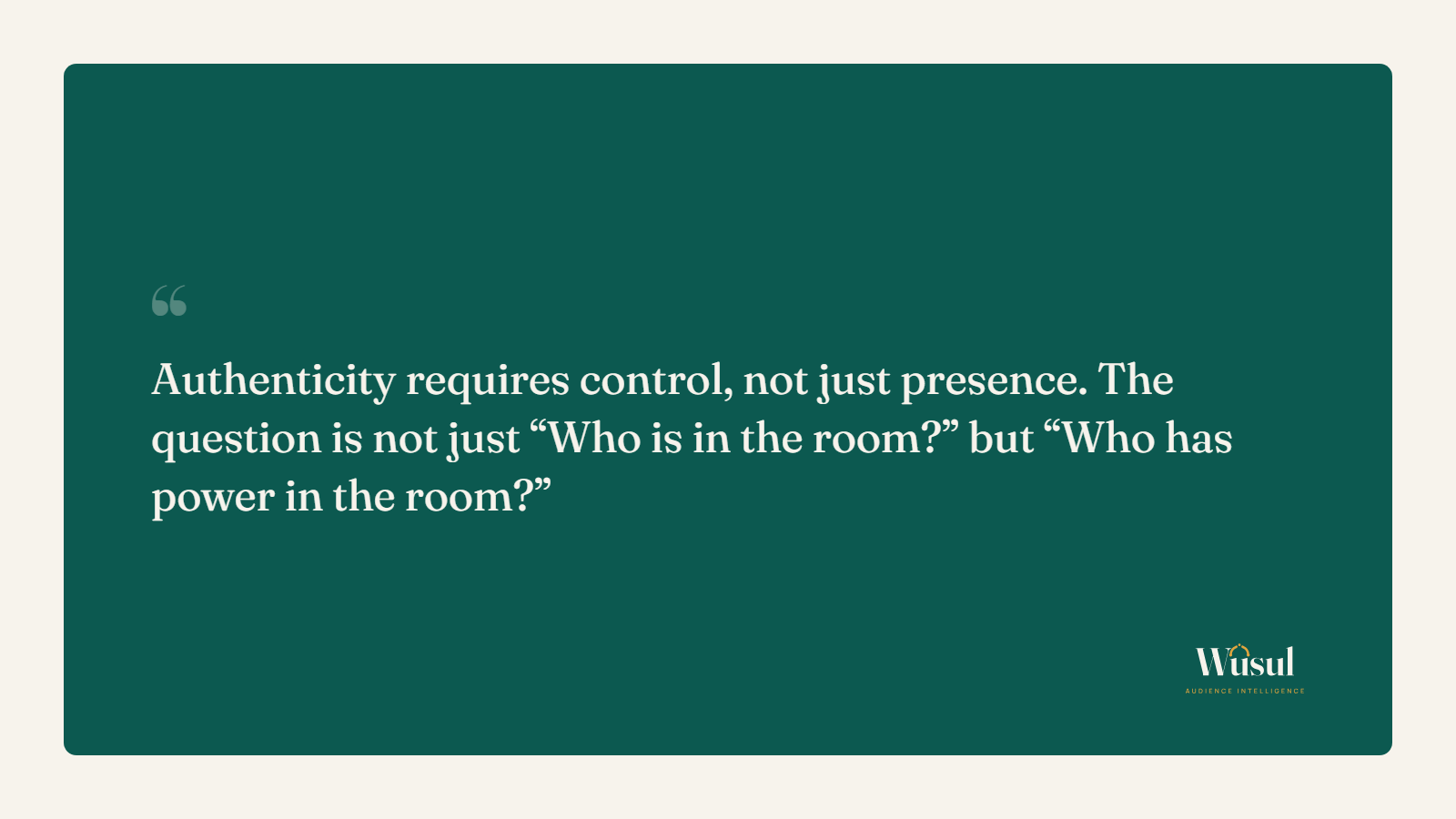
For cultural intelligence practitioners, the lesson is that authenticity requires control, not just presence. The question is not just "Who is in the room?" but "Who has power in the room?"
2. Representation is a Spectrum, not a Destination
Ms. Marvel is neither a perfect representation nor a complete failure. It is a step forward, a significant one; but it is also a reminder that representation is a process, not a destination. As one Marvel fan observed: "Kamala Khan is not some exotic woman from a Muslim country. That instantly sets her apart in the Marvel universe". But being "not exotic" is a low bar.
For organizations seeking to engage Muslim audiences, the implication is clear: visibility is important, but it must be accompanied by depth, complexity, and the willingness to tell stories that are not always comfortable or marketable.
3. The Small Screen Paradox
The Public Books analysis highlights a critical paradox: television, with its smaller budgets and more flexible storytelling, is "a much more hospitable medium for the marginalized narratives to thrive" . Hollywood blockbusters, by contrast, flatten differences for mass consumption.
For cultural intelligence practitioners, this suggests that medium matters. Streaming platforms may be more amenable to authentic representation than mainstream cinema. Organizations seeking to tell their own stories should consider where their narratives will be most respected.
Conclusion: it’s a bridge, not a destination
Ms. Marvel is not the final word on Muslim representation. It is a bridge; a step from invisibility to visibility, from stereotype to complexity. But as Riz Ahmed warned, visibility alone is not enough. The challenge is to move from representation to "worldmaking", to create narratives that do not just include Muslims but reimagine the worlds they inhabit.
The show's legacy will depend not on whether it pleased Western audiences or Muslim critics, but on whether it opened doors for more complex, diverse, and challenging stories. As the creators of Ms. Marvel knew when they adapted the comic from the page to the screen, the first Muslim superhero was never going to be perfect. But it was always going to be important.
At Wusul, we believe that authentic engagement with Muslim communities requires understanding both the power and the limits of representation. Ms. Marvel is a case study in what visibility can achieve; and what it cannot. By examining its successes and failures, we can build a more nuanced understanding of cultural intelligence in practice.