When people hear performance marketing, they often think of e-commerce brands selling products through Meta or Google ads. But performance marketing has become just as important for charities, humanitarian organizations, and nonprofit organizations looking to raise funds, recruit supporters, and maximize the impact of every marketing dollar.
Unlike traditional awareness campaigns, performance marketing focuses on measurable results. Every campaign is optimized toward a specific goal; whether that's increasing online donations, acquiring recurring donors, generating Zakat contributions during Ramadan, or encouraging volunteers to sign up.
For charities operating in an increasingly competitive and noisy digital landscape, performance marketing offers a smarter, more accountable approach to fundraising.
What is performance marketing?
Performance marketing is a digital marketing strategy where success is measured by specific actions rather than simply exposure.
Instead of focusing only on impressions or reach, charities track metrics such as:
- Online donations
- Monthly donor sign-ups
- Zakat & Sadaqah donations
- Emergency appeal donations
- Volunteer registrations
- Email newsletter subscriptions
- Petition signatures
- Event registrations
Every advertising decision is backed by data, allowing organizations to continually improve campaign performance.
Why performance marketing matters for charities
Nonprofits operate with limited resources.
Whether funded by grants, donations, or institutional support, marketing budgets need to generate real impact.
Performance marketing helps charities:
- Reach people who are most likely to donate.
- Spend advertising budgets more efficiently.
- Measure return on investment (ROI).
- Optimize campaigns in real time.
- Build long-term donor relationships.
- Scale successful fundraising initiatives.
Instead of guessing what works, charities rely on measurable evidence.
How performance marketing works?
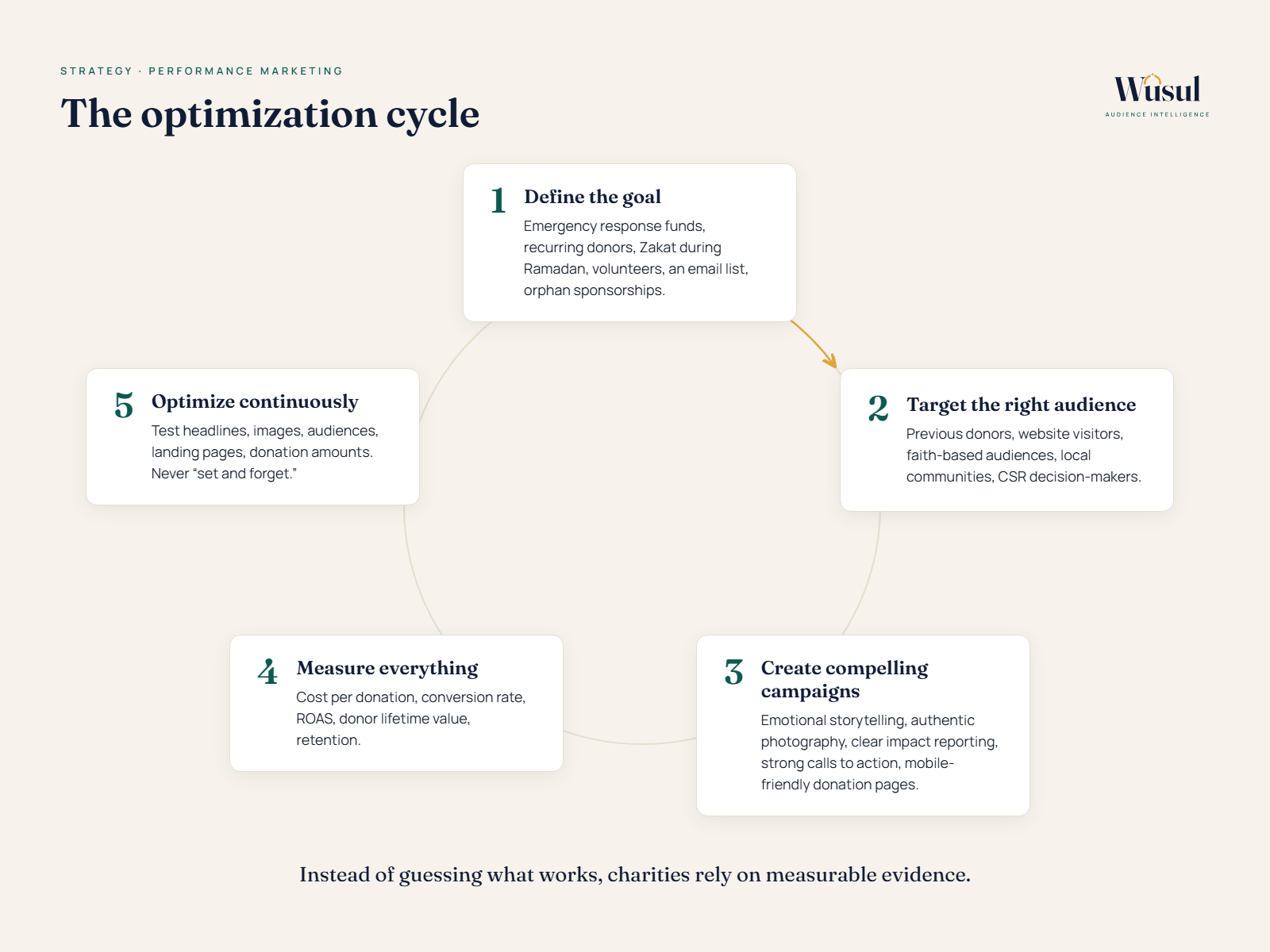
A successful performance marketing campaign follows a continuous optimization cycle.
1. Define the goal
Every campaign starts with a clear objective.
Examples include:
- Raise funds for an emergency response
- Increase recurring monthly donors
- Collect Zakat during Ramadan
- Recruit volunteers
- Build an email list
- Promote orphan sponsorships
Without a defined goal, measuring success becomes difficult.
2. Target the right audience
Digital advertising platforms allow charities to reach highly relevant audiences based on interests, demographics, behaviors, and previous engagement.
For example:
- Previous donors
- Website visitors
- People interested in humanitarian causes
- Faith-based audiences
- Local communities
- Corporate decision-makers for CSR partnerships
This ensures campaigns are shown to people most likely to take action.
3. Create compelling campaigns
Performance marketing isn't just about advertising.
Creative assets play a huge role in campaign success.
Effective charity campaigns often include:
- Emotional storytelling
- Authentic photography
- Short videos
- Clear impact statistics
- Strong calls to action
- Mobile-friendly donation pages
The goal is to remove friction and make donating simple and meaningful.
4. Measure everything
One of performance marketing's biggest advantages is transparency.
Organizations can track:
- Cost per donation
- Conversion rate
- Donation value
- Return on ad spend (ROAS)
- Cost per lead
- Donor lifetime value
- Recurring donor retention
These insights help marketers continuously improve campaign performance.
5. Optimize continuously
Performance marketing is never "set and forget."
Campaigns are constantly tested by changing:
- Headlines
- Descriptions
- Images
- Videos
- Audience targeting
- Landing pages
- Donation amounts
- Call-to-action buttons
Small improvements often lead to significantly higher donation rates over time.
Charity digital marketing channels: paid search, social and SEO
Successful nonprofits usually combine multiple digital channels.
- Google ads
Google Search Ads help charities reach people actively searching for opportunities to donate or support a cause.
For example:
- Donate to Gaza
- Sponsor an orphan
- Pay Zakat online
- Charity near me
Many eligible nonprofits can also benefit from the Google Ad Grants program, which provides free advertising credits for search campaigns.
- Social media advertising
Platforms like Facebook, Instagram, TikTok, and LinkedIn help charities reach new audiences while engaging existing supporters.
Social advertising works particularly well for:
- Emergency appeals
- Ramadan fundraising
- Disaster relief
- Storytelling campaigns
- Community awareness
Search Engine Optimization (SEO)
SEO complements paid advertising by helping charities appear organically in search results.
Educational content, donation guides, impact stories, and frequently asked questions all contribute to long-term website traffic.
Unlike paid ads, organic traffic continues generating visitors long after content is published.
- Email marketing
Email remains one of the highest-performing fundraising channels.
Performance marketing helps grow high-quality email lists, allowing charities to nurture supporters through:
- Campaign updates
- Impact stories
- Appeals
- Newsletters
- Volunteer opportunities
A well-maintained email list often delivers strong long-term fundraising results.
- Remarketing campaigns
Not everyone donates during their first visit.
Remarketing allows charities to reconnect with people who previously visited their website but didn't complete a donation.
These reminders often improve conversion rates significantly.
Key metrics every charity should track
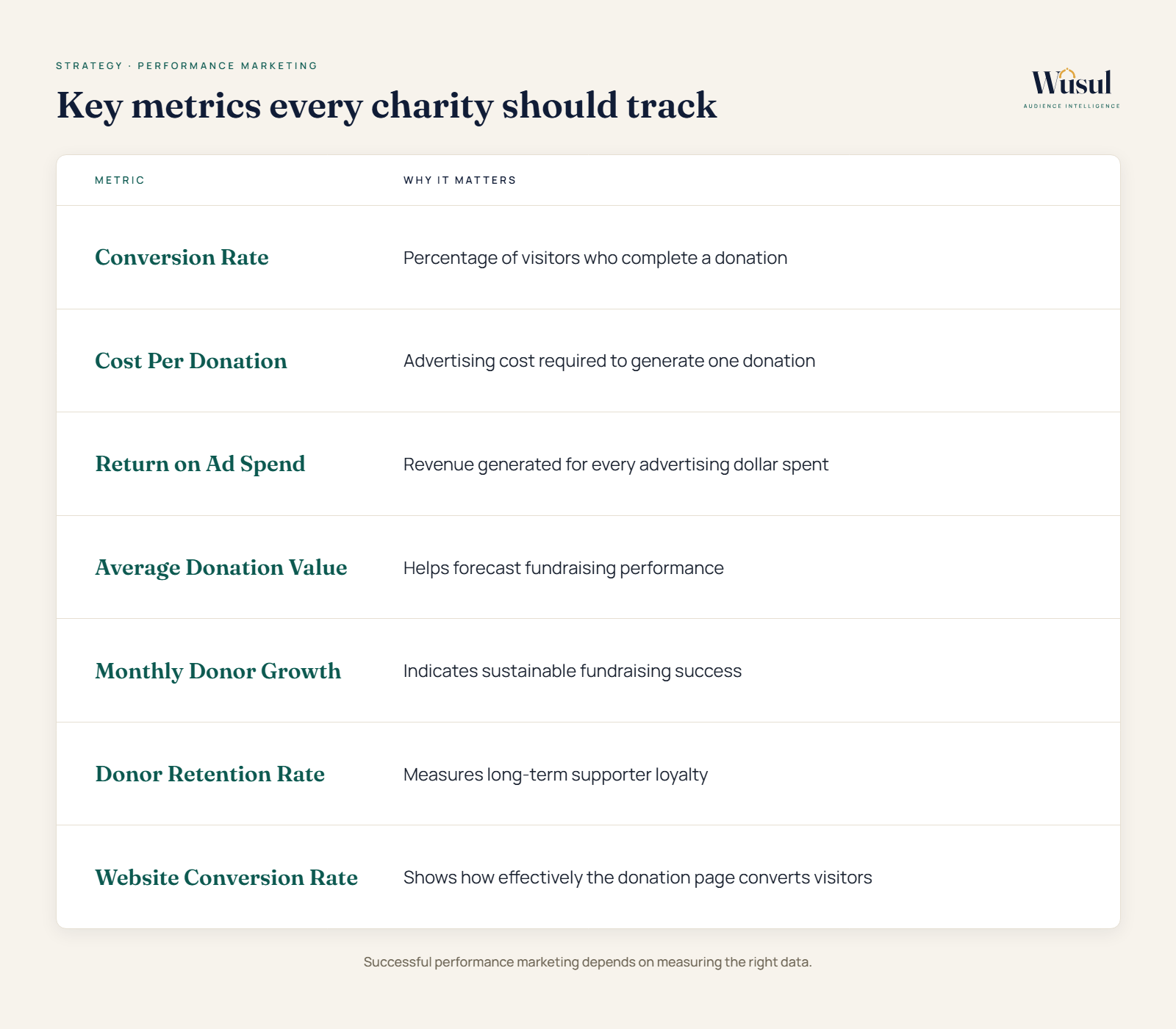
Successful performance marketing depends on measuring the right data.
Some of the most important KPIs include:
Common mistakes charities make
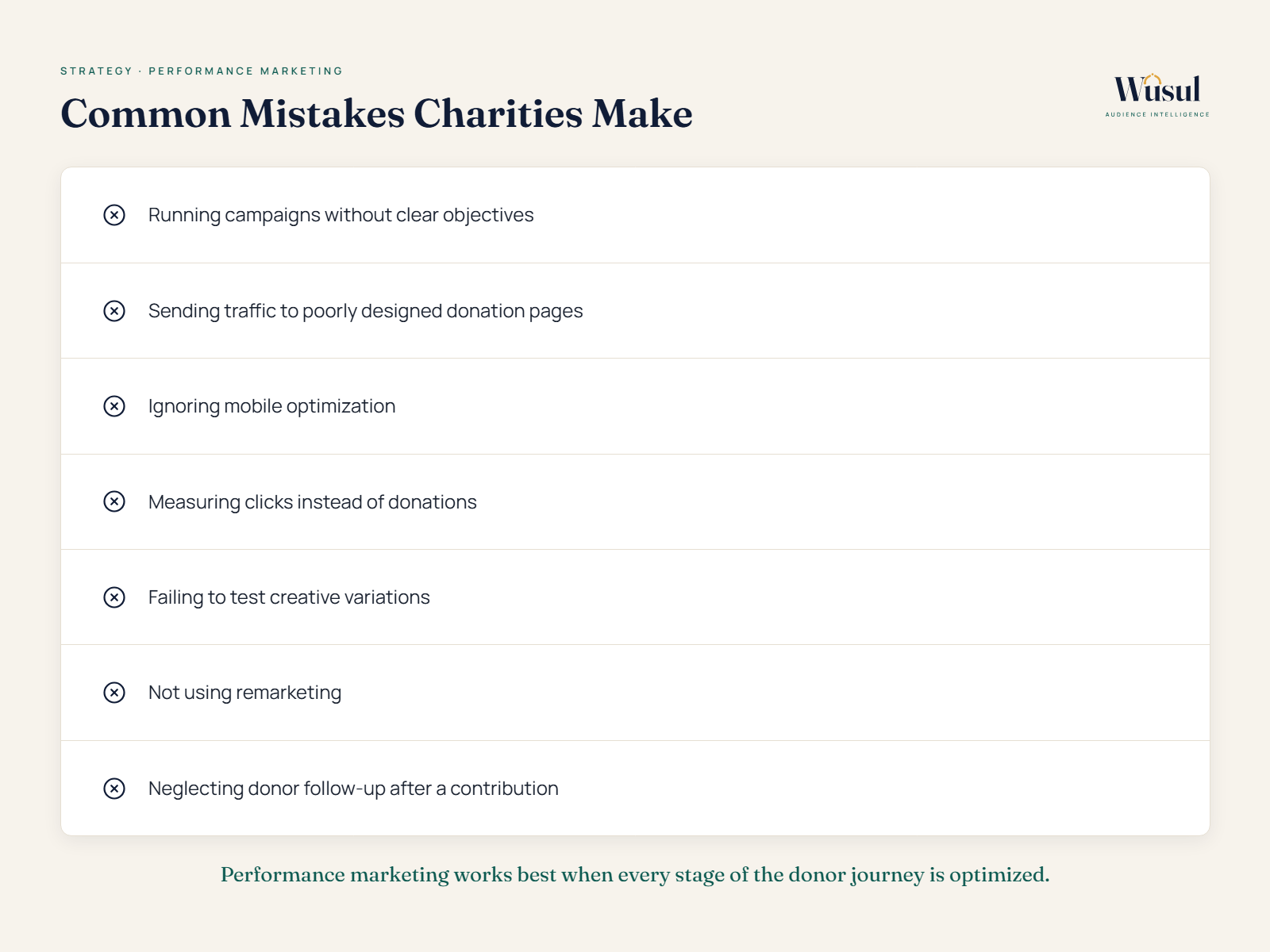
Even experienced organizations can struggle with performance marketing.
Some of the most common mistakes include:
- Running campaigns without clear objectives
- Sending traffic to poorly designed donation pages
- Ignoring mobile optimization
- Measuring clicks instead of donations
- Failing to test creative variations
- Not using remarketing
- Neglecting donor follow-up after a contribution
Performance marketing works best when every stage of the donor journey is optimized.
It's more than donations
While fundraising is often the primary goal, performance marketing also supports broader organizational growth.
Charities can use it to:
- Build awareness around humanitarian crises
- Recruit volunteers
- Promote advocacy campaigns
- Increase newsletter subscribers
- Generate event registrations
- Encourage recurring giving
- Strengthen long-term donor relationships
Every action contributes to a stronger, more sustainable nonprofit.
How Wusul approaches performance marketing for charities?
At Wusul, we believe performance marketing for Islamic charities requires a unique combination of cultural intelligence and data-driven execution. Generic campaigns that work for secular charities often fail with Muslim donors because they miss cultural nuance; the importance of Ramadan timing, Zakat-specific messaging, and community-centered language.
Our approach includes:
- Donor intelligence audits to understand what drives giving behavior.
- Multi-channel targeting that meets donors where they are (WhatsApp, email, social, and search).
- Post-campaign analysis to measure not just donations but donor lifetime value.
Performance marketing allows charities to make informed, data-driven decisions that maximize both fundraising and impact.
Rather than relying on assumptions, organizations can measure exactly what's working, refine their campaigns, and ensure every marketing investment contributes to their mission.