Artificial intelligence agents are beginning to transform how nonprofits operate; from donor engagement to grant writing to operational efficiency. For Islamic charities and organizations serving Muslim communities, these tools present a distinct set of opportunities and challenges. In short: what AI for nonprofits looks like when the nonprofit is an Islamic charity.
What makes AI agents different from chatbots
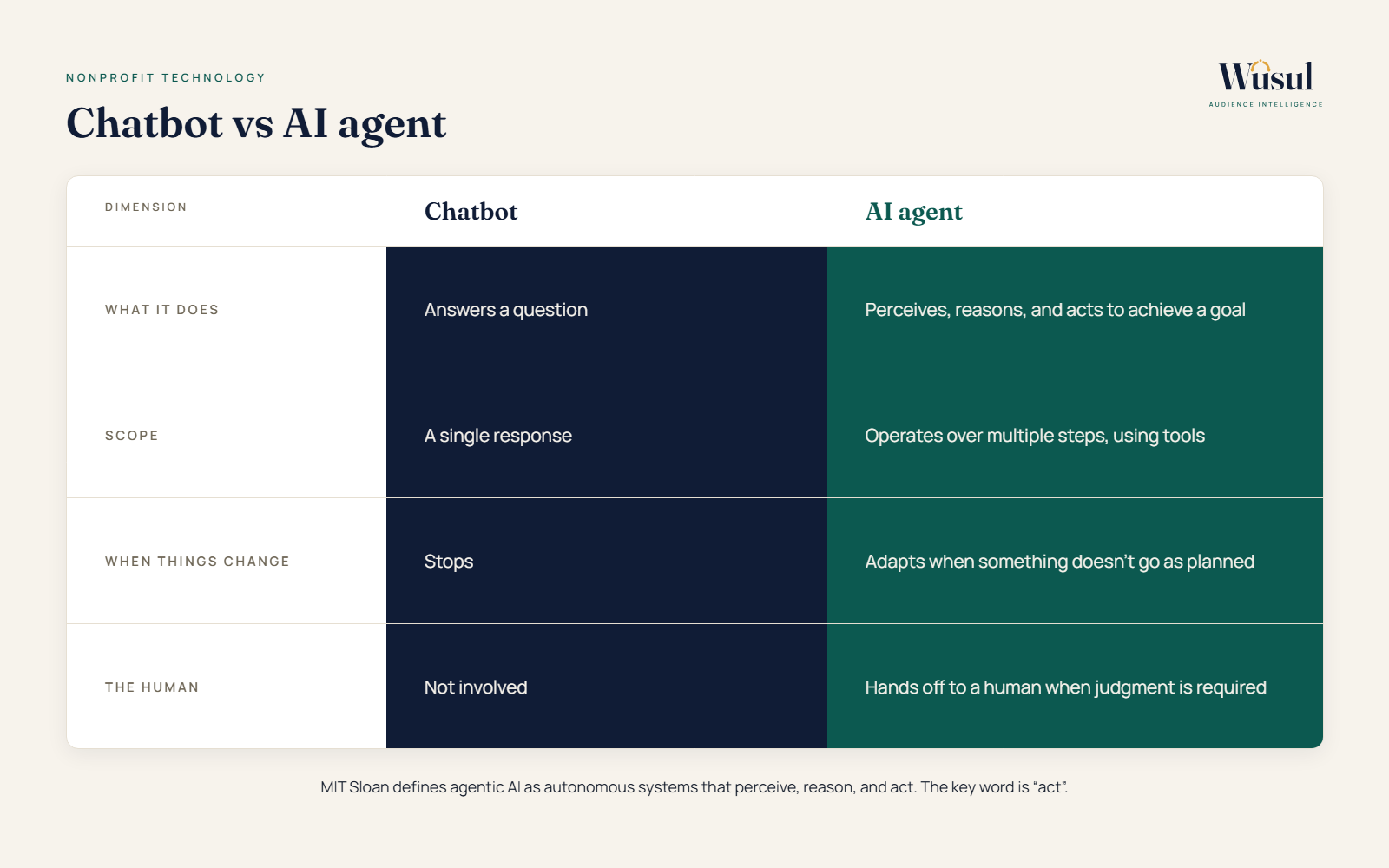
Most people first experience AI through a chatbot: ask a question, get an answer. AI agents go further. Researchers at MIT Sloan define agentic AI as "autonomous software systems that perceive, reason, and act in digital environments to achieve goals." The key word is "act" .
A chatbot answers a question about your organization's mission. An AI agent can search your donor database, identify at-risk supporters, draft personalized outreach, and queue it for your review, all from a single prompt. The defining characteristics include the ability to use tools, operate over multiple steps, adapt when something doesn't go as planned, and hand off to a human when judgment is required.
AI for nonprofits today: the agentic landscape
Blackbaud, a leader in social impact technology, has launched the Development Agent, positioned as the first "Agent for Good" embedded directly in a dedicated social impact platform . The agent identifies, cultivates, and engages donors with timely, individualized, and brand-aligned outreach, operating autonomously but with human oversight.
Paul Goldstein, Senior Director and Head of AI Growth at Blackbaud, highlights a specific opportunity: "Mid-tier donors are a high-potential group because these individuals are often affluent enough to give more, but don't necessarily have a deep enough personal affinity with the organization to inspire them to do so. The challenge is, fundraising teams rarely have the capacity to personally steward or engage this large donor segment" . The Development Agent addresses this capacity gap.
AI agents and grant writing and research
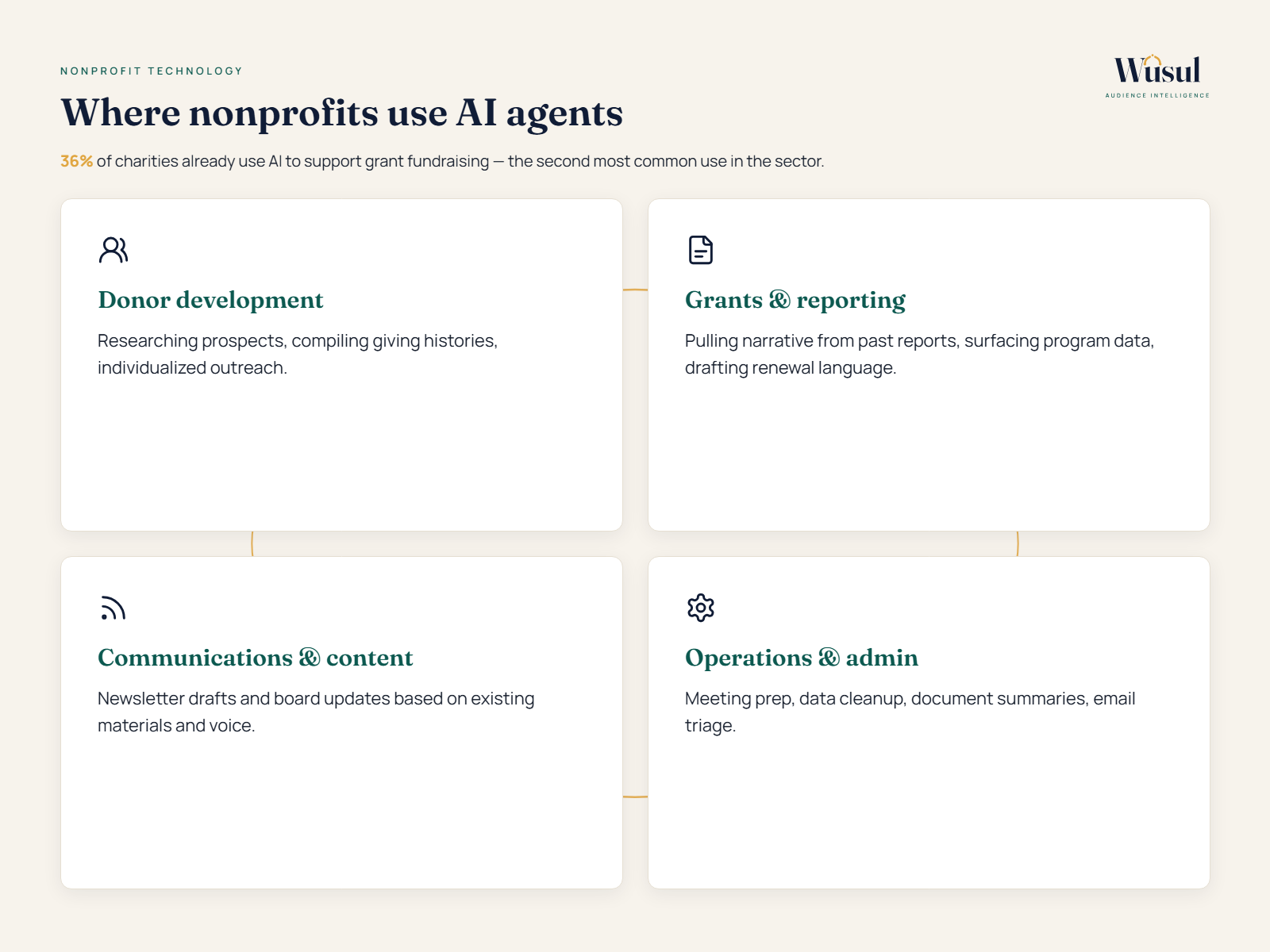
A 2025 Charity Digital Skills report found that 36% of charities are using AI to support grant fundraising, making it the second most common use of AI in the sector . Agentic AI tools can streamline grant research, filtering relevant opportunities based on an organization's specific needs. They can also help review applications against funder criteria, identifying gaps before submission .
However, experts caution that AI-generated applications should be a first draft, not the final version. "Generative AI has made grant funding only more competitive... Applications that have obviously been written by AI may be more easily disqualified. It is the human element that makes an application meaningful and authentic" .
Membership and community engagement
Momentive Software has launched Agentic Workers specifically for nonprofits and associations, including Membership Assistant and Community Assistant. Membership Assistant manages the member lifecycle, from onboarding through renewal and win-back campaigns, identifying signs of disengagement before members leave. Community Assistant applies an organization's own moderation standards to online community spaces, quarantining flagged content rather than deleting it outright.
Staff can review and sign off on agent actions, and all decisions are logged in a timestamped audit trail, giving boards and leadership visibility.
Administrative workflow automation
According to a Blackbaud analysis, nonprofits are using AI agents across several key areas:
- Donor development and fundraising: Researching prospects, compiling giving histories, and conducting individualized outreach
- Grants and reporting: Pulling narrative elements from past reports, surfacing program data, and drafting initial language for renewal applications
- Communications and content: Generating newsletter drafts and board updates based on existing materials and voice
- Operations and administration: Meeting prep, data cleanup, document summaries, email triage
AI for Zakat management
Zakat, one of the pillars of Islam, mandates an annual charitable contribution of 2.5% of a Muslim's wealth. Traditional methods of Zakat collection and distribution often face challenges in efficiency, transparency, and impact assessment.
A recent study presented at NeurIPS 2025 introduced a novel approach: using Large Language Model (LLM)-based Agent-Based Modeling to simulate Zakat policy dynamics. The research proposes a multi-agent system where LLM-powered agents represent diverse economic actors within an Islamic finance ecosystem, including Zakat payers, beneficiaries, and regulatory bodies . Preliminary results suggest this framework can provide more granular and realistic simulation of Zakat dynamics compared to traditional econometric models.
Another study published in the Review of Islamic Social Finance and Entrepreneurship proposes a conceptual model of AI-enabled zakat management, identifying technological readiness, organizational capabilities, environmental pressures, and institutional legitimacy as critical determinants of successful AI adoption in zakat governance. The research positions AI not as a neutral technology but as a socio-technical system that must align with the normative objectives of zakat and Islamic ethics, guided by Maqasid al-Sharia as an ethical anchor.
Case study: the human-first ethical framework
The Spanish nonprofit Civio offers a compelling model for ethically integrating AI into donor operations. The organization built TobIAs, a Slack-based AI agent designed to serve as a single interface for donor management. Crucially, they made a foundational decision: donor data would never leave their office.
The team purchased a local Mac Studio and committed to running everything on open-source models. This decision was driven by both GDPR compliance and a deeper ethical commitment, donors trust them with personal information, and they felt uneasy sending that data to cloud-based AI services.
The project revealed a surprising lesson: "It's how hard it is to document what your organization actually does. To turn 14 years of informal knowledge into something structured enough for a machine to follow. That process, messy as it is, is already making us better organized" .
This model is particularly relevant for Islamic charities, where donor trust is paramount and data sensitivity is heightened.
Where AI agents don't belong
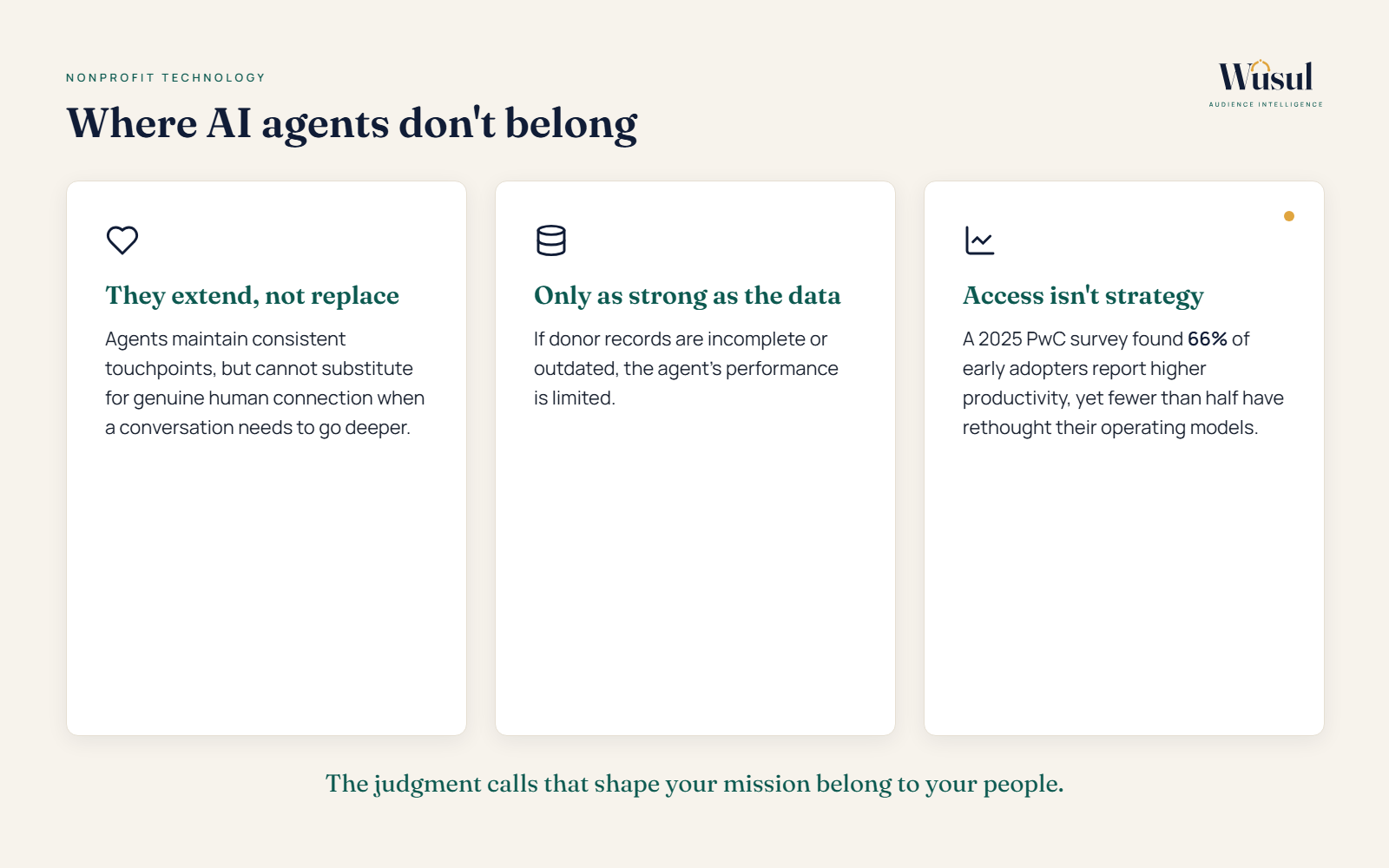
AI agents are not human decision-makers. The judgment calls that shape your mission and donor relationships belong to your people.
Key limitations to remember:
- They extend relationships, they don't replace them. Agents can maintain consistent, personalized touchpoints, but they cannot substitute for genuine human connection when a conversation needs to go deeper.
- They are only as strong as the data behind them. If your donor records are incomplete or outdated, your agent's performance will be limited .
- Access is not the same as a strategy. A 2025 PwC survey found that while 66% of early AI agent adopters report increased productivity, fewer than half have rethought their operating models .
AI for charities: practical implications for Islamic organisations
For organizations serving Muslim communities, several considerations emerge from this landscape:
1. Data privacy is paramount. The Civio model, running AI locally rather than sending data to cloud services, offers a template for organizations that must protect sensitive donor information.
2. Human oversight is non-negotiable. Blackbaud's approach, treating the agent as a team member that operates under human supervision, reflects best practice. Fundraising is built on trust, and trust cannot be delegated to AI .
3. Transparency builds trust. Vered Siegel of Seagull Partners notes: "Information is no longer the scarce resource. Judgment is" . Being clear about when and how AI is used reinforces donor confidence.
4. Islamic values can guide AI governance. As the Review of Islamic Social Finance study argues, Maqasid al-Sharia can serve as an ethical anchor for AI adoption in Islamic philanthropy . This means positioning AI to support distributive justice, wealth protection, and social welfare; not just technical efficiency.
AI agents are tools, not solutions
AI agents offer significant potential for Islamic charities and values-driven organizations to expand their capacity, deepen donor engagement, and streamline operations. But they are tools, not solutions. Their effectiveness depends on the quality of the data behind them, the clarity of the governance surrounding them, and the judgment of the humans directing them.
For Wusul, the emergence of agentic AI in Islamic philanthropy represents both a challenge and an opportunity. The challenge is ensuring that AI adoption is guided by the cultural intelligence that makes organizations truly understand their communities. The opportunity is using these tools to expand capacity, deepen relationships, and ultimately serve communities more effectively.