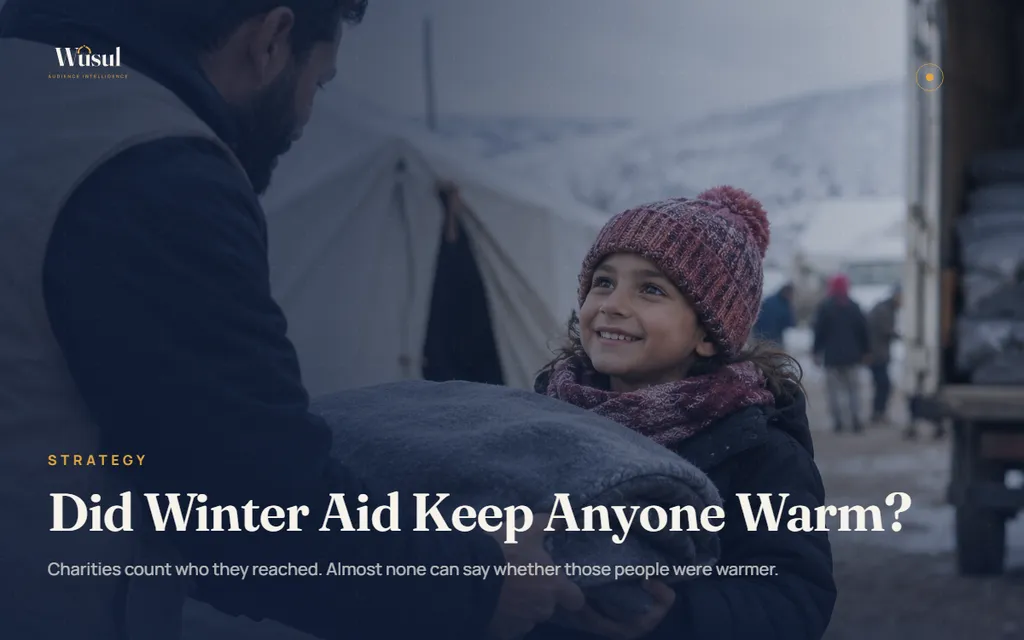
Charities report how many people received winter help. Almost none report whether those people were warmer. This article, the ninth in Wusul's winter series, looks at the difference between reaching people and protecting them, and at one of the few rigorous tests of winter aid in the region, which found something its designers did not expect.
In the winter of 2013-14, the UN and its partners in Lebanon drew a line on the map at 500 metres above sea level. Poor Syrian refugee families living in communities above it received winter cash on an ATM card: $147 in November and $107 a month until March, intended for heating and warm clothing. Equally poor families just below the line received none. A senior UNHCR official later explained that 500 was simply a round number chosen to target colder places within the budget.
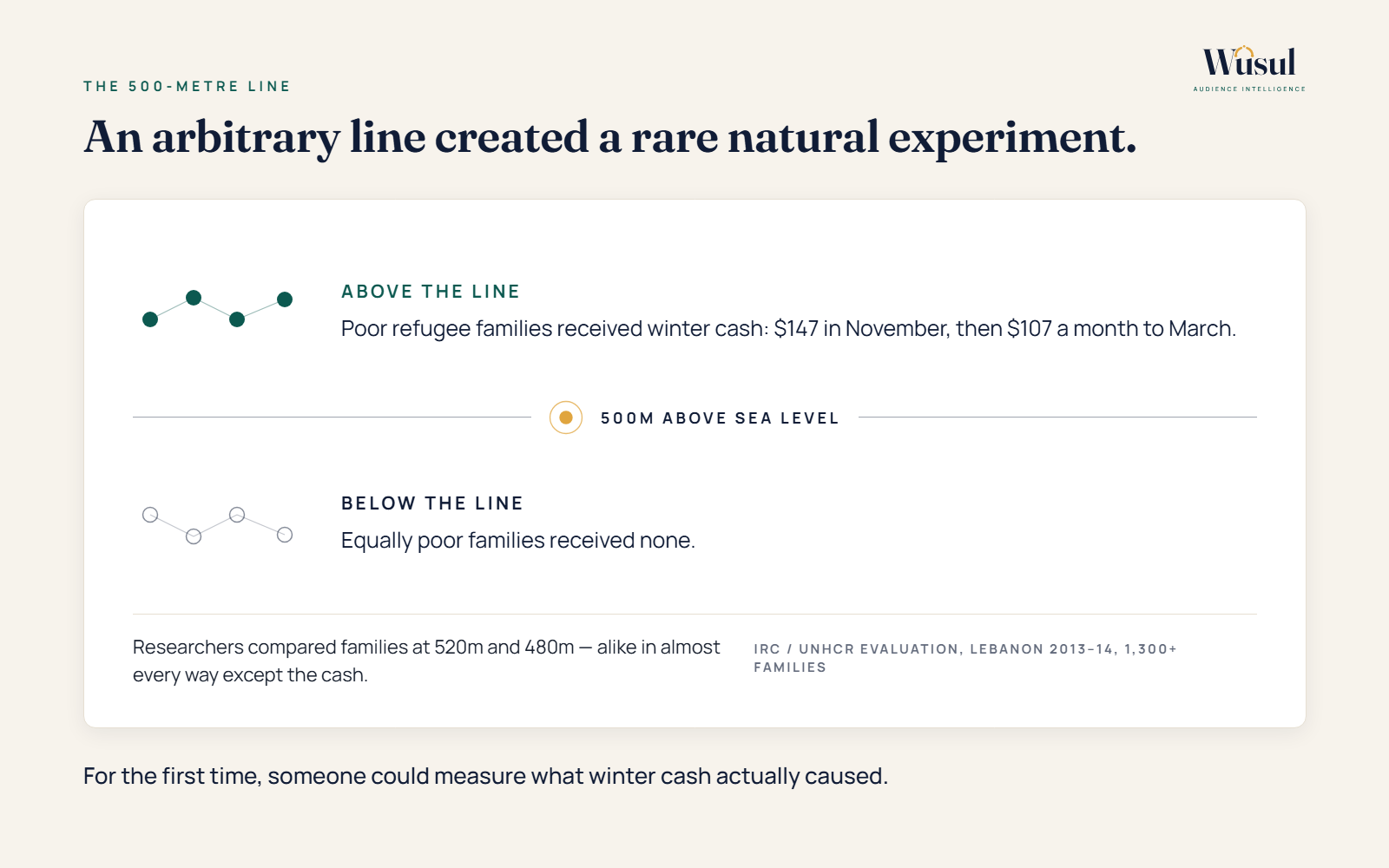
That arbitrary line created something rare in humanitarian work: a natural experiment. Families at 520 metres and at 480 metres were alike in almost every way except the cash. Researchers working with the International Rescue Committee surveyed more than 1,300 of them and, for the first time, could measure what winter cash actually caused.
Their findings, discussed below, did not quite match the programme's promise. That gap is the subject of this article. Most winter campaigns report how many people received help: 2,000 kits, 10,000 people. Very few can say whether those people were warmer. The Lebanese experiment is one of the few places where someone checked.
Who counts as reached?
Before asking whether people were kept warm, it is worth asking who is being counted. "Beneficiary" can mean someone registered, someone in a household that received a kit, someone present at a distribution, or someone who used what they received. Earlier articles in this series found the term stretched in several ways:
- Counted once, or many times? Human Appeal's 2024 annual report is unusually candid: in Gaza it cannot calculate the number of unique individuals reached, so it reports outputs and uses the highest single figure where people received help repeatedly, leaving out Ramadan hot meals to avoid double or triple counting. Most reports simply add up every contact.
- Counted in the same way across countries? Qatar Charity's 2023-24 winter campaign reached 4.5 million people in its Syrian response at about QAR 11 each, against about QAR 77 per person in Palestine, a gap that most likely reflects different ways of counting rather than different levels of help, as the Gulf article showed.
- Counting what, exactly? Human Appeal's own 2024 report described its UK Wrap Up campaign as over 29,000 coats, as over 41,000 coats and jumpers, and as 7,012 coats and 18,532 other items supporting 25,355 people.
None of this is dishonest. But it means the most visible number in a winter report, people reached, often mixes unique people, households, contacts and items. And even a perfectly counted number of people reached says nothing about whether they were protected.
Outputs, outcomes and impact
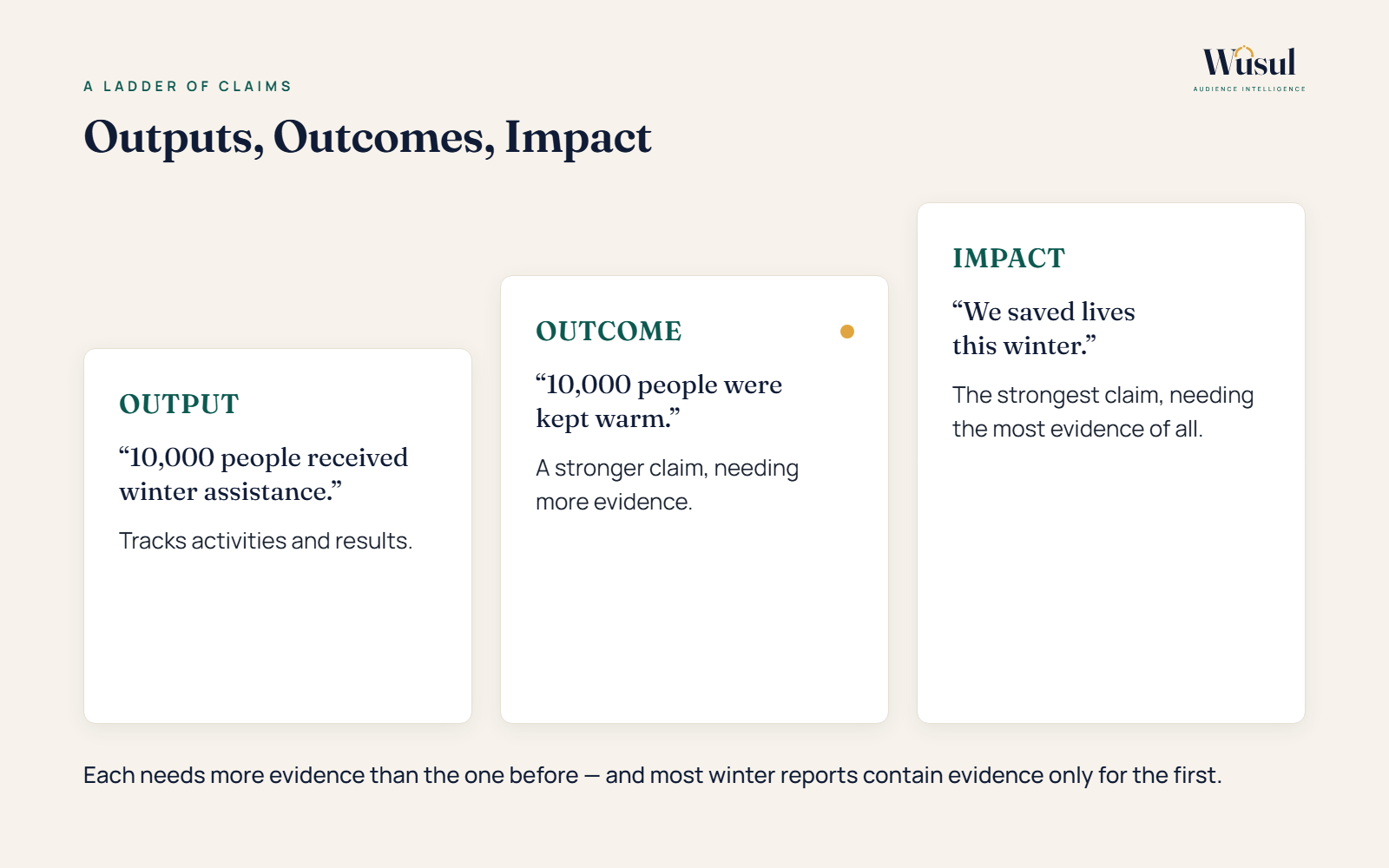
Humanitarian evaluation has long distinguished three levels of result. ALNAP's guide to evaluating humanitarian action, the sector's standard reference, describes monitoring as tracking activities, resources and results, usually at the level of outputs. For winter aid, the three levels look like this:
| Level | Question | Example | Evidence needed |
|---|---|---|---|
| Output | What was delivered? | 2,000 winter kits distributed | Distribution records |
| Outcome | What changed for recipients? | More households with enough bedding; less reliance on unsafe heating | Household surveys, observation |
| Impact | What difference did the aid itself make? | Less cold-related illness than would otherwise have occurred | A comparison group or other causal design |
The label matters less than the strength of the claim. "10,000 people received winter assistance" describes an output. "10,000 people were kept warm" claims an outcome. "We saved lives this winter" claims an impact. Each needs more evidence than the one before, and most winter reports contain evidence only for the first.
What the 500-metre experiment found
The 2013-14 programme gave $575 over the winter to 87,700 refugee families, with the stated objective of keeping people warm and dry. Because eligibility depended only on which side of 500 metres a family lived, researchers could use a regression discontinuity design, comparing families slightly above the line with similar families slightly below it, to estimate what the cash caused.
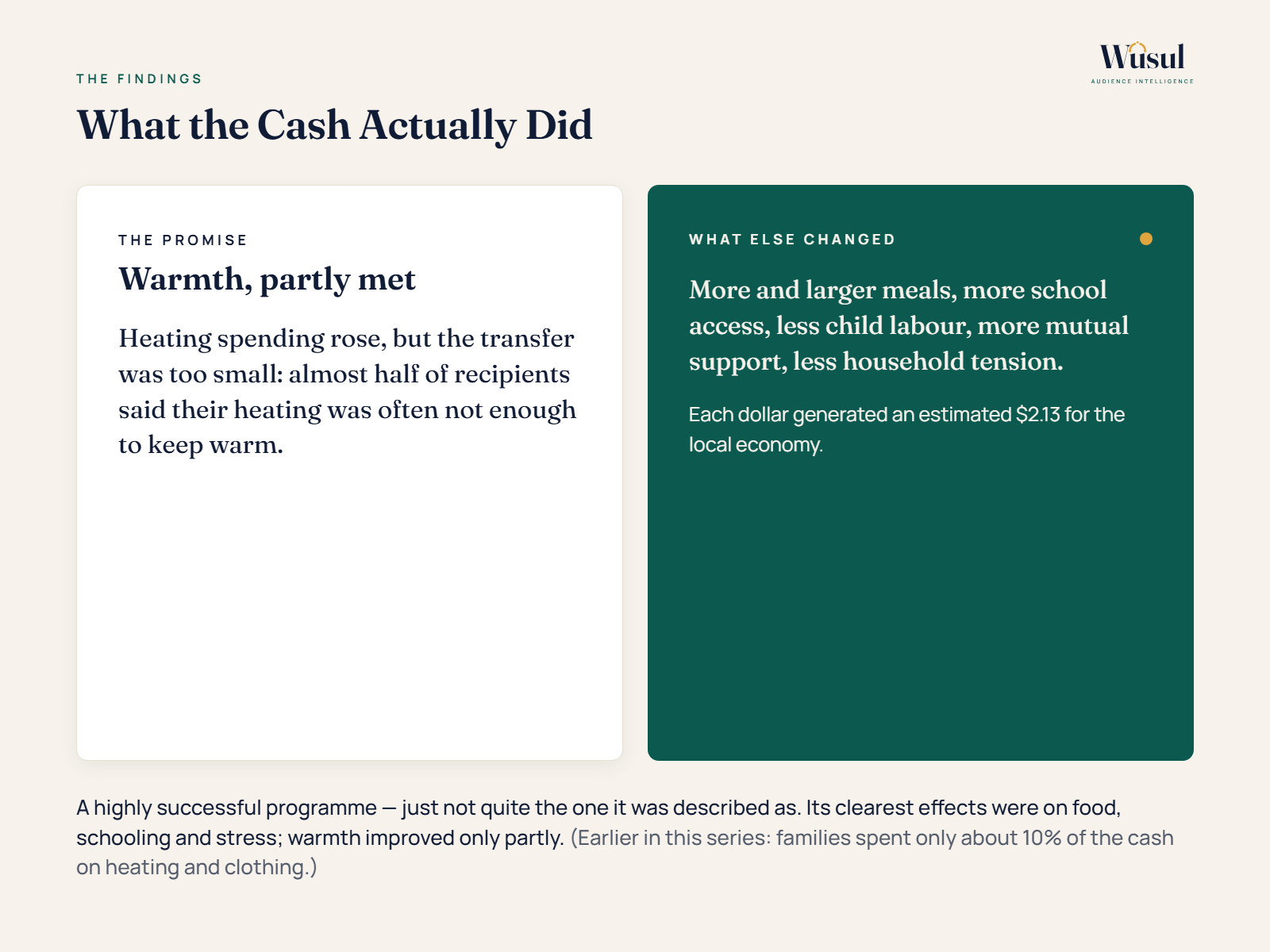
Did it keep people warm? Partly. The cash increased spending on heating supplies. But the evaluation concluded that the value of the assistance was too low to keep all beneficiaries warm throughout the winter, and that families used it only partly for that purpose. Almost half of beneficiaries said their heating supplies were often not enough to keep warm. Fuel was available in the markets; families simply had so little income that they had to spend much of the cash on other basic needs, above all food.
What else changed? A great deal. Meals were more frequent and larger. The cash increased access to school, reduced child labour, increased mutual support between refugees and their neighbours, and reduced tension within households. Families did not use it to repay debts or misuse it, it did not attract refugees to move to cash areas, and it did not push up local prices. Each dollar spent generated an estimated $2.13 for the Lebanese economy. A later study of the same programme found that, if anything, the transfers reduced violence against refugees. A second evaluation, of the 2014-15 winter programme, found similar patterns.
This is, by most measures, a highly successful programme. It is also not quite the programme it was described as. Its clearest effects were on food, schooling, child labour and family stress, while warmth improved only partly. The second article in this series reported that families spent only about 10% of the cash on heating fuel and clothing; the experiment shows what the rest of the money did.
Is warmth the right measure?
The Lebanese evidence raises an awkward question for winter fundraising. If families given "winter" cash use most of it to eat better, keep children in school and ease tension at home, was the programme a failure because they were still cold? Or was it a success that was measured, and marketed, against the wrong goal?
There are two honest answers, and they point in different directions.
If the promise is warmth, measure warmth. A donor who gave because an appeal said their money would keep a family warm is entitled to know whether it did. If almost half of recipients were often too cold, the programme fell short of its own objective, and the transfer was too small for what it was asked to do. A charity making that promise should either provide enough to meet it, or change the promise.
If the aim is wellbeing, measure what families chose. Cash lets a family decide that food or school matters more this month than an extra litre of fuel. That choice is information. A programme that improved meals, schooling and safety has done real good, even if a thermometer would not show it. The honest description is not "we kept 87,700 families warm" but "we gave 87,700 families winter cash; it improved food, schooling and safety, and partly met heating needs".
What neither answer allows is to report the second outcome under the first headline. And one caution applies to both: a later review of cash programmes for Syrian refugees in Lebanon found that some gains, such as reduced child labour and borrowing, faded once the transfers stopped. Seasonal help can relieve a winter. It rarely changes the circumstances that make the next winter dangerous.
What adequate warmth means
If charities are to report warmth, they need a definition of enough. The humanitarian sector's minimum standards, the Sphere Handbook, provide one. Sphere has long framed shelter in terms of thermal comfort, fresh air and protection from the climate, and its standard on clothing and bedding has asked that people have a combination of blankets, bedding or sleeping mats to provide thermal comfort, and that every woman, girl, man and boy has at least one full set of clothing in the correct size, appropriate to culture, season and climate. The 2018 edition keeps household items, including clothing and bedding, as one of seven shelter standards.
Two things follow. First, Sphere does not define warmth by counting blankets. It defines it as an outcome, people being warm, dry and protected, achieved through clothing, bedding, sleeping insulation, shelter and energy together. A kit that meets its packing list can still leave a family short of that outcome if the shelter leaks or there is no fuel.
Second, adequacy depends on the person and the climate. Clothing in the wrong size, or a blanket designed for a mild winter in a place of prolonged frost, does not meet the standard however carefully it was procured. Standard packages are useful for buying and checking goods. Compliance with a package specification is not the same as evidence that the package met a household's needs.
Measuring warmth: temperature, damp and harmful coping
Could charities simply measure temperature? Sometimes, but a thermometer captures less than it seems. How cold a person is depends on humidity, wind, damp bedding, insulation from the ground, clothing and their own health as well as air temperature. A mattress can sharply reduce the heat a family loses to a cold floor without changing the air temperature at all. Indoor readings are most useful for shelter repairs and heating support, and only alongside other measures.
The Lebanese evaluation shows a simpler approach that works: ask whether households had enough heating to stay warm, and compare those who received help with those who did not. Almost half of the families who received cash said their heating was often not enough. That single question told the programme more about its effect than any distribution total.
An even more revealing measure is what families do when they cannot stay warm. They burn rubbish or plastic, sleep crowded together, or cut back on food to buy fuel. Last winter in Afghanistan, UNHCR reported, many families burned cardboard and plastic because fuel was unaffordable. A fall in these practices after help arrives is a meaningful outcome, more meaningful than the number of blankets handed out, provided it is measured carefully and safely, since families may be reluctant to admit to them.
None of these measures proves cause on its own. A before-and-after comparison can be distorted by a milder winter, other aid or changes in the household. Stronger evidence needs a comparison, such as families who received help at different times, where that can be done without withholding essential protection. The 500-metre line in Lebanon was such a comparison, found rather than designed.
Satisfaction is not adequacy
The tool most agencies use after a winter distribution is post-distribution monitoring: a survey, interviews or visits to check whether items arrived, were of good quality, were used and were valued. UNHCR's guidance recommends it for non-food item distributions, and its 2023-24 monitoring of winter cash in Ukraine found that recipients valued the flexibility of cash for coping with severe cold and high energy costs.
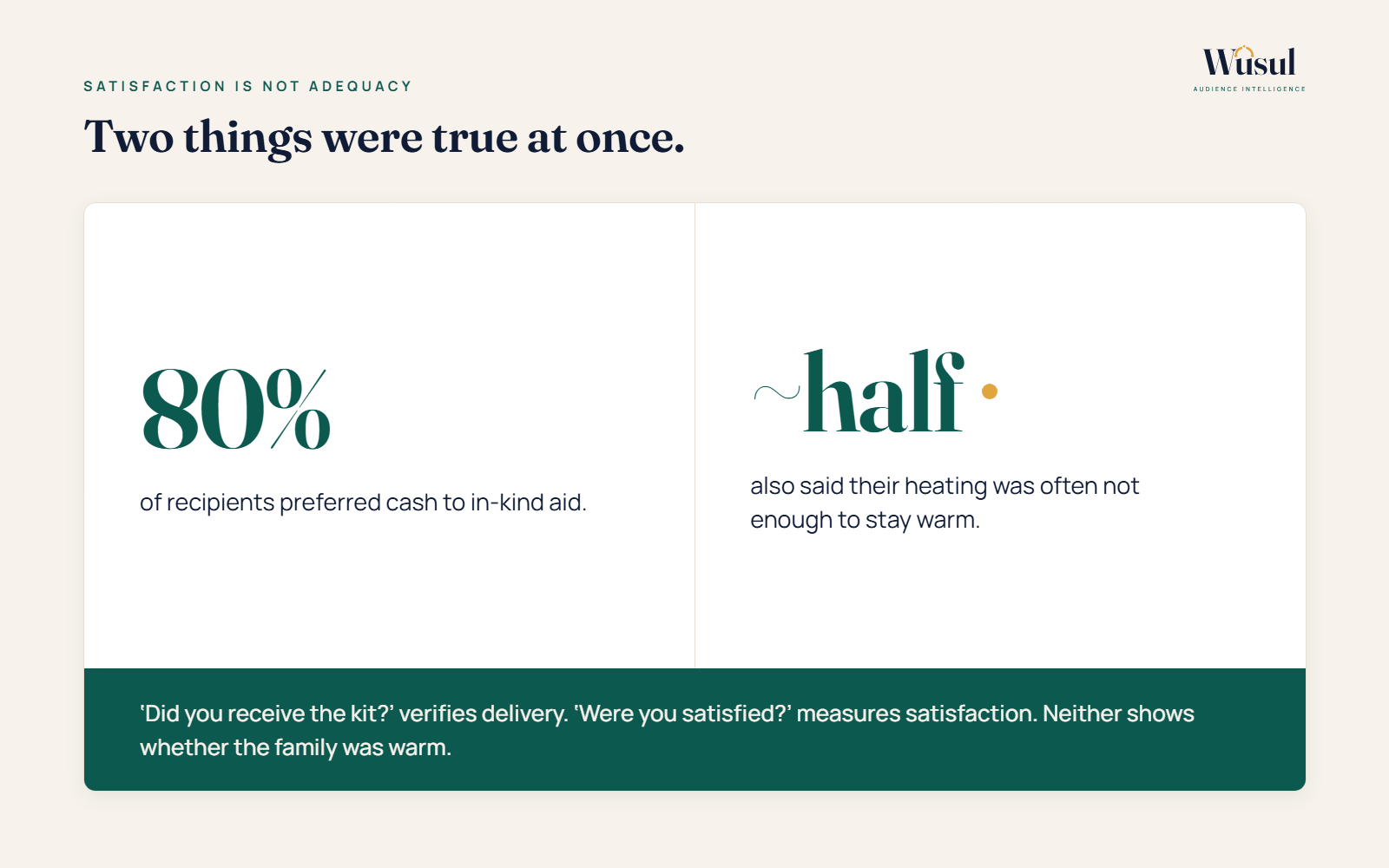
That is useful evidence, but much depends on the questions. "Did you receive the kit?" verifies delivery. "Were you satisfied?" measures satisfaction. Neither shows whether the family was warm. A household may be grateful for two blankets when it needs five, or say it is satisfied because aid is scarce and it fears losing future help. In Lebanon, 80% of recipients said they preferred cash to in-kind aid, while almost half also said their heating was often not enough. Both were true at once.
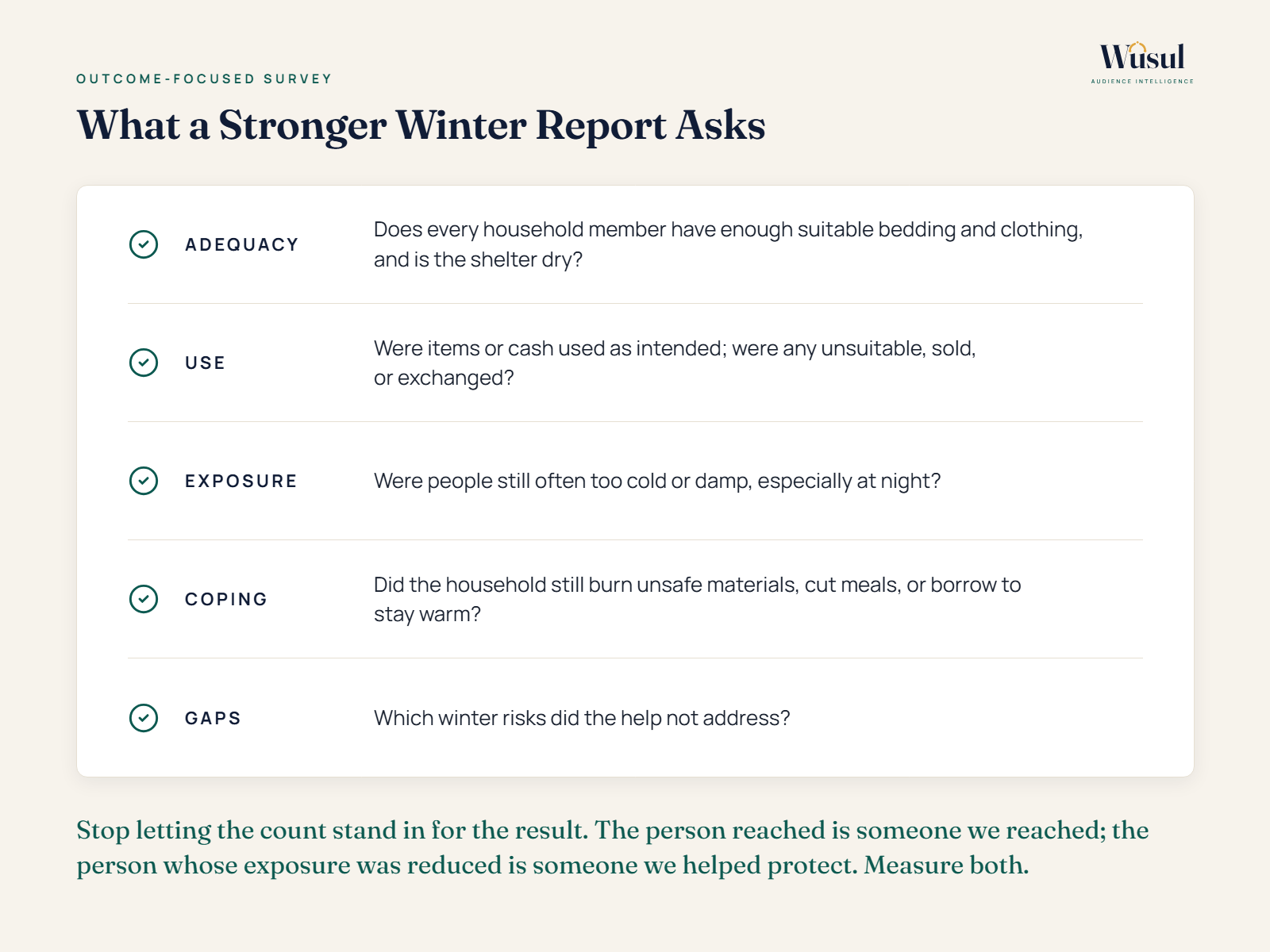
A winter survey that aims at outcomes would ask, adapted to the programme and place:
- Adequacy: does every household member have enough suitable bedding and clothing, and is the shelter dry?
- Use: were the items or cash used as intended, and were any unsuitable, sold or exchanged?
- Exposure: were people still often too cold or damp, especially at night?
- Coping: did the household still burn unsafe materials, cut meals or borrow to stay warm?
- Gaps: which winter risks did the help not address?
The answers will not all flatter the programme. That is the point. A charity that publishes "95% of households were satisfied with their winter kits" has said nothing about whether 95% were warm, and should not let readers think it has.
Lives saved: when the claim is real, and when it is not
Winter appeals often promise to save lives. Sometimes that is no exaggeration. In January 2019, UNICEF reported that at least eight children had died in a month in Syria's Rukban camp, most under four months old, the youngest one hour old, amid freezing temperatures and a lack of medical care. Weeks later, WHO reported that at least 29 children and newborns had died, mainly from hypothermia, travelling to or arriving at al-Hol camp. In December 2024, newborns and infants in Gaza were reported to have died of hypothermia, deaths UNICEF described as preventable.
In such places, shelter, blankets and heat are life-saving in the plainest sense. But "lives saved" is still a causal claim. It means that particular people survived who would otherwise have died, and that is very hard to show from distribution records. The number of kits delivered cannot be turned into a number of lives saved, and nor can the number of people reached. Even where deaths fall after a programme, weather, health care, displacement and other aid all play a part.
Charities can be accurate without being timid. It is fair to say help is intended to prevent life-threatening exposure where the context supports it. It is fair to report reduced risk, such as fewer families without shelter or heating. Claiming a specific number of lives saved needs evidence most winter programmes do not have. The same applies, more mildly, to "people kept warm": a powerful phrase, but as a reported result it needs a definition and data.
What a stronger winter report would say
No charity needs a natural experiment to improve its reporting. It needs to report a few things at each level, and keep them apart.
| Level | What to report | Example |
|---|---|---|
| Delivered | Kits, cash or repairs, verified | 2,000 kits to 2,000 verified households |
| Reached | Unique households and people, with the counting method | About 10,000 people, from recorded household size |
| On time | Share helped before the coldest weeks | 85% before mid-December |
| Adequate | Share meeting a defined minimum for bedding, clothing, shelter and heating | 60% after help, against 25% before |
| Experienced | Share often too cold, and harmful coping | Burning plastic fell from 40% to 15% of households surveyed |
| Still missing | The main needs left unmet | Damp shelters; fuel for February |
Example figures are illustrative.
A conventional report would say: "We distributed 2,000 winter kits, supporting an estimated 10,000 people." A stronger one would add what a sample survey found about adequacy, cold and coping, including what was not solved. The second report may sound less dramatic. It is far more believable.
The same evidence also improves the next winter. If families have blankets but remain cold because shelters are damp, the next programme should fix shelters. If clothing does not fit, vouchers may work better. If transfers no longer cover fuel, as in Lebanon, the amount needs to change. Measurement stops being a reporting chore and becomes a way to learn what actually helps.
Conclusion: reaching people is not the same as protecting them
A winter kit can be counted when it leaves the warehouse. A household can be counted when delivery is verified. A person can be counted as reached when the programme's definition is met. Warmth is not established at any of those moments. It depends on whether the help was enough, arrived in time and was used in conditions where it could make a difference.
When researchers in Lebanon had the rare chance to test winter aid properly, they found a programme that did a great deal of good and only partly did what it promised. Families ate better, sent children to school and lived with less tension; almost half were still often cold. That is not a failure to hide. It is exactly the kind of finding donors and charities need, and almost never get.
The lesson is not that charities should stop counting kits. It is that they should stop letting the count stand in for the result.
The person who received the blanket is someone we reached. The person whose exposure to cold was reduced is someone we helped protect. We should learn to measure both.
Frequently asked questions
Does "people reached" mean people kept warm?
No. People reached describes who received help. Whether they were kept warm depends on whether the help was enough, timely and used in adequate shelter, which needs separate evidence.
Has winter aid ever been rigorously evaluated?
Yes. In Lebanon in 2013-14, winter cash was given only to refugees living above 500 metres, which let researchers compare similar families on either side of the line. The cash increased heating spending, food, schooling and family wellbeing, but almost half of recipients still often lacked enough heating to stay warm.
Why didn't families spend winter cash on heating?
They did, partly. But their incomes were so low that much of the cash went on food and other basic needs. The transfer was too small to cover all of them.
What does Sphere say about winter protection?
Sphere's minimum standards describe warmth as an outcome, people being warm, dry and protected, achieved through suitable clothing, bedding, sleeping insulation, shelter and energy, rather than a fixed number of items.
Can charities say their winter aid saves lives?
They can say it is intended to prevent life-threatening exposure where that is true, and cold has killed children in Syrian camps and in Gaza. Claiming a specific number of lives saved requires much stronger evidence than distribution records.
What should a good winter impact report include?
What was delivered and to how many unique people, whether help arrived in time, whether households met a defined minimum of protection, whether they were still often cold or using harmful coping, and what needs remained.
Wusul Insight: Winter reports count what was delivered; donors are told people were kept warm. When winter cash in Lebanon was rigorously tested, it improved food, schooling and family life and only partly met heating needs. Charities that report adequacy, cold and coping alongside distribution totals, including what remained unsolved, will tell donors something far more useful than how many kits left the warehouse.
Research note*: this article draws on published evaluations, humanitarian standards, monitoring guidance and UN reports. It does not present an original evaluation. Findings from the Lebanon evaluation apply to that programme and period. Example figures in the reporting table are illustrative.