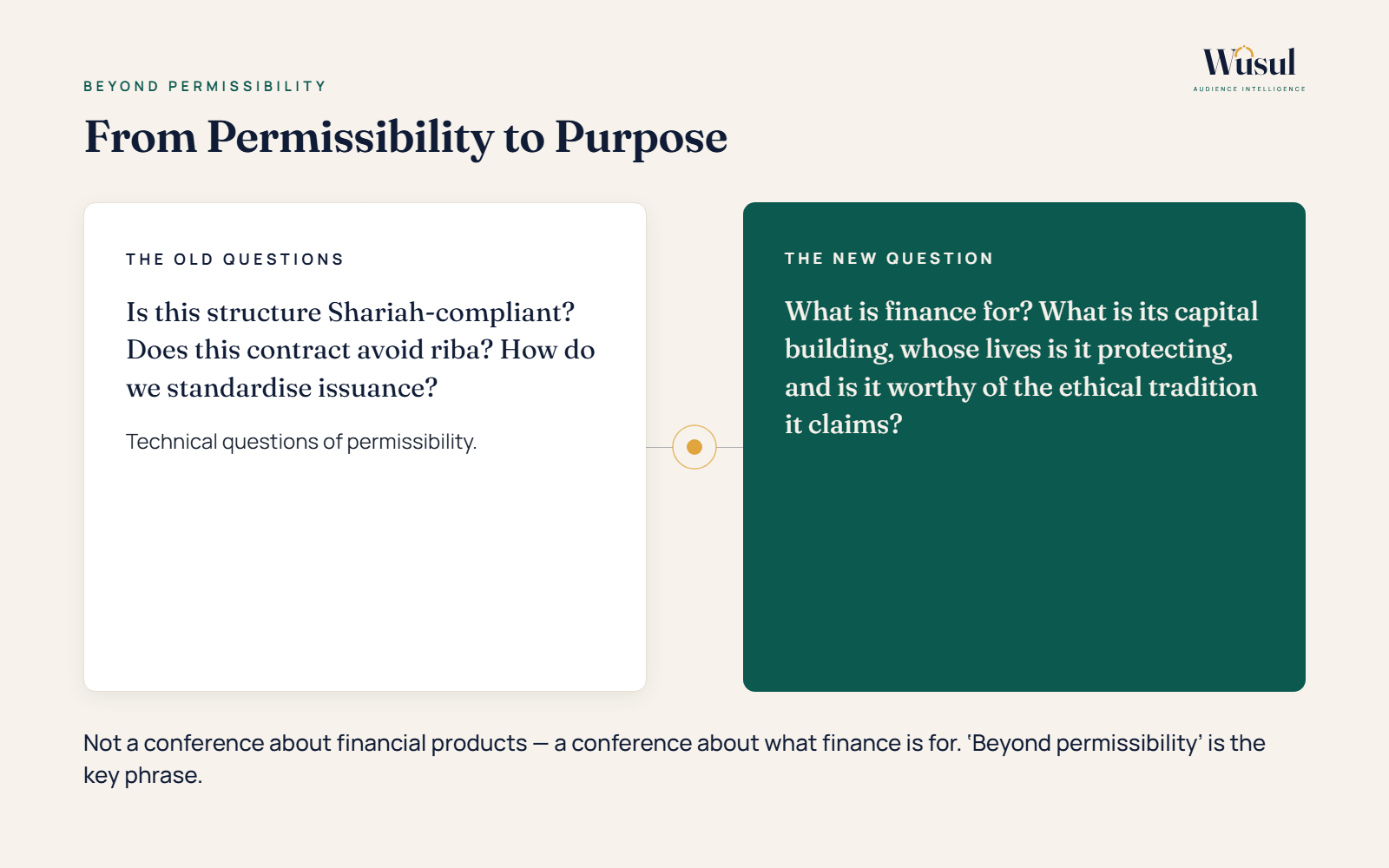
The language of Islamic finance is shifting. For decades, the sector's central vocabulary was built around compliance, prohibition, and profit-and-loss sharing. The questions that dominated conferences were technical: Is this structure Shariah-compliant? Does this contract avoid riba? How do we standardize sukuk issuance across jurisdictions?
Those questions still matter. But a conference convening in Doha later this month suggests the conversation has moved to something more urgent, and more uncomfortable.
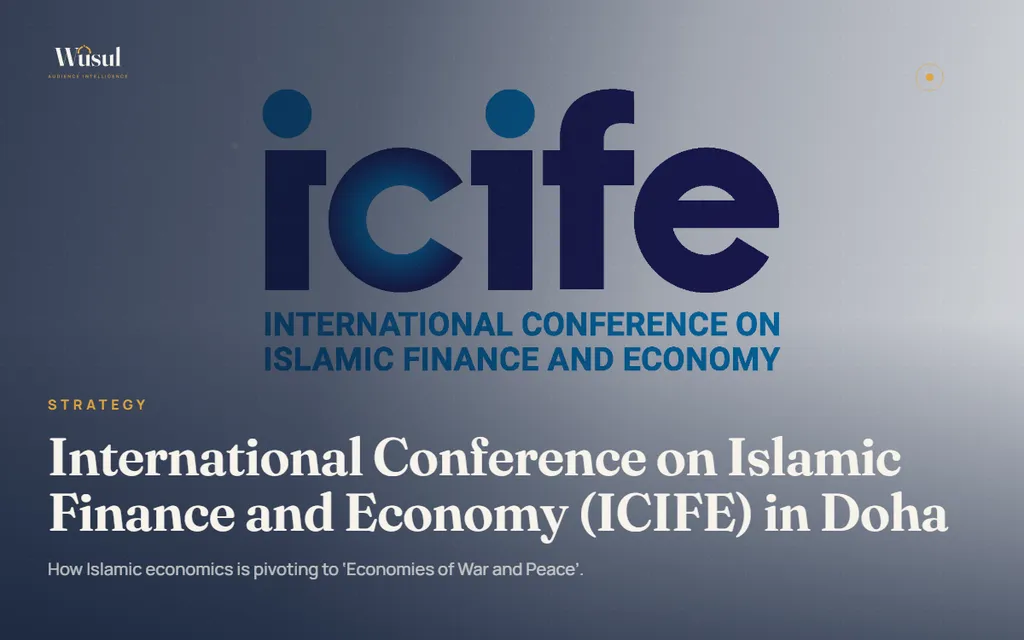
The 9th International Conference on Islamic Finance and Economy (ICIFE), organized by the Center for Islamic Economics and Finance (CIEF) at Hamad Bin Khalifa University's College of Islamic Studies, in collaboration with the Qatar Financial Centre Authority, will be held on 29-30 November 2026. Its theme is a deliberate provocation: "Islamic Economics Perspectives on Economies of War and Peace: Ethics, Resilience, Reconstruction, and Responsible Security."
This is not a conference about financial products. It is a conference about what finance is for.
Shifting from permissibility to purpose
The organizers are explicit about what they want to move beyond. According to the conference brief, ICIFE 2026 "invites critical reflection on how Islamic economics and finance can respond to the realities of geopolitical risk, fragile economies, humanitarian needs, damaged infrastructure, and post-conflict recovery."
That phrase "beyond permissibility" is the key. It signals a recognition that the Islamic finance industry has spent too long asking whether instruments are allowed, and not long enough asking whether they are doing any good.
Dr. Recep Şentürk, Dean of the College of Islamic Studies at HBKU, framed the stakes in stark terms: "In a world increasingly affected by geopolitical instability, disrupted markets, food and energy insecurity, displacement, and fiscal pressures, the need for principled and humane economic thinking has never been more important."
The conference's central concern, as described by the organizers, is to avoid normalizing destruction or treating war as an engine of growth. This is a direct challenge to a global economic system that has, at times, treated reconstruction as a market opportunity and conflict as a driver of demand.
The context: a sector confronting its own relevance
The timing of this pivot is not accidental. Across the Muslim world, the past several years have been defined by crises that have exposed the limits of existing humanitarian and financial models.
With protracted conflicts simultaneously devastating Gaza, Sudan, and Yemen, Islamic economists are grappling with the limits of short-term emergency relief. The intellectual frontier is shifting toward designing Sharia-compliant financial architectures specifically built for post-conflict reconstruction and conflict prevention.
The conference materials acknowledge this directly. "Conflict-affected economies often face weakened institutions, damaged infrastructure, limited access to long-term capital and urgent reconstruction needs," the organizers note. Islamic finance, they argue, is "well-positioned to offer both a normative and practical framework for protecting welfare, rebuilding productive capacity, mobilizing ethical capital, and supporting recovery in times of insecurity" .
The Arabic-language coverage of the conference is even more explicit. It notes that the event gains particular importance "in light of the reconstruction needs of Gaza, Syria, Sudan, and other affected areas" . The central question, as framed by the organizers, is "how to move from temporary charitable initiatives to Islamic finance institutions capable of financing production, operations, and infrastructure reconstruction without drowning affected countries in debt."
This is a question that Wusul's clients; Islamic charities, halal brands, and Muslim-focused media, will recognize. The shift from emergency relief to sustainable development is one that the philanthropic sector has been grappling with for years. The conference's framing suggests that the Islamic finance industry is now confronting the same challenge, and that the two sectors may have more to learn from each other than either has previously acknowledged.
The bigger question: can Islamic instruments reach the "un-investable"?
The conference's agenda poses a question that conventional finance has largely refused to answer: How can traditional Islamic instruments (like Mudarabah reconstruction funds, Sukuk, and community Waqf) be structured to rebuild shattered economies when conventional private capital deems war-torn regions "un-investable"?
The scale of the challenge is staggering. The World Bank estimates Syria's reconstruction costs at approximately US 216 billion, a figure that far exceeds the country’s immediate fiscal capacity. Gaza’s needs are similarly vast, with the UN estimating 4.06 billion required to deliver life-saving support to 3 million people across the Occupied Palestinian Territory in 2026 . Yemen's humanitarian response plan remains funded at barely a quarter of what is required.
Conventional private capital avoids these markets for rational reasons: weak institutions, unclear property rights, currency instability, sanctions risk, and the absence of bankable projects. The conference's intellectual bet is that Islamic finance, with its distinct legal architecture and ethical commitments, can do what conventional finance cannot.
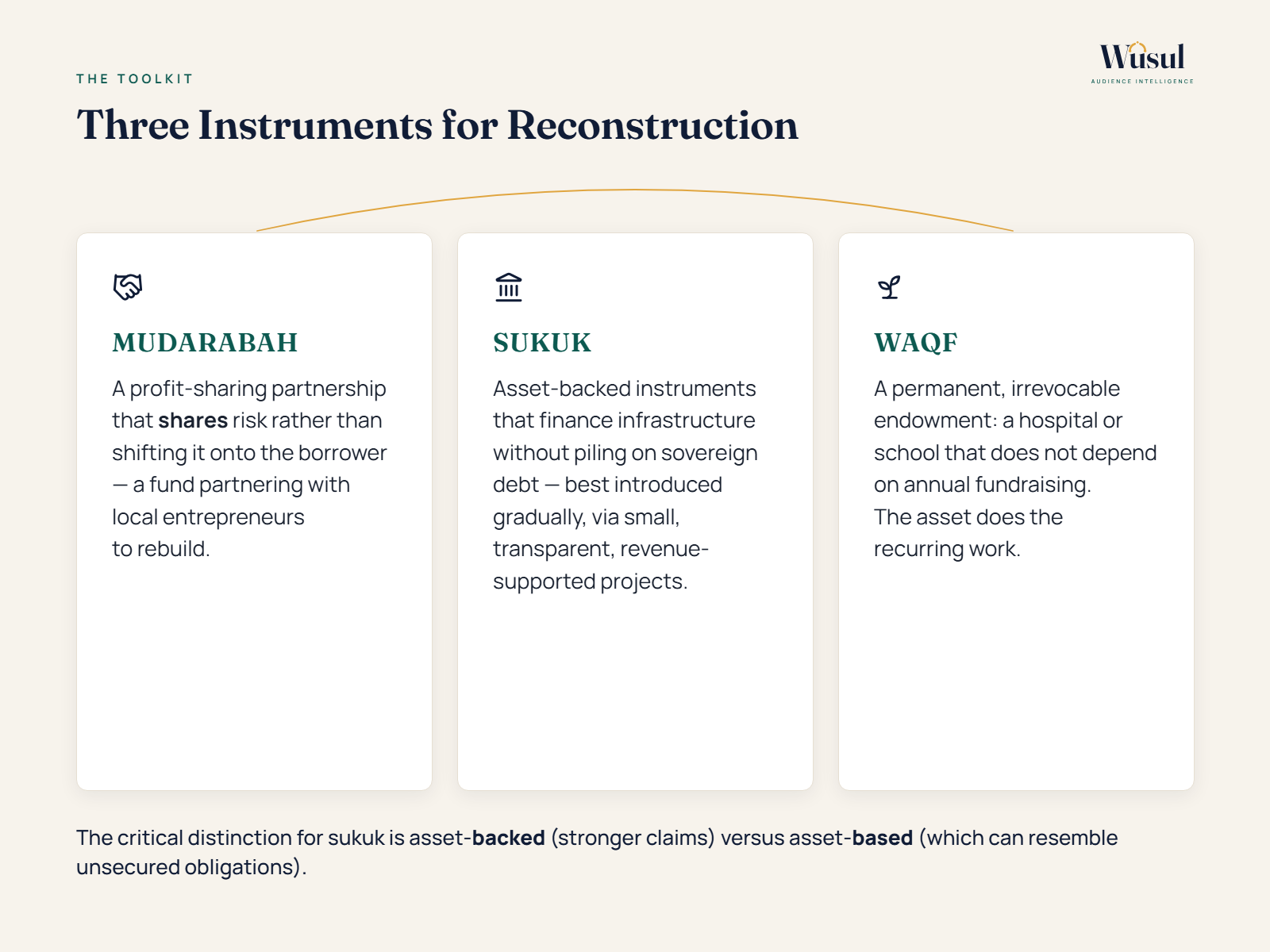
Mudarabah: the profit-sharing partnership where one party provides capital and the other provides expertise, offers a structure that shares risk rather than shifting it entirely onto the borrower. In a reconstruction context, this could mean a fund that partners with local entrepreneurs to rebuild businesses, sharing both the upside and the downside. Research on Islamic banking in post-disaster recovery notes that Mudarabah, Musharakah, and Ijarah contracts are particularly suited to reconstruction because they "ensure that the bank shares the risk and reward of any investment with the customer, promoting more equitable wealth distribution."
Sukuk: Islamic bonds backed by tangible assets, offer a mechanism for financing infrastructure without accumulating sovereign debt. A sukuk tied to a solar microgrid, a water system, or a hospital creates a direct link between the investor's capital and a productive asset. The academic literature on Syria's reconstruction finance emphasizes that sukuk should be introduced "gradually, beginning with small, transparent, revenue-supported projects rather than large opaque sovereign issuances" to reduce legal and market risk . The critical distinction is between asset-backed sukuk, which give investors stronger claims, and asset-based sukuk, which can resemble unsecured obligations if cash-flow and asset transfer are weak.
Waqf: the permanent endowment, offers something neither conventional finance nor annual charity can provide: perpetuity. A waqf asset is irrevocable and held for public benefit, making its structure naturally aligned with infrastructure that must serve communities for generations. The conference's thematic tracks include "Waqf, Zakat and Community-Based Resilience," recognizing that these instruments can operate as "preventive social infrastructures" that mitigate exclusion and build trust in post-conflict settings . A waqf-funded hospital or school does not depend on annual fundraising cycles or donor attention spans. The asset does the recurring work.
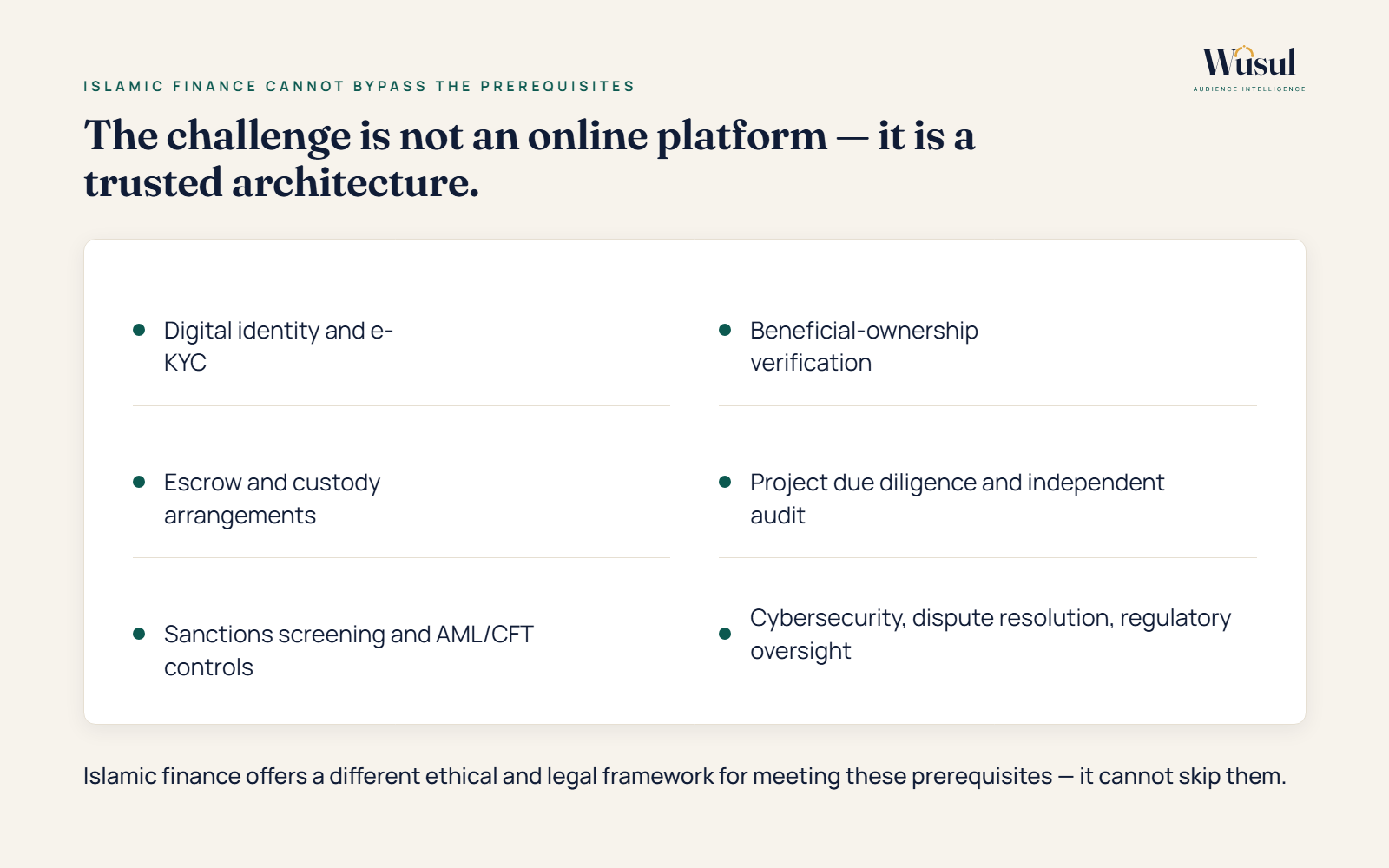
But the gap between theoretical potential and operational reality remains wide. As one analysis of Islamic FinTech for Syria's reconstruction notes, the core challenge is "not merely to create an online platform but to build a trusted investment architecture composed of digital identity, e-KYC, beneficial-ownership verification, escrow and custody arrangements, project due diligence, feasibility screening, independent audit, investor reporting, sanctions screening, AML/CFT controls, cybersecurity, dispute resolution, and regulatory oversight" . Islamic finance cannot bypass the institutional prerequisites that make investment possible. It can only offer a different ethical and legal framework for meeting them.
The uncomfortable questions
What makes ICIFE 2026 notable is not just its theme, but the questions it is willing to ask.
The conference objectives include a commitment to "clarify the ethical boundaries of finance in relation to public security, strategic industries, defense sectors, humanitarian protection, and post-conflict recovery" . This is a direct engagement with a tension that the Islamic finance industry has often avoided: the relationship between finance and violence.
It also includes an assessment of how emerging technologies, "artificial intelligence, cybersecurity, drones, surveillance, fintech, and digital infrastructure", are reshaping war, security, reconstruction, and financial ethics . In an era where surveillance technology is increasingly used against Muslim communities, and where AI systems have been shown to encode cultural biases, this is a necessary conversation.
Dr. Ahmet Faruk Aysan, Professor and Associate Dean at the College of Islamic Studies and Conference Chair, framed the agenda as an effort to connect Islamic finance with "conscious economics, conscious futures, foresight, scenario planning, anticipatory governance, social trust, human dignity, and resilience" .
The language is ambitious. Whether the conference can deliver on it remains to be seen. But the fact that it is being attempted at all is significant.
A question of purpose
ICIFE 2026 is not a conference that will produce a new financial instrument or a new regulatory standard. Its significance lies elsewhere: in the questions it is willing to ask about what Islamic finance is for.
In a world where war, displacement, and economic instability are not aberrations but ongoing realities for much of the Muslim world, the sector cannot afford to remain confined to questions of permissibility. It must ask what its capital is building, whose lives it is protecting, and whether the systems it creates are worthy of the ethical tradition it claims to inherit.
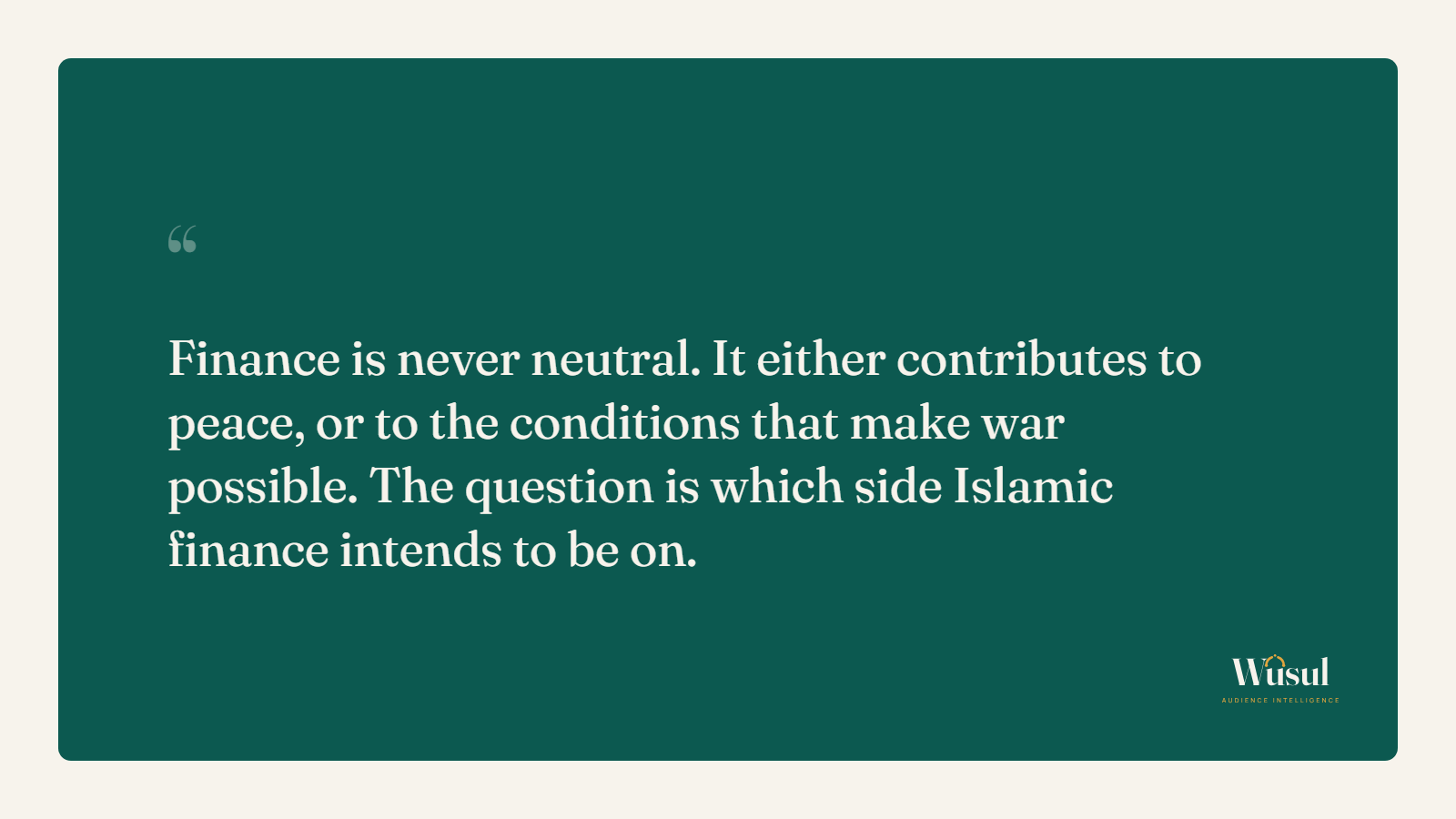
The conference's theme, Economies of War and Peace, is a recognition that finance is never neutral. It either contributes to peace or to the conditions that make war possible. The question the organizers are posing is which side Islamic finance intends to be on.
The answer will not be settled in two days in Doha. But the fact that the question is being asked, by the institutions with the power to shape the sector's direction, is a start.