Most charities can tell you how much they raised last Ramadan. Very few can tell you how many of last Ramadan's new donors gave again. That second number decides whether a charity grows or just runs to stand still, and for Muslim charities, whose year is shaped by a lunar calendar that most donor software ignores, it is harder to see than it should be.
We built Basira, Wusul's donor intelligence platform, to make that number visible, along with the dozen others that sit behind it. Basira has now profiled more than 200,000 donors, scored more than 2 million transactions and analysed over $100 million of giving. This article shares what that work has taught us about donor retention, and what any Muslim charity can do about it, with or without our software.
The retention problem, in one number
Across the US nonprofit sector, the Fundraising Effectiveness Project's report for 2025, covering 15,102 organisations and 7.8 million donors, found:
- 43.3% of donors gave again the following year
- 59.3% of repeat donors were retained
- but only 18.9% of first-time donors came back
Over the same year, dollars raised rose 5.0% while the number of donors fell 3.6%. The sector is raising more from fewer people. That works until it does not.
In our experience Muslim charities feel this sharply, because so much of their acquisition happens in a few weeks of Ramadan and in emergency appeals. Both bring in large numbers of first-time donors, and first-time donors are the ones most likely to disappear.
What the first gift tells you
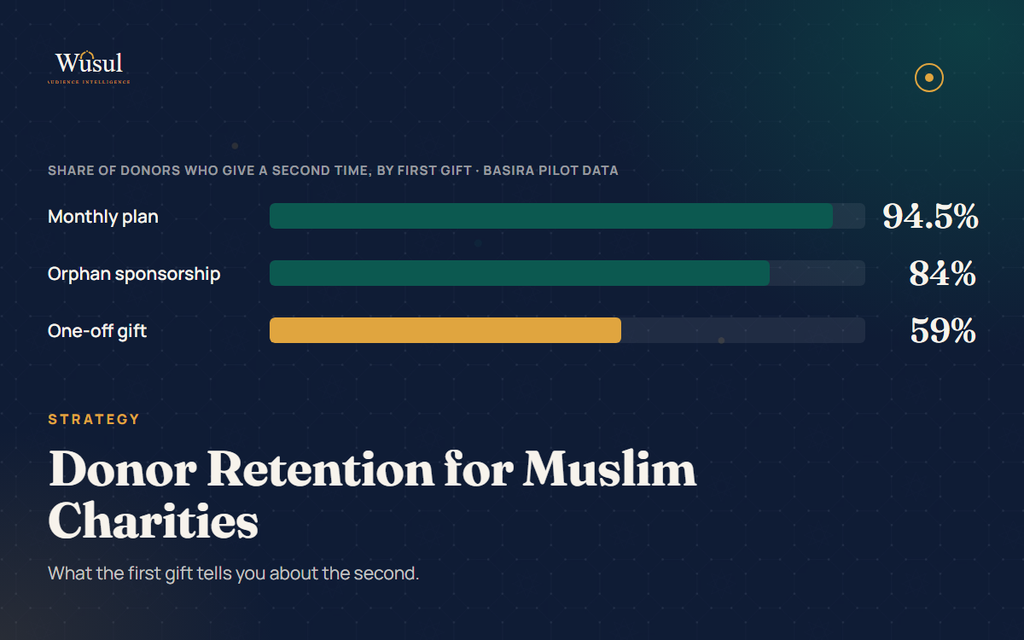
The most useful thing we have learned from our pilot data is that what a donor's first gift is for is one of the strongest signals of whether they will give again.
| First gift | Share who give a second time |
|---|---|
| A monthly giving plan | 94.5% |
| An orphan sponsorship | 84% |
| A one-off gift (most emergency donors) | 59% |
Nineteen of every twenty donors who start on a monthly plan give again; automated giving builds the habit for them. Orphan sponsors stay because the gift is a relationship with a child, not a transaction. But four in ten one-off donors never return.
These figures measure something different from the sector benchmark above. The Fundraising Effectiveness Project measures whether a donor gives again in the following year; ours measure whether a donor ever makes a second gift. The two are not directly comparable. The direction, though, is the same, and it is stark: the product you sell a donor first shapes everything that follows.
What that is worth
A simple illustration, using our pilot rates. Imagine a charity acquires 10,000 new donors in Ramadan, all with one-off gifts. At 59%, about 5,900 will give again. If the same charity started just 2,000 of them on a monthly plan instead, the arithmetic becomes 2,000 at 94.5% plus 8,000 at 59%: about 6,610 returning donors. That is 710 more people giving again, from the same acquisition budget, before counting the value of their monthly gifts.
Why generic donor tools miss Muslim donors
Most donor software treats Ramadan as a spike in the data. For a Muslim charity, it is the shape of the year. Three things break when the tools do not understand that.
- Year-on-year comparisons are wrong. Ramadan arrives about eleven days earlier every Gregorian year. Comparing this February with last February compares different parts of the Islamic year. Basira aligns every year-on-year view to the Hijri calendar, Ramadan to Ramadan.
- Different giving is lumped together. A Zakat payer, an emergency responder and an orphan sponsor behave completely differently. Basira measures Zakat, Sadaqah and Qurbani, and schemes like the 10 and 30 Nights, the 10 Days of Dhul Hijjah and Jummah giving, as the separate products they are.
- The moments that matter are invisible. Whether a donor gave in the last ten nights, or every Friday, or only at Qurbani, is some of the most predictive information a Muslim charity holds, and standard reports do not show it. See our Ramadan 2027 planning calendar for how each season works.
How Basira scores every donor
Basira connects to a charity's CRM, builds one clean donor database in the charity's own data warehouse, and runs six models on every donor, every night.
- RFM segments. Recency, frequency and monetary value, each scored 1 to 4, map every donor into ten named segments, from Champions and Loyal donors to those About to sleep, At risk or Hibernating.
- Churn risk. A score from 0 to 100 that warns before a donor leaves, so the team can call them this week rather than notice next year.
- Lifetime value. Everything a donor has given plus a five-year forecast of future giving, in tiers from Bronze to Diamond.
- Next transaction. The expected amount and timing of each donor's next gift, from their own giving rhythm.
- Seasonal intelligence. Ramadan-to-Ramadan comparisons, last-ten-nights tracking and Zakat, Sadaqah and Qurbani behaviour.
- An AI analyst. Plain-English questions ("which donors should we call this week?") answered from live queries on the charity's own data, with every query cited under the answer.
Scores become action: segments built from forty donor traits with a live count in about two seconds, call lists ordered by value, and audiences sent to thirteen platforms, from Meta, Google Customer Match and TikTok to Snapchat, LinkedIn and connected TV, with identifiers hashed to each platform's specification. Every export is logged, and the charity's team confirms donor consent before any audience is used.
Serious engineering, so the charity does not need a data team
Scoring runs inside the charity's own BigQuery warehouse, so the donor file is not copied out to be scored. Nearly a million gifts are re-scored in about 45 seconds, for around a fifth of a cent of compute. Every query is parameterised and cost-capped, and every export, profile view and scoring run is written to an audit log. The donor data stays the charity's.
Five things any Muslim charity can do this Ramadan
You do not need Basira to start. You need to measure the right things and act on them.
- Measure your second-gift rate by first product. Split last Ramadan's new donors by what they first gave to, and count how many have given again. It is the most revealing report most charities never run.
- Offer a regular gift at the first moment, not the last. Night-by-night schemes in Ramadan and monthly plans should be offered in the first ask, because the first product sticks.
- Plan the second gift within 90 days. Emergencies fill the funnel; the second gift is your job. Thank every new donor within 48 hours and give them a reason to give again before the next season.
- Compare Ramadan with Ramadan. Report on the Hijri calendar, so that a year's results are not distorted by the month moving.
- Treat Zakat payers as their own audience. They give on a date, for a reason, and they care where it goes. Transparency about Zakat is a retention strategy.
If you want to know where your charity stands across donor data, measurement and retention, take Itqan, our free five-minute fundraising maturity assessment. If you want to see your own donors clearly, book a Basira demo.
Frequently asked questions
What is a good donor retention rate?
Across the US sector in 2025, 43.3% of donors gave again the following year, 59.3% of repeat donors and 18.9% of first-time donors, according to the Fundraising Effectiveness Project. A charity above those figures is doing better than average; the most important number to improve is usually first-time donor retention.
How do you improve first-time donor retention?
Start donors on a regular gift where you can, thank them quickly, and plan a second ask within 90 days. In our pilot data, 94.5% of donors whose first gift was a monthly plan gave again, against 59% of donors whose first gift was a one-off.
What is RFM analysis for donors?
RFM scores each donor on recency (how recently they gave), frequency (how often) and monetary value (how much). Basira scores each from 1 to 4 and maps every donor into ten named segments, such as Champions, At risk and Hibernating, so a team knows who to thank, who to upgrade and who to call.
What is Basira?
Basira is Wusul's donor intelligence platform for charities. It builds a clean donor database in the charity's own warehouse, scores every donor nightly on six models including churn risk and lifetime value, and turns the scores into audiences on thirteen platforms.
Sources
- Fundraising Effectiveness Project (AFP and GivingTuesday), Q4 2025 report, published April 2026
- Basira pilot data: share of donors who give a second time, by first gift
- Wusul, Basira product documentation