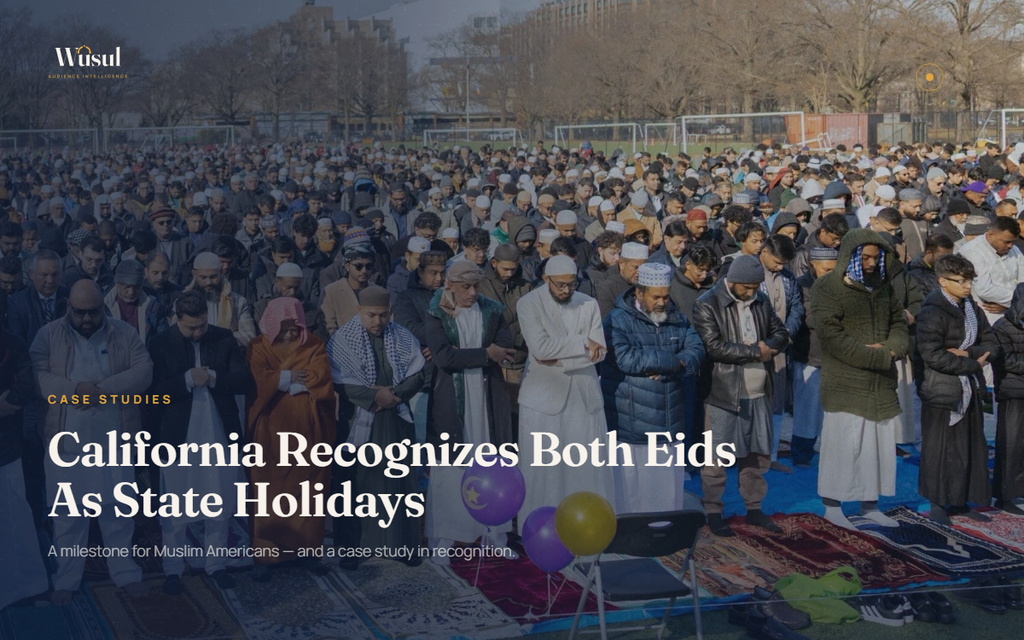
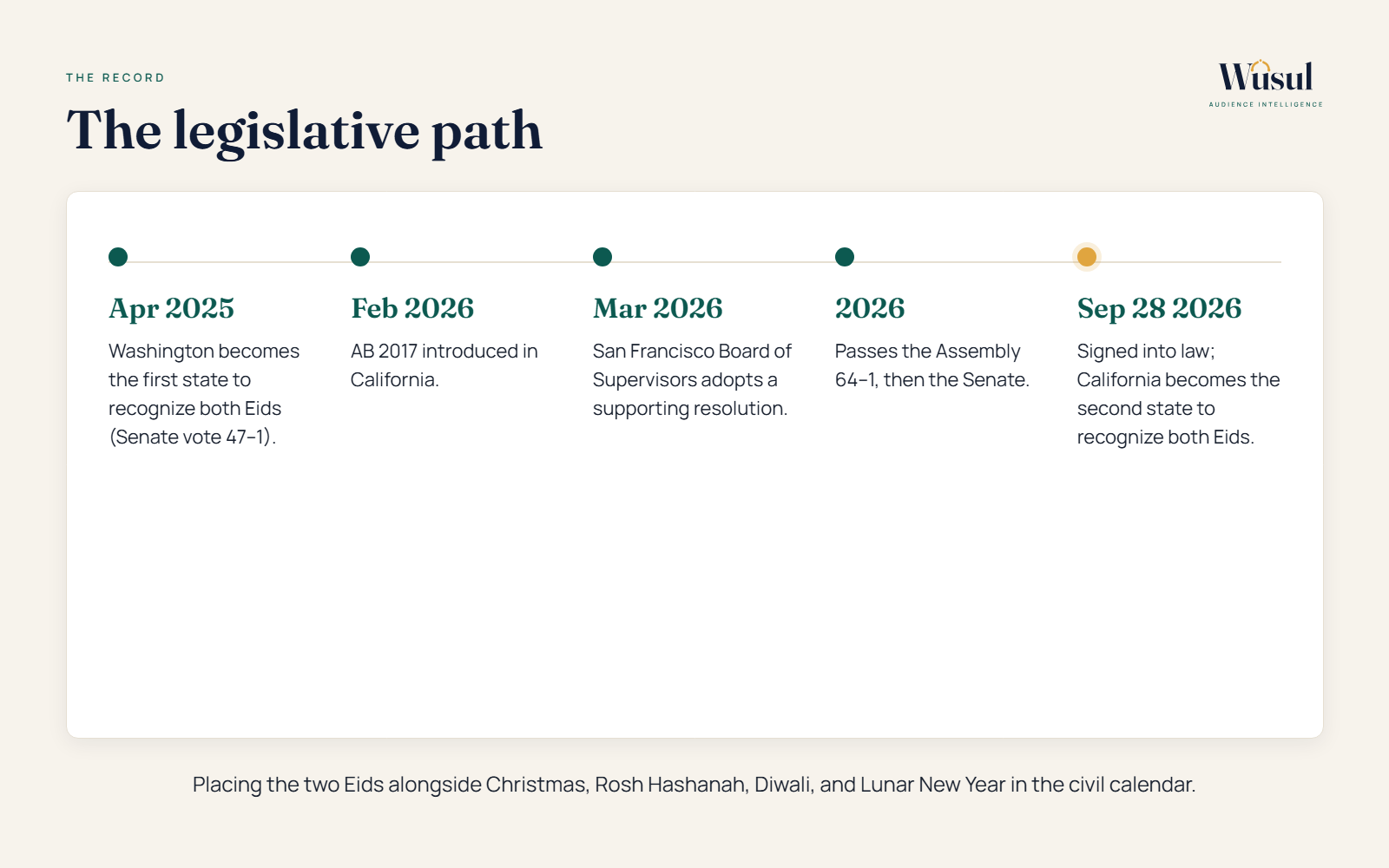
On September 28, 2026, California Governor Gavin Newsom signed Assembly Bill 2017 into law, officially recognizing Eid al-Fitr and Eid al-Adha as state holidays. California becomes only the second U.S. state to do so, following Washington, which adopted the same recognition in 2025.
Washington made history as the first state to officially recognize both Eid holidays when Governor Bob Ferguson signed Senate Bill 5106 on April 8, 2025. Sponsored by Senator Yasmin Trudeau, the Washington law added both Eids to the state's list of recognized observances, similar to Lunar New Year or Billy Frank Jr. Day. The bill passed with overwhelming support; 47 votes in favor and just 1 against in the Senate.
The California law adds the first day of Shawwal (Eid al-Fitr) and the 10th day of Dhu al-Hijjah (Eid al-Adha) to the state's official holiday calendar. As the legislation states, this is "a civil calendar determination that acknowledges their cultural significance to California communities."
For the state's more than one million Muslim residents; the largest Muslim population of any U.S. state, the signing represents more than symbolic recognition. It addresses a longstanding structural barrier that has forced Muslim students and employees to choose between observing their faith and meeting academic or professional obligations.
What California's Eid holiday law actually does
Understanding the scope of AB 2017 is essential. The recognition does not mean all government offices, schools, courts, or private businesses must close on the two Eid days.
For state employees: Eligible state employees may receive holiday credit for the two Eids, or use personal holiday credit or available leave time to observe the holidays.
For students and schools: Public schools and community colleges may close for Eid through locally negotiated agreements . Muslim students who miss school to observe Eid will have their absence treated as an excused absence .
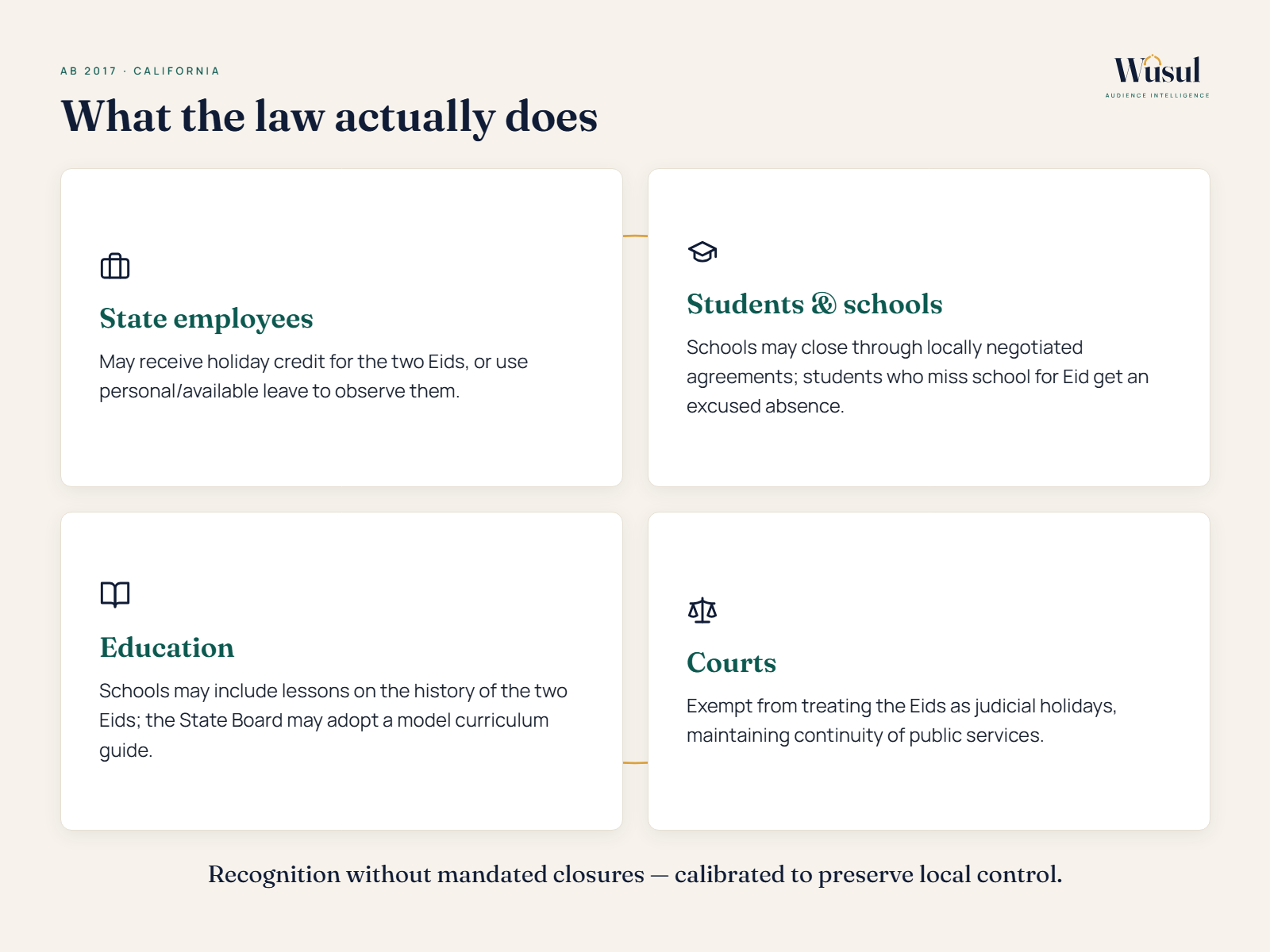
For educational institutions: Public schools and educational institutions may include exercises exploring the history of Eid al-Fitr and Eid al-Adha, funded through existing resources. The State Board of Education may adopt a model curriculum guide for use by public schools.
For courts: The law exempts courts from considering the two Eids as judicial holidays, maintaining continuity of public services.
The law also formally acknowledges the cultural significance of the holidays while "preserving local control, maintaining continuity of public services, and avoiding unnecessary fiscal, educational, and operational burdens" .
The legislative journey
AB 2017 was introduced by Assemblymember Matt Haney in February 2026. The bill moved through the legislature with remarkable support, passing the Assembly by a vote of 64 to 1 before receiving Senate approval and being sent to the Governor.
The City and County of San Francisco Board of Supervisors adopted a resolution supporting the bill on March 24, 2026, signaling strong local backing.
Assemblymember Haney framed the legislation in terms of fundamental fairness: "California is home to one of the largest and most vibrant Muslim communities in the country, and their traditions deserve recognition and respect. Recognizing Eid in state law is an important step toward ensuring every Californian can celebrate their holidays with their families without being forced to make unnecessary sacrifices."
The community response
The Council on American-Islamic Relations California chapter (CAIR-CA), which co-sponsored the bill, welcomed the signing as a powerful statement.
"For far too long, Muslim students and employees in California have had to make the difficult choice between participating in observances essential to their faith or falling behind on their academic or professional obligations," CAIR-CA stated. "AB 2017 removes these structural barriers and aligns state policy with the values of inclusion, equity, and respect for cultural diversity that define our state" .
The context: a response to rising hostility
The timing of AB 2017 is significant. The legislation was signed amid documented increases in incidents targeting Muslim communities.
CAIR recently documented a 183% increase in incidents targeting mosques and Islamic centers from May to July 2026 compared to the same period the previous year. The organization recorded 17 incidents of attacks against mosques during that three-month window.
In this context, the state's official recognition of Eid carries weight beyond the practical benefits. It signals that California (home to the nation's largest Muslim population) is committed to protecting and valuing its Muslim community even as hostility rises elsewhere.
Lesson in cultural intelligence
For organizations seeking to engage Muslim audiences, California's recognition of Eid offers several lessons.
A. Symbolic recognition has practical consequences. The law addresses a real structural barrier (the forced choice between faith and work or school) that has affected Muslim families for decades. Cultural intelligence means understanding not just the values of an audience, but the practical obstacles they face in living with those values.
B. Recognition is not the same as accommodation. California's law is deliberately calibrated. It recognizes the holidays without mandating closures. It provides flexibility without imposing burdens. This balance reflects a sophisticated understanding of how to honor cultural significance within a diverse, secular state.
C. Timing matters. The law was signed during a period of documented anti-Muslim hostility. Recognition in this moment is not just administrative, it is a statement of belonging. For organizations engaging Muslim audiences, the lesson is clear: showing up consistently, especially during difficult moments, builds trust that transactional engagement cannot.
A milestone, not a finish line
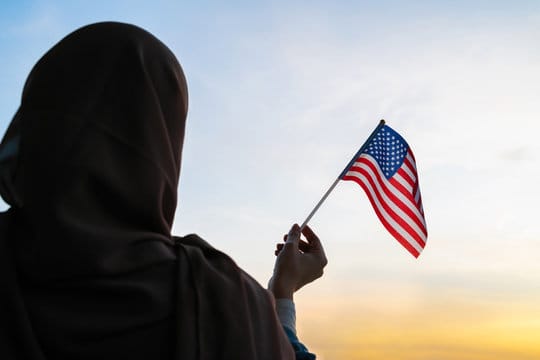
California's recognition of Eid al-Fitr and Eid al-Adha as state holidays is a milestone for Muslim Americans. It places the two holiest days in the Islamic calendar alongside Christmas, Rosh Hashanah, Diwali, and Lunar New Year in the state's civil calendar.
But recognition is not the same as full inclusion. The law's reliance on local agreements and voluntary closures means implementation will vary across the state. And the broader context( rising mosque attacks, persistent discrimination) reminds us that legal recognition alone cannot dismantle prejudice.
What it can do is signal that Muslim Californians belong. That their faith is part of the fabric of the state. And that their holidays deserve the same respect as anyone else's.
At Wusul, we believe that cultural intelligence means understanding not just what an audience does, but why they do it; and designing for the values that shape their decisions. California's recognition of Eid is a case study in what happens when a state takes those values seriously.
Frequently asked questions
Is Eid a holiday in California?
Yes, California officially recognizes Eid al-Fitr and Eid al-Adha as state holidays. Governor Gavin Newsom signed the legislation into law on September 28, 2026. This recognition acknowledges the cultural significance of these holidays to the state's large Muslim population, which is the largest of any U.S. state.
What is AB 2017 California?
AB 2017 is a piece of legislation signed into law by Governor Gavin Newsom that officially recognizes Eid al-Fitr and Eid al-Adha as state holidays in California. Introduced by Assemblymember Matt Haney, the law aims to address structural barriers faced by Muslim residents regarding their professional and academic obligations during these religious observances.
Why did California make Eid a holiday?
California made Eid a holiday to acknowledge the cultural significance of these observances to its large Muslim community. The law addresses structural barriers that previously forced Muslim students and employees to choose between their faith and their obligations. It serves as a statement of inclusion and respect for the state's diverse population.