A 100% donation policy sounds like the ultimate act of charity. Every pound, every dollar, every penny goes directly to those in need. Nothing is lost to administration. Nothing is spent on salaries. No overhead. Pure, unadulterated aid. It is why so many Muslim charities, especially with Zakat, advertise a 100% donation policy.
It is, as Islamic Relief puts it, a promise that looks like "the superior choice" when compared to charities that openly disclose their admin fees. It's understandable why so many donors, particularly in the Muslim community, are drawn to this model. "When they are done with sincere intention they can earn copious rewards," Islamic Relief notes. Who wouldn't want their entire donation to reach the person in need?
But is the 100% model possible, or even ethical?
The transparency dilemma
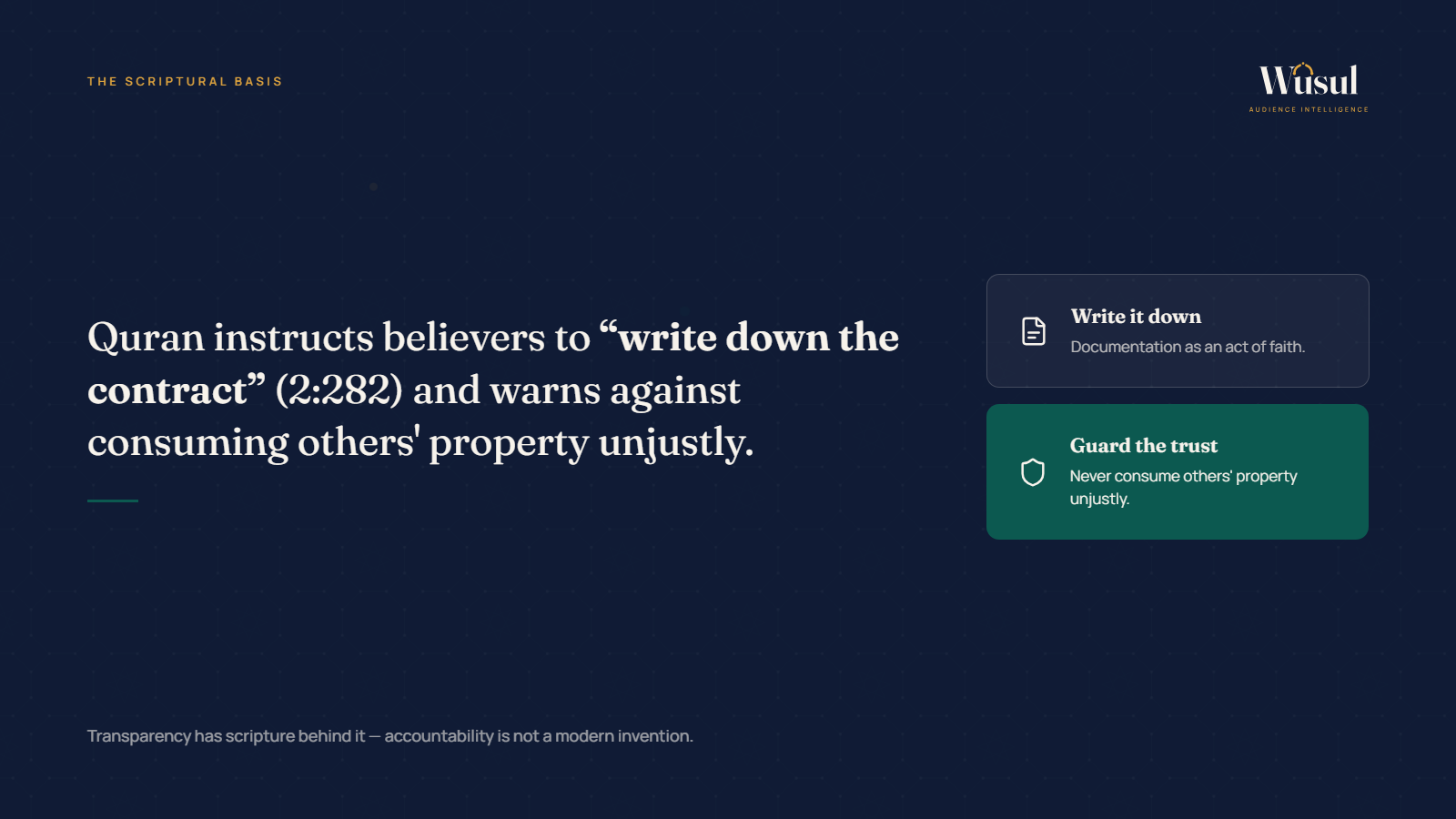
Transparency in Islamic giving is not a modern marketing trend; it is a religious imperative. The Quran instructs believers to "write down the contract" (2:282) and warns against consuming others' property unjustly. Accountability (to the donor, to the beneficiary, and ultimately to Allah) is woven into the fabric of Islamic finance.
Research consistently shows that transparency drives giving. A 2025 study published in the Journal of Islamic Marketing found that information disclosure; financial and non-financial, directly affects donor trust and giving behavior. Another 2025 study on Zakat donors in Pakistan revealed that donors are most influenced by the organization's "disbursement mechanism" and the "provision of financial information."
A case study of Lazismu Sidoarjo in Indonesia found that financial transparency, program publication, and activity documentation were the three pillars of a successful donor empowerment strategy. Dompet Dhuafa, an Indonesian philanthropic institution that has been audited by a Public Accounting Firm since 1993 with an Unqualified Opinion, makes a powerful case for openness. The organization opens its books to public scrutiny and holds annual public expose events; not because it is required by law, but because "public trust is born from the transparency of the management of funds raised."
When a charity commits to 100% of donations reaching beneficiaries, it is signaling that every cent is being delivered. The promise is not just about distribution; it is about erasing the perceived barrier between donor and recipient.
The admin cost reality: why "100%-plus" matters
The central challenge with a 100% donation promise is simple: charities have costs. Islamic Relief, one of the world's largest Muslim charities operating in over 40 countries since 1984, is unequivocal: "A 100% donation policy wouldn't work".
Any organization performing life-saving work needs staff, vehicles, offices, fuel, and monitoring systems. Admin costs cover conducting needs assessments to ensure aid is relevant, transporting aid to remote areas (often in conflict zones), rent for local offices, salaries for staff, and expenses for volunteers who deliver life-saving responses. Islamic Relief notes that 95% of its staff are recruited locally to ensure "we're sensitive to the cultural and religious requirements of those in need."
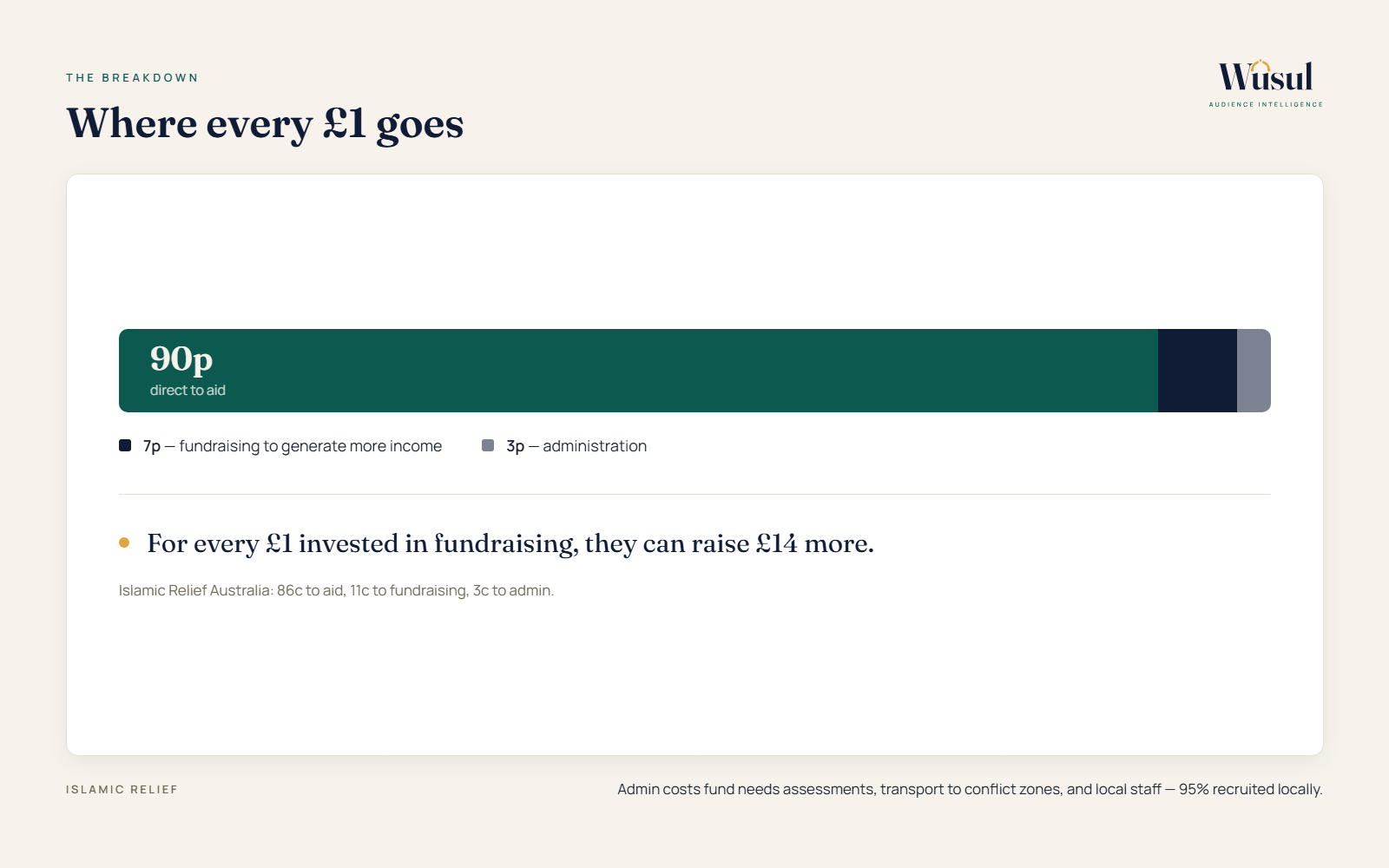
For Islamic Relief UK, 90p of every £1 goes directly to aid, 7p supports fundraising to generate more income, and 3p covers admin costs. For every £1 invested in fundraising, they can raise £14 more. In their Australian division, 86c of every dollar goes to people in need, 11c to raising more funds, and 3c on administration. As they explain, "for every 1c we spend on fundraising, we raise an additional 10c;"effectively doubling the donor's contribution.
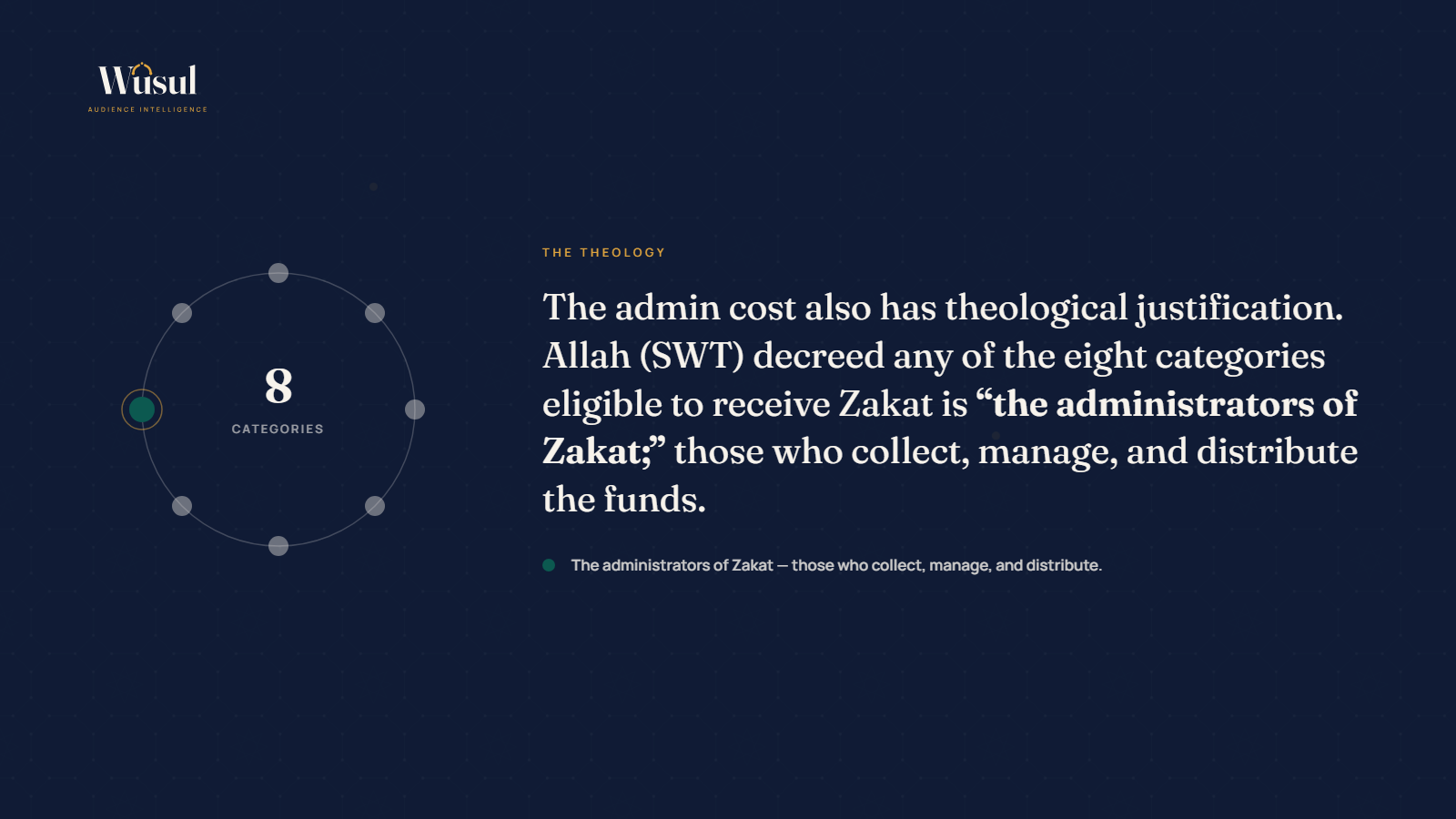
The admin cost also has theological justification. Allah (SWT) decreed any of the eight categories eligible to receive Zakat is "the administrators of Zakat;" those who collect, manage, and distribute the funds. Islamic scholars have long recognized that facilitating the delivery of charity is itself a service. Dompet Dhuafa notes that the share of Zakat for amil is 12.5 percent, in line with classical jurisprudence.
The UNHCR model: a Zakat 100% donation policy in practice
One organization has operationalized the 100% promise at an extraordinary scale. Since 2017, the United Nations High Commissioner for Refugees (UNHCR) has built a Refugee Zakat Fund that has supported more than 9.9 million people across 36 countries.
The UNHCR model is built on a rigorous foundation: 18 fatwas and endorsements from Islamic scholars and institutions globally affirm the validity of the fund. And crucially, UNHCR promises that 100% of Zakat donations go directly to refugees and displaced families. Every dollar of Zakat is distributed to eligible recipients. Administrative costs are covered by non-Zakat sources.
Donors are assured that "these charitable donations are not used to cover administrative costs such as salaries." In 2025, the fund received over USD 23 million in Zakat contributions, reaching more than 579,000 Zakat-eligible refugees and IDPs across 17 countries.
The UNHCR approach is unique; a non-Muslim international agency administering a key Islamic social finance vehicle. The policy has been described as both "an operational commitment" and "a rhetorical device which enhances institutional credibility." The agency uses technology like IRIS scanning at ATMs to ensure cash assistance reaches only registered beneficiaries, reducing fraud risk and ensuring efficiency.
The true meaning of transparency
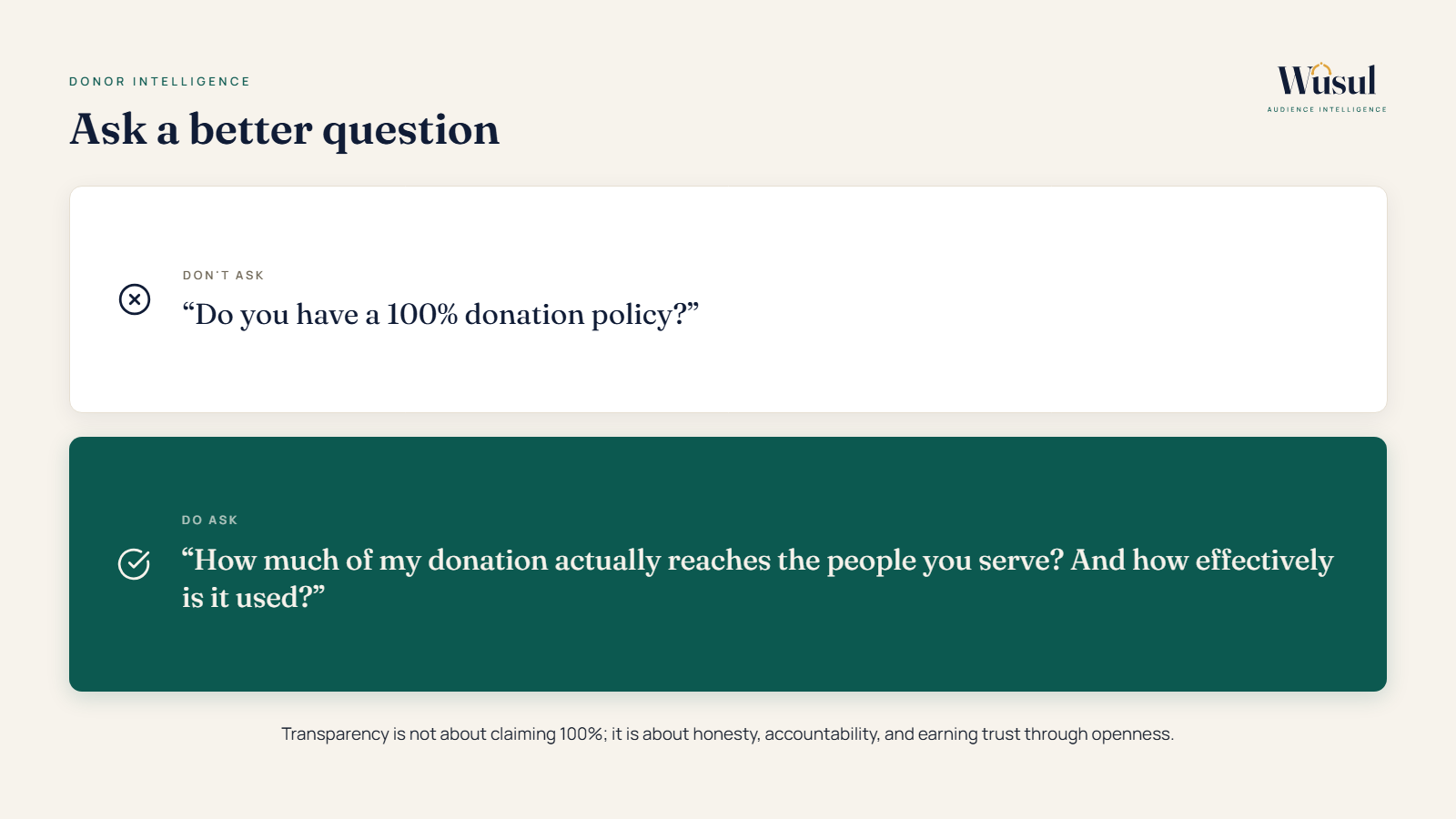
Transparency in Islamic giving is not about claiming 100% of every donation reaches the needy. It is about honesty, accountability, and earning trust through openness. It is about showing donors exactly how their money was spent, not hiding costs behind a superficial promise.
Islamic Relief states: "We're accountable to you, to the people we serve and most importantly to Allah (SWT)." Dompet Dhuafa insists that "openness in the management of Zakat, Infaq, Sadaqah, and waqf funds is the key to Dompet Dhuafa's existence to date." UNHCR's annual reports transparently document every dollar, every beneficiary, and every program.
For donors, the message is clear: Ask the right question. Do not ask, "Do you have a 100% donation policy?" Ask, "How much of my donation actually reaches the people you serve? And how effectively is it used?"
Islamic Relief frames this simply: "Transparency around our admin costs is an integral part of the relationship we have with our loyal donors. We are accountable to those in need, and to you, our loyal donors."
At Wusul, we believe that transparency is not just a compliance requirement, it is the foundation of trust. For Islamic charities and organizations, the most powerful way to honor donor intent is to be honest about costs and clear about impact. Because when donors trust you, they don't just give once; they give for life.