Let’s take a look at 10 British Muslim charities,across three financial years and millions of pounds of changing income. The accounts show who grew and who shrank. They also show why neither tells us whether a December appeal worked. The last of four British articles follows the money.
Eight grew, two declined, and neither answers the December question
Human Appeal's income rose from £56.2 million in 2023 to £90.2 million in 2024. Al-Khair Foundation's almost doubled, from £31.3 million to £61.0 million. Penny Appeal's fell from £22.4 million to £13.1 million. Across the ten British Muslim charities in this series, eight reported higher income for their financial years ending in 2024 than in 2023, and two reported less.
It looks like a fundraising result. What does it say about December? Almost nothing, directly. Al-Khair's financial year ends in July, One Nation's in September, Ummah Welfare Trust's in November and UK Islamic Mission's in March. An account labelled "2024" does not necessarily contain December 2024. And even when it does, annual income includes Ramadan, emergency appeals, regular giving, grants and gifts in kind, all added together.
The previous three articles asked why British Muslim charities fundraise in December, what their appeals said, and where Gift Aid on Zakat goes. This one follows the money, using Charity Commission financial histories, annual reports and HMRC statistics for 2023 to 2025. It tests two common assumptions: that rising annual income means a successful year-end appeal, and that a strong December means extra giving rather than giving that would have come anyway.
The question is not whether a charity raised more in a year. It is whether anyone can tell how much more its year-end appeal raised.
Ten charities, two years
The first comparison uses the total income each charity reported to the Charity Commission for financial years ending in 2023 and 2024. These are whole-organisation figures, not year-end campaign revenue.
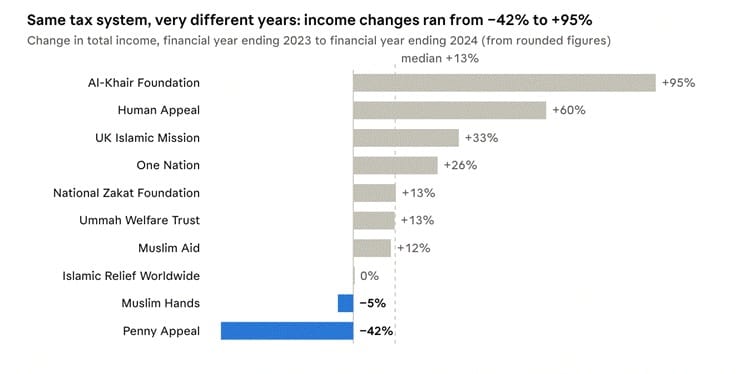
The typical charity grew by about 13%, roughly in line with the 7% to 10% annual growth in Gift Aid across the whole UK charity sector over the same period. But the spread is what stands out. Al-Khair Foundation and Human Appeal grew by 95% and 60%; Islamic Relief's worldwide income barely moved; Penny Appeal lost two-fifths of its income.
These charities share a tax system and, broadly, a donor community. If the December season drove their results, they would move together. They did not. The differences point to factors specific to each charity, including emergency fundraising, the mix of income, grants and gifts in kind, and events within the organisations themselves. The accounts do not say which mattered for whom.
The financial year that does not contain December
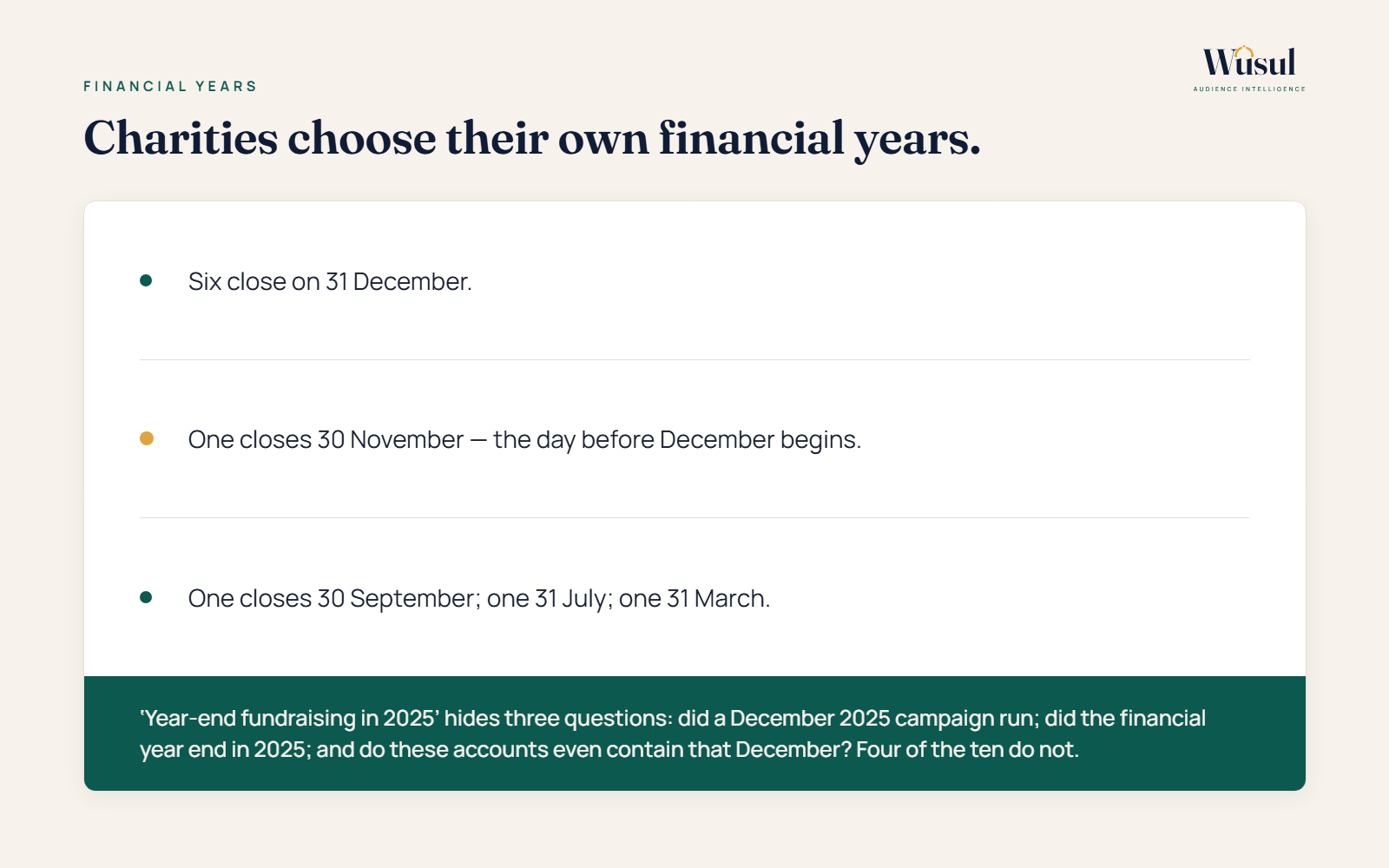
Britain's personal tax year ends on 5 April, but charities choose their own financial years. Six of the ten close on 31 December. Four do not: Ummah Welfare Trust closes on 30 November, One Nation on 30 September, Al-Khair Foundation on 31 July and UK Islamic Mission on 31 March.
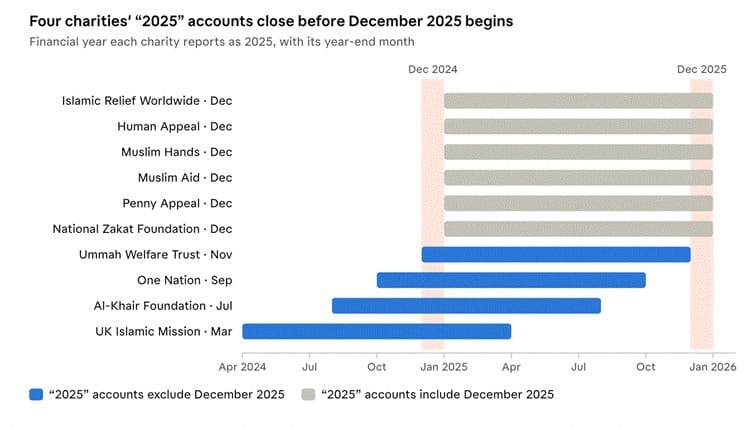
That changes what each set of accounts can contain. Al-Khair's year to July 2025 covers August 2024 to July 2025: it includes December 2024, but not December 2025. Ummah Welfare Trust's year to November 2025 closes the day before December 2025 begins. UK Islamic Mission's "2025" accounts ended nine months before it.
So "year-end fundraising in 2025" hides three separate questions: did the charity run a December 2025 campaign; did its financial year end in 2025; and do the accounts being read actually contain that December? Pairing a December 2024 campaign with Ummah Welfare Trust's "2024" accounts, for example, would match it to the wrong year entirely: December 2024 belongs to the year ending November 2025.
The Al-Khair figures show the effect. Its income was £31.3 million in the year to July 2023, £61.0 million to July 2024 and £74.8 million to July 2025. The big jump covers August 2023 to July 2024, the first months of the Gaza war, and includes December 2023. Comparing its 2023 and 2024 accounts compares two Decembers, but not the two the labels suggest.
Islamic Relief: worldwide income and British donations
Islamic Relief Worldwide's income was almost flat between 2023 and 2024, at about £275 million. Its British donors told a different story.
| Islamic Relief, UK operations | 2023 | 2024 | 2025 |
|---|---|---|---|
| Donations and legacies | £78.9m | £73.3m | £63.7m |
| Spent on raising donations | £17.2m | £19.2m | £21.1m |
| Net fundraising contribution | £61.8m | £54.1m | £42.6m |
| Worldwide income, for comparison | £274.7m | £275.6m | about £239m |
Over two years, UK donations and legacies fell by about a fifth while the cost of raising them rose, so the net contribution from British fundraising fell by about 31%. The charity explained that 2024 had followed exceptionally strong emergency fundraising and that 2025 faced cost-of-living pressures and competing crises. The worldwide figure hid the 2024 decline because Islamic Relief Worldwide also receives money from its member offices abroad and from institutional partners.
A note on figures used earlier in this series. Articles 3 and 4 cited a narrower line from the same accounts, UK donations, appeals and fundraising events, of about £53.0 million in 2024 and £48.2 million in 2025, which appears to exclude legacies, Gift Aid and some other UK income. Both lines fell in 2025, by about 13% and 9% respectively; they measure different things.
None of this shows how much Islamic Relief raised in December, or whether a December appeal did well. A December campaign could have beaten its target in a year when annual donations fell. The accounts cannot say.
Human Appeal and Al-Khair: what the largest increases are made of
The two fastest-growing charities show why a headline increase needs to be opened up.
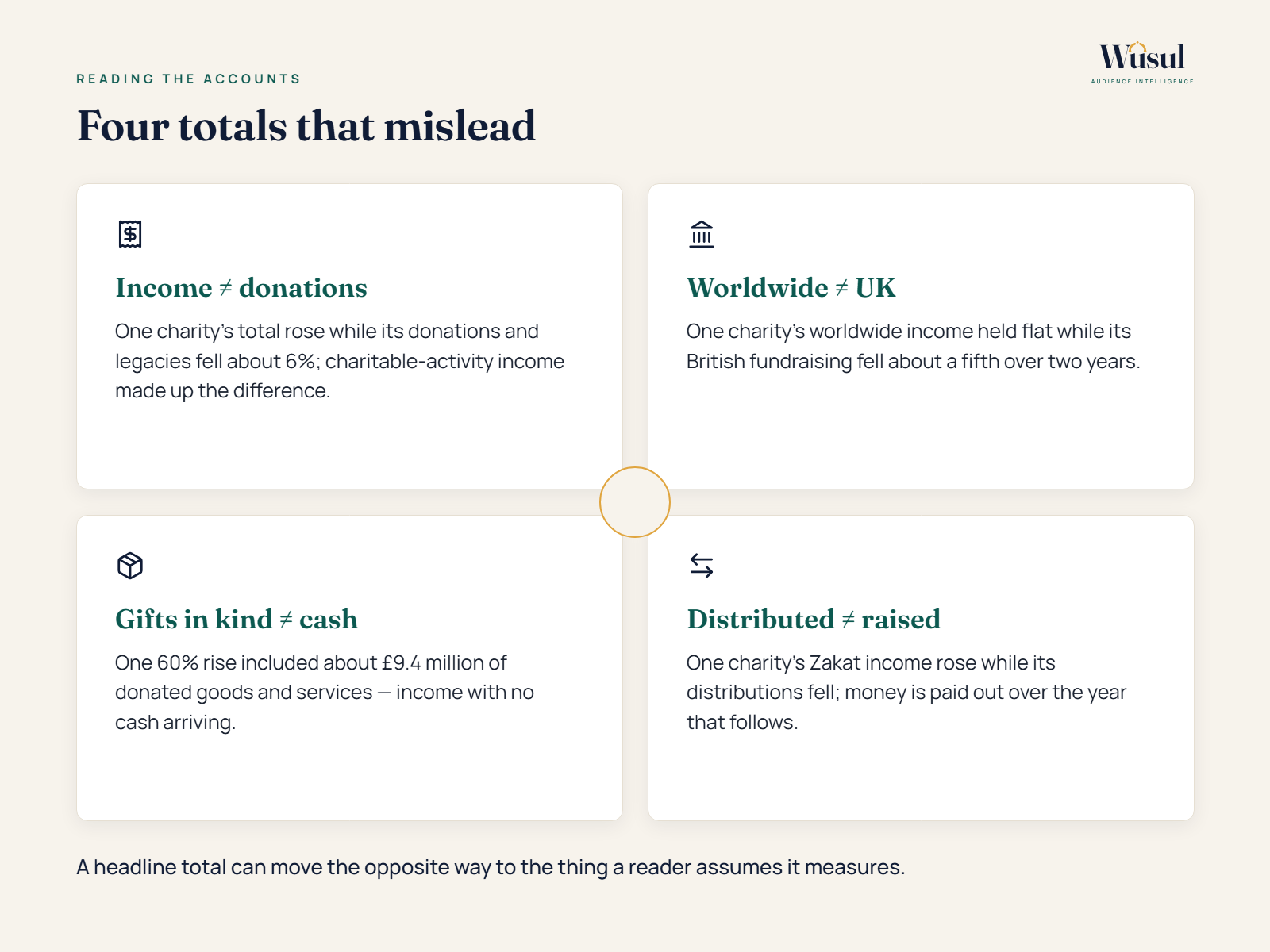
Human Appeal's income rose from £56.2 million in 2023 to £90.2 million in 2024, up about 60%. Its 2024 annual report shows that about £9.4 million of that income was gifts in kind, donated goods and services that count as income without any cash arriving. Institutional funding also rose, alongside large emergency appeals for Palestine and Sudan. Some of the growth, in other words, is not money given by individual donors at all, and none of it can be placed in a particular month.
Al-Khair Foundation's growth was of a different kind. Its Charity Commission record shows donations and legacies rising from £29.0 million in the year to July 2023 to £58.3 million in the year to July 2024, while income from charitable activities barely moved, from £2.2 million to £2.5 million. Almost all of the 95% increase came through donations and legacies, a category that can itself include gifts in kind, so the annual report is needed to separate cash from goods. That year ran from August 2023 to July 2024, beginning in the first months of the Gaza war. Income rose again, to £74.8 million, in the year to July 2025.
Both charities grew dramatically during an extraordinary period of humanitarian need. Neither set of accounts shows whether December contributed more than any other month, or whether any of the growth came from a year-end appeal.
Muslim Aid and Penny Appeal: totals that mislead
Muslim Aid is the clearest example in the study of a total moving the wrong way for the reader. Its income rose from about £21.2 million in 2023 to £23.7 million in 2024. But its Charity Commission record shows donations and legacies falling, from about £17.3 million to £16.3 million, down about 6%. The growth came from income from charitable activities, which almost doubled, from £3.7 million to £7.3 million. Spending on raising funds rose from £2.3 million to £3.4 million. A headline of "income up 12%" would describe a year in which donations fell.
Penny Appeal shows the opposite caution. Its income fell from £22.4 million in 2023 to £13.1 million in 2024 and £11.0 million in 2025. Its 2025 report, discussed publicly in October 2026, described a difficult income environment and cost reductions, with restricted and unrestricted income moving differently. Article 4 discussed the Fundraising Regulator's findings on Penny Appeal published in June 2024; the accounts themselves do not identify the causes of the decline, and this article does not attribute it to any one factor.
A charity whose annual income falls by two-fifths can still run a December appeal that beats its target. The annual fall would be real; so would the campaign's success. They measure different things.
National Zakat Foundation: the Ramadan clue
The National Zakat Foundation's income rose from about £9.0 million in 2023 to £10.2 million in 2024 and £11.1 million in 2025. But the most useful figure in its reporting is not a total. It is a month.
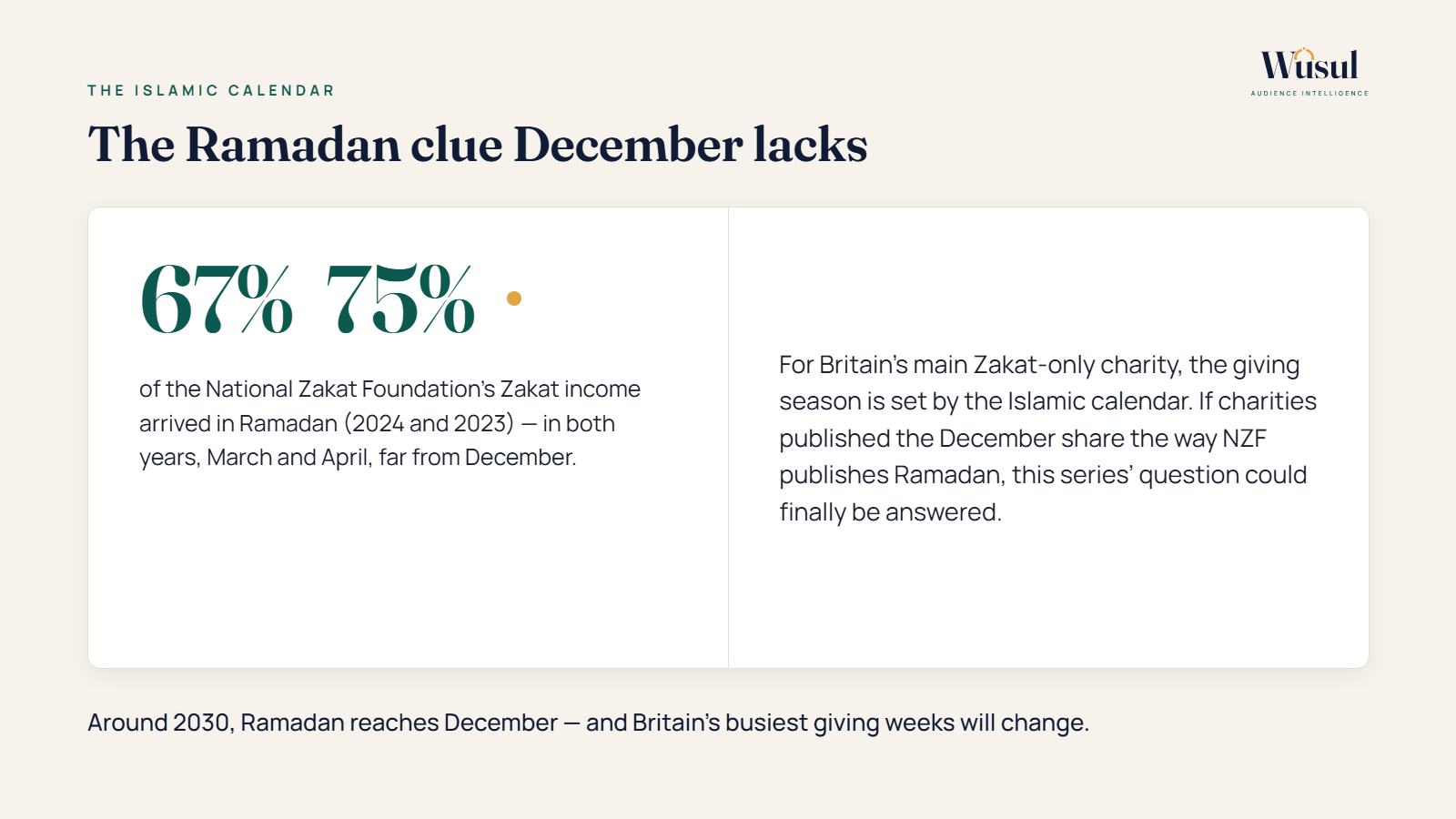
NZF reports that 67% of its 2024 Zakat income arrived in Ramadan, and 75% in 2023. In both years Ramadan fell in March and April, far from December. For Britain's main Zakat-only charity, the giving season is set by the Islamic calendar, and annual growth may say more about Ramadan than about the year-end.
Its figures also show why money raised and money distributed must be kept apart. Zakat income rose from about £7.1 million to £8.0 million between 2023 and 2024, while distributions fell from about £7.6 million to £6.3 million. Zakat is collected mostly in Ramadan and paid out as applications arrive through the year, within a lunar year of receipt. The same applies to winter appeals: money raised in December may be spent in January and February.
NZF's Ramadan percentages are exactly the kind of figure missing for December. If charities published the share of annual donations arriving in December, and how much of it was Zakat, emergency giving or a year-end appeal, the question in this article's title could finally be answered.
2025, and the wider Gift Aid market
The growth most of the sample recorded in 2024 did not continue. Of the eight charities with 2025 figures available, five reported lower income, one was broadly flat, and two grew.
| Charity | 2024 | 2025 | Direction |
|---|---|---|---|
| Islamic Relief Worldwide | £275.6m | about £239m | Down |
| Ummah Welfare Trust | £78.4m | £71.9m | Down |
| One Nation | £26.3m | £23.1m | Down |
| UK Islamic Mission | £18.1m | £14.6m | Down |
| Penny Appeal | £13.1m | £11.0m | Down |
| Muslim Aid | £23.7m | £23.8m | Flat |
| Al-Khair Foundation | £61.0m | £74.8m | Up |
| National Zakat Foundation | £10.2m | £11.1m | Up |
Financial years ending in 2025, from Charity Commission records and Wusul's Islamic Charity Index. As the timeline above shows, four of these years do not include December 2025.
The wider sector moved the other way. HMRC's statistics show Gift Aid paid to all UK charities rising from about £1.60 billion in the tax year to April 2024 to £1.71 billion in 2025 and £1.88 billion in 2026. HMRC notes, though, that about half of the latest increase came from a small number of very large Gift Aided donations, so national growth does not mean the typical charity, or the typical donor, did better. The contrast is worth noting, and worth testing; it does not show that Muslim charities underperformed, because the measures, populations and periods all differ.
The annual income trap
The ten charities show four steps between an annual total and the effect of a year-end appeal. Each step needs its own evidence.
| Step | What can go wrong | Example |
|---|---|---|
| Total income is not donations | Grants, gifts in kind and charitable activities can drive the total | Muslim Aid: income up, donations down |
| Donations are not December | Annual figures merge Ramadan, emergencies and regular giving | NZF: 67–75% of Zakat in Ramadan |
| December is not the year-end appeal | December gifts may answer an emergency, winter or Zakat | Article 3: one of thirty cases was a year-end campaign |
| A year-end appeal is not extra giving | Donors may give in December what they would have given in January | Discussed in article 1 |
The opening article set out how a charity could test the last step properly, by comparing donors who did and did not receive a year-end message over a period that runs well past 31 December. No public data in Britain allows that test today.
Conclusion: did Britain's Muslim year-end appeals raise more money?
The accounts show a great deal. Several British Muslim charities grew sharply between 2023 and 2024, others shrank, and by 2025 most were raising less. Islamic Relief's British fundraising fell by a fifth in two years even as its worldwide income held. Human Appeal's growth included £9.4 million of donated goods. Muslim Aid's total rose while its donations fell. And four of the ten charities' "2025" accounts do not contain December 2025 at all.
What the accounts cannot show is whether the end of the year caused any of it. That is not because the figures are unreliable. It is because annual accounts answer a different question: how much a charity recognised in a year, not how much one campaign added in one month.
The accounts can prove that income changed. Without campaign-level evidence, they cannot prove that the year-end caused the change.
What Britain taught us
This is the last of four articles on Britain. Together they found:
- 31 December is not a tax deadline in Britain. The dates that matter for donors are 31 January, the last day to carry Gift Aid relief back a year, and 5 April. (Article 2)
- British Muslim charities do not pretend otherwise. In the records found, no charity in the sample tied giving before 31 December to tax relief, while American Muslim charities, including one in the same network, did. (Article 3)
- Year-end campaigns are rare. Of thirty charity-years, one campaign explicitly closed on 31 December; December fundraising was driven by winter, Gaza, Sudan and events. (Article 3)
- Gift Aid on Zakat goes to at least five different places, and large charities appear to reclaim Gift Aid on only about half of their main donation income. (Article 4)
- Four of ten charities' financial years do not contain December. Annual income changed sharply, by a median of about 13% in 2024, and mostly fell in 2025, but none of it can be traced to the year-end. (Article 5)
- The Zakat season is Ramadan, not December, with 67% to 75% of NZF's Zakat arriving in that month. When Ramadan reaches December around 2030, Britain's busiest giving weeks will change. (Articles 4 and 5)
Frequently asked questions
Did British Muslim charities raise more in 2024 than in 2023?
Eight of the ten in this study reported higher total income for financial years ending in 2024, with a median rise of about 13%. That does not show whether their December appeals raised more.
Which grew fastest?
Al-Khair Foundation, by about 95% between its years to July 2023 and July 2024, almost all through donations and legacies. Human Appeal grew about 60%, including about £9.4 million of gifts in kind.
Can income rise while donations fall?
Yes. Muslim Aid's total income rose in 2024 while its donations and legacies fell about 6%; income from charitable activities made up the difference.
Why do financial year-ends matter?
Because accounts labelled "2025" may end in March, July, September or November. Four of the ten charities' 2025 accounts do not include December 2025.
Does a strong December mean extra giving?
Not necessarily. Donors may give in December what they would otherwise have given in January. Telling the two apart needs donation data over a longer period.
When do British Muslim charities receive most Zakat?
At the National Zakat Foundation, in Ramadan: 67% of Zakat income in 2024 and 75% in 2023. Comparable December figures are not published.
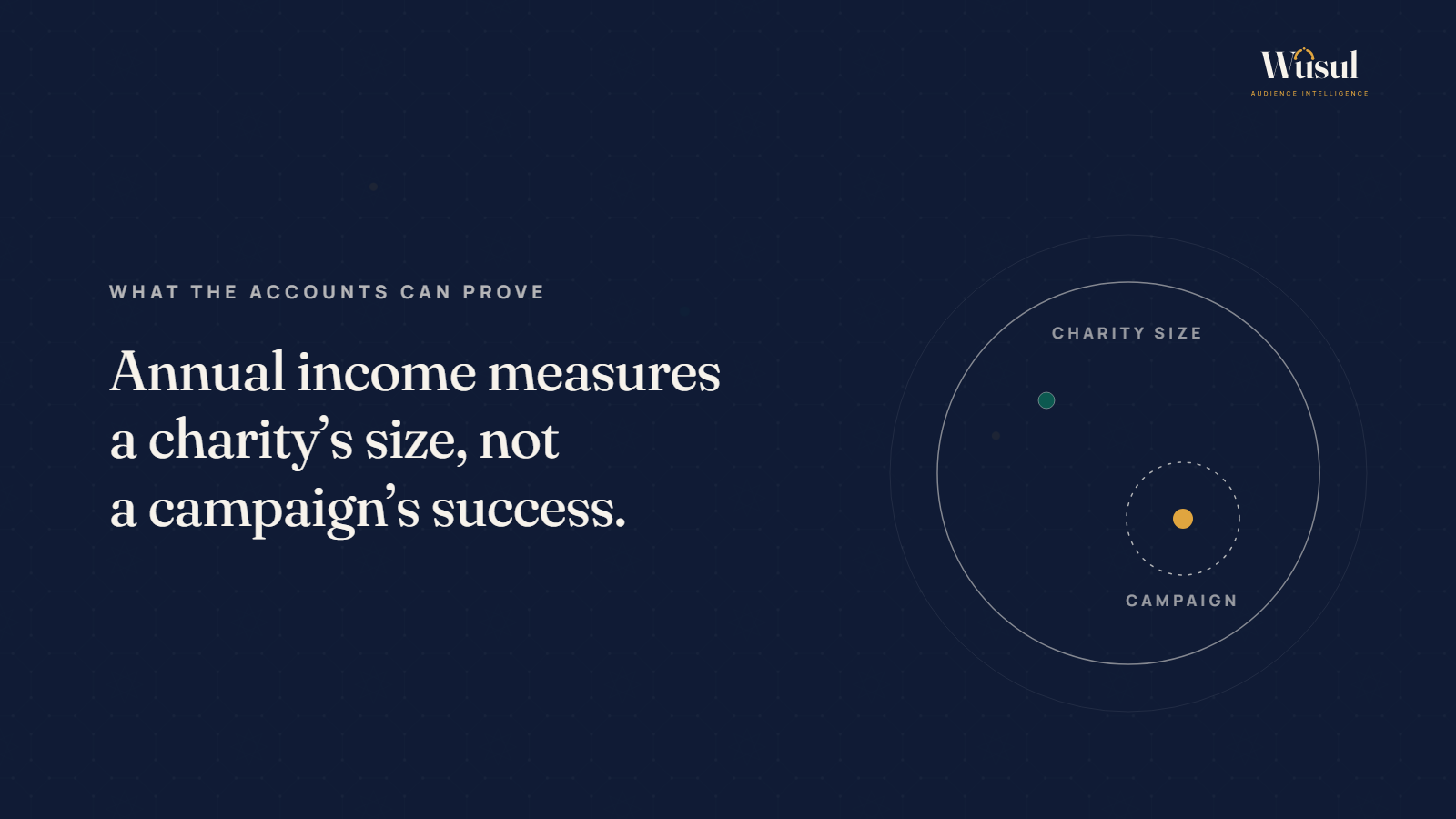
Wusul Insight: Annual income measures a charity's size, not a campaign's success. Across ten British Muslim charities, the accounts reveal sharp growth, sharp decline and changing income mixes, but mismatched financial years, emergencies, Ramadan and the absence of December totals mean none of it can be traced to the year-end. Publishing the share of income received in December, as NZF does for Ramadan, would change that.
Methodology note: the study covers the ten British Muslim charities in Wusul's year-end giving dataset. The 2023-2024 comparison uses total gross income for financial years ending in each year, from Charity Commission records; percentage changes and the median are calculated from rounded figures. Financial years end in different months and are not aligned to December. 2025 figures are shown where available. Total income, donations and legacies, gifts in kind, grants, Gift Aid and fundraising costs are treated as distinct. No figure is attributed to December, and no causal estimate of year-end fundraising is made. This is not an audit or a ranking.