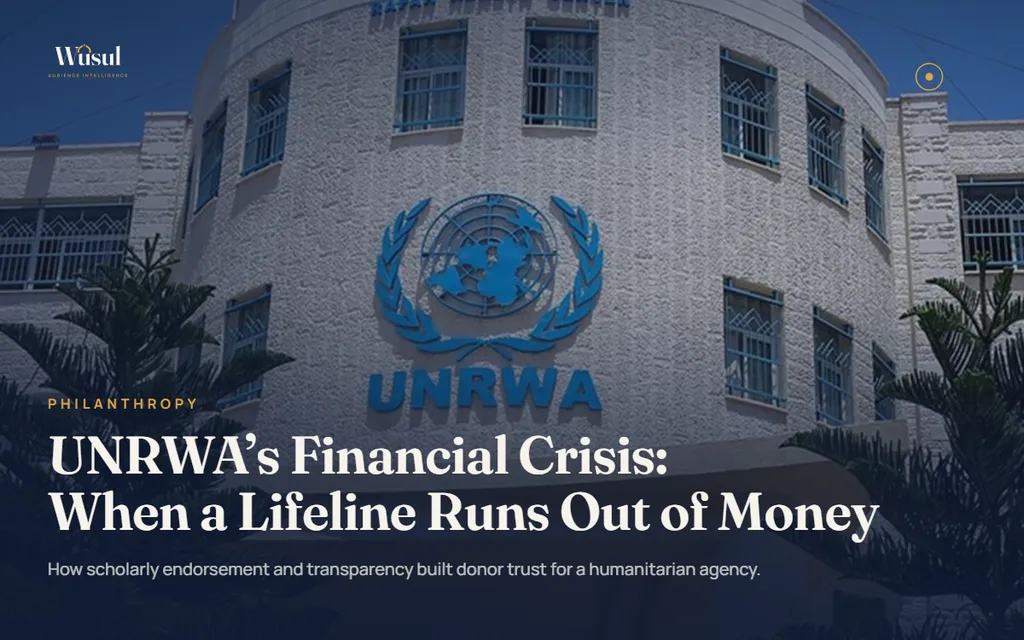
For nearly 75 years, the United Nations Relief and Works Agency for Palestine Refugees in the Near East (UNRWA) has been more than another UN body. Across Gaza, the West Bank, Jordan, Lebanon, and Syria, it has functioned as the backbone of public services for millions of Palestinian refugees, operating schools, health clinics, food distribution centers, shelters, and emergency relief programs.
Today, that system is under unprecedented financial strain.
The agency has weathered funding crises before. But the current shortfall arrives amid the largest humanitarian emergency in its history, as the war in Gaza has dramatically increased humanitarian needs while simultaneously making the agency itself the subject of intense political and diplomatic controversy.
The result is a crisis that extends beyond accounting. It raises fundamental questions about the future of humanitarian assistance for Palestinian refugees and the sustainability of an international system that relies largely on voluntary political goodwill.
An agency funded by choice, not obligation
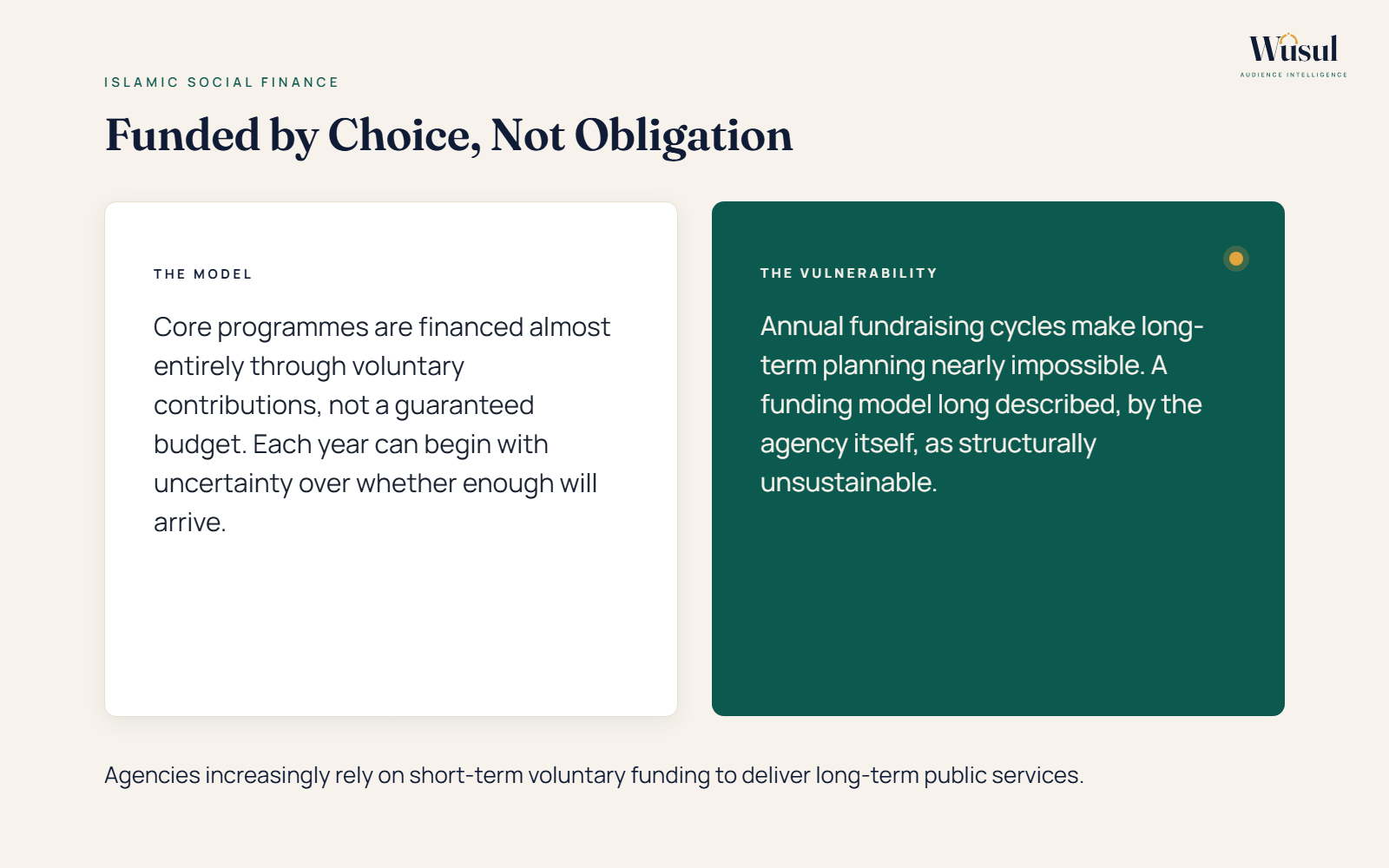
Unlike many UN bodies, UNRWA does not receive a guaranteed operational budget from the United Nations.
Its core programs, including education, healthcare, and social services, are financed almost entirely through voluntary contributions from member states. Emergency appeals, launched during conflicts or humanitarian disasters, depend on separate fundraising efforts.
This financing model has always made the agency vulnerable. Political changes in donor countries can quickly translate into budget gaps. For years, UNRWA has described its funding model as structurally unsustainable, warning that annual fundraising cycles make long-term planning nearly impossible. Each year often begins with uncertainty over whether sufficient funding will arrive to keep schools, clinics, and relief operations functioning.
As a 2022 academic analysis noted, the agency's funding has been characterized by a "jack-in-the-box" appearance and disappearance, with even long-time large donors wavering in their commitments. This financial instability has put UNRWA, in the words of its Commissioner-General, on the "brink of collapse."
A perfect storm
The current financial crisis stems from several overlapping pressures with the Trump administration and Israel at the center.
The first is scale. Since the outbreak of the Gaza war in October 2023, humanitarian needs have expanded dramatically. Millions of displaced Palestinians have required food assistance, healthcare, shelter, clean water, sanitation services, and emergency protection. As needs increased, operating costs also rose sharply.
The second is political. Donor confidence weakened after Israel alleged that a small number of UNRWA employees had participated in the October 7 attacks. The allegations prompted several major donor countries to suspend or review their funding while investigations were launched.
Although many governments later restored contributions following independent reviews and additional oversight measures, the interruptions exposed how politically fragile UNRWA's funding base had become. The United States (historically one of UNRWA's largest donors) has remained absent from the agency's funding base since January 2024, when it cut off funding following the Israeli allegations. Sweden also cut its funding for 2025.
Finland, which had maintained a four-year agreement providing €5 million annually from 2023 to 2026, announced in August 2026 that it would end its support for UNRWA when the agreement expired, redirecting funding through other channels such as the World Food Program.
The third is structural. The agency's mandate was renewed by the UN General Assembly in December 2025 with overwhelming support. But funding to implement that mandate has not been forthcoming. As UNRWA itself stated: "UNRWA cannot fulfil all the responsibilities entrusted to it without the requisite resources."
An alarming budget shortfall
UNRWA has repeatedly warned that its financial position is deteriorating.
By June 2026, UN Secretary-General António Guterres told an emergency meeting of the General Assembly that the agency faced a $100 million funding gap and was nearing collapse after austerity measures and sharp spending cuts. A pledging conference held on 30 June 2026 reported that only approximately 44% of the Program Budget had been confirmed in pledges, of which $267 million had been received. Based on the current donor pipeline, a projected funding gap of $275 million remained for 2026.
By November 2026, UNRWA reported a cashflow deficit of $80 million, with accumulated liabilities and recurring financial obligations threatening its longer-term sustainability.
The funding gap affects not only emergency aid but also routine public services that millions depend on every day. Unlike many humanitarian organizations that respond primarily to emergencies, UNRWA operates one of the largest education and healthcare systems in the Middle East. Its budget supports teachers, doctors, nurses, engineers, sanitation workers, and administrative staff serving generations of Palestinian refugees. The agency employs approximately 28,000 personnel, the overwhelming majority of whom are Palestinian.
The human cost of austerity
Financial crises rarely remain confined to balance sheets.
UNRWA has already introduced austerity measures in response to worsening budget pressures. The agency has cut its service hours by 20%, reduced the salaries of local staff, and left 15% of international positions vacant. In Gaza, the school week in some areas has been reduced from five to four days.
Reports from late 2026 indicated that proposals to lay off between 7,000 and 8,000 employees out of approximately 15,000 across the occupied Palestinian territories were under consideration (nearly half the agency's workforce) under the pretext of addressing its funding gap. UNRWA has stated that "a reduction in workforce will take place only where financial and operational circumstances leave no viable alternative," but acknowledged the "profound implications such measures would have for its personnel, their families, and the communities they serve" .
Such decisions carry consequences beyond employment. Fewer staff can mean larger classrooms, longer waits at health centers, slower aid distribution, and reduced support for some of the world's most vulnerable communities.
The pressure is especially acute in Gaza, where UNRWA has remained one of the few organizations with longstanding operational infrastructure despite repeated displacement, damaged facilities, and severe restrictions on humanitarian access. Since October 2023, 390 agency employees have died in Gaza.
In November 2026, UNRWA employees marched in Khan Younis to protest potential layoffs and demand the protection of their labor rights. The UNRWA Arab Employees Union described the proposed austerity measures as devastating for staff livelihoods and disruptive to critical services for displaced Palestinians.
UNRWA is more than a humanitarian agency
Established in 1949 following the first Arab Israeli war, UNRWA serves registered Palestinian refugees across five fields of operation: Gaza, the West Bank, Jordan, Lebanon, and Syria. Unlike UNHCR, which works to find long-term solutions for refugees worldwide, UNRWA was created specifically for Palestinian refugees until a political solution to their status could be achieved.
That unique mandate has long made the agency a subject of political debate. Supporters argue that UNRWA fills an indispensable humanitarian role that no other organization currently has the capacity to replace. Critics contend that the agency has become part of a prolonged political status quo surrounding the Palestinian refugee issue.
Those debates have increasingly shaped donor decisions, making UNRWA's financial health inseparable from broader geopolitical dynamics. As one academic analysis noted: "The failure to sufficiently support UNRWA is in effect a decision of the international community not to provide for the humanitarian needs of refugees."
The Islamic philanthropy response: a growing channel
Amid the funding crisis, a new channel has emerged: Islamic giving.
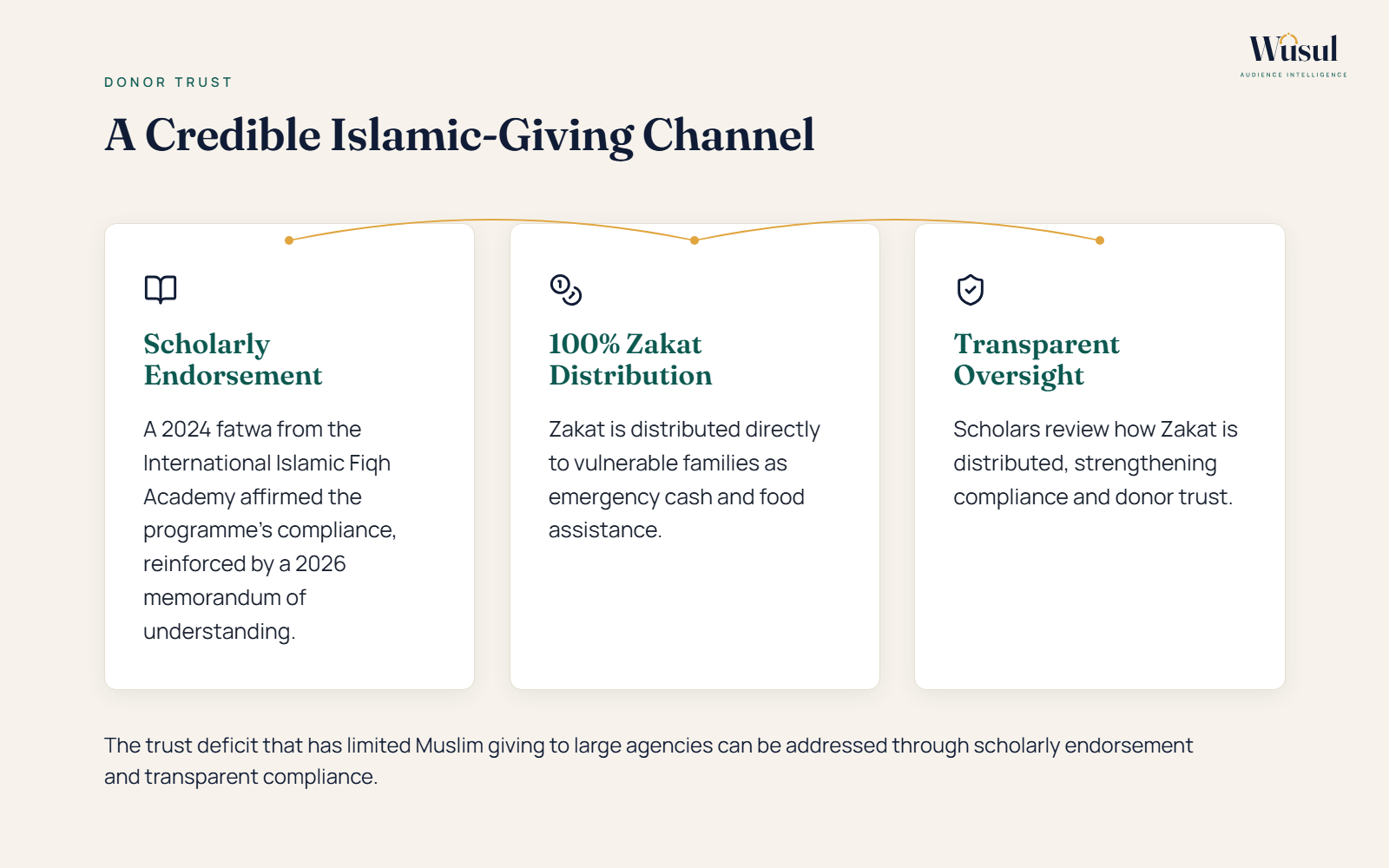
In June 2026, UNRWA and the International Islamic Fiqh Academy (IIFA); an institution under the Organization of Islamic Cooperation bringing together leading Islamic scholars, signed a Memorandum of Understanding to strengthen UNRWA's Islamic Giving and Zakat programs. The agreement ensures that UNRWA's fundraising initiatives are fully aligned with Islamic Sharia principles. The Academy will provide expert guidance on Islamic charity, review how Zakat donations are distributed to ensure compliance with Islamic rules and contribute to strengthening transparency and donor trust.
IIFA had already endorsed UNRWA's Zakat program through a 2024 Fatwa affirming its compliance with Sharia principles. The current agreement aims to further enhance the credibility and transparency of the program.
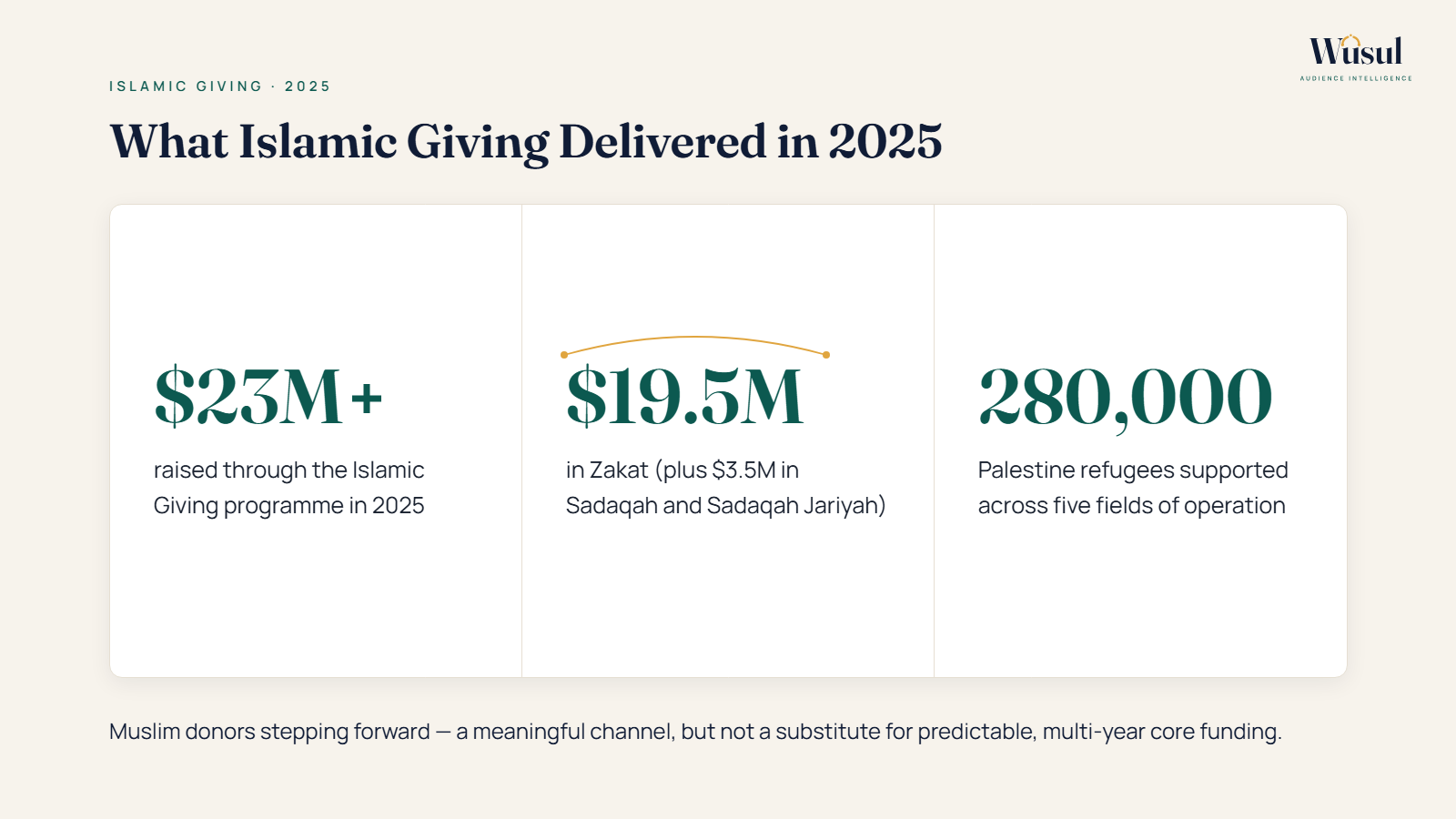
The results are tangible. In 2025, UNRWA's Islamic Giving program raised more than $23 million, including $19.5 million in Zakat and $3.5 million in Sadaqah and Sadaqah Jariyah contributions, supporting almost 280,000 Palestine Refugees across Gaza, the West Bank, Jordan, Lebanon, and Syria.
Under its Islamic Giving program, UNRWA distributes 100% of Zakat donations directly to vulnerable refugee families in the form of emergency cash and food assistance. Other forms of Islamic giving, including Sadaqah and Sadaqah Jariyah, fund a broad range of services, from education and healthcare to shelter, access to clean water and emergency relief.
This development is significant for two reasons. First, it demonstrates that Islamic philanthropy can play a meaningful role in sustaining humanitarian institutions that serve Muslim populations. Second, it shows that the trust deficit that has historically limited Muslim giving to large international agencies can be addressed through scholarly endorsement and transparent compliance.
Searching for new donors
Facing recurring deficits, UNRWA has sought to diversify its funding base. The agency has expanded partnerships with Gulf countries, Asian donors, philanthropic organizations, and private-sector supporters while encouraging existing donors to shift from annual emergency contributions toward more predictable multi-year funding commitments.
The European Union has also emphasized the need for a more sustainable financing model while continuing significant financial support. Yet diversification has proven difficult. Replacing one major donor requires multiple new contributors, and humanitarian funding globally is increasingly stretched by simultaneous crises in Ukraine, Sudan, Afghanistan, Myanmar, and elsewhere. Competition for limited aid budgets has intensified across the international system.
The agency's leadership has acknowledged this reality. In a pledging conference, UNRWA stated: "Our goal over the next 5-10 years is to make UNRWA more financially sustainable and supportable, by reducing duplication and redundancy and by adopting a more sustainable service-delivery model."
A story from Gaza
Consider the story of Haneen and her daughter Dina, as told through UNRWA's Islamic Giving impact reports.
Amid overwhelming needs, Haneen received a message from UNRWA notifying her that her family had been eligible for emergency cash assistance for families fostering unaccompanied and separated children with disabilities. For the first time since their displacement, Haneen could provide for Dina's most urgent necessities: hygiene supplies, clothes, and the medication she could not otherwise access.
This is what the funding crisis looks like in human terms. It is not measured in budget deficits. It is measured in whether a mother can buy medicine for her disabled child. It is measured in whether a teacher can keep showing up for her students. It is measured in whether a family can eat today.
For people like Haneen, Zakat provides dignity, stability, and relief in moments of uncertainty. It allows caregivers to meet urgent needs and ensures that people like Dina are cared for despite unimaginable hardships.
Can the model survive?
The financial crisis facing UNRWA reflects broader challenges confronting humanitarian financing worldwide. Humanitarian needs are growing faster than donor contributions. Agencies increasingly rely on short-term voluntary funding to deliver long-term public services. Political disagreements can quickly translate into operational disruptions affecting millions of civilians.
For UNRWA, the stakes are particularly high. Its future is not only about balancing budgets. It is about whether schools remain open, health clinics continue operating, and emergency assistance reaches families who have few alternatives.
As donors deliberate over future contributions, the agency finds itself caught between expanding humanitarian needs and shrinking financial certainty. The Islamic Giving program offers one path forward, a way to tap into a source of funding that is both religiously motivated and rigorously overseen. But it is not a substitute for the core funding that UNRWA has historically received from member states.
The agency needs both. It needs the predictable, multi-year commitments of governments. And it needs the trust and generosity of Muslim donors who want to fulfil their Zakat obligations in a way that reaches the most vulnerable.
Conclusion: The Lifeline and the clock
For millions of Palestinian refugees, UNRWA is not an abstraction. It is the school their children attend. It is the clinic where they receive healthcare. It is the food parcel that keeps them alive.
The agency's financial crisis is not just a budget problem. It is a moral one. It asks whether the international community is willing to fund the services that millions depend on. It asks whether donor countries will prioritize humanitarian needs over political considerations. It asks whether the world will allow an agency that has served refugees for nearly 75 years to collapse.
The Islamic Giving program offers a partial answer. It shows that Muslim donors are willing to step forward when traditional donors step back. It shows that trust can be built through scholarly endorsement and transparent distribution. It shows that Zakat and Sadaqah can sustain institutions that serve the most vulnerable.
But it is not enough. UNRWA needs the predictable, sustained funding that only governments can provide. It needs the international community to honor the mandate it renewed. It needs the world to decide that Palestinian refugees are not disposable.
The clock is ticking. The lifeline is fraying. The question is whether anyone will catch it before it breaks.
At Wusul, we believe that cultural intelligence means understanding not just what donors give to, but why; and designing engagement that honors the values, trust signals, and aspirations of the communities we serve. UNRWA's crisis is a reminder that the most vulnerable are always the first to suffer when funding fails. But it is also a reminder that Islamic philanthropy, when done with integrity and transparency, can be a lifeline. The organizations that can build that trust (that can speak the language of faith and evidence) will be the ones that make a difference when it matters most.
Frequently asked questions
Is UNRWA a UN agency?
Yes, the United Nations Relief and Works Agency for Palestine Refugees in the Near East is a United Nations body. It has functioned for nearly 75 years as the primary provider of public services for millions of Palestinian refugees across Gaza, the West Bank, Jordan, Lebanon, and Syria.
What is the role of UNRWA?
UNRWA serves as the backbone of public services for millions of Palestinian refugees. It operates schools, health clinics, food distribution centers, shelters, and emergency relief programs. The agency employs approximately 28,000 personnel, including teachers, doctors, nurses, engineers, and sanitation workers, to provide essential daily support to the refugee population.
How does UNRWA get its funding?
Unlike many UN bodies, UNRWA does not receive a guaranteed operational budget from the United Nations. Its core programs and emergency appeals are financed almost entirely through voluntary contributions from member states. This reliance on voluntary political goodwill makes the agency vulnerable to budget gaps and creates significant long-term financial uncertainty.