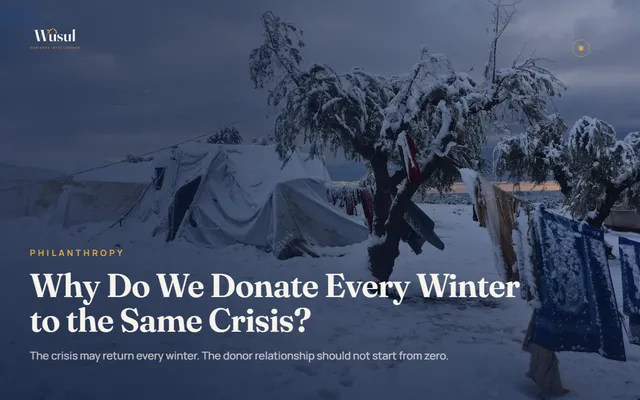
A Canadian donor does not need a fundraising campaign to explain what a bitter winter feels like. The freezing morning, the extra layers before leaving home, the heating that runs for months, the snow that reorganises how people travel and work: for millions of Canadians, winter is not an emergency but a fixed part of the year.
Predictable is not the same as safe. A household with heating, insulated walls, warm clothes and a steady income lives through cold very differently from someone sleeping outdoors, crowded into a shelter or unable to pay the electricity bill. The same is true abroad. A displaced family may face temperatures milder than a Canadian city's and be in far greater danger, because it lacks everything that makes cold manageable.
That raises a question Canadian Muslim charities answer, implicitly, every autumn: does living through hard winters make Canadians more responsive to people facing winter elsewhere? Several of their appeals are built on the assumption that it does. The research suggests the answer is more interesting. Knowing the cold can open the door to compassion. It can also close it.
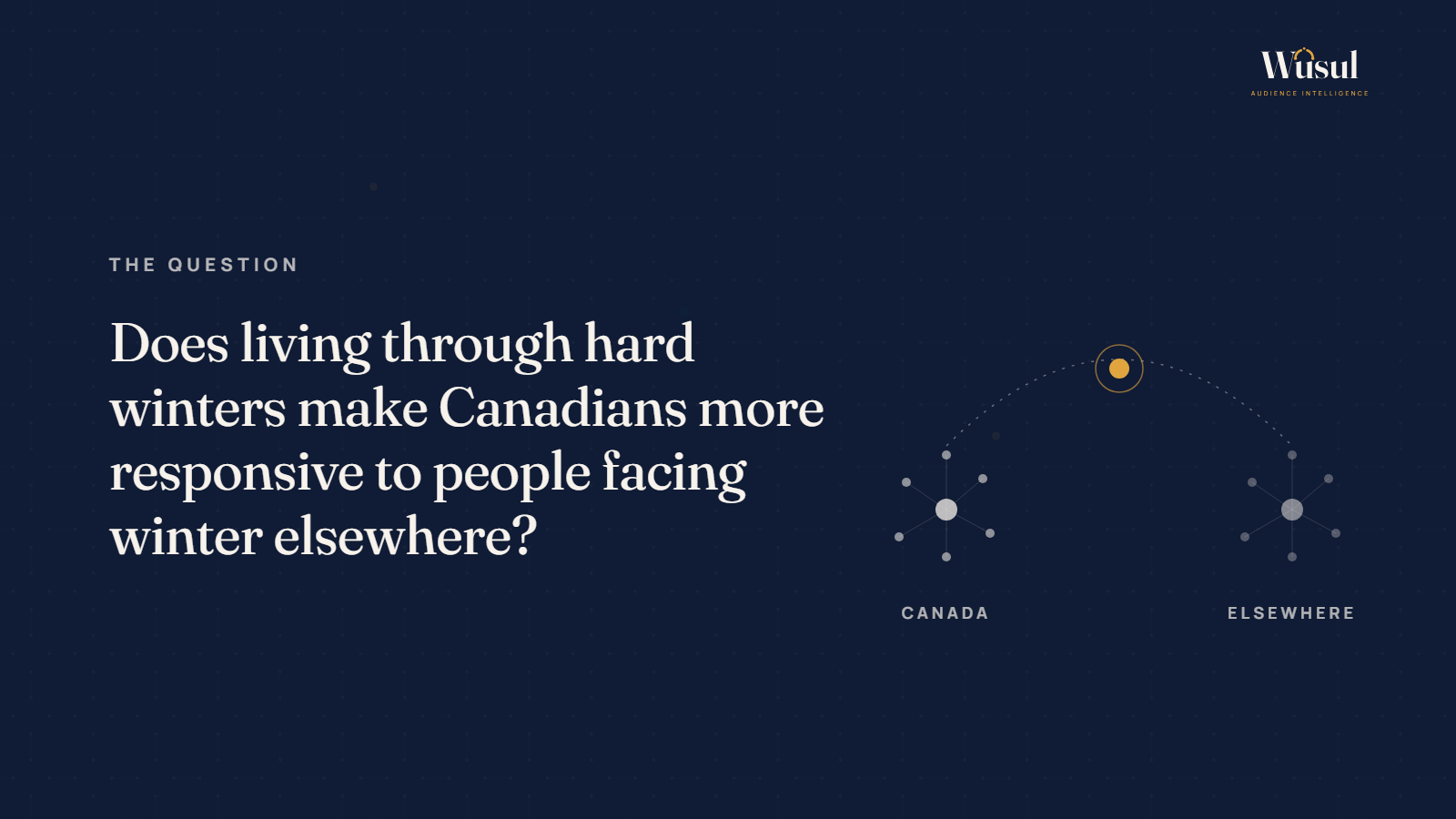
Canada adds three things to Wusul's winter series. Its charities run winter programmes at home and abroad at once. Its donors live through some of the world's coldest winters, in a country whose winters are warming fast. And its tax year ends on 31 December, in the middle of the giving season. Each changes how the question should be asked.
This article, part of Wusul's winter series, asks whether knowing the cold makes donors more generous towards people facing it, and finds research pointing both ways.
How cold is a Canadian winter?
Canada is not one climate. Winter in Vancouver bears little resemblance to winter in Winnipeg or in northern communities, and exposure varies with housing and income even within one city. Canada's winters are also changing fast. Environment and Climate Change Canada reported that December 2023 to February 2024 was the warmest winter in its national record, which begins in 1948: 5.2°C above the 1961-1990 average, and 1.1°C warmer than the previous record in 2009-10. Across the full record, average winter temperatures have risen by about 3.6°C.
That does not mean Canada no longer has dangerous cold. It means winter severity has to be measured, not assumed. A cultural identity built around winter can coexist with winters that are, on average, much milder than they were.
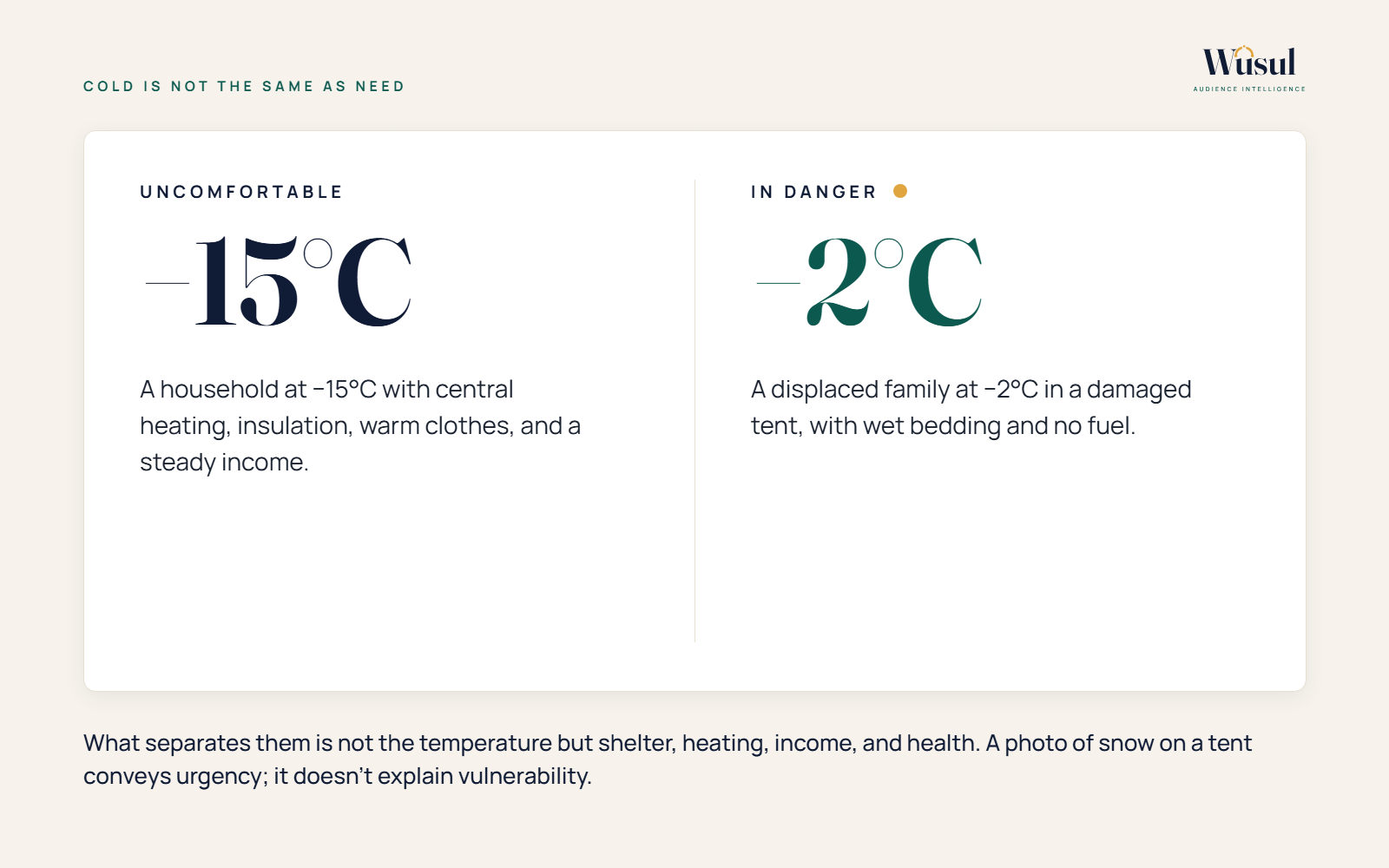
It also sharpens a point made earlier in this series, in Does a Colder Winter Raise More Money?: cold is not the same as need. A Canadian household at minus 15°C with central heating is uncomfortable. A displaced family at minus 2°C in a damaged tent, with wet bedding and no fuel, is in danger. What separates them is not the temperature but shelter, heating, income and health. The best winter appeals explain why the same weather produces such different consequences. A photograph of snow on a tent conveys urgency; it does not explain vulnerability.
Does knowing cold make you kinder, or harsher?
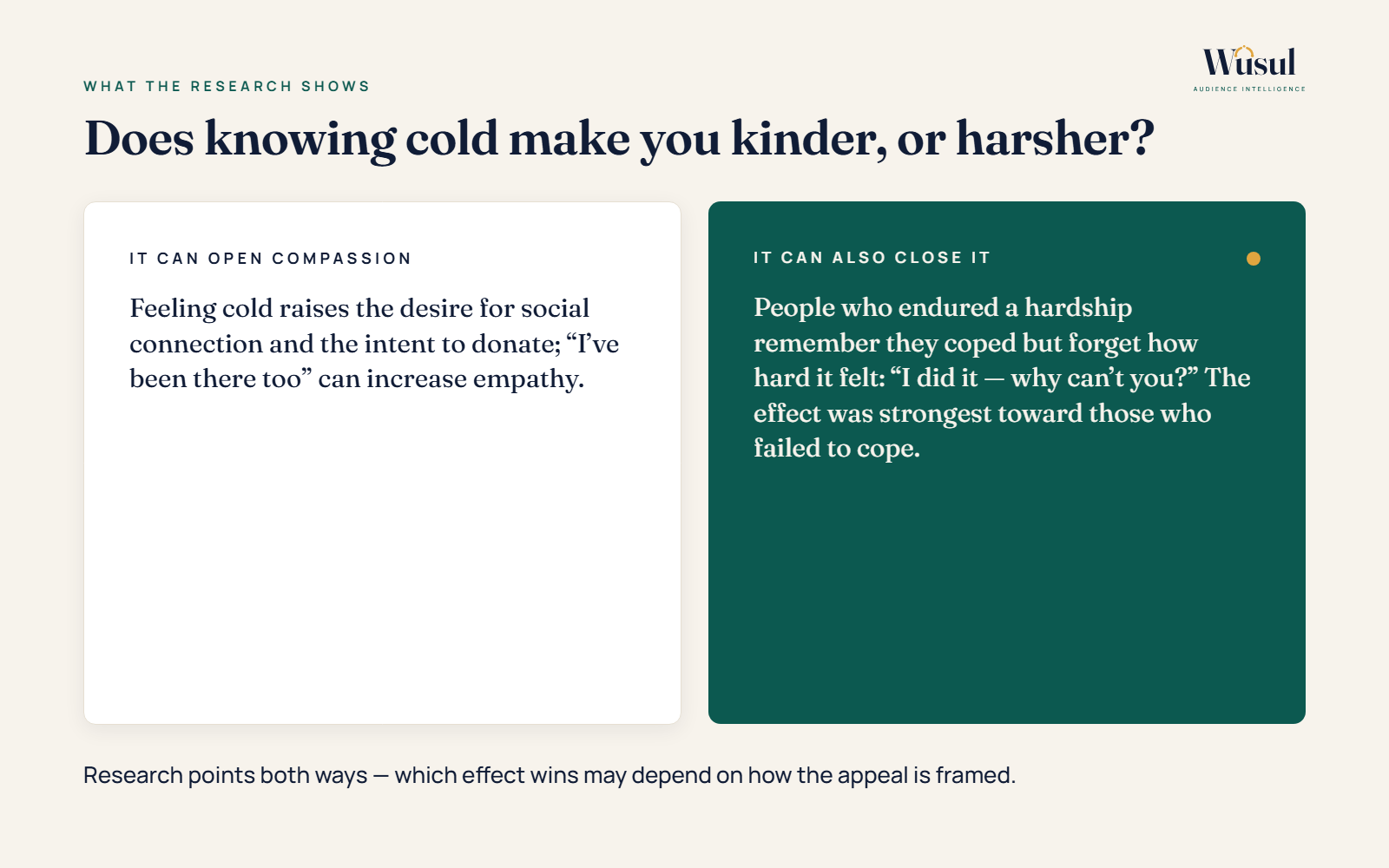
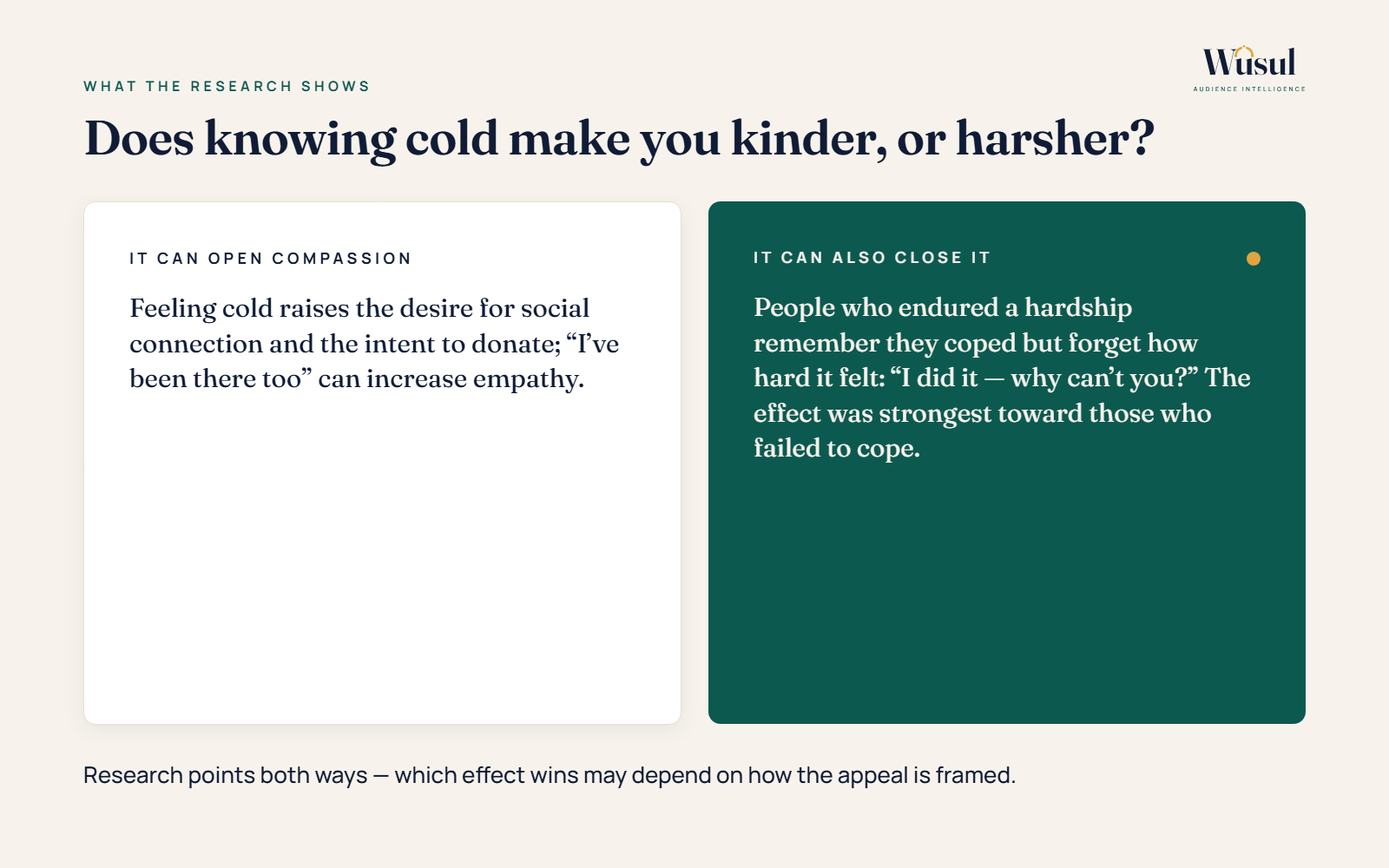
The intuition behind Canadian winter appeals is that people who know cold will feel for those who suffer from it. Some research supports that. Experiments by Rai, Lin and Yang found that cold temperature cues increased people's intention to donate, because feeling cold raises the desire for social connection. Earlier work by Batson and colleagues found that having experienced a need oneself, "I've been there, too", can increase empathy for others facing it.
But there is an important counterweight, and it was tested, fittingly, in icy water. Ruttan, McDonnell and Nordgren recruited 54 people taking part in a polar plunge, a charity swim in freezing water. All read about Pat, a man who signed up for the plunge but backed out at the last moment. Those who had already completed their own plunge felt less compassion and more contempt for Pat than those who had not yet jumped. Later experiments found the same with unemployment and bullying.
The researchers' explanation is that people who have endured a hardship remember that they coped, but forget how hard it felt, so the event seems less difficult in hindsight: "I did it. Why can't you?" Crucially, the effect was strongest towards people who failed to cope. Towards someone still enduring, prior experience could help.
For winter appeals, the implication is subtle but important. An appeal that says "you know how hard winter is" invites the donor to compare endurance, and risks the response "we manage every year". An appeal that says "you know winter, and you have heating, insulation and a warm home; these families have none of them" invites a comparison of resources, where the donor's own experience works in the family's favour. Canada's winters may make donors more generous, or more judgemental. Which one may depend on how the appeal is framed.
Three examples of Canadian Muslim winter appeals
Let's take a look at three prestigious nonprofits and how differently Canadian Muslim charities turn winter into an appeal.
Islamic Relief Canada: winter at home
Islamic Relief Canada runs a domestic Winter Warmth programme alongside its international winter work. In November 2025 it announced a national campaign across 18 Canadian cities, aiming to distribute 3,000 winter hygiene kits and 3,000 food packs to about 3,000 people, and said the programme had supported more than 35,000 people across 25 regions since it began in 2018. Those are a target and a cumulative claim, not verified results. But the model matters: the donor recognises the climate, and the person helped may live in the same city. Internationally, the same charity's winter work ranges from cash in Afghanistan to firewood and electricity in Bosnia, blankets in Nepal and heating materials in Syria. One seasonal message; very different interventions.
Muslim Hands Canada: winter as a product
Muslim Hands Canada's winter appeal offers three packages: warm winter clothes for a family at CAD 100, a winter emergency food parcel at CAD 175, and a winter family survival pack of food, blankets, clothing and bedding for a month at CAD 350, for communities in Pakistan, Yemen, Türkiye and Canada. As the second article in this series found for British appeals, such prices make giving simple but leave the key questions open: for how many people, for how long, and is it enough?
Human Appeal Canada: comparing resources, not endurance
Human Appeal Canada's winter appeal uses the Canadian winter directly, and in the way the research points to. It describes Canadians who layer up, turn on the heat and wrap their hands around a hot mug when winter drops below −20°C, and then families in Gaza, Syria, Lebanon and Pakistan facing the same cold with no walls, coats or blankets. The comparison is about what people have, not how tough they are.
The page also shows how national websites in an international network relate to one another. Its country kits are the same as those on Human Appeal USA's site, with the same contents, and their prices differ by almost exactly the exchange rate:
| Kit | Human Appeal USA | Human Appeal Canada | Ratio |
|---|---|---|---|
| Pakistan winter kit | USD 62 | CAD 85 | 1.37 |
| Lebanon winter kit | USD 125 | CAD 175 | 1.40 |
| Syria winter kit | USD 165 | CAD 230 | 1.39 |
| Pakistan winter clothing | USD 72 | CAD 99 | 1.38 |
That is sensible: the same kit costs the same to deliver wherever the donor lives. It also confirms that the price on a Canadian donation page is set by the programme and the exchange rate, not by anything Canadian. The page's impact figures for "the last 4 winters" raise a different question: they report 544,900 families shielded from the cold and 279,701 winter items distributed. More families than items is possible if many were helped with fuel or cash, but the page does not say, and the figures appear to cover the international network rather than Canadian donations alone. As the American article in this series found, a national charity's website and its own legal entity's results are not the same thing.
December: the tax year and the giving season
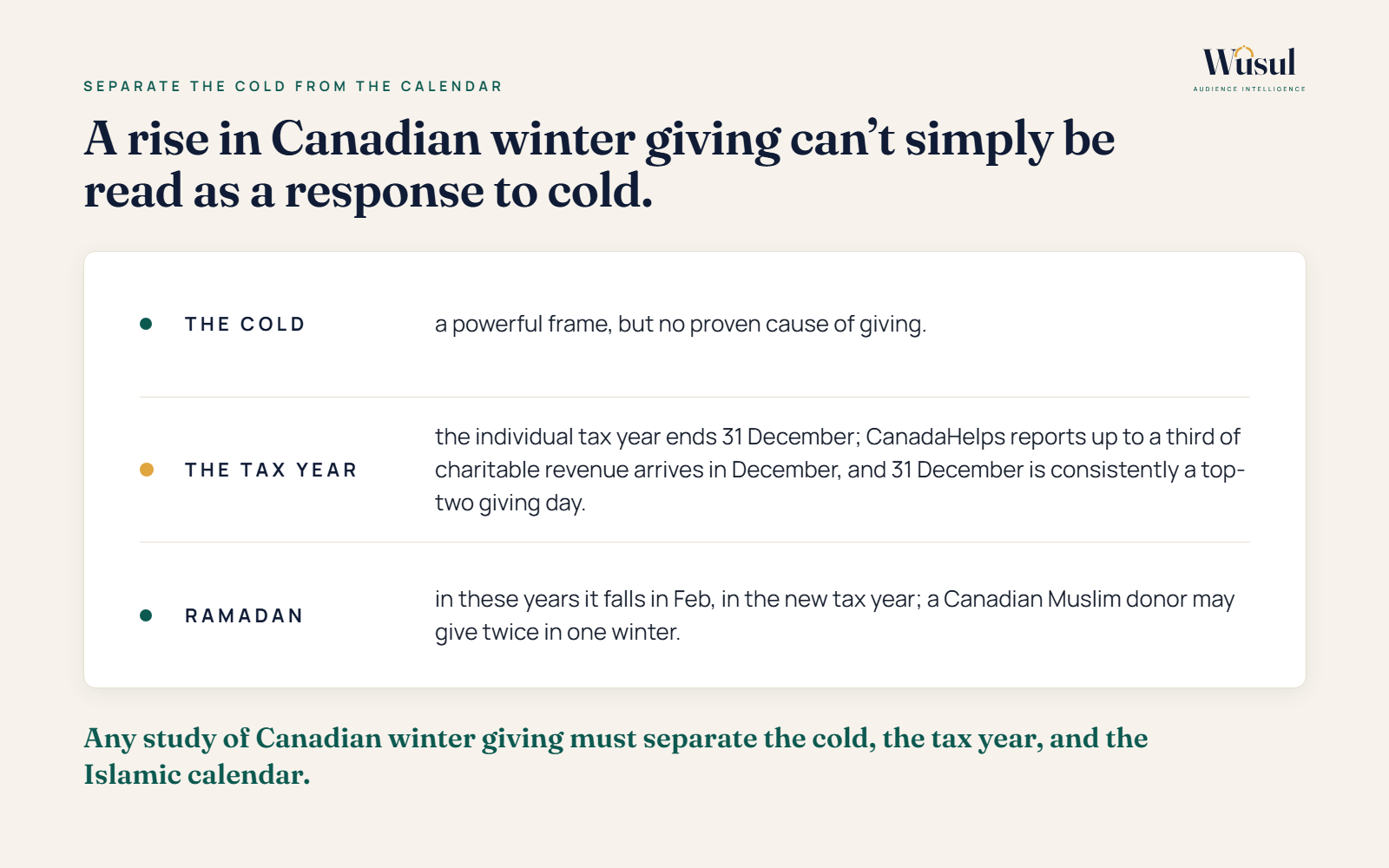
In Canada, the individual tax year ends on 31 December. Gifts to registered charities can earn federal and provincial tax credits, and unused credits can generally be carried forward for up to five years. That deadline shapes Canadian giving more than any thermometer.
CanadaHelps, the country's largest online giving platform, reports that up to a third of all charitable revenue arrives in December, 10% of annual donations come in the last three days of the year, and GivingTuesday and 31 December are consistently the two biggest days. It has told Parliament that the tax deadline drives a significant portion of giving, with almost 6% of its annual volume on 31 December alone. Meanwhile, its 2024 report found the number of Canadians giving had fallen for the eleventh consecutive year, with inflation adding to the strain.
So a rise in winter giving in Canada cannot simply be read as a response to cold. December is when Canadians give, whatever the weather. Exceptional years make the point: after the Canada Post strike in late 2024, the government let 2024 donations be claimed if made by 28 February 2025.
For Muslim donors, there is a second calendar. Ramadan began in mid-February 2026 and is expected in early February 2027, in the new tax year. In these years, a Canadian Muslim donor may give twice in one winter: in December, for the tax year, and in Ramadan, for Zakat and Sadaqah. Gifts to registered charities, including Zakat, can earn tax receipts, but the religious designation alone does not decide that. Any study of Canadian winter giving needs to separate three things: the cold, the tax year and the Islamic calendar.
Canada as a natural laboratory
Does a Colder Winter Raise More Money? set out how a charity could test whether weather affects giving: weekly donations, local temperatures, measures of news attention, and controls for every calendar that shapes giving. Canada offers three features that would make such a study unusually powerful.
Different winters, one campaign. On the same day, a donor in Vancouver may be standing in drizzle at 6°C and one in Winnipeg in −25°C. With anonymised donor regions and regional weather data, a charity could compare responses to the same appeal under very different conditions, while allowing for differences in income, age and giving history between regions.
A record warm winter. 2023-24 was Canada's warmest winter on record. Comparing giving that winter with colder ones, after allowing for the December tax effect, Ramadan, emergencies such as Gaza and changes in campaign spending, would show whether donor-side cold matters at all.
A testable message. The polar plunge research suggests a cheap and decisive experiment. Returning donors could be randomly sent one of two appeals for the same programme: one that says "you know how hard winter is", one that says "you have heating and a home; they do not". If the second consistently performs better, charities would learn something useful about framing, whatever the weather.
The last test would show which message persuades. It would not show that experiencing cold caused anyone to give. A campaign can prove that a winter message works without proving that winter weather is why.
What Canadian charities could report
Canada's dual model, winter help at home and abroad under one appeal, makes clear reporting both more important and more straightforward. A Canadian winter statement could separate:
- Money raised for domestic and international winter work, and how much arrived in December for the tax year versus in Ramadan.
- What was delivered in each place, recognising that a hygiene kit for someone sleeping rough in Toronto and heating fuel in Idlib are different kinds of help, and should not be added into one total.
- Unique people or households reached, without double counting, and whether the figures are Canadian or network-wide.
- Whether help arrived before the worst cold, which for domestic programmes may mean before the first extreme cold alerts.
- What recipients said afterwards, and what needs remained.
Some Canadian charities already offer pieces of this. Islamic Relief Canada publishes targets and cumulative reach for its domestic programme. Human Appeal Canada links its appeal to an online impact tracker for the winter campaign and promises that gifts reach families within weeks. The next step is to report the results of each season against the plans announced at its start: the 3,000 kits promised, and the number actually delivered.
Conclusion: knowing cold is not knowing vulnerability
Canada challenges a simple assumption. Its donors know winter intimately, and its Muslim charities use that knowledge in their appeals, for families abroad and for neighbours at home. But knowing how winter feels is not the same as knowing what it is like to face it without shelter, heating or income.
The research suggests that familiarity can work in two directions. Feeling cold, and remembering one's own hardship, can open the way to compassion. Having coped can also make others' struggles look easier than they are. Which effect wins may depend less on the weather than on the message: an appeal that compares endurance invites judgement; one that compares resources invites generosity.
Whether Canadians give more because their winters are hard remains unproven. Answering it means separating the cold from the tax year, and both from Ramadan. What is already clear is that the Canadian winter is a powerful frame, and that how charities use it matters.
Frequently asked questions
Do Canadian Muslim charities help people through winter in Canada?
Yes. Islamic Relief Canada runs a domestic Winter Warmth programme, and Muslim Hands Canada and ICNA Relief Canada also describe winter support inside Canada, alongside international winter appeals.
Does experiencing cold make people more generous?
It can. Experiments suggest feeling cold can increase willingness to donate. But research on people who have endured a hardship, including a polar plunge in icy water, found they can be less compassionate towards others who fail to cope with it. The framing of an appeal may decide which effect wins.
Why do Canadians give so much in December?
Largely because the tax year ends on 31 December. CanadaHelps reports that up to a third of charitable revenue arrives in December, and 31 December is consistently one of the two biggest giving days.
Was 2023-24 an unusually warm winter in Canada?
Yes. It was the warmest winter in the national record since 1948, 5.2°C above the 1961-1990 average.
Why are Human Appeal's Canadian prices higher than its American ones?
The kits are the same; the Canadian prices are close to the American ones converted at the exchange rate.
Do Zakat donations to Canadian charities get tax receipts?
Gifts to registered charities can qualify for tax credits, subject to the usual rules. Calling a gift Zakat does not by itself decide whether it is receiptable.
Wusul Insight: Canadian Muslim charities draw on donors' own experience of winter, at home and abroad. Research suggests that experience can raise compassion, or lower it when hardship seems easy in hindsight. Appeals that compare resources rather than endurance, and studies that separate the cold from the tax year and Ramadan, will tell charities what Canada's winters really do to giving.
Methodology note: this article combines official climate and tax information, published research and Canadian charities' appeal pages and announcements. Appeal pages are treated as evidence of current messaging and pricing, not as archives of past campaigns. Campaign targets and cumulative claims are distinguished from verified results. The price comparison uses Human Appeal's US and Canadian appeal pages as accessed in November 2026. No causal link between Canadian winter temperatures and Muslim giving has been established. This article is general information, not tax advice.