The same Islamic obligation costs £5 in Britain, $10 in the United States and anywhere from 110 to 2,805 taka in Bangladesh. Who sets those figures, and what they reveal about food,
Imagine five Muslims preparing for Eid al-Fitr: one in London, one in New York, one in Cairo, one in Jakarta and one in Moscow. All five are about to fulfil the same obligation, Zakat al-Fitr, the charitable payment that marks the end of Ramadan. Yet each meets a different number.
In London, most major charities asked for £5 per person in 2026. In New York, the Fiqh Council of North America recommended $10. In Cairo, Egypt Dar al-Ifta set a minimum of 35 Egyptian pounds. In Jakarta, the national Zakat agency BAZNAS asked for 50,000 rupiah. In Moscow, the Spiritual Administration of Muslims published three figures: 250 rubles as a minimum, 800 for those of moderate means and 1,300 or more for the well-off.
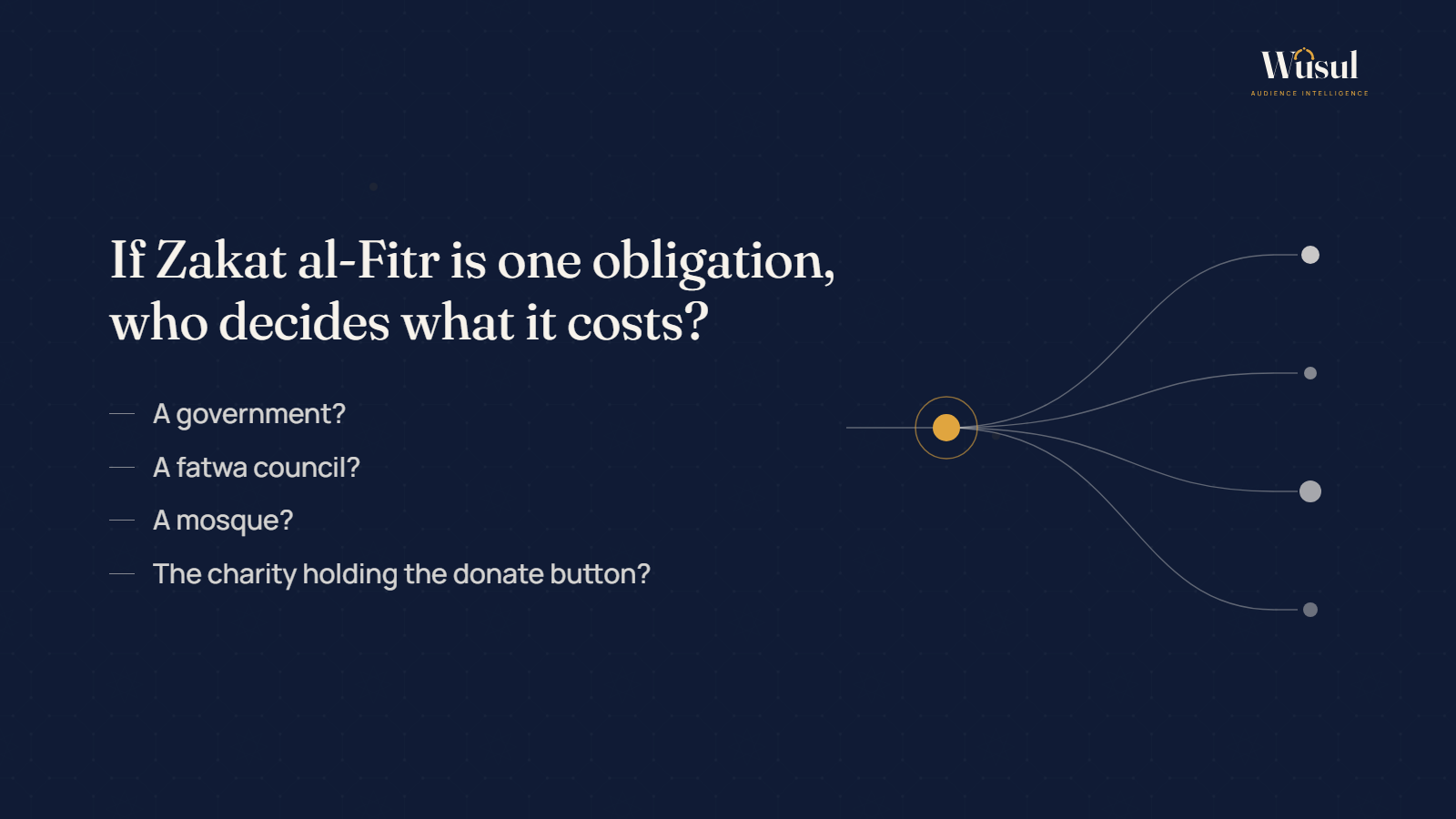
Exchange rates explain only a little of this. The rest comes from food prices, religious interpretation, institutional structure and the method used to turn a food-based obligation into money. Which raises the question at the heart of this article: if Zakat al-Fitr is one obligation, who decides what it costs? A government? A fatwa council? A mosque? The charity holding the donate button?
Before there was a price, there was a measure
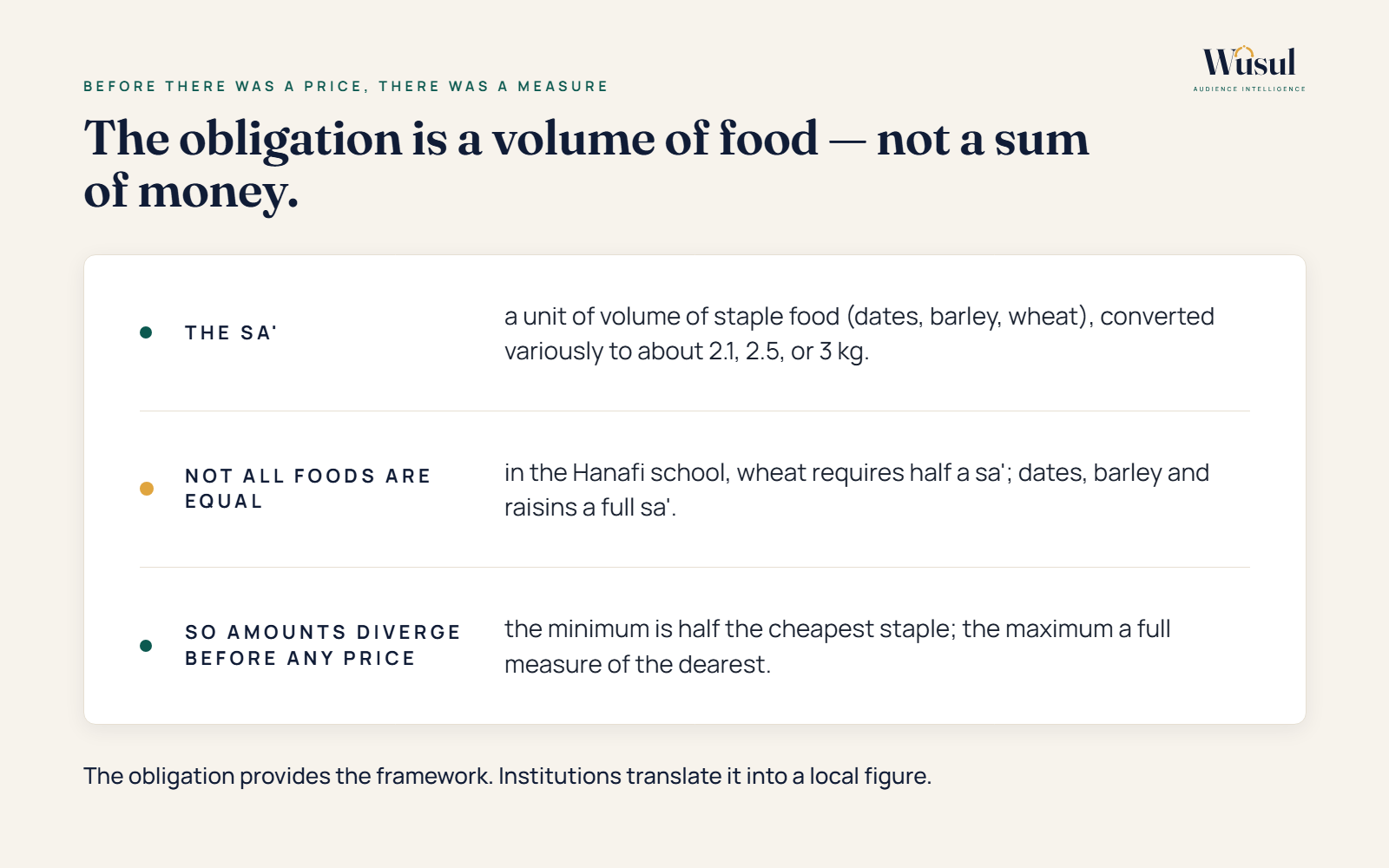
Zakat al-Fitr is different from annual Zakat. Annual Zakat is a percentage of qualifying wealth. Zakat al-Fitr is a fixed contribution per person, due before the Eid prayer, and its traditional measure is not money at all. It is the sa', a unit of volume. The hadith literature describes giving a sa' of staple foods such as dates and barley.
Two features of that measure explain much of today's variation.
First, a sa' is a volume, not a weight. Rice, wheat and dates do not weigh the same when they fill the same container, which is why modern guidance variously converts a sa' to around 2.1, 2.5 or 3 kilograms.
Second, the schools of jurisprudence do not treat every food alike. In the Hanafi school, the obligation for wheat or wheat flour is half a sa', while dates, barley and raisins require a full sa'. That single rule produces some of the widest price ranges in the world. In Bangladesh, the national committee sets 1.65 kg for wheat or flour but 3.3 kg for dates, raisins, cheese and barley. The minimum figure is half the quantity of the cheapest staple. The maximum is the full quantity of the most expensive.
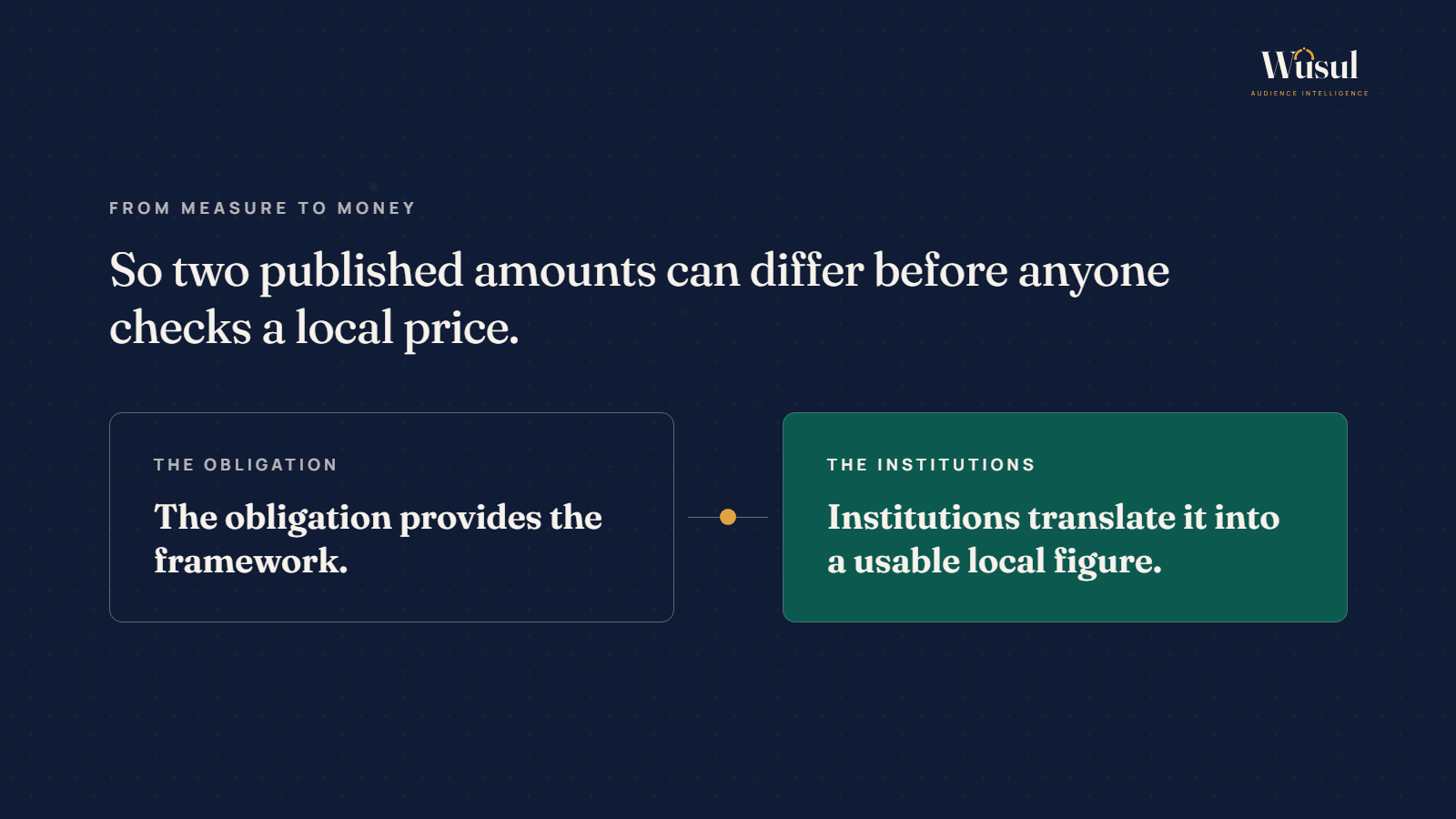
So two published amounts can differ before anyone checks a local price. The obligation provides the framework. Institutions translate it into a usable local figure.
The cash-or-food question
Before comparing prices, it helps to ask what a donor is actually doing when they pay Zakat al-Fitr online. Are they giving money, giving food, or appointing someone to give food for them? There are three practical models:
- Direct food. The donor buys the staple and hands it to an eligible recipient. This is closest to the original form of the obligation.
- Direct cash. The donor gives the recipient the monetary value, under guidance that permits it. The recipient gains flexibility to meet immediate needs.
- Cash collected, food delivered. The donor pays an institution acting as their agent, which then buys and distributes food. Islamic Relief describes its role this way, as a charitable agent that holds the money until it buys food at the right time.
Which model applies depends partly on jurisprudence. The Hanafi school has long permitted the monetary value, and bodies such as Egypt's Dar al-Ifta and the UAE Council for Fatwa accept cash. Many scholars, following the majority classical position, hold that it must be food. Saudi Arabia's Grand Mufti reaffirmed in 2024 that Zakat al-Fitr should be given as food, not cash, directly or through a representative.
The third model bridges the two: the donor pays digitally, but the beneficiary receives food. A charity can collect every Fitr payment online and still distribute everything as food, so describing that activity as "cash Zakat al-Fitr" would be misleading. Charities should state plainly which model they follow.
What do most Muslims actually do? There is no clear answer. The growth of online payments shows that digital collection is common, but not what beneficiaries ultimately receive. Answering that would require surveys or distribution records that separate how donors pay from what recipients get.
The 2026 snapshot: five pricing models
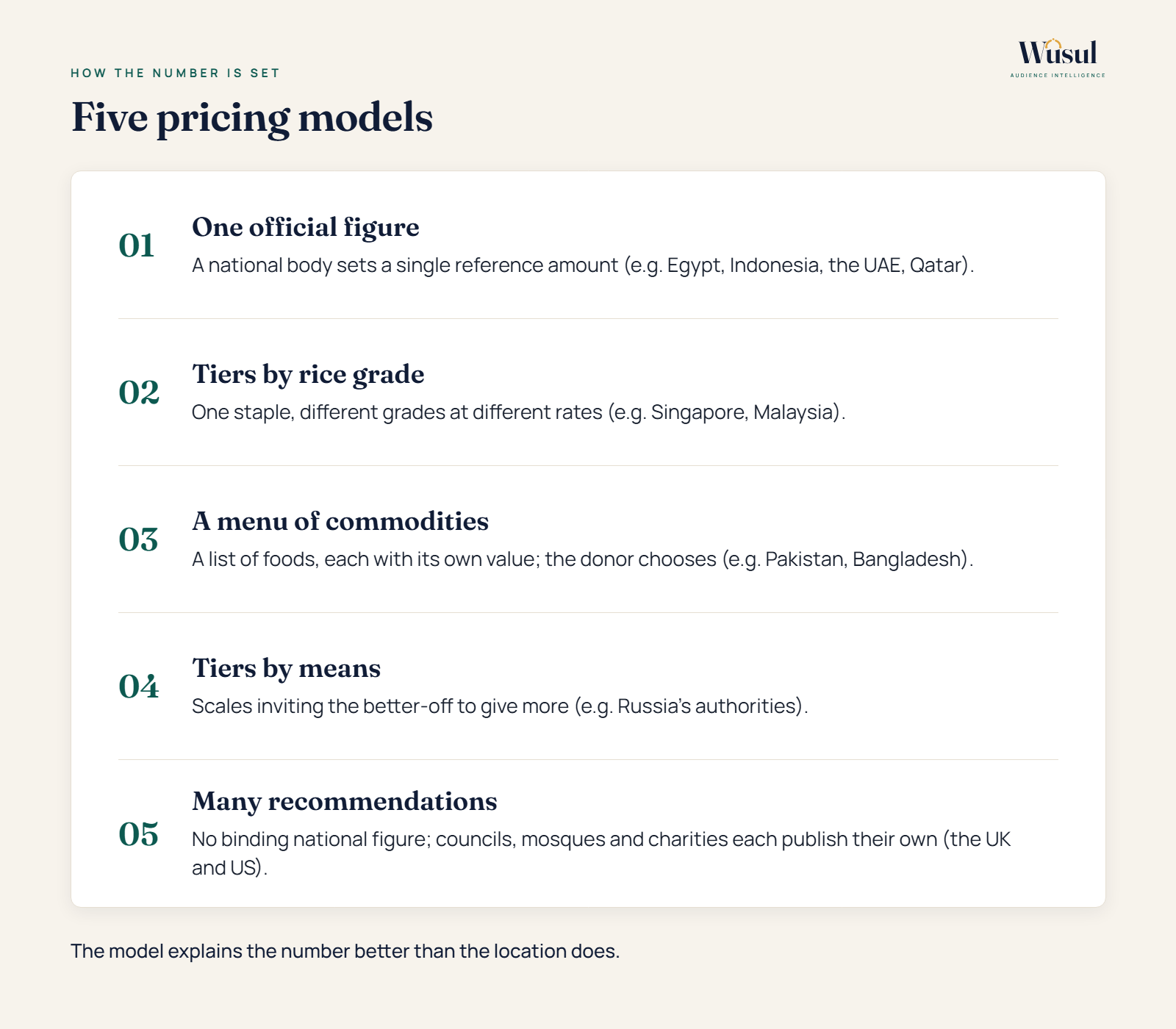
Across the countries studied, published figures fall into five broad models. The table groups them by model rather than by geography, because the model explains the number better than the location does.
| Model | Country | Who sets it | Ramadan 2026 amount (per person) | Reference food |
|---|---|---|---|---|
| 1. One official figure | Egypt | Dar al-Ifta, with Al-Azhar | EGP 35 minimum | Staple food value |
| 1. One official figure | Morocco | Supreme Council of Ulama | MAD 25 | Staple food value |
| 1. One official figure | Qatar | Ministry of Awqaf | QAR 15 | Rice |
| 1. One official figure | UAE | UAE Council for Fatwa | AED 25 | 2.5 kg rice |
| 1. One official figure | Indonesia | BAZNAS | IDR 50,000 | 2.5 kg premium rice |
| 2. Tiers by rice grade | Singapore | MUIS | SGD 5 or 8 | Median price of normal or higher-grade rice |
| 2. Tiers by rice grade | Malaysia (Selangor) | State religious authority | MYR 8, 16 or 25 | Rice grades |
| 3. Menu of commodities | Pakistan | Council of Islamic Ideology | PKR 300 to 5,400 | Wheat flour to dried grapes |
| 3. Menu of commodities | Bangladesh | National Fitra Fixation Committee | BDT 110 to 2,805 | Wheat or flour to cheese and dates |
| 3. Menu of commodities | Uzbekistan | Muslim Board of Uzbekistan | UZS 10,000 to 200,000 | Wheat to dates |
| 4. Tiers by means | Russia | Spiritual Administration of Muslims | RUB 250, 800 or 1,300+ | Dates, barley, wheat, raisins |
| 5. Many recommendations | United Kingdom | Charities and mosques | Commonly £5; some £5.50 to £10 | Flour or rice |
| 5. Many recommendations | United States | Fiqh Council of North America, mosques | $10 (FCNA); some mosques higher | Blended staples |
Saudi Arabia does not appear in the table, and that absence is itself a finding; it is discussed below.
Model 1: one official figure
In many Muslim-majority countries, a recognised national body publishes a single reference amount. Egypt's Dar al-Ifta set EGP 35 as a minimum per person for 2026, in coordination with Al-Azhar's Islamic Research Academy. Morocco's Supreme Council of Ulama set MAD 25 as the cash amount. The UAE Council for Fatwa announced AED 25, equivalent to about 2.5 kg of rice, after a price study with the Ministry of Economy and Tourism.
Indonesia follows the same pattern with a distinctly local reference. BAZNAS set IDR 50,000 for payments through its national system, based on about 2.5 kg of premium rice after a review of rice prices nationwide. In a country where rice is the everyday staple, that is the obvious basis.
Qatar shows that a single figure can sit on top of different delivery models. Its Ministry of Awqaf announced QAR 15, based on local rice prices, and stated that it accepts payment in money but distributes Zakat al-Fitr as food. A donor paying QAR 15 online is therefore authorising the ministry to buy and deliver food, not sending cash to a family.
Official figures give the public one clear reference. But they still have a scope: a national figure for Indonesia cannot capture every regional price, and Egypt's figure is explicitly a minimum.
Model 2: tiers by rice grade
Singapore and Malaysia keep a single reference food, rice, but recognise that not everyone eats the same rice.
The Islamic Religious Council of Singapore (MUIS) announced two rates for 2026: SGD 5 at the normal rate and SGD 8 at the higher rate, based on the median prices of normal and higher-grade rice. It kept the lower rate for accessibility while offering the higher one to those who eat, and can afford, better rice.
Malaysia goes further, because Zakat is administered by each state. The federal Baitulmal portal recorded different 2026 rates across states, typically three tiers tied to rice categories: Selangor listed MYR 8, 16 and 25; Penang MYR 10, 15 and 25; Johor MYR 8, 10 and 20; the Federal Territories MYR 8, 15 and 25. Sarawak listed a single rate of MYR 7.50.
This model raises an interesting question: if two families in one country eat different varieties of rice, should their Fitr be the same? The tiered answer is no. But tiers carry a communication duty. Unless a charity explains that each option reflects a grade of rice, donors may read them as arbitrary fundraising packages designed to lift the average gift.
Model 3: a menu of commodities
In Pakistan, Bangladesh and Uzbekistan, authorities publish a list of foods, each with its own monetary value, and the donor chooses.
Pakistan's Council of Islamic Ideology set a 2026 minimum of PKR 300 based on wheat flour, with higher valuations of PKR 1,100 for barley, 1,600 for dates, 3,800 for raisins and 5,400 for a particular variety of dried grapes. It also noted a lower figure based on subsidised flour and advised attention to provincial prices.
Bangladesh's National Fitra Fixation Committee set a minimum of BDT 110 and a maximum of BDT 2,805, calculated from market prices of wheat or flour, barley, dates, raisins and cheese. Uzbekistan's Muslim Board published values from about UZS 10,000 for wheat to 200,000 for dates.
The maximum in Bangladesh is more than 25 times the minimum. That does not mean the obligation varies 25-fold, or that food costs 25 times more in some places. As the Hanafi half-sa' rule explains, the minimum is half a sa' of the cheapest staple and the maximum is a full sa' of the most expensive. Record only the minimum and Bangladesh looks extraordinarily cheap; record only the maximum and it looks expensive. Both would be wrong.
The menu model makes the pricing logic visible, which is its great strength. It lets donors ask a better question than "how much is it?": which food was this figure based on?
Model 4: tiers by means
Russia adds a different logic: tiers based on the donor's circumstances. It also shows that one country can have several religious authorities, each with its own scale.
For 2026, the Spiritual Administration of Muslims of the Russian Federation published a minimum of RUB 250, a recommended RUB 800 for people of moderate means, and RUB 1,300 or more for the wealthy, based on foods including dates, barley, wheat and raisins. The Spiritual Assembly of Muslims of Russia published a different scale of RUB 300, 600 and 1,200 or more. In Tatarstan, the regional Muslim authority set a minimum of RUB 200, with RUB 1,200 recommended for those with sufficient means.
There is no single "Russian price" for Zakat al-Fitr. The tiers invite those with more to give more, without implying that the obligation itself changes with income. For charities working with Russian-speaking Muslims, knowing which authority a community follows may matter as much as the number itself.
Model 5: many recommendations
In the UK and the United States, no state authority sets a binding national figure. Religious councils, mosques and charities each publish their own, so donors may meet several numbers in the same Ramadan.
In Britain, £5 per person is the most common figure. Muslim Hands and Muslim Aid both set £5, explaining it as the value of a sa' of staple food. But others ask for more: Human Appeal referred to £5.50, while Action For Humanity suggested £7 and London's Mayfair Islamic Centre £7 to £10, according to Al-Arab in UK. None of these is "the" British price. Each is an institution's valuation.
The United States has a clearer reference point. The Fiqh Council of North America published an unusually detailed method for 2026: it priced a sa' of several staples, including rice, wheat flour, pasta, oats, dates and barley, arrived at a blended average of around $6, and then recommended $10 out of caution. Large charities follow it; Islamic Relief USA lists $10 on the Council's guidance. Some mosques ask for more to reflect higher local costs.
Where many figures coexist, a higher number is not necessarily a markup, and a lower one is not necessarily a shortfall. They may rest on different food baskets or margins of caution. That places a duty on charities: explain where the number comes from, rather than placing it silently beside a donate button.
Where there is no official cash price
Saudi Arabia is missing from the table for a reason. Its senior religious authority holds that Zakat al-Fitr should be given as food, and in 2024 the Grand Mufti reaffirmed that it should not be paid in cash. Where the official position is food, an official monetary price is not the natural output. The guidance is expressed as a measure of staple food, around a sa' of rice or another staple, not as a riyal amount. The gap in the data is therefore a finding about jurisprudence, not a failure of research.
The Gulf as a whole should be read as several distinct environments, not one market. Qatar collects cash and delivers food. The UAE publishes a cash figure and permits cash payment. Saudi Arabia's official guidance favours food. For Kuwait, Bahrain and Oman, a verified and comparable set of 2026 figures has not been established for this article, and filling that gap with numbers from donation pages would mislead more than it would inform.
For international charities, the lesson is direct: the guidance of one Gulf country should never be assumed to apply in another.
Same number, different value: does a higher price mean greater generosity?
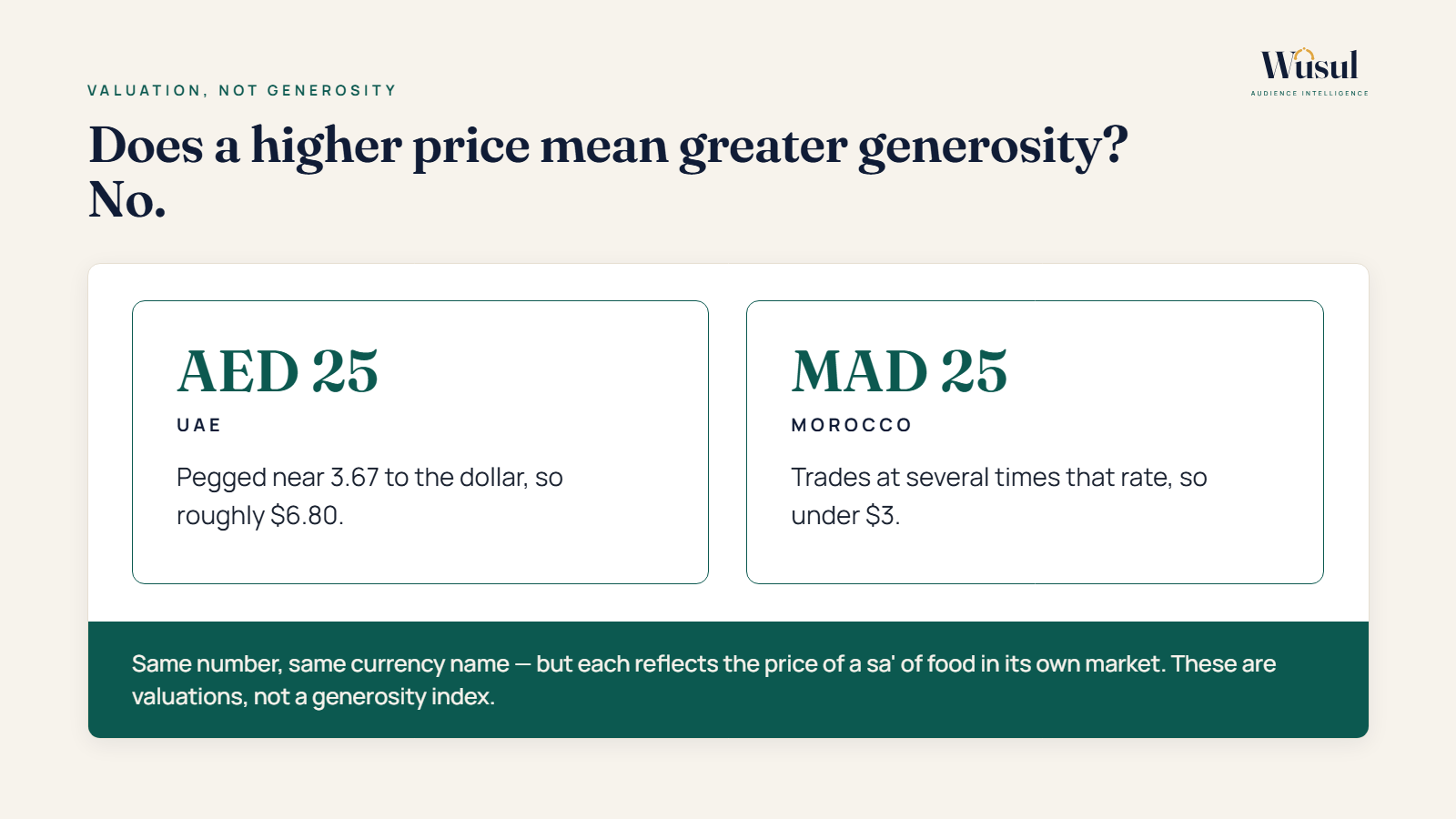
In 2026, the UAE and Morocco both set Zakat al-Fitr at 25 dirhams. Same number, same name of currency. But the UAE dirham is pegged at about 3.67 to the US dollar, so AED 25 is roughly $6.80. The Moroccan dirham trades at several times that rate, so MAD 25 is worth under $3.
Is a Muslim in Dubai three times as generous as one in Casablanca? Of course not. Each amount reflects the price of a sa' of food in its own market. Converting both into dollars does not settle the matter either, because exchange rates measure currencies, not what food costs where people live.
There is also a difference between the obligation and voluntary giving. One person may pay the recognised minimum and then give separate Sadaqah. Another may choose a higher food-based valuation. Neither choice tells us much about personal generosity without knowing their circumstances.
Zakat al-Fitr figures describe a religious valuation mechanism, not a generosity index, and charities should never compare them as if they were average gift values.
The hidden economics: rates do not simply track inflation
Because Zakat al-Fitr is tied to food prices, it might be expected to rise every year with food inflation. The record shows otherwise. In Bangladesh, the 2024 range was BDT 115 to 2,970. In 2025, it fell to 110 to 2,805. In 2026, it stayed exactly the same. Some institutions revise rates from fresh price surveys, others hold them steady, and others change the reference food or quantity altogether.
That makes Zakat al-Fitr a potentially valuable economic dataset, but only if read carefully. A multi-year record of each announced rate, its reference food, quantity and institution could be compared with food inflation and household purchasing power. Yet a switch from a wheat-based minimum to a rice-based valuation would change the number without any change in prices, and a charity raising its suggested amount out of caution is not evidence that food got dearer. Any study would need to separate genuine price movements from changes in method.
What Islamic charities should do
A single Ramadan campaign may reach donors in Britain, the United States, the Gulf and Southeast Asia, each with different authorities, currencies, food prices and expectations. A one-size-fits-all Fitr page invites confusion. Seven principles help:
- Localise. Identify the relevant local guidance before publishing an amount, and never assume one country's figure applies in another.
- Show your source. Say whether your amount is an official figure, a council's recommendation or your own valuation, and which food it is based on.
- Explain tiers before asking. If you offer several amounts, explain what each represents before the donor reaches the payment button, so they are not mistaken for upsell packages.
- State your delivery model. Tell donors whether you distribute food, cash or both, and in which countries.
- Plan for the deadline. Zakat al-Fitr must reach recipients before the Eid prayer. For cross-border programmes, that means procurement in time, reliable local partners, a clear cut-off for online collection, and an allowance for time zones and different Eid dates.
- Keep the money separate. Record Zakat al-Fitr apart from annual Zakat, Fidyah, Kaffarah and Sadaqah in donation systems and accounts.
- Respect differences. Do not present a contested position, on cash or on amounts, as universally agreed, and do not turn higher optional valuations into emotional pressure.
The payment is only half of the obligation. A successful transaction is not the same as food reaching a family before Eid.
A research opportunity: a global Fitr index
The table above is a first sketch of something the sector does not yet have: a systematic, annual record of how Zakat al-Fitr is valued and administered around the world. Such an index would not rank countries by generosity. It would document, for each country and authority, the published amount, currency, reference food, quantity, position on cash, distribution model and date of announcement. Where a country has several recognised authorities, it would keep each record rather than force a single national price.
Over a few years, it could answer questions no one can answer today: which countries use rice and which use wheat, where tiers are offered, how often rates change, and how closely they follow local food prices. It would need annual verification and religious review. But it would turn one of the most searched questions of every Ramadan into a genuine contribution to research on Islamic philanthropy.
Conclusion: one obligation, many local economies
Zakat al-Fitr is one of the clearest examples of a shared religious practice meeting different economies and institutions. A British charity asks for £5. An American council recommends $10. Cairo sets a minimum of 35 pounds. Qatar collects riyals and delivers rice. Malaysia offers a choice of rice grades, Bangladesh a menu of foods, and Russia a scale based on means. Saudi Arabia publishes no cash price at all, because its guidance favours food.
These differences are rarely contradictions. They are the visible result of translating a measure of food into local currencies, local prices and local religious guidance. For donors, understanding that process makes the obligation clearer. For charities, explaining it builds trust.
The obligation is shared. The price is local. And the responsibility to explain the difference belongs to every institution asking Muslims to pay.
Frequently asked questions
How much is Zakat al-Fitr in the UK?
There is no single official UK figure. For Ramadan 2026, most major charities, including Muslim Hands and Muslim Aid, set £5 per person, while some organisations recommended £5.50 to £10. Each figure is an institution's valuation of a sa' of staple food. New figures for 2027 are usually announced shortly before or during Ramadan.
How much is Zakat al-Fitr in the United States?
The Fiqh Council of North America recommended $10 per person for 2026, after estimating the blended cost of a sa' of staple foods at around $6 and adding a margin of caution. Some mosques recommend more.
Can Zakat al-Fitr be paid in cash?
Scholars differ. The Hanafi school permits paying the monetary value, and bodies such as Egypt's Dar al-Ifta and the UAE Council for Fatwa accept cash. Many other scholars, including Saudi Arabia's senior religious authority, hold that it must be given as food. Many charities collect cash and then buy and distribute food as the donor's agent.
Why do different organisations quote different amounts?
Because they may base the figure on different foods, quantities, local prices or margins of caution. Under the Hanafi view, for example, half a sa' of wheat is sufficient, while dates require a full sa', which can produce very different amounts.
When is the deadline for Zakat al-Fitr?
It must reach recipients before the Eid al-Fitr prayer. Paid after the prayer, it counts as ordinary charity. Charities distributing abroad usually close online collection earlier to allow time for delivery.
Wusul Insight: Zakat al-Fitr is not a global donation product with one price. It is a religious obligation translated into local food prices, institutional guidance and distribution practice. Charities that explain that translation earn the trust that a number alone cannot.