UK charity law requires nonprofits to name and explain every material fund in their accounts. So why is it still so hard to find what a winter appeal raised? This article, the fourth in Wusul's winter series, looks at six British Muslim charities, and at the two places winter goes missing: inside country funds, and inside bags of donated clothes.
In October 2026, Human Appeal announced the return of Winter Wrap Up for an eleventh year, collecting coats and warm clothing for people experiencing homelessness, refugees and families in hardship across UK cities. It is one of the most open winter campaigns in British Muslim charity: it sets public targets, announces results and names its corporate partners.
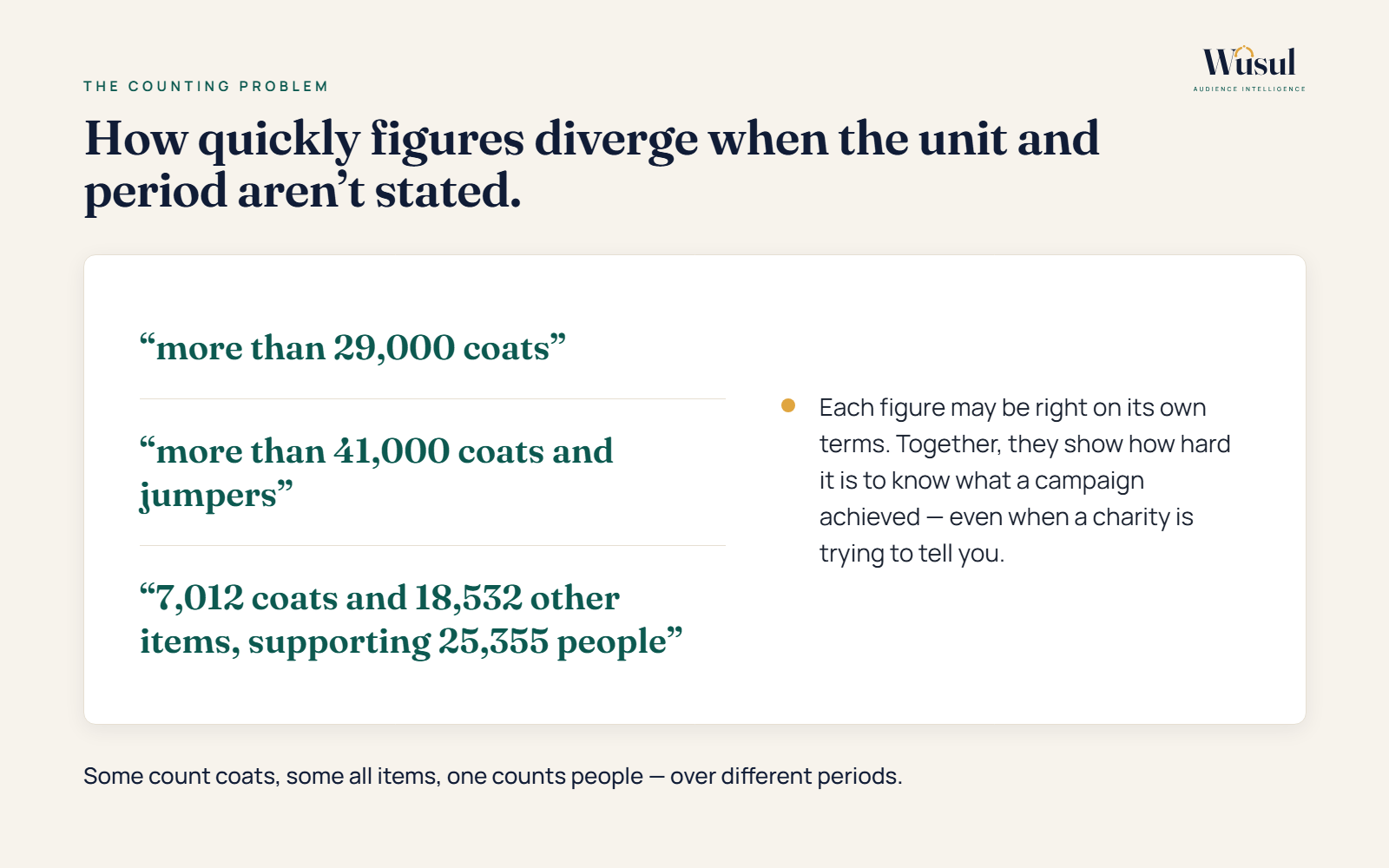
Yet its own annual report for 2024 describes that year's campaign in three different ways: as more than 29,000 coats, as more than 41,000 coats and jumpers, and as 7,012 coats and 18,532 other items supporting 25,355 people. Each figure may be right on its own terms. Together, they show how hard it is to know what a winter campaign achieved, even when the charity is trying to tell you.

Britain should be the easiest place to answer that question. UK charity accounting is built around restricted funds, money given for a stated purpose, and the rules require charities to name and explain their material funds. If a winter appeal raises money for winter, the accounts ought to show it.
Usually, they do not. The previous article in this series found the same gap in the United States. Here we ask why it persists under Britain's stricter rules and finds two distinctly British answers: winter money is restricted by country rather than season, and a large part of winter giving arrives as clothing, which can end up as cash for something else entirely.
What UK rules actually require
UK charity accounting divides money by the terms on which it was given. Restricted funds must be spent on the purpose a donor, a grant or the terms of a public appeal specified. Unrestricted funds can be spent on any of the charity's purposes; trustees may set some aside as designated funds, but that is an internal choice, not a legal restriction.
Two rules go further than US practice. The Charities (Accounts and Reports) Regulations require the accounts to give a description of the nature and purpose of all material funds. And the Charities SORP, the accounting code charities follow, requires separate disclosure of balances on material funds, along with their purpose, income, spending and transfers. "Material" means, in the Charity Commission's words, an item whose inclusion or exclusion would be likely to change a reader's view of the accounts.
The 2026 edition of the SORP adds a further requirement directly relevant to seasonal appeals: charities must now disclose the legal powers they used to amend or remove restrictions on funds. In other words, if money given for one purpose is moved to another, the basis for doing so has to be stated.
So the UK framework is stronger than the US one examined in the previous article. If a winter appeal created a restricted fund large enough to matter, it would have to appear in the notes, by name. When it does not, there are only two explanations: the money was not restricted to winter, or the fund was too small to be material. For charities raising millions each winter, the first is far more likely.
Why winter disappears: restricted by country, not by season
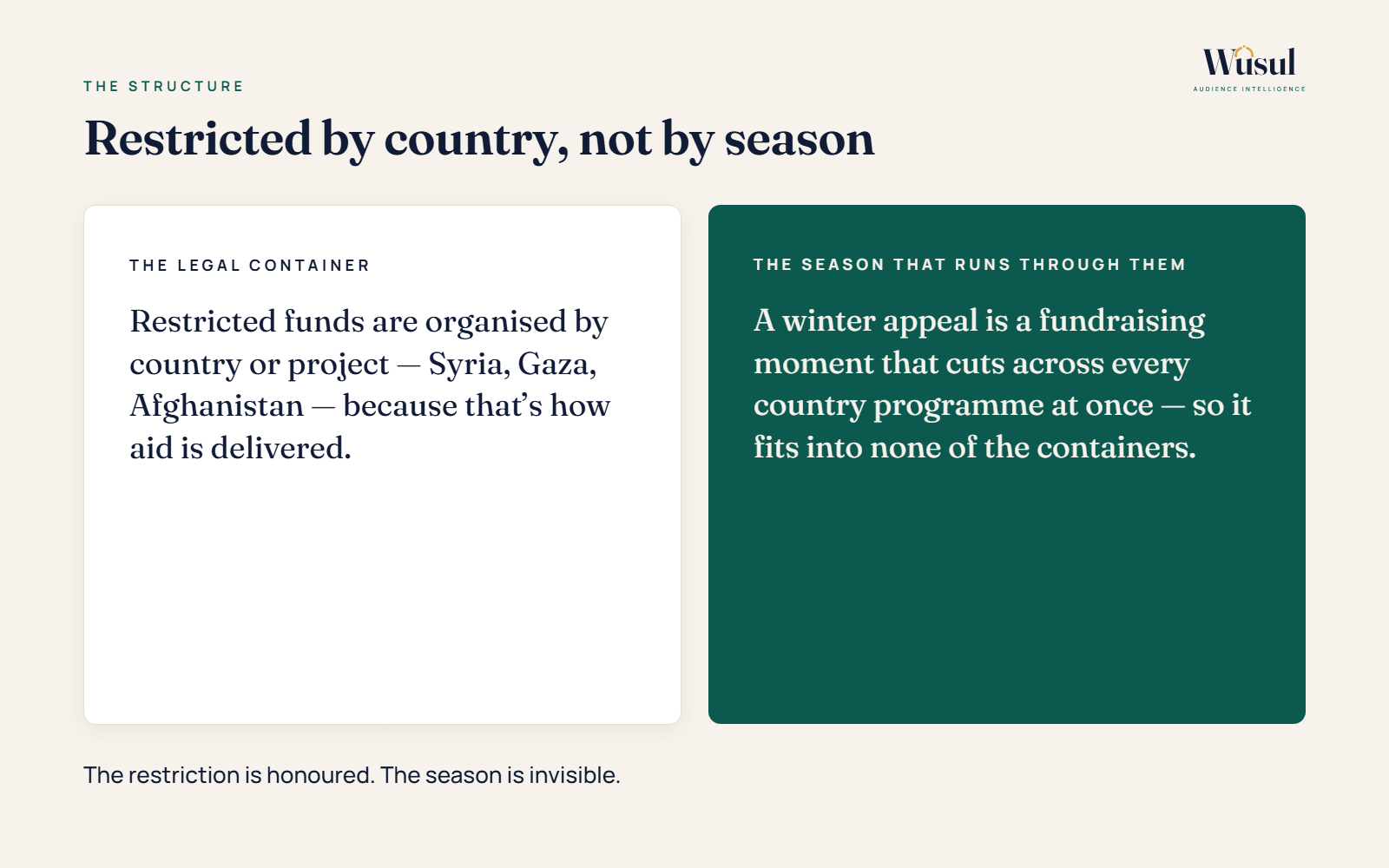
Islamic Relief Worldwide's accounting policy shows why the first explanation is the likely one. Its restricted funds are assigned by the donor or the terms of the appeal, specified by a particular country or project. The unit of restriction is a place or a project, not a time of year.
That is a sensible way to run an international charity. A donor giving to "winter in Syria" has restricted the gift to Syria; the charity then spends it on Syrian programmes, which in December will include blankets and fuel. In the accounts, the gift sits in a Syria fund alongside Ramadan food parcels, health projects and emergency relief for the same country. The restriction is honoured. The season is invisible.
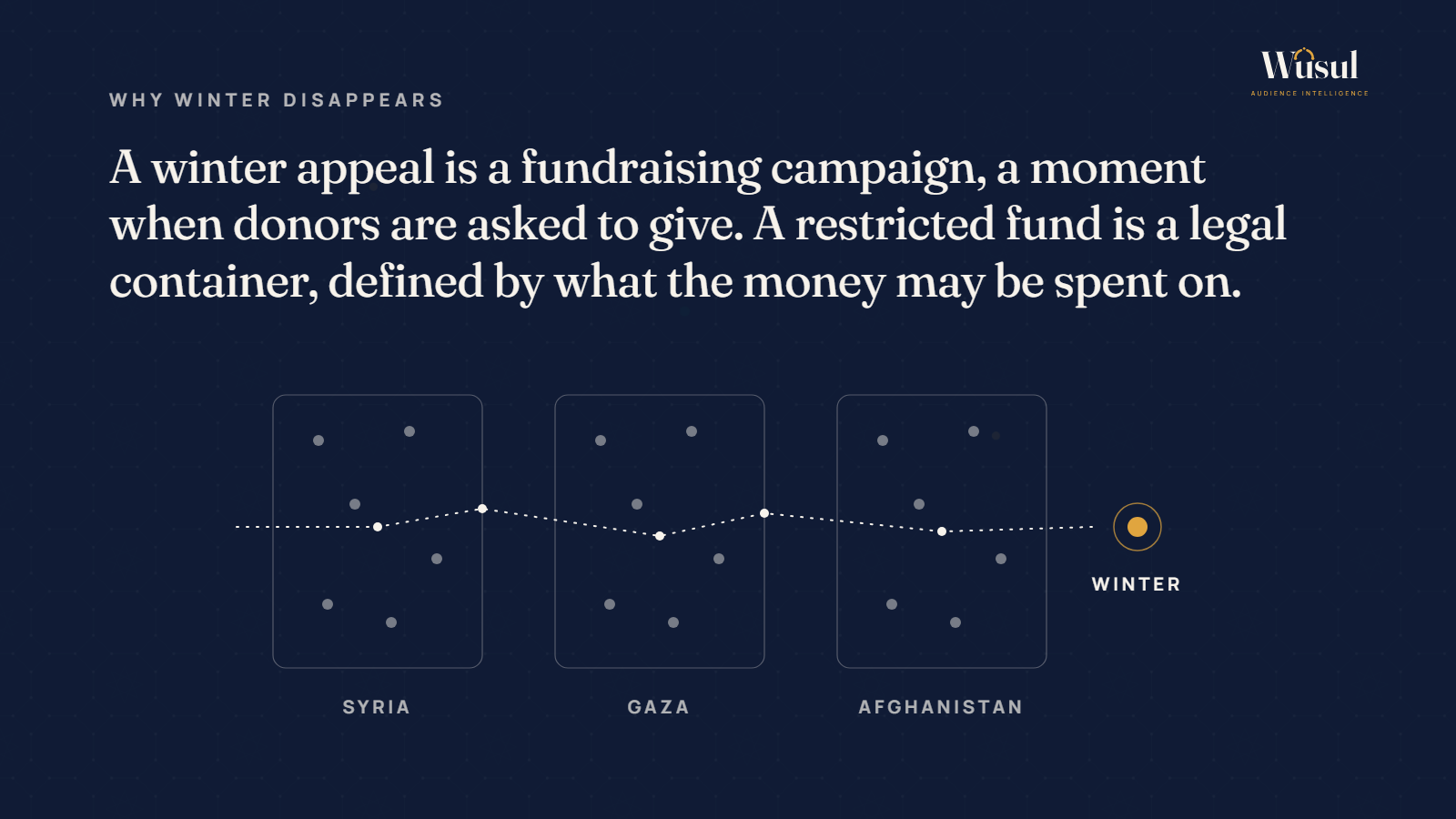
The same logic applies across much of the sector. A winter appeal is a fundraising campaign, a moment when donors are asked to give. A restricted fund is a legal container, defined by what the money may be spent on. Most charities design their containers around countries and programmes because that is how they deliver aid. Winter, which runs through every country programme at once, does not fit neatly into any of them.
That is why reading the notes is necessary but not sufficient. A careful reader can find what each charity holds for Syria or Gaza or Afghanistan. To learn what the winter appeal raised, they need the charity to add up the seasonal gifts across those funds, which is exactly what most do not publish.
Human Appeal: a winter season, reported as a season
Human Appeal shows how far a UK charity can already go. Its 2024 annual report, covering a year in which income reached £90.2 million, treats winter as one of three seasonal campaigns alongside Ramadan and Qurbani, and gives it its own result: 75,535 people helped across nine countries, with clothing, heating, hygiene kits and other supplies delivered between November 2024 and March 2025.
That date range matters. The charity's financial year ends in December, but it reported winter as a season that runs across the year-end. That is precisely the approach this article argues for, and it is already in practice.
The report also says Human Appeal publishes separate impact reports for Ramadan, Qurbani and winter, and it is unusually candid about counting. For Gaza, it states that it is not possible to calculate the number of unique individuals reached precisely, so it reports project outputs and, where people received help repeatedly, uses the highest single figure. Hot meals in Gaza during Ramadan were left out of the totals altogether to avoid double or triple counting.
What the narrative report does not show is what winter raised. It reports a 56% rise in Ramadan digital income and a 147% rise in Qurbani digital income compared with 2023, but no equivalent figure for winter. The same pattern appeared in the US: in Islamic Relief USA's audited accounts, Qurbani had its own fund and winter had none. Of the three seasons, winter is consistently the least visible as money, even at the charities that report it most fully as delivery.
One campaign, three numbers: Wrap Up
Winter Wrap Up, Human Appeal's UK clothing drive, is the most measurable winter campaign in this review. For the 2025 season the charity set a target of 10,000 coats and reported collecting 10,567, plus 30,956 other winter items, 41,523 in all, distributed across 15 UK cities. That is a genuine target-against-result comparison: the coat target was beaten by about 6%.
The previous year is harder to pin down. Human Appeal's 2024 annual report describes the 2024 campaign in three places:
| Where in the 2024 report | What it says |
|---|---|
| Chief executive's message | Over 29,000 coats delivered |
| UK programmes section | Over 41,000 coats and jumpers distributed |
| Environmental (carbon) report | 7,012 coats and 18,532 other items, supporting 25,355 people |
The March 2026 results announcement adds a fourth reference point. It describes 2025 donations as up 62% year on year, which fits a 2024 total of around 25,500 items, as in the environmental report, but also says the campaign collected 25,500 more items than the year before, which does not.
There are likely to be simple explanations. The figures may cover different periods, a calendar year versus a campaign season, or include the year-round door-to-door collections that grew out of Wrap Up; some count coats, some all items, one counts people. None of this suggests anything wrong with the campaign, which publishes more than most. It shows how quickly numbers diverge when the unit and the period are not stated, even inside one report from one charity that is trying to be transparent.
Wrap Up also shows the value of non-cash giving. Businesses contributed more than 200 bales of clothing and £35,000 of in-kind donations in 2025, up from £15,000 the year before. That is real support, valued in pounds, that would never appear in a figure for money raised.
When a winter coat becomes cash
Britain has something far less prominent among the US charities in the previous article: a large network of charity shops and clothing collections. For winter giving, that creates a route most donors never see.
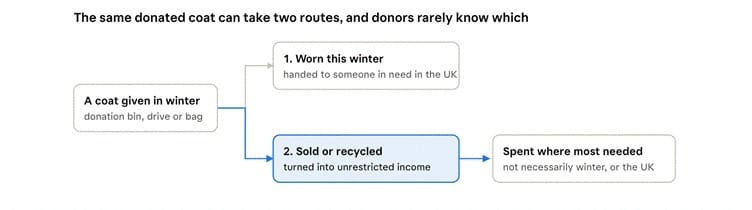
Human Appeal describes both routes in its 2024 report. Wrap Up grew into a year-round collection, Wrap Up Door to Door, run with Bag2Charity across 20 UK cities, which delivers warmth to people in need locally while recycling clothes to fund its Where Most Needed appeal internationally. Islamic Relief operates on a larger scale: in 2022 it converted 1,931 tonnes of unwanted clothing into income, reselling good items in its shops and recycling the rest to fund humanitarian projects. Ummah Welfare Trust says it pays its running costs partly from charity shops and clothing recycling, so that donations for relief go to relief.
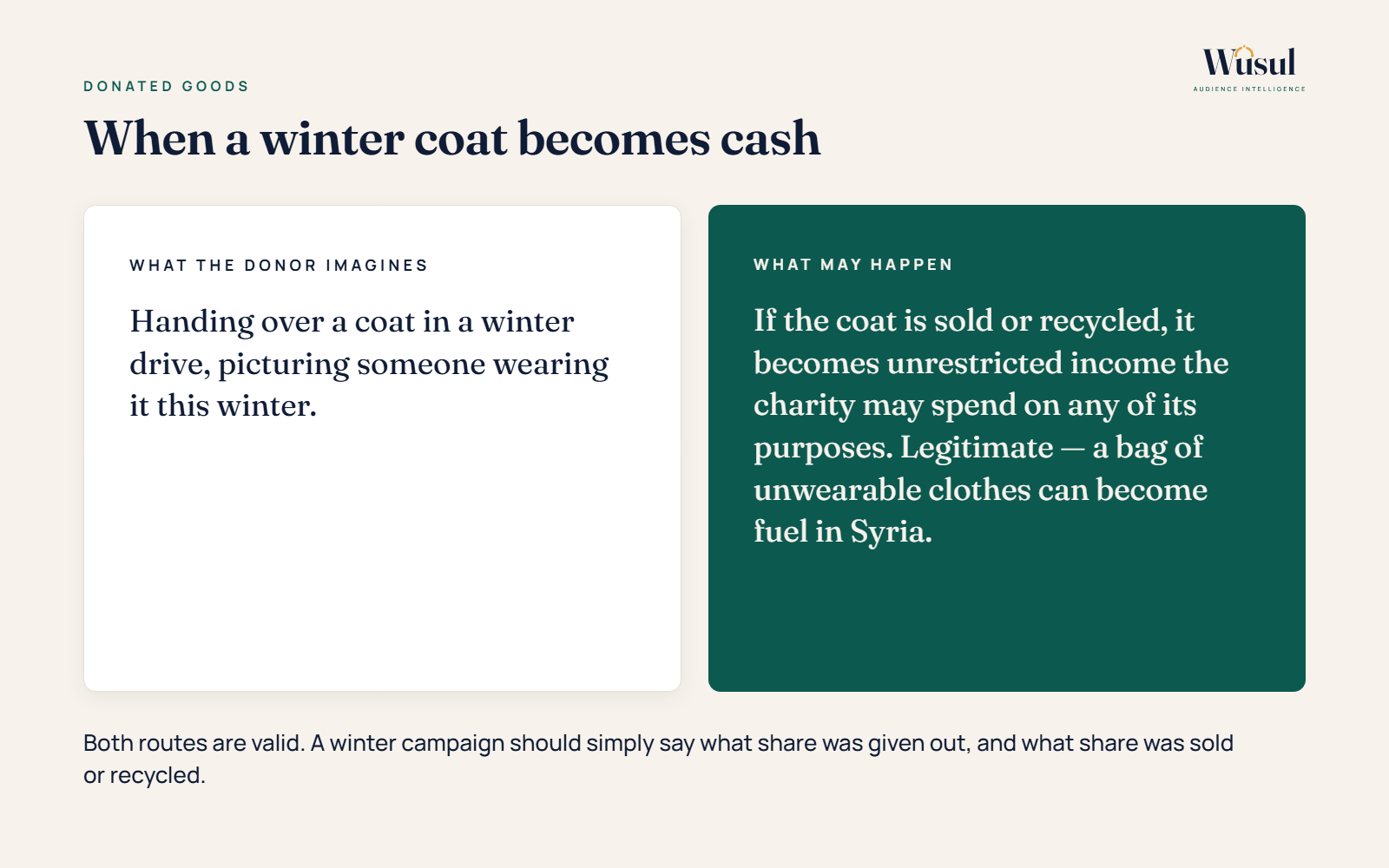
Both routes are legitimate, and the second can be very efficient: a bag of unwearable clothes becomes money that can buy fuel in Syria. But they are different gifts. A donor who hands over a coat in a winter drive may imagine someone wearing it this winter. If it is sold or recycled, it becomes unrestricted income, which the charity may spend on any of its purposes. That is not a breach of anything; donated goods usually carry no legal restriction. It is, however, something a winter campaign should say plainly: what share of donated clothing was given out, and what share was sold or recycled.
The other charities: what each shows
The four other charities in this review, plus Penny Appeal, which runs one of the longest-standing UK winter appeals, each reveal a different part of the picture.
| Charity | Scale | What its winter reporting shows | Where winter money appears to sit |
|---|---|---|---|
| Islamic Relief Worldwide | About £276m income (2024, Charity Commission) | Seasonal fundraising discussed; winter delivered through country programmes | Restricted by country or project |
| Muslim Hands | About £35m charitable spending (Charity Commission) | December 2024 announcement of about £2m of winter aid across nine locations, over £1m of it for Gaza | Not separated in accounts reviewed |
| Muslim Aid | About £24m income (2024) | Winter blankets and clothing described within emergency response | Within emergency programmes |
| Ummah Welfare Trust | About £57m income (2023–24) | Winter supplies listed within £22.8m of emergency relief | Within emergency relief, alongside food, tents and fuel |
| Penny Appeal | About £13m income (2024) | Annual winter emergency appeal with UK and overseas results in past years | Not separated in accounts reviewed |
Two cases deserve a closer look.
Muslim Hands published a headline figure for winter, which most charities do not. But a figure for aid being distributed is not the same as money raised, or money spent. To compare it with anything, a reader would need to know whether £2 million was a target, a budget, a commitment or a total delivered.
Penny Appeal has reported winter results for the UK itself: in one past winter, over 2,500 emergency winter kits to homeless people, older people and refugee families, alongside 19,240 people helped overseas; in 2020, 5,000 winter kits for homeless people and over 6,000 hot meals. Its appeal pages also show how terms shape the answer to "where did my gift go?": the charity says it will endeavour to use a gift as requested, wherever possible. Under the 2026 SORP, when a charity does use its powers to change a restriction, the accounts must now say so.

Two British complications
Gift Aid. For an eligible gift from a UK taxpayer, a charity can reclaim basic-rate tax from HMRC, adding 25p to every £1. A £100 winter gift can therefore become £125 of income. But not every donor or gift qualifies, and charities record Gift Aid in different ways. When a charity announces that its winter appeal raised a sum, it should say whether that figure includes Gift Aid, corporate matching or donated goods. Without that, two charities' totals cannot be compared.
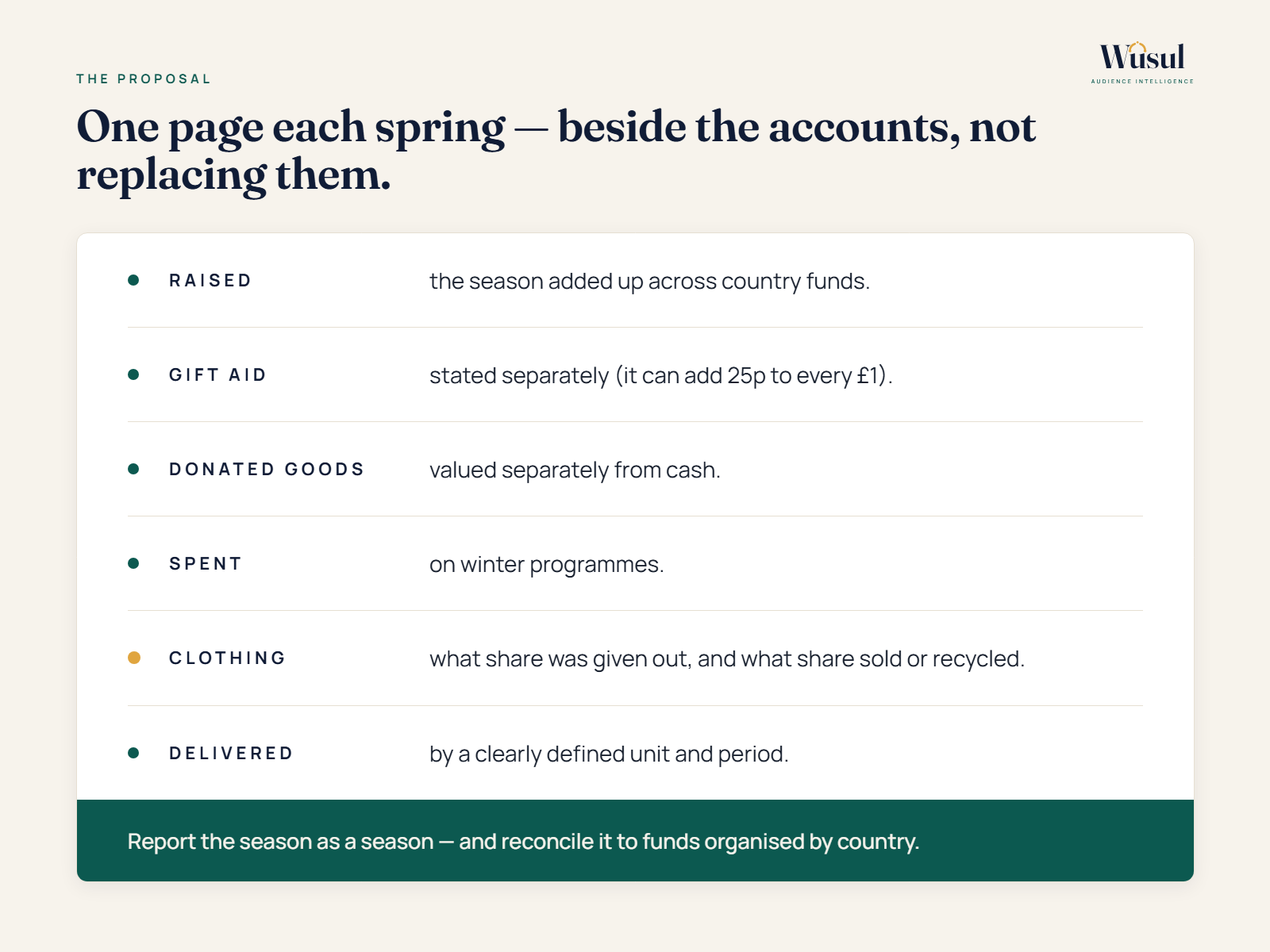
The split winter. Many British Muslim charities close their books on 31 December; others, such as Ummah Welfare Trust, at the end of February. A winter appeal that opens in October and delivers until March falls across two financial years: gifts arrive in one, much of the spending happens in the next. Reading one year's accounts, a reader may see winter income without the matching spending, or the reverse. Human Appeal's approach, reporting winter results for November to March, shows the obvious fix: report the season as a season, and reconcile it to the accounts separately.
A British winter statement
The previous article proposed a one-page winter reconciliation for US charities. The British version needs a few extra lines, because British winter giving includes Gift Aid, donated goods and clothing that can be sold.
| Item | What to disclose |
|---|---|
| Season | The dates the winter appeal and delivery ran, e.g. October to March |
| Cash raised | Donations attributed to the winter appeal |
| Gift Aid and matching | Included in the total or shown separately |
| Donated goods | Number of items collected, and value where recognised |
| What happened to clothing | Share distributed to people, share sold or recycled |
| Where it was restricted | The country or project funds the money entered |
| Spent this season | Winter spending, including from earlier years' funds |
| Carried forward or moved | Balances held for next winter, and any restriction changed, with the power used |
| Reach | People or households reached, with the unit and period stated |
None of this replaces the audited accounts. It sits beside them, reconciling a season that crosses the year-end to funds organised by country, in a form a donor can read in a minute.
Conclusion: Britain can name the fund. It has yet to name the season.
British charities work under some of the strictest fund-accounting rules anywhere. Material funds must be named and explained; from 2026, changes to restrictions must be justified. Yet winter, one of the biggest fundraising moments of the Muslim charity year, still disappears into the accounts, for two reasons this article has traced: gifts are restricted to countries rather than to the season, and much of what is given in winter arrives as clothing that may be worn, sold or recycled.
Nothing in this review suggests that the charities are hiding anything. Human Appeal already reports winter as a season and publishes a winter impact report; its clothing campaign sets public targets. But even there, one campaign can produce several figures that do not obviously agree, and the money raised for winter does not appear in the material reviewed.
The gap is narrow and easy to close: a one-page statement each spring that adds up the season across country funds, separates cash from Gift Aid and goods, and says where the clothing went.
Britain can account for the restriction on a donation. The next step is to account for the season in which it was given.
Frequently asked questions
Do UK charities have to publish what their winter appeal raised?
Not as such. They must name and explain every material fund in their accounts. Because most restrict gifts by country or project rather than by season, winter money usually sits inside country funds and is not shown separately.
What is a restricted fund?
Money that must be spent on a purpose set by the donor, a grant or the terms of a public appeal. A designated fund, by contrast, is unrestricted money that trustees have set aside themselves.
Can a charity move my winter donation to another cause?
Only within the terms of the gift and the law. Some appeal terms allow a gift to be used elsewhere if the original purpose cannot be met. From 2026, charities must disclose the legal powers they use to change a restriction.
What happens to coats I donate in winter?
It depends on the charity and the scheme. Some are given directly to people in need. Others, especially through year-round collections, are sold or recycled to raise money for the charity's wider work. Ask which applies before you give.
Does a winter total include Gift Aid?
It may. A charity can reclaim 25p for every £1 from eligible UK taxpayers. Reported totals should say whether Gift Aid, matching or donated goods are included.
Which UK charity reports winter most fully?
Among those reviewed, Human Appeal: it reports winter as a November-to-March season with a reach figure, publishes a winter impact report, and sets and reports targets for its Wrap Up clothing campaign.
Wusul Insight: UK accounting rules make restricted money visible by fund, but British Muslim charities restrict by country, so winter disappears into the accounts. Add donated clothing that may be worn or sold, and Gift Aid that may or may not be counted, and a winter total becomes hard to interpret. A one-page seasonal statement, set beside the accounts, would close the gap.
Methodology note*: this is a review of published annual reports, accounts, appeal pages and announcements for six UK-registered Muslim charities. It is not an audit or a ranking. Figures refer to different years and scopes. Where a winter figure was not found that means it was not located in the sources reviewed, not that the charity lacks it or has breached any requirement. Discrepancies between published figures are noted as reporting questions, not as findings of error, and the charities concerned may hold explanations. The proposed seasonal statement is an editorial framework, not a legal requirement.
Sources note: This article is based solely on publicly available annual reports, financial statements, regulatory records and web pages published by the organisations named. None of the organisations discussed was involved in its preparation.