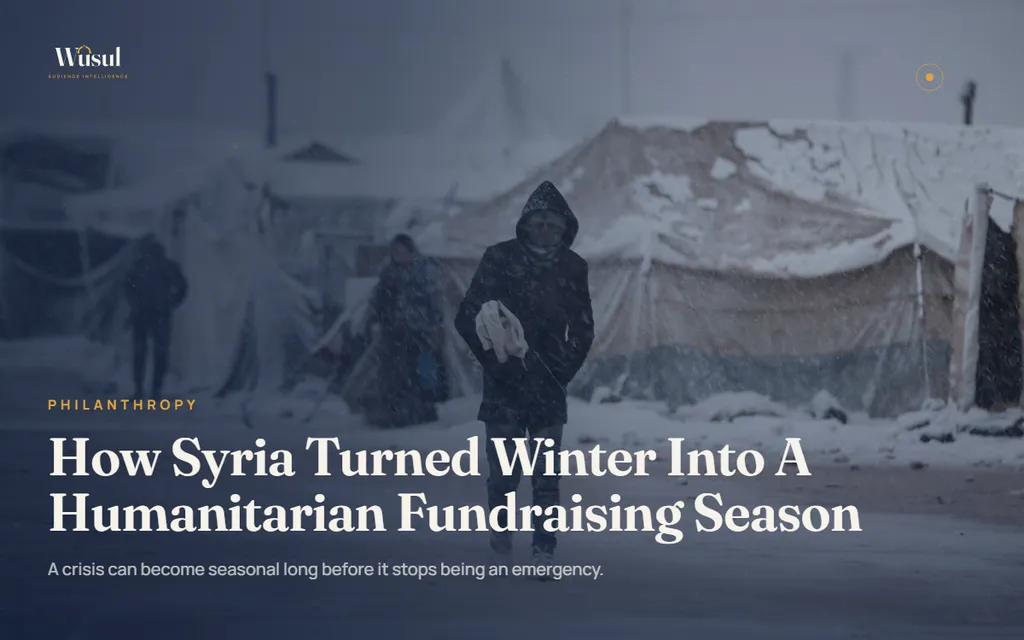
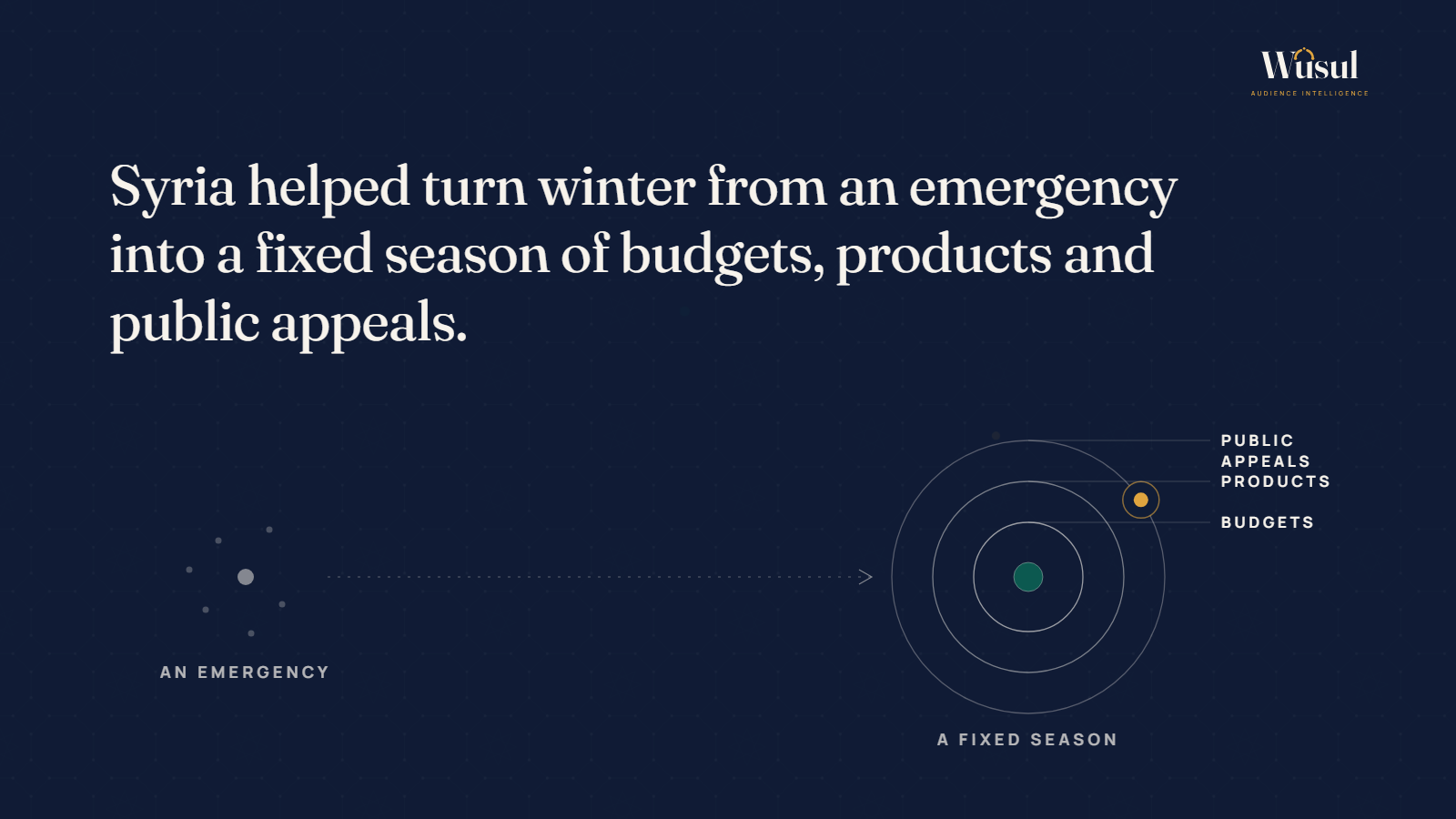
From the first emergency winter preparations in 2012 to families returning to damaged homes in 2026, the Syrian crisis helped turn winter from an occasional emergency into a fixed season of humanitarian planning and public fundraising. This article, the first in Wusul's winter series, traces how it happened, and what it means for the appeals donors see every year.
On 30 October 2026, the UN Refugee Agency launched its annual winter fundraising appeal. It aims to raise at least $50 million from individuals and the private sector for winter support in 2026-27, $3 million more than it raised the year before. The money will buy heaters in Afghanistan, thermal blankets in Syria and Lebanon, and repair kits for bombed homes in Ukraine. At least 9 million people across those four countries, the agency estimates, need extra help to get through the cold.
One word in that announcement carries a history: annual. Winter is now something humanitarian agencies plan for every year, budget for every year and ask the public to fund every year, as reliably as Ramadan or Christmas.
It was not always so. The clearest record of how winter became a fixed humanitarian season runs through Syria. When displaced Syrians faced their first winters in 2012, agencies treated the cold as an emergency to be survived. By the time Syria had faced its seventh, eighth and ninth winters of displacement, winter had become a budget line, a set of standard products, a public appeal and a recurring funding gap. In 2026, with millions returning home, it remains a season of need: 2.4 million people in Syria will need winter assistance in priority areas this year.
This article follows that transformation, from emergency to season, and from operations to fundraising. A crisis can become seasonal long before it stops being an emergency.
A look at pre-Syria winter crises
Winter aid was not invented in Syria. Humanitarian agencies had faced the cold before, and the word "winterization" was already in use.
In the former Yugoslavia, UNHCR ran a full winterization program in the early 1990s; in November 1993 the British government told Parliament that the agency had just issued a progress report on the winterization program in the former Yugoslavia, as MPs pressed for temporary shelters to reach Bosnia before the snow.
After the Pakistan earthquake of October 2005, which killed more than 80,000 people in the Himalayan foothills, the response was explicitly a race with the season. Operation "Winter Race" airlifted IOM, Islamic Relief and IFRC teams into isolated villages to deliver 10,000 shelter repair kits in November. By January 2006, UNHCR was in the second phase of its winterization drive, distributing heaters and kerosene on top of earlier tents, blankets, plastic sheets and mattresses.
What these responses had in common was that they ended. Bosnia's war ended in 1995; Pakistan's earthquake survivors rebuilt. Winter returned for a few seasons at most; it was a hazard within an emergency, not a fixed part of the humanitarian year. Syria changed that, not by inventing winter aid, but by lasting long enough for winter to become permanent.
2012-2013: the first winters' limits of a blanket
On 12 October 2012, UNHCR announced it was preparing to spend more than $64 million helping displaced Syrians survive the coming winter, inside Syria and across the region. From the start, the agency distinguished between refugees in camps such as Jordan's Za'atari, where temperatures could fall to around 2°C, and the larger number living in towns and cities with little money for heating or proper housing.
That distinction would shape the next decade. A family in a tent needed insulation, flooring and protection from rain. A family renting a room needed fuel, clothing or cash. A family in an unfinished building needed plastic sheeting and repairs. No single package fitted all three.
The winter of 2012-13 tested the response. In January 2013, Za'atari flooded during some of Jordan's worst weather in two decades, and families arrived at the border barefoot and soaked. Agencies scaled up blankets, mattresses, heaters, fuel vouchers and plastic sheeting, and around 6,700 families had help weatherproofing their homes.
The lesson came early. A blanket keeps in body heat but cannot stop a tent from flooding. A heater is useless without fuel and dangerous without ventilation. Warm clothes cannot fix a broken window. From its first winters, the Syrian response treated cold as a problem of shelter, money and energy, not only of supplies.
2013-2016: a budget line, an appeal and a monthly cost
By the end of 2013, there were more than 2.3 million registered Syrian refugees in neighbouring countries, up from around half a million at the start of the year. UNHCR earmarked $138 million for regional winter measures, from weatherproofing and drainage to stoves, fuel and cash, plus a separate $79 million plan inside Syria. Winter had become a budget line.
It was also becoming an appeal. Islamic Relief's own history records that in 2013 it ran a £5 million winterisation appeal covering Syria, Jordan and Lebanon. Winter was no longer just one need inside a general Syria emergency appeal; it was its own proposition, with its own deadline. By November 2014, Islamic Relief's Syria Winter Appeal listed gas heaters, fuel, blankets, clothing, carpets, mattresses, tarpaulins and food vouchers. The UN, meanwhile, launched a $206 million winterization plan in October 2014 for 3.3 million people inside Syria, and by January it was still $70 million short.
The biggest change was less visible: cash. In October 2015, UNHCR announced winter cash grants for more than 151,000 refugee families in Lebanon over four months: $147 a month for families living above 500 metres, $100 for those lower down. Two ideas were built into that design. Winter is a recurring household cost, not a one-off shortage: fuel is burned, electricity bills return, children outgrow clothes. And exposure varies: a family on a mountainside needs more than one in a valley. The same winter, the response stretched along migration routes into Europe, with sleeping bags, raincoats and footwear for people on the move.
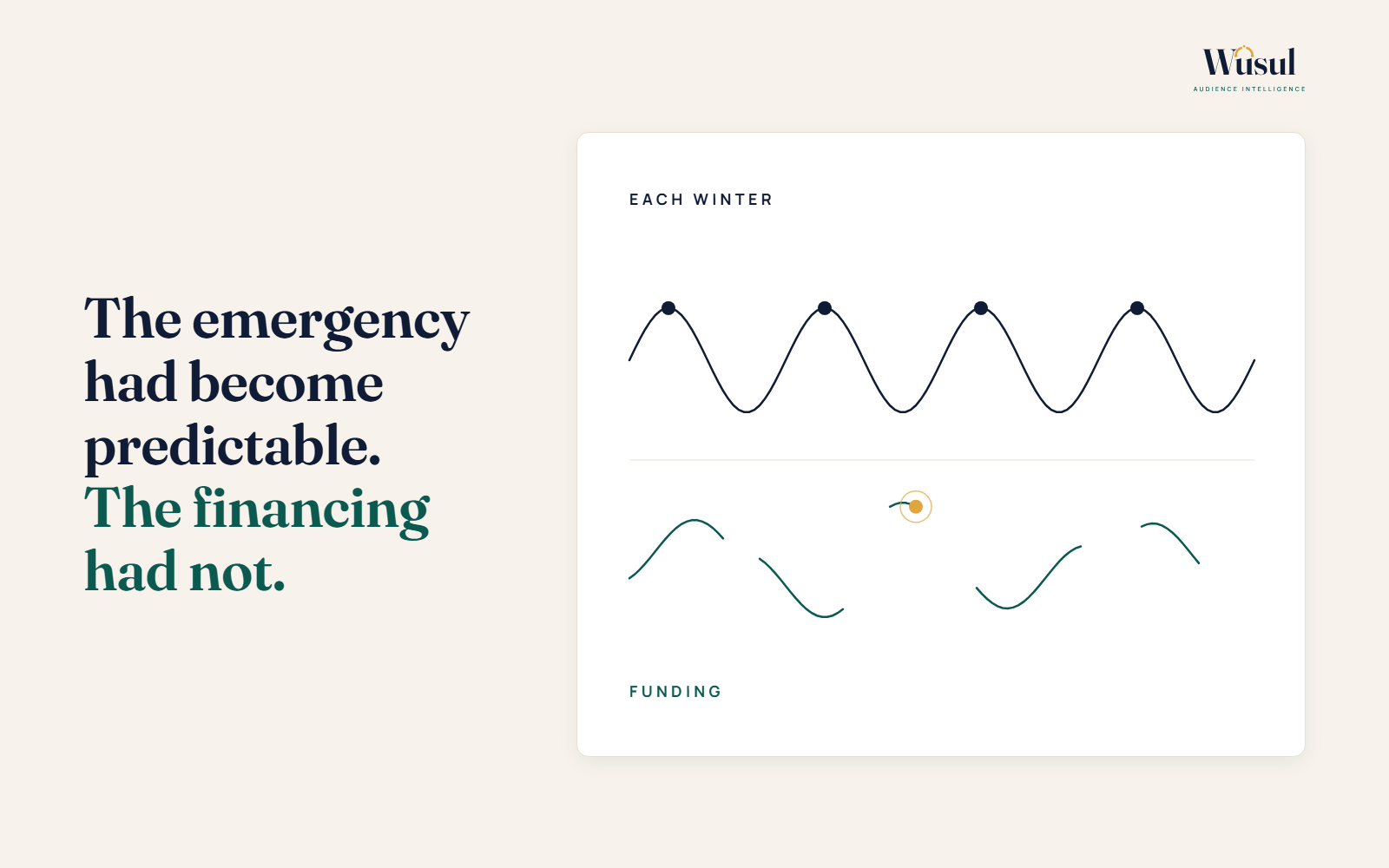
2017-2021: predictable emergency, unpredictable financing
By October 2017, UNHCR was preparing a $245 million regional winter plan for Syrian and Iraqi refugees and displaced people across six countries. It was 26% funded when announced. Up to four million people were at extreme risk, and only about one in four were expected to get the help they needed. For many Syrian families, it was a seventh winter away from home, and more than half the planned assistance was to be delivered as cash.
This is the central paradox of winter aid. Agencies knew exactly when the cold would come and which settlements were most exposed. They knew how to buy blankets, insulate tents and transfer cash. What they could not rely on was money arriving in time. Médecins Sans Frontières described the result in north-west Syria: in previous years, winterization started too late, after winter had already arrived, mainly because of a lack of funding.
Agencies adapted by moving earlier. In January 2021, after heavy snow collapsed tents in north-west Syria, a senior UN official noted that winter clothing and blankets had been handed out the previous June and July. Winter aid was now being delivered in summer. Even so, of the $84 million needed for winterization in the north-west that season, only $45 million had arrived.
By then the response had a settled shape. UNHCR's 2020-21 regional program, covering Egypt, Iraq, Jordan, Lebanon and Syria, identified almost 3.8 million people in need and reached about 2.5 million through three kinds of help: seasonal cash, winter items such as thermal blankets and plastic sheeting, and shelter winterization, including repairs, weatherproofing and drainage. Winter had become a mature operational field.
2022-2026: energy, return and damaged homes
In 2022 the nature of the problem shifted. The UN warned in September that Syria's coming winter could be among the harshest, because of severe fuel and electricity shortages: about six million people needed winter assistance, a third more than the year before. The shelter and household-items sector had received $26.1 million of the $140 million it requested. A heater was little use without fuel; a cash transfer was little use if fuel was unaffordable.
In late 2024, families fleeing Lebanon into Syria received winter kits of five blankets, two jackets, a plastic sheet and undergarments, more than 17,000 of them in a few weeks. The contents would have been familiar in 2012. Not every useful product is new; some remain necessary because the vulnerability behind them has never been resolved.
Then the context changed again. After the fall of the Assad government in December 2024, more than a million Syrians had returned home by February 2025, and millions more since. But home was often a damaged building without windows, doors, power or heating. UNHCR's distributions began to include indoor solar devices alongside jackets, boots and heaters, and its winter work increasingly overlapped with repairing homes.
That is where Syria stands this winter. UNHCR's 2026 appeal describes reasons for optimism as millions have returned, but warns that without more funding for a roof, clothes and heating oil, returnees' situation may become increasingly precarious. In 2012 the question was whether a tent would survive the rain. In 2026 it is whether a damaged house can be made safe enough to live in through the cold.
From operations to appeals: the fundraising season
Once a need returns on a known date, it can be planned for, and it can be fundraised for. Syria shows both transitions.
The operational side became a fixed calendar: assess in summer, procure and pre-position before autumn, distribute before the first storms, report in spring. The fundraising side followed. Islamic Relief's 2013 winterisation appeal is an early example of winter offered to donors as its own cause. By now the season is formal enough that UNHCR runs an annual winter fundraising appeal aimed at individuals and the private sector, and can say it raised about $47 million the previous winter and wants $50 million this one. That is not a budget or a plan; it is money raised from the public for winter, year after year.
Turning a program into an appeal means translating it. An operational plan involves cash transfers, supplier contracts, fuel, shelter repairs, assessments and monitoring. A donation page offers a blanket, a heater, a winter kit or a family package. That translation is reasonable: donors need to picture what their gift does. But it creates two problems that grow with every winter.
The product is not the outcome. A blanket is an item delivered; warmth is a condition experienced. A heater is an asset; safe heating depends on fuel and ventilation. A repaired roof is an output; a dry, warm room is the result. Fundraising favours what can be pictured and priced. Protection is harder to photograph.
The appeal repeats. If the same family needs winter help again next year, how should a charity explain why last year's help was not enough? Sometimes the honest answer is simply that the crisis continued. But after more than a dozen winters, donors are entitled to ask whether program are only maintaining survival, or also reducing the need to come back.
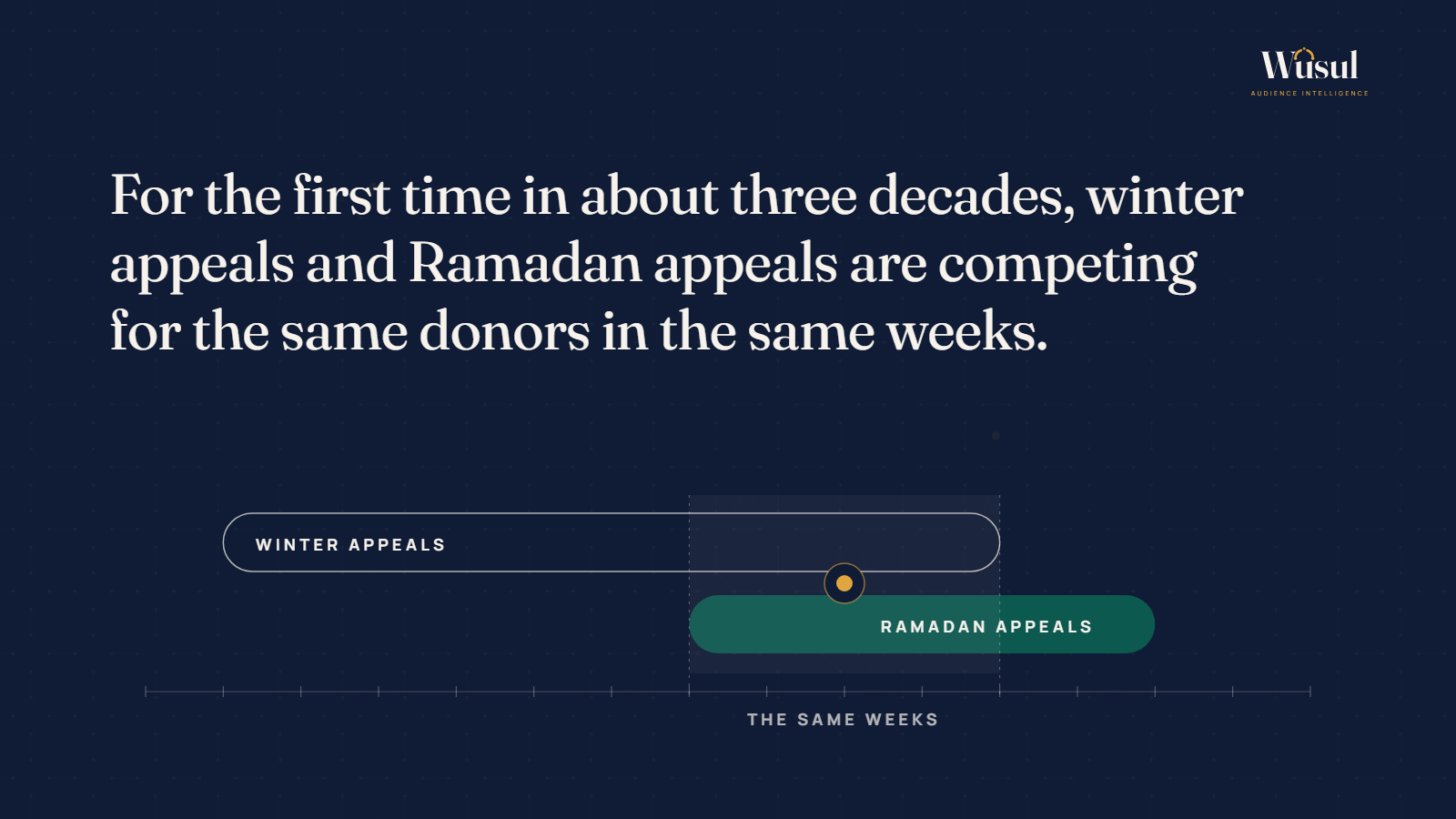
There is a new complication for Muslim charities. Because the Islamic calendar moves, Ramadan now falls in the northern winter: it began in mid-February in 2026, is expected in early February in 2027, and will start in January for several years after. For the first time in about three decades, winter appeals and Ramadan appeals are competing for the same donors in the same weeks. How charities handle that overlap deserves its own analysis.
What the numbers can and cannot tell us
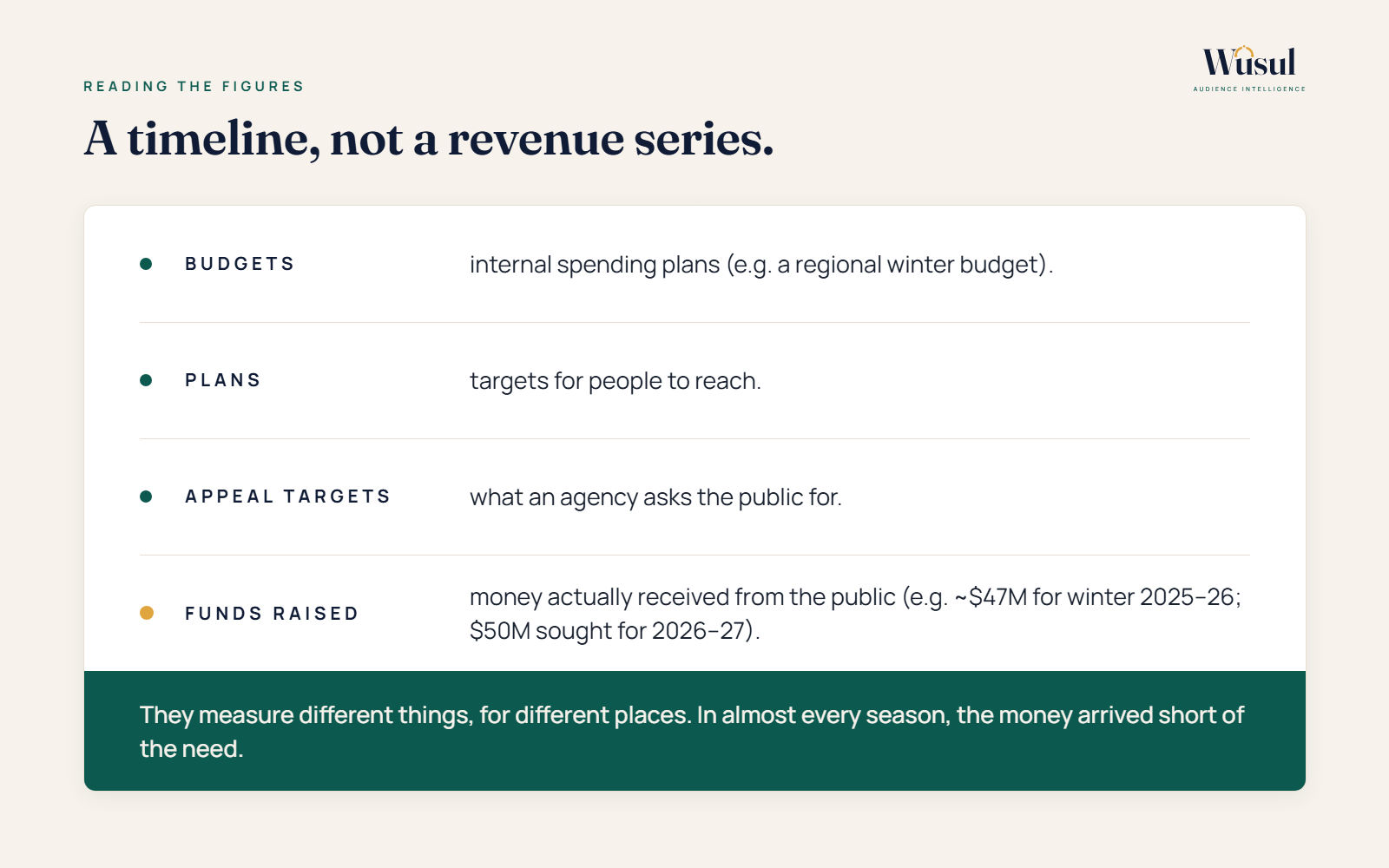
It would be easy to line up these figures on a chart and call the result growth. That would mislead. They measure different things, for different places and organizations:
| Season | Figure | What it measures |
|---|---|---|
| 2012–13 | More than $64m | UNHCR winter preparations budget, Syria and region |
| 2013–14 | $138m, plus $79m | UNHCR regional winter allocation; separate plan inside Syria |
| 2013 | £5m | Islamic Relief winterisation appeal target |
| 2014–15 | $206m ($70m short in January) | UN and partners' winter plan inside Syria |
| 2017–18 | $245m (26% funded at launch) | UNHCR regional plan, Syrian and Iraqi displacement |
| 2020–21 | $84m needed, $45m received | Winterization in north-west Syria |
| 2022–23 | $26.1m of $140m received | Syria shelter and household-items sector, September 2022 |
| 2025–26 | About $47m raised | UNHCR's annual winter appeal to individuals and the private sector, all countries |
| 2026–27 | At least $50m sought | The same appeal, this winter |
The table is a timeline, not a revenue series. Some figures are budgets, some plans, one an appeal target, some funding received, and only the last two are money raised from the public. Their scopes run from one region of Syria to four countries.
What it does show is a pattern. In almost every season, the money arrived short of the need. And over time, winter moved from a line inside emergency plans to an appeal with its own name, target and track record. Measuring how winter fundraising itself has grown, charity by charity, would require what is rarely published together: the amount sought, the amount raised, the amount spent, what was delivered, and to how many people.
The template Syria built, and who inherited it
The tools developed for Syria's winters, seasonal cash, standard winter kits, shelter insulation, pre-positioning in summer and an annual public appeal, did not stay in Syria. They became the template for every protracted crisis in a cold climate.
UNHCR's 2026 appeal is the clearest illustration: one winter campaign now spans four countries. In Ukraine, facing its fifth winter of full-scale war, energy facilities were hit at least 423 times last winter, and 75% of people leaving the country between December 2025 and February 2026 cited a lack of electricity, water or heating. In Afghanistan, amid large-scale returns, 4.2 million people are expected to need shelter support, and many families burned cardboard and plastic last winter because fuel was unaffordable. In Lebanon, almost 300,000 people will need winter help, and funding allows UNHCR to reach only half of them.
For Muslim charities, a major inheritor has been Gaza, where most of the population has lived in tents and damaged buildings through successive winters since 2023. The same products, blankets, tarpaulins, winter clothing and shelter kits, and the same tension between immediate relief and lasting protection, have appeared there, under far harder access conditions.
Syria's legacy, then, is not a single crisis's winters. It is a way of working: a recognised season, a recognised set of responses, and a recognised appeal that returns every autumn wherever displacement and cold coincide.
Conclusion
Syria did not invent winter relief. It showed how a crisis that will not end turns winter into a permanent part of the humanitarian year, with all the planning, products and fundraising that implies.
That history raises the question the rest of this series takes up. After more than a dozen winters of the same appeal, the measure of success cannot be how reliably it returns, or how many blankets it buys. It has to be whether families are warmer, drier and safer, and whether fewer of them need the appeal next year.
Frequently asked questions
When did winter appeals for Syria begin?
Winter assistance was organized from the early years of the crisis. UNHCR announced a regional winter budget of more than $64 million in October 2012, and Islamic Relief records a dedicated £5 million winterisation appeal in 2013. These are early documented examples, not proof of the very first.
Did Syria invent winter aid?
No. UNHCR ran winterization program in the former Yugoslavia in the early 1990s, and after the 2005 Pakistan earthquake, "Operation Winter Race" rushed shelter kits to mountain villages. What Syria changed was duration: the crisis lasted long enough for winter to become an annual season of planning and fundraising.
Why do the same families need winter help every year?
Because many remained displaced for years in tents, unfinished buildings, rented rooms or damaged homes, with little income for fuel or repairs. Each winter brings the same costs again.
Why do charities give cash instead of winter kits?
Where markets work, cash lets families spend on what they need most, such as fuel, rent or clothing. Physical items remain important where goods are unavailable or access is difficult.
How much is raised for winter each year?
There is no sector-wide figure. UNHCR alone raised about $47 million from individuals and the private sector for winter 2025-26, and is seeking at least $50 million for 2026-27.
Is a winter kit enough to protect a family?
Not on its own. Protection depends on shelter quality, heating, fuel, clothing and timing. A kit is an item delivered; staying warm and dry is the outcome.
*Methodology note: this is a historical synthesis of published UN, NGO and charity sources, not a complete dataset of winter appeals. Budgets, plans, appeal targets, funding received and public donations are distinguished throughout and are not a continuous financial series. UNHCR's private-sector figure covers all countries in its winter appeal, not Syria alone. The article argues that Syria helped institutionalise winter aid and winter fundraising; it does not claim Syria invented either.