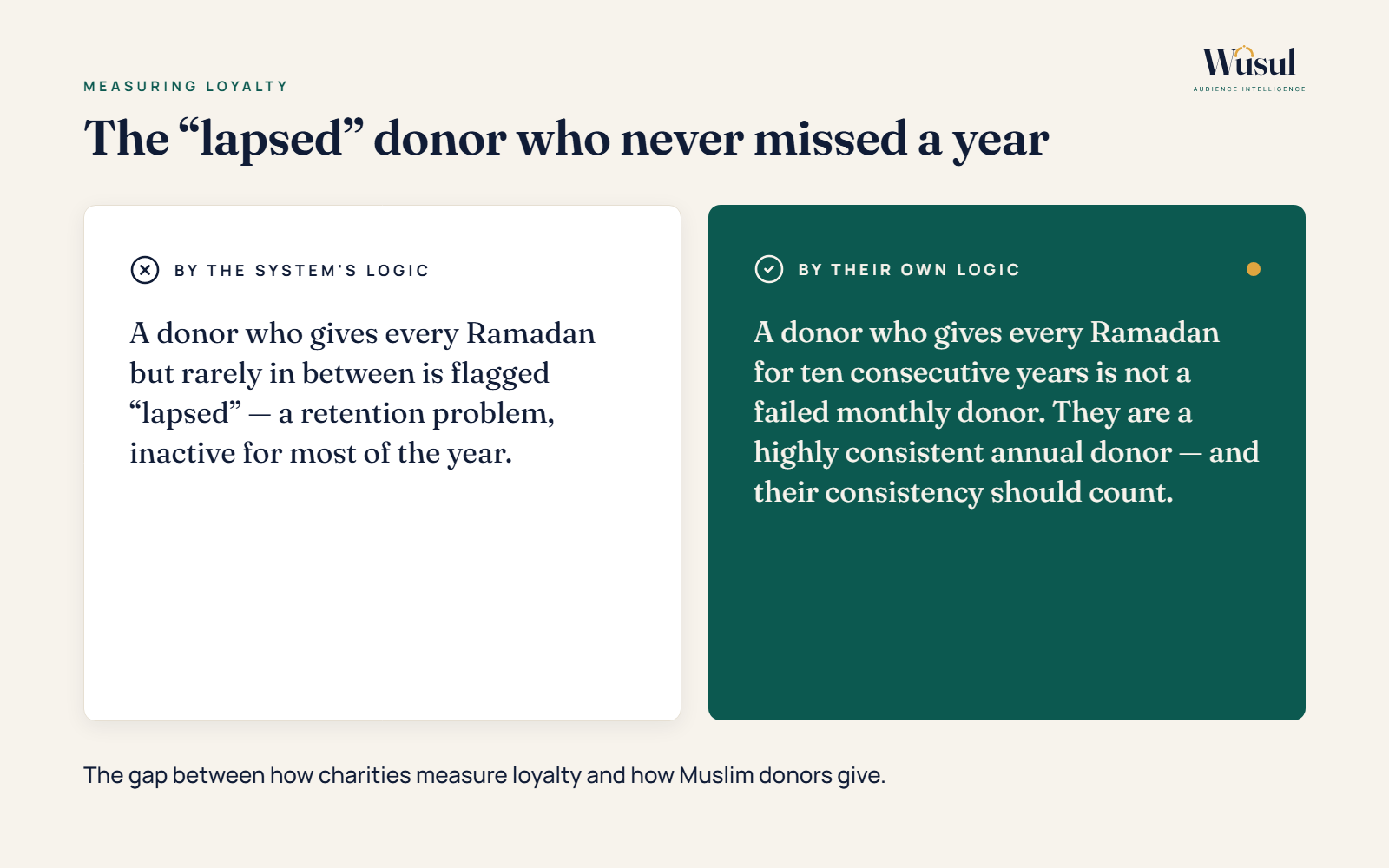
Somewhere in a charity's CRM, a donor who has given every Ramadan for a decade is flagged as "lapsed." By the system's logic, they are a retention problem. By their own logic, they have never missed a year.
That gap between how charities measure loyalty and how Muslim donors give is the subject of this article. Modern fundraising treats recurring giving as something to be engineered: monthly programs, automated payments, upgrade journeys and retention campaigns designed to turn one-off donors into long-term supporters. The principle behind all of it is sound. Generosity becomes more sustainable when it is repeated.
But for Muslim donors, repetition is not a new behavior that a charity has to introduce. It is already built into faith.
Islam is not the only tradition to structure giving in this way. What is distinctive about Islamic giving is its combination of features: an obligation calculated as a fixed share of qualifying wealth, recipients defined by scripture, a lunar calendar of sacred seasons, and institutions designed to make a single gift last for generations. Together, they form an architecture in which giving is expected to return, endure and become part of ordinary life.
So why do so many fundraising strategies still treat recurring giving as something Muslim donors must be taught from scratch? Largely because the tools charities use were built for a different rhythm. CRM systems, retention benchmarks and reporting cycles were mostly designed around monthly payments and the Gregorian calendar. When those tools meet a donor whose giving follows Zakat, Ramadan and Dhul Hijjah, consistent behavior can look like inconsistency.
Zakat: an obligation that returns
The clearest expression of structured recurring giving in Islam is Zakat. A note on precision first, because it applies to everything that follows: Zakat is a religious obligation governed by specific conditions, and the details vary between schools of jurisprudence. With that said, its basic shape is well established. Zakat on wealth is 2.5% of qualifying assets held for a full lunar year (the hawl), once those assets reach the minimum threshold known as the nisab. Research from the Muslim Philanthropy Initiative at Indiana University's Lilly Family School of Philanthropy estimates that Muslim Americans contribute about $1.8 billion in Zakat each year, with nearly 70% of that given during Ramadan.
Zakat is not a subscription, and its amount is not fixed. It rises and falls with the donor's wealth. Yet it introduces something unusual into the architecture of philanthropy: a recurring, calculated obligation to redistribute part of one's wealth, with the eligible recipients set out in the Qur'an (Surah At-Tawbah, 9:60).
The logic behind that recurrence is as social as individual. A family facing poverty does not stop needing support when a campaign ends, and economic vulnerability can persist across years and generations. Zakat does not guarantee an end to poverty; its effect depends on compliance, distribution and governance. But its design reflects a clear principle: society's responsibility to vulnerable people should not depend on occasional bursts of charitable enthusiasm. The obligation returns because the need does.
There is a practical detail here that matters to fundraisers. Each donor's Zakat year is personal, beginning when their wealth first reached the nisab. In practice, many donors choose to calculate and pay in Ramadan, and many scholars permit paying Zakat in advance, which is why some donors spread it across monthly instalments. That makes a monthly Zakat plan a legitimate way of paying an annual obligation, not a different kind of giving.
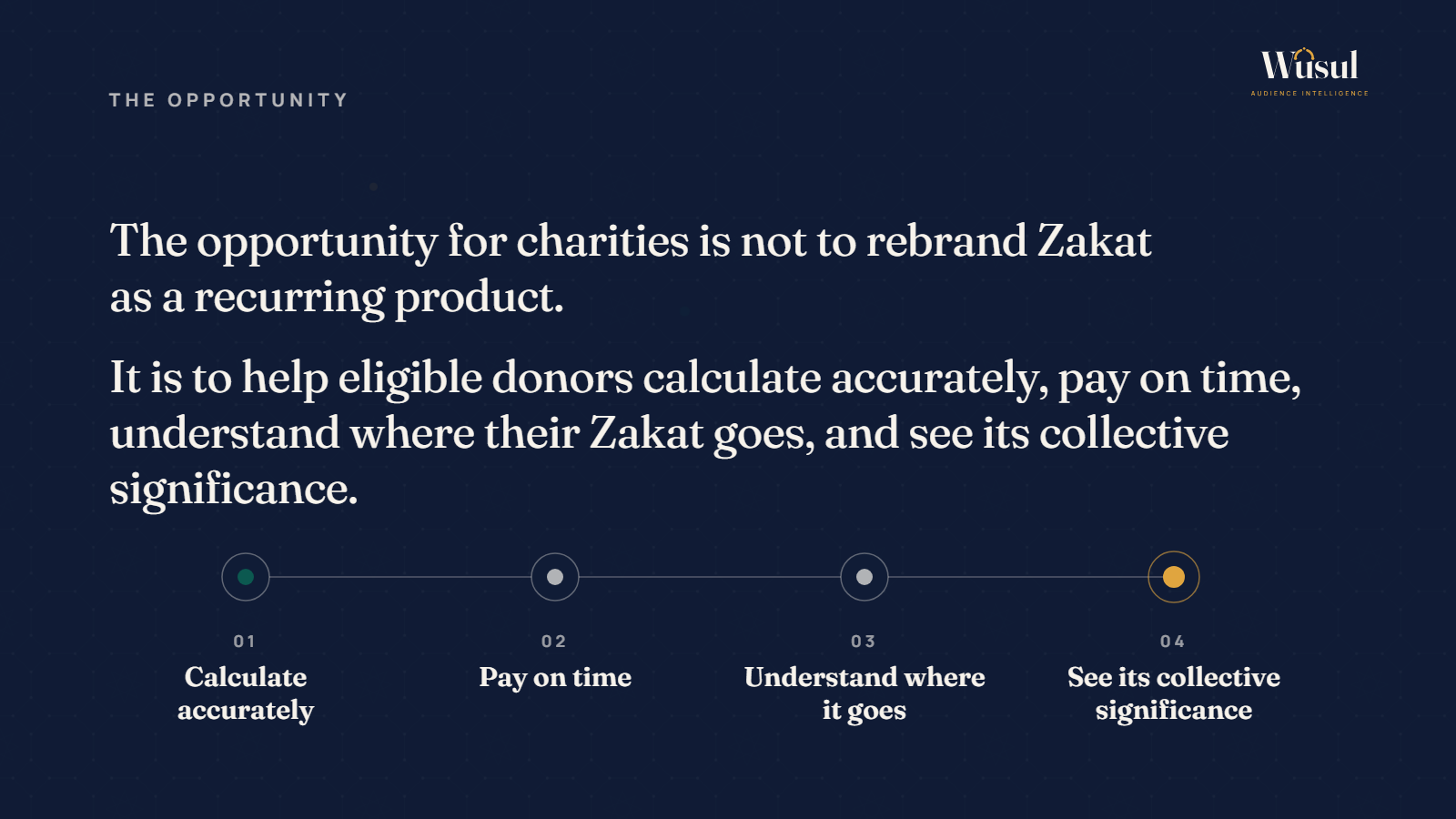
The opportunity for charities, then, is not to rebrand Zakat as a recurring product. It is to help eligible donors calculate accurately, pay on time, understand where their Zakat goes, and see its collective significance.
Daily, weekly, nightly; rhythms closest to "monthly"
If Zakat is the annual backbone of Islamic giving, voluntary Sadaqah supplies a higher-frequency rhythm. Islamic teaching encourages giving that is small, regular and woven into ordinary days. Many Muslims give something every day, and Friday, the day of congregational prayer, carries particular weight as a day for charity.
Charities have already built products around this. Weekly Friday giving schemes, such as Human Appeal's Jummah Club, take an automated payment every Friday . Muslim Aid runs a similar Jummah Giving program, allowing donors to automate weekly donations to selected appeals.
The most striking example is nightly. MyTenNights, a UK platform that splits donations across the last ten nights of Ramadan, so donors never miss Laylat al-Qadr, reported that more than 100,000 Muslim donors gave £10.9 million through it in 2020, more than double the £4.3 million raised in 2019. Its partners included Islamic Relief, Penny Appeal, Oxfam and Barnardo's.
These products succeed for a simple reason. They did not invent a new habit. They took a rhythm donors already observed and removed the friction of keeping it. That is the model for everything that follows: technology works best when it serves an existing rhythm, not when it imposes a new one.
Ramadan: the annual return
For Islamic charities, Ramadan is the single most important fundraising period of the year. Islamic Relief UK's director has said that about 40% of the charity's annual income is raised during its Ramadan campaign. A 2020 survey of Muslim charities by Islam Channel found a similar average of 40%, with one charity expecting as much as 80%.
That concentration shapes how charities see the month: as a campaign window to be planned for, competed in and closed. But a donor experiences Ramadan differently. For them, it is part of a lifelong spiritual rhythm of fasting, prayer, reflection and giving, and it comes back every year. Each time it returns, the same questions return with it. What should I give? Have I calculated my Zakat? Which causes do I trust?
For the charity, the campaign ends. For the donor, Ramadan will return. The real question is whether the relationship with the charity returns with it.
This is where the "lapsed" Ramadan donor comes in. A supporter who gives every Ramadan and rarely in between may be classed as inactive or poorly retained. Yet a donor who gives every Ramadan for ten consecutive years is not a failed monthly donor. They are a highly consistent annual donor, and their consistency should count.
Qurbani: consistency without uniformity
Every year at Eid al-Adha, Muslims with the means perform Qurbani (also called Udhiyah), the sacrifice of an animal whose meat is shared with family, neighbors and people in need. Jurists differ on its exact status, but its annual return is not in question. For charities that run Qurbani programs, it creates a predictable yearly cycle of donor engagement, procurement, distribution and reporting.
Qurbani also shows something the monthly model tends to miss. A donor might fund a Qurbani in Yemen one year and in Bangladesh the next. Their budget may change, and so may their chosen charity. What stays constant is the occasion and the donor's participation in it.
In other words, consistency of giving does not require consistency of amount, destination or even organization. Modern recurring programs are built around fixed sums at fixed intervals. Islamic giving includes that pattern, but also annual obligations, seasonal commitments and repeated participation in shared acts. A charity that recognizes those differences will build better relationships than one that tries to move every supporter into the same monthly payment.
Sadaqah jariyah: when the donation stops but the benefit continues
Sadaqah Jariyah, or ongoing charity, moves the idea of recurrence from payment to benefit. Its basis is well-known hadith in Sahih Muslim: when a person dies, their deeds come to an end except for three, one of which is ongoing charity. A donor may give once towards a well, a school or a source of beneficial knowledge, and the reward is understood to continue for as long as people benefit from it.
This is a fundamentally different idea of sustainability. In conventional fundraising, continuity usually means repeated income for the organization. In Sadaqah Jariyah, it means enduring value for the people served. A monthly gift can stop while the project it funded keeps working. Equally, a donor can give every month to something whose benefits are short-lived.
Neither model is superior; they do different jobs. But they work best together. A one-off Sadaqah Jariyah gift can build a water system, and regular donations can keep it maintained and running. The first creates the asset. The second protects its benefit.
Waqf: Sustainability Beyond the Individual Donor
Waqf takes the logic of Sadaqah Jariyah and gives it an institutional form. A waqf dedicates an asset permanently to a charitable purpose: the capital is preserved, and the income it generates funds the cause. Historically, awqaf financed schools, hospitals, mosques, water supplies and social welfare across Muslim societies, often for centuries.
The model is being revived in the UK. In September 2026, Human Appeal's subsidiary The Waqf Fund bought a £1.9 million retail unit in Solihull, expected to generate £150,000 a year in rent for humanitarian projects. It was the fund's fourth property in under two years, bringing the portfolio to £5.6 million. Donors could choose which of thirteen causes their share of the income would support, with most choosing orphans, water projects and Sadaqah Jariyah.
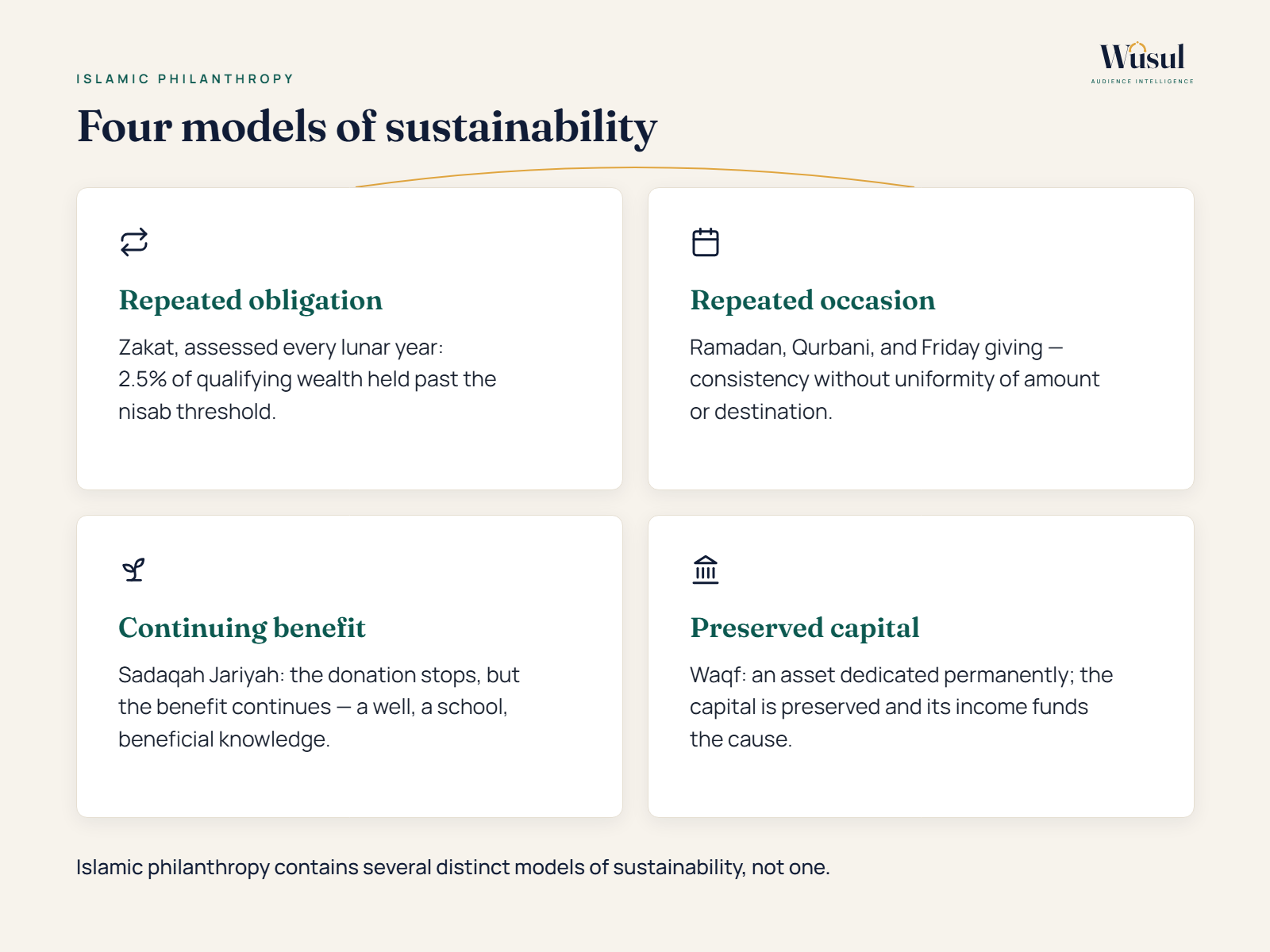
A waqf does not depend on the same donor giving again. The asset does the recurring work. That makes it the clearest proof that Islamic philanthropy contains several distinct models of sustainability, not one:
- Repeated obligation: Zakat, assessed every lunar year.
- Repeated occasion: Ramadan, Qurbani and Friday giving.
- Continuing benefit: Sadaqah Jariyah.
- Preserved capital: Waqf.
Sustainable generosity needs more than the willingness to give today. It needs structures that let the benefit continue tomorrow.
The Hijri calendar problem hiding in your retention data
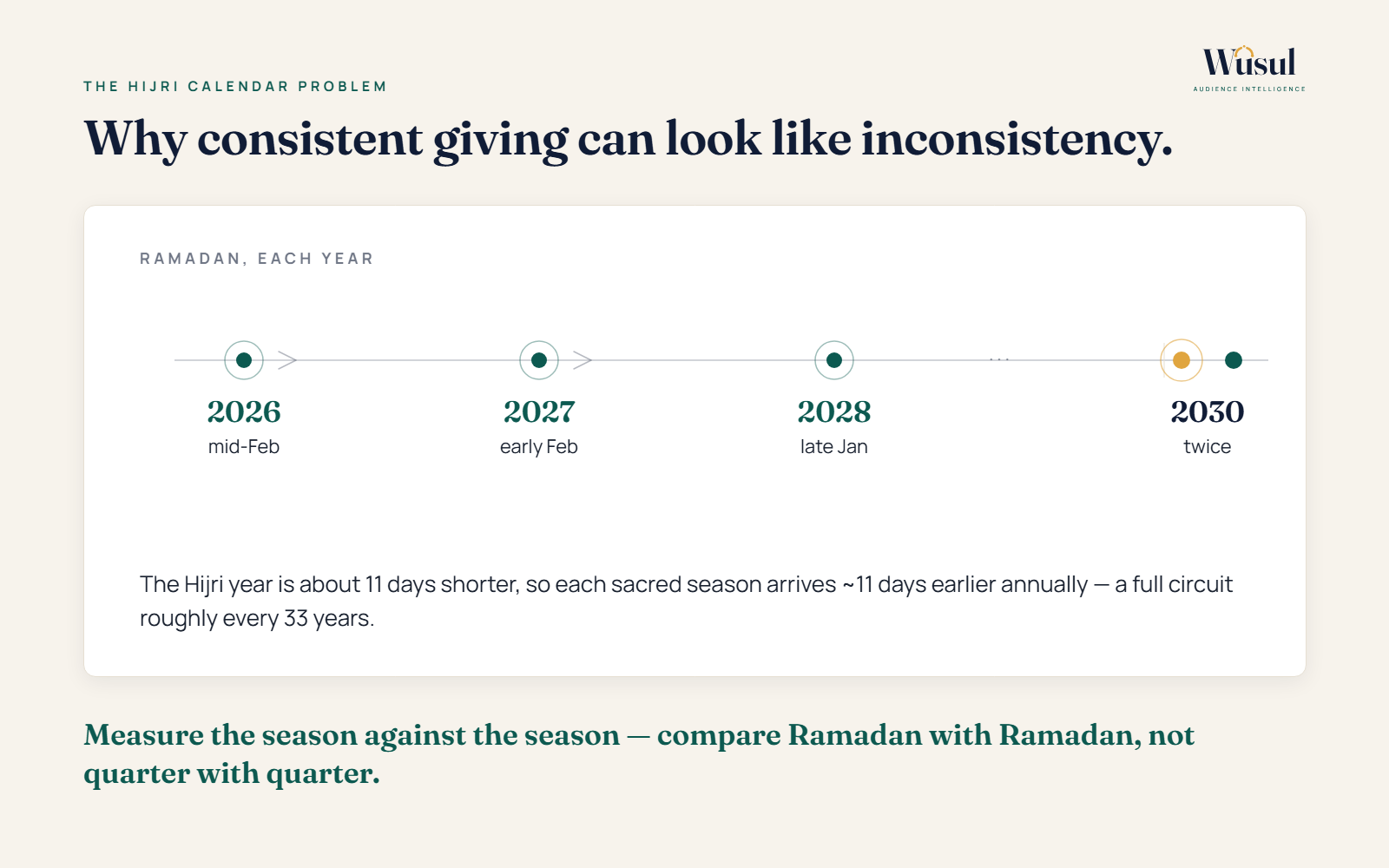
There is a technical reason Muslim giving rhythms are easy to misread: they run on a different calendar. Ramadan, Dhul Hijjah and the other sacred seasons follow the lunar Hijri year, which is about 11 days shorter than the Gregorian year. Each occasion therefore arrives roughly 11 days earlier every year, completing a full circuit of the Gregorian calendar about every 33 years.
That drift has real consequences for reporting. Ramadan began in mid-February in 2026, is expected in early February in 2027 and in late January in 2028. In 2030, it is expected to begin twice: once in early January and again in late December. Exact dates depend on the moon, but the pattern is fixed.
Now consider what that does to standard metrics. A quarterly report that compares Q1 with "the same quarter last year" will slowly shift Ramadan income from one quarter to another, creating growth or decline that is purely calendrical. A financial year that contains two Ramadans will look like a breakthrough; the following year will look like a collapse. Any lapse rule based on a fixed Gregorian window, such as "no gift in the last six months," will flag annual Ramadan and Qurbani donors as lapsed for most of the year, even when they have never missed an occasion.
The fix is not complicated. It is to measure seasonal giving against the season, not the month: compare Ramadan with Ramadan, Dhul Hijjah with Dhul Hijjah, and track retention by Hijri year for donors whose giving follows it. Wusul's Ramadan and Eid calendar maps these dates across five markets.
The modern fundraising paradox
Here lies the paradox. Islamic charities operate within a tradition that already contains recurring obligations, annual rhythms and lasting forms of generosity. Yet their fundraising is often organized as a sequence of isolated peaks. Ramadan begins, donations rise, Ramadan ends and engagement falls away. An emergency attracts attention, the coverage fades and the next appeal begins. Then, separately, the charity invests in a recurring giving campaign to persuade the same donors to commit.
Part of the problem is the question being asked. Most recurring giving strategies start here: how do we turn a one-off donor into a monthly donor? A better starting point is: what recurring pattern of generosity already exists in this donor's life, and how can we support it?
The first question begins with the organization's preferred revenue model. The second begins with the donor's values, obligations and behavior. Neither removes the need for reliable income; charities have to plan, staff and sustain programs. But financial reliability can come in more than one shape. Some donors will prefer monthly Sadaqah. Others will plan their Zakat once a year, give every Ramadan and Qurbani, or make a single large gift to a waqf. The task is not to force these behaviors into one category. It is to understand how each can contribute to a lasting relationship.
Technology can help with that, but it cannot create motivation. Automated payments, digital wallets and predictive analytics make giving easier to organize and measure. The motivation itself comes from faith, responsibility, compassion and identity. As the success of Friday giving schemes and MyTenNights shows, the best technology does not replace a donor's rhythm. It makes that rhythm easier to keep.
From recurring donation to recurring relationships
A recurring donation is an important sign of commitment, but it is not the only measure of loyalty. One donor may have a monthly direct debit and almost no connection to the charity. Another may give a substantial sum every Ramadan, follow the charity's work, recommend it to friends and stay for fifteen years. Which one is more loyal depends on how loyalty is defined.
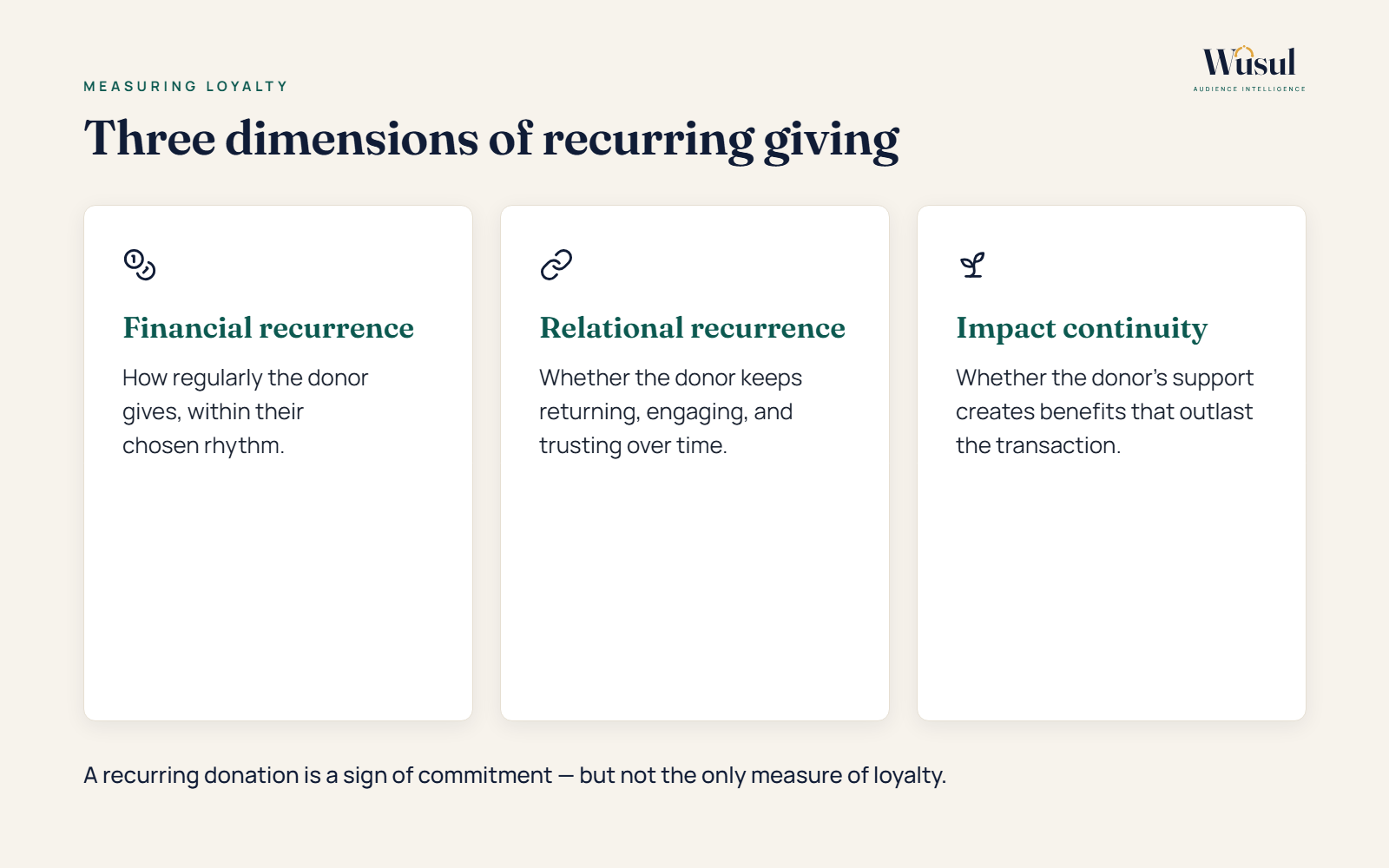
A fuller definition of recurring giving has three dimensions:
- Financial recurrence: how regularly the donor gives, within their chosen rhythm.
- Relational recurrence: whether the donor keeps returning to the organization, engaging with its work and trusting it over time.
- Impact continuity: whether the donor's support creates benefits that outlast the transaction.
These are related but not interchangeable, and a strong strategy tracks all three. In practice, that means designing a different journey for each giving rhythm:
| Giving rhythm | Typical donor | What they need, and when | Metric that fits |
| Weekly or monthly Sadaqah | Automated regular giver | Regular impact updates; easy ways to pause, change or upgrade | Monthly retention; average gift; tenure |
| Annual Zakat | Planner meeting an obligation | Calculation tools before their Zakat date or Ramadan; clear eligibility; reporting on how Zakat was spent | Year-on-year Zakat retention by Hijri year |
| Ramadan and the last ten nights | Seasonal giver | Pre-Ramadan reminders; nightly giving options; a post-Ramadan impact report that keeps the thread alive | Ramadan-to-Ramadan retention |
| Qurbani | Occasion-based giver | Ordering window before Dhul Hijjah; evidence of distribution after Eid | Qurbani-to-Qurbani retention, regardless of country chosen |
| Sadaqah Jariyah and Waqf | Legacy-minded giver | Long-term updates on the asset and who still benefits from it | Repeat or larger legacy gifts; referrals |
Communication changes too. Instead of contacting supporters only when a payment or campaign is due, charities can stay present through honest impact reporting, educational content and invitations to keep participating. The goal is no longer the next transaction. It is a relationship in which giving stays meaningful year after year.
Utilizing religious concepts responsibly
Drawing on Islamic tradition comes with an obligation of its own: accuracy. Zakat is governed by specific conditions, and not every program is eligible to receive it. A monthly Zakat plan can help donors manage an annual obligation, but it should never be presented as automatically fulfilling it without clear guidance on calculation and eligibility. Equally, not every long-term project qualifies as Sadaqah Jariyah, and a waqf requires capital that is genuinely preserved.
These distinctions matter because Muslim donors notice when they are blurred, and trust is the foundation of Islamic giving. Cultural intelligence means respecting them, not simplifying them for marketing convenience.
At Wusul, we believe that cultural intelligence means understanding not just what donors do, but why they do it and designing systems that honor the rhythms, values, and faith that shape their giving. Recurring generosity is not a behavior to be engineered. It is an inheritance to be recognized, supported, and sustained.
Frequently asked questions
How to calculate Zakat?
Zakat on wealth is calculated as 2.5 percent of qualifying assets. These assets must be held for a full lunar year, known as the hawl, once they reach the minimum threshold called the nisab. Because details vary between schools of jurisprudence, scholars differ on specific calculations and readers should ask a qualified scholar.
How does Zakat work?
Zakat is a recurring religious obligation to redistribute a portion of wealth to recipients defined in the Quran. It is calculated based on qualifying assets held for a full lunar year. While it is an annual obligation, some donors choose to pay in advance or through monthly installments to fulfill their commitment.
What is Zakat on wealth?
Zakat on wealth is a religious obligation requiring the redistribution of 2.5 percent of qualifying assets. This obligation applies once assets reach the minimum threshold known as the nisab and are held for a full lunar year. The specific details of this obligation vary between schools of jurisprudence, so scholars differ on the application.