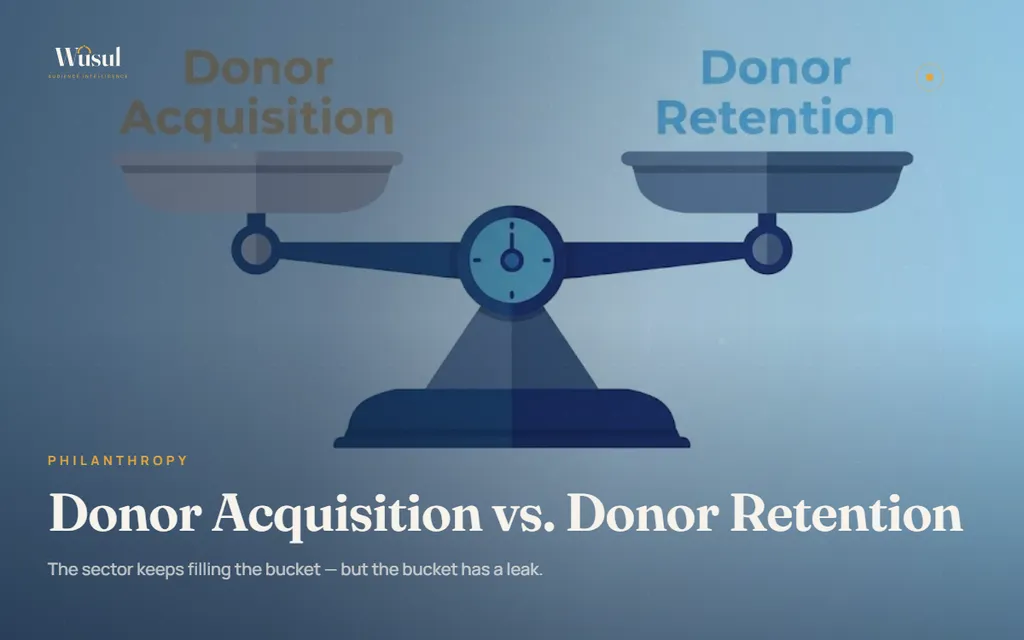
For decades, the nonprofit sector operated on a simple growth logic: acquire more donors, raise more money. The assumption was that as long as new donors kept coming through the door, the organization would grow. Retention was a secondary concern: a nice-to-have, not a strategic priority.
That logic no longer holds. The data from the Fundraising Effectiveness Project (FEP) and other sector research reveals a stark reality: donor acquisition is no longer the primary bottleneck. Retention is. Nonprofits are spending more to acquire donors who give once and disappear, while the donors they already have (the ones who could sustain their work for years) are being neglected.
The shift is not just operational. It is philosophical. It requires moving from a transaction mindset to a relationship mindset, from counting new names to cultivating lasting partnerships.
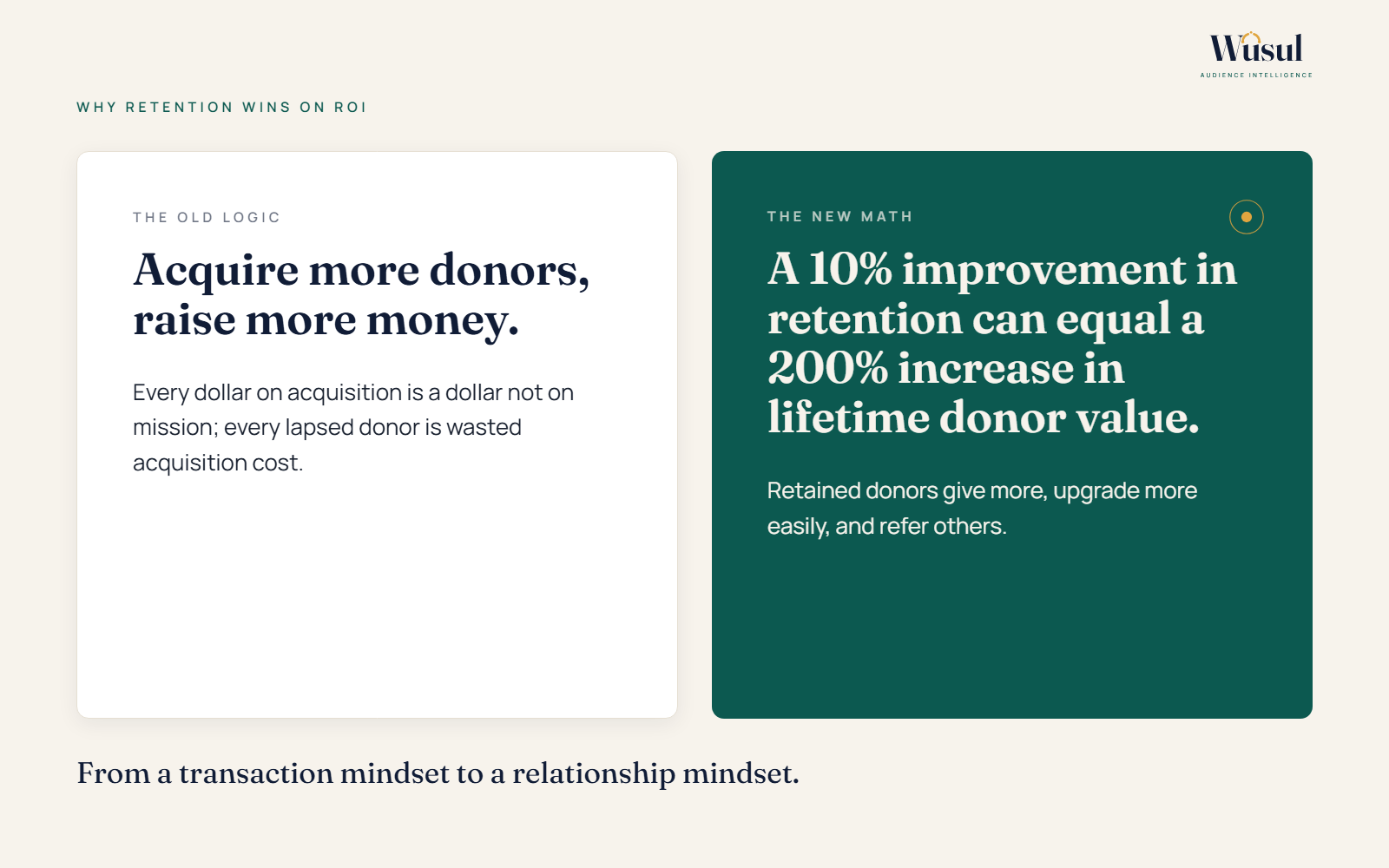
Donor acquisition vs donor retention: why retention wins on ROI
The financial case for retention is unambiguous. Acquiring a new donor costs roughly five times more than keeping an existing one. Some estimates place the ratio even higher, between five and ten times.
This cost differential has profound implications. Every dollar spent on acquisition is a dollar not spent on mission. Every donor who lapses after a single gift represents not just lost revenue, but wasted acquisition cost.
The lifetime value (LTV) equation makes the stakes even clearer. Research shows that a 10% improvement in retention can equal a 200% increase in lifetime donor value. Retained donors give more over time, are easier to upgrade to higher gift levels, and refer others at meaningful rates.
The FEP data confirms this. In Q1 2026, while total dollars raised grew slightly, the number of donors slipped by 0.8%. The sector is leaning on fewer, larger donors to keep revenue stable. The top 3% of donors now account for 77.5% of all revenue, a level of concentration that puts most organizations one major donor lapse away from a budget crisis.
The retention crisis: first-time donors disappear
The aggregate retention number is troubling. The FEP consistently shows sector-wide donor retention rates of approximately 43-46%, meaning that for every 100 donors an organization brings in, roughly half are gone within 12 months.
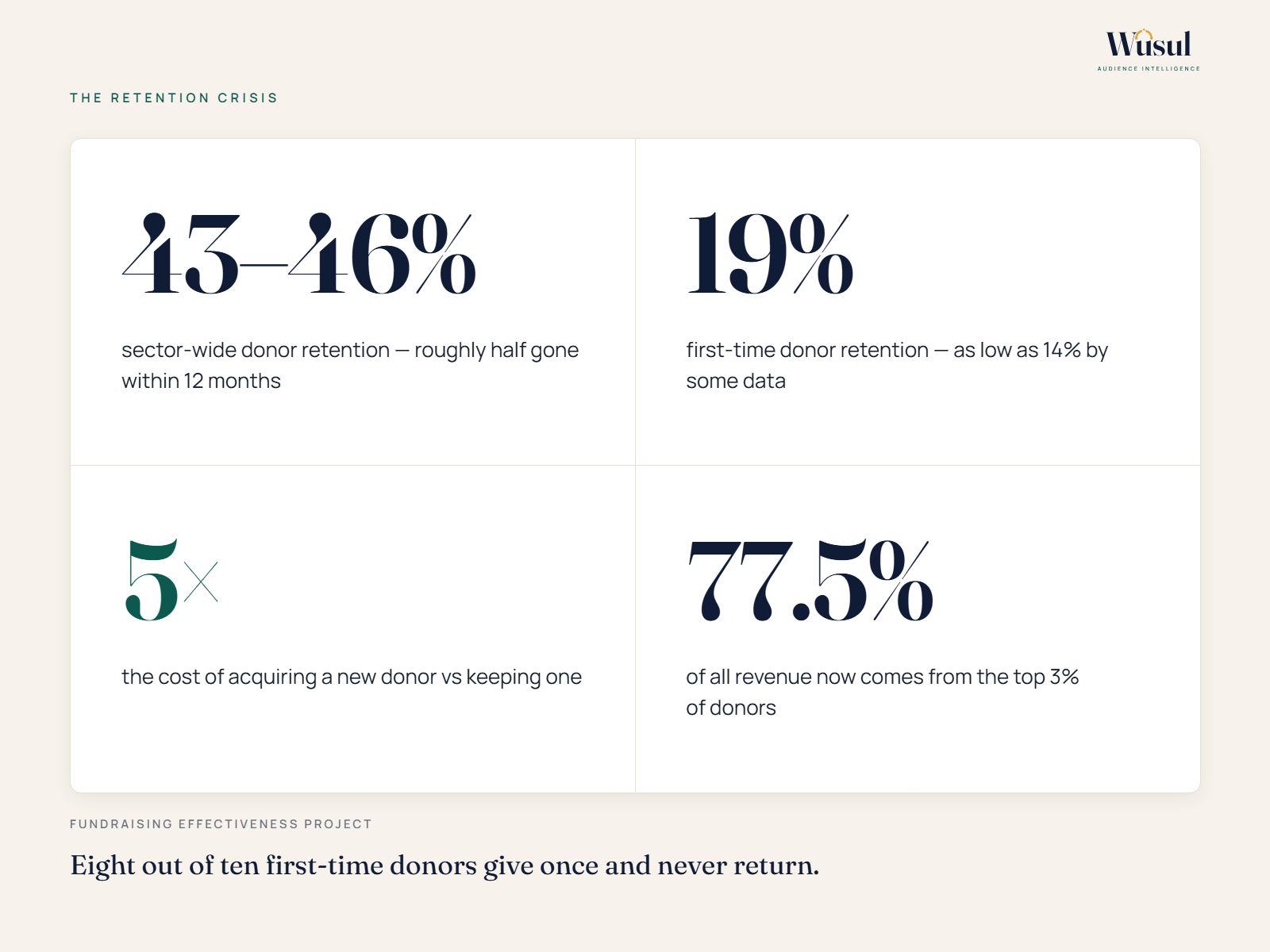
But the first-time donor number is worse. First-time donor retention averages approximately 19% across the sector. Some data suggests it may be even lower, as few as 14% of first-time donors return for a second gift. That means eight out of ten new donors give once and never return.
The reasons are predictable and fixable. Research consistently identifies the same gaps: thank-yous arrive late, generic, or not at all; there is no impact follow-up within 30 days; the donor feels like a transaction rather than a person; and recurring gifts fail silently when cards expire, with no recovery workflow.
The biggest gap happens in the first 90 days after a first gift. The single highest-impact intervention is the speed and quality of the initial acknowledgment. Thank-you communications sent within 24 to 48 hours of a gift correlate with meaningfully higher rates of second-year giving. A templated email with the donor's name and dollar amount is not an acknowledgment, it is a receipt. An acknowledgment tells the donor what their specific contribution made possible.
The recurring giving advantage
One segment stands out as the exception to the retention crisis: recurring donors. Monthly sustainers retain at dramatically higher rates than one-time donors. Research from Bloomerang and other sector sources indicates that monthly donors retain at rates exceeding 80-90% annually, compared with the sector-wide average for one-time donors.
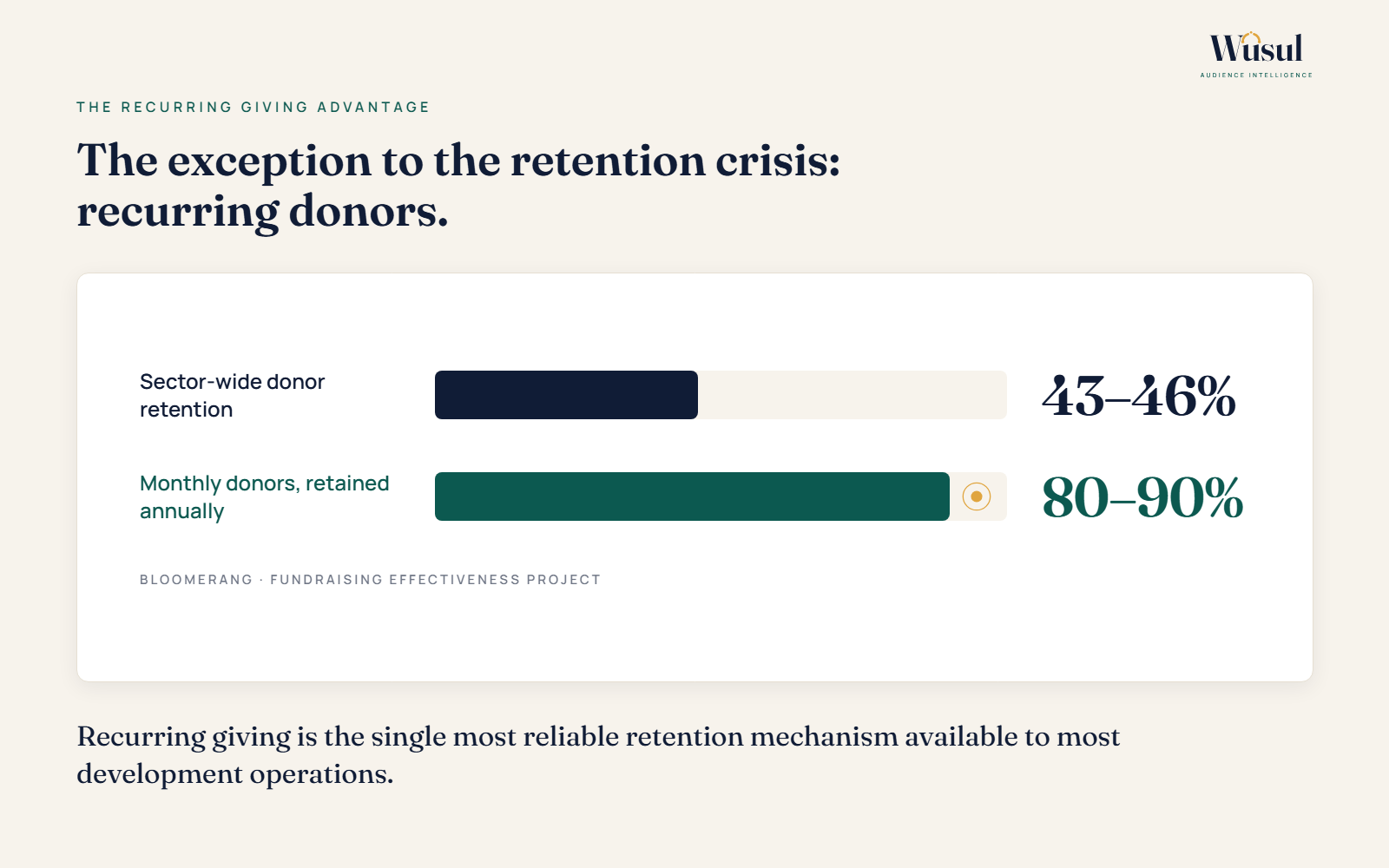
This is not a marginal difference. It is the difference between a donor who gives once and disappears and a donor who stays for years. The structural shift from transactional annual giving toward recurring giving is not just a revenue diversification strategy, it is the single most reliable retention mechanism available to most development operations.
For organizations serving Muslim communities, recurring giving offers a particularly powerful framework. It aligns with Islamic values of consistency; the Prophet Muhammad (PBUH) taught that the most beloved deeds to Allah are those done consistently, even if they are small. It also addresses the post-Ramadan drop-off that plagues Islamic charities, converting seasonal donors into year-round sustainers.
The Muslim context: a sector that already knows retention matters
For Islamic charities, the retention challenge is both familiar and urgent. BAZNAS, Indonesia's national zakat body, recently reported a dramatic transformation in its donor retention rates. By shifting from a transactional approach to a value-driven, relational model grounded in four pillars: Dakwah Zakat (Zakat outreach), Impact Zakat, Management Muzaki (donor management), and Engagement Muzaki (donor engagement), BAZNAS increased its muzaki retention rate from 17% to 80%.
The organization's leadership emphasized that effective donor management can increase retention by 41 to 68%, and that the shift requires moving from collection number targets to a value ecosystem and change.
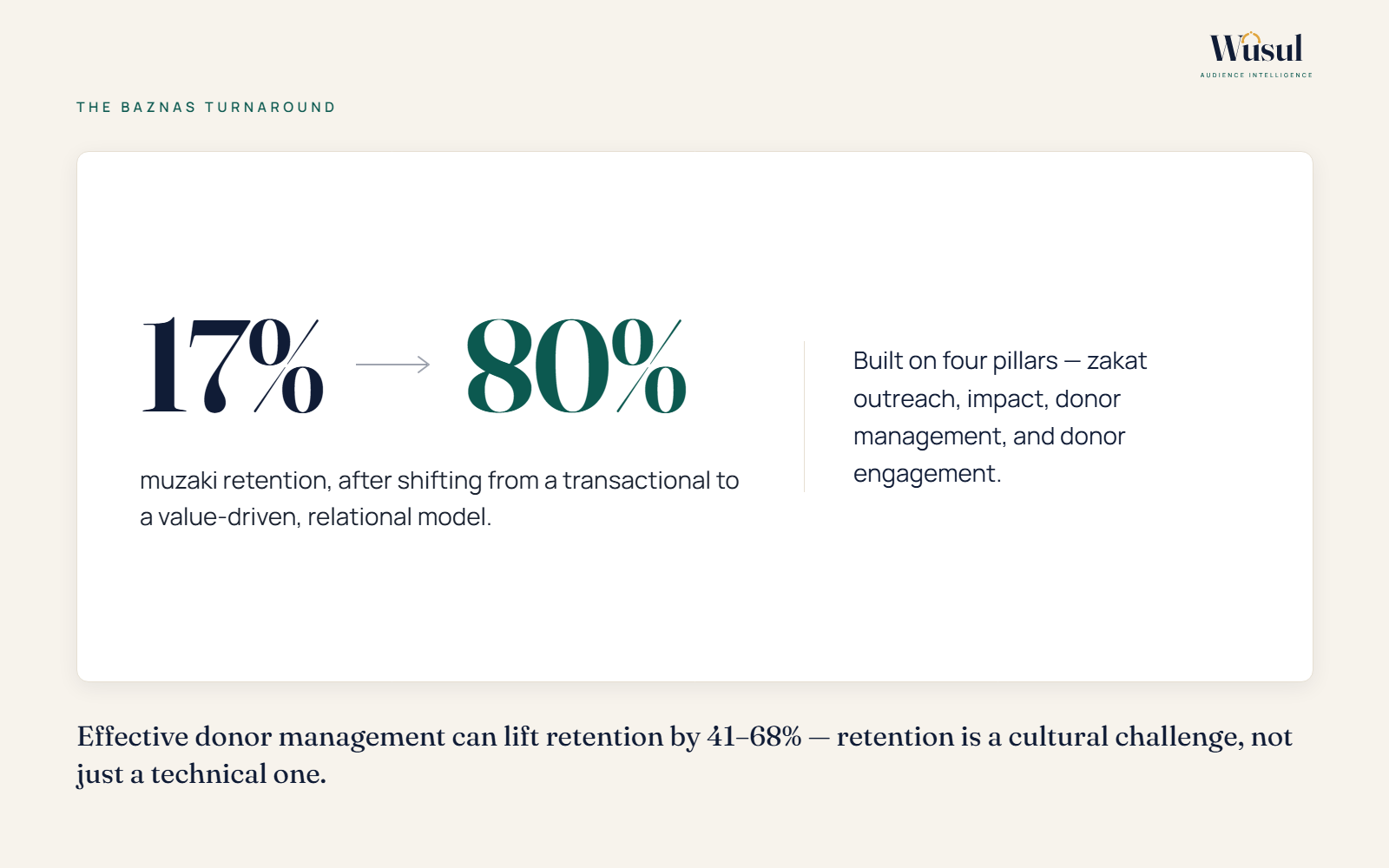
This model demonstrates that retention is not just a technical challenge. It is a cultural one. It requires organizations to see donors not as sources of funds, but as partners in a shared mission, and to invest in the relationship accordingly.
The Muslim Council of Britain's Mizan framework for charitable excellence goes further, embedding donor stewardship within Islamic principles. It cites the principle of shukr (gratitude), the teaching that thanking people is inseparable from thanking Allah, and ihsan (excellence) in interactions with donors. The framework sets a clear KPI for donor retention: greater than the prior year, with maturity levels that progress from ad-hoc acknowledgments to board-level dashboarding, and continuous improvement based on data analytics and donor feedback.
For Islamic charities, this is not an imported Western framework. It is an indigenous one, rooted in the same values that motivate giving in the first place.
Conclusion
The nonprofit sector has spent decades focused on filling the bucket. More acquisition, more campaigns, more names. But the bucket has a leak. Roughly half of all donors disappear within a year. Eight out of ten first-time donors never return.
The organizations that thrive in the coming decade will be those that fix the leak. They will invest in retention not as an afterthought, but as the core of their fundraising strategy. They will treat the first gift as the beginning of a relationship, not the end of a transaction. And they will recognize that the most valuable donor is not the one who gives the most in a single moment, but the one who gives consistently over years.
For Islamic charities, this shift is not just strategic. It is spiritual. The trust that donors place in an organization (the amanah they entrust) demands stewardship. Retention is how that trust is honored.
At Wusul, we believe that cultural intelligence means understanding not just what donors do, but why they do it, and designing engagement that honors the values that shape their giving. Donor retention is not a fundraising tactic. It is a commitment to relationship, consistency, and trust.
Frequently asked questions
What is the difference between donor acquisition and donor retention?
Donor acquisition is bringing new donors through the door. Donor retention is keeping the donors you already have giving year after year. Acquiring a new donor costs far more than keeping an existing one, which is why retention, not acquisition, is now the main bottleneck for most nonprofits.
Why do first-time donors not give a second time?
The reasons are predictable and fixable: thank-yous arrive late, generic, or not at all; there is no impact follow-up within 30 days; the donor feels like a transaction rather than a person; and recurring gifts fail silently when cards expire.
How can charities improve donor retention?
Start with the first 90 days after a first gift. Send a thank-you within 24 to 48 hours that tells the donor what their gift made possible, not just a receipt, and invite them into recurring giving, the most reliable retention mechanism available to most charities.