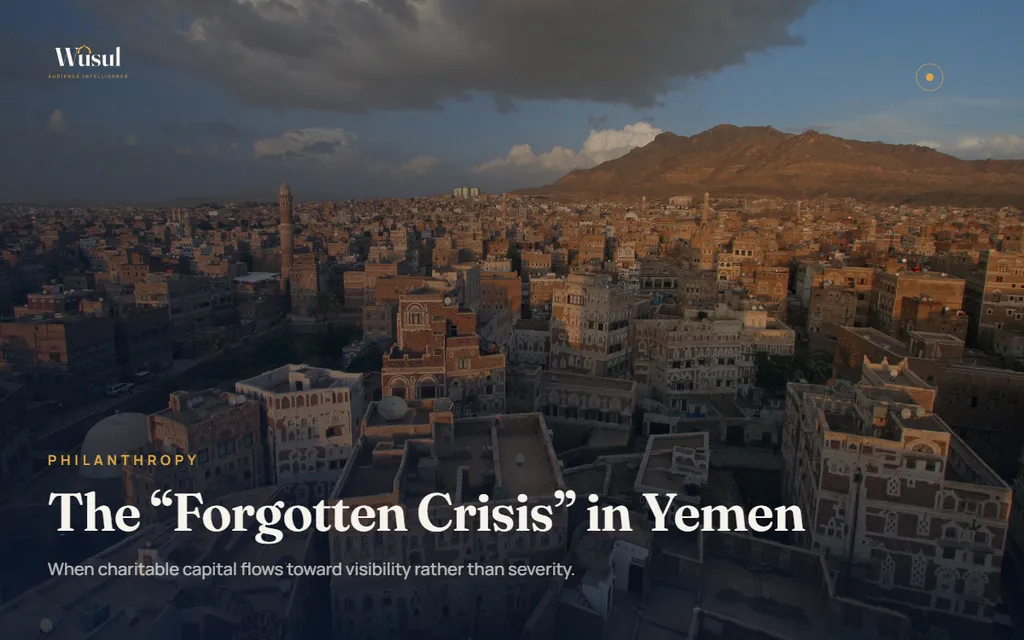
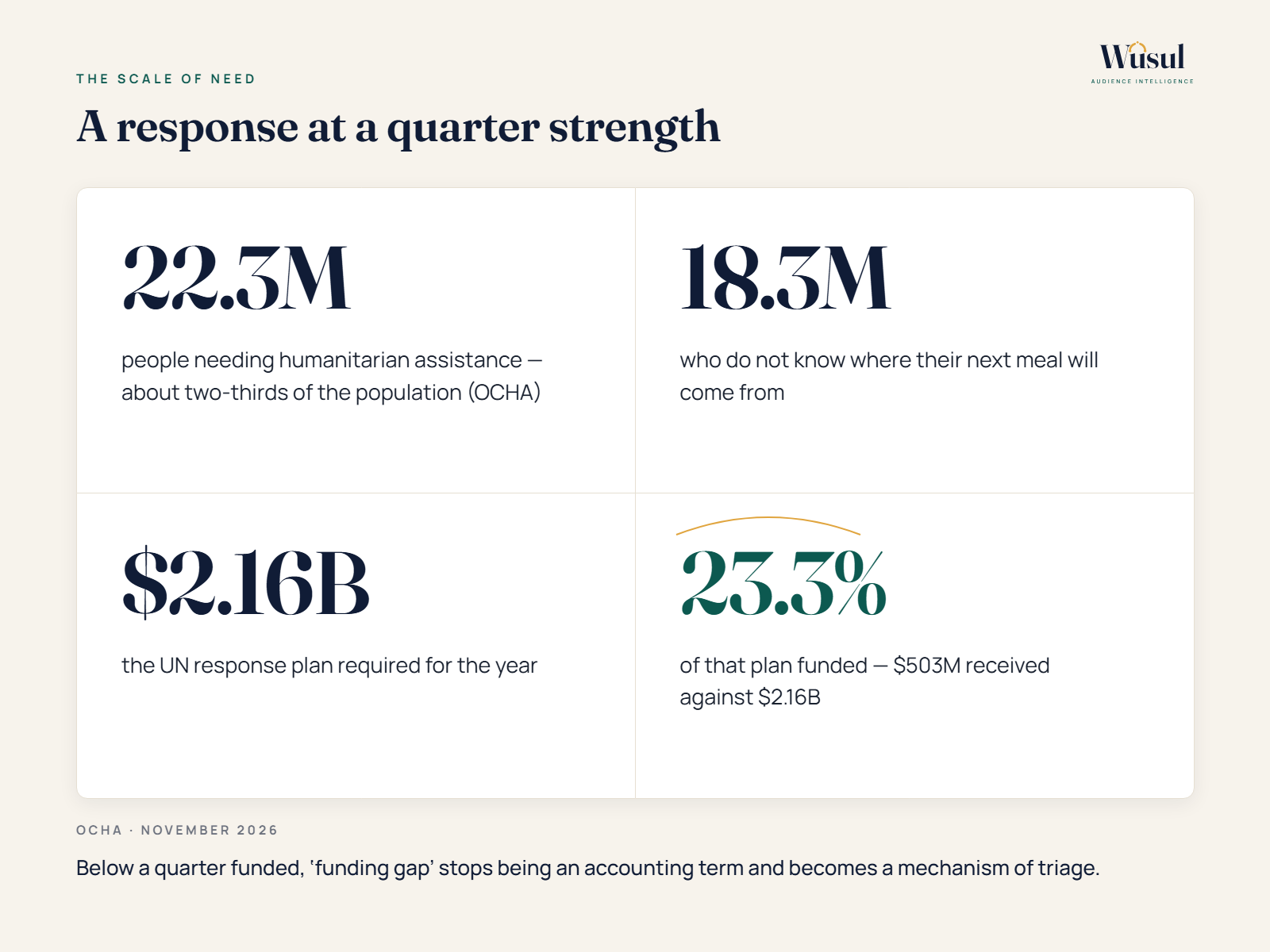
By November 2026, the numbers defining Yemen's humanitarian catastrophe had grown so vast they risked becoming abstract. According to the United Nations Office for the Coordination of Humanitarian Affairs (OCHA), 22.3 million people (roughly two-thirds of the country's population) require humanitarian assistance and protection services. More than 18.3 million do not know where their next meal will come from. Roughly 4.8 million remain internally displaced, a figure compounded by renewed fighting since August 2026 that has driven more than 280,000 additional people from their homes, many fleeing for the third or fourth time. Only 59.3 percent of health facilities across the country remain fully functional, and in accessible regions monitored by the World Food Program, nearly three-quarters of households cannot meet their basic food needs.
Yet as winter approaches in mid-November 2026, the UN's $2.16 billion Yemen Humanitarian Needs and Response Plan sits at just 23.3% funded; $503 million received against $2.16 billion required.
When a humanitarian response operates at less than a quarter of its required budget, "funding gap" ceases to be an accounting term. It becomes a mechanism of triage. Clinics close their doors. Water trucking routes are suspended. Food rations are halved or eliminated entirely for families who have no alternative safety net. As Islamic Relief (which has operated continuously in Yemen since 1998) warned in an urgent November 2026 advocacy update, aid agencies on the ground are being forced into impossible choices over which life-saving programs survive and which are shut down.
For the global Islamic philanthropy sector, Yemen's 23.3% funding figure is more than a diplomatic failure by wealthy donor nations. It is a mirror reflecting an uncomfortable structural reality within modern charitable giving: the collision between perpetual human need and an attention economy built on novelty.
The anatomy of a "forgotten" emergency
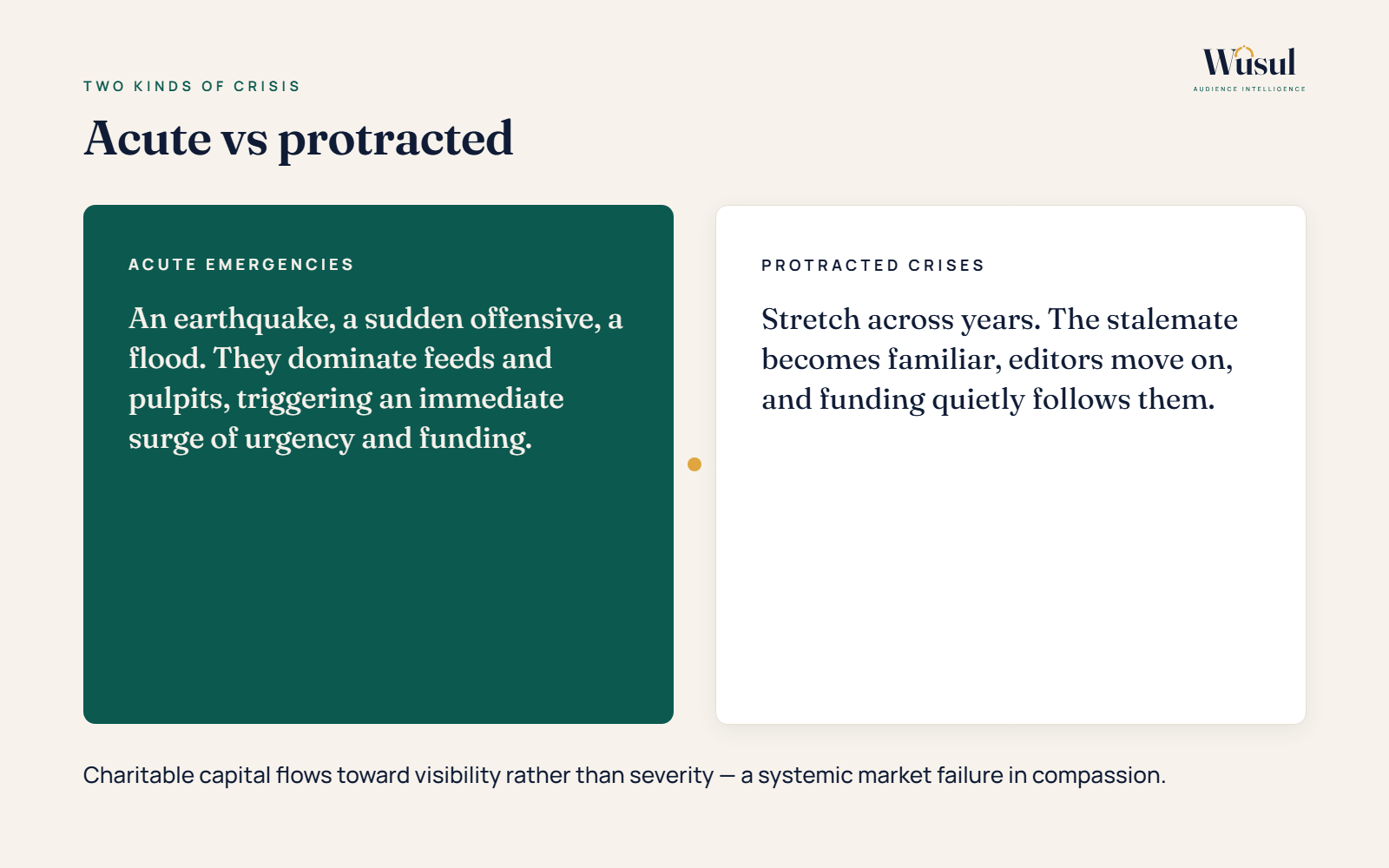
In humanitarian policy circles, crises are informally divided into "acute" and "protracted." Acute emergencies (an earthquake, a sudden military offensive, a flash flood) dominate television screens, social media algorithms, and mosque pulpit appeals. They trigger an immediate surge of moral urgency and financial liquidity. Protracted crises, by contrast, stretch across years or decades. The frontlines calcify, the macro-political stalemate becomes familiar, and media editors quietly move on to newer storylines.
Yemen has been locked in conflict since March 2015, more than eleven years of war, economic blockade, currency collapse, and infrastructure decay. Over that decade, the crisis has not resolved; it has compounded. Renewed clashes in late summer 2026 around Taiz and Lahj triggered rapid displacement, while wheat flour prices in parts of Taiz spiked as commercial stocks dwindled. Simultaneously, extreme weather (deadly seasonal floods followed by harsh winter conditions) has eroded agricultural livelihoods and battered displacement camps.
Despite escalating severity, the global attention apparatus has largely moved elsewhere. Institutional donors have reallocated bilateral budgets toward competing geopolitical emergencies, leaving pooled mechanisms like the Yemen Humanitarian Fund and frontline NGOs stretched thin.
Private Muslim philanthropy, while remarkably resilient compared to secular retail giving, is not immune to these gravitational forces. Most Muslim fundraising infrastructure (from digital crowdfunding platforms to major international NGOs) is engineered around event-driven mobilization. Campaigns perform best when anchored to a breaking news peg or a sacred calendar peak like Ramadan or Dhul Hijjah. When a crisis lacks a fresh media hook, click-through rates drop, donor acquisition costs soar, and fundraising teams quietly pivot their marketing spend toward appeals that convert more efficiently.
The result is a systemic market failure in compassion: charitable capital flows toward visibility rather than severity.
The psychology of compassion collapse
To understand why donors, pull back from multi-year crises even when the data proves conditions are worsening, behavioral economists and psychologists point to two well-documented phenomena: psychic numbing and compassion collapse.
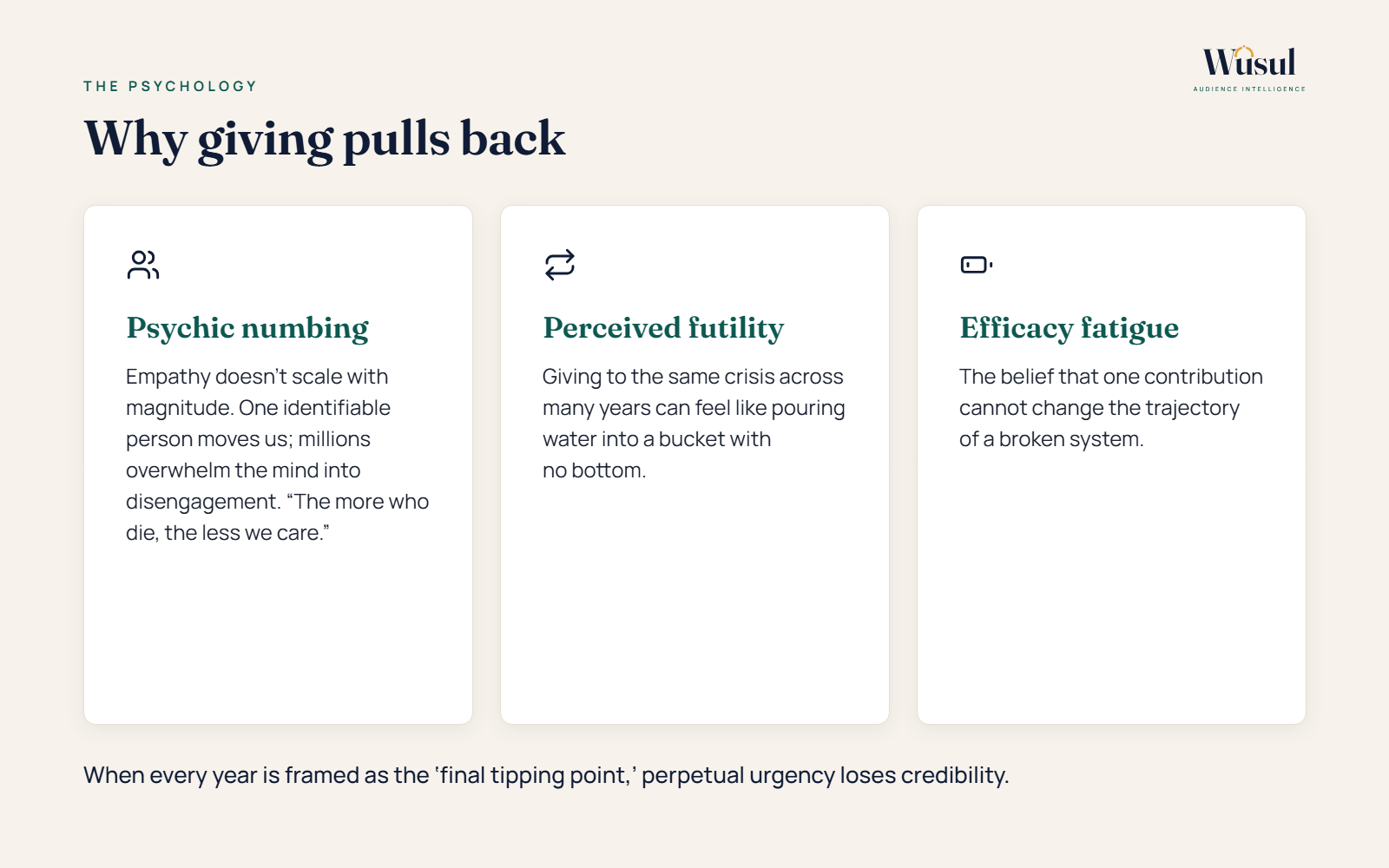
Research pioneered by psychologist Paul Slovic demonstrates that human empathy does not scale linearly with the magnitude of suffering. When confronted with a single identifiable victim, people feel an intense emotional pull to act. When presented with statistics involving 18.3 million hungry people or 4.8 million displaced citizens, the human brain struggles to process the scale, triggering emotional disengagement. As Slovic and his colleagues have written, "the more who die, the less we care" . The mind, confronted with overwhelming numbers, simply shuts down.
In protracted conflicts, a third factor enters the equation: perceived futility. When a donor gives to Yemen in 2017, again in 2020, and again in 2023, only to read in 2026 that 22.3 million people still need aid, a subtle cognitive shift occurs. Generosity begins to feel like pouring water into a bucket with no bottom. Without a clear narrative of resolution or visible systemic progress, donors experience what researchers call efficacy fatigue; the belief that their individual contribution cannot meaningfully alter the trajectory of a broken system.
For Muslim charities, this presents a profound communication dilemma. Traditional fundraising relies heavily on visceral urgency: "Act now before it's too late." But when an emergency enters its twelfth year, perpetual urgency loses credibility. If every year is framed as the "final tipping point," donors eventually become desensitized to the alarm.
Why faith-based charities are the last line of defense
When international institutional funding contracts (as reflected in OCHA's 23.3% funding figure for November 2026) the operational burden falls disproportionately on organizations with deep, uninterrupted local roots.
Unlike multilateral agencies or foreign contractors that often scale down or evacuate during periods of heightened insecurity and funding shortfalls, established Islamic humanitarian organizations frequently remain embedded in local communities because their legitimacy is anchored in long-term social trust rather than short-term bilateral grant cycles.
Islamic Relief's nearly three-decade presence in Yemen, that has been operating continuously since 1998, illustrates how this structural advantage functions in practice. Because the organization maintains permanent local staff who themselves live through the same inflation, water shortages, and insecurity as the communities they serve, it can continue executing complex operations even when international headlines fade. Working alongside partners like the World Food Program and the Yemen Humanitarian Fund, its teams have maintained hospital supply chains, rehabilitated water infrastructure, and delivered emergency food and winterization kits across contested governorates.
Similarly, smaller, specialized Muslim charities have carved out high-trust niches by focusing on hyper-local, tangible infrastructure. Organizations like the Human Development Fund, for example, have concentrated on drilling deep water wells in displacement hotspots like Taiz, where single completed wells provide clean water to thousands of people, sparing displaced families from spending scarce cash on expensive water trucks or risking waterborne diseases.
Crucially, Muslim charities possess a theological financing mechanism that secular NGOs lack: Zakat.
Because Zakat is an obligatory annual wealth transfer (2.5% of qualifying net assets) rather than discretionary charity, its supply is largely insulated from news cycles. Donors do not calculate their Zakat based on whether Yemen is trending on social media; they calculate it based on their balance sheets. And because Yemeni recipients, displaced families, impoverished households, debt-burdened individuals, and stranded travelers, unambiguously fall within the eight Quranic categories (asnaf) eligible for Zakat, Islamic charities have a dedicated, renewable pool of capital that can be directed toward "forgotten" crises regardless of media visibility.
This is not merely a financial mechanism. It is a theological one. The Qur'an commands believers to "seek help through patience and prayer" (2:45), and the tradition of sabr (patience, perseverance, and steadfastness) is central to Islamic ethics. For Muslim donors, supporting a crisis that has lasted more than a decade is not just a financial decision. It is a spiritual discipline. It is an expression of sabr, a commitment to stand with the vulnerable not just for a news cycle, but for as long as it takes. Charities that can articulate this theological framework (that can help donors see their giving as an act of spiritual perseverance) will be better positioned to sustain support for protracted crises.
The Institutional Trap: Treating Chronic Collapse Like an Acute Shock
Yet even with Zakat providing a vital financial floor, the broader Islamic philanthropic sector faces a strategic reckoning in Yemen. Eleven years into the crisis, simply delivering monthly food parcels and emergency blankets is no longer a sustainable model, both financially and developmentally.
When humanitarian funding covers only 23.3% of assessed needs, every dollar must work harder. Continuing to operate purely on a short-term emergency relief model creates two compounding vulnerabilities.
High operational burn rate. Trucking water and importing in-kind food rations month after month requires continuous fundraising just to maintain baseline survival. The moment donations dip, the entire lifeline collapses.
Erosion of local agency. Prolonged dependency on external food aid can distort local agricultural markets and leave communities entirely exposed when international supply chains fracture.
Leading practitioners in Islamic social finance argue that protracted crises like Yemen require a deliberate shift from pure relief to resilience-oriented philanthropy; even inside active conflict zones.
What does this look like on the ground?
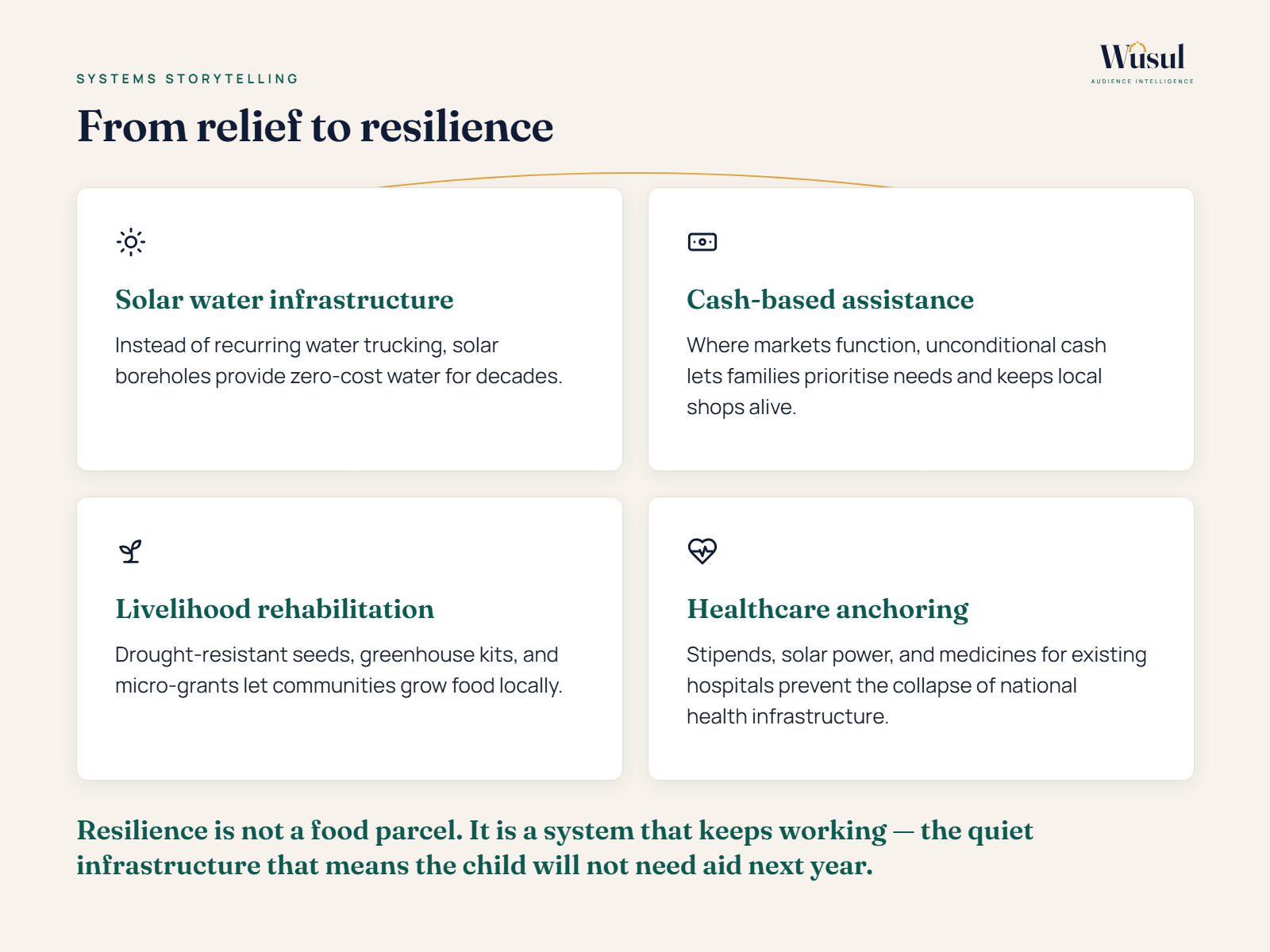
From water trucking to solar water infrastructure. Instead of paying recurring costs to truck water into displacement camps, charities are increasingly using Sadaqah Jariyah and pooled cash Waqf to build solar-powered boreholes and desalination units. Once installed, these assets eliminate fuel dependencies and provide zero-cost water for decades.
Cash-based assistance over in-kind parcels. Where local markets still function (even under inflationary pressure) unconditional Zakat cash transfers allow families to prioritize their own most urgent needs (medicine, rent, flour) while injecting liquidity directly into local Yemeni shops and bakeries, keeping small businesses alive.
Agricultural and livelihood rehabilitation. Supporting smallholder farmers with drought-resistant seeds, greenhouse kits, and micro-grants enables communities to produce food locally rather than relying entirely on imported humanitarian rations.
Healthcare system anchoring. Rather than setting up parallel temporary field clinics, sustained funding for existing public hospitals, paying stipends to Yemeni doctors and nurses, supplying solar power to maternity wards, and stocking essential medicines, prevents the permanent collapse of national health infrastructure.
A story from Taiz
Consider the story of a water engineer named Ahmed who works for a Muslim charity in Taiz. Before the charity installed a solar-powered borehole in his community, Ahmed spent his days managing water trucking routes, coordinating deliveries, negotiating prices, and watching as the costs rose year after year. The water was never enough. The trucks were never on time. The families were always waiting.
Now, Ahmed maintains the solar panels that power the borehole. The water flows every day. The cost is zero. The waiting is over.
"Before, we were always waiting for the next truck," he says. "Now, we are not waiting anymore."
This is what resilience looks like. It is not a food parcel. It is a system that keeps working. It is not a photograph of a child receiving aid. It is the quiet infrastructure that means the child will not need aid next year.
For donors, this is a harder story to tell. It does not produce the tear-jerking images of emergency relief. It does not offer the immediate gratification of knowing a family was fed today. It requires donors to trust that their giving will produce results they may never see, and to believe that the institution managing their Zakat will still be there decades from now.
But it is the story that matters. Because it is the story that ends the cycle of dependence. It is the story that builds a future where the next disaster is less devastating.
Rewriting the Story: How Charities Must Engage Donors
If Islamic charities want to close the funding gap for Yemen without relying on short-lived crisis spikes, they must also rethink how they communicate with modern Muslim donors.
Today's philanthropic audience; particularly younger Millennial and Gen Z donors is increasingly analytical, skeptical of generic emotional appeals, and hungry for transparency. When an organization asks a donor to support a crisis that has lasted over a decade, guilt-driven messaging rarely works. What builds sustained commitment is intellectual honesty paired with clear theories of change.
To break out of the attention economy trap, Muslim philanthropic institutions need to adopt three editorial and fundraising shifts.
Normalize subscription-based "baseline" giving. Campaign-based fundraising trains donors to give sporadically in response to emergencies. Charities must aggressively transition donors into automated monthly giving programs specifically earmarked for "underfunded" or "silent" emergencies. Framing a $30 monthly contribution not as a reaction to today's news, but as a permanent commitment to keeping a clinic open in Taiz or a water well running in Marib, shifts the donor's identity from a reactive responder to a reliable sustainer.
Replace "crisis porn" with systems storytelling. Instead of recycling identical images of malnourished children every six months (which inadvertently reinforces donor fatalism) storytelling should spotlight local resilience, institutional mechanics, and measurable outcomes. Show donors the Yemeni engineers maintaining solar microgrids, the female healthcare workers running rural nutrition clinics, and the exact unit economics of how $100 in Zakat cash assistance stabilizes a displaced household for three months. Competence inspires confidence; fatalism inspires withdrawal.
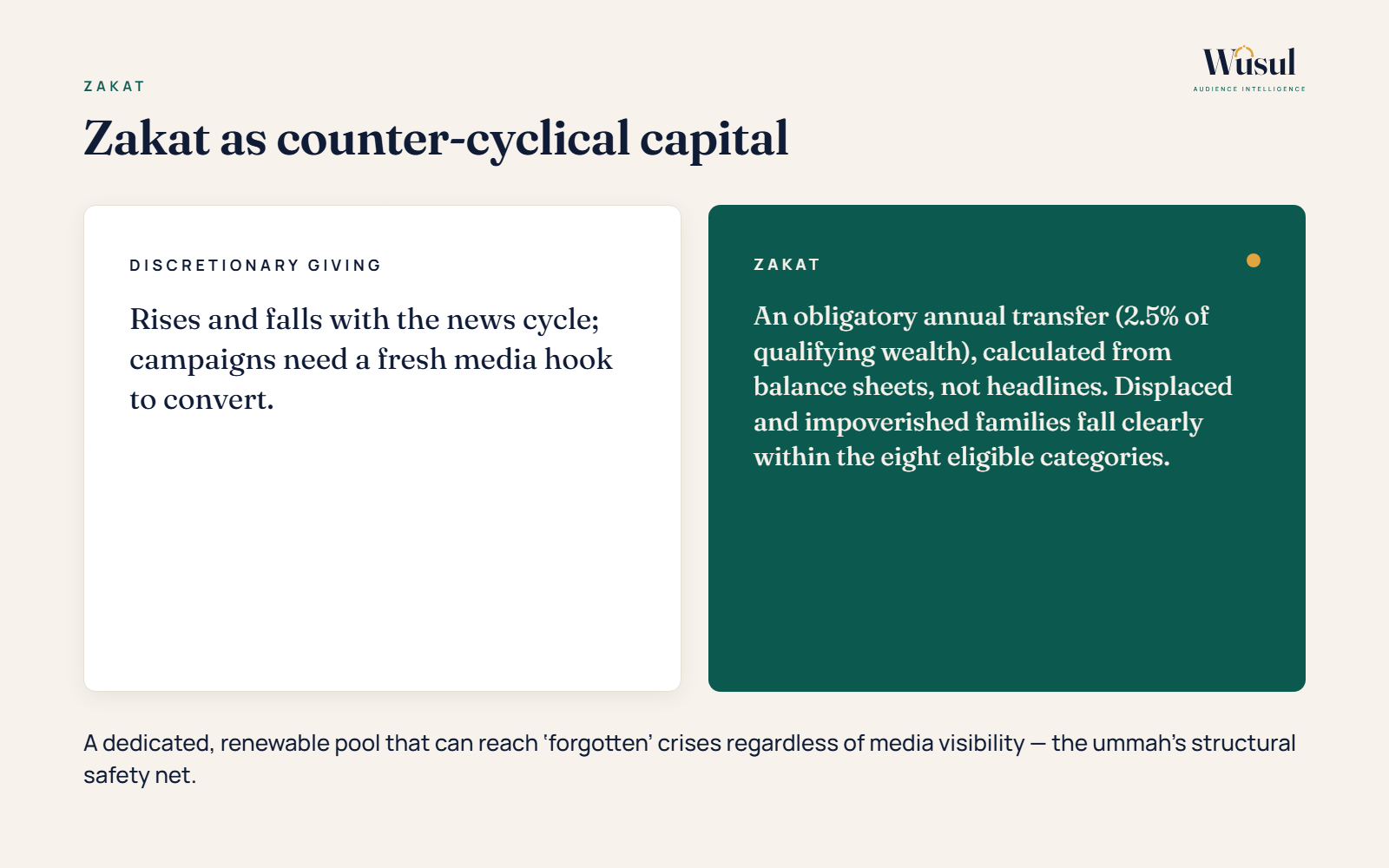
Use Zakat strategically as counter-cyclical capital. Charities and Zakat-collecting platforms should actively educate donors on the counter-cyclical role of Zakat. When secular bilateral aid drops to 23.3%, Zakat can be positioned explicitly as the ummah's structural safety net, designed specifically to step in where global political will fails. Transparency tools that verify 100% Zakat distribution policies and independent field audits are essential to converting this theological duty into sustained funding for neglected regions.
The bigger question
The numbers coming out of Yemen in November 2026 are a sobering indictment of the international humanitarian system. A response plan funded at 23.3% means that for every four people in desperate need of food, water, or medical care, three are being left behind.
For Muslim philanthropy, however, Yemen represents a defining test of institutional maturity. It is easy to be generous when the cameras are rolling, when social media feeds are unified in outrage, and when the emotional reward of giving is immediate. The true measure of a philanthropic ecosystem is what it does when the cameras leave, when the crisis becomes chronic, complex, and unglamorous.
The bigger question posed by Yemen's funding crunch is not merely how charities can raise more money before winter sets in. It is whether modern Muslim giving can evolve beyond the emotional highs of the attention economy to build an architecture of patient, disciplined solidarity, one capable of standing with vulnerable communities not just for a news cycle, but for as long as it takes.
The answer will determine not just the future of Islamic philanthropy, but the future of the communities it serves.
At Wusul, we believe that cultural intelligence means understanding not just what donors give to, but why, and designing engagement that honors the values, trust signals, and aspirations of the communities we serve. The shift from reactive charity to patient, disciplined solidarity is not just a fundraising question. It is a cultural intelligence question. It requires understanding why donors give, what they trust, and how to communicate the value of slow, systemic work in a way that resonates with different generations. Organizations that can make this shift, that can help donors see their giving as an investment in long-term resilience, not just emergency relief, will be the ones that lead the next era of Islamic philanthropy.
Frequently asked questions
Why is Yemen aid underfunded?
Yemen aid is underfunded because global attention has shifted toward newer geopolitical emergencies. Institutional donors have reallocated budgets elsewhere, and private philanthropy often relies on event-driven mobilization. When a crisis lacks a fresh media hook or a breaking news peg, fundraising efforts become less efficient, leading to a systemic market failure where capital flows toward visibility rather than severity.
What is compassion collapse in charity?
Compassion collapse is a psychological phenomenon where human empathy does not scale linearly with the magnitude of suffering. While individuals feel an intense emotional pull to help a single identifiable victim, the human brain struggles to process large-scale statistics. When confronted with overwhelming numbers of people in need, the mind may experience emotional disengagement and simply shut down.