A clear cultural intelligence definition explains why shared values, beliefs, and behavioral norms shape how a group of people thinks and acts. Most organizations think they understand an audience because they know their age, income, and location. Those are demographics. Understanding why that audience behaves the way it does (what they value, how they decide, what they trust) is culture. Confusing the two is the single most common root cause of the Cultural intelligence gap.
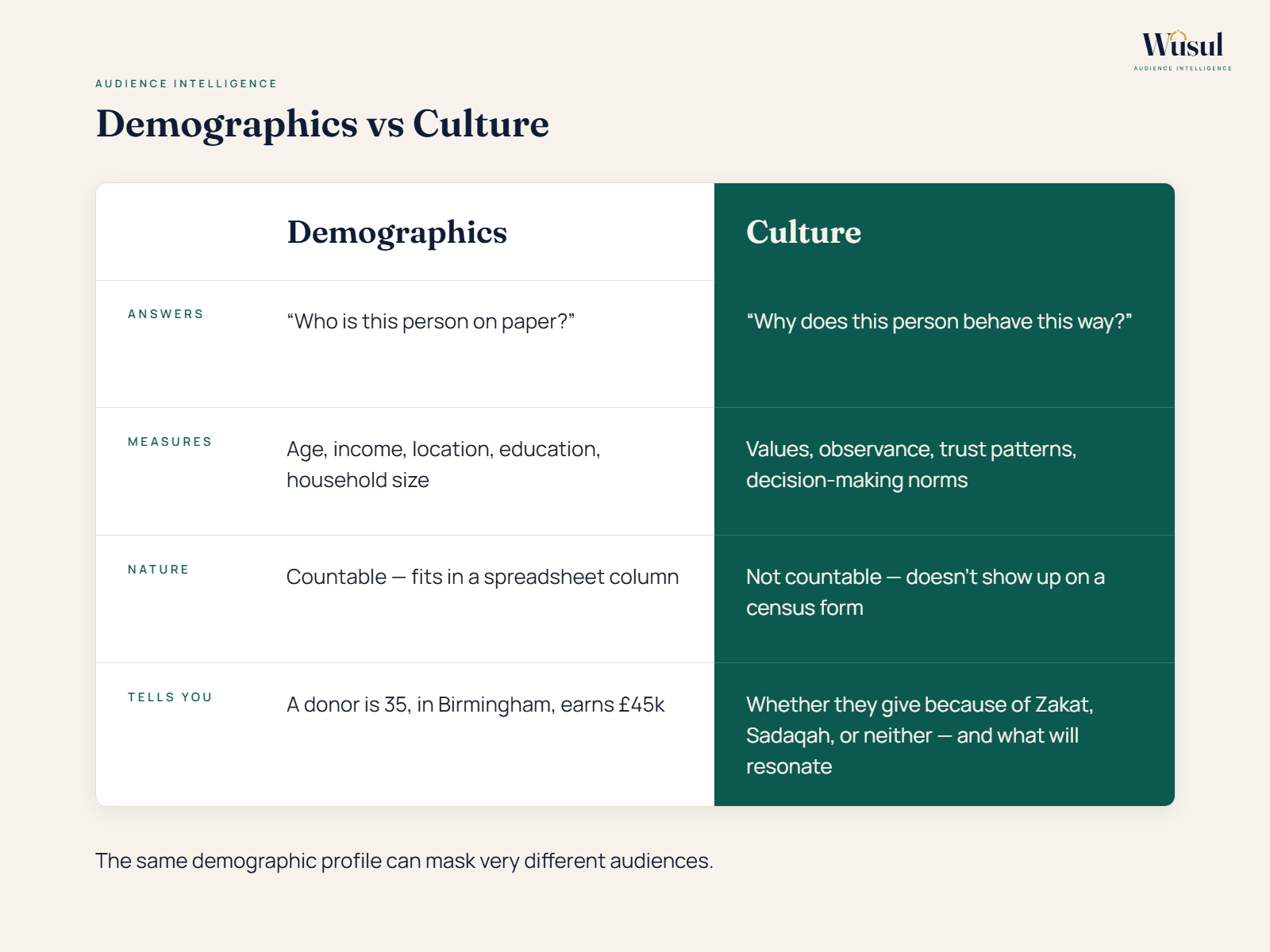
Demographics are countable. Age, gender, income, location, education level, household size; these are facts you can put in a spreadsheet column, and a survey can capture them in seconds. Culture is not countable in the same way. It is the shared values, beliefs, behavioral norms, and meaning-making systems that shape how a group of people thinks and acts; and it doesn't show up on a census form.
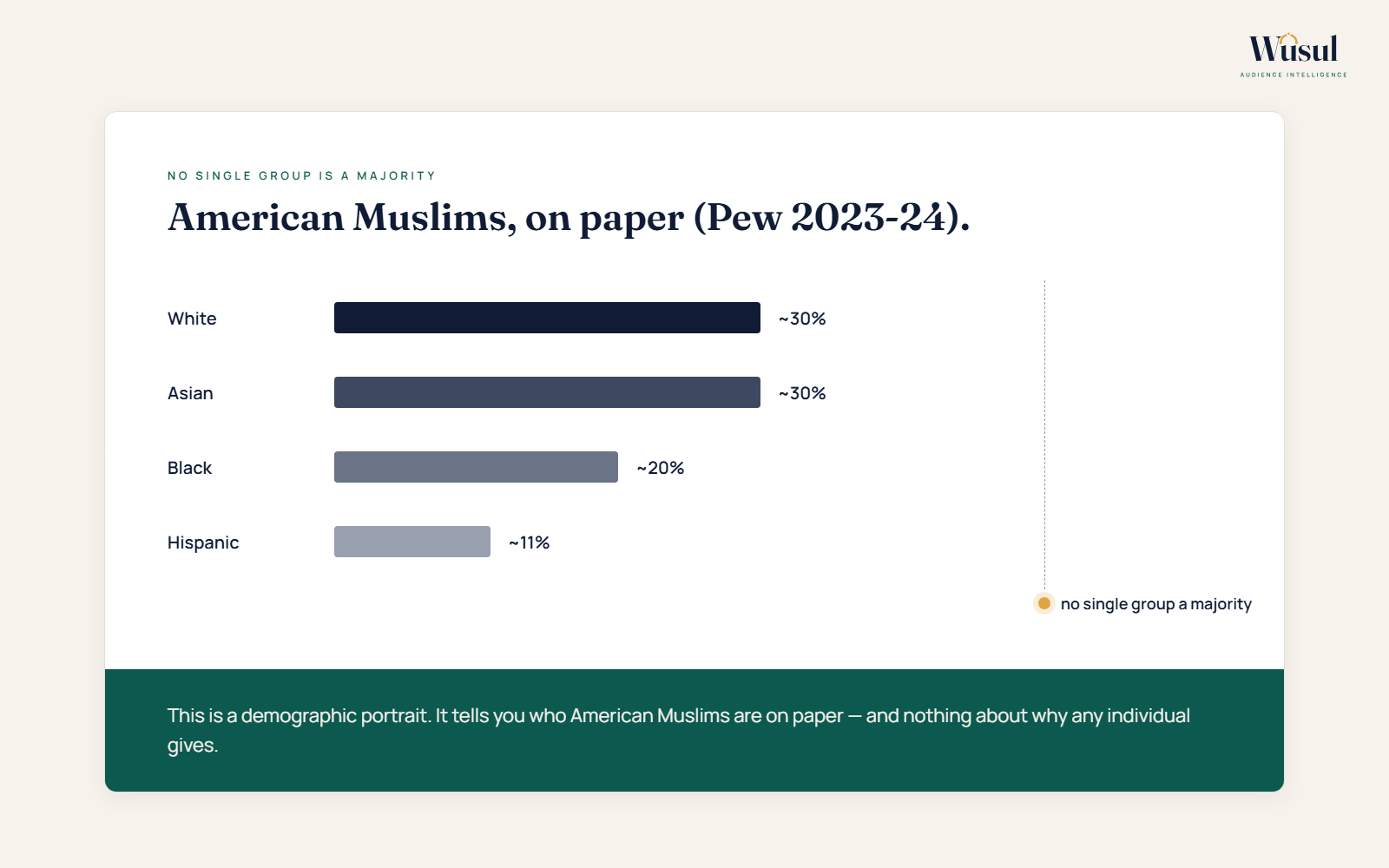
This distinction matters enormously for the Cultural Intelligence Gap, because it explains exactly how well-resourced organizations still get Muslim audiences wrong. A team can have excellent demographic data (precise age brackets, accurate income figures, granular location data) and still have no real understanding of the audience in front of them. Pew Research Center's 2023-24 Religious Landscape Study, which surveyed over 36,000 Americans, found that while Muslims make up only about 1% of the US adult population, no single racial or ethnic group forms a majority: roughly 30% are White, 30% Asian, 20% Black, and 11% Hispanic. This is a demographic portrait. It tells you who American Muslims are on paper. It tells you nothing about why a 35-year-old Muslim donor in Birmingham gives; whether out of religious obligation, family expectation, or personal conviction.
The core distinction, side by side
Demographics answer the question "who is this person on paper?" by age, income, location, education, household size. Culture answers the question "why does this person behave this way?" values, religious observance, trust patterns, decision-making norms.
Demographic data tells you a Muslim donor is 35, lives in Birmingham, and earns £45k. Cultural intelligence tells you whether that donor gives because of Zakat, Sadaqah, or neither; and what kind of messaging will resonate. The same demographic profile can mask very different audiences, while the same cultural identity can span wildly different demographic profiles.
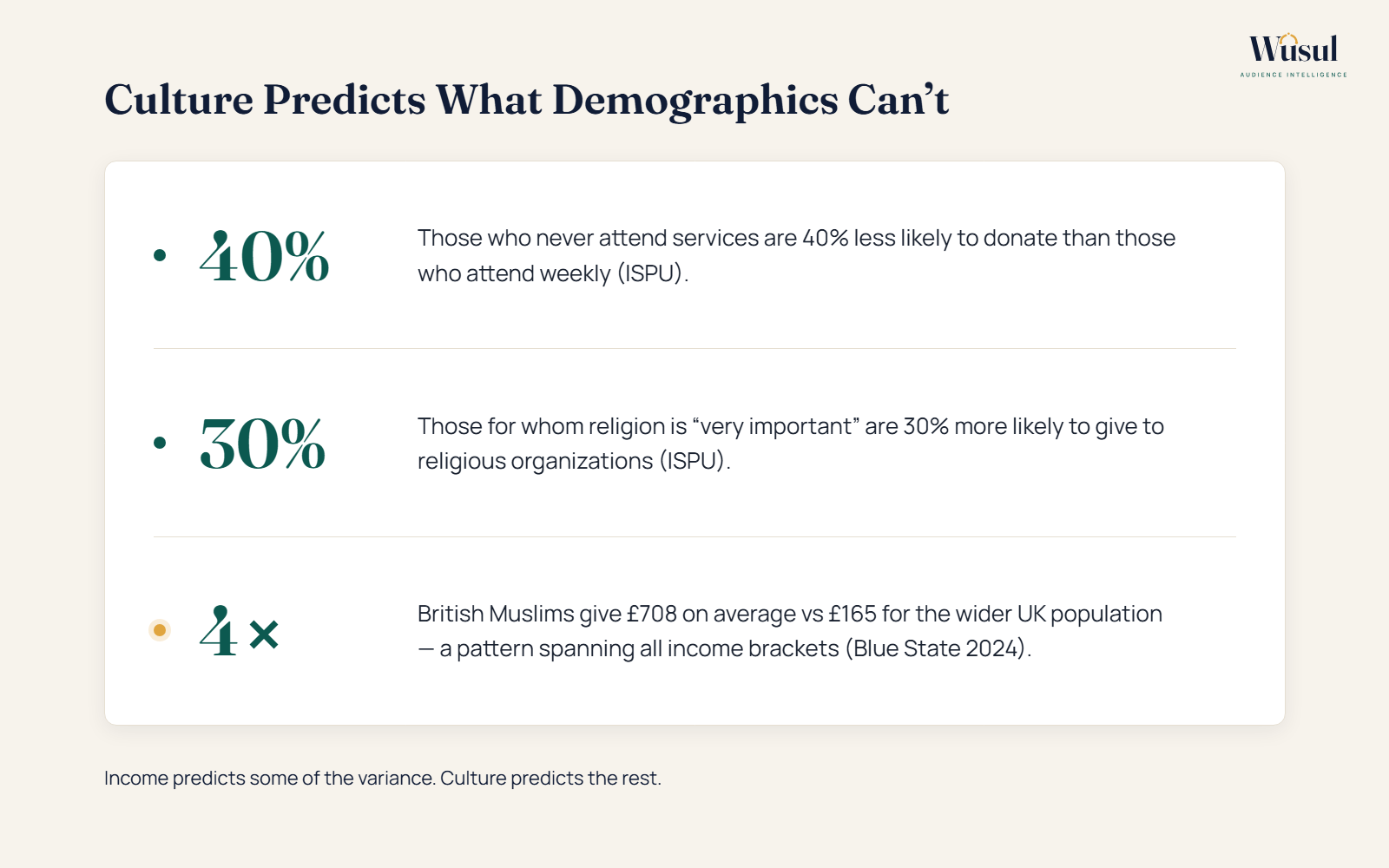
Research on Muslim giving illustrates this. ISPU's American Muslim Poll found that while higher income and education levels are associated with an increased probability of donating, the most powerful drivers are cultural and religious: those who never attend services are 40% less likely to donate than those who attend more than once a week, and those who feel religion is "very important" to their lives are 30% more likely to give to religious organizations than those who say religion is "not at all important." Demographics predict some of the variance. Culture predicts the rest.
Why is this distinction the root of the gap?
Most organizations don't deliberately ignore culture; they simply default to demographics because demographics are easier to collect, easier to buy, and easier to put into a dashboard. A donor database tells you exactly how old someone is. It tells you nothing about whether they associate giving with Zakat, Sadaqah, or neither.
This produces a specific, recurring failure: two donors with identical demographic profiles (same age, same income, same postcode) can have completely different relationships to faith, observance, and giving motivation. Any charity running a single donor persona based on age and income brackets alone will describe a demographic cluster accurately while completely missing why any individual donor within that cluster actually gives.
Research on cultural intelligence (CQ) has formally established that cultural understanding is a distinct capability from general intelligence or emotional intelligence. Earley and Ang, who introduced the concept in 2003, defined CQ as the capability to function effectively in culturally diverse settings, and identified three essential facets: cognition (the ability to develop patterns from cultural cues), motivation (the desire and ability to engage others), and behavior (the capability to act in accordance with cognition and motivation). Cultural intelligence specifically addresses how culture shapes behavior, which is exactly the layer demographic data cannot reach.
A concrete example
Two British Muslim women, both 32, both living in Manchester, both earning a similar income. Demographically, they are nearly identical. Culturally, one may have grown up in a household where Friday prayer and daily religious practice structured family life; the other may identify as Muslim primarily through cultural heritage and family tradition, with faith playing a quieter role day to day. A campaign written for "32-year-old Muslim women in Manchester" risks speaking to neither of them precisely, because the demographic bracket says nothing about which version of Muslim identity it's addressing.
The scale of the UK Muslim population; 3.87 million in England and Wales, or 6.5% of the population, according to the 2021 Census, makes this distinction operationally urgent. A campaign that treats this population as a single demographic bloc is, by definition, speaking to part of the community while excluding the rest.
What research says about cultural understanding
This isn't just an intuitive distinction; it has a real academic foundation. Cultural intelligence, commonly abbreviated CQ, was formally defined by researchers Christopher Earley and Soon Ang in their 2003 work as the capability to function effectively in culturally diverse settings. Critically, the framework treats cultural understanding as a distinct capability from general intelligence or emotional intelligence; CQ specifically addresses how culture shapes behavior, which is exactly the layer demographic data cannot reach.
Research on Muslim philanthropy confirms this. The Muslim Philanthropy Initiative's 2021 study, funded by Islamic Relief USA, found that Muslim Americans give more on average (3,241)thanthegeneralpopulation(1,905), and that 85% of their contributions stay within the US. These are behavioral facts that demographic segmentation alone cannot explain. The motivations behind them (religious duty, compassion, community solidarity) are cultural.
Demographics aren't useless, they're just insufficient
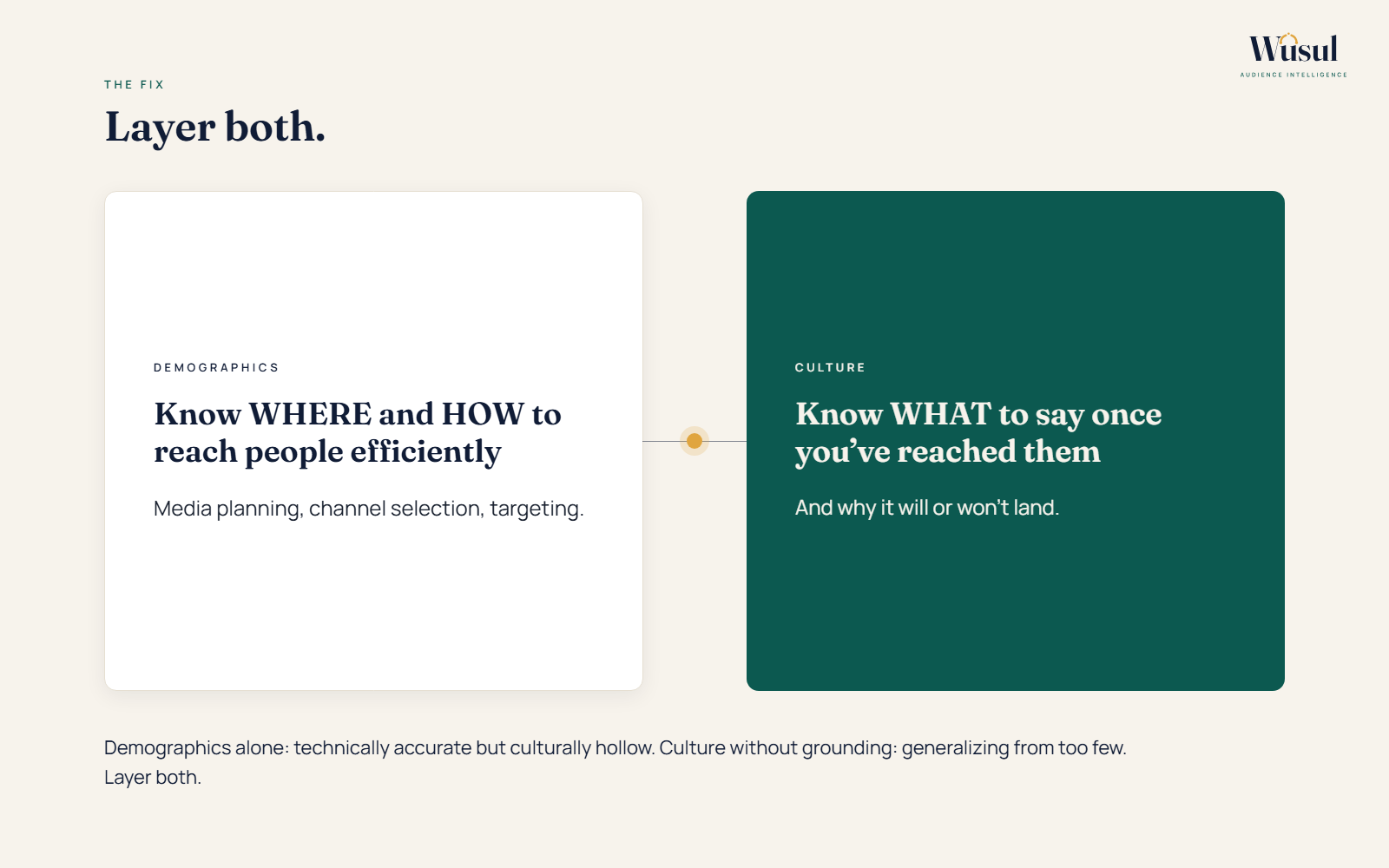
None of this means demographic data should be discarded. Knowing the age distribution, geographic concentration, or income bracket of an audience is genuinely useful for media planning, channel selection, and basic targeting. The mistake isn't collecting demographic data, it's treating it as a substitute for cultural understanding rather than a complement to it.
The most effective audience strategies layer both: demographic data to know where and how to reach people efficiently, and cultural intelligence to know what to say once you've reached them, and why it will or won't land. One without the other produces an incomplete picture; demographics alone risk a technically accurate but culturally hollow campaign, while cultural insight without demographic grounding risks generalizing from a small or unrepresentative group to an entire population.
The data on British Muslim giving reinforces this. A 2024 Blue State study found that British Muslims give £708 on average per year, compared to £165 for the wider UK population, more than four times as much. This is a behavioral pattern that spans all income brackets, rising to its highest among those earning between £75,000 and £100,000. Income data alone would not predict this. Cultural values (specifically the Islamic obligation of Zakat and the emphasis on charitable giving) are the explanatory variable.
So, why do organizations default to demographic data instead of cultural insight?
Mainly because demographic data is easier and cheaper to collect; it can be purchased, surveyed quickly, or pulled from existing databases. Cultural insight requires deeper research, direct engagement with the community, or genuine insider knowledge, which takes more time and resources to build.
For organizations engaging Muslim audiences specifically, this gap is particularly consequential. Muslim communities in the US and UK are racially and ethnically diverse; no single group forms a majority. A campaign built around one ethnic visual or one cultural reference risks speaking to part of the community while inadvertently excluding the rest.
What this means for your organization
For brands: If your Muslim consumer research stops at population size and average income, you have market-sizing data, not audience understanding. Both are useful, but only one tells you what to say in a campaign.
For charities: Audit your donor personas. If a persona is built entirely from age, income, and location, it is a demographic profile, not a cultural one, add a cultural dimension (observance level, generational relationship to faith, motivation for giving) before using it to guide messaging.
For media and content teams: When commissioning audience research, separate the brief into two explicit questions (who are they (demographic) and why do they behave this way (cultural)) rather than asking one vague question and hoping the answer covers both.
For researchers: Be precise in how findings are reported. A study that surveys "Muslim consumers aged 18-34" has demographic boundaries; whether it captures genuine cultural insight depends on what it actually measured, not who it sampled.
At Wusul, we believe that confusing culture with demographics is to mistake the vessel for what it carries. Numbers tell us about shifts and arrivals, but culture speaks to values, stories, and the shared fabric we weave day by day. Demographics are a matter of fact; culture is a matter of nurture and choice. So let us not be fascinated by statistics alone but instead invest in the difficult and beautiful work of becoming a society animated not by who shows up, but by what we build once we are all in the room.