British Muslims donate an estimated £2.2 billion annually to charitable causes up to four times the national average, according to research by the think tank Equi. This is not because Muslims are four times wealthier, but because they are four times more generous, by measure, than the average British donor.
Behind that number is something the sector has not yet properly reckoned with: a giving culture shaped by centuries of theological tradition, communal obligation, and a faith in which generosity is not optional; it is structural. Zakat, one of the five pillars of Islam, requires it. Sadaqah extends it. And the social infrastructure of Muslim communities in Britain has been quietly sustained by it for decades.
What is missing is not the giving; it is the understanding. The motivations that drive £2.2 billion in annual philanthropy, and the barriers that prevent that figure from being even larger, remain largely invisible to the policymakers, researchers, and charity leaders who could do the most with that knowledge.
That invisibility is not a footnote. It is the gap this article is about.
Zakat and the Islamic teachings on charity
Islamic teachings mandate two primary forms of charity: Zakat, the compulsory donation of 2.5% of surplus wealth, and Sadaqah, voluntary giving driven by compassion and the desire for spiritual reward.
Islamic teachings map out, in specific and practical terms, an entire social responsibility framework; beyond naming the two categories.
At its core, the Quran calls on believers to feed the hungry, give to those in need, and care for orphans without expectation of return or recognition. Water also holds a significant place in Islamic charity. Providing water to the thirsty is among the most highly rewarded acts a person can perform; a teaching that explains why water wells remain one of the most popular forms Muslim donations.
Environmental stewardship; planting trees, protecting natural resources, sits within the same giving tradition as feeding the hungry and housing the orphan.
The framework extends further still. Relieving someone's debt, feeding a neighbor regardless of their faith, giving one's time or skill, and even removing a harmful object from a public path are all considered acts of charity.
So, generosity is not a category of exceptional behavior reserved for the Muslim wealthy. It is woven into the texture of a Muslim's ordinary life.
Muslim charity in the UK: the faith-driven foundation of generosity
Zakat alone accounts for up to 40% of total funds raised by surveyed Muslim charities, with the remaining 60% coming from other forms of donation.
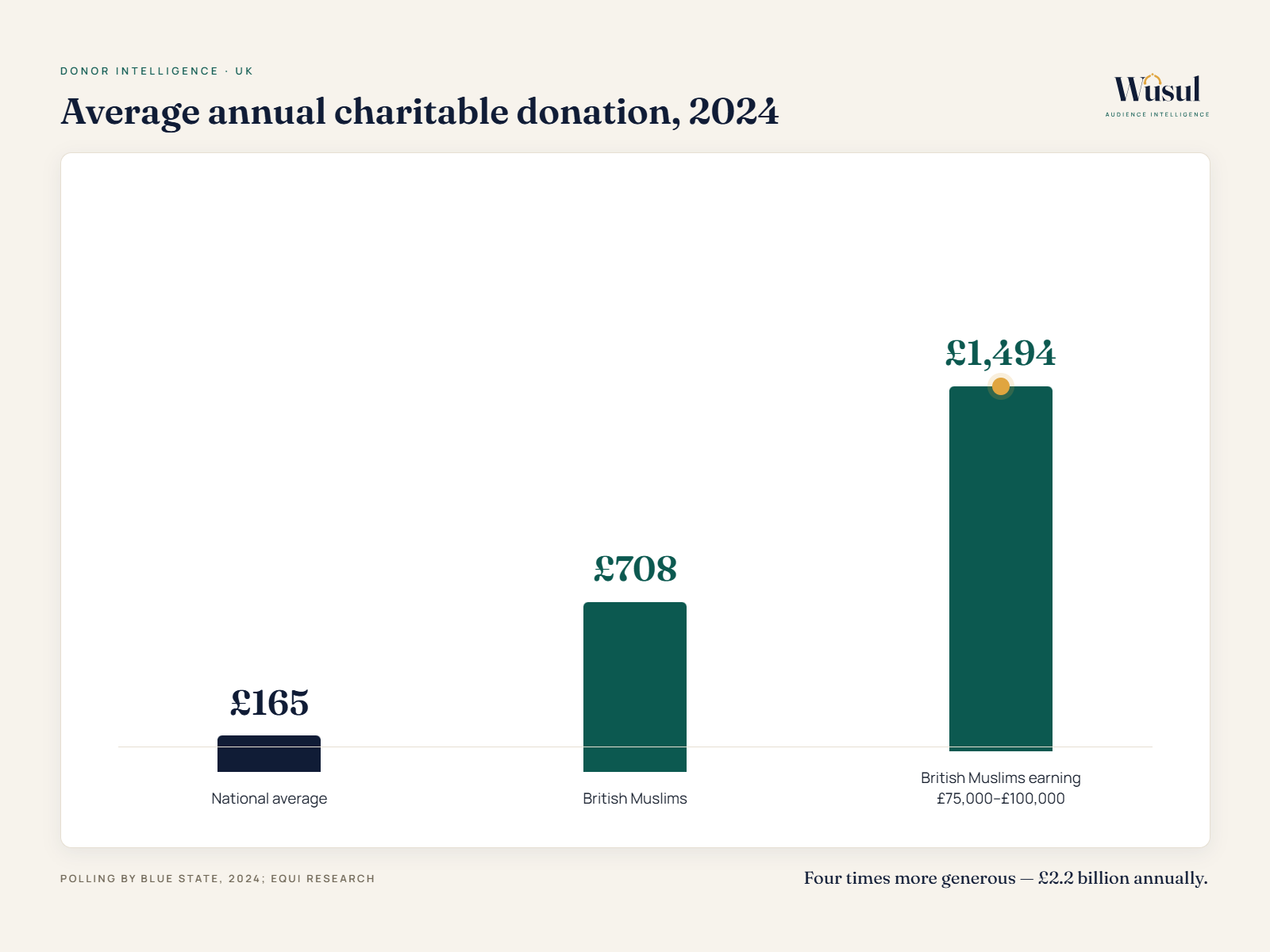
This is not merely an abstract religious duty; it is a lived commitment. Polling by Blue State found that British Muslims donated an average of £708 in 2024, compared to the national average of £165. This higher giving spans all income levels, with Muslims earning between £75,000 and £100,000 donating an average of £1,494, more than ten times the amount given by the typical British adult. Generosity persists despite the cost-of-living crisis, reflecting the deep value placed on ensuring "everyone has what they need."
A generational shift: from international to domestic giving
While much of this generosity has traditionally supported international humanitarian causes (driven by transnational family connections and a sense of global Muslim solidarity) a significant generational and cultural shift is redirecting Muslim charitable giving toward domestic concerns.
Young British Muslim professionals, particularly third- and fourth-generation individuals, are increasingly directing their donations to causes within the UK, responding to visible local crises including homelessness, food insecurity, and child poverty. Polling conducted by Savanta for Equi shows British Muslims exceed the national average in donations to mental health and healthcare charities by about 10%. Yet international humanitarian aid remains nearly double the national average, a trend the report partly attributes to greater familiarity with overseas charitable needs compared with domestic social issues.
The filling of a welfare gap
Equi's report highlights the critical role of British Muslim charities in filling gaps left by a struggling welfare state. "Despite barriers, both large and small organizations offer housing aid, emergency cash grants and psychological support aimed at diverse groups of beneficiaries, regardless of their faith," the report noted.
The scale of this impact is measurable. The National Zakat Foundation, established in 2011 to address UK poverty, has distributed more than £25 million to over 21,000 beneficiaries, providing housing assistance, emergency grants, and employment support. In 2023 alone, the charity allocated £7 million in zakat funds, with 76% directed toward hardship relief. Its housing program helped prevent evictions that year, generating estimated public sector savings of £28.8 million; equivalent to £73 saved for every £1 donated.
Other examples include Islamic Relief UK, which provided £5 million in grants to domestic initiatives in 2024, and Al-Khair Foundation, which contributed £300,000 to Great Ormond Street Hospital while supporting emergency responses to events like the Rochdale floods and Grenfell Tower tragedy. Equi estimates that Muslim-led youth programs contribute up to £30 million annually in avoided public costs.
The barriers: debanking, scrutiny, and invisibility
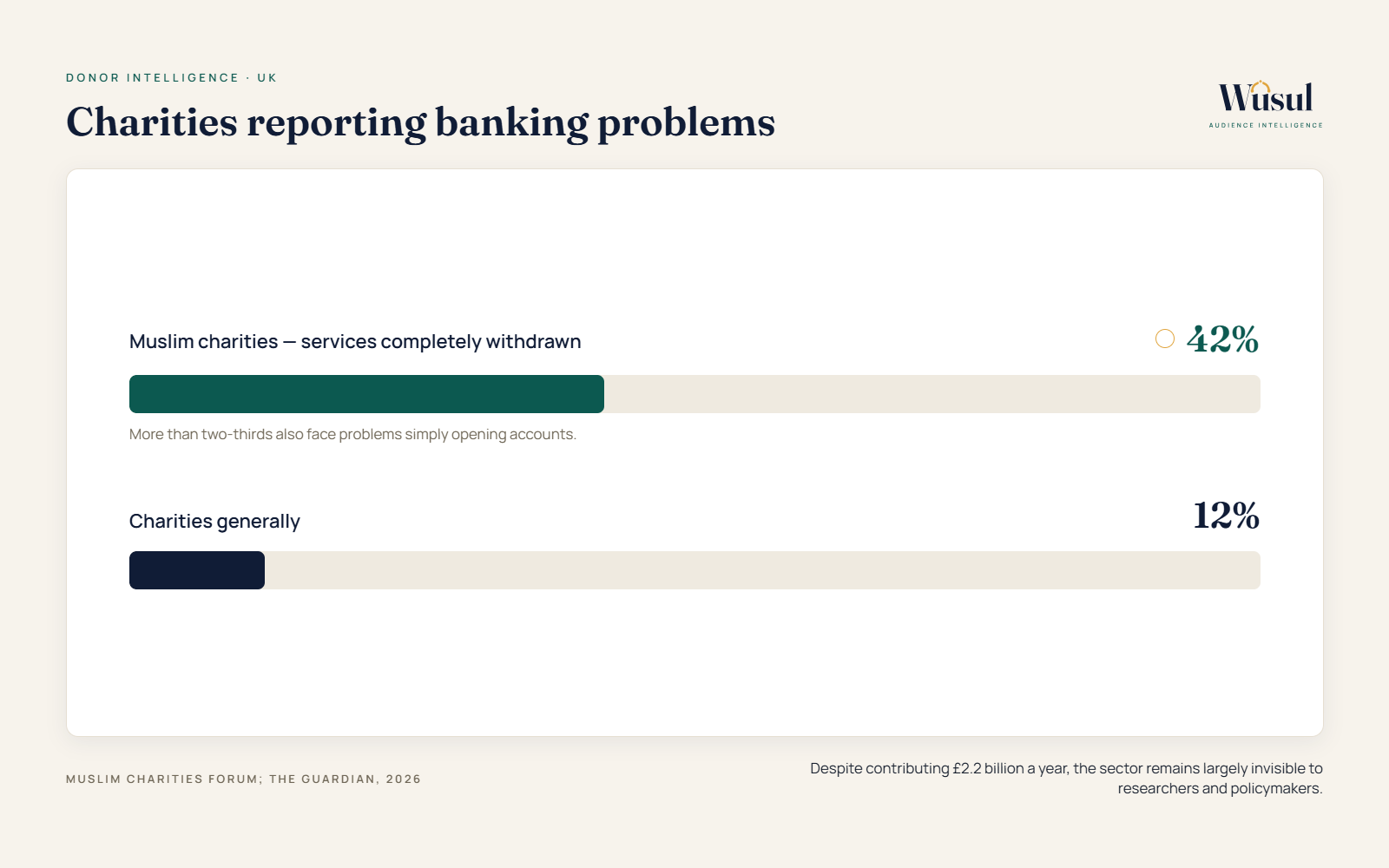
Despite their immense contribution, British Muslim charities face structural challenges that severely limit their potential. More than two-thirds of Muslim charities face problems opening bank accounts, and 42% have had their banking services completely withdrawn, compared to just 12% of charities generally.
This "debanking" crisis stems from the derisking policies banks employ to avoid falling short of counter-terrorism and anti-money laundering regulations. But as Fadi Itani, CEO of the Muslim Charities Forum (MCF), has noted, Muslim charities are disproportionately impacted, often subjected to "rigorous questioning about aid payments, particularly going to Palestine, Syria or Pakistan." One charity surveyed by MCF reported that simply using "Syrian refugees" as a reference led to transactions being frozen for a project supporting Syrian children receiving cancer treatment in Turkey.
This scrutiny is not incidental. As MCF documents, far-right networks have mastered a strategy of systematic delegitimization, "moving claims from report to headline to parliamentary soundbite until suspicion hardens into policy and practice" . Organizations are framed as "extreme, untrustworthy, or foreign," making their perspectives "easier to dismiss, their credibility easier to undermine, and their participation easier to marginalize." The result is economic harm and political exclusion: funding is lost, bank accounts closed, and communities excluded from shaping policies affecting their lives.
Meanwhile, as the University of Warwick's "Rooted in Faith" project notes, "British Muslims donate over four times the national average; yet their charities remain largely invisible to researchers and policymakers" . This invisibility, combined with operational barriers, prevents the sector from fulfilling its potential.
Policy implications and the path forward
The Equi report offers a series of recommendations to unlock the potential of Muslim philanthropy:
Greater collaboration between policymakers and faith-based organizations, including match-funding mechanisms and improved faith literacy within public institutions.
Policy intervention on banking access. The FCA has issued guidelines on proportionate treatment of charities, but advocates argue for legislation similar to France and Belgium, which makes having a bank account a legal right.
Recognition of the fiscal value of Muslim philanthropy. As the Equi report notes, recognizing both the moral imperative and fiscal value of Muslim philanthropy could unlock billions of pounds in additional social investment while strengthening community resilience and public service delivery.
For the charity sector, the broader risk is that the delegitimization targeting Muslim-led organizations serves as an early warning. As Itani has warned, "tactics that undermine Muslim organizations are often later used against other groups seen as inconvenient."
At Wusul, we believe that understanding the deep motivations behind Muslim generosity, and the barriers that limit its potential, is essential for authentic engagement. By recognizing the values that drive giving and the challenges that constrain it, we help organizations build trust, communicate effectively, and unlock the full potential of Muslim philanthropy.