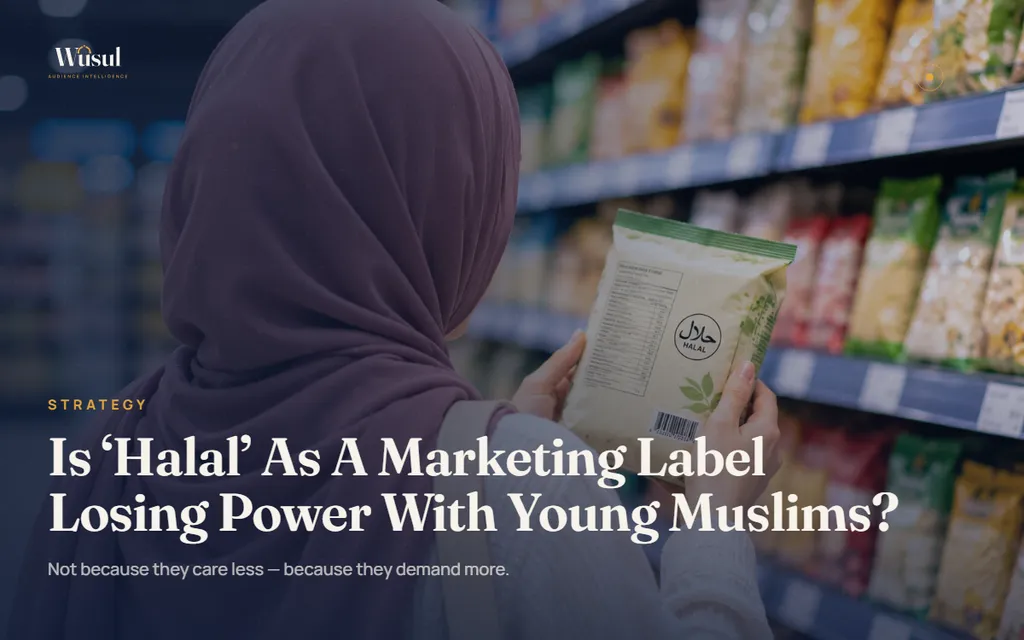
For decades, the halal label has been the cornerstone of marketing to Muslim consumers. It signals compliance with Islamic law, assures buyers that products meet their religious requirements, and commands a premium in markets from Jakarta to London. But a growing body of research suggests that for younger Muslims, the label may be losing its power.
The evidence is not that young Muslims care less about their faith. It is that they are increasingly sophisticated, skeptical, and pragmatic consumers who demand more than a logo. They want quality. They want transparency. They want brands that align with their values; not just their dietary restrictions.
This shift has profound implications for halal brands, Islamic charities, and any organization that has built its positioning around the halal label. Understanding why it is happening (and what it means) is essential for anyone seeking to engage the next generation of Muslim consumers.
The evidence: when the label doesn't move the needle
The most striking data comes from Indonesia, the world's largest Muslim-majority country and a bellwether for global halal markets.
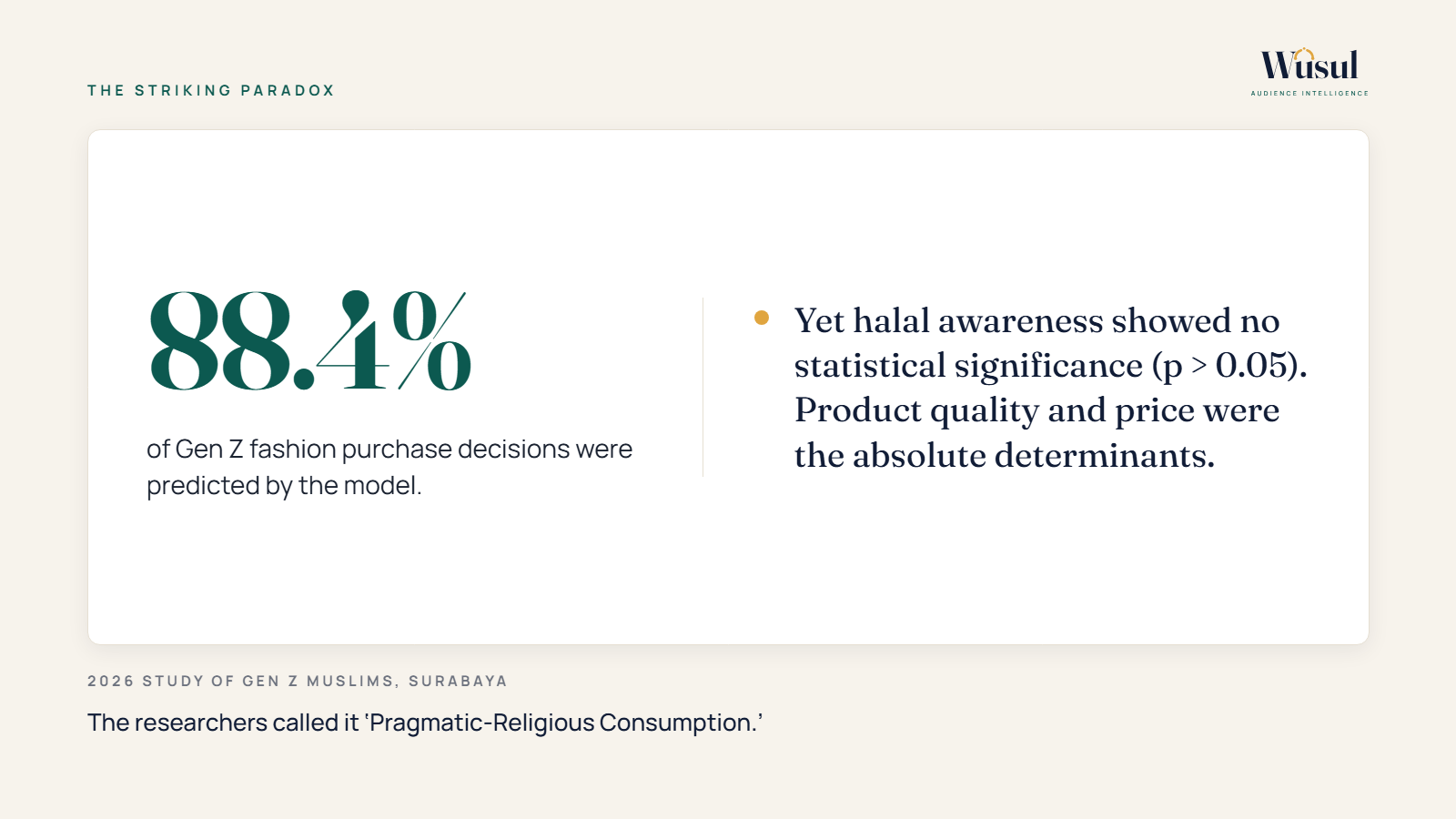
A 2026 study of Generation Z Muslims in Surabaya, examining purchase decisions within the Shopee fashion ecosystem, found a "striking paradox." While the model collectively predicted 88.4% of purchase decisions, Halal Awareness failed to demonstrate statistical significance (p > 0.05). Product quality and price emerged as absolute determinants.
The researchers described this as a paradigm shift toward "Pragmatic-Religious Consumption." Generation Z, they concluded, operates as "rational economic actors who prioritize visual aesthetics and cost efficiency over formal religious labeling in the context of fashion."
A separate policy brief from UIN Raden Mas Said Surakarta reached a similar conclusion. The study found that the halal label did not significantly influence purchasing decisions among Muslim students. Brand image and product quality were the dominant factors. The researchers speculated that students assume products on the market are already halal, making the label feel redundant.
This is not an isolated finding. A 2025 study of Generation Z consumers of Wardah cosmetics in Lamongan found that the halal label had a positive but not significant effect on purchasing decisions. Product quality was the significant determinant. Even religiosity, tested as a moderating variable, did not strengthen the relationship between the halal label and purchase decisions.
The Tacit Halal Cues: When Appearance Replaces Certification
Perhaps the most revealing insight comes from research on what scholars call "tacit halal cues."
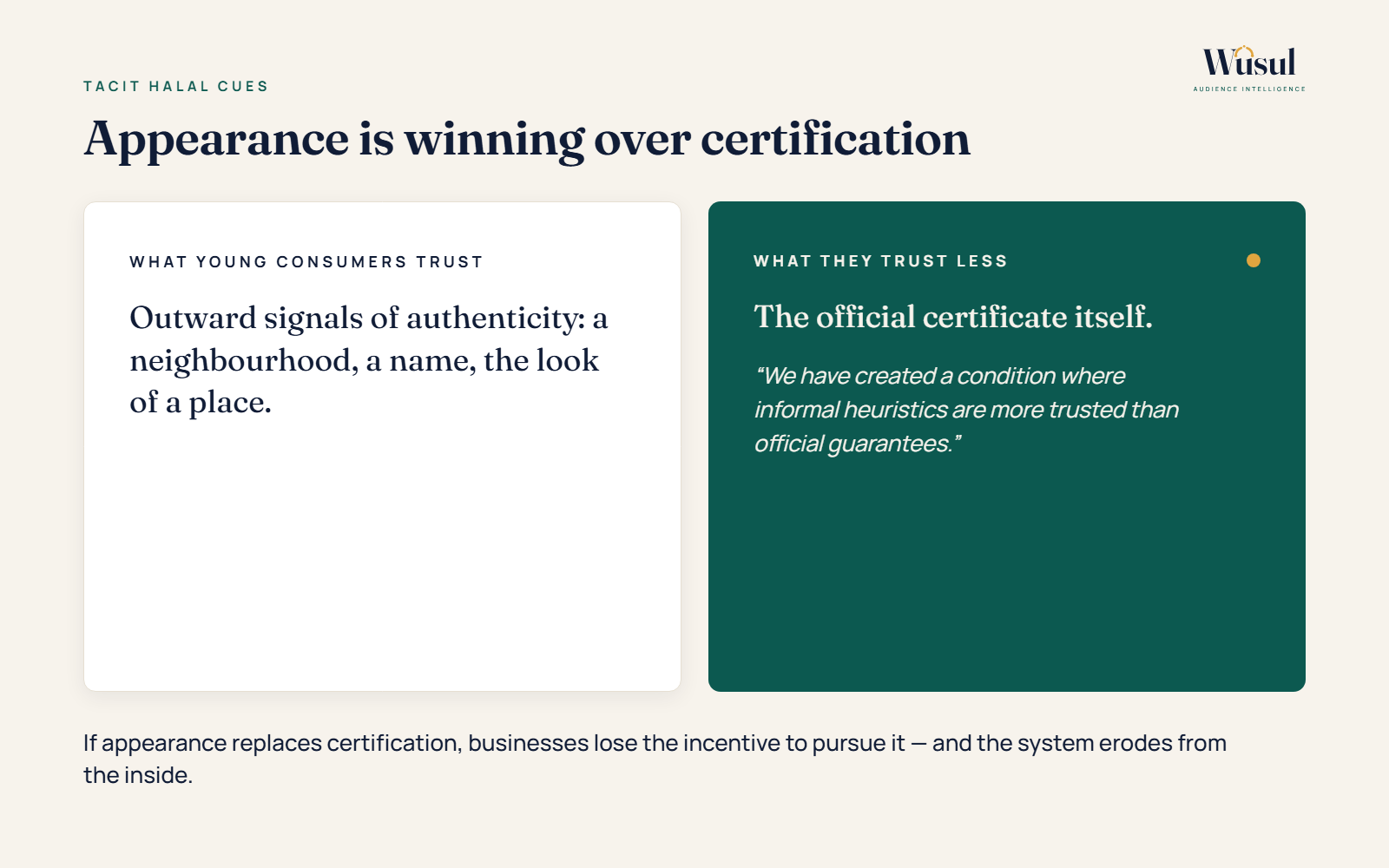
Dr. Ezlika Ghazali, a marketing lecturer at Universiti Malaya, studied young Muslim consumers in Malaysia and Indonesia and found a phenomenon that should concern every halal certification body. Young Muslims, she found, are more likely to trust outward appearances; Arabic-sounding names, waitresses wearing hijab, restaurant locations in Muslim neighborhoods, than official halal certificates.
"We have created a condition where informal heuristics are more trusted than official guarantees," Ghazali said. The social symbols have become a substitute for halal perception among a significant portion of young consumers.
The implications are stark. If young consumers trust appearance over certification, businesses have little incentive to pursue official halal status. The certification ecosystem, built on the assumption that consumers value and demand the label, begins to erode from the inside.
Dr. Dilip Mutum, a marketing professor at Monash University Malaysia, warned: "If certification is no longer valued, then its value will continue to weaken in the market."
The trust shift: from passive acceptance to critical evaluation
A 2026 grounded theory study of young Muslim entrepreneurs in Pekalongan, Indonesia (individuals who occupy the dual role of consumer and business actor) traced how trust in halal labels evolves.
In the early stage, trust is passive and direct. The halal label is perceived as a normative religious guarantee, a symbol of compliance with Islamic law and an indicator of product safety. Consumers accept it without further evaluation.
But that trust shifts. The study identified three factors that trigger a more critical stance: consumption experience, unclear product information, and increased access to information in the digital environment.
One informant, a TikTok affiliate, described finding a product with a halal logo that raised doubts because the packaging did not list a trusted certification body. An online food entrepreneur said: "Sometimes products with a halal logo are not necessarily officially halal certified."
The researchers concluded that "consumer confidence can change when there is a mismatch between expectations and perceived experiences." The halal label "can lose its meaning if it is not supported by clear and transparent information."
Young consumers, in other words, are not abandoning the halal label. They are demanding more from it. The label alone is no longer sufficient. It must be backed by verifiable transparency, credible certification, and consistent quality.
The Exception: When faith and pragmatism collide
The picture is not uniform. There are contexts where the halal label remains significant, particularly in food, where the stakes are higher and the consequences of non-compliance more immediate.
A 2026 study of female students from West Sulawesi living in Yogyakarta found that economic factors, time pressures, and low halal literacy led some students to disregard halal certification mechanisms. In areas dominated by non-halal food vendors, the rejection of halal labels was a matter of pragmatism, not principle.
This suggests a segmentation that halal brands must understand. For fashion and cosmetics (where the product is not ingested and the religious stakes are lower) young consumers prioritize aesthetics, quality, and price. For food, where the stakes are higher, the label remains more relevant, but even there, pragmatism can override principle when economic or logistical constraints are pressing.
The market paradox: growth alongside erosion
Here is the paradox. Even as the halal label loses its power to drive purchase decisions among young consumers, the halal market itself continues to grow.
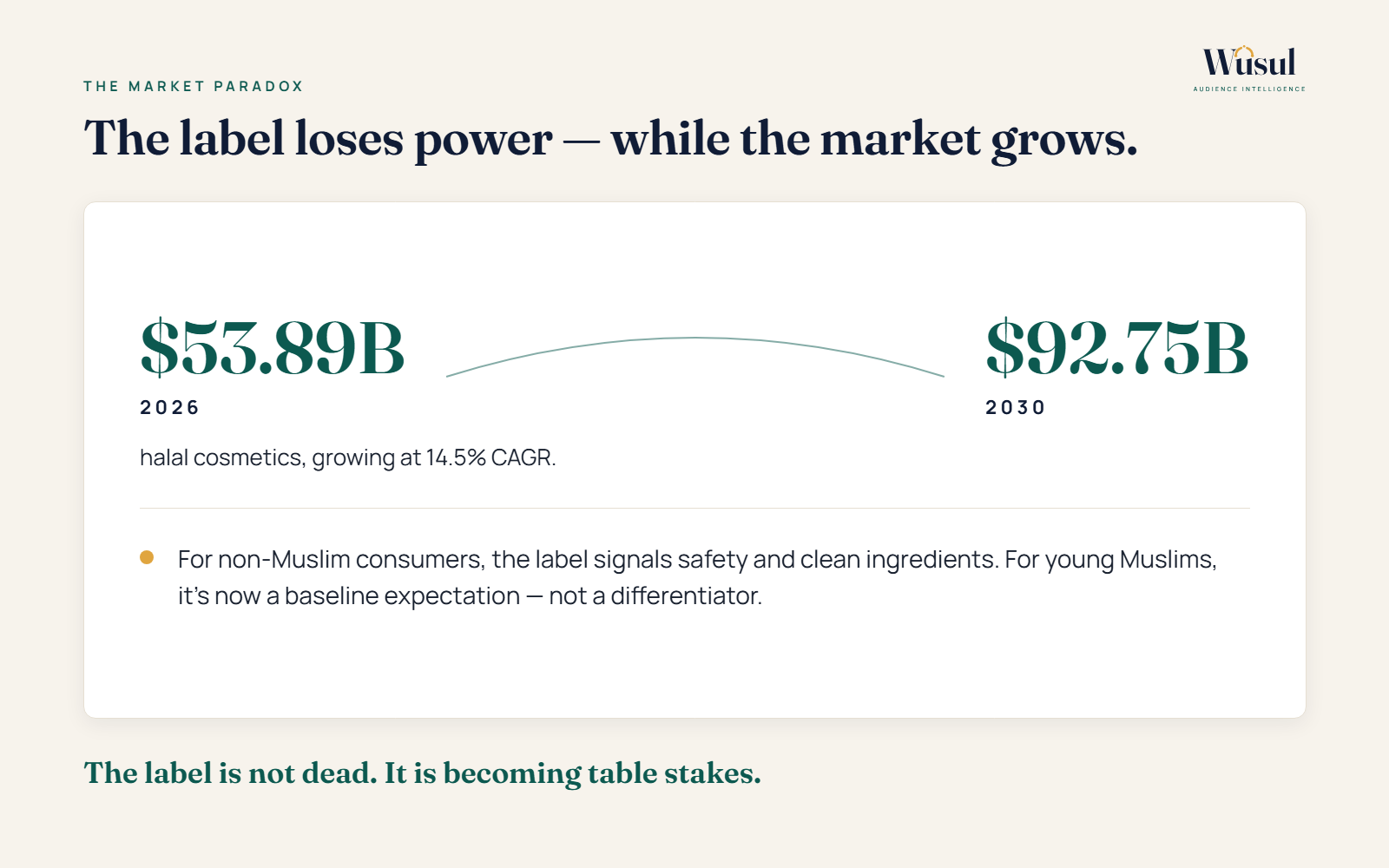
The global halal cosmetics market was valued at 53.89 billion in 2026 and is projected to reach 92.75 billion by 2030, growing at a compound annual growth rate of 14.5%. The halal food market continues to expand, driven by rising demand for certified products, expansion of halal foodservice, and growing adoption of certification standards.
How can the label be losing power while the market grows?
The answer lies in what the label represents. For non-Muslim consumers (a growing segment of the halal market) the label signals safety, ethical sourcing, and clean ingredients. For Muslim consumers, the label is increasingly a baseline expectation, not a differentiator. They expect products to be halal. They choose based on other factors: quality, brand, price, and values alignment.
As one industry analysis noted, "Mainstream beauty consumers increasingly gravitate toward familiar clean-label products rather than halal-certified alternatives, creating market segmentation challenges that limit halal cosmetics' addressable market expansion beyond Muslim demographics" .
The label is not dead. It is becoming table stakes.
What this means for halal brands
For organizations that have built their positioning around the halal label, the message is clear: the label is necessary but not sufficient.
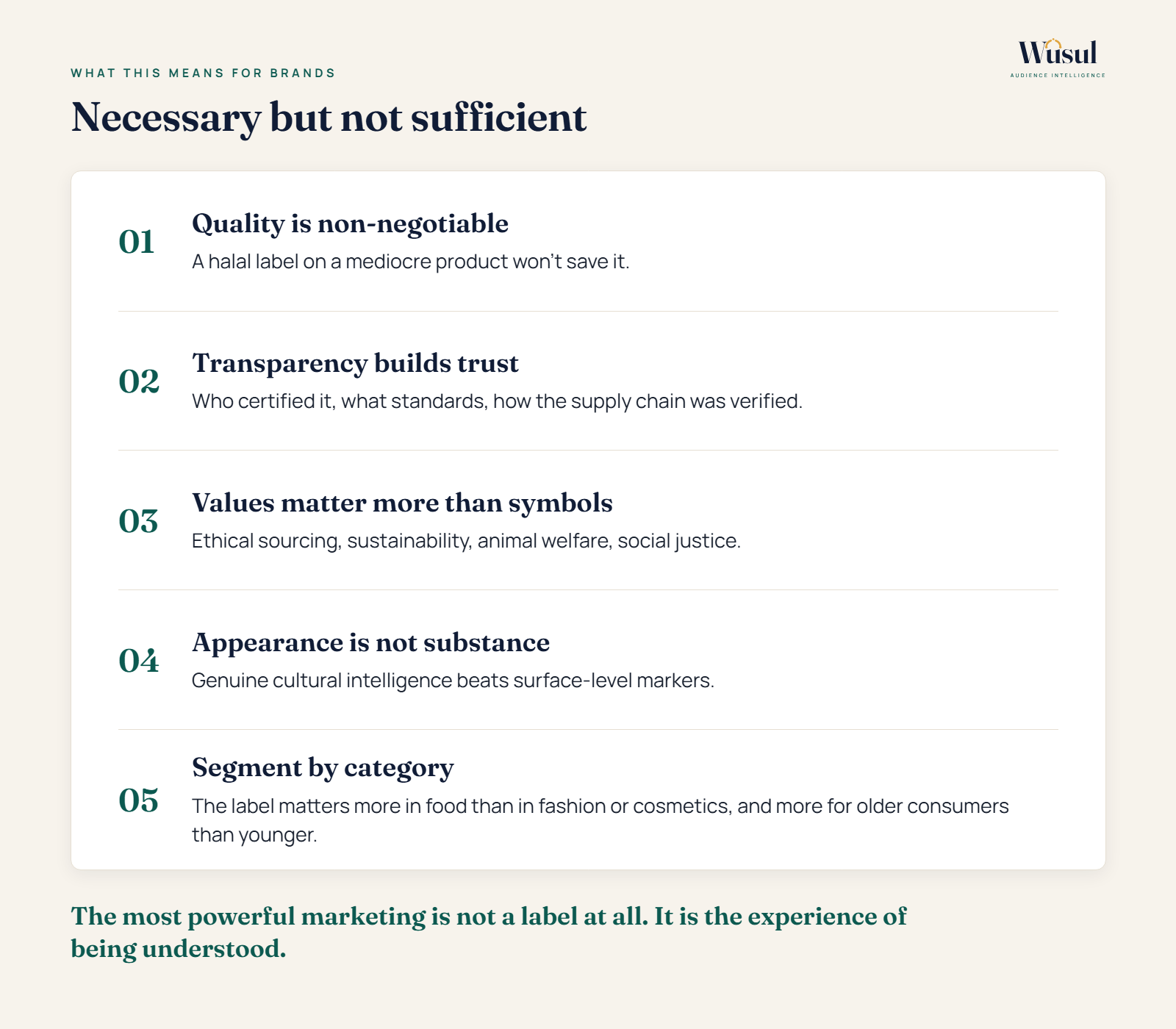
1. Quality is non-negotiable. The research is consistent. Product quality is the dominant driver of purchase decisions among young Muslims. A halal label on a mediocre product will not save it. A high-quality product with a halal label will outperform a high-quality product without one, but only if the quality is there first.
2. Transparency builds trust. Young consumers are increasingly skeptical of unverified claims. They want to know who certified the product, what standards were applied, and how the supply chain was verified. Brands that provide this information (on packaging, on websites, in social media) will earn trust that the label alone cannot.
3. Values matter more than symbols. The halal label signals one value: religious compliance. But young Muslims care about a broader set of values, ethical sourcing, environmental sustainability, animal welfare, and social justice. Brands that align with these values will resonate more deeply than brands that rely solely on the halal label.
4. Appearance is not a substitute for substance. The "tacit halal cues" phenomenon; trusting Arabic names and hijab-wearing staff over official certification, is a warning. It suggests that consumers are looking for signals of authenticity, not just compliance. Brands that invest in genuine cultural intelligence (that understand the community they serve and reflect its values) will outperform those that rely on surface-level markers.
5. Segment by category. The halal label matters more in food than in fashion or cosmetics. It matters more for older consumers than younger ones. It matters more for those with high halal literacy than those without. Brands should not assume that the label has the same power across all categories and audiences.
So, the label was never the point
The halal label was always a proxy. It was a shortcut, a way for consumers to signal their religious commitment and for brands to signal their compliance. But shortcuts are fragile. They depend on trust in the system that administers them.
For young Muslims, that trust is shifting. They are not abandoning the halal label. They are demanding more from it. They want quality, transparency, and values alignment. They want to know that the label means something; not just that it exists.
The brands and organizations that thrive will be those that understand this. They will invest in substance over symbol. They will build trust through transparency. And they will recognize that the most powerful marketing is not a label at all; it is the experience of being understood.
At Wusul, we believe that cultural intelligence means understanding not just what a community buys, but why; and designing engagement that honors the values, skepticism, and aspirations of the people you serve. The halal label is not losing power because young Muslims care less about their faith. It is losing power because they are demanding more from the brands that claim to serve it.
Frequently asked questions
Is the halal label losing power?
Research suggests the halal label is losing influence among younger Muslim consumers. While it remains a cornerstone of marketing, younger generations are increasingly sophisticated and skeptical. They prioritize product quality, transparency, and brand values over formal logos. In sectors like fashion and cosmetics, the label often fails to significantly influence purchasing decisions compared to other factors.
What is pragmatic religious consumption?
Pragmatic-religious consumption describes a shift where younger Muslims act as rational economic actors. They prioritize visual aesthetics, cost efficiency, and product quality over formal religious labeling. This behavior is particularly evident in fashion and cosmetics, where consumers may assume products are already compliant, making the formal halal label feel redundant or less important than other brand attributes.
How do Muslims choose brands?
Younger Muslims choose brands based on quality, transparency, and alignment with personal values. Many rely on informal heuristics, such as Arabic-sounding names, staff wearing hijabs, or restaurant locations, rather than official certificates. Trust is also influenced by consumption experiences and the availability of clear information, as consumers increasingly demand verifiable proof rather than passive acceptance of a logo.