On 31 December, the calendar year ends. In Britain, the tax year does not. So why do British Muslim charities run year-end appeals, and what exactly is ending when they do? The first of four articles on Britain in Wusul's series on year-end giving, tax relief and Zakat sets out the rules and the dates behind the question.
The deadline that does not exist
In the United States, 31 December is a genuine deadline. A gift made on New Year's Eve can reduce that year's tax bill; a gift made a day later cannot. American charities build their whole year-end season around it.
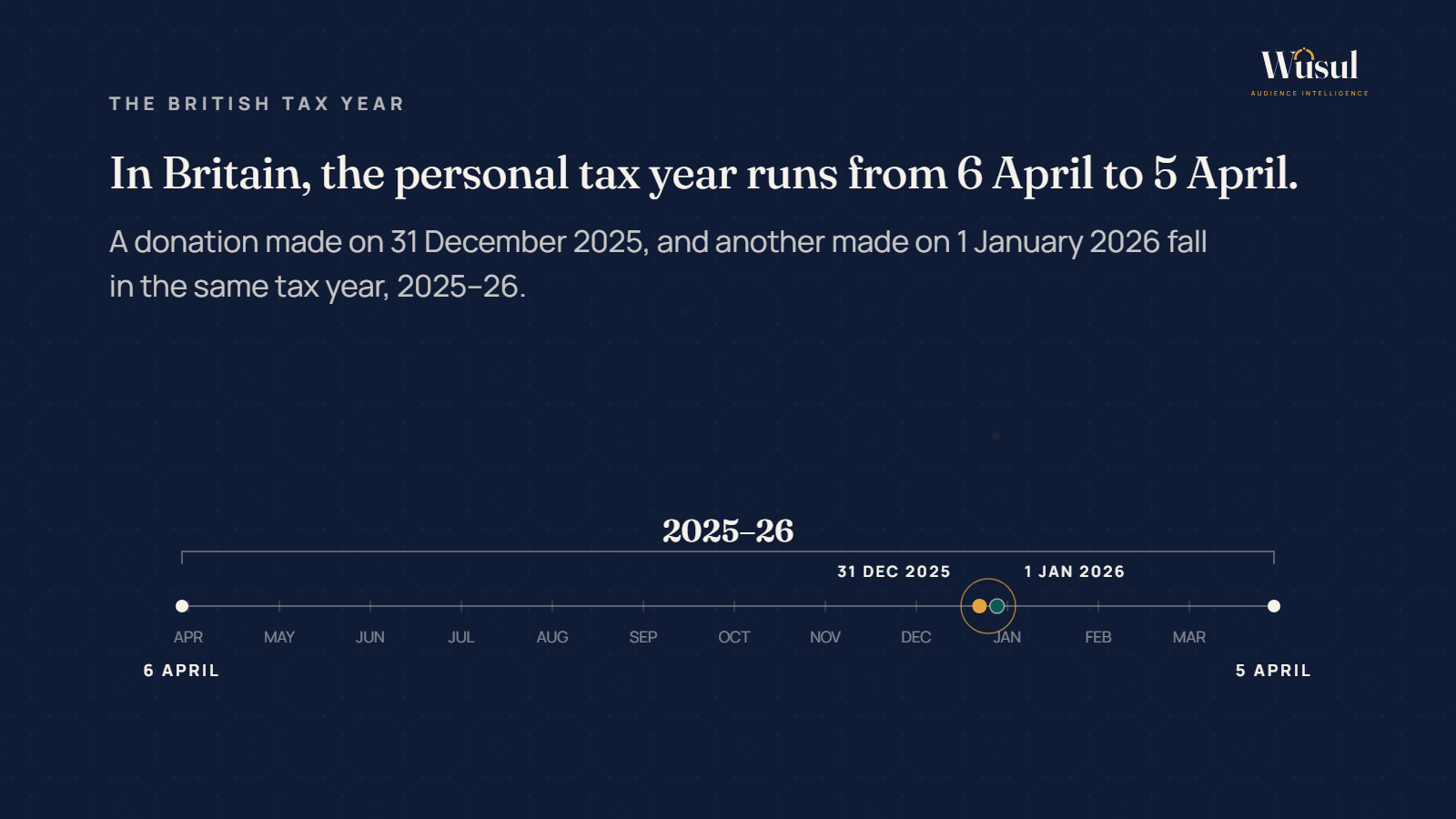
In Britain, the same date means nothing for income tax. The personal tax year runs from 6 April to 5 April. A donation made on 31 December 2025, and another made on 1 January 2026 fall in the same tax year, 2025-26. Yet British charities, Muslim charities among them, fill November and December with year-end appeals, countdowns and "last chance" emails alongside Christmas campaigns, GivingTuesday and winter emergencies.
So, when a British Muslim charity asks supporters to give before the year ends, what exactly is ending? It may be a fundraising campaign, a budget target, an emergency deadline or simply a moment of heightened public generosity. It is not, in most cases, a tax deadline. And for Muslim donors, at least two more calendars run alongside: the Islamic lunar year, which sets Ramadan and many donors' Zakat dates, and the humanitarian calendar of need.
The opening article of this series set out the five calendars behind a Muslim charity appeal and the five tax systems the series covers. This article, the first of four on Britain, looks at the country where the year-end and the tax year are furthest apart.
Britain's three year-ends, and its two real giving deadlines
Britain has three different year-ends that matter to charities: the calendar year, which ends on 31 December and frames the festive giving season; the personal tax year, which runs from 6 April to 5 April; and each charity's own financial year, which may end at any point. None of them coincides with the others.
For a British donor, the dates that actually affect tax relief are two.
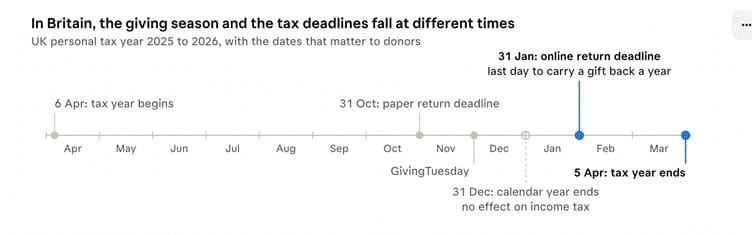
5 April ends the tax year. Gift Aid relief, and any extra relief a higher-rate taxpayer claims, belongs to the tax year in which the gift was made.
31 January is less obvious and, for some donors, more important. Under the Gift Aid carry-back rule, a donor can choose to treat a gift made in the current tax year as if it had been made in the previous one, so long as they make the election in their original Self-Assessment return for that earlier year and file it by the deadline, usually 31 January. This can help someone who paid higher-rate tax last year but will not this year. The election cannot be added later by amending a return already filed.
In other words, the closest thing Britain has to an American-style give-before-the-deadline moment for tax falls in late January, a month after the year-end appeals have finished, with a second at the start of April. Whether any British Muslim charity runs a campaign around either date is one of the questions this series will test.
December is a giving season, not a tax deadline
Britain does not need a tax deadline to make December matter. The charity regulators themselves treat it as a peak: in December 2024 the Fundraising Regulator, the Charity Commission and Report Fraud issued joint guidance on giving safely during the festive season, a time they describe as one of increased generosity. Christmas appeals, GivingTuesday at the start of December, and winter emergencies all reinforce one another.
British Muslim charities take part in that season while speaking to donors in their own terms. Winter appeals from charities such as Islamic Relief UK and Muslim Hands present blankets, fuel and food as protection from the cold, and invite donors to give their Zakat or Sadaqah, with no reference to Christmas or tax. Faith and humanitarian need do the persuading.
That makes Britain a useful comparison with countries where the tax year does end on 31 December. In Canada, as Wusul's winter series found, up to a third of online charitable revenue arrives in December, and 31 December is one of the year's two biggest giving days. If Britain's December share turns out to be markedly smaller, that gap is a rough measure of how much of year-end giving elsewhere is driven by tax rather than by the season. Measuring it is one of this series' tasks; a regulator's warning that December is busy is evidence of attention, not of volume.
A December campaign deadline, then, is legitimate. It may reflect a budget target, a winter operation that must be funded before the worst weather, or simply the season. It is just not a tax deadline, and the question this series asks is whether charities make that clear.
What Gift Aid is, and is not
British donors do not get a tax deduction in the American sense. Instead, under Gift Aid, a charity can reclaim the basic-rate tax a UK taxpayer has already paid on a donation. An eligible £100 gift becomes £125 for the charity.
The extra £25 goes to the charity, not the donor. A basic-rate taxpayer gets no personal refund. Only higher-rate and additional-rate taxpayers can claim further relief for themselves, through Self Assessment or their tax code. A 40% taxpayer, for example, can claim back a further £25 on a £100 gift.
| On an eligible £100 gift | Amount |
|---|---|
| Paid by the donor | £100 |
| Gift Aid reclaimed by the charity from HMRC | £25 |
| Total value to the charity | £125 |
| Further relief a 40% taxpayer can claim personally | £25 |
| Personal relief for a basic-rate taxpayer | None |
The donor must make a Gift Aid declaration and must have paid at least as much income tax or capital gains tax in the year as all the charities will reclaim on their gifts; if not, the donor owes the difference.
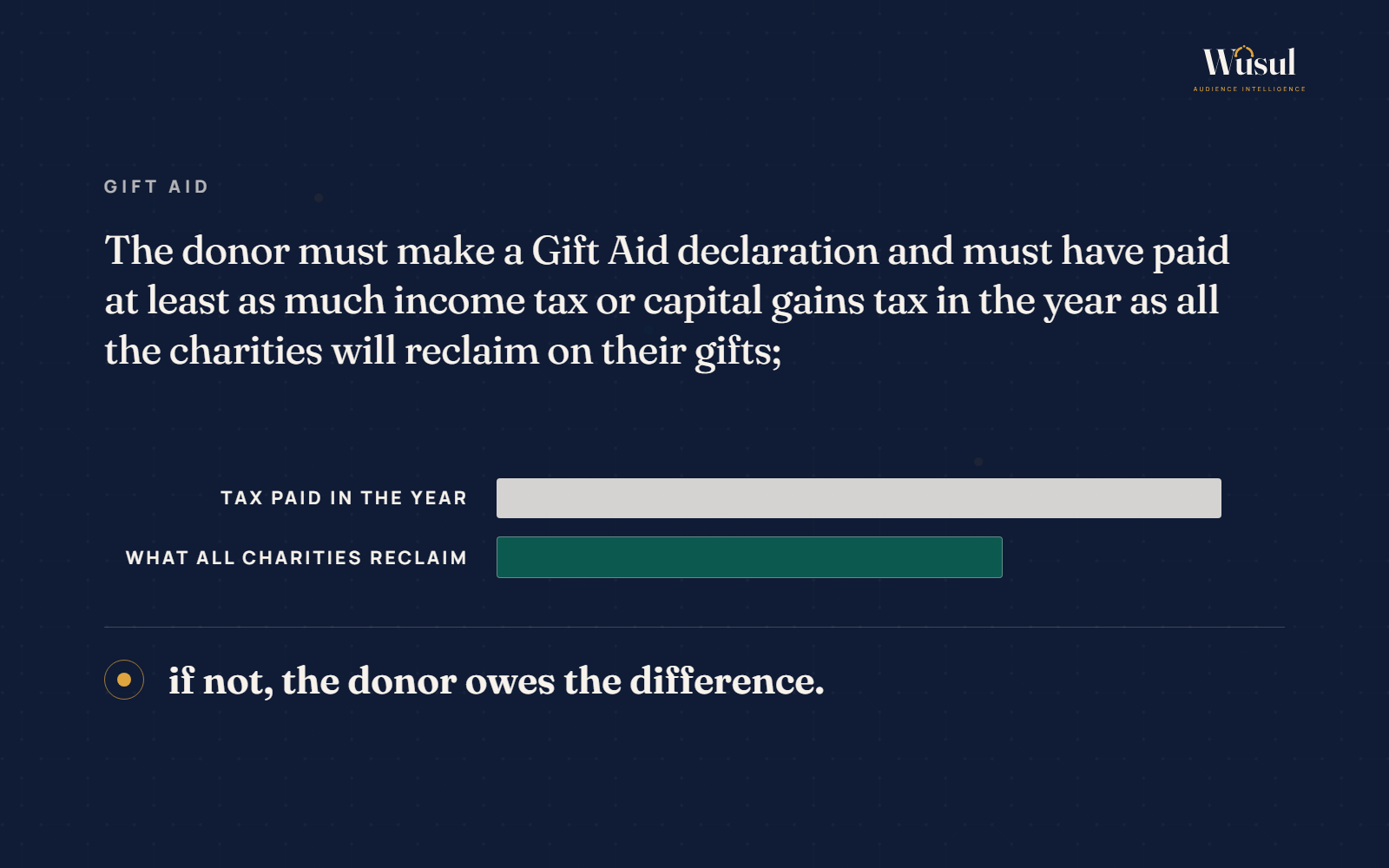
That changes what a year-end tax message can honestly say. "Your £100 could be worth £125 with Gift Aid" is accurate when properly qualified. "Give before 31 December to secure your tax relief" is not, because nothing about Gift Aid changes at midnight on New Year's Eve. The honest opportunity for British charities is not to invent a December deadline, but to explain Gift Aid clearly at the moment donors are already thinking about giving.
How much Gift Aid matters
Gift Aid is not an administrative footnote. HMRC's latest statistics show charities received £1.88 billion in Gift Aid in the tax year to April 2026, up 10%, shared among some 67,650 charities. Higher-rate relief claimed by donors themselves rose 10% to an estimated £920 million, nearly double the £480 million of 2014-15. Across all charity tax reliefs, the total was about £7.4 billion.
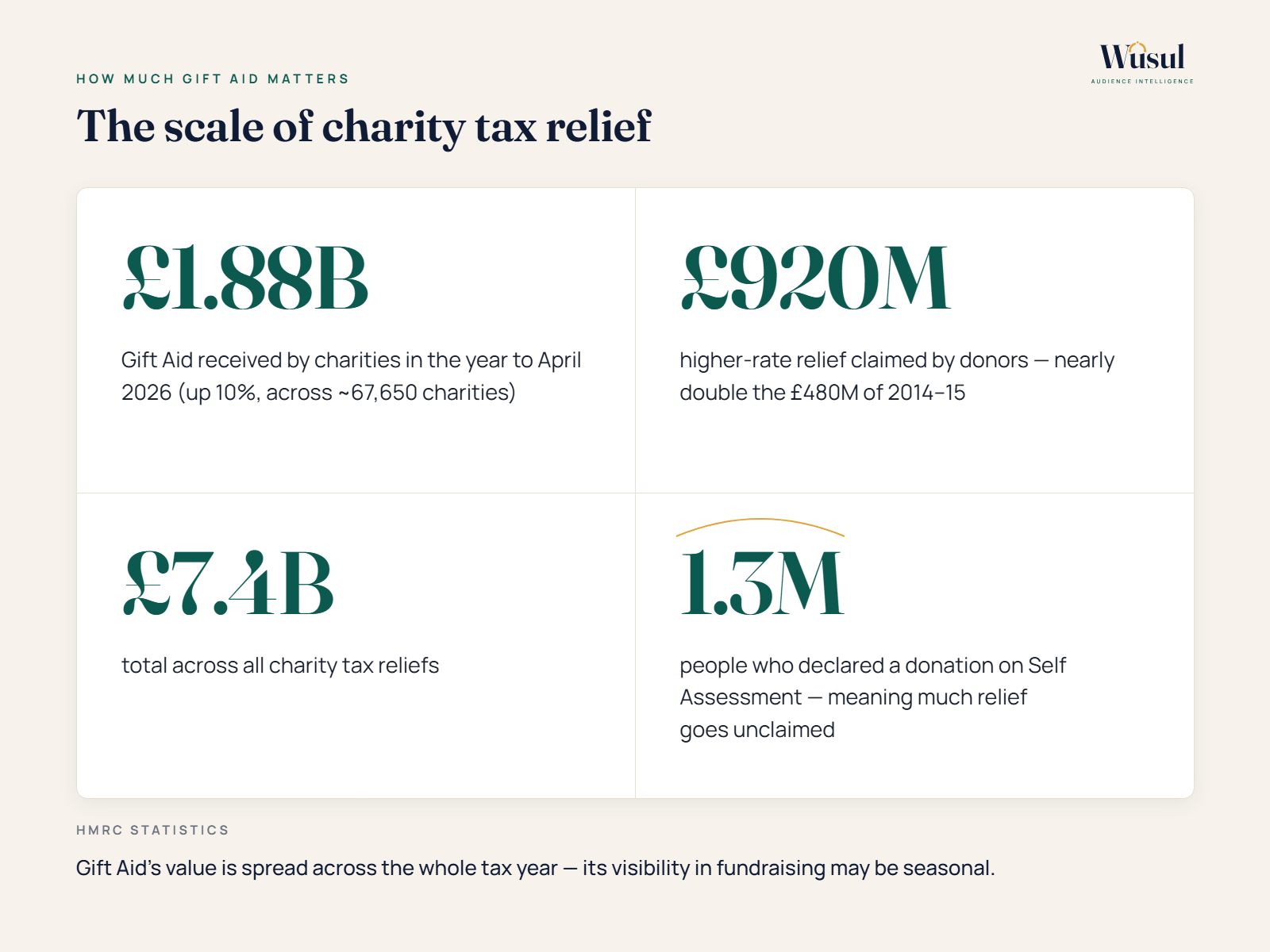
One figure suggests how much relief goes unclaimed: only 1.3 million people declared a donation on their Self Assessment return for the year to April 2025, 2% fewer than the year before. Many higher-rate taxpayers who give with Gift Aid never claim the extra relief they are entitled to.
These are sector-wide numbers. They cannot tell us how much Gift Aid British Muslim charities receive, how much of it comes from Zakat, or whether December brings in a disproportionate share. Those questions need organisation-level evidence, which later articles in this series will look for. What the national figures do show is that Gift Aid's value is spread across the whole tax year. Its visibility in fundraising, by contrast, may be seasonal. That difference is worth measuring.
Where Zakat complicates the picture
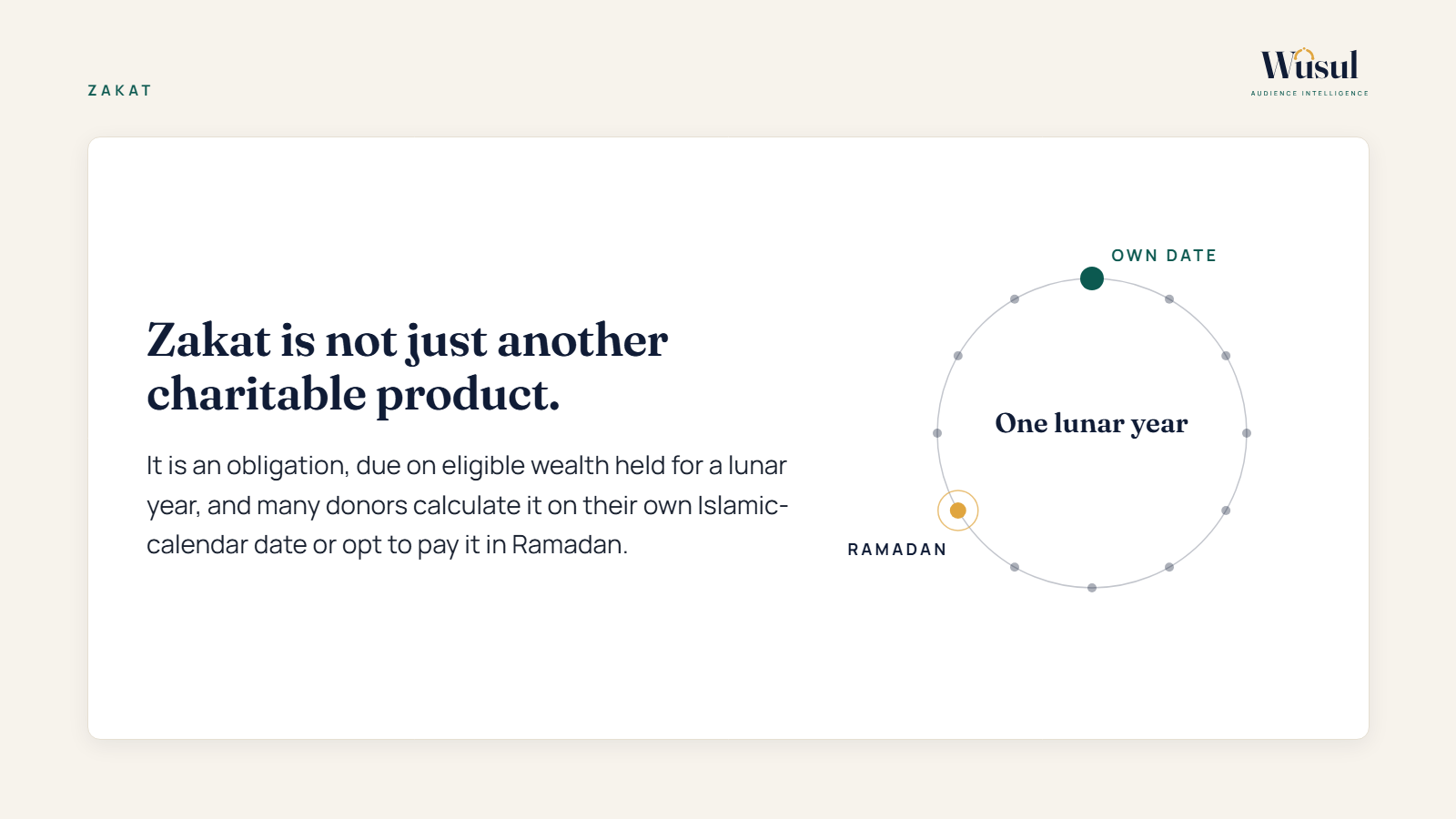
For a Muslim donor, Zakat is not just another charitable product. It is an obligation, due on eligible wealth held for a lunar year, and many donors calculate it on their own Islamic-calendar date or opt to pay it in Ramadan. Neither 31 December nor 5 April has any religious meaning for it.
So, a December appeal can capture several different kinds of gift: Zakat that happens to fall due in December; voluntary Sadaqah given in the festive season while Zakat is kept for its proper date; a winter emergency gift the donor asks to count as Zakat; or a gift with no Zakat intention at all. These are different behaviours, and lumping them together as "Muslim year-end giving" hides more than it shows.
Tax adds a further layer. Calling a gift Zakat does not stop it qualifying for Gift Aid: the tax question depends on the charity, the gift and the donor's tax position, not on its religious label. But once Gift Aid is claimed on Zakat, a question follows that has no single answer in Britain: where does the extra 25% go?
Charities answer it differently, and publicly. Muslim Hands says it never spends donations on admin and funds its administration solely from Gift Aid. The National Zakat Foundation says it uses Gift Aid to pay staff and running costs such as IT and audit. Oxfam, which accepts Zakat, puts the Gift Aid it reclaims on Zakat into its general unrestricted income. The same £25 on the same £100 of Zakat can end up funding running costs, general programmes, or something else again. Article 4 of this series examines those policies in detail.
When Ramadan reaches Christmas
As the opening article explained, Ramadan is moving towards December and, on current estimates, will begin there from around 2030. In America, Canada and France, that will put Ramadan and Zakat on top of the tax deadline. In Britain the collision will be different: Ramadan, the month in which many donors pay Zakat, will land on Christmas, GivingTuesday and winter emergency appeals, but still three months before the tax year ends. British Muslim charities will face the busiest giving weeks of the year with no tax deadline to explain them, which makes it all the more important to be clear now about which calendar each appeal is following.
Conclusion: the year ends; the tax year does not
Britain's year-end giving season is real. Its tax significance is mostly imagined. December is a powerful moment for generosity, shaped by Christmas, GivingTuesday and winter need, but nothing about Gift Aid changes on 31 December. The dates that matter for tax are 31 January and 5 April, and for Zakat, a date set by the Islamic calendar.
None of this makes December appeals wrong. A charity can encourage generosity in December without calling it a tax deadline; explain Gift Aid without implying every donor gets money back; welcome Zakat without suggesting it must be paid before the Gregorian year ends; and set a fundraising target without confusing it with the date a family needs help. Those distinctions are not obstacles to good fundraising. They are what make it credible, and with Ramadan heading towards December, they are about to matter a great deal more.
Frequently asked questions
Does the UK tax year end on 31 December?
No. The personal tax year runs from 6 April to 5 April.
Is there any tax reason to give before 31 December in Britain?
Not for Gift Aid. A gift on 31 December and one on 1 January fall in the same tax year. The tax dates that matter are 5 April, the end of the tax year, and 31 January, the online Self Assessment deadline and the last day to carry a gift back to the previous tax year.
Does Gift Aid give the donor 25% back?
No. On an eligible £100 gift, the charity reclaims £25. Only higher-rate and additional-rate taxpayers can claim extra relief for themselves.
Can Zakat be Gift Aided?
Yes, if the gift and the donor meet the normal Gift Aid conditions. The religious label does not decide the tax treatment. Charities differ in how they use the Gift Aid reclaimed on Zakat.
Does Zakat have to be paid before 31 December?
No. Zakat falls due according to Islamic rules and the donor's own circumstances, usually on an Islamic-calendar date.
When will Ramadan fall in December?
On current estimates, Ramadan will begin around 26 December 2030, and in mid-December and early December in the following two years.
Wusul Insight: In Britain, December is a giving season, not a tax deadline. The real tax dates for donors are 31 January and 5 April, and for Zakat, the Islamic calendar. As Ramadan moves towards December, British Muslim charities that keep these calendars distinct, and tell donors honestly which one is driving an appeal, will be best placed when they collide.
Methodology note: this article is a regulatory and contextual analysis. UK tax rules are drawn from official HMRC guidance; sector-wide statistics are not attributed to Muslim charities. Charity pages are cited as examples of published policy and messaging, not as evidence of historical campaigns or results. Future Ramadan dates are approximate astronomical estimates. This article is general information, not tax or religious advice.