In the past decade, Diversity, Equity, and Inclusion (DEI) has become a standard framework for how organizations think about difference. It has shaped hiring practices, training programs, and public commitments across the corporate, nonprofit, and public sectors.
But DEI is not the same as cultural intelligence (CQ). And the persistent confusion between the two has led to a significant blind spot in how organizations approach cross-cultural engagement.
DEI and CQ are related. They overlap. But they solve different problems, require different capabilities, and produce different outcomes. Understanding the distinction is essential for any organization seeking to engage diverse audiences (including Muslim communities) with genuine competence rather than performative gestures.
Defining the terms
Diversity, Equity, and Inclusion (DEI) is an organizational framework focused on representation, fairness, and belonging within a workplace or institution. Diversity refers to the presence of difference, race, gender, ethnicity, disability, sexual orientation, and other identity categories. Equity refers to fair treatment and access to opportunity, often through the correction of systemic disadvantage. Inclusion refers to the creation of an environment where diverse people feel welcomed, respected, and able to participate fully.
Cultural Intelligence (CQ) is the capability to function effectively across cultural contexts. It was formally defined by researchers Christopher Earley and Soon Ang in 2003 and has since been developed into a measurable framework with four dimensions: CQ Drive (motivation and confidence to engage with cultural difference), CQ Knowledge (understanding of how cultures differ), CQ Strategy (planning and sense-making in cross-cultural encounters), and CQ Action (adapting behavior appropriately in the moment).
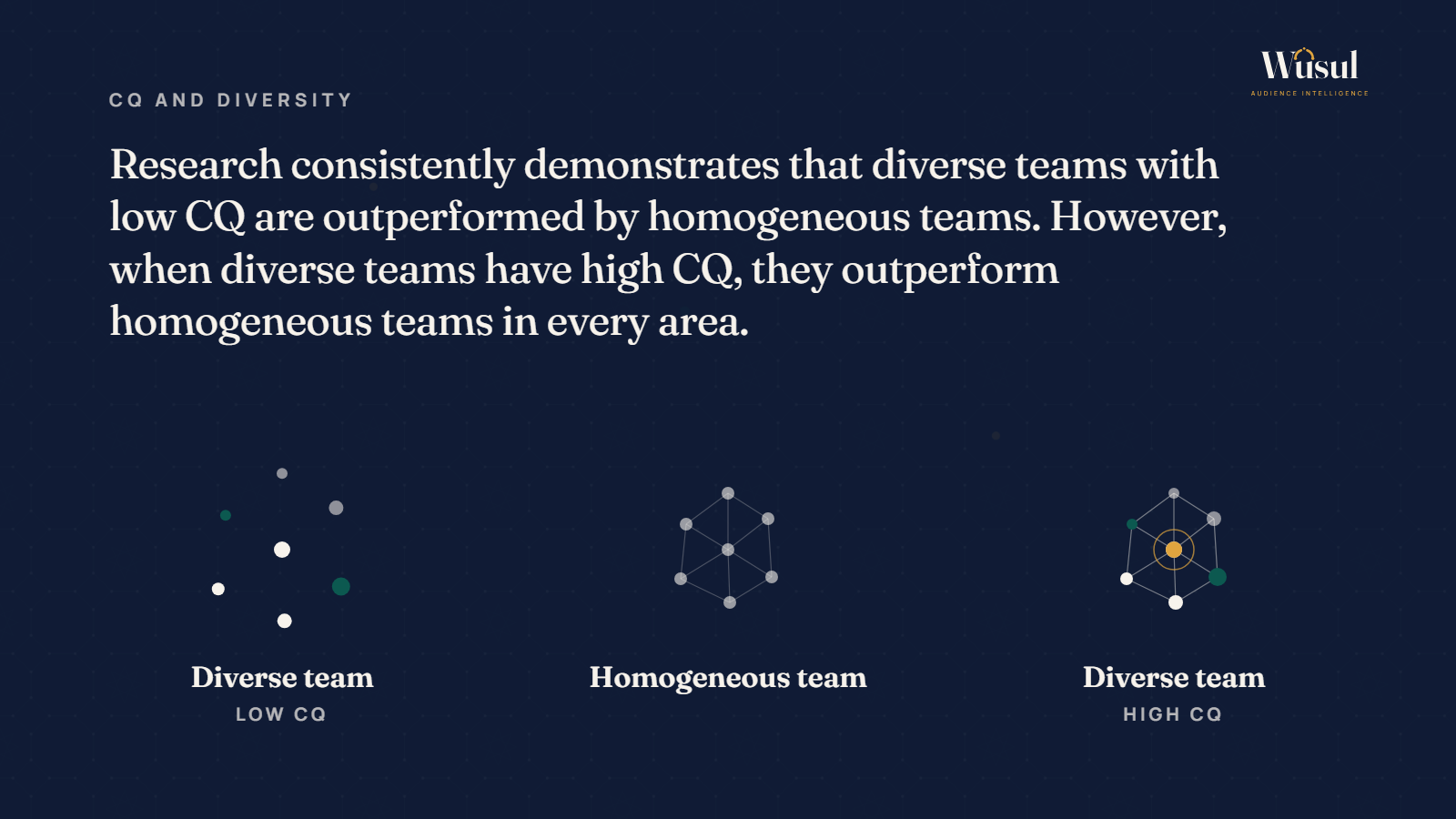
The difference in emphasis is significant. DEI focuses on who is in the room and whether they are treated fairly. CQ focuses on whether the people in the room can work together effectively across cultural difference.
The core distinction: Awareness vs. Capability
The most fundamental difference between DEI and CQ is that DEI is primarily about awareness and structural fairness, while CQ is about capability and performance.
DEI training, at its best, builds awareness of identity dynamics, surfaces unconscious bias, and establishes norms of respect and inclusion. It addresses the systemic advantages and disadvantages that shape people's experiences in organizations.
But DEI training does not teach you how to run a meeting where half the participants come from high-context cultures (where meaning is implied) and the other half from low-context cultures (where meaning is explicit). It does not prepare you for the moment when your direct feedback style, celebrated in your home culture, lands as a public humiliation in someone else's. It does not help you understand why a colleague from a collectivist society will not take individual credit for their work, even when you are trying to promote them.
These are not diversity problems. They are cultural navigation problems. And they require a different set of capabilities.
As one analysis puts it: "DEI training addresses who we are, our identities, our biases, our systemic positions. Cultural intelligence addresses how we operate, our communication patterns, our decision-making defaults, our expectations about hierarchy, authority, and social interaction."
The strategic link: how CQ supports DEI
This is not an argument against DEI. It is an argument for understanding what DEI can and cannot do, and for recognizing that cultural intelligence is the missing link that can make DEI efforts more effective.
David Livermore, a leading researcher on cultural intelligence, argues that "CQ is the strategic link to creating diverse, inclusive, and equitable work environments."
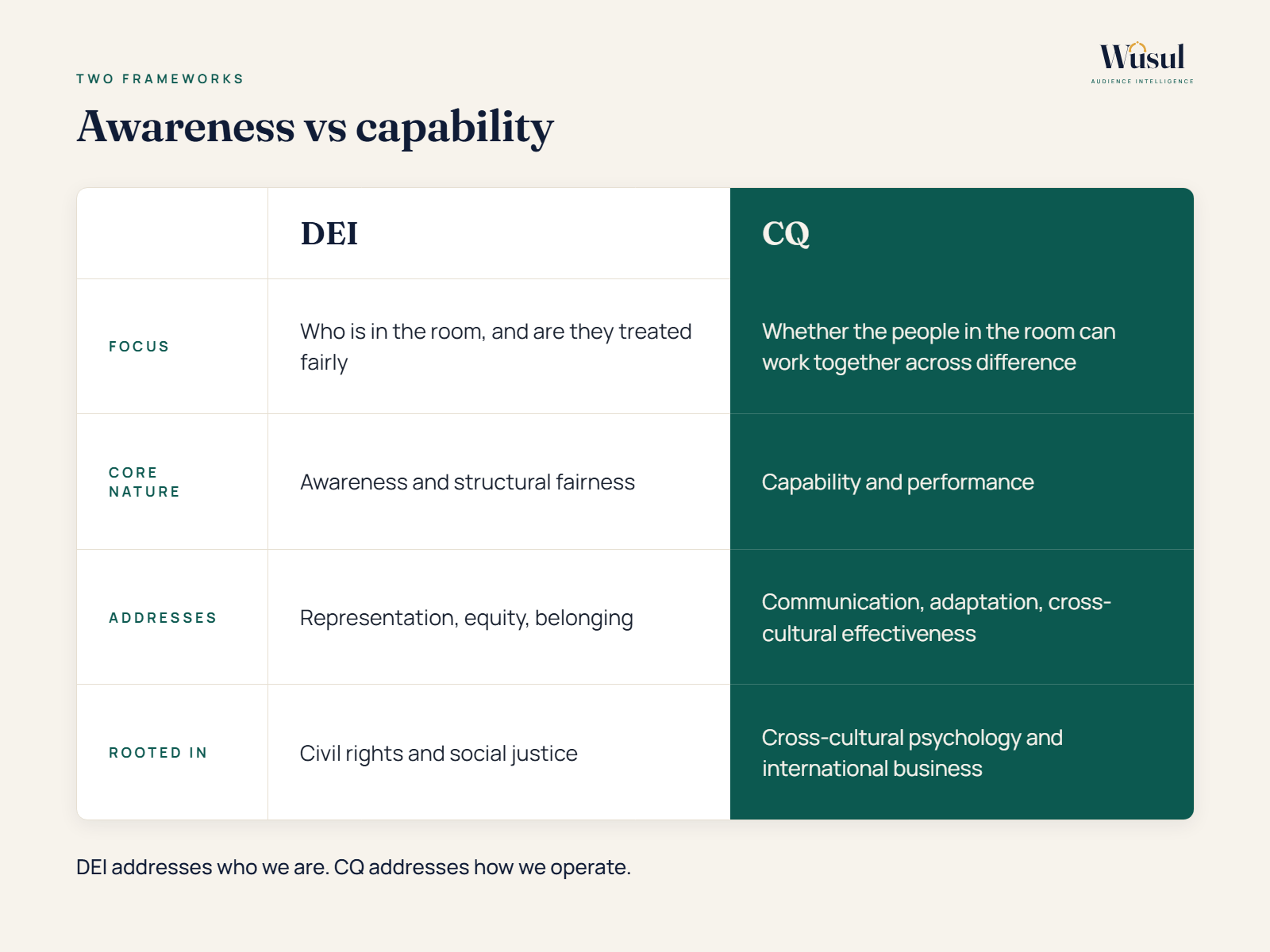
CQ and Diversity. Diversity without CQ can reduce performance. Research consistently demonstrates that diverse teams with low CQ are outperformed by homogeneous teams. Why? Because working with people who are different creates misaligned expectations and conflict, and apart from CQ, increased diversity creates gridlock and reduced productivity. However, when diverse teams have high CQ, they outperform homogeneous teams in every area, including innovation, decision-making, building trust, and leadership effectiveness.
CQ and Inclusion. Inclusion is not just about welcoming everyone. It is about having a culture and set of organizational routines that are explicitly inclusive. The Academy of Management reported that the top three factors influencing whether diverse staff feel included are participation in decision-making, information sharing, and informal networking. CQ allows organizations to develop decision-making processes that manage bias, enable a variety of ways for diverse individuals to share their perspectives, and ensure that knowledge sharing is inclusive and multi-directional.
A practitioner's mantra captures the relationship: "Diversity is a fact; inclusion is an act; equity is the impact, when CQ is unpacked."
The different problems they solve
The distinction becomes clearer when you consider the specific problems each framework is designed to address.
DEI addresses problems of representation and fairness. Its core questions are: Who is being excluded? Who is being treated unfairly? What systemic barriers prevent certain groups from participating fully? These are questions of justice and equity, and they are essential.
CQ addresses problems of cross-cultural effectiveness. Its core questions are: Why do people from different cultural backgrounds misunderstand each other? How do we adapt our communication and behavior to be effective across cultural contexts? How do we navigate differences in values, norms, and expectations? These are questions of capability and performance.
A concrete example illustrates the difference. A multinational team preparing for a product launch across European and Asian markets includes members from the UK, Germany, Japan, and Brazil. They are all competent professionals. There are no representation issues; the team is diverse by any measure. Everyone has completed the company's DEI program.
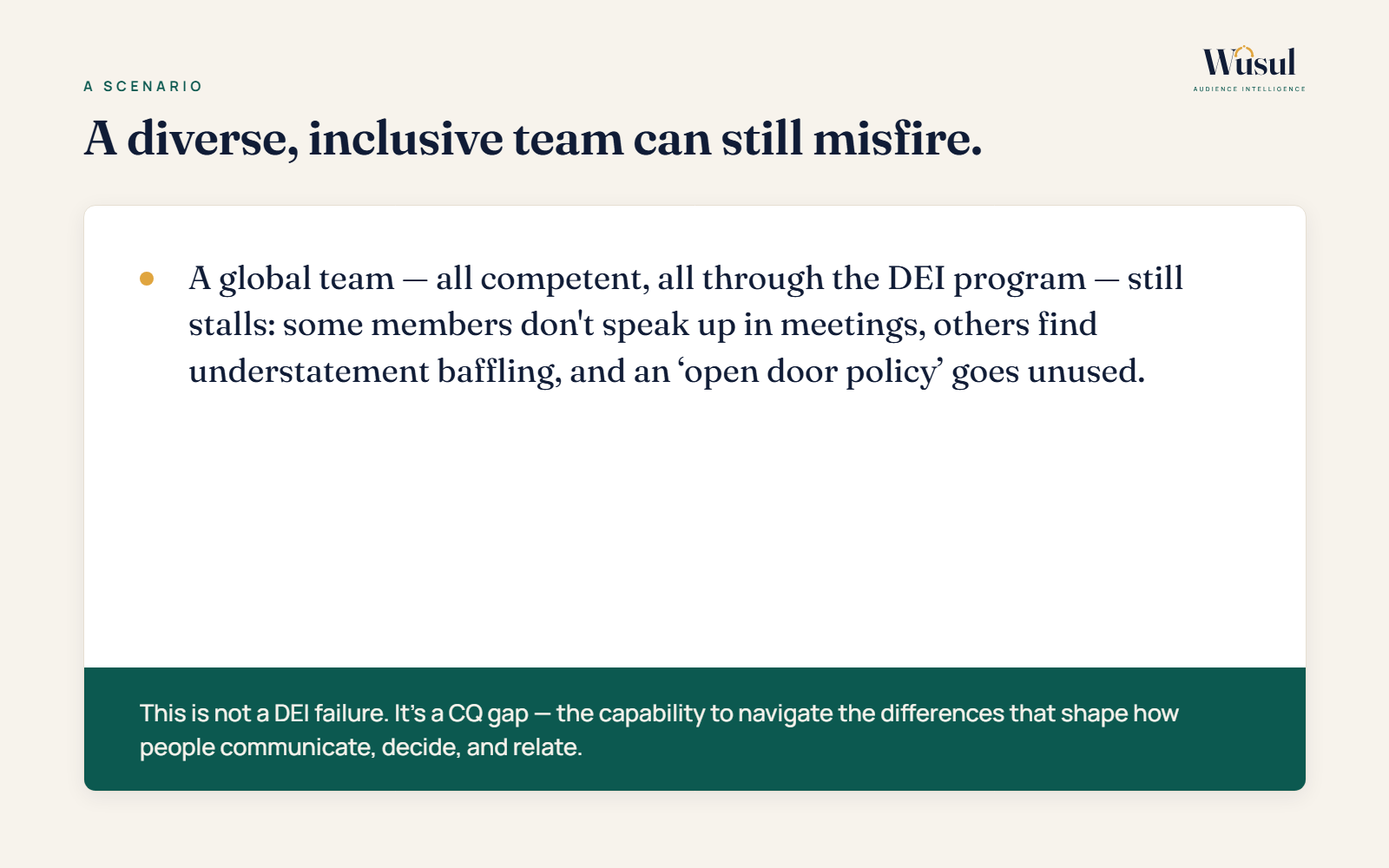
And yet: the Japanese team members don't speak up in meetings, the German team members find the British understatement baffling, and the American manager doesn't understand why their "open door policy" isn't being used by their South Korean direct reports.
This is not a DEI failure. It is a CQ gap. The team has diversity. It has (presumably) an inclusive environment. But it lacks the capability to navigate the cultural differences that shape how its members communicate, decide, and relate.
The overlap and the tension
There is significant overlap between DEI and CQ. Both are concerned with how people from different backgrounds interact. Both value respect and inclusion. Both seek to reduce conflict and improve outcomes.
But they operate in different registers. DEI is often framed in the language of identity, power, and justice. CQ is framed in the language of capability, adaptation, and effectiveness. DEI is rooted in the history of civil rights and social justice movements. CQ is rooted in cross-cultural psychology and international business research.
This difference in framing can create tension. Some DEI practitioners worry that CQ is a way of sidestepping difficult conversations about race and systemic bias; that it focuses on "culture" as a neutral, apolitical category while ignoring the power dynamics that DEI exists to address.
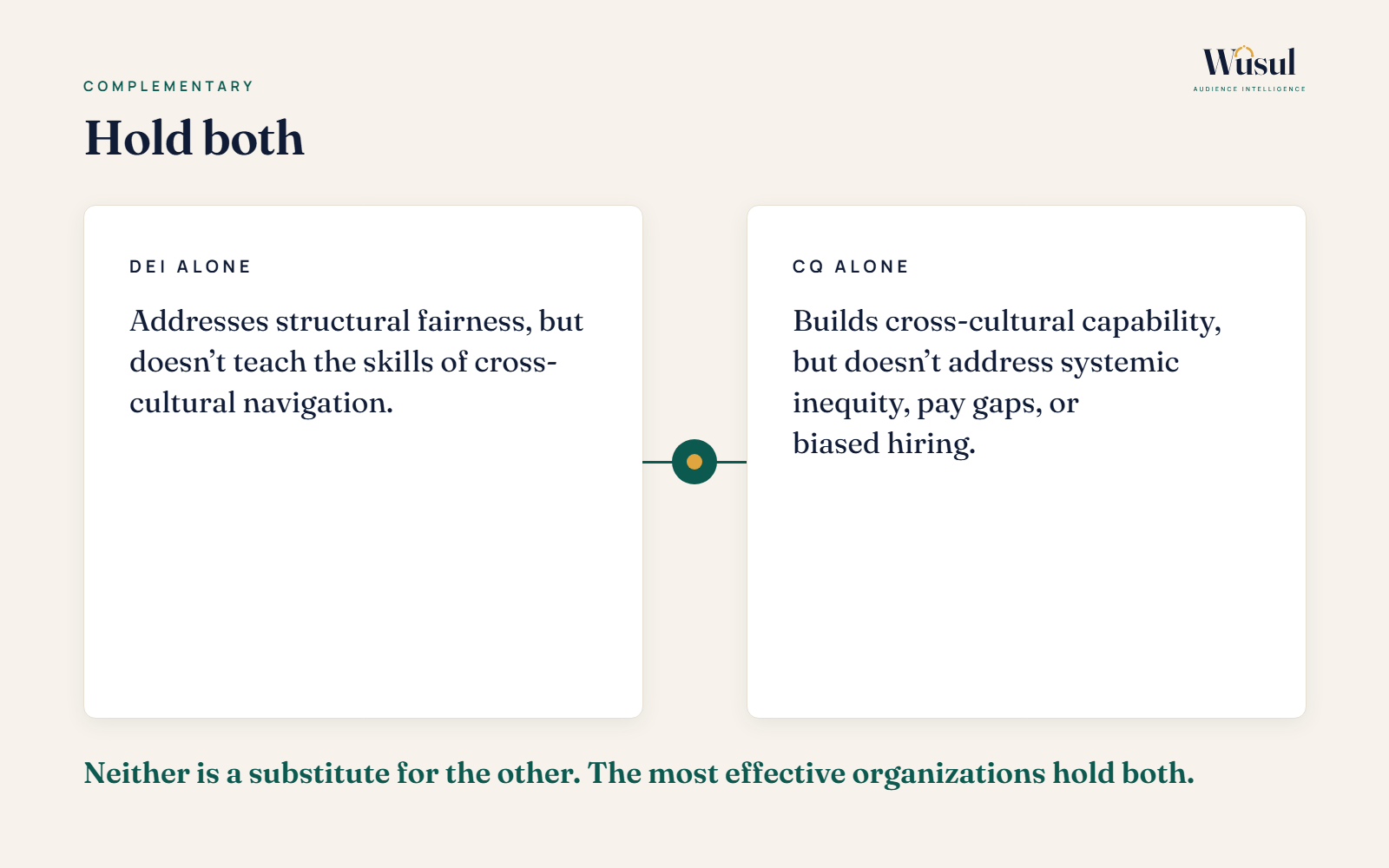
This concern is legitimate. CQ, on its own, does not address systemic racism. It does not fix pay gaps. It does not dismantle biased hiring practices. It is not a substitute for the structural work that DEI demands.
But the reverse is also true. DEI, on its own, does not teach the skills of cross-cultural navigation. It does not prepare people to work effectively across cultural difference. It does not address the communication breakdowns, the misaligned expectations, and the friction that arise when people from different cultural contexts try to collaborate.
The most effective organizations will use both. They will address structural fairness through DEI. They will build cross-cultural capability through CQ. And they will recognize that neither is sufficient on its own.
The current context: DEI under pressure
The conversation about DEI and CQ is happening in a particular moment. In the United States, DEI programs have come under significant political pressure. In January 2025, an executive order was signed eliminating DEI programs in the federal government. Several major companies; including Meta, Zoom, Target, Snap, Tesla, and others, eradicated or scaled back their DEI initiatives. At least 50 percent of employees in DEI roles were eliminated in some organizations.
This backlash has created uncertainty for organizations committed to equity and inclusion. Some have rebranded their DEI efforts. Others have quietly scaled back. And some have sought alternative frameworks that are less politically charged.
Cultural intelligence, because it is framed as a capability rather than a political commitment, may be less vulnerable to this backlash. It is harder to argue against the value of being effective across cultural difference than it is to argue against specific DEI policies.
But this also creates a risk. If CQ is adopted as a replacement for DEI (rather than a complement to it) the structural work of addressing systemic inequity may be abandoned in favor of a softer, more palatable focus on "cultural understanding."
The most responsible approach is to hold both. CQ can help organizations navigate cultural difference more effectively. DEI can help them address the structural barriers that prevent diverse people from thriving. Neither is a substitute for the other.
What this means for Wusul's clients
For organizations seeking to engage Muslim audiences (whether Islamic charities, halal brands, or Muslim-focused media) the distinction between DEI and CQ has practical implications.
DEI is about who is in your organization. Does your staff reflect the communities you serve? Are Muslim employees represented at decision-making levels? Is your workplace inclusive of religious observance, prayer space, Eid holidays, halal food options? These are DEI questions, and they matter.
CQ is about how effectively you engage across cultural difference. Do you understand why a Ramadan campaign that works in London may fail in Chicago? Do you know the difference between how Somali and South Asian Muslim communities experience charitable giving? Can you adapt your communication style to resonate with different segments of the Muslim audience? These are CQ questions, and they are equally essential.
The most culturally intelligent organizations will address both. They will build diverse teams that reflect the communities they serve. They will create inclusive environments where Muslim staff can bring their full selves to work. And they will invest in the cross-cultural capability that allows them to engage Muslim audiences with genuine understanding rather than surface-level gestures.
The distinction between DEI and CQ is not a reason to choose one over the other. It is a reason to understand what each does, and to use both in service of a deeper commitment to cultural intelligence.
DEI and CQ: two frameworks with one goal
DEI and CQ are not competitors. They are complementary frameworks that address different dimensions of the same challenge: how to create organizations and engage audiences across lines of difference.
DEI asks: Who is included? Who is treated fairly? Whose voices are heard?
CQ asks: Can we work together effectively? Can we navigate the cultural differences that shape how we communicate, decide, and relate? Can we adapt our behavior to be effective in contexts that are not our own?
Both questions matter. Both frameworks are necessary.
For organizations serving Muslim communities, the most effective approach is to hold both. Build diverse, inclusive teams through DEI. Build cross-cultural capability through CQ. And recognize that the goal is not to choose between them, but to use both in service of a deeper commitment to understanding, respect, and effectiveness.
At Wusul, we believe that cultural intelligence means understanding not just who is in the room, but whether the people in the room can truly work together across difference. DEI and CQ are not rivals. They are partners in the work of building organizations that are both fair and effective, and in engaging communities with the depth of understanding they deserve.
Frequently asked questions
What is cultural intelligence?
Cultural intelligence, or CQ, is the capability to function effectively across various cultural contexts. It is a measurable framework that focuses on how individuals operate, including their communication patterns, decision-making defaults, and expectations regarding hierarchy, authority, and social interaction. Unlike DEI, which focuses on structural fairness, CQ emphasizes individual capability and performance in cross-cultural encounters.
How does cultural intelligence support DEI?
Cultural intelligence acts as the strategic link that makes DEI efforts more effective. While diversity alone can lead to gridlock and reduced productivity, teams with high CQ leverage their differences to outperform homogeneous groups in innovation and decision-making. CQ helps organizations create inclusive routines by managing bias and enabling diverse individuals to participate fully in decision-making and information sharing.
What are the four dimensions of cultural intelligence?
The four dimensions of cultural intelligence are CQ Drive, CQ Knowledge, CQ Strategy, and CQ Action. CQ Drive involves the motivation and confidence to engage with cultural differences. CQ Knowledge refers to understanding how cultures differ. CQ Strategy involves planning and sense-making during cross-cultural encounters. CQ Action focuses on the ability to adapt one's behavior appropriately in the moment.