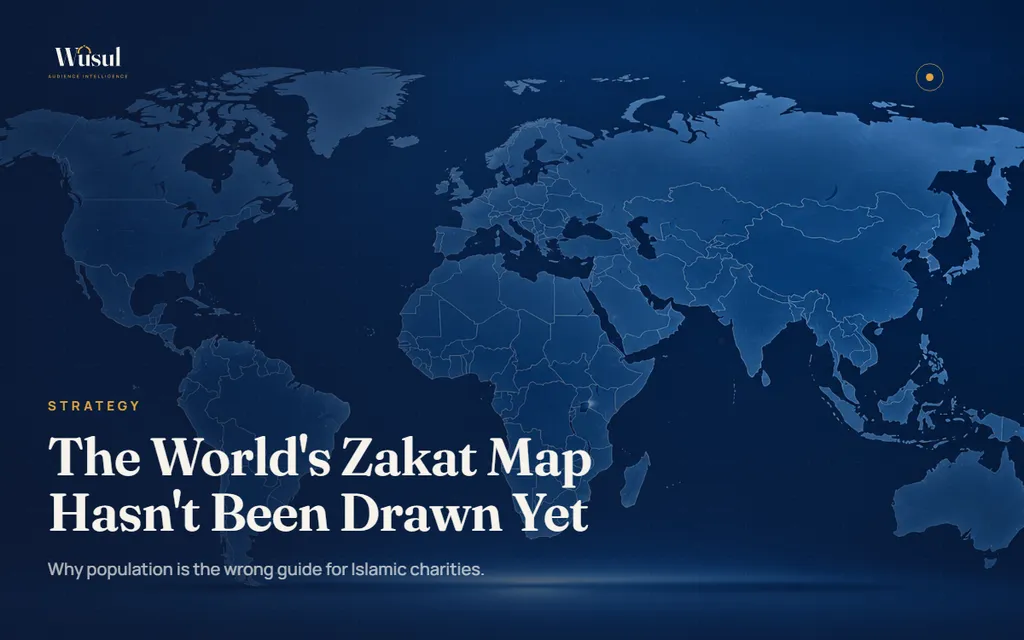
The world's largest Muslim populations are not necessarily its largest Zakat markets, and nobody can yet say which country gives the most. Understanding why could change how Islamic charities find, engage and serve donors.
According to the Pew Research Center's 2025 analysis, about 2 billion Muslims lived worldwide in 2020, roughly a quarter of the global population. The ten countries with the largest Muslim populations were home to about 65% of the Ummah.
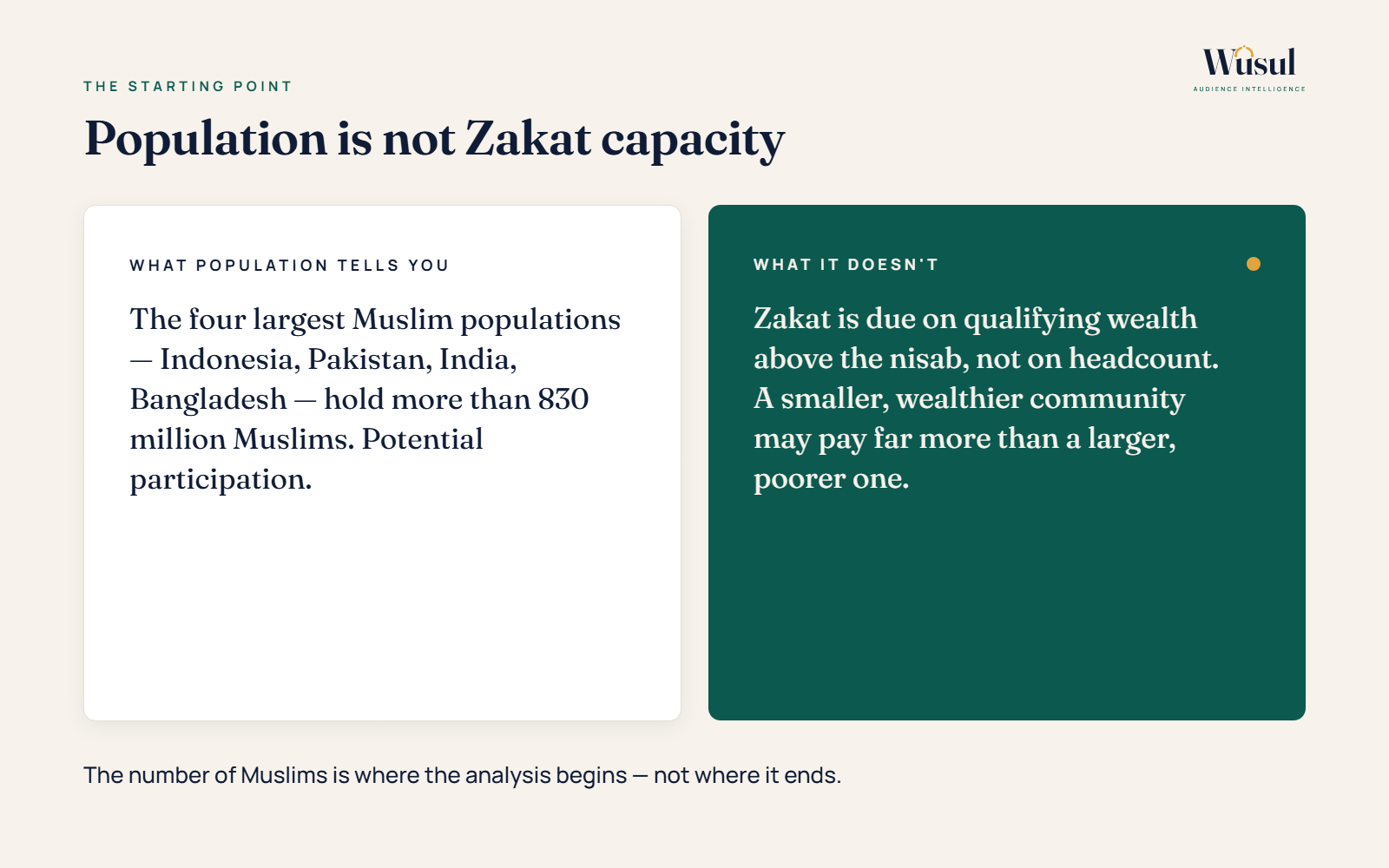
The four largest Muslim populations are in Indonesia, Pakistan, India, and Bangladesh. Together, they hold more than 830 million Muslims. So, any global analysis of Zakat normally has to look at South and Southeast Asia, not only at wealthy Gulf donors.
But population creates potential participation, not a measurable financial contribution. Zakat is due on qualifying wealth above the nisab threshold, not on headcount or income. Two countries with the same number of Muslims can have very different Zakat volumes. A smaller, wealthier community may pay a great deal, while a country with millions of Muslims living near the poverty line may have relatively few people liable to pay at all. The number of Muslims is where the analysis begins, not where it ends.
This question takes us to one of the most important gaps in the research on Islamic philanthropy. Despite Zakat's central place in Muslim economic life, there is no comprehensive, standardized database of how much Zakat is paid in each country. Some governments collect and report it. Others leave it to religious institutions, charities or individuals. In many communities, Zakat passes directly between families and neighbors without appearing in any institutional record.
The global geography of Zakat therefore cannot be read off a population table. It requires a harder question: where do Muslims live? Where is their qualifying wealth? How do they distribute their Zakat? And how much of that can be measured? For Islamic charities, the answers could reshape international fundraising strategy.
The global Zakat value we're not sure about
How much Zakat is paid worldwide each year? The most widely repeated answer is somewhere between $200 billion and $1 trillion. Development Initiatives' 2015 report An Act of Faith cited that range, but it also stated plainly that no reliable data showed how much Zakat Muslims pay. The range describes theoretical potential: what could be due if qualifying wealth were assessed and obligations met under assumptions.
Measured payments look very different. The same report found at least 5.7billion collected each year in five countries that it could document. A more recent mapping exercise bridging the gap in the global Zakat sector identified about 8 billion in formal institutional flows, rising to roughly $14.5-15.5 billion once selected estimates of informal giving were added. Even that is not a global total; it reflects whatever has been reported, under varying definitions and reference years.
The distinction between potential, estimated payments and recorded collections is the key to everything that follows. One country may have high theoretical capacity but low institutional collection. Another may report large collections simply because it has a centralised system. A third may have widespread direct giving that researchers cannot see. Rank countries without separating these, and you end up rewarding data availability rather than measuring generosity.
The most visible Zakat markets are not necessarily the most populous.
What the national figures actually measure
The table below brings together the best available national figures. It looks like a ranking, but the final column explains why it is not one: each number measures something different, in a different year and currency.
| Country | Reported figure | Year | What it measures | Source |
| Saudi Arabia | SAR 16.4bn (about $4.36bn) | 2025 | Institutional collection, mainly from businesses | CIRIC Zakat World Map |
| Pakistan | Rs 619bn (about £1.7bn) | 2024 | Household survey of all Zakat paid, formal and informal | ICTD and LUMS |
| United States | $1.8bn | 2021 | Household survey of all Zakat paid, formal and informal | Indiana University |
| Indonesia | about $1.65bn | First half of 2024 | Institutional collection of Zakat plus Infak, Sedekah and other giving | CIRIC Zakat World Map |
| Malaysia | about $845m | 2025 | Institutional collection by state religious authorities | CIRIC Zakat World Map |
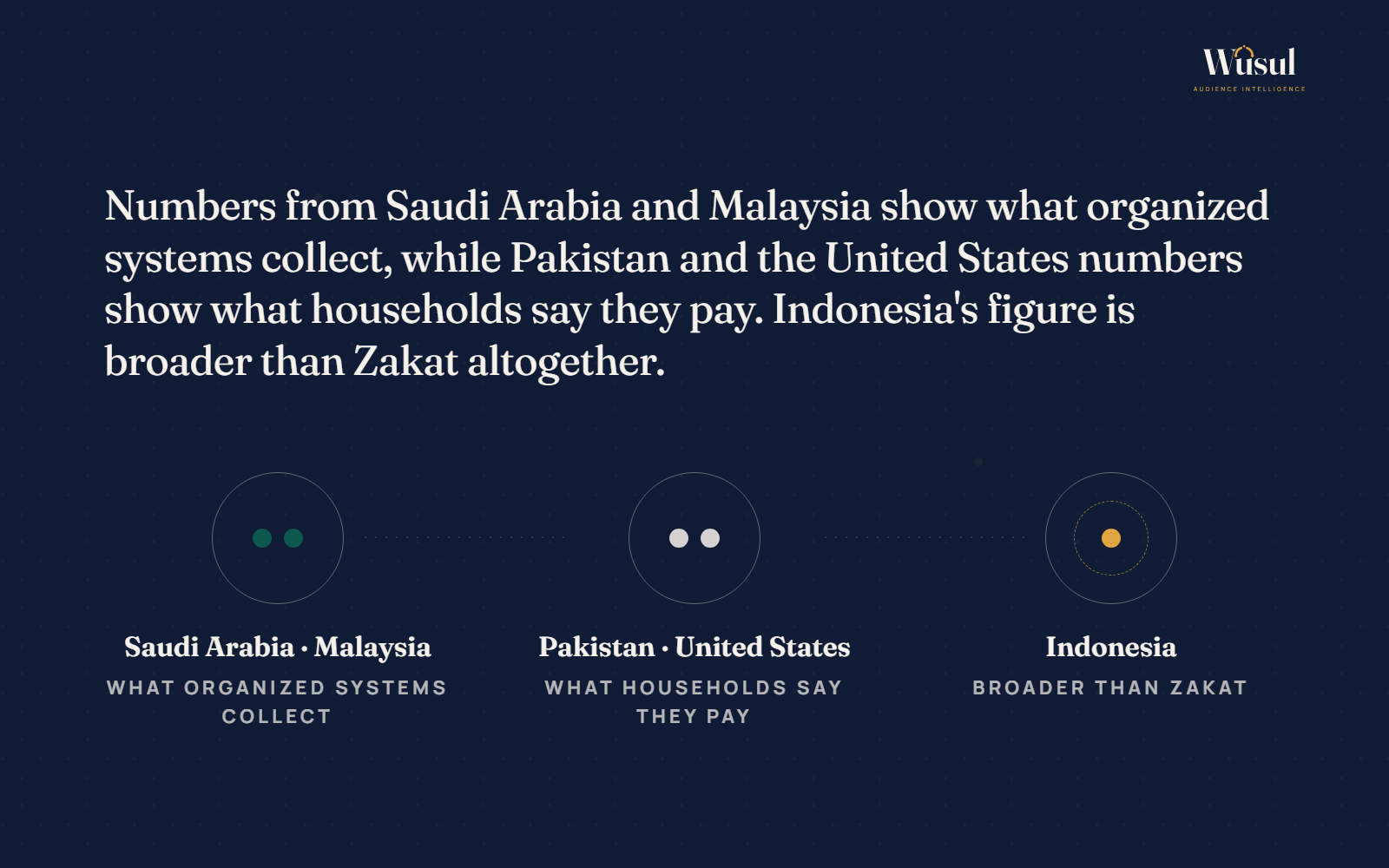
Numbers from Saudi Arabia and Malaysia show what organized systems collect, while Pakistan and the United States numbers show what households say they pay. Indonesia's figure is broader than Zakat altogether. Placing them in one column invites a comparison the data cannot support, which is precisely the point.
Saudi Arabia: What a Corporate Collection System Can See
Saudi Arabia reports one of the largest documented Zakat figures in the world: about SAR 16.4 billion ($4.36 billion) in 2025, according to CIRIC's Zakat World Map. The collection is administered by the Zakat, Tax and Customs Authority, and its scope matters. The formal system applies mainly to businesses, while individuals largely pay their personal Zakat through other channels.
So the Saudi figure is not the Zakat of every Saudi Muslim. It is principally a measure of corporate Zakat collected by the state, and it should not be compared directly with household surveys from countries where Zakat is paid privately.
Its lesson is about visibility. Organized collection, regulatory clarity and reporting can make large sums of Zakat measurable. For charities elsewhere, that is a reminder that infrastructure shapes not only how much Zakat flows through formal channels, but how much of it anyone can see.
Pakistan: The Billions Official Systems Miss
Pakistan offers the opposite picture. In 2025, researchers from the International Centre for Tax and Development (ICTD) and the Lahore University of Management Sciences published findings from a nationally representative survey of 7,500 Sunni Pakistanis. They estimate that Pakistanis pay more than Rs 619 billion (over £1.7 billion) in Zakat each year, with more than 50 million people contributing an average of about Rs 15,000 each. The researchers describe this as a conservative estimate.
Three findings stand out:
- The state sees almost none of it. Pakistan's official Zakat fund collects only about a fiftieth of the estimated total, and fewer than 2% of Zakat payers use it.
- Most Zakat goes directly to people. About three-quarters of givers pay directly to individuals, with smaller shares going through mosques, schools and NGOs.
- It outweighs state welfare. Annual Zakat exceeds the budget of the Benazir Income Support Program, Pakistan's largest cash-transfer scheme. More than half of respondents gave exclusively to women, especially widows.
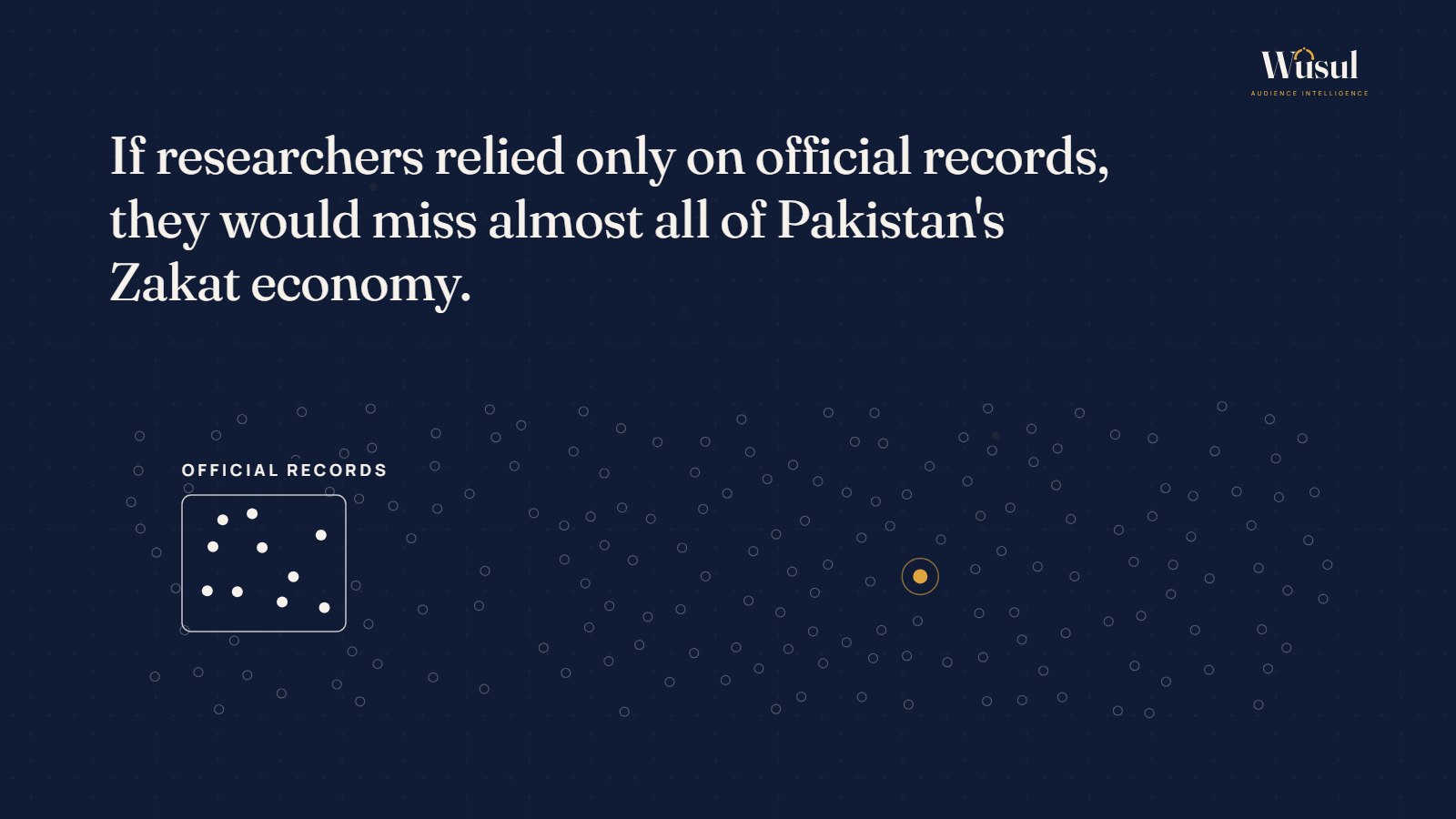
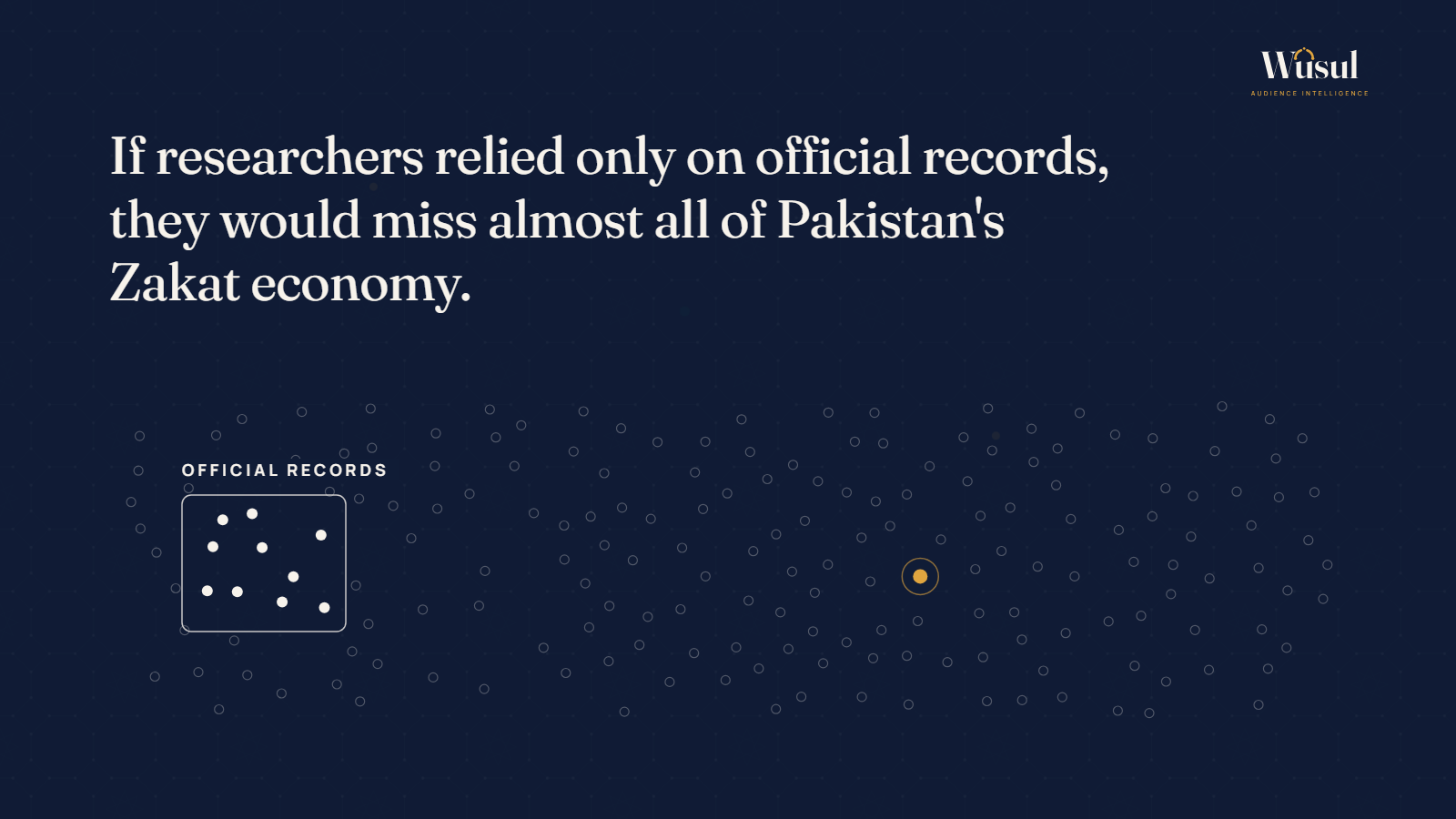
If researchers relied only on official records, they would miss almost all of Pakistan's Zakat economy. For charities, the lesson is sharper still. A large Zakat market is not the same as a large accessible fundraising market. Giving that flows to relatives, neighbors and trusted local intermediaries is embedded in relationships and judgements of trust. Digital advertising cannot simply redirect it.
Indonesia and Malaysia: when definitions shape the number
Indonesia combines the world's largest Muslim population with a well-developed Zakat system, led by the national agency BAZNAS and a network of recognized Zakat organizations. Yet its headline figures are hard to use. Indonesian reporting often combines Zakat with Infak and Sedekah (voluntary giving) under the label ZIS.
CIRIC reports about $1.65 billion in these broad flows for the first half of 2024, of which the Zakat-only component (Zakat Maal and Zakat Fitrah) was substantially smaller. The two figures describe different things and cannot be used interchangeably.
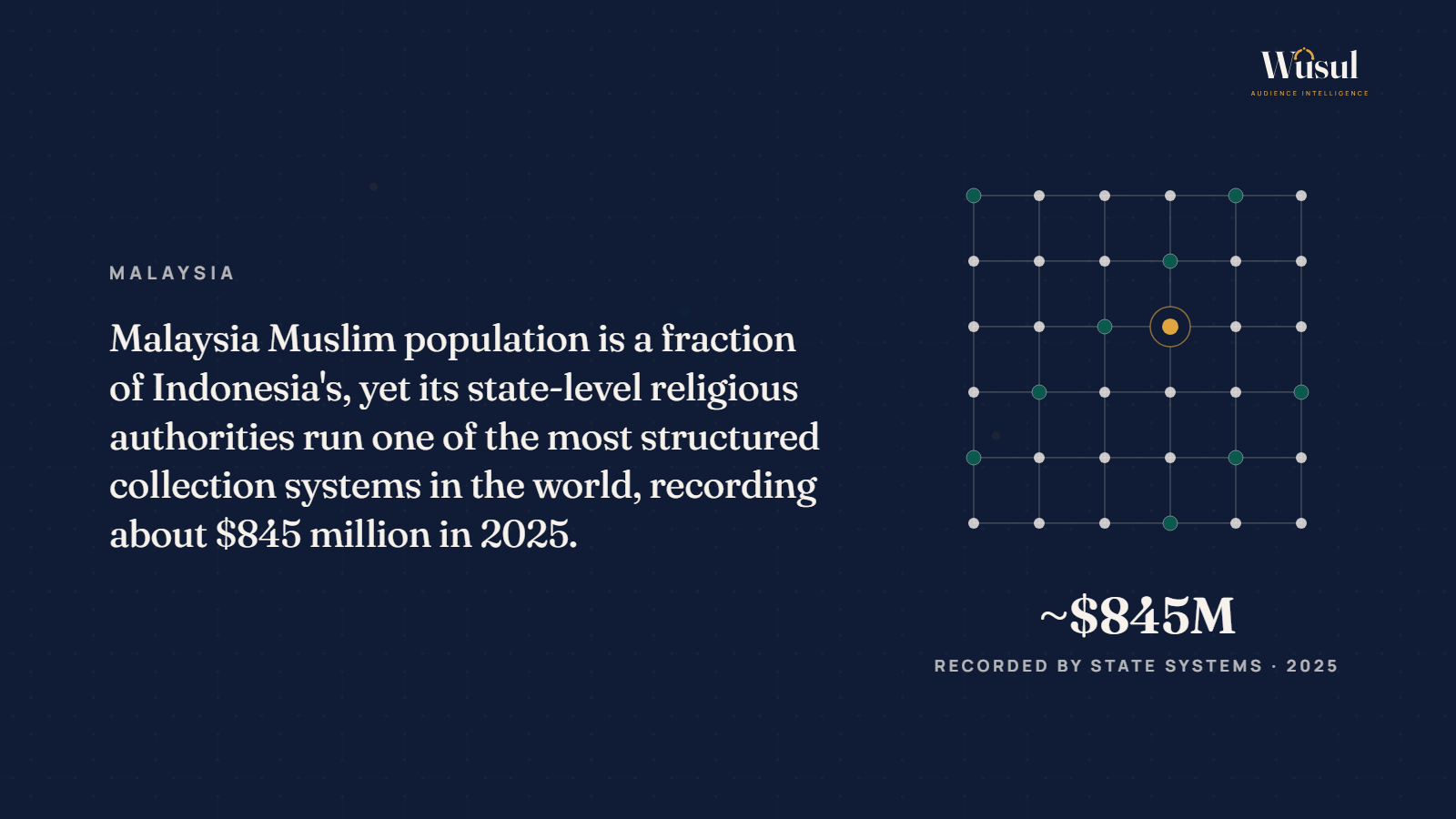
Malaysia shows the other side of the same lesson. Its Muslim population is a fraction of Indonesia's, yet its state-level religious authorities run one of the most structured collection systems in the world, recording about $845 million in 2025. Different sources give different totals for different years, so the figures need careful reconciliation of coverage, currency and definitions. But the direction is clear: administration, compliance and trusted institutions can make a smaller community into a substantial, visible Zakat market.
Both countries show why even precise-looking national statistics can mislead. The first question about any Zakat figure should be what, exactly, it counts.
The United States: A Small Minority with Major Capacity
The United States is the clearest case of a small community with large Zakat capacity. Indiana University's survey-based research estimated that Muslim Americans paid about 1.8billioninZakatin2021**,anaverageofroughly**2,070 per giver. The researchers estimate Zakat at around 40% of all Muslim American giving.
The same research shows how Zakat moves. International nonprofits received about a quarter of it and domestic nonprofits under a fifth. More than one in four Zakat dollars was given informally, directly to individuals or sent abroad as remittances.
This is where population-based strategy breaks down. A charity choosing markets by Muslim population would priorities Indonesia, Pakistan or Bangladesh and underrate the United States. Yet Muslim Americans live in a high-income economy with developed financial infrastructure and established charities. That does not make every Muslim American wealthy; the research also finds the community is disproportionately poor despite average education levels. It means a population percentage measures presence, not Zakat capacity. And capacity, in turn, is not the same as fundraising revenue.
The United Kingdom: What We Know at Home
The UK has no Zakat-only national estimate, but it has more evidence than most countries. Muslims make up about 6.5% of the population of England and Wales, around 3.9 million people at the 2021 census. Blue State's UK Giving Behaviors Tracker, cited by the Muslim Charities Forum, estimates that UK Muslims give an average of £708 a year to charity, more than four times as much as non-religious donors, with total Muslim giving of £1.48-2.2 billion annually. Earlier estimates put Ramadan giving alone at around £130 million, and many British Muslims pay their Zakat during that month.
These are measures of total Muslim giving, not Zakat, and they should be read that way. On the institutional side, Wusul's Islamic Charity Index ranks Islamic charities in the UK and US by the income they report to regulators: the closest thing to a "documented institutional" view of the market, though it does not separate Zakat from other income.
The most useful insight for UK charities comes from connecting this to Pakistan. Around 1.6 million people in England and Wales are of Pakistani heritage and around 650,000 of Bangladeshi heritage. If most Zakat in Pakistan is paid directly to individuals, a large share of British Muslim Zakat may follow the same pattern across borders: to relatives, neighbors and trusted contacts in the family's country of origin. For many UK donors, a charity's real competitor for Zakat is not another charity. It is the cousin, the widow down the road from the family home, or the local mosque back in Mirpur or Sylhet.
The Rest of the Map: Where the Data Runs Out
Beyond these cases, the evidence thins quickly. Africa is home to some of the largest Muslim populations in the world, including Nigeria (about 120 million) and Egypt (about 104 million), yet neither has a verified national total covering both institutional and direct Zakat. Across continental Europe, Canada, Australia and South America, there are established Muslim communities and Islamic charities, but no comparable Zakat-only estimates.
The absence of a figure is not the absence of giving. Africa in particular may contain large Zakat flows that remain almost entirely undocumented, which points to an opportunity for research partnerships and locally grounded donor studies.
A global map of Zakat is partly a map of generosity, and partly a map of what researchers have been able to measure.
The Denominator Problem
What share of global Zakat do Muslim Americans pay? It depends entirely on the denominator.
| If global Zakat is... | The US share of $1.8bn is... |
| $15 billion (identified flows) | 12% |
| $200 billion (low estimate of potential) | 0.9% |
| $1 trillion (high estimate of potential) | 0.18% |
All three calculations are arithmetically correct, and none of them is the real answer. The global figures measure different things, for different years and scopes. That is why any ranking that publishes precise national "shares of world Zakat" should be treated with suspicion. The lack of a defensible percentage is not a weakness of the research. It is a finding about the state of the sector.
Professions: A Hypothesis, Not a Hierarchy
It is tempting to segment Zakat donors by profession: doctors, pharmacists, engineers, developers, business owners. There is no representative evidence to rank professions by Zakat paid, and there is a deeper problem. Zakat is due on qualifying wealth, not on job titles. A well-paid consultant with little saved may owe less than a shopkeeper with substantial stock and cash. A retired investor with no occupation may owe a great deal. Business owners, in particular, may need help calculating Zakat on inventory and receivables, which makes tools like Wusul's Zakat calculator relevant to them.
Professional networks such as medical associations or workplace Muslim networks can still be valuable channels. But they should be tested, not assumed. A more useful segmentation combines several dimensions:
- Country of residence and economic circumstances
- Employment, business ownership and relevant financial characteristics
- Previous Zakat behavior and preferred payment channels
- Trust in institutions versus direct giving
- Religious-calendar preferences and giving frequency
- Interest in domestic versus international causes
A Framework: Four Kinds of Zakat Number
The sector needs a global measurement framework, and it should start by keeping four kinds of figure apart:
| Category | What it measures | Example |
| Documented institutional Zakat | What public authorities, recognised institutions and charities collect, under consistent definitions | Saudi Arabia, Malaysia |
| Estimated household Zakat | What individuals say they pay, including direct and informal giving | Pakistan, United States |
| Theoretical Zakat capacity | What could be due, based on qualifying wealth and stated assumptions | The 200bn–1tn range |
| Accessible fundraising market | The share of giving charities could realistically engage through formal channels | Not yet measured anywhere |
These answer different questions and should never be added together without reconciliation. A credible framework would also need to handle cross-border giving. Zakat paid by a British Muslim to a recipient in Pakistan should not be counted as new Zakat in both countries; researchers must separate the donor's country, the collecting institution's location and the final destination of funds, or global totals will double-count.
What this means for Islamic charities
Separate potential from behavior. Wealth models can inform long-term planning, but only evidence of what donors do should drive fundraising targets.
Compete with direct giving, not just with other charities. Where donors prefer to give to people, they know, trust and transparency matter more than advertising volume. For UK charities, that means earning a place alongside family and community networks in the donor's country of heritage: showing exactly who received the Zakat, where, and how eligibility was checked.
Test professional channels; don't assume them. Workplace and professional networks may be useful routes to donors, but no profession is inherently more generous.
Take the diaspora seriously. Muslim communities in high-income countries can be significant philanthropic markets despite small population shares, as the United States shows.
Invest in better data. Distinguishing Zakat from Sadaqah, recording donor geography, tracking repeat behavior and following cross-border flows is not just better reporting. It is the foundation for accountable Islamic philanthropy, and for knowing where your next donor is.
Conclusion
More than two billion Muslims live across the world, in communities that differ in wealth, institutions and charitable tradition. Some pay Zakat through governments, some through charities, and many directly to people they know.
The most important finding, then, is not which country ranks first. It is that the sector does not yet have concrete evidence to say.
At Wusul, we believe that cultural intelligence means understanding not just what donors do, but why they do it; and designing systems that honor the rhythms, values, and faith that shape their giving. The world's Zakat map has not been drawn yet. But the organizations that invest in understanding it will be the ones best positioned to serve Muslim donors with the trust, transparency, and cultural intelligence they deserve.
Frequently Asked Questions
How much Zakat is paid worldwide each year? No one knows precisely. Estimates of theoretical Zakat potential range from $200 billion to $1 trillion, while identifiable recorded flows come to roughly $15 billion. The gap reflects incomplete reporting and the large share of Zakat paid directly to individuals.
Which country pays the most Zakat? There is no reliable answer. Saudi Arabia reports one of the largest institutional collections, mainly from businesses, while household surveys suggest Pakistanis pay more than £1.7 billion a year, mostly outside official systems. These figures measure different things and cannot be ranked against each other.
How much Zakat do Muslims in the UK pay? There is no Zakat-only estimate for the UK. Research suggests UK Muslims give £1.48-2.2 billion a year to charity in total, with an average of £708 per person, and many pay their Zakat during Ramadan.
Why doesn't Muslim population predict Zakat? Zakat is due on qualifying wealth above the nisab threshold, not on population or income. A small, wealthier community can pay more Zakat than a much larger community where fewer people are liable.
Do most Muslims pay Zakat through charities? In many countries, this is not the case. In Pakistan, about three-quarters of Zakat givers pay directly to individuals, and in the United States more than a quarter of Zakat is given informally or sent abroad as remittances.
Frequently asked questions
How much Zakat is paid worldwide?
There is no comprehensive or reliable database to determine the total amount of zakat paid worldwide. While some reports estimate a theoretical potential between 200 billion and 1 trillion dollars, these figures are based on assumptions rather than actual data. Recorded institutional flows are significantly lower, reflecting only what is reported under varying definitions.
Is Zakat based on population?
No, zakat is not based on population or headcount. It is due on qualifying wealth that exceeds the nisab threshold. Consequently, countries with large Muslim populations do not necessarily have the highest zakat volumes, as the amount depends on the wealth of the community rather than the number of individuals living there.
Why is Zakat data hard to measure?
Zakat data is difficult to measure because there is no standardized global database. Many individuals pay zakat directly to neighbors or families, which remains outside institutional records. Furthermore, different countries use varying methods for reporting, such as corporate collection systems or household surveys, making it impossible to create a consistent or accurate global total.