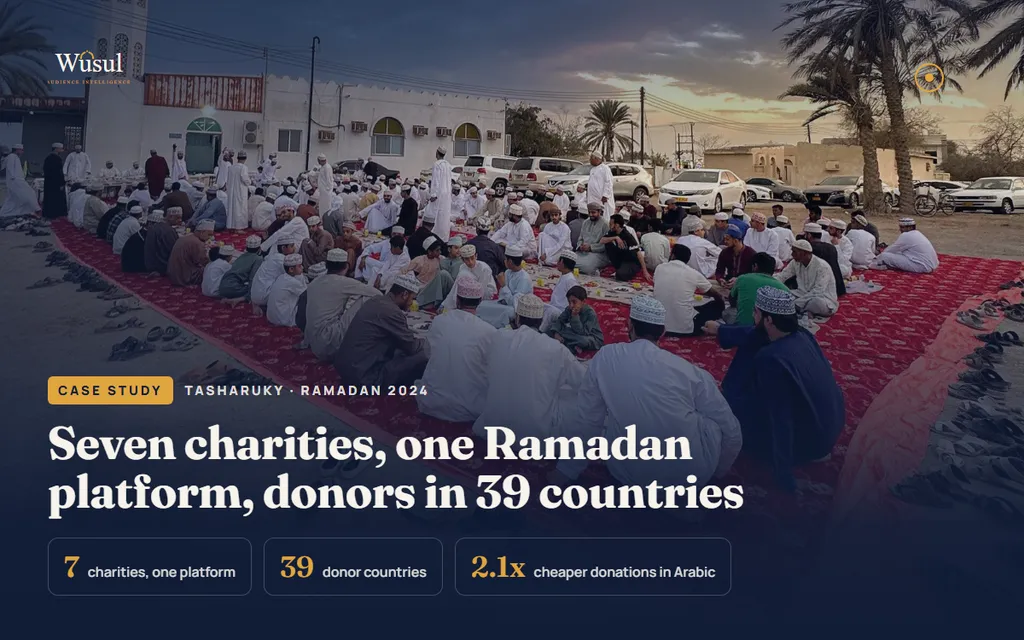
Most Ramadan campaigns sell one appeal for one charity. We brought seven charities together on one giving platform and sold all of their appeals at once, in two languages, to donors in 39 countries.
Tasharuky (تشاركي) is a digital platform for humanitarian giving. For Ramadan 2024, it hosted appeals from partner charities for Gaza, orphans, Sudan, waqf and copies of the Quran, alongside its own iftar, Zakat and sadaqah campaigns. Our team built and ran the paid digital campaign for the whole platform, from 8 March, just before the first fast, to Eid al-Fitr on 10 April: the campaign architecture, the media on five platforms, the Arabic and English ad sets, tracking and reporting.
Tasharuky · Ramadan 2024 · Results
Tasharuky Ramadan campaign report, 8 March to 10 April 2024. Cost per donation on Meta, Arabic against English ad sets.
The mandate: visibility and giving, for many causes at once
Tasharuky set two objectives: make the platform visible to donors across a diverse global audience, and turn that visibility into donations for every appeal on it. The challenge was structural. Seven charities, each with its own cause and its own story, had to be marketed side by side, and every one had to be measured on its own results.
AlamalGaza emergency appeal and Orphans appealGaza-Alamal Orphans-Alamal
GazzeDestekGaza emergency appealGaza-GazzeDestek
IhyaGaza emergency appealGaza-Ihya
Human-InitiativeRamadan appealHuman-Initiative
AjiaalMushaf (copies of the Quran) appealMushaf-Ajiaal
AnassarSudan appealSudan-Anassar
AlnnorWaqf (endowment) appealWaqf-Alnnor
Tasharuky’s own campaigns, alongside the charities
Campaign names from the Tasharuky Ramadan 2024 report. Alamal ran two appeals: Gaza and orphans.
We gave every appeal its own landing page and its own ad sets across the platforms, with Arabic and English versions, all under one naming system. In total we mapped 130 campaigns and more than 500 ads across five advertising platforms. That structure is what made a shared platform work: each charity got a campaign built for its cause, and Tasharuky got one view of the whole portfolio.
The architecture: five platforms, three jobs
Every platform had a defined role. Facebook and Instagram were the engine of reach, carrying 61% of the spend and most of the video. Twitter carried real-time updates as the Gaza crisis unfolded. Google Search met donors at the moment of intent. AdRoll and Snapchat were kept for retargeting, bringing back people who had already visited an appeal.
ReachVideo and feed ads at scale, real-time updates on the Gaza appeals, and a brand campaign for Tasharuky itself that delivered 46% of all impressions.Facebook · Instagram · Twitter (X) · 69% of spend
IntentArabic and English giving searches, from Gaza appeals to sadaqah jariyah, caught donors already looking for a way to give.Google Search · 22% of spend
ReturnRetargeting brought visitors back to the appeal they had seen. Snapchat added video for younger audiences.AdRoll · Snapchat · 9% of spend
arrived on a phone.
Platform spend shares from the report’s platform table. Device share from Google Analytics.
Above the appeals, a brand campaign built recognition for Tasharuky itself. It delivered 46% of all the campaign’s impressions.
Ad platforms, Google Analytics and the platform’s donation records, 8 March to 10 April 2024. Impressions and clicks are counted once across all five platforms.
The platform felt the lift. 41.8K people used Tasharuky’s website during the campaign, 4.1 times the previous period, with 57,739 sessions. Across the appeals, paid donations reached 1.27 times their advertising spend, and even with the brand campaign counted, donations covered every unit of advertising (1.03x).
The insight: Arabic first halved the cost of a donation
We ran the appeals in Arabic and in English, side by side, so the data could tell us which language moved donors. The answer was decisive. On Facebook and Instagram, the Arabic ad sets brought in a donation for less than half the cost of the English ones: English cost 2.1 times as much per donation.
Meta Ads, Arabic and English ad sets, from the campaign report. Donations are purchases recorded by the Meta pixel.
Arabic took 64% of the spend and delivered 79% of the donations. Arabic clicks were 1.8 times as likely to end in a gift. This is cultural intelligence in one chart: when a Ramadan appeal speaks to Arab donors in their own language, they do not just click, they give.
Search as audience intelligence
Search data told the same story from another angle. The Arabic giving keywords drew far stronger engagement than their English equivalents.التبرع لغزة(“donating to Gaza”) was clicked by 17.5% of the people who saw the ad, 3.3 times the rate of “donate to gaza”. Searches for sadaqah jariyah, ongoing charity, performed strongly in Arabic too.
Google Ads keyword report, Ramadan 2024. The number beside each keyword is its click-through rate.
The words donors type are a map of their intentions. Arabic searches for Gaza and for sadaqah jariyah came from people who had already decided to give and were choosing where. Those are the searches a giving platform must own.
Every charity appeal carried its weight
A shared platform only works if every partner gets results. Seven of the eight charity appeals raised more in paid donations than they cost in advertising. The three Gaza appeals, from Alamal, GazzeDestek and Ihya, brought in 69% of all paid donations.
Two appeals show the range of what worked. Waqf-Alnnor returned 1.62x from paid media alone, with no influencer support: an endowment cause, sold entirely through ads. GazzeDestek returned 1.99x by combining paid media with influencers, who brought 40% of its donations. Paid media alone returned 1.19x for that appeal, and the creators lifted it further.
A global congregation
The campaign reached well beyond any single market. Donations came from 39 countries. The Gulf gave the largest share, 39%, and Europe and North America together gave 39%, the diaspora answering the same appeals as donors in the Gulf.
The campaign report’s donations by country, grouped into regions.
The countries also gave in different ways. Among the top ten countries, France recorded the most transactions, 74, through many smaller gifts. Jordan gave through few transactions but the largest average gift in the top ten: its average donation was 3.4 times the average across the top ten countries. Knowing which markets give often and which give big is how the next Ramadan budget gets allocated.
The next lever: checkout
When we compared every donation donors attempted with every donation that completed, 7.0% of the attempted value had not gone through. The demand our campaign created was larger than the result shows. For any giving platform, the payment page is part of the fundraising strategy and deserves the same attention as the ads.
Brand signals: exposure, search and recognition
A giving platform is only as strong as its name: donors have to trust the platform before they trust the appeals on it. So we gave the Tasharuky brand its own campaign, with one goal, recognition, and no donation target at all.
Tasharuky Ramadan 2024 campaign report and Meta dashboard (impressions 12.1M, reach 4M). Google Trends via DataForSEO, Oman, web search, weekly, 2023 to 2024, pulled November 2026; search volume for the name is small. No controlled brand-lift study was run, so no brand-lift percentage is claimed.
Recognition is what makes the rest of the campaign cheaper. Every appeal on the platform, from Gaza to Sudan to an endowment, borrowed trust from the same name. Building that name once served all seven charities at the same time.
What we bring to every multi-charity Ramadan campaign
Planning Ramadan for a giving platform, or for several charities at once? Book a call and we will show you how we would build it for you.
About this case study: our team ran this campaign in Ramadan 2024, before Wusul was founded in 2026. Figures come from the campaign’s final report for 8 March to 10 April 2024 (ad platforms, Google Analytics and the platform’s donation records) and are shown as rates, shares and counts. Charity names are written as they appear in the report’s campaign names. Return on ad spend means paid donations tracked to the appeals, including those that came through influencers, divided by their advertising spend. Impressions and clicks are counted once across all five platforms. The previous period for website visitors is as reported by Google Analytics.