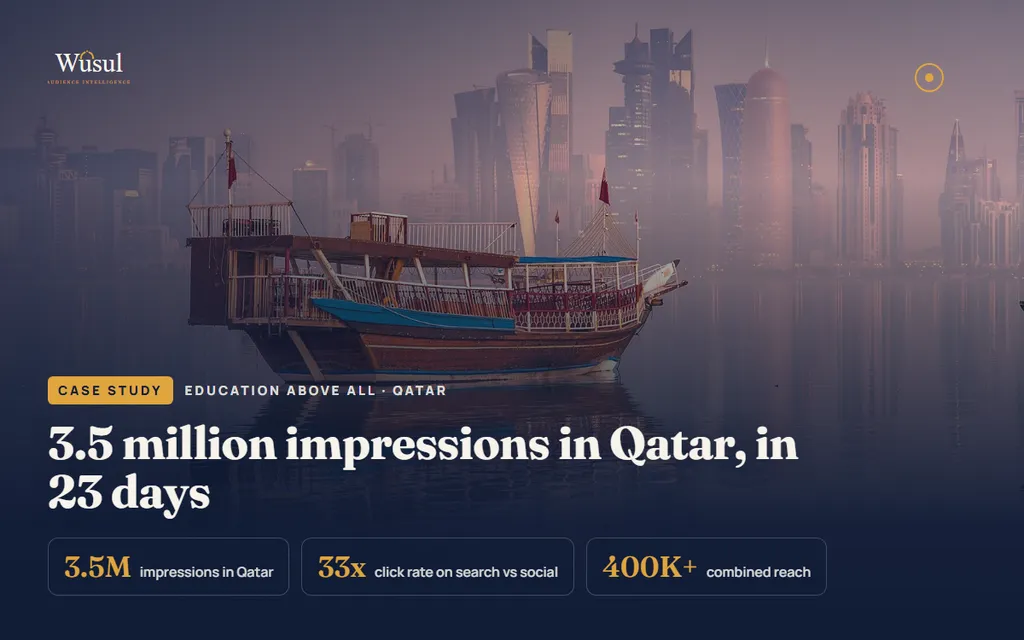
Education Above All Foundation asked our team to take its Be the Change campaign to the public in Qatar, in Arabic and English. In a small market, every impression has to earn its place. We made 3.46 million of them work in 23 days, and found out which ones mattered.
Education Above All Foundation, the Doha-based foundation working for access to learning for vulnerable and marginalised children and young people, asked our team to take its giving campaign to the public in Qatar, in Arabic and English, under its Be the Change campaign (كُن أنت التغيير) and the hashtag #donate2educate. We ran the paid digital campaign end to end: the platform set-up, the channel plan, the targeting, the testing and the final analysis.
In 24 days we stood up six advertising platforms. In the 23 days that followed, our ads were seen 3,459,162 times, built a combined reach of more than 400,000 across the social platforms and earned 6,785 clicks. And the campaign produced something more durable than any single result: a clear picture of how this audience searches, clicks and gives.
Education Above All · Qatar · Results
Final campaign report: platform data and website analytics. Reach adds up each platform’s own reported reach, so a person reached on two platforms counts twice.
The mandate: reach, awareness and an audience strategy
The campaign set out to win the attention of donors at home in Qatar, in both of the languages they live in. We agreed four objectives:
- Maximise reach among potential donors.
- Raise awareness of Education Above All Foundation.
- Build a data-driven audience strategy.
- Grow giving, online and offline.

Education Above All Foundation: six platforms in 24 days
Before a single ad could run, the campaign needed its digital foundations. Our team built them: new advertising accounts on Snapchat, Google Ads and AdRoll, restored access to Facebook advertising, tracking codes on the website and every ad size each platform required. 24 days after we started, the campaign launched on six platforms at once: Google search, Snapchat, Twitter, AdRoll, Facebook and Instagram.
- New ad accounts on Snapchat, Google Ads and AdRoll
- Access to Facebook advertising resolved
- Tracking codes and ad sizes set up
- Six platforms live at once
- Arabic and English audiences in Qatar
- 30+ ads across creative, targeting, keywords and audiences
- A/B tests to find the winners
- Every channel judged on what happened on the website
- A plan for the next campaign
Over the 23 days that followed we built and tested more than 30 ads, varying the creative, the targeting, the keywords and the audiences, with A/B tests to separate the winners from the rest.
Scale in a small market
Qatar is a small market, and that changes the job: the same people see a campaign again and again, so volume has to come from the platforms where they spend their time. We put the weight of the campaign on Snapchat and Twitter, and it delivered. Twitter carried 60% of all impressions. Snapchat drove half of all the clicks in the campaign.
Final campaign report, platform table. Shares computed from the report’s clicks and impressions.
Google search was the quiet outlier: 0.4% of the impressions, but 10.7% of the clicks, on 6.5% of the investment. That gap is where the most important finding of the campaign begins.
The strategic finding: intent beats volume
Our Google search ads earned a click-through rate of 5.83%. All the social and display ads together earned 0.18%. A person who is already searching is about 33 times as likely to click as a person scrolling a feed.
Final campaign report, platform table. Click-through rate is clicks divided by impressions.
Both have a job. Social builds the awareness that makes people search; search is there when they do. But they are not the same job, and they should never be judged by the same number.
Judge a channel by what happens after the click
A click is not engagement. We tracked visitors onto the EAA website and compared them by where they came from. People who arrived from our search ads stayed 5.5 times as long as people from Snapchat, a full minute against 11 seconds, and saw nearly twice as many pages. Visitors from Google’s organic results stayed longest of all, at 1:40.
Final campaign report, website analytics by source. Facebook and Instagram ran at a very small scale, so their rows rest on few visits.
Snapchat delivered the most clicks in the campaign and the shortest visits. That is not a reason to drop it; it is a reason to give it the right job. Snapchat and Twitter bought attention at scale. Search turned interest into time with the cause. A dashboard that counted clicks alone would have told the opposite story.
Arabic first, with a human face
Education Above All’s creative team supplied the ads; our job was to test them and find the ones that worked. Two clear winners came out of Be the Change, the creative line we kept running for much of the campaign and the one that drew the most interest. Each showed a smiling person holding a sign readingكُن أنت التغيير, Be the Change, over a photograph of children at their studies, with Arabic copy and a single “Donate” call to action.
Final campaign report, creative performance. The creatives were supplied by Education Above All.
The lesson travels well beyond one campaign: on the platforms where this audience spends its time, Arabic creative with a real, relatable person in it outperformed everything else.
The cultural insight: give education a religious reason
Our most valuable finding was not in a dashboard. Education is one of the most powerful causes there is, but for many donors in Qatar it is not the first cause that comes to mind. Sadaqah, building mosques and digging wells are familiar, trusted forms of giving with a clear religious meaning. Education has to earn its place beside them.
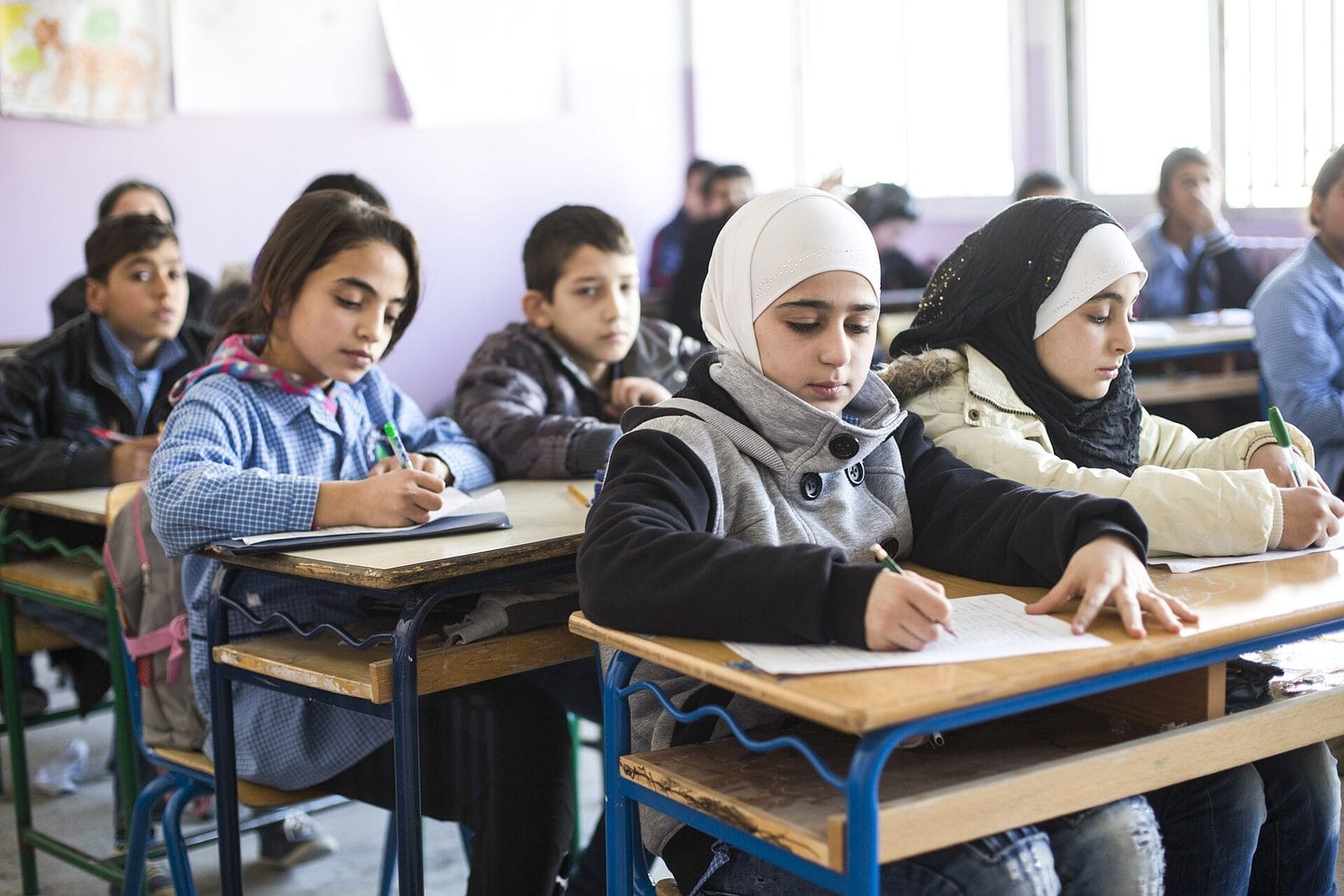
The answer is to give the gift a religious basis the donor recognises: educating orphaned children, and naming clearly which projects are eligible for zakat. This is cultural intelligence at its most practical. The cause stays the same; the reason to give changes, and with it the response.
Brand signals: exposure, attention and recognition
Raising awareness of Education Above All was one of the four objectives, so we tracked the brand as closely as the clicks. Exposure was deliberate: frequent enough on the big social platforms for the name to stick, while search caught the people who were already looking.
Education Above All campaign report. The report gives no year, so search interest for the name cannot be matched to the campaign weeks on Google Trends and no search lift is claimed. No controlled brand-lift study was run, so no brand-lift percentage is claimed.
That is the sequence a new donor brand needs: be seen often enough to be remembered, earn real attention with a human face, then be there when people search. The report’s own recommendation follows from it: run branded search all year, so the attention built in a campaign is never left without an answer.
The playbook we left behind
We closed the campaign with a full report and a plan for the next one, built on what the data and the audience had shown us.
These principles now sit at the heart of how we work with every charity that raises money from Muslim donors: put money behind intent, judge every channel on what happens after the click, lead in the audience’s language, and give every appeal a reason to give that the donor’s faith already recognises.
Raising money for education, or any cause that has to compete with sadaqah, mosques and wells? Book a call and we will show you how we would build the campaign for your donors.
About this case study: our team ran this paid digital campaign for Education Above All Foundation in Qatar, before Wusul was founded in 2026. Figures come from the campaign’s final report (platform data and website analytics) and are shown as rates, shares and counts. Reach adds up each platform’s own reported reach, so a person reached on two platforms counts twice. The report does not include donation figures, so this case study makes no claim about money raised. The ad creative was supplied by Education Above All.