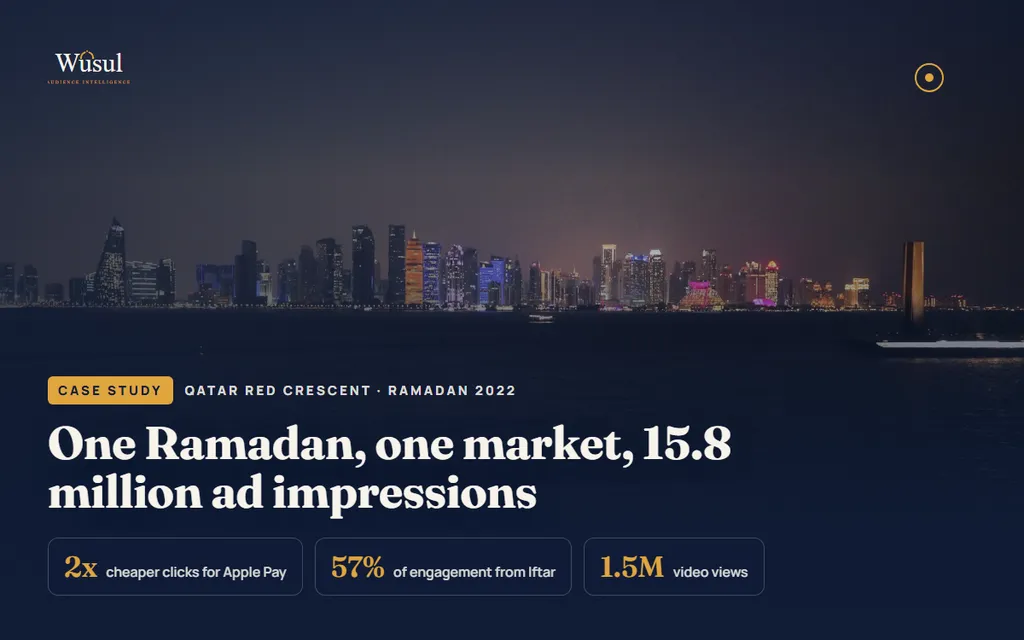
In a single Ramadan, in one small market, our team put Qatar Red Crescent’s appeal in front of donors 15.8 million times. The reach was the headline. The insight was what the data told us about how Qatar gives.
For Ramadan 1443, in spring 2022, Qatar Red Crescent Society took its Ramadan appeal online under one promise:بعطائكم.. يتواصل الخير, “with your giving, goodness continues”. Our team planned and ran the online advertising end to end: the tracking, the plan, the audiences, the optimisation, the daily dashboard and the final report. The campaign ran inside Qatar only, in Arabic only, across ten advertising platforms and channels.
Qatar Red Crescent · Ramadan 1443 / 2022 · Results
Qatar Red Crescent Society online advertising report, Ramadan 1443 (2022). Totals across every campaign and platform.
The mandate: build the machine, not just the campaign
Qatar Red Crescent set six objectives for the season. Half of them were about the future: grow the charity’s audience data, restructure its advertising platforms, and share best practice with its team so that every campaign after Ramadan would start stronger. The other half were about reach: widen targeting to new segments, expand across every major online platform, and introduce more of Qatar to the charity’s projects.
That brief shaped everything we did. We treated Ramadan not as a burst of ads but as the moment to build the charity’s digital fundraising infrastructure, and to prove it under the heaviest load of the year.
Infrastructure first: a charity’s ad stack, rebuilt in one season
Before a single ad went live, we installed and coordinated tracking codes on Facebook and Instagram, Twitter, Snapchat and Google Ads, and reorganised Google Analytics so every visit could be followed, targeted and measured. We built one plan for the whole campaign: technical requirements and ad sizes, budget and duration for every campaign, content, and a priority for each campaign ranked by its expected return.
We gave every campaign on every platform one naming convention, Ramadan2022_Iftar_Search_AR_Visits: season, cause, placement, language, objective. It sounds like housekeeping. It is what makes 50 campaigns across 10 platforms readable on one screen, comparable cause by cause, and reusable the next year.
- Tracking codes on Facebook and Instagram, Twitter, Snapchat and Google Ads
- Google Analytics reorganised
- One plan for sizes, budgets, content and priorities
- Every platform live, audiences set inside Qatar
- Targeting by interests, behaviour and first-party data
- Spend and frequency balanced across platforms and time of day
- Visitors who had not given, found again on five platforms
- Bidding adjusted to the right audience
- One live dashboard on every platform’s data
- Decisions made from the numbers, daily
At launch, every audience was set inside Qatar and built from three layers: interests, behaviour, and the first-party data our tracking captured on the charity’s own website. The sharpest signals were intent: people searching Google for sadaqah and zakat, and people watching YouTube videos about giving, Ramadan and zakat. Visitors who came to the website and did not give were found again on five platforms and retargeted with video, image and text ads coordinated across them.
ProspectingNew audiences inside Qatar, built from interests and behaviour.
IntentPeople searching Google for sadaqah, zakat and related words, or watching YouTube videos about giving, Ramadan and zakat.
Branded searchPeople already looking for Qatar Red Crescent by name.
RemarketingWebsite visitors who had not yet donated, found again across social platforms and through AdRoll.
Campaign plan and report. Channels included Google Search, Display and YouTube, Facebook, Instagram, Snapchat, Twitter, AdRoll and Apple Search Ads.
Speaking the donor’s language
Every ad was written in Arabic, and every appeal had its own call to action, in the language of giving that donors already use. The zakat creative promised that zakat would reach those entitled to it through its sharia channels, and the ads carried the licence line of Qatar’s Regulatory Authority for Charitable Activities. In a month when every charity is asking, trust is the deciding detail.
Campaign plan, Ramadan 2022. All creative was in Arabic.
Insight one: the payment method was the message
One campaign did not ask for a cause at all. It told donors they could give through Apple Pay. On 12.9% of the budget it drew 26.4% of every click in the campaign, 46,196 clicks, more than any other campaign, Iftar and Zakat included.
The budget
- Apple Pay campaign’s share
- 12.9%
Every click
- Apple Pay campaign’s share
- 26.4%
46,196 of 175,108 clicks. Click-through rate 2.05%, against 1.11% for the whole campaign.
Measured against the budget, the Apple Pay campaign earned its clicks at twice the efficiency of the campaign average, and it was clicked at almost twice the average rate. Iftar came next, at 1.5x.
Shares computed from the report’s results by campaign; smaller single-cause appeals are not shown. Platforms count clicks slightly differently, so read the ranking as directional.
The lesson is bigger than one wallet. Donors in Ramadan have already decided to give. What holds them back is friction: a long form, a card to find, a page that does not load. Telling them that giving takes one tap removed the last reason to wait. For any charity, the payment experience is not back office. It is a message, and it can be the strongest one you have.
Insight two: Iftar is Ramadan’s attention engine
Iftar for the fasting delivered the most attention of any cause: 28% of all impressions and 57% of all engagement on the ads, on just 16% of the budget. No cause bought its audience more cheaply.
73,654 of 129,294 engagements. The report records no engagement for the Apple Pay and Palestine campaigns.
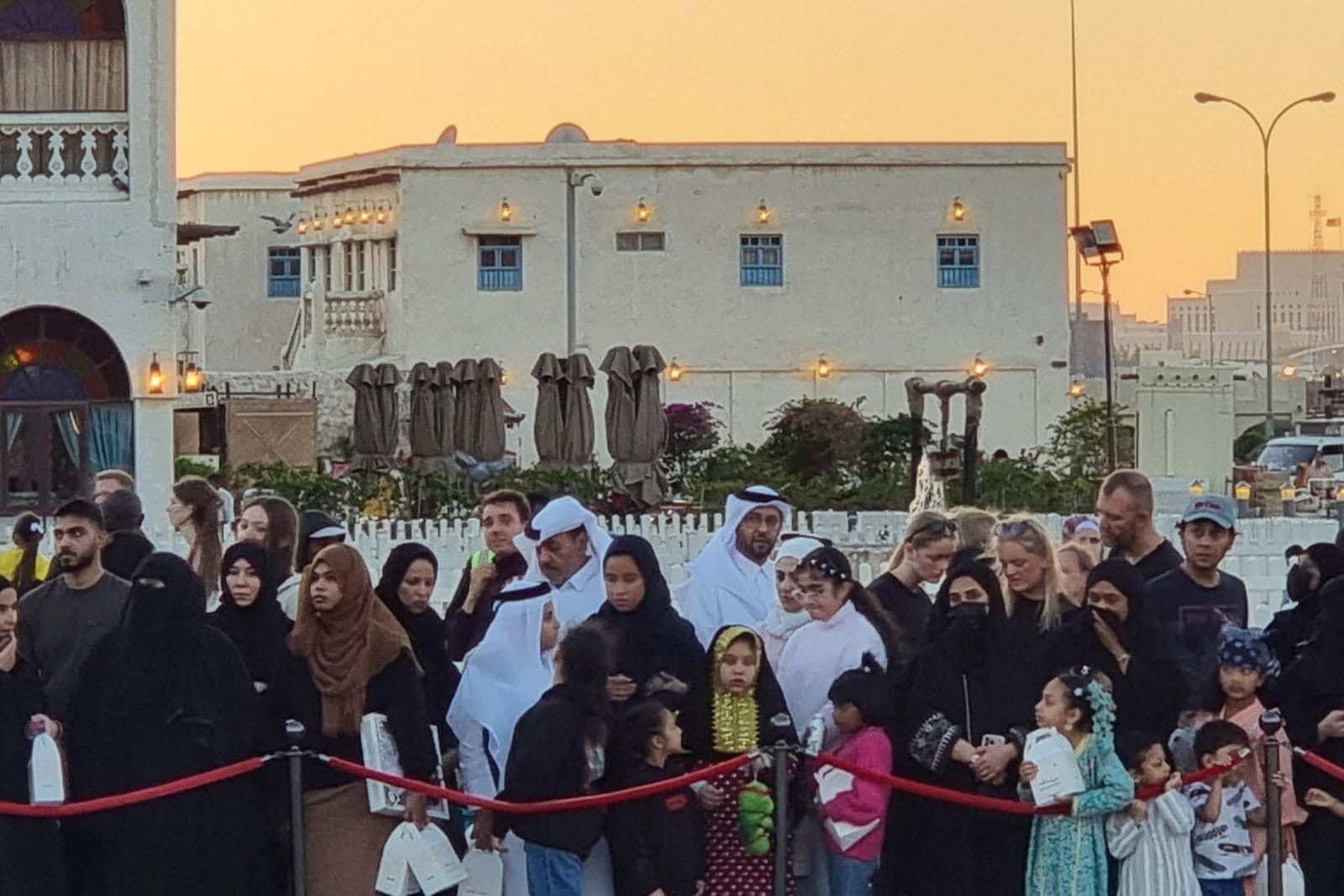
This is cultural intelligence in its simplest form. Iftar is the moment the whole community shares every evening of the month. An appeal built around it does not need to explain itself; the donor is already living it. Generic asks compete for attention. A culturally native cause already has it.
Insight three: one brand, ten causes, ten different economics
Running ten causes side by side under one brand, in one market, in one month, gave us a rare clean comparison. The causes donors can picture, a meal, a well, a home, drew the most engagement for every impression. Iftar and water each drew more than four times the engagement per impression of zakat.
Computed from the report’s results by campaign. Apple Pay and Palestine are left out because the report records no engagement for them.
Our reading: zakat is an obligation that donors calculate and plan, so they do not react to it in a feed the way they react to a child at an iftar table. Zakat and sadaqah together took about a third of the budget and brought about a quarter of the clicks. Obligatory and planned giving needs to be met where the decision is made, in search and on the page, all year round. Spontaneous giving responds to emotion and the moment. One budget rule for both leaves results on the table.
Video at scale
The ads were watched 1,513,793 times, about one video view for every ten impressions. The medical treatment and economic empowerment videos were the most efficient, earning 2.2 times the campaign’s average video views for their budget. Our recommendation for the next season was to go further, with vertical video made for the phone.
Every platform on one screen, every day
We connected every platform’s data to a single Google Data Studio dashboard, now Looker Studio. Impressions, reach, clicks, video views, website users and cost were visible daily, platform by platform and campaign by campaign. Every optimisation, from rebalancing spend and frequency across platforms and times of day to adjusting bids, was made from that screen.
From campaign to roadmap
We closed the season with a method, not just a report. The Donor Journey Map is the framework our team uses to manage a charity’s digital fundraising as one process: every stage from first impression to advocacy has its own tools and its own measure, and the work does not end at the donation.
Donor Journey Map, from the recommendations section of the campaign report.
With it came a roadmap for the year ahead:
- Always-on search for the main campaigns, not only in Ramadan.
- Vertical video and the newest ad formats on every platform.
- Premium placements on Qatar’s most visited websites, bought programmatically, alongside influencers.
- Email and WhatsApp automation along the donor journey.
- Faster, simpler donation pages for the phone.
- Start earlier, so the audience is warm before the first night of Ramadan.
Brand signals: exposure, attention and recognition
In Qatar, Qatar Red Crescent is already a household name. Google Trends shows no week-level change in searches for it during Ramadan 2022, so we claim no search lift. The brand job was different: to be seen, often and everywhere, at the moment the whole country decides where its Ramadan giving goes, and to hold attention long enough to be remembered.
Qatar Red Crescent online advertising report, Ramadan 1443. Google Trends via DataForSEO, Qatar, web search, weekly, 2020 to 2023, pulled November 2026. No controlled brand-lift study was run, so no brand-lift percentage is claimed.
Repetition builds memory. Each person reached saw Qatar Red Crescent’s Ramadan message at least 6 times, across ten channels, in one month. For a charity competing for the same Ramadan giving as every other organisation in the country, that is how a known name stays the first name people think of.
What this means for your Ramadan campaign
Every charity has a Ramadan plan. Few have the data to know which part of it is working. These are the principles we bring to every Ramadan campaign we build.
Planning Ramadan, Zakat or Qurbani for Muslim donors? Book a call and we will show you how we would build it for you.
About this case study: our team ran this campaign for Qatar Red Crescent Society in Ramadan 2022, before Wusul was founded in 2026. Figures come from the campaign’s advertising report and cover advertising inside Qatar only. Results are shown as rates, shares and counts. The report measures media results (impressions, video views, clicks and engagement) and does not report donations, so this case study makes no claim about money raised.