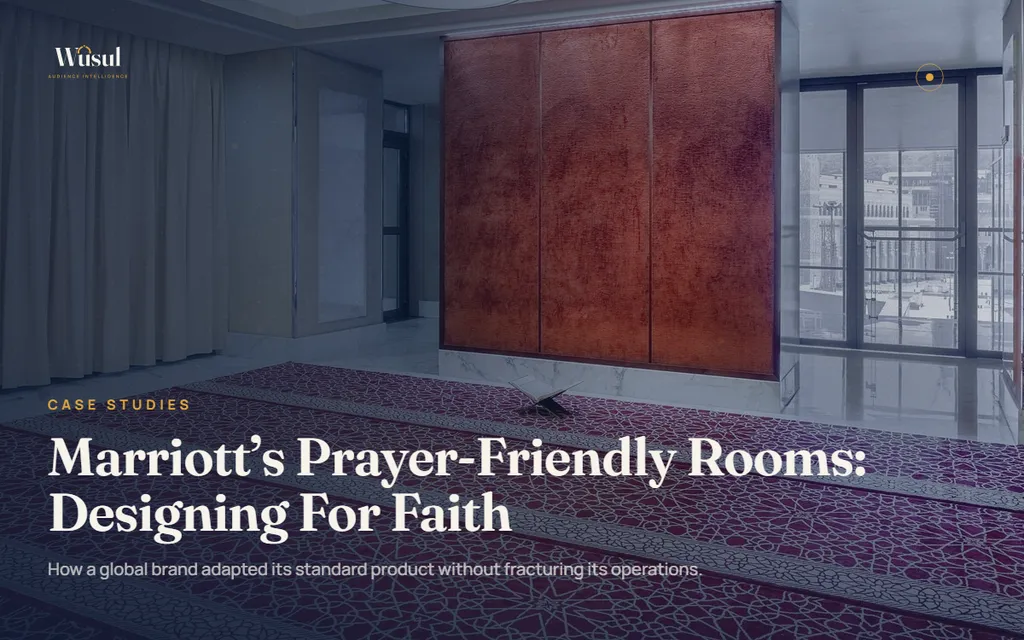
In the global hospitality industry, the standard room is a remarkably consistent product. A bed, a desk, a television, a bathroom. The variables are usually limited to view, size, and thread count.
But for a Muslim traveler, the standard room has a gap. The bed faces a direction that may not be Mecca. There is no prayer mat. The bathroom may lack the fixtures required for wudu. The Quran is absent. And the call to prayer, which structures the day for millions of guests, is an external reality the hotel has no way of acknowledging.
Marriott International (the world's largest hotel chain, with over 9,000 properties across 140 countries) has been quietly closing that gap. Through a combination of in-room amenities, third-party accreditation, and localized adaptations, the company has built a model for how a global brand can serve faith-conscious travelers without fracturing its standard operating procedures.
This is the story of how Marriott's prayer-friendly rooms became a case study in operational cultural intelligence.
The baseline: what "prayer-friendly" actually means
The phrase "prayer-friendly" sounds vague. In practice, it refers to a specific set of operational commitments that a hotel makes to ensure Muslim guests can observe their religious obligations without friction.
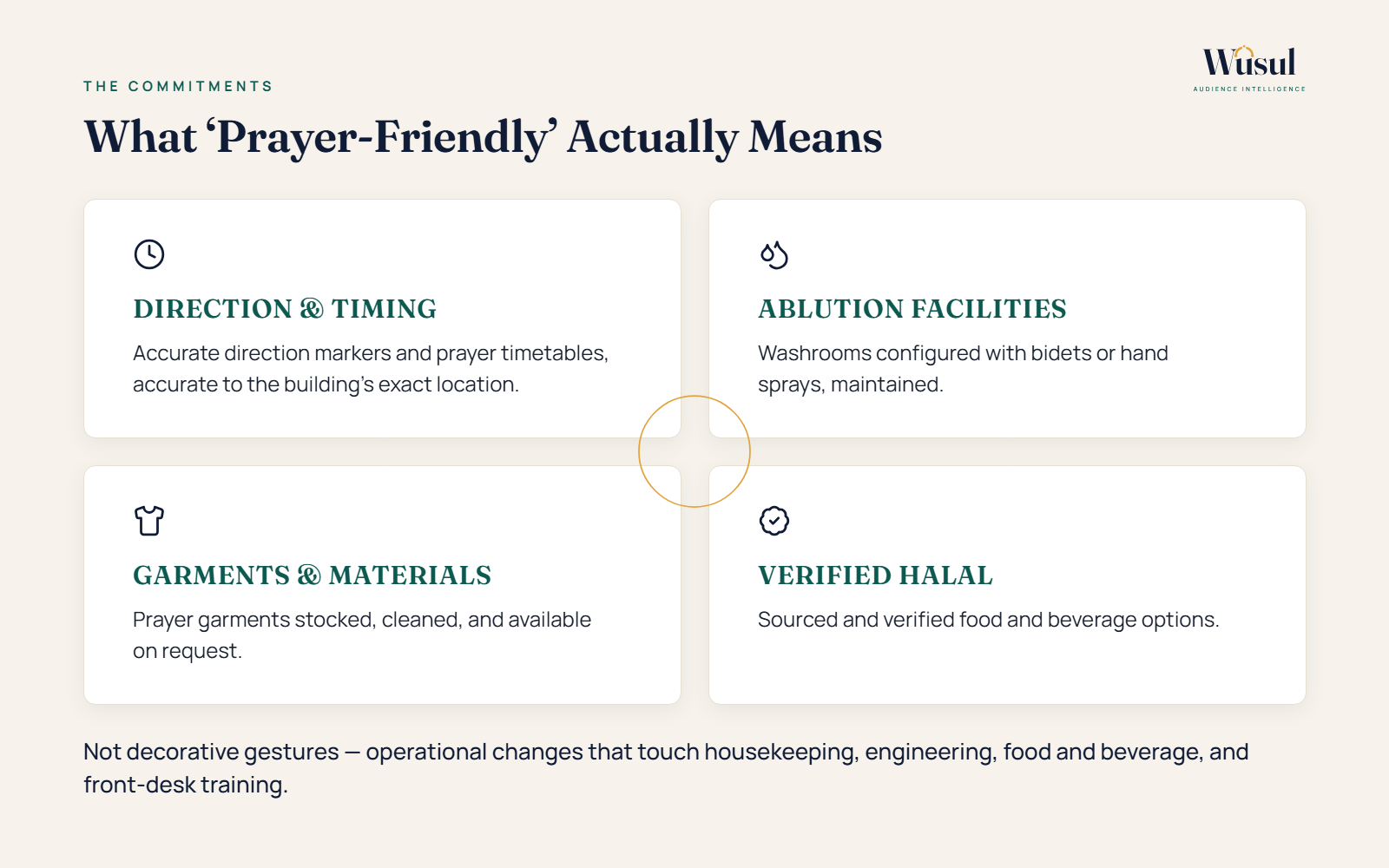
The CrescentRating accreditation system (the global standard for Muslim-friendly hospitality) defines the core requirements. A property seeking accreditation must provide accurate Qibla direction markers in guest rooms, either analog or digital prayer timetables, and prayer garments available on request. It must configure bathrooms to include bidets or hand sprays, which are foundational for wudu (ablution) before prayer. And it must offer verified Halal food and beverage options within the hotel.
These are not decorative gestures. They are operational changes that touch housekeeping, engineering, food and beverage, and front desk training. A prayer mat must be stocked and cleaned. A Qibla marker must be accurate for the specific location of the building. A bidet must be installed and maintained. A Halal menu must be sourced and verified.
Marriott's approach has been to implement these requirements at the property level, adapting them to local market conditions, while using third-party accreditation to signal compliance to travelers.
Three tiers of implementation
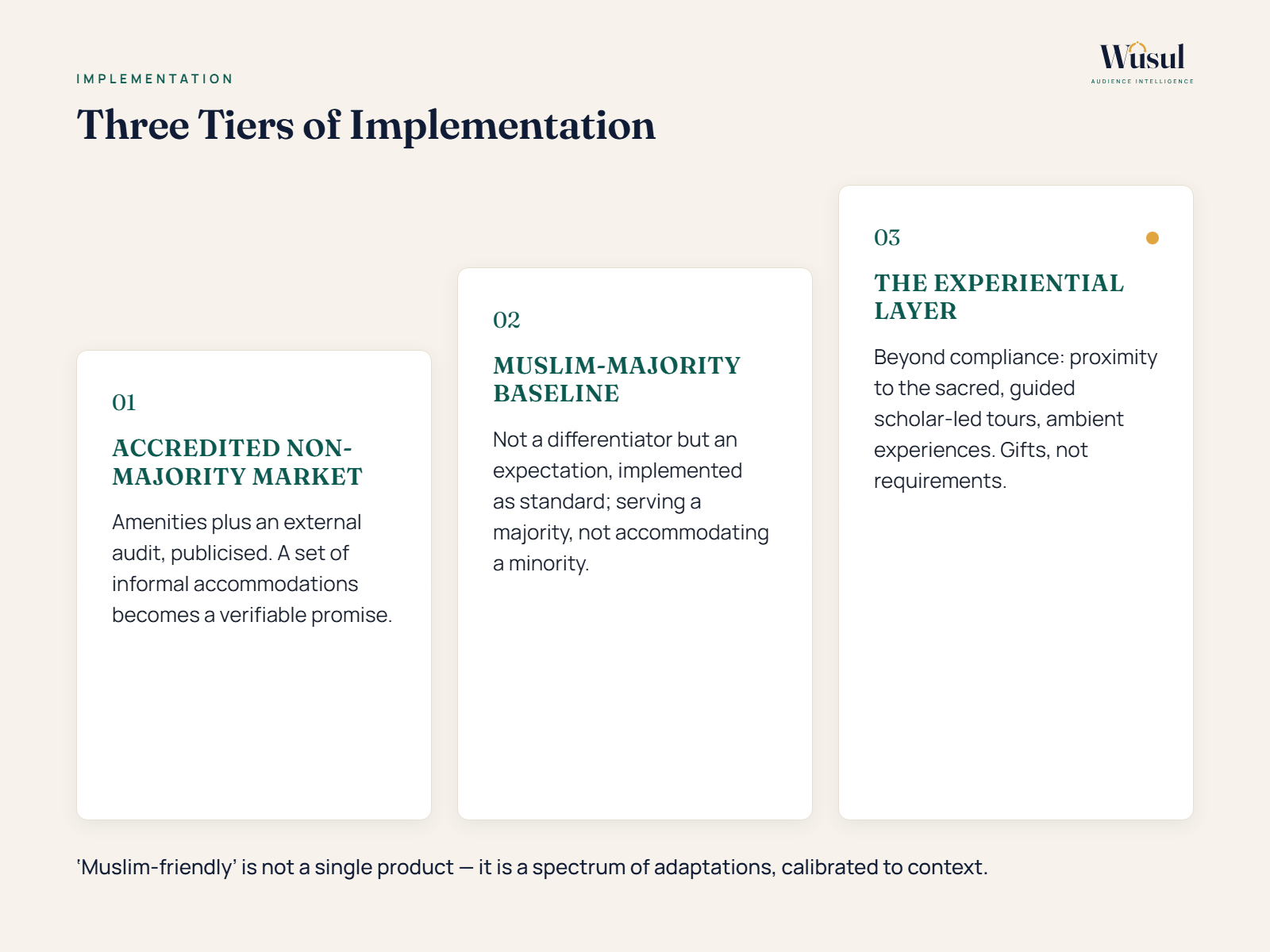
Marriott's prayer-friendly rooms are not a single product. They are a spectrum of adaptations, shaped by the market in which each property operates.
Tier one: the accredited non-OIC property
The clearest example of Marriott's model for non-Muslim-majority markets is the Aloft by Marriott Singapore Novena, which formalized a strategic partnership with CrescentRating in June 2026 .
The property achieved Crescent Rated 3 status, meaning it met a verified standard across the traveler lifecycle. The operational commitments are specific: in-room Qibla direction markers and prayer timetables, prayer garments available, water-friendly washroom facilities including bidets, and verified Halal options at the hotel's restaurant, 21 on Rajah .
What makes the Singapore property notable is not the amenities themselves, many hotels offer prayer mats on request. It is the accreditation. The hotel chose to submit to an external audit and to publicize the result. That choice transforms a set of informal accommodations into a verifiable promise.
For a Muslim traveler choosing between two hotels in Singapore, one with a prayer mat on request and one with a Crescent Rating, the second offers something the first cannot: a guarantee that the prayer mat exists, that the Qibla direction has been checked, and that the bidet has been installed.
Tier two: the Muslim-majority market standard
In Muslim-majority countries, prayer-friendly amenities are not a differentiator. They are a baseline expectation. Marriott's properties in these markets implement them as standard practice.
The Four Points by Sheraton Makkah Ibrahim Al Khalil, for example, lists "Prayer friendly environment, In-room prayer mat & Holy Quran" as a core room feature, alongside Wi-Fi and a safe . The Foshan Marriott Hotel in Guangdong, China (a non-OIC market but with a significant Muslim population) offers designated rooms equipped with the Holy Quran, prayer mats, and Qibla direction indicators, alongside a Muslim-friendly dining area with strictly segregated sections and no pork products.
The Sheraton Hong Kong Hotel & Towers holds CrescentRating Level 3 accreditation and provides in-room prayer amenities including a Quran and prayer mat upon request, with Qibla direction provided in all guest rooms. The nearest mosque is 0.5 km away.
In these markets, the prayer-friendly room is not a marketing initiative. It is a reflection of the guest demographic. The hotel is not accommodating a minority; it is serving a majority.
Tier three: the experiential layer
Beyond the functional requirements, some Marriott properties have added an experiential dimension that goes beyond compliance.
The Riyadh Marriott Hotel offers "Eid View Rooms" with unobstructed panoramic views of Masjid Alhamra, featuring ambient soundscapes that simulate dawn adhan chants and complimentary early-morning prayer time alerts . The hotel also organizes guided evening tours of nearby mosques led by local scholars, with discussions on Islamic architecture and traditional carpet artistry .
The Jabal Omar Marriott Hotel in Makkah, located a two-to-three minute walk from Masjid al-Haram, includes a private prayer room on the third floor overlooking the Haram, with connected speakers that allow guests to hear the Haram prayers .
These are not baseline amenities. They are differentiators that signal a deeper understanding of the guest's spiritual journey. They transform a hotel stay from a transaction into an experience of proximity to the sacred.
Operational challenge: standardization without flattening
Marriott's scale is its advantage and its challenge. A brand with 9,000 properties cannot impose a single operational standard for prayer-friendly rooms across every market. The requirements vary too widely.
In Makkah, a prayer mat is expected. In Singapore, it is an amenity that signals inclusion. In Foshan, it is a gesture toward a growing Muslim customer base. In a Marriott property in a market with no significant Muslim population, it may be unnecessary.
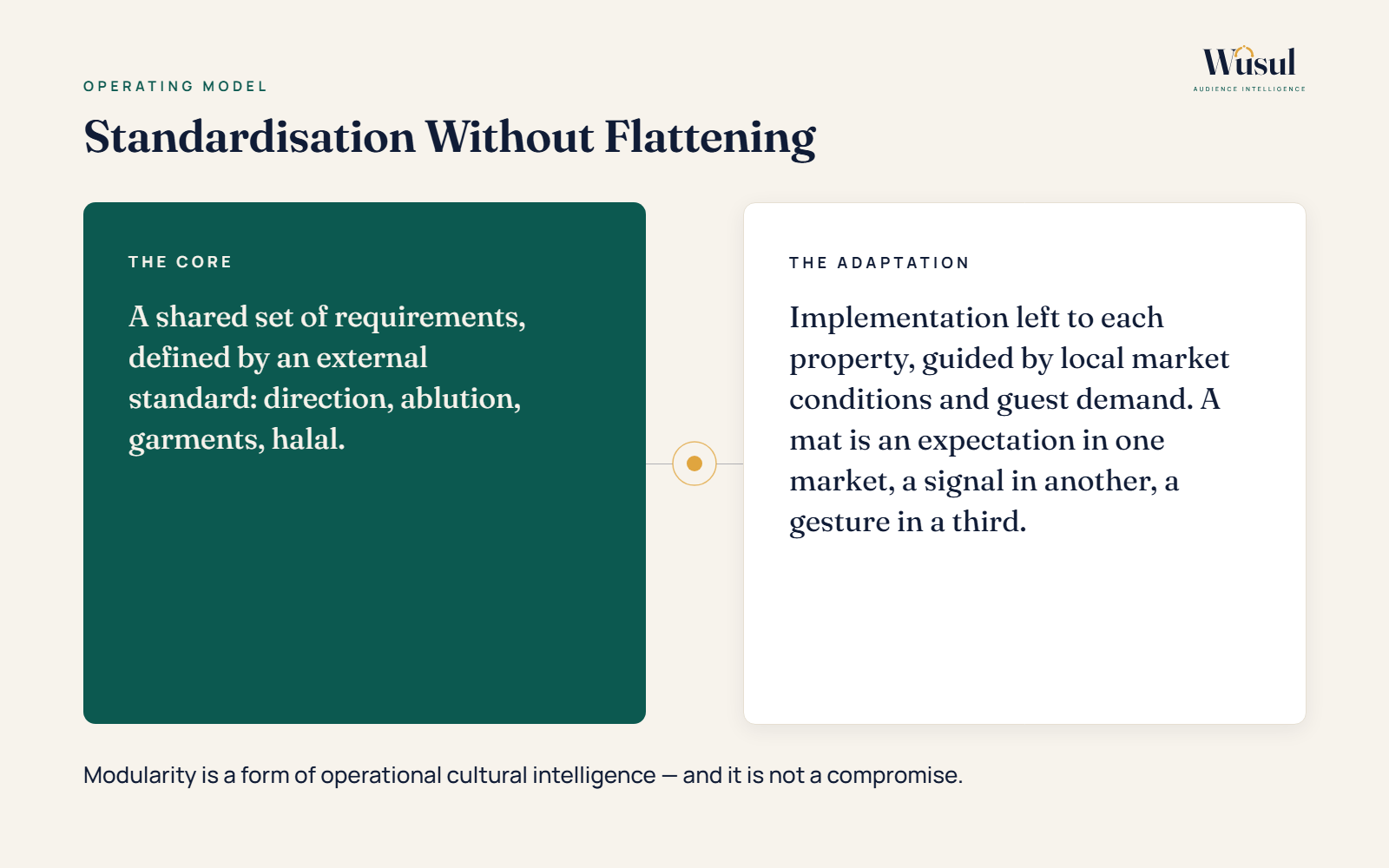
The solution Marriott has adopted is modularity. The core requirements (Qibla direction, prayer mat, bidet, Halal options) are defined by CrescentRating's standards, but implementation is left to the property, guided by local market conditions and guest demand.
This is a form of operational cultural intelligence. It recognizes that "Muslim-friendly" is not a single product. It is a spectrum of adaptations, calibrated to context. A hotel in Singapore that achieves Crescent Rating 3 is not the same as a hotel in Makkah that offers a Haram-view prayer room. Both are serving Muslim guests. But they are serving different needs, in different contexts, with different expectations.
The critique: what Marriott still Gets wrong
Despite its progress, Marriott's approach has gaps.
The inconsistency problem. Prayer-friendly amenities are not guaranteed across the brand. A guest who stays at a Crescent-rated Marriott property in Singapore may arrive at another Marriott property in the same city and find that the prayer mat is "on request" but unavailable, or that the Qibla direction is not marked. The accreditation applies to the property, not the brand. For a traveler, this means that Marriott's promise is only as reliable as the specific hotel they choose.
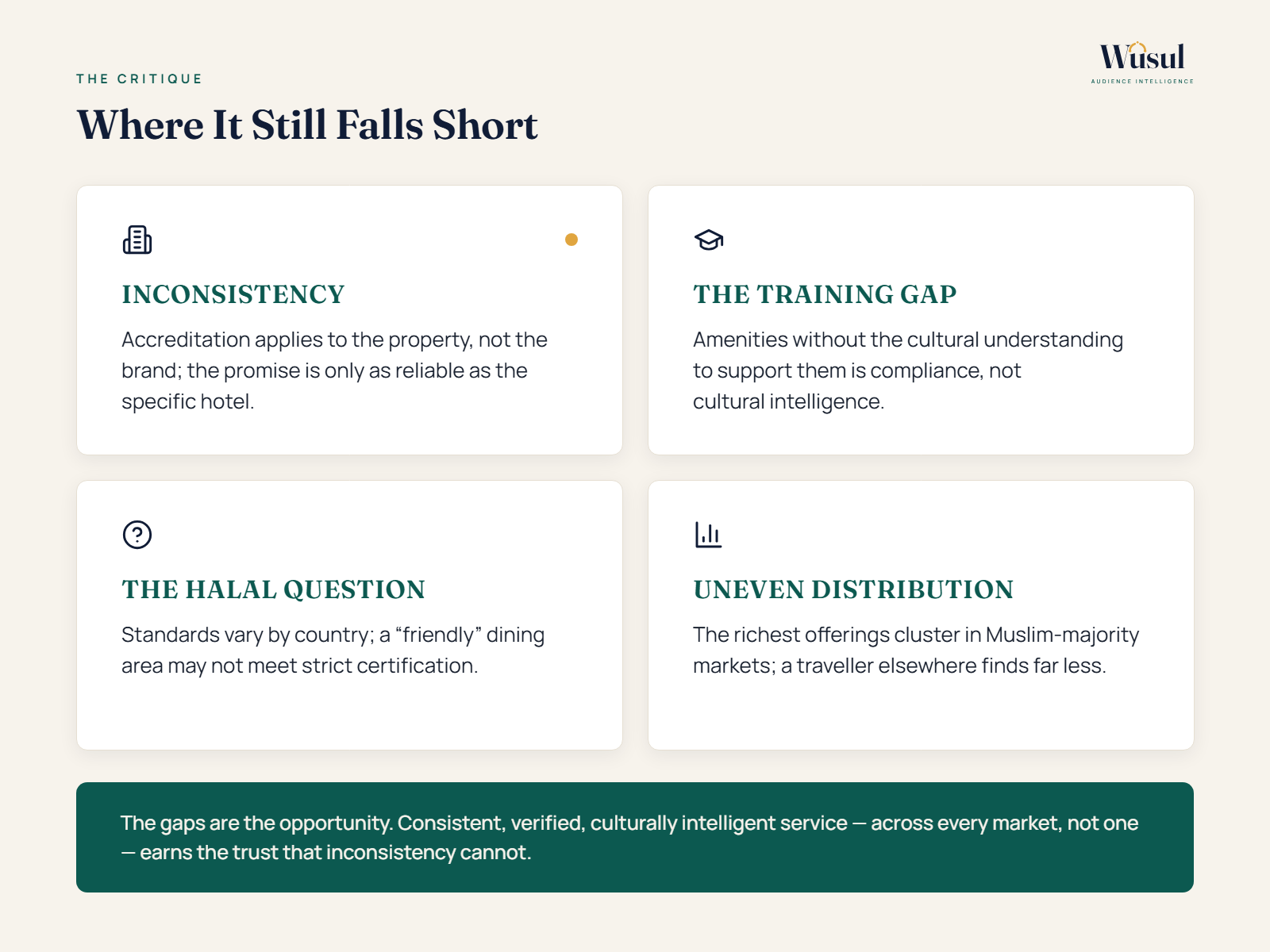
The training gap. A prayer mat in a closet is not the same as a staff trained to ensure it is clean, placed correctly, and replenished. The CrescentRating standard includes "Staff trained on Muslim guest requirements" , but the quality of that training varies. A hotel that provides the amenities without the cultural understanding to support them is performing compliance, not cultural intelligence.
The Halal question. Halal food certification is complex, and standards vary by country. A hotel that offers a "Muslim-friendly dining area" may not meet the requirements of a guest who observes strict Halal certification. Marriott's properties in Muslim-majority markets generally handle this well. In non-OIC markets, the standard is less consistent.
The experiential imbalance. The most sophisticated prayer-friendly offerings (the Haram-view rooms, the adhan soundscapes) are concentrated in Muslim-majority markets. A Muslim traveler in London or New York is unlikely to find a Marriott property that offers the same depth of experience. The brand's cultural intelligence is unevenly distributed.
What to learn from Marriot’s experience
Marriott's model offers several lessons for organizations seeking to serve Muslim audiences.
1. Accreditation builds trust. A prayer mat on request is a gesture. A Crescent Rating is a promise. The difference is verification. Organizations that submit to external audit and publicize the result offer something that self-declaration cannot: confidence. For Islamic charities, this translates to Shariah compliance certification, financial audits, and transparent reporting. The principle is the same: third-party verification builds trust that self-assertion cannot.
2. Modularity is not a compromise. Marriott did not impose a single standard across its global portfolio. It defined a core set of requirements and adapted implementation to local contexts. Charities operating across markets should do the same. A Ramadan campaign in London is not the same as a Ramadan campaign in Jakarta. The principles may be shared; the execution must be local.
3. The baseline is not the differentiator. In Muslim-majority markets, prayer-friendly amenities are expected. In non-OIC markets, they are a signal. Organizations should understand where their audience sits on this spectrum. A charity serving a majority-Muslim community does not need to "prove" its Islamic credentials in the same way as a charity serving a diaspora community in a non-Muslim context.
4. Experiential layers matter. The most memorable Marriott experiences are not the prayer mats. They are the Haram-view rooms, the adhan soundscapes, the scholar-led mosque tours. These are not requirements. They are gifts. For charities, the lesson is that the most powerful engagement goes beyond compliance. It creates moments of connection that the donor or beneficiary will remember.
5. The gaps are the opportunity. Marriott's inconsistency is its weakness. A brand that could guarantee prayer-friendly amenities across every property would own the Muslim travel market. For charities, the opportunity is in the gaps that larger institutions leave. The organizations that can provide consistent, verified, culturally intelligent service (not just in one market, but across the communities they serve) will earn the trust that inconsistency cannot.
The room as a statement
A hotel room is not a neutral space. It is a designed environment that either accommodates the guest's needs or ignores them. For decades, the standard hotel room ignored the needs of Muslim travelers. The Qibla was unmarked. The prayer mat was absent. The bidet was a luxury, not a standard.
Marriott's prayer-friendly rooms are a correction. They are an acknowledgment that the guest who checks in is not a generic consumer. They are a statement that faith is not a private matter to be left at the door.
The company's approach is not perfect. It is inconsistent, unevenly distributed, and sometimes more performative than substantive. But it is a model. It shows that a global brand can adapt its standard product to serve a specific community without abandoning its operational discipline. It shows that cultural intelligence can be modular, scalable, and commercially viable.
For organizations serving Muslim communities, the lesson is not about hotel rooms. It is about the principle. The spaces we design (whether physical, digital, or experiential) either say "we see you" or "we don't." Marriott has chosen to say "we see you," at least in some of its properties, some of the time.
The challenge for the rest of us is to say it consistently, everywhere, and mean it.
At Wusul, we believe that cultural intelligence means understanding not just what an audience needs, but how the spaces and systems we design either honour or ignore those needs. Marriott's prayer-friendly rooms are a case study in what happens when a global brand decides that faith is not a niche concern. The lesson is not about hospitality. It is about respect.
Frequently asked questions
What is a prayer-friendly hotel room?
A prayer-friendly hotel room is a space designed to help Muslim guests observe religious obligations without friction. These rooms typically feature Qibla direction markers, prayer mats, prayer timetables, and prayer garments. Additionally, the bathrooms are configured with bidets or hand sprays to facilitate wudu, and the rooms may include a copy of the Quran.
Why do hotels need crescentrating?
Hotels seek CrescentRating accreditation to provide a verifiable promise to travelers that their facilities meet specific standards for Muslim-friendly hospitality. This external audit confirms that the hotel has accurately implemented requirements like Qibla direction markers, wudu-friendly washrooms, and verified Halal food options, allowing guests to choose accommodations with confidence in the services provided.
How do hotels accommodate Muslim travelers?
Hotels accommodate Muslim travelers by implementing operational changes across housekeeping, engineering, and food services. This includes providing in-room prayer mats, Qibla markers, and prayer timetables, as well as installing bidets for wudu. Some properties also offer verified Halal dining options, prayer garments upon request, and specialized experiential features like prayer room access or proximity to mosques.