In the crowded inbox of Ramadan, most charity emails blur into one. Donors receive a constant stream of appeals from multiple organizations, often multiple times a day, and the standard template; a logo, a generic story, a donation button, struggles to stand out. For Muslim Charity, a UK-registered organization with around £7.5 million in annual income and roughly 25 staff, the challenge was acute: how do you make a donor feel seen when every other charity is shouting at them at the same time?
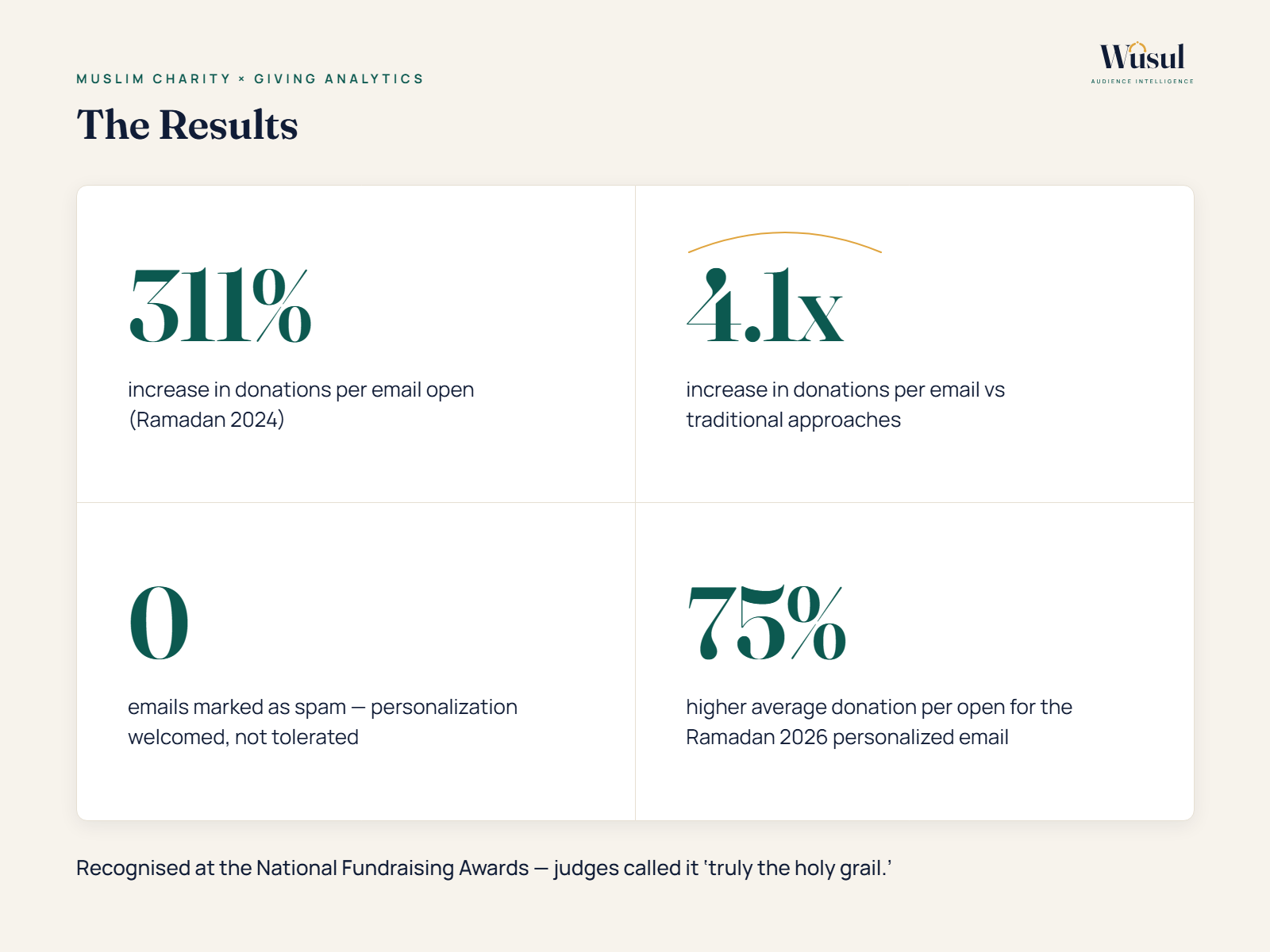
The answer, developed in partnership with data-led fundraising specialists Giving Analytics, was to stop talking about the charity and start talking about the donor. The result was a campaign that achieved a 311% increase in donations per email open and a 4.1x increase in donations per email compared with traditional marketing approaches; numbers that would go on to win national recognition and set a new benchmark for faith-based fundraising in the UK.
The problem: personalization at Muslim Charity stuck at first name
For most charities, personalization still means inserting a donor's first name at the top of an otherwise identical message. That is not personalization in any meaningful sense, and donors see straight through it.
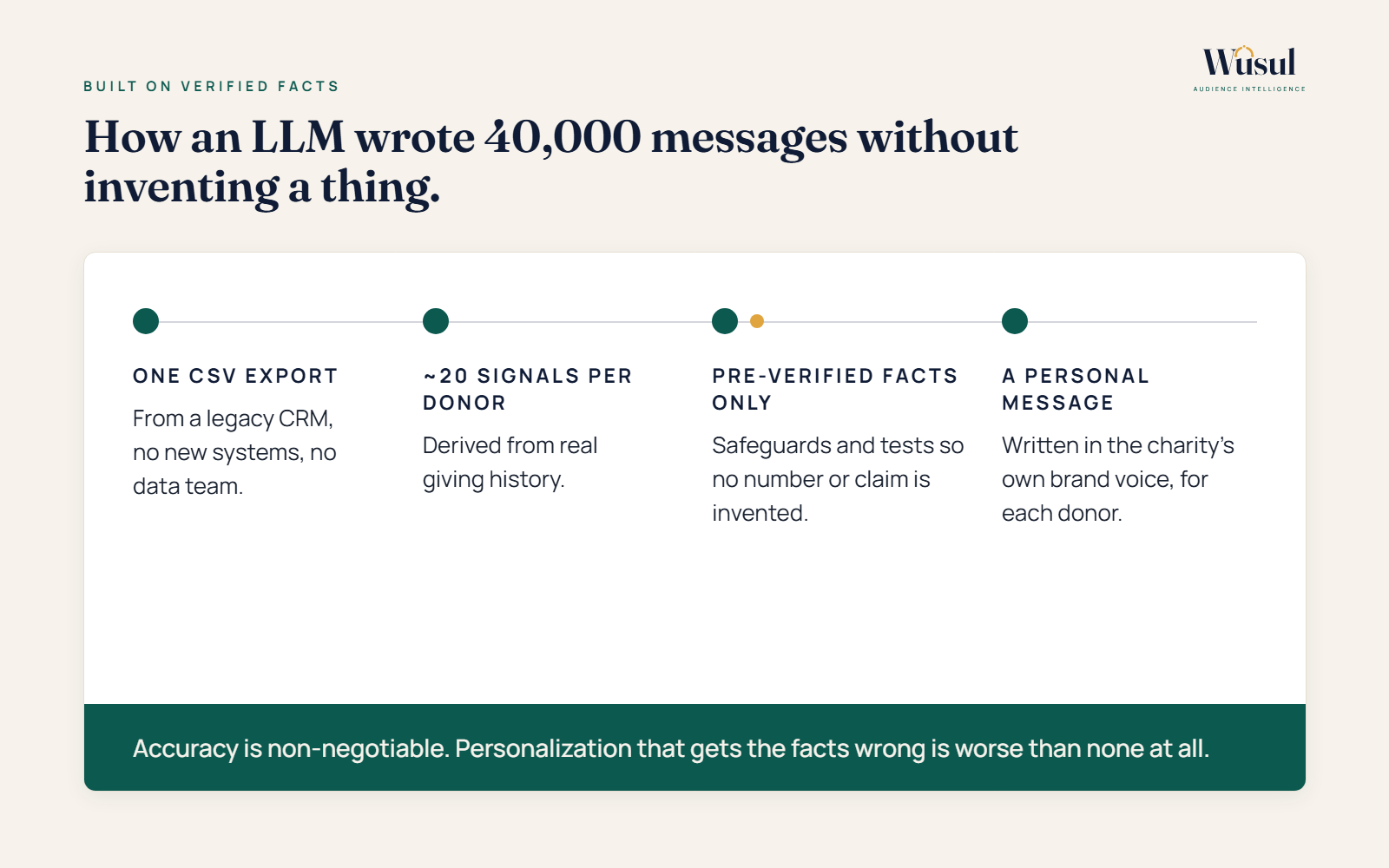
Muslim Charity faced a specific set of constraints. It had no in-house data team. It ran on a legacy CRM with limited segmentation capabilities. Any solution had to work from a simple CSV export rather than expensive new systems or specialist staff. The charity could not afford to build a sophisticated data infrastructure. It had to work with what it already had.
The goal was more ambitious than a mail merge. It was to reflect each donor's real relationship with the charity (in their own words and figures) across an entire experience rather than a single greeting.
A personalization engine built on signals
Giving Analytics built a pipeline that turned one CRM export into a complete, individualized experience for every donor. At the center was a personalization engine that derived around 20 signals for each donor from their giving history.
The engine was designed to always surface each donor's most positive and relevant facts, so that every person saw a reason to feel proud of what they had already done. A large language model then wrote a totally personalized message for each donor, trained to match the brand voice of the charity. Crucially, the system implemented safeguards and tests to ensure that none of the numbers or claims were invented; the LLM wrote only around pre-verified facts.
The campaign was not simply about asking for more money. It was about showing donors what they had already achieved. As the judges at the Chartered Institute of Fundraising later noted, the project used LLMs to "talk to donors about their specific impact, rather than just talking about the charity's activities as a whole."
The results: A 4.1x increase and zero Spam complaints
The Ramadan 2024 campaign delivered results that were, by any measure, exceptional.
The 4.1x improvement in pounds donated per email was the headline figure. The campaign also achieved a 311% increase in donations per email open. Perhaps most tellingly, zero emails were marked as spam, a signal that the personalization was not just effective but welcomed.
The recognition followed quickly. Muslim Charity won the Fundraising Innovation of the Year award at the National Fundraising Awards 2025, hosted by the Chartered Institute of Fundraising. The judges praised the campaign as an "outstanding example of innovation and creativity," commending its ability to "break new ground while maintaining authentic connections with supporters" . Giving Analytics separately won the CIOF award for Most Powerful Insight Using AI/ML.
The judging panel's comments were striking: "We've never seen this level of personalization before; it's truly the holy grail" .
The Evolution: from emails to personal websites and AI voice messages
The success of Ramadan 2024 did not end with the campaign. It became the foundation for something more ambitious.
For Ramadan 2026, Muslim Charity set out to give every one of its roughly 40,000 donors something no charity had given them before: their own dedicated website telling the story of their giving, and a personalized voice message greeting them by name in the AI-cloned voice of a real colleague.
Each donor's mini-site brought together four adapting elements: an AI voice message that greeted the donor by name and highlighted their personal achievements (with the voice matched to their profile, the UK Director for most donors, a Scottish colleague for donors in Scotland, and a female colleague for women); a giving journey with visualizations of how their donations had built up over time; regional context showing the collective impact of their community; and a tailored impact story tied to the causes they had supported most.
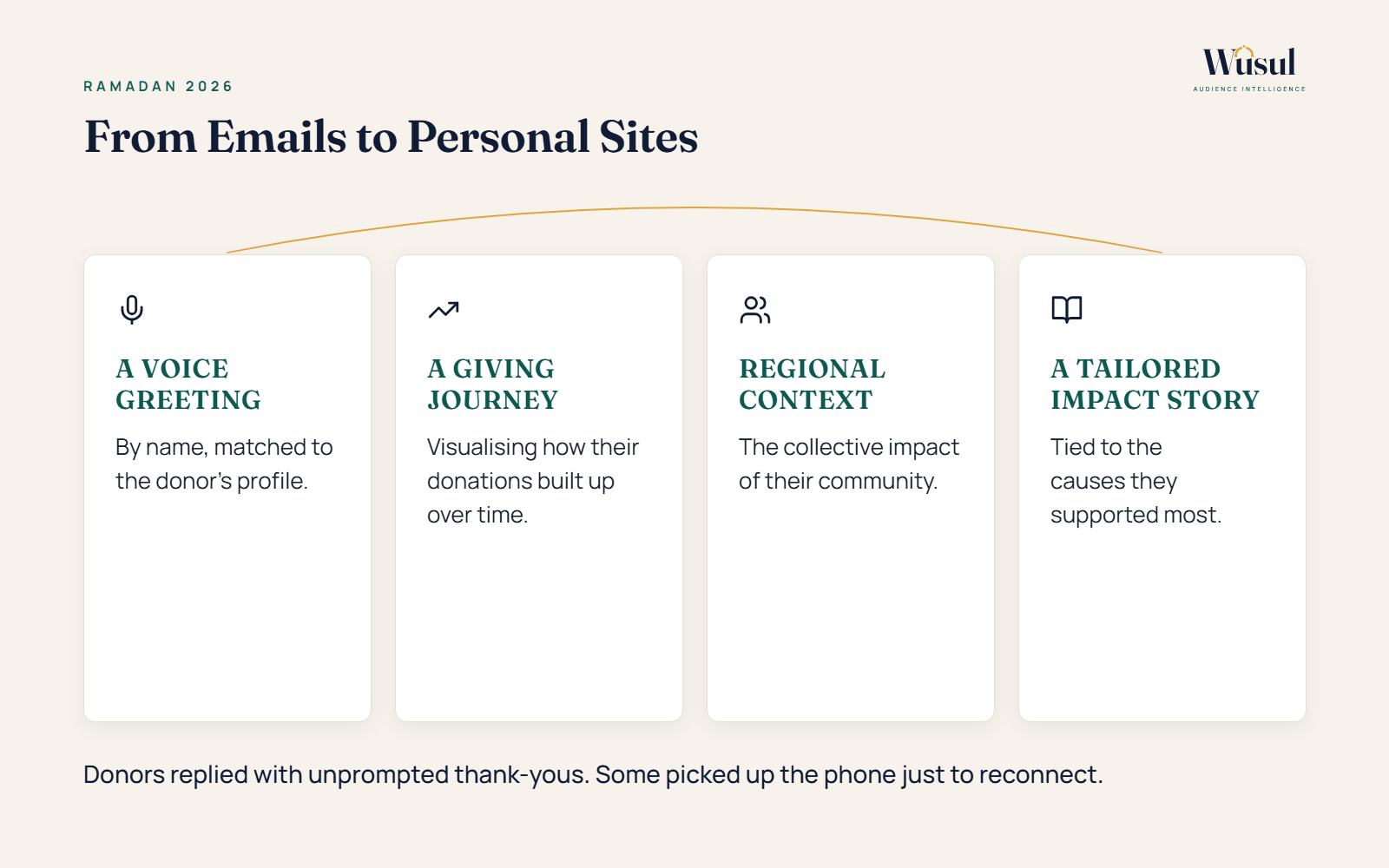
Again, the results were remarkable. The personalized email achieved a 75% higher average donation per open than standard emails sent in the same period and was the highest donation per open of any email the charity sent during Ramadan. Donors replied with unprompted thank-you messages. Some picked up the phone simply to reconnect.
The campaign was shortlisted for Digital Innovation of the Year at the 2026 Third Sector Awards, alongside organizations including Great Ormond Street Hospital Charity, the RNLI, and Alzheimer's Society; household names with digital teams and in-house data functions, each generating between 15- and 35-times Muslim Charity's income.
As Giving Analytics noted: "The constraint is rarely the size of the team or the age of the system. It is whether anyone is using the data already sitting there" .
Lessons to learn
The Muslim Charity case offers several lessons for Islamic charities and organizations seeking to engage Muslim donors.
1. Personalization is not a mail merge. Inserting a donor's first name is not personalization. True personalization reflects each donor's real relationship with the charity, their history, their preferences, their impact. The technology to do this at scale now exists, and it does not require a data team or a new platform. It requires a willingness to use the data already sitting in the CRM.
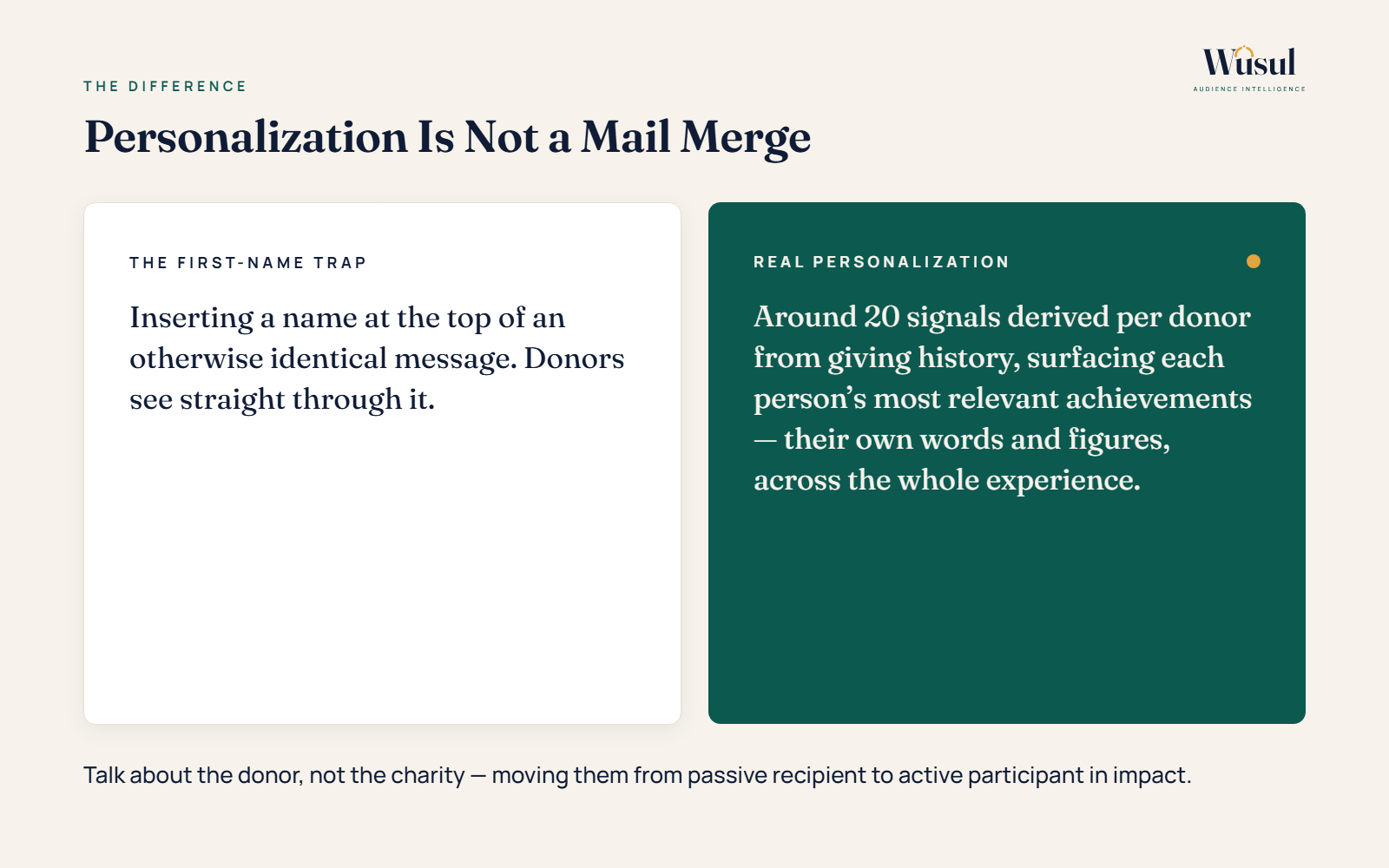
2. Talk about the donor, not the charity. The most effective communications in this campaign were the ones that talked about what the donor had achieved, not what the charity was doing. This is a fundamental shift in framing. It moves the donor from passive recipient of appeals to active participant in impact.
3. Accuracy is non-negotiable. The campaign's success depended on trust. Every number and claim was verified before the LLM wrote a word. In an era where donors are increasingly skeptical, this attention to factual accuracy is essential. Personalization that gets the facts wrong is worse than no personalization at all .
4. Small charities can compete with giants. Muslim Charity had 25 staff, a legacy CRM, and no data team. It was shortlisted for a national award alongside organizations many times its size. The lesson is that the barrier to sophisticated donor engagement is not resources. It is imagination and execution.
5. Recognition follows impact. The awards and shortlisting's were not the goal. They were the byproduct of doing something genuinely innovative and effective. Organizations that focus on serving donors well (rather than chasing awards) are the ones that end up being recognized.
So, the Holy Grail can be found
For years, fundraisers have talked about personalization as the holy grail; the ability to make every donor feel like the only donor. The technology to do this at scale has always seemed out of reach, particularly for small charities with limited resources.
Muslim Charity's campaign with Giving Analytics demonstrated that the holy grail is not only achievable but achievable from a single CSV export and a legacy CRM. The 4.1x increase in donations per email, the zero spam complaints, the unprompted thank-you messages, and the national awards all point to the same conclusion: donors want to be seen. They want to know that their giving matters. They want to feel that the charity understands them, not just their money.
The organizations that can deliver this experience, that can use data to show donors their own story; will be the ones that build lasting relationships in an increasingly crowded and skeptical market.
The technology is here. The data is here. The question is whether charities will use it.
At Wusul, we believe that cultural intelligence means understanding not just what donors give, but why, and designing engagement that honours the values, trust signals, and aspirations of the communities we serve. Muslim Charity's journey from generic templates to hyper-personalized donor experiences is a case study in what happens when an organization decides to see its donors as individuals, not segments. The holy grail was never about technology. It was about attention.