Ramadan is not just the busiest fundraising season for Islamic charities. It is the season that determines whether the rest of the year is sustainable.
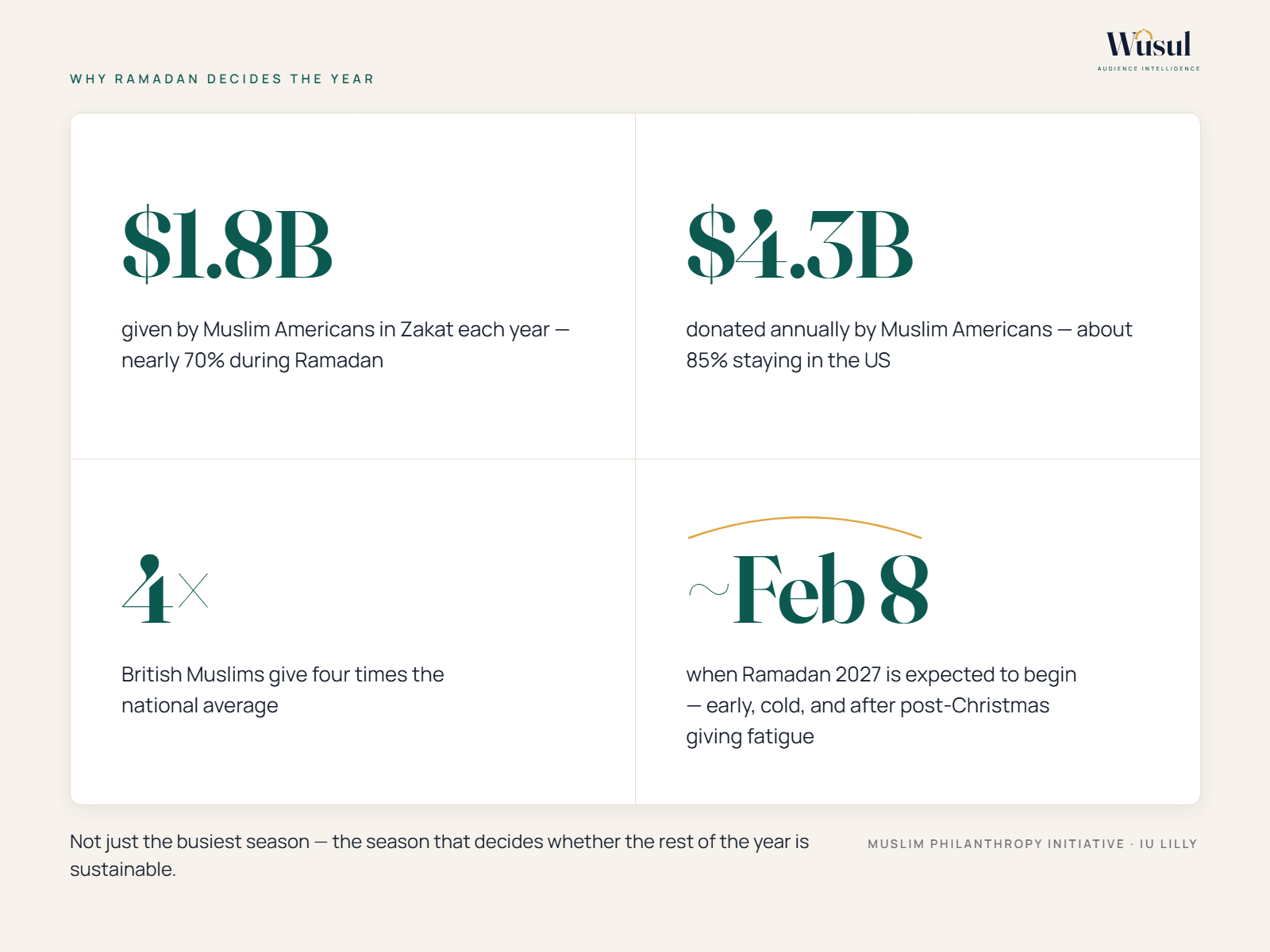
The numbers are unambiguous. Research from the Muslim Philanthropy Initiative at Indiana University's Lilly Family School of Philanthropy estimates that Muslim Americans contribute about $1.8 billion in Zakat each year, and the study's director said much of it is likely donated or pledged during Ramadan. Muslim Americans donate around $4.3 billion annually to charitable causes, with about 85% staying within the US. In the UK, British Muslims give an estimated £2.2 billion a year, around four times the national average, according to the think tank Equi, and the Muslim Charities Forum estimates that at least £200 million was given during Ramadan 2025 alone.
Ramadan 2027 is expected to begin on approximately February 8, 2027, with Eid al-Fitr falling around March 9, 2027. This timing matters. February is dark, cold, and, in many Western markets, financially tight for donors. It follows the post-Christmas period, when giving-fatigue may be at its peak. And it falls during a time when competition for attention is intensifying.
The most successful campaigns are built over months, not weeks.
Understanding the psychology of Ramadan giving
Before you plan a campaign, you must understand what motivates donors during Ramadan.
The spiritual multiplier effect. The Qur'an and Hadith promise that good deeds performed during Ramadan carry multiplied reward. A 2008 study at one Tehran hospital found that organ donor registrations rose by 154% during Ramadan, although a later national study found no difference in actual donation rates between Ramadan and other months. Another study found that stock market returns were substantially higher during Ramadan, suggesting "increased optimism and life satisfaction affected investor sentiment".
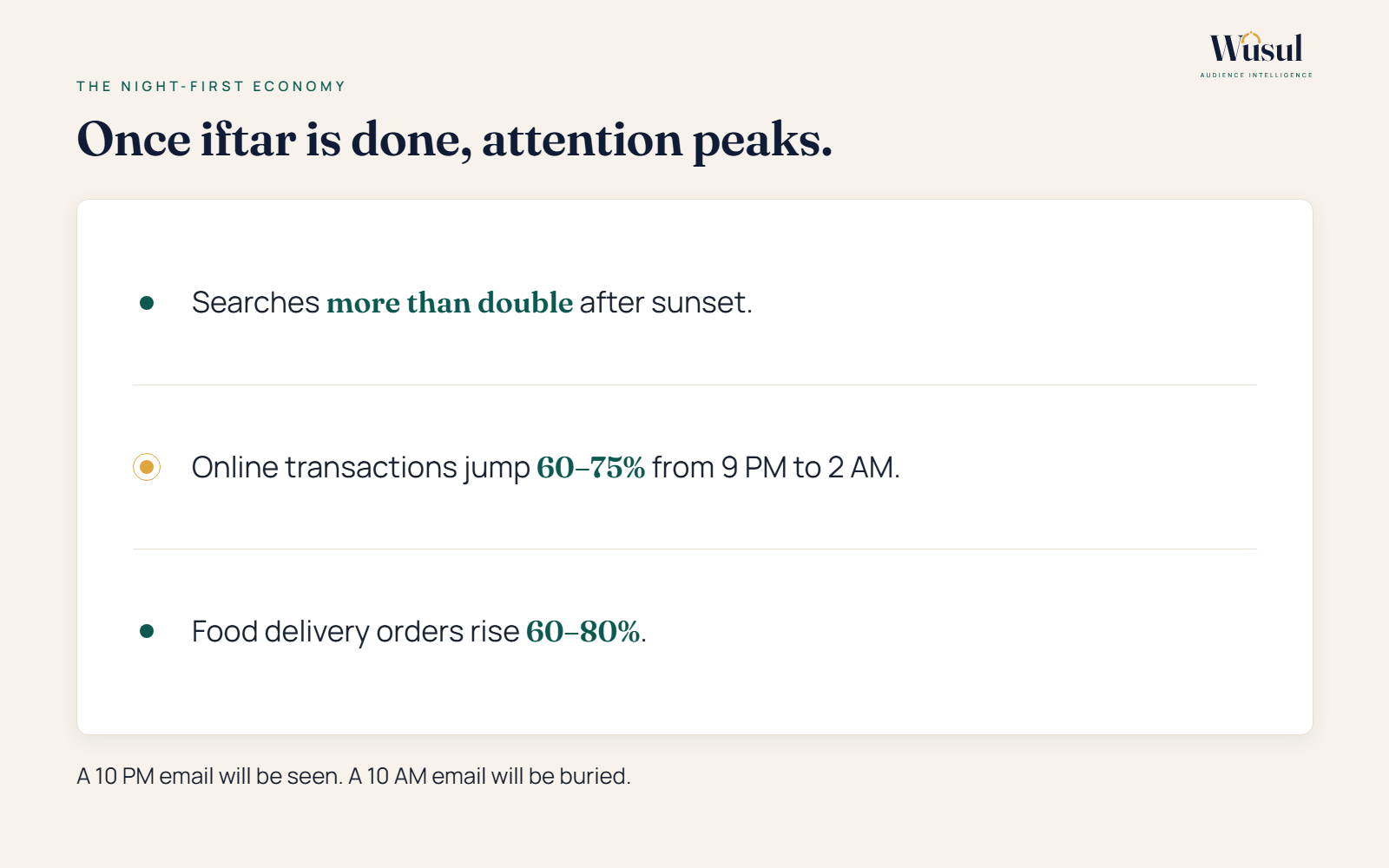
The night-first economy. Once iftar is done, attention, searching, and shopping peak. Visa's analysis of card payments found that the share of spending between 10 PM and 4 AM roughly doubles in Ramadan: from 17.6% to 35.0% in Saudi Arabia and from 15.9% to 26.9% in the UAE, with food delivery apps, groceries and restaurants among the biggest shifts.
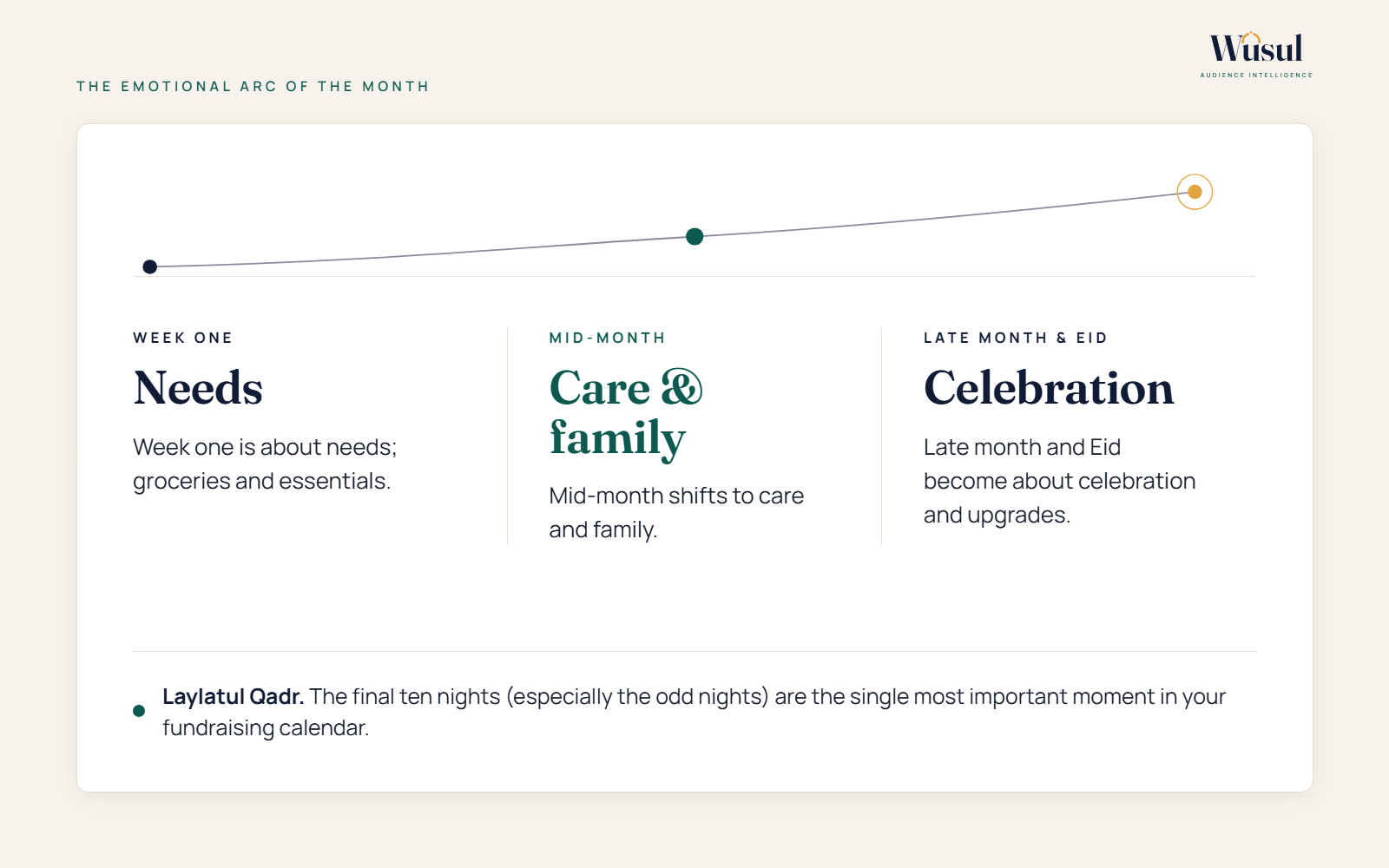
The emotional arc of the month. Week one is about needs: groceries and essentials. Mid-month shifts to care and family. Late month and Eid become about celebration and upgrades.
Laylatul Qadr. The final ten nights (especially the odd nights) are the single most important moment in your fundraising calendar. Plan your highest-impact creative, your most urgent appeals, and your most generous matching offers for this period.
The planning timeline for mature nonprofits
With Ramadan beginning in approximately four months, the planning window is tight but manageable for organizations with established infrastructure, donor data, and campaign experience.
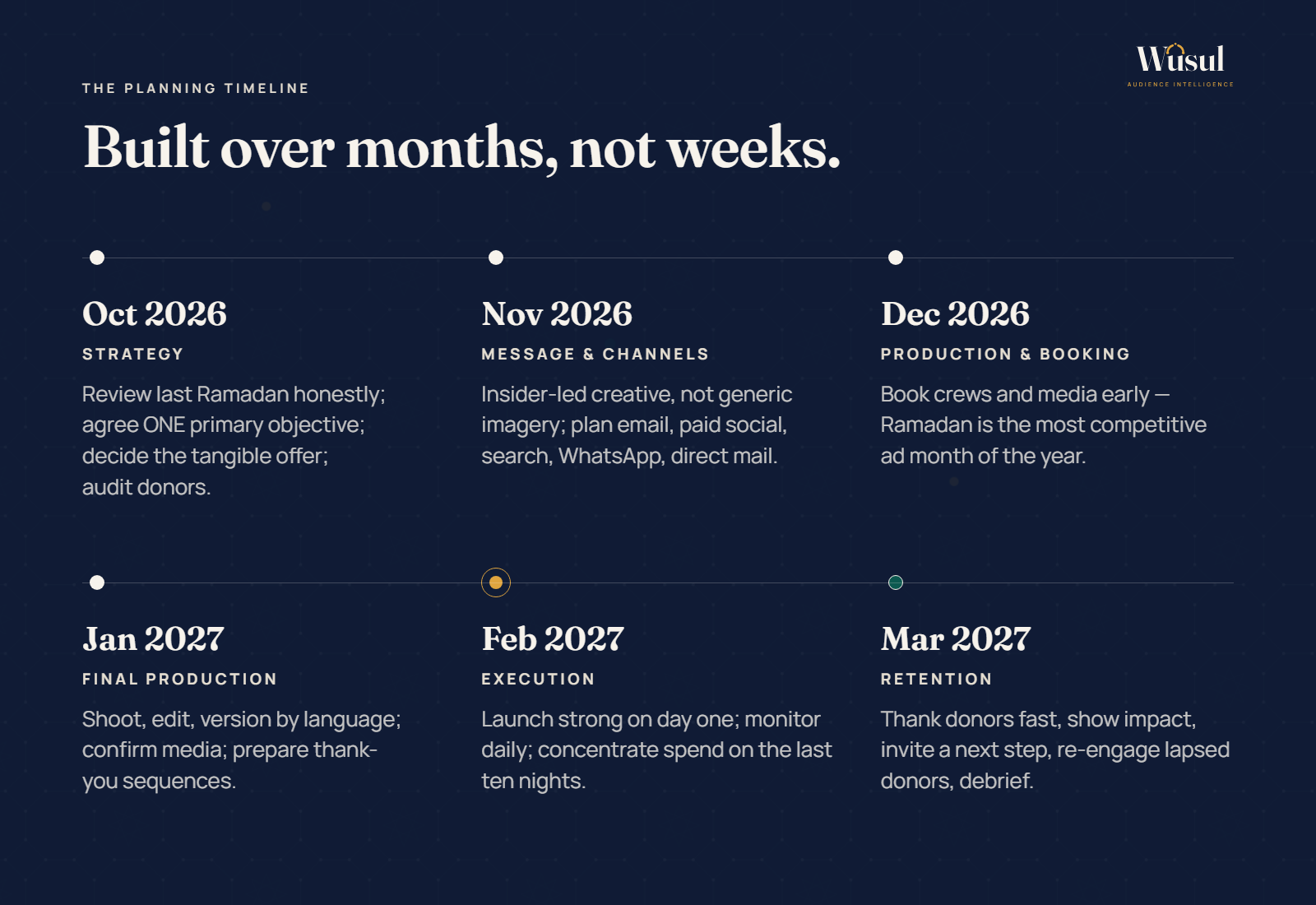
October 2026: Strategy and Decisions. Review last Ramadan honestly. Pull your data by week, by channel, by creative, and by donor segment. Agree one primary objective: volume of donations, new donor acquisition, or major gift revenue. A campaign trying to do all three splits the budget into portions too small to work. Decide the offer, not the film, not the key visual, but the specific, tangible thing you are asking donors to fund. Set your budget and plan for media inflation during Ramadan. Conduct a donor audit to segment your base and identify lapsed donors.
November 2026: Message and Channel Plan. Develop your creative concept, rooted in cultural intelligence, not generic Ramadan imagery. Write the idea in one sentence that anyone in your organization would understand. Plan your channel mix: email, paid social, search, WhatsApp, and direct mail for major donors. Commission insider-led creative and work with Muslim creatives and scholars from the beginning.
December 2026: Production and Booking. Book production resources: cast, locations, crew, and studio spaces fill up quickly. Start anything physical, as gifting boxes and printed materials have lead times. Hold media positions now; Ramadan is the most competitive advertising month of the year. Test your donation platform for mobile-first, multiple payment options, and short, frictionless forms.
January 2027: Final Production and Confirmation. Complete the shoot and edit in early to mid-January. Version all assets in the languages you need. Confirm and pay for media. Book creator partnerships now; they are usually booked out by early January. Prepare your thank-you and follow-up sequences; the first gift is not the finish line.
Ramadan Begins (February 2027): Execution. Launch with your strongest message, the first day is a moment of high attention. Monitor performance daily and adjust spending, messaging, and channel mix in real time. Engage with donors personally. Concentrate spending on the last ten nights.
After Ramadan (March 2027): Retention and Stewardship. Thank every donor quickly: timely thanks and impact updates increase repeat giving. Show impact through photos, beneficiary stories, and outcome data. Invite a next step matched to the donor's engagement level. Re-engage lapsed donors and use the momentum of the month to invite them into a year-round relationship. Conduct a debrief while it is still fresh.
A different approach for relatively new nonprofits
If your organization is relatively new, the framework above may feel overwhelming. You do not have the donor data, the established relationships, or the infrastructure of a mature nonprofit. That is okay.
Focus on one thing, not everything. Choose one primary channel and one primary audience. If you have a strong email list, focus there. If you have a social media following, focus there. If you have relationships with a few major donors, focus there.
Build on what you already have. Your existing email list, your social media followers, your personal and professional networks, your volunteers. A personal email to 50 people who know your organization is worth more than a generic email to 5,000 strangers.
Prioritize trust-building over reach. Share your story. Show your work. Be specific about impact. Ask for feedback.
Use free and low-cost tools. Free email platforms, organic social media, WhatsApp for personal outreach, and Canva for simple graphics.
Ask for help. Reach out to other Muslim nonprofits, community leaders, mosques, volunteers, and Wusul.
Common Ramadan fundraising mistakes to avoid
1. Treating Ramadan as a discount season. Ramadan is not a discount season. It is a behavioral shift season. In Ramadan, how you show up matters more than how much you spend.
2. Using generic Ramadan imagery. Crescent moons, lanterns, and golden-hued mosques are the visual equivalent of wallpaper. They signal a lack of genuine cultural understanding.
3. Forced emotional storytelling. Emotion needs to be tied meaningfully to the brand's message rather than left to feel like an afterthought.
4. The "fake sale" trap. Many brands increase prices just before Ramadan begins, only to bring them back down and call it a "special discount." Consumers can tell when a brand is sincere versus when it is simply cashing in on season.
5. Starting too late. If you are planning your Ramadan campaign in January, you are already behind.
6. Ignoring the night-first economy. Sending emails at 10 AM misses the moment. A 10 PM email will be seen. A 10 AM email will be buried.
7. Treating all donors the same. A £10 donor and a £10,000 donor are not the same. Segment your audience and personalize your outreach.
8. Measuring reach instead of relationship. Track donor retention, repeat giving, average gift size, and engagement over time, not just impressions.
9. Dropping the ball after Eid. Plan for after Ramadan before Ramadan begins.
10. Not asking for feedback. After Ramadan, review your performance. Document your findings and use them to improve.
Conclusion
Ramadan is not just a fundraising season. It is the season that determines whether your organization can sustain its work for the rest of the year. It is the moment when Muslim donors are most generous, most engaged, and most open to relationships.
But Ramadan 2027 will not be like previous years. It falls earlier in the calendar. It follows a season of giving fatigue. And the competition for donor attention is intensifying.
The charities that succeed will be those that start planning now: four months in advance, not four weeks. They will understand the psychology of Ramadan giving. They will align with the rhythm of the month. They will use insider-led creative. They will segment their donors and personalize their outreach. And they will use Ramadan as the beginning of a relationship, not the end.
The month is coming. The question is whether you will be ready.
At Wusul, we believe that cultural intelligence means understanding not just what donors do, but why they do it, and designing campaigns that honor the values, faith, and community that shape their giving. Ramadan 2027 is an opportunity. Planning is how you seize it.
Frequently asked questions
When should charities start planning for Ramadan 2027?
Now. Ramadan 2027 is expected to begin around 8 February 2027, so the plan works backwards from there: strategy and decisions in October, message and channel plan in November, production and media booking in December, and final production in January.
When is the best time to fundraise during Ramadan?
The last ten nights, especially the odd nights when Muslims seek Laylatul Qadr, are the most important moment of the month. Evenings matter too: once iftar is done, attention, searching and giving peak, so appeals sent late in the evening are more likely to be seen.